
Penetrating Learning: Complete Chapter-by-Chapter Summary

Welcome to our session on Penetrative Learning by Fang Jun. Today, we're diving into the core mission of the lifelong learner: bridging the gap between theoretical knowledge and practical execution.
Imagine learning not as a static accumulation of facts, but as a dynamic journey. We start with a call to action—whether it's a workplace challenge or an inner desire to grow. But true learning doesn't stop there. It requires stepping into the "grind," facing confusion and frustration as we explore unknown territories. The real magic happens in the return phase, where we take those insights back to the real world, turning abstract concepts into tangible skills.
Many of us, however, fall into the trap of "fake learning." We might buy books or sign up for courses but never open them, or we retreat at the first sign of difficulty, seeking shortcuts instead of breakthroughs. To escape this, we need to start small. Take the path of least resistance, seek out mentors, or focus on solving one immediate problem at a time.
In a rapidly changing world, we don't need grand, linear plans. Instead, we embrace "micro-learning"—tiny cycles of learning and doing that fit into our daily lives. Whether it's tackling a single data problem, optimizing a whole workflow, or integrating diverse skills to solve complex issues, the key is constant collision between what we know and what we do.
As we move forward, remember that our goal isn't just to know more, but to do better. Let's turn this knowledge into action.

Look at this slide. It poses a brutal question: Are you actually learning, or just performing the aesthetics of learning? On the left, we see "Fake Learning," the illusion. It's about consuming fragmented information without ever synthesizing it, collecting unread books just to feel productive, chasing certificates for memorization, and staying safely inside your comfort zone. It's the trap of looking busy while going nowhere.
But on the right, we have "Real Learning," the penetration. This isn't about looking smart; it's about solving specific, real-world problems. It requires aggressively cross-referencing ideas from diverse fields, engaging in deliberate practice driven by output, and forcing a collision between abstract knowledge and tangible execution. The contrast is stark. One side is passive consumption; the other is active creation. The slide challenges us to stop pretending and start penetrating the core of what we do.

Look at this circular map. It visualizes the entire journey of learning, moving from the comfort of "The Daily World" all the way to becoming "The Master of Both Worlds." But before we dive into the cycle, let's be honest about where most of us get stuck.
We often fall into the trap of "fake learning." This happens in two ways. First, we never truly start. We buy books or sign up for courses but never open them, or we cram just for an exam and forget everything the moment it's over. We stay stuck in the "call" phase, never entering the real exploration. Second, we hover right at the edge. We encounter a new challenge and immediately give up, becoming the "hand-raiser" who copies someone else's answer instead of doing the work. Solving the problem for them doesn't mean we've crossed the boundary.
So, how do we break through? The key is to ask yourself: "Am I faking it?" If you are, here are three ways to take that first step. First, choose the path of least resistance. Don't try to read the whole book; just buy it or flip through the table of contents to get moving. Second, find a mentor. It could be a senior colleague or even a specific quote that hits home. Let external wisdom push you forward. Third, draw a small circle. Don't try to learn everything about Excel right now; just master the one formula that solves your current problem.
This brings us to a crucial shift in how we think about learning. We used to believe learning was a linear process: spend twenty years studying, then work for forty. But in today's fast-changing world, learning is actually a series of micro-loops. We call this "micro-learning." Its core value is simple: learn and apply immediately. Instead of spending years on a vague system, you tackle a specific problem, use what you know, check the result, and adjust.
To make this work, you need to collide your knowledge with reality in three ways. You can do a "point collision" for a single, specific problem by asking a precise question. You can do a "line collision" to optimize a whole process when you face the same type of problem repeatedly. And for complex, systemic issues, you use a "surface collision" by integrating knowledge from multiple disciplines.
The ultimate goal isn't just to accumulate knowledge; it's to build "practical wisdom." This is the ability to make the right judgment in complex, real-world situations. It's about facing reality without being trapped by theory and turning your vision into tangible results. As we move through this cycle, remember that the map is just a tool. The real power comes from your courage to act, your persistence in the face of uncertainty, and your willingness to turn every "mistake" into a stepping stone toward the truth.

Think of your personal knowledge not as a rigid library, but as a sturdy house under construction. As the slide illustrates, true masters like Herbert Simon or Steve Jobs don't rely on a single pillar; they build a robust structure with multiple, interconnected supports.
Your foundation is your fundamental worldview and mental models—the bedrock upon which everything stands. From there, you need three solid pillars. First, your current professional expertise, your daily bread and butter. Second, your formal education, providing that essential academic structure. Third, your personal interests and passions, which act as the unique source of cross-pollination, sparking innovation where other disciplines meet.
But don't stop there. Look at the right side of the diagram: Pillars 4 and 5 are marked "Under Construction." These represent your future targeted skills—areas you are actively building right now. The magic happens when these diverse disciplines interconnect, forming an unshakable Knowledge House. Instead of being stuck in one lane, you create a dynamic ecosystem where your expertise, education, and passions work together, allowing you to tackle complex problems from multiple angles and build a career that is truly resilient.

Today's slide maps out the five-step ladder to true mastery, a path many of us stop climbing after just the first few rungs. We start with **Knowledge Acquisition**, absorbing theory, but we must be careful not to become slaves to abstract frameworks. The real work begins in **Practice & Validation**, where we test limits in safe, simulated environments. This is where the MVP principle comes in—building a minimum viable prototype to quickly validate our ideas before going all in.
Next, we move to **Junior Practice**. Here, the golden rule is simple: done is better than perfect. We build a functional prototype in reality, accepting that an imperfect solution is infinitely better than a perfect one that never launches. Once we have something working, we enter **Deep Refinement**. This is where we calibrate our personal knowledge system against established industry standards, polishing our skills until they are robust and reliable.
Finally, we reach the top: **Senior Practice**. This is where we solve entirely unknown problems and scale our systems. It's the realm of true innovation, where we stop following rules and start creating them. The key takeaway from this journey is that mastery isn't a destination you reach once; it's a continuous climb up these five steps, moving from passive learning to active creation, and ultimately, to leading in the unknown.

So, we've talked about how to build a system and how to practice with intention. Now, let's talk about the most critical ingredient for actually getting things done: focus.
The reality is, in today's world, we are constantly being pulled in a thousand directions. Notifications, emails, and endless meetings fragment our attention. But if you look at the formula for high-quality work, it's simple: Results equal Time multiplied by Focus. And here is the game-changer: Tools.
While we can't necessarily create more hours in the day or instantly double our focus, we can multiply our output by choosing the right tools. Think about it: using a complex Excel function or a data analysis software doesn't just save time; it turns a two-hour task into a ten-minute one. That is a tenfold increase in value.
But knowing how to focus is one thing; actually doing it is another. This is where the concept of "Deep Work" comes in. It's about creating an environment where you can concentrate without distraction on cognitive tasks that require intense effort. The goal isn't just to be quiet; it's to produce something valuable that is hard to replicate.
To master this, you need to find your rhythm. Some people thrive in isolation, shutting out the world completely. Others work best in a "dual-peak" mode, alternating between deep focus blocks and collaborative times. For most of us, a consistent daily routine works best—dedicating a specific block of time, maybe the first two hours of the morning, just to deep work. It's about showing up for that work, again and again.
However, remember this: don't get obsessed with the method. Don't spend so much time perfecting your "focus ritual" that you forget the actual work. The method is just the handle on the box; the box itself is the result. If you're not producing value, you aren't succeeding, no matter how pure your focus looks.
So, stop chasing the feeling of being busy. Start chasing the output. Use the right tools to amplify your time, protect your focus, and ensure that every hour you invest actually moves the needle on what matters. That is how you turn potential into real, tangible results.
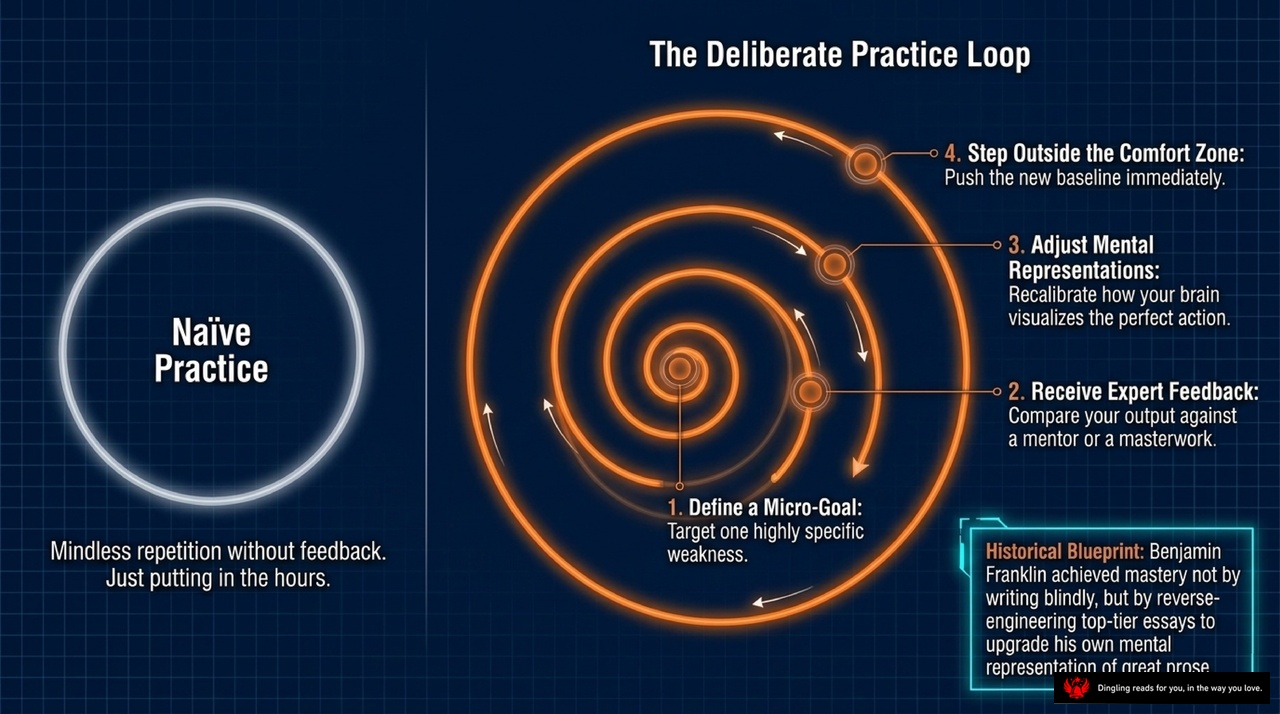
Naive practice is just mindless repetition—putting in the hours without feedback. But true mastery comes from the Deliberate Practice Loop, a cycle designed to push you constantly outside your comfort zone. It starts with defining a specific micro-goal, like targeting one weak point. Next, you must receive expert feedback, comparing your output against a mentor or a masterwork to see the gap. Then, adjust your mental representations; recalibrate how your brain visualizes the perfect action. Finally, step outside your comfort zone immediately and push that new baseline.
This loop isn't just about effort; it's about engineering your brain. As Benjamin Franklin discovered, he didn't achieve mastery by writing blindly. He reverse-engineered top-tier essays to upgrade his own mental representation of great prose. By comparing his work to the best and adjusting his internal model, he turned practice into progress. This is how you move from spinning your wheels to achieving real expertise.

Output isn't just about how many hours you sit at your desk; it's a formula of Time, Focus, and Effective Tools. Think of it this way: Time is about using your "Deep Time Mirror" to track actual uninterrupted hours, not just the time you think you worked. But raw time alone isn't enough. You need Focus—achieving that Flow state where you zero out distractions to perfectly match a high challenge with your high skill. And finally, you need Effective Tools. These are your ultimate multipliers. Mastering complex tools like advanced software, AI, or statistical models doesn't just help; it scales your output exponentially. If you want to win in today's fast-paced world, stop chasing empty busyness and start optimizing this equation. Master your time, lock in your focus, and leverage the right tools to turn your effort into real, measurable results.

So, how do we actually bridge the gap between knowing something and doing it? The answer lies in building a solid plan. Think of a plan not as a vague wish list, but as a written contract with reality that clearly defines your goal, your specific steps, and how you'll measure success. This shifts your mindset from "What can I do?" to "What does reality need me to do?"
One powerful tool for this is the Toyota One-Page Report. It forces you to be concise and visual, fitting your entire solution on a single page. You start by defining the background and current situation, then dig deep into the root cause before proposing your countermeasures. A great way to visualize this is the "Cloud-Rain-Umbrella" model: the current problem is the cloud, the root cause is the rain, and your solution is the umbrella.
But what if you're facing a massive, unknown challenge? That's where the Minimum Viable Product, or MVP, comes in. Instead of building a perfect solution from scratch, create the simplest version possible to test your hypothesis. Whether you're launching a new service or learning a complex concept like monetary finance, start small, get real feedback, and iterate. This prevents you from wasting time on the wrong direction.
For even more radical innovation, try First Principles thinking. Instead of copying what others have done, break a problem down to its most fundamental truths and build up from there. Elon Musk used this to revolutionize battery costs and rocket launches by ignoring traditional analogies and focusing on raw material realities.
Finally, don't be afraid to play. Create "Brittle Toys"—small, low-stakes systems you build in your free time. Whether it's a simple coding project or a personal experiment, these safe failures teach you more than any textbook ever could. By combining clear planning, iterative testing, first-principles thinking, and safe experimentation, you turn abstract knowledge into tangible, real-world results.

Stop treating learning like a rigid construction project. The old "Waterfall Approach"—where you build the whole car before testing if people want to travel—is slow, heavy, and often leads to failure. Instead, embrace the Minimum Viable Product (MVP) Loop. It's a dynamic cycle of Build, Learn, and Test. Don't aim for perfection upfront; build a simple prototype, like a skateboard instead of a full car, and immediately test it in the real world. This agility of learning lets you validate your assumptions against reality before committing massive resources.
To make this even safer and more educational, adopt the "Breakable Toy Concept." Build a low-stakes sandbox project where failure isn't a disaster but a feature. Design your experiments so that when things go wrong, you gain valuable insights. This mindset shifts you from fearing mistakes to leveraging them as your fastest teachers. By iterating quickly and learning from real-world feedback, you transform uncertainty into your greatest asset, turning every small failure into a step toward a breakthrough.

First Principles thinking isn't about copying what others have done; it's about breaking free from the trap of analogy. Instead of making minor aesthetic tweaks to existing solutions, we must go down the U-Curve to strip problems down to their most fundamental, indisputable truths. At the bottom of this curve, we isolate the raw core, removing all legacy assumptions to see what is truly essential. From there, we climb back up the U to reconstruct an entirely new, innovative, and highly efficient solution from scratch. This is the Musk Method. By focusing on the physics and logic of reality rather than comparing ourselves to competitors, we unlock the potential to create breakthroughs that mere imitation could never achieve.

When tackling complex implementation challenges, we often feel overwhelmed by too many variables. The solution lies in simplifying the chaos into three core circles: Content, Visuals, and Delivery. Think of this as your "3-Element Canvas."
First, look at **Content**. This is the logic, structure, and raw material of your argument. It's the "what" you are saying. Next is **Visuals**. This covers the design and the cognitive load of your slides—the "how" it looks and feels. Finally, there is **Delivery**. This includes your voice modulation, timing, and body language—the human element of your message.
Notice how these three circles overlap in the center. That glowing intersection is where true mastery lives. It's not enough to have great content if your visuals distract or your delivery is flat. True expertise happens when all three align perfectly.
The strategic insight here is simple but powerful: diagnose which ring is failing. If your message isn't landing, don't just guess. Identify whether the gap is in your logic, your design, or your presence. Then, direct your deliberate practice specifically to that variable. By forcing your complex work into these three buckets, you instantly identify your knowledge gaps and stop spinning your wheels. This framework turns confusion into a clear, actionable path forward.

The Metamorphosis of Mastery: From Tutorial to System. This slide maps the evolution of true expertise into three distinct levels.
Level 1 is The Tutorial. Think of it as writing a step-by-step guide for a beginner, like a IKEA manual or a recipe. You don't need to be an expert yet; you just need to understand the linear sequence of execution. By forcing yourself to simplify complex knowledge into a foolproof checklist, you prove you understand the basics.
Level 2 is The Training Course. This is where you teach the concept to peers. It's harder than writing a guide because you can't just skip steps. You have to explain the "why," handle edge cases, and answer tough questions. This forces deep comprehension and reveals your blind spots, marking the shift from knowing to understanding.
Level 3 is The Standard Operating Procedure, or SOP. Here, you move from teaching to systematizing. You create a rigorous checklist—like Toyota's famous one-page reports—that guarantees high-level results even when operated by novices. This is where mastery becomes a repeatable asset.
The journey goes from a simple guide, to a dynamic lesson, and finally to an unbreakable system. That is how you transform knowledge into true mastery.

Welcome back. Today, we're diving into the very engine of our personal growth: the Personal Knowledge Guide. Think of it not as a dusty textbook, but as a personalized, ruthlessly efficient operational manual that you write for yourself. It's the ultimate distillation of everything you've learned over a 6-to-24 month sprint, synthesized specifically for your unique reality.
So, what exactly goes into this guide? It rests on three critical pillars. First, we must define the exact problem. You can't solve what you haven't clearly identified. Second, we need a step-by-step execution protocol—a clear roadmap of exactly how to tackle that problem. And third, we must anticipate the critical pitfalls and understand how to avoid them before they derail us.
But here is the Golden Rule that ties it all together: Exclude all fluff. No long-winded stories. No abstract theories. We are only interested in actionable, modular truths derived directly from your own collisions with reality. And remember, this isn't a static document; you must update it ruthlessly as you learn and grow. This is how you turn scattered information into a powerful, living system for your success.
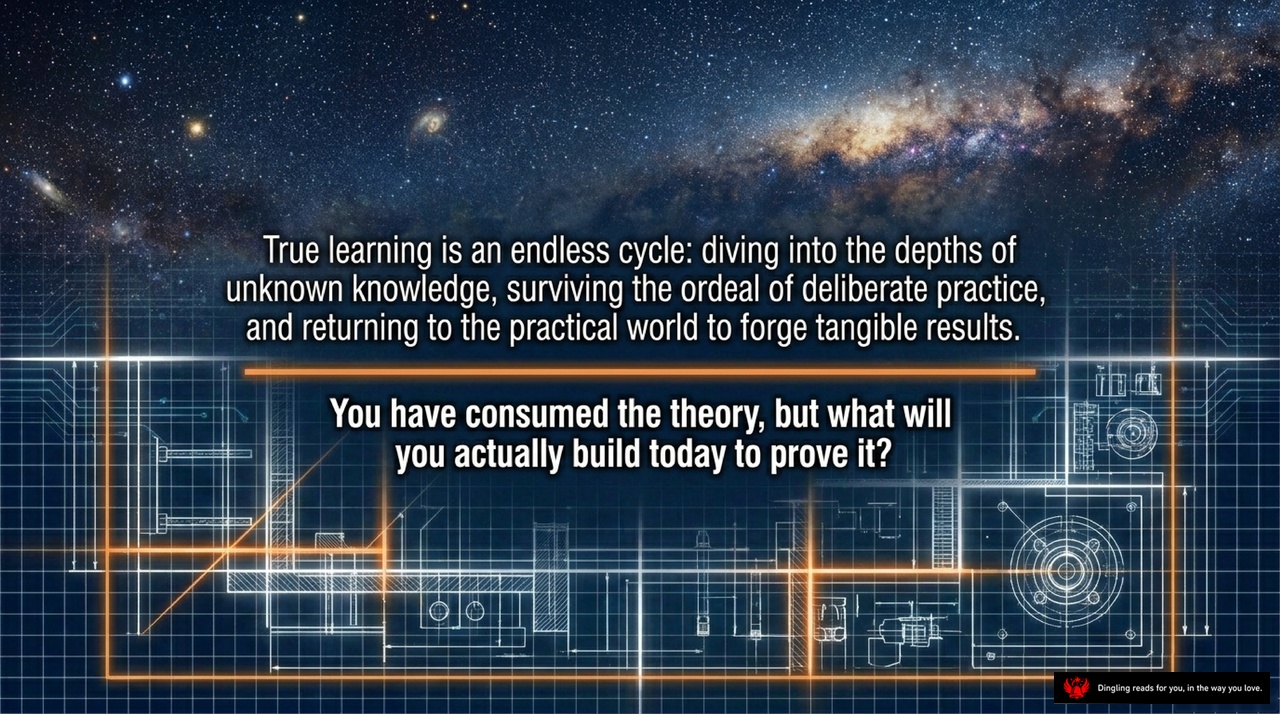
True learning isn't a straight line; it's an endless cycle. Think of it like diving into the unknown depths of knowledge, surviving the tough process of deliberate practice, and then returning to the real world to build something tangible. You might have consumed the theory, but the real test is this: what will you actually build today to prove it? Because without that final step of creating real results, you haven't truly completed the loop.