
Philosophical Investigations: Complete Chapter-by-Chapter Summary
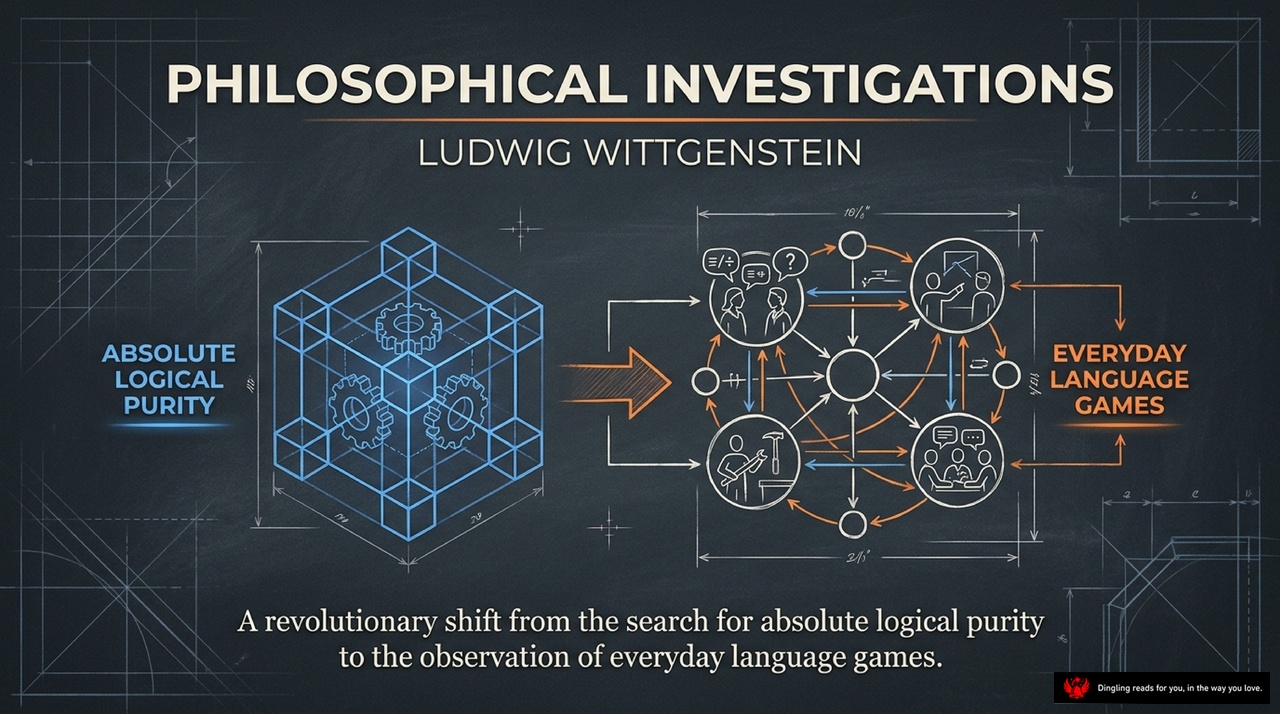
Welcome to today's exploration of Ludwig Wittgenstein's *Philosophical Investigations*. This slide captures the very heart of his revolutionary shift. On the left, you see a complex, rigid structure labeled "Absolute Logical Purity." This represents the early, traditional view that language must be a perfect, logical mirror of reality—where every word simply names an object, and every sentence follows strict, mathematical rules. It's like trying to build a house using only perfect, unbreakable bricks, assuming that's how the world actually works.
But look at the arrow pointing to the right. That is the pivot point. Wittgenstein argues that we've been looking in the wrong place. Instead of chasing this impossible "logical purity," we need to look at the messy, vibrant reality on the right: "Everyday Language Games."
Notice the network of icons here. We aren't just naming things; we are doing things. We are giving orders, asking questions, joking, praying, and solving problems. Wittgenstein realized that language isn't a static tool for describing the world; it's an activity, a game we play within our shared "form of life." The meaning of a word isn't found in a dictionary definition or a hidden mental image. It is found in how we use it. Just as a hammer is a hammer because of how we use it to drive nails, not because of what it looks like, the meaning of "pain" isn't a private feeling inside us, but how we react, say, and care for others.
So, the journey today is to leave the sterile world of abstract logic behind and step into the colorful, chaotic, and incredibly rich world of how we actually speak and live. We will see that philosophy isn't about building grand theories, but about clearing away the confusion caused by misusing our language. Let's dive in and see how these everyday games unlock the deepest truths about the human mind.

Welcome back to our deep dive into the nature of language. Today, we're tackling a concept that has puzzled philosophers for centuries: the "Augustinian Illusion of Language."
Look at the image on your screen. You see a simple apple on a table, labeled with a tag that simply says "Apple." Above it, we see a diagram of the brain, suggesting a direct link between the object and our thoughts. This visual perfectly captures the traditional, centuries-old assumption: that words are just labels attached to objects, like that tag on the apple. In this view, every word has one fixed, hidden meaning—the specific thing it points to.
But here's the twist. This "labeling" idea is actually an illusion. While it might seem like we learn language by simply naming things—pointing at an object and saying its name—this model is far too simple. It fails to explain the vast complexity of how we actually use language. Words aren't just static tags; they are tools with different jobs depending on the situation. Just like a toolbox contains hammers, saws, and rulers, each serving a unique purpose, language contains words that function as commands, descriptions, questions, and more.
So, how do we truly understand meaning? It's not about finding a hidden definition behind the word. Instead, we understand a word by seeing how it is used in real-life activities. We learn to use the word "apple" not just by memorizing the label, but by participating in the activity of buying, eating, or describing fruit. The meaning of a word lives entirely in its use within these specific contexts, not in some abstract, hidden object it represents.
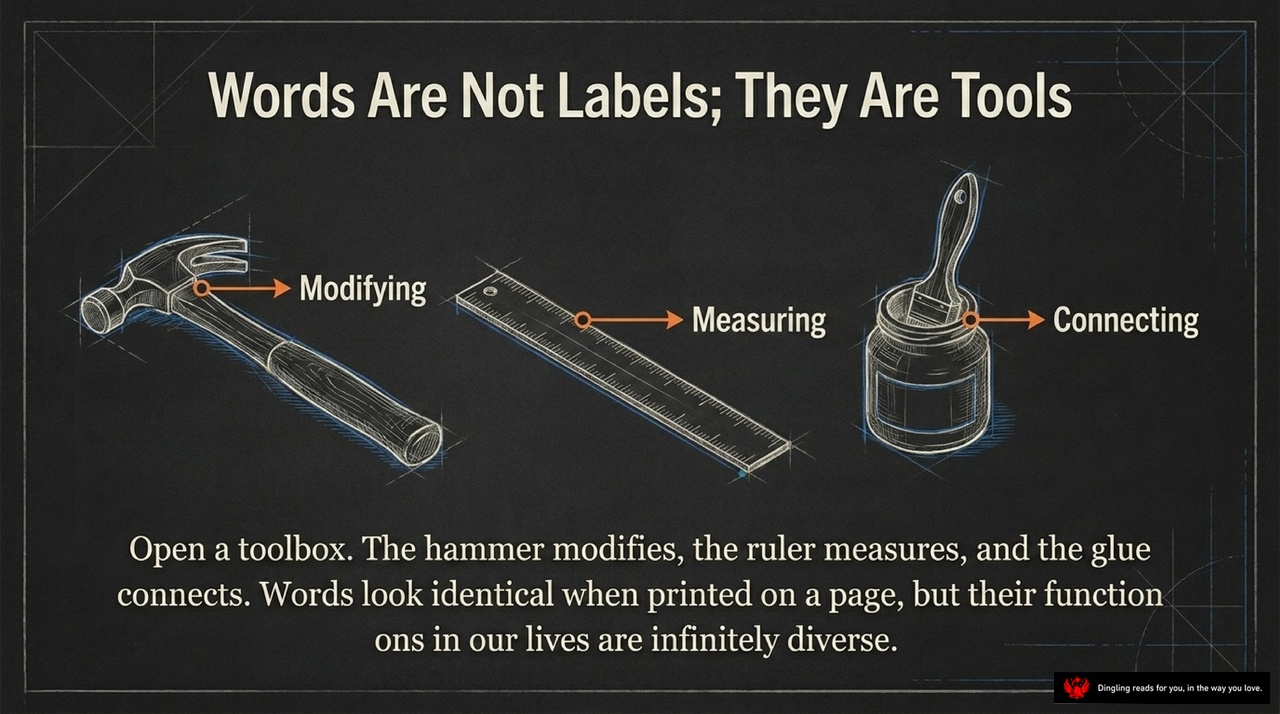
Words are not just labels we stick on things; they are active tools we use to shape our reality. Think about your toolbox: a hammer modifies, a ruler measures, and glue connects. Each tool looks different and serves a unique purpose. Even though they might all sit together in a box, trying to force them into one single definition—like saying "all tools are for hitting"—makes no sense. It's just as confusing to say every word in a language does the exact same thing.
This is where the real magic happens. When we look at a word, we often think it's just a static label, like a name tag. But in practice, words are tools for specific jobs. Sometimes a word modifies, sometimes it measures, and sometimes it connects. The meaning of a word isn't hidden inside your head waiting to be found; it lives entirely in how you use it. If you stop using a word in its proper context, it loses its function and becomes nonsense. So, don't look for the "essence" of a word. Instead, look at the job it's doing right now in your life. That's where the true meaning lives.
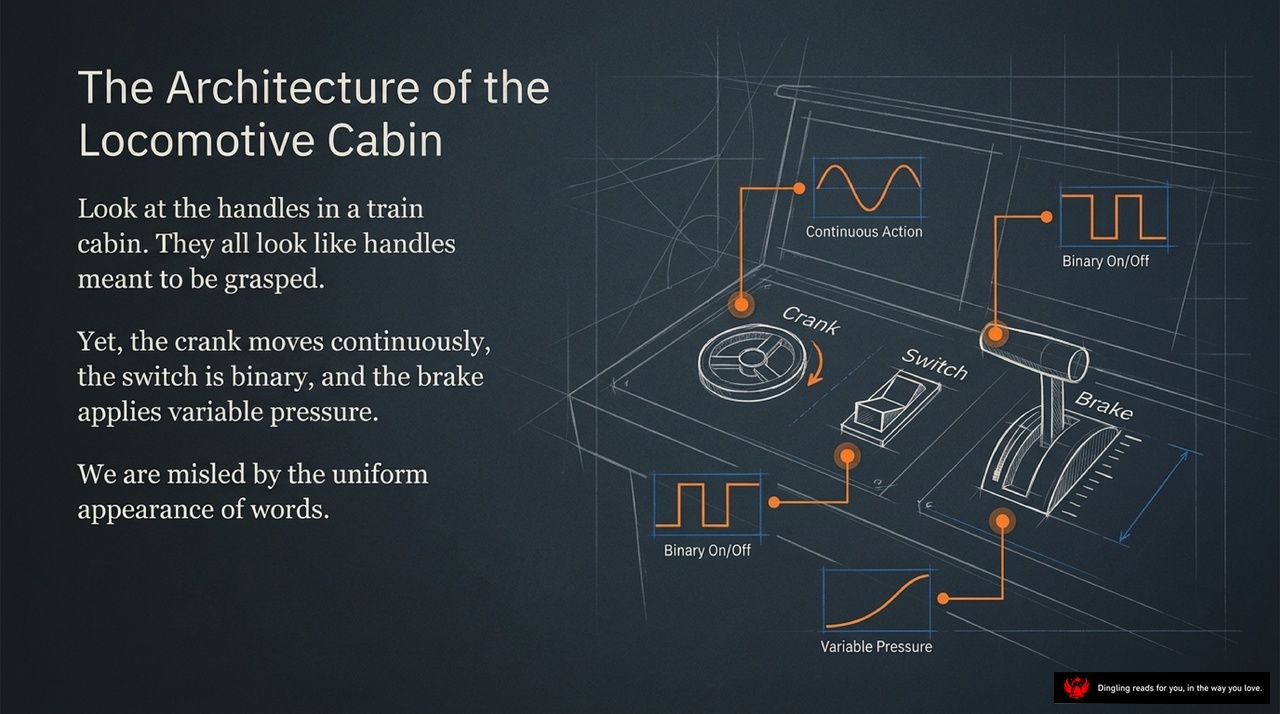
Look at this blueprint of a locomotive cabin. On the surface, everything looks the same: a uniform row of handles meant to be grasped. But if you dig deeper, you'll see a hidden architecture. That crank rotates continuously, that switch flips on and off, and that brake lever applies variable pressure. They are all different tools for different jobs, yet they share a confusingly similar appearance.
This image perfectly mirrors a major trap in philosophy. We often look at words and assume they all function the same way—like those handles on the train. We think every word simply "names" an object, just as every handle seems to just "grab." But this uniform appearance misleads us. Just as the brake needs pressure and the switch needs a binary flip, words have different jobs. Some describe, some command, some ask, and some report.
The real problem arises when we try to find a single "essence" of language or a universal definition for every word. We get stuck trying to force a square peg into a round hole, ignoring the specific context where the word lives. We need to stop looking for a hidden, abstract meaning behind the words and instead focus on how they are actually used in our daily lives. The meaning isn't hidden inside the word; it's in the activity itself.

Let's look at this diagram. It shows a loop: Builder A yells "Slab!", and Builder B performs the physical action of flowing the stone. This isn't just abstract thought being translated into words; it's a shared activity woven into our form of life.
As we've discussed, language isn't about matching words to hidden mental images. Instead, speaking is making a move in a language game. Meaning requires context. Think about that word "Slab." It doesn't point to a ghostly object in your head. Its meaning is found in the action itself—the command and the building.
This is the core of our view: words are tools, like hammers or saws. A hammer isn't just a shape; it's for driving nails. Similarly, "Slab" isn't just a label; it's an instruction to act. If we try to define everything by a single rule, we get confused, just like mixing up the functions of a train's controls.
So, when we say something has meaning, we aren't describing a private feeling. We are describing a role in a shared practice. Whether it's giving an order, reporting a fact, or telling a joke, the meaning lives in the use. Language is a collection of these diverse games, not a single rigid system.
By focusing on how we actually use words in real life, we dissolve old philosophical puzzles. We stop searching for the "essence" behind the word and start seeing the activity it enables. That's how we find clarity.
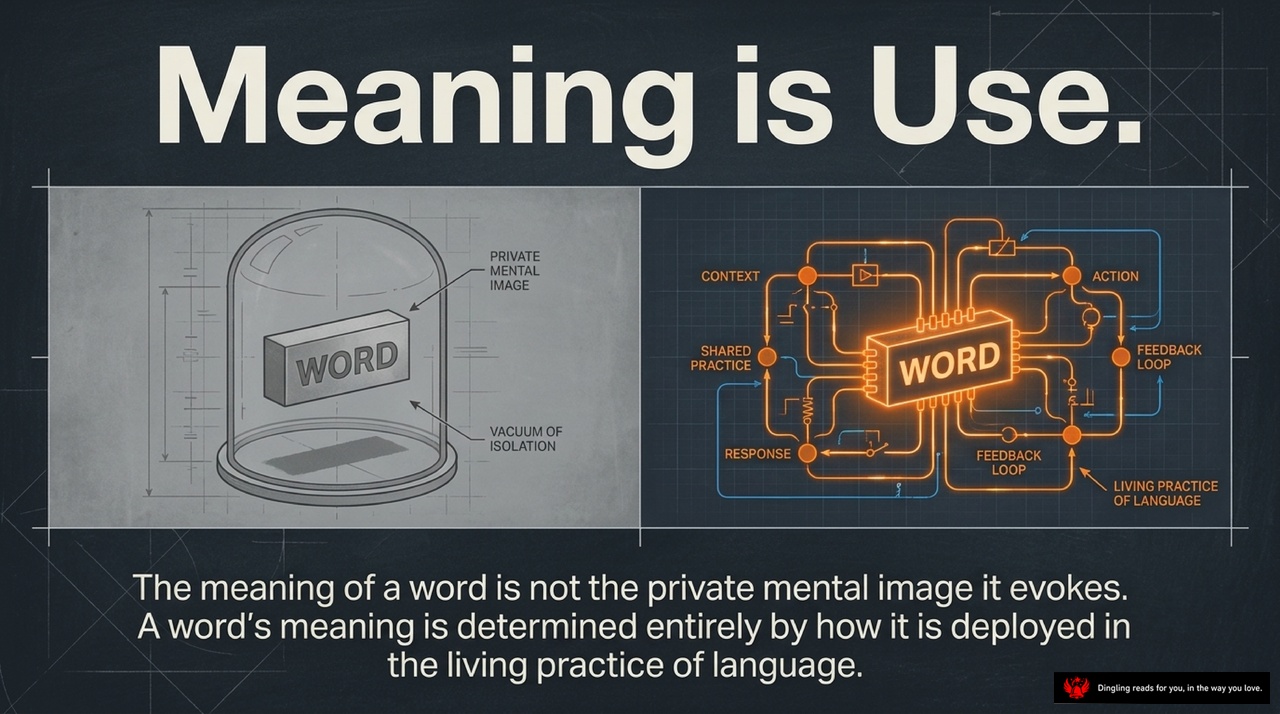
When we look at the classic duck-rabbit image, we experience something fascinating: the same lines can suddenly shift from a duck's head to a rabbit's. This isn't just a visual trick; it reveals how our understanding is actually a matter of perspective. The slide highlights this beautifully by contrasting a word trapped in a "vacuum of isolation" with a vibrant "living practice of language."
On the left, we see a word stuck inside a glass dome, representing a private mental image. This is the trap many of us fall into: thinking that the meaning of a word is just a fixed picture in our heads. But the right side of the image shows the truth. Meaning isn't that isolated static image. It's a dynamic circuit. It connects context, shared practice, and action through feedback loops.
As the text reminds us, "The meaning of a word is not the private mental image it evokes." Instead, meaning is determined entirely by how we deploy it in the living practice of language. Just like the duck-rabbit image, the meaning of a word changes depending on the "face" we see it from in that specific moment. We don't just describe the world; we actively construct it through how we use our words. So, don't look for a hidden definition inside your head. Look at what you do with the word. That action is the meaning.

When we look at this diagram, we see something fascinating: the "Constellation of Family Resemblance." Notice how the circles for Board Games, Card Games, and Ball Games overlap. There isn't one single hidden line connecting them all. Instead, we have a complex web of similarities—like "Luck," "Skill," "Amusement," and "Competition"—that crisscross through the network. Some games share skill with board games; others share amusement with card games. Just like traits within a family, where no single feature defines every member, yet they are all clearly related.
This idea challenges the old philosophical habit of looking for a single "essence" to define everything. We used to think a "game" must have a specific core, like strict rules or a winner. But as we see here, the concept is open and flexible. It's defined by this overlapping family of similarities. The same logic applies to language itself. We don't need one perfect definition for a word; we just need to see how it fits into these different "language games." Whether we are giving commands, describing objects, or telling stories, the meaning lives in these diverse, overlapping uses, not in some abstract, hidden truth.

When we look at the Jastrow duck-rabbit image, we experience something profound: the same lines can suddenly shift from a rabbit to a duck. This isn't just an optical trick; it reveals how we actually see the world. We don't passively receive data; we actively organize it. This is what Wittgenstein calls "seeing-as."
Look at the slide. On the left, we have "The Illusion / Early Philosophy." This is the old way of thinking, where we believed in exact boundaries and absolute logical purity. We thought words had hidden essences waiting to be discovered, like a frictionless ideal where everything fits perfectly. But this view is a trap. It tries to force the messy, living world into a rigid, crystalline mold.
On the right, we see "The Reality / Later Philosophy." This is the shift. We move from exact boundaries to blurry, functional ones. We stop looking for hidden essences and start focusing on observable use. We embrace the friction of the rough ground instead of dreaming of a frictionless ideal. Why? Because meaning isn't a static object hidden behind a word; it's a tool in a toolbox. A hammer isn't defined by its shape alone, but by what it does.
The slide drives home a crucial point at the bottom: "We cannot walk without friction. We must return to the rough ground." Just as you can't walk on perfectly smooth ice, you can't understand language without context and use. If we try to strip away the roughness of real life to find a perfect, pure meaning, we end up lost. True understanding comes from seeing how words function in our daily activities, in our specific language games. We must stop chasing the illusion of purity and step back onto the rough, practical ground where language actually lives.
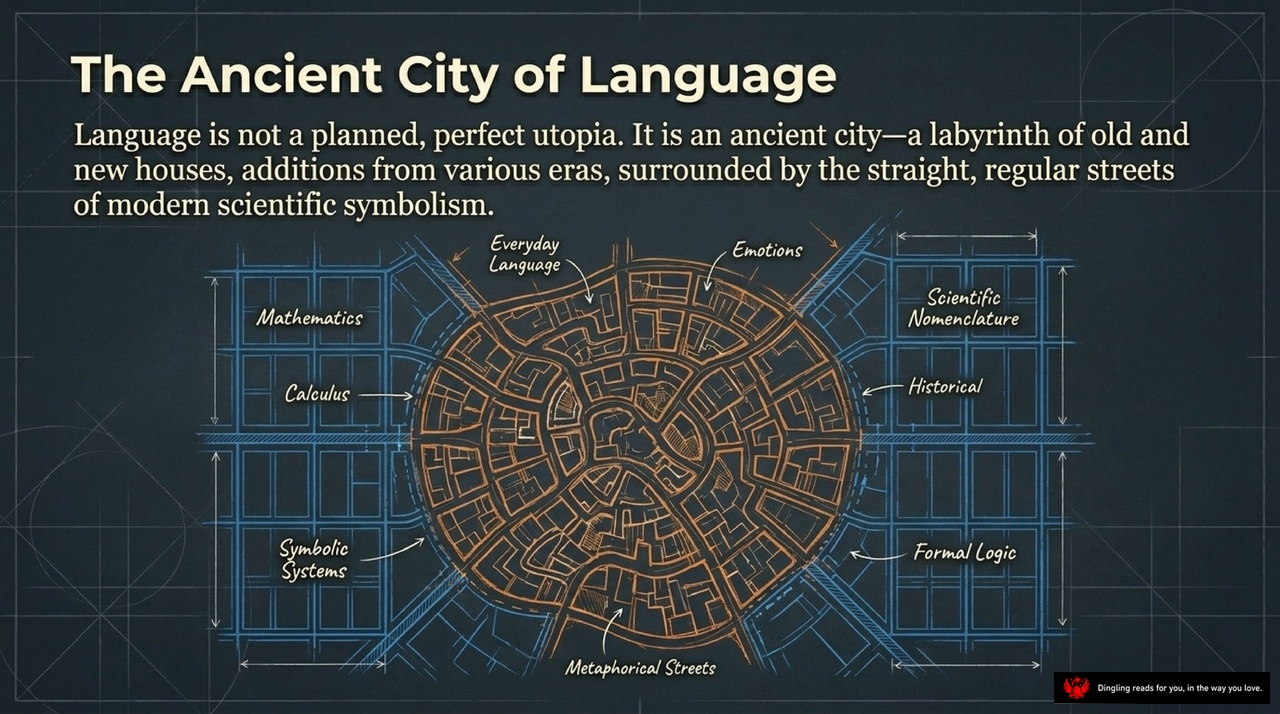
Language is not a planned, perfect utopia. It is an ancient city—a labyrinth of old and new houses, additions from various eras, surrounded by the straight, regular streets of modern scientific symbolism. Imagine standing in the center of this bustling metropolis. On one side, you have the grid-like, orderly districts of **Mathematics**, **Calculus**, and **Formal Logic**—the clean, predictable streets where every rule is clearly marked. On the other, you wander into the winding, chaotic alleys of **Everyday Language**, where **Emotions** flare up, **Metaphorical Streets** twist in unexpected directions, and **Historical** layers pile up without a blueprint.
We also find specialized zones like **Scientific Nomenclature** and **Symbolic Systems**, which operate with their own strict codes, distinct from the messy, vibrant life of the main city. This map perfectly captures the core idea: language is a complex, evolving ecosystem. It isn't just a set of definitions waiting to be learned; it's a living city where different "games" happen simultaneously. Whether you're solving an equation or expressing a sudden feeling, you are navigating different parts of this ancient city. The beauty lies in its diversity—there is no single rule that governs every corner, just as there is no single definition for every word.

Look at this sequence: 2, 4, 6, all the way up to 1000. It looks simple, right? Just add two, keep going. But what happens when we hit that gap? How do we know to jump from 1000 to 1002? The image suggests there's a bridge labeled "Training & Custom." That's the key. We don't have some magical, invisible rule that tells us exactly what to do forever. Rules don't possess a track that dictates our actions to infinity. Instead, we follow rules blindly, grounded solely in shared human training and custom.
Think about it this way: you learn the pattern not because you understand a universal law of math written in the stars, but because you've been trained to see the pattern. You've seen 2, then 4, then 6. You've practiced the "+2" step. That practice creates the bridge. Without that shared training, without that custom, the sequence breaks. We aren't following a hidden code; we are participating in a game we all learned to play together. Our ability to continue the sequence isn't a discovery of a pre-existing truth, but a result of our collective habit and instruction. We build the bridge ourselves, every time, through the very act of following the rule we were taught.
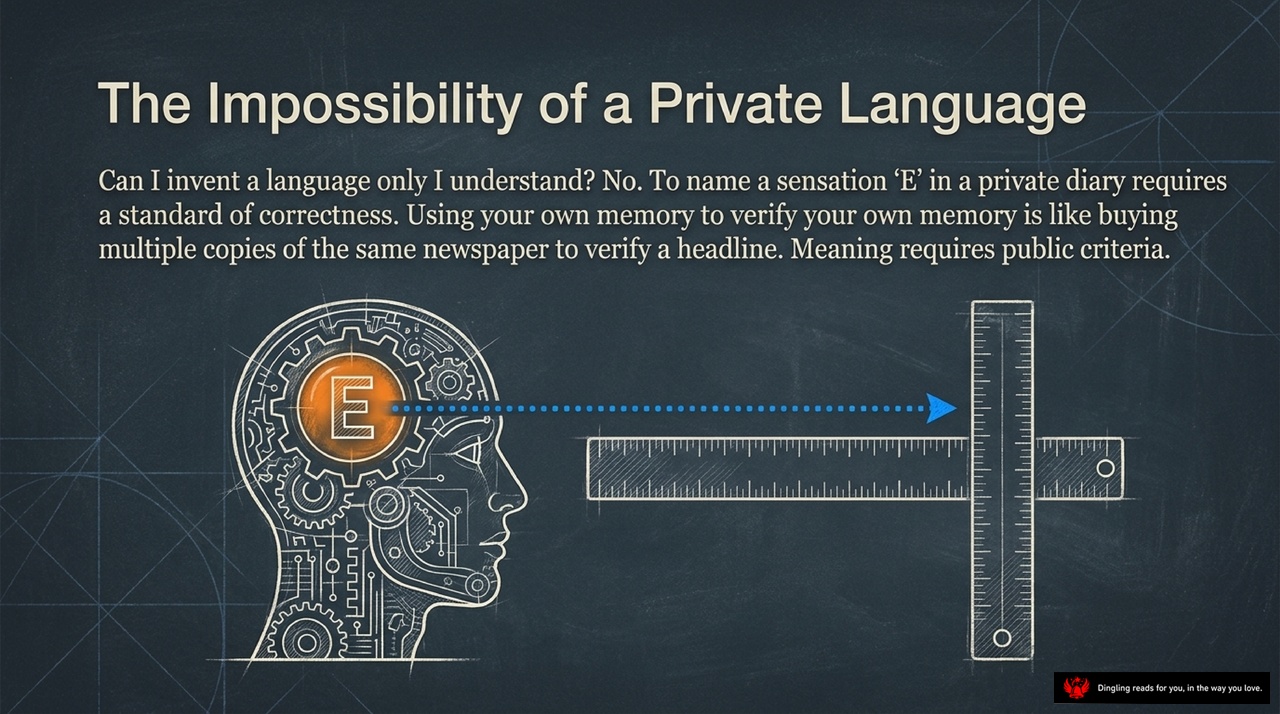
So, can I invent a language that only I understand? The short answer is a hard no. It turns out that true privacy is impossible when it comes to language. Even if you're writing in a private diary, trying to name a personal sensation like 'E' requires a standard of correctness. How do you know you're remembering 'E' correctly? You can't just use your own memory to verify itself; that's like buying multiple copies of the same newspaper to check a headline—it doesn't prove the news is real. Without public criteria, meaning dissolves.
Think about the image on the screen. We see a mind trying to measure a concept against a ruler, but without a shared standard, that measurement is meaningless. Meaning isn't something hidden inside your head waiting to be found; it requires public rules and a shared life. We can't have a language where only one person understands the words, because language is built on how we all use things together. If your rules for using a word change every day based on your private mood, it stops being a rule and just becomes a whim. So, the impossibility of a private language isn't a philosophical puzzle—it's a fact of how human communication actually works.
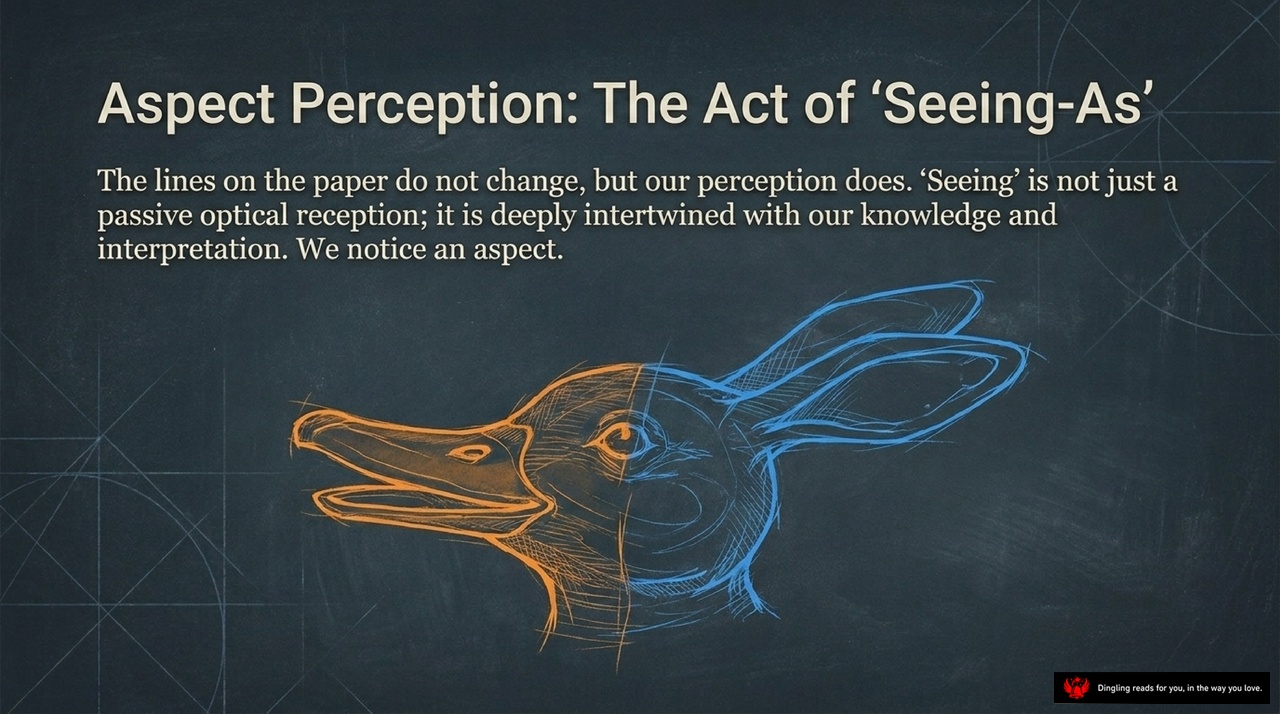
Look at this classic duck-rabbit image. The lines on the paper never change, yet suddenly, one moment it's a duck, and the next, it's a rabbit. This isn't just a trick of the eye; it's a profound lesson on how we actually see the world. We often think perception is a passive process, like a camera simply recording light. But as we've explored, seeing is an active act of "seeing-as." It's deeply intertwined with our knowledge, our concepts, and our interpretation.
Notice how the image forces us to choose a perspective. We can't see both animals at the same time in the same way. Our mind organizes these lines based on the concepts we already possess. If we don't know what a duck or a rabbit looks like, this image remains just a confusing sketch. This shows that our understanding is built on a foundation of shared language and life forms. We don't just receive raw data; we actively construct meaning by applying our concepts to what we see.
This "aspect perception" challenges the idea that there is a single, objective reality waiting to be discovered. Instead, it reveals that meaning is dynamic and context-dependent. Just as the same lines can form a duck or a rabbit, the same words can take on different meanings depending on how we use them. Understanding, therefore, isn't about finding a hidden truth behind the words; it's about mastering the rules of the language game we are playing. We grasp meaning not by holding a mental picture, but by knowing how to act and respond in specific situations.
Ultimately, this concept helps us see why philosophical confusion often arises. When we try to strip words from their everyday use and search for a hidden "essence" behind them, we get lost. We forget that the meaning of a word is found in its use, not in some abstract entity. By returning to the concrete, messy, and diverse ways we actually speak and act, we can dissolve these illusions and see the world clearly again. Our perception, our language, and our reality are all woven together in this active, creative dance of "seeing-as."

Philosophy as Therapy: The Fly-Bottle Metaphor
Today, let's look at the core mission of philosophy. The image on the right shows a fly trapped inside a bottle, struggling against the glass walls. It flies straight up, only to hit the ceiling and crash back down. This is our mind, trapped by the wrong way of looking at language. The goal of philosophy isn't to build grand, abstract metaphysical theories. Instead, it is a battle against the bewitchment of our intelligence by means of language.
Think about the "knotted intelligence" on the left. Our thoughts often get tangled in confusing philosophical knots, like this messy string. We try to solve these knots by creating more complex theories, but that just tightens the knot further. Philosophy acts as the tweezers and the needle here, performing the "unraveling." It doesn't add new threads; it simply untangles the existing ones.
The ultimate aim is simply to show the fly the way out of the fly-bottle. We need to find that escape path. Often, we are confused because we are looking at the wrong angle, just like the fly looking straight up. By clarifying how we actually use words in daily life, we can dissolve these illusions. Once we see the real function of language, the trap disappears, and the fly finds its way out. That is the healing power of philosophy.

The End of the Bewitchment.
Look at this toolbox. It's not just a collection of items; it's a map of how language actually works. In philosophy, we've been trapped in a "bewitchment," convinced that every word must represent a hidden, private object inside our minds. We've been looking for the essence behind the tool, forgetting that a hammer isn't defined by some abstract "hammer-ness," but by what it *does*.
Wittgenstein's great discovery is that the only way to find peace is to bring words back from these metaphysical illusions to their everyday use. Just like a hammer is used to drive nails, or a ruler to measure, words only have meaning within a specific "language game." When we stop trying to force every word into a single, rigid definition, we stop tormenting ourselves with problems of our own making. The confusion vanishes the moment we realize that meaning isn't a hidden thing to be found, but a skill to be practiced.

Wittgenstein shattered the illusion that language is a hidden, perfect logic waiting to be decoded. Instead, he revealed it as a living, breathing toolkit defined entirely by human practice, context, and shared forms of life. Think of it not as a static system of rules, but as a workshop where words are tools—like hammers, saws, and rulers—each serving a unique purpose depending on the task at hand. The confusion often arises when we try to force every tool into a single category, just as philosophers have historically tried to find a single "essence" for all games or all words.
But here is the crucial question that ties it all together: If the true meaning of our words is found only in their messy, everyday use, are the deepest and most agonizing philosophical problems of our time simply grammatical illusions we have yet to untangle? We often get trapped in these puzzles because we treat language as a mirror reflecting a hidden reality, when in truth, it is the very ground we stand on. By returning to how we actually speak and act, we can dissolve these traps and see the world clearly again.