
Political Order in Changing Societies: Complete Chapter-by-Chapter Summary
Welcome everyone. Today we are exploring a foundational text in political science: Political Order in Changing Societies by Samuel P. Huntington. The slide captures his central thesis perfectly: Modernization breeds instability when social mobilization outpaces political institutionalization.
Put simply, Huntington warns that rapid social change does not automatically lead to stability. If a society mobilizes its people through education, urbanization, or demands for rights faster than its political institutions can adapt, chaos is the likely result. We will be unpacking this concept, looking at why some nations thrive during change while others descend into turmoil. Let's dive in.
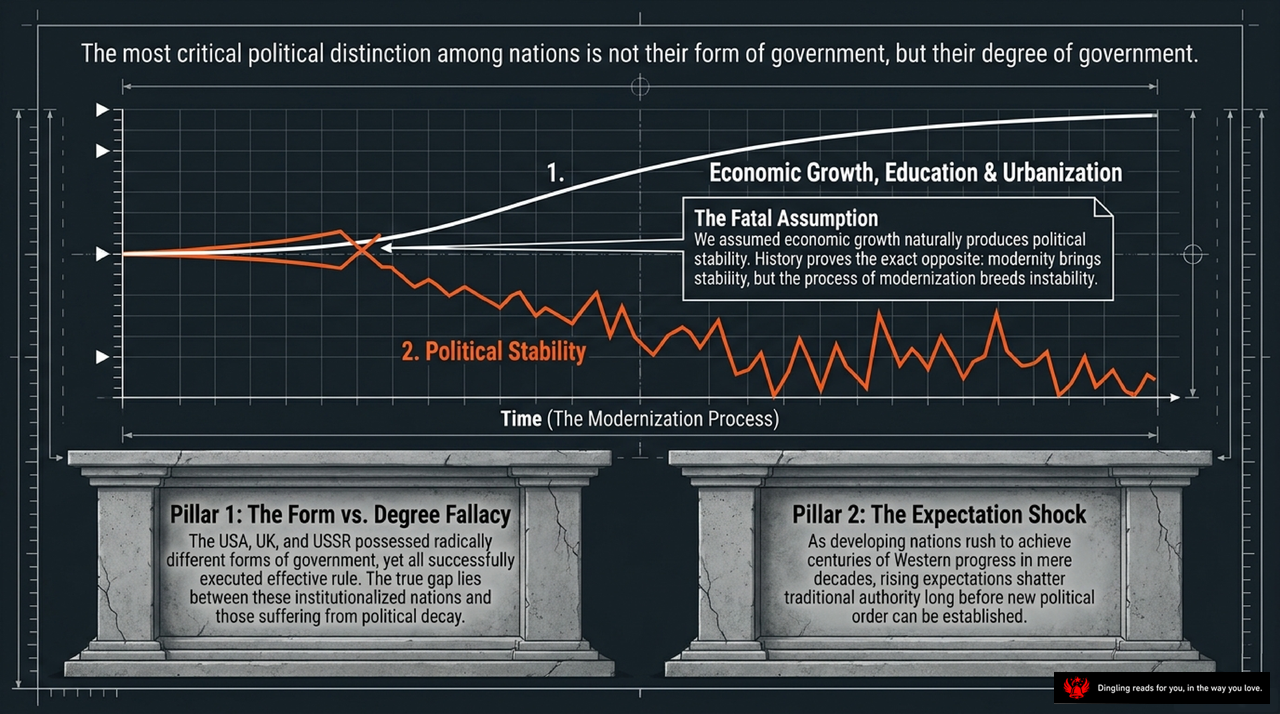
The slide opens with a provocative truth that challenges everything we think we know about politics: the real difference between nations isn't the *type* of government they have, but the *degree* of government.
Look at this chart. On one side, you have economic growth, education, and urbanization climbing steadily over time. But on the other, political stability is actually plummeting or becoming volatile as modernization happens. This visual perfectly captures what the author calls 'The Fatal Assumption.' We've always assumed that if an economy grows, politics will naturally stabilize. But history proves the exact opposite. Modernity itself brings stability, but the *process* of modernizing is what breeds instability.
Let's break this down further. Pillar one is the 'Form vs. Degree Fallacy.' Think about the US, UK, and USSR. They had completely different systems—democracy, monarchy, and communism—but they all executed effective rule. The real gap isn't the label on the system, but whether the government can actually govern. In contrast, many developing nations lack the institutional strength to command authority.
Pillar two is 'The Expectation Shock.' Developing nations rush to catch up with Western progress in just a few decades. This creates a massive gap. Social mobilization, like urbanization and education, raises expectations faster than the economy can satisfy them. This shatters traditional authority long before a new political order can take its place.
So, the lesson is clear. Just building an economy isn't enough. You need a government strong enough to manage the chaos of change. If you ignore this dynamic, you're setting yourself up for the exact instability the graph predicts.
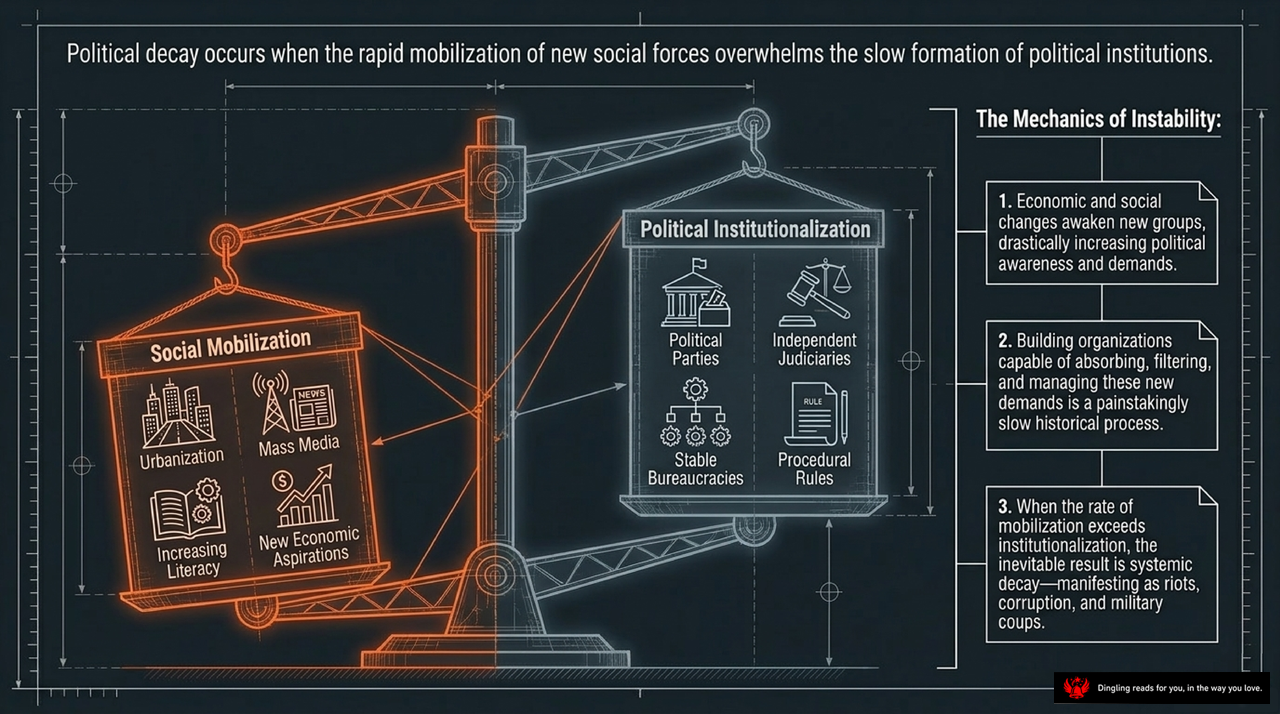
Imagine this scale on the screen. It perfectly captures the core tension driving political instability in the modern world. On the left, we have Social Mobilization. Think about what's happening on the ground: cities are growing, mass media is spreading, literacy rates are climbing, and people's economic aspirations are skyrocketing. Basically, people are waking up and demanding a bigger role. On the right, we have Political Institutionalization. This is the machinery of the state: political parties, independent judiciaries, stable bureaucracies, and procedural rules. It's the framework that manages these demands.
The problem, as the slide points out, is a timing mismatch. Social mobilization happens fast. It's rapid. But building institutions is slow. It's a painstakingly slow historical process. When the rate of mobilization exceeds institutionalization, the system gets overwhelmed. This is what we call political decay.
The mechanics of instability are clear. First, economic and social changes wake up new groups, increasing their demands. Second, building the organizations to handle these demands takes time. Third, when the gap gets too wide, the result is systemic decay. We see it in riots, corruption, and military coups.
Think about it: if people expect more and the government can't deliver or manage it, trust breaks down. The gap between what people want and what the system can provide creates frustration. This isn't just about money; it's about political order. The text notes that modernity breeds stability, but the process of modernization breeds turmoil. If you look at the four standards of institutionalization—adaptability, complexity, autonomy, and cohesion—you'll see that without these, the state can't handle the pressure.
So, for a country to stay stable, it needs to keep up the pace of institutionalization with its social mobilization. Otherwise, the pressure builds up until something snaps. That's why some developing nations face such chaos: they mobilize their people faster than they can build the rules to guide them. It's a race against time, and losing it leads to the inevitable result: systemic decay.
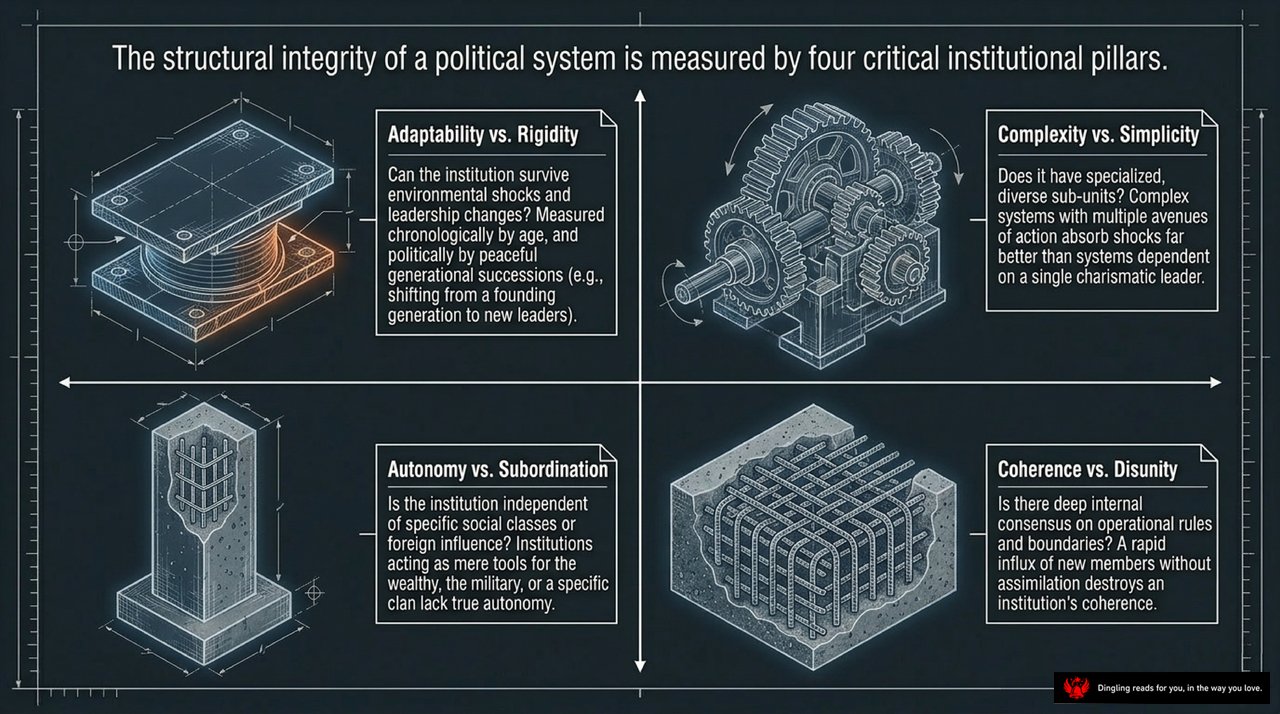
Think of a political system not just as a government, but as a complex structure designed to survive over time. We often talk about stability, but what actually makes a system strong? It all comes down to four critical institutional pillars that measure its structural integrity.
First, look at Adaptability versus Rigidity. Can the institution survive environmental shocks and leadership changes? As we see here, it is measured chronologically by age, and politically by peaceful generational successions. A mature system can shift from a founding generation to new leaders without collapsing. If it is too rigid, it simply shatters when the environment shifts.
Second, consider Complexity versus Simplicity. Does it have specialized, diverse sub-units? Complex systems with multiple avenues of action absorb shocks far better than systems dependent on a single charismatic leader. Think of a machine with many gears versus one big cog; the former is much more resilient. Specialized institutions allow for a smoother transition of power and function.
Third, examine Autonomy versus Subordination. Is the institution independent of specific social classes or foreign influence? Institutions acting as mere tools for the wealthy, the military, or a specific clan lack true autonomy. A strong system must not be just a puppet for narrow interests; it needs independence to make decisions that serve the long term.
Finally, look at Coherence versus Disunity. Is there deep internal consensus on operational rules and boundaries? A rapid influx of new members without assimilation destroys an institution's coherence. As history shows, internal unity is key to resisting external impact. The Ottoman Empire, for example, failed partly because its ruling institutions lost this internal cohesion.
These four pillars are not just theory; they are the difference between a regime that lasts and one that crumbles. Look at Japan, which used complex dual institutions to modernize successfully. Conversely, many developing nations fail because their political systems lack these four elements. They might have a government, but without adaptability, complexity, autonomy, and coherence, that government cannot truly govern. The text highlights that while economic growth is important, political institutionalization is the bedrock of stability. Without it, you end up with a system that is easily toppled by the very changes it tries to manage. So, when we look at history, from the successful modernization of Japan to the decline of the Ottoman Empire, the lesson is clear: structural integrity matters more than the people in charge.
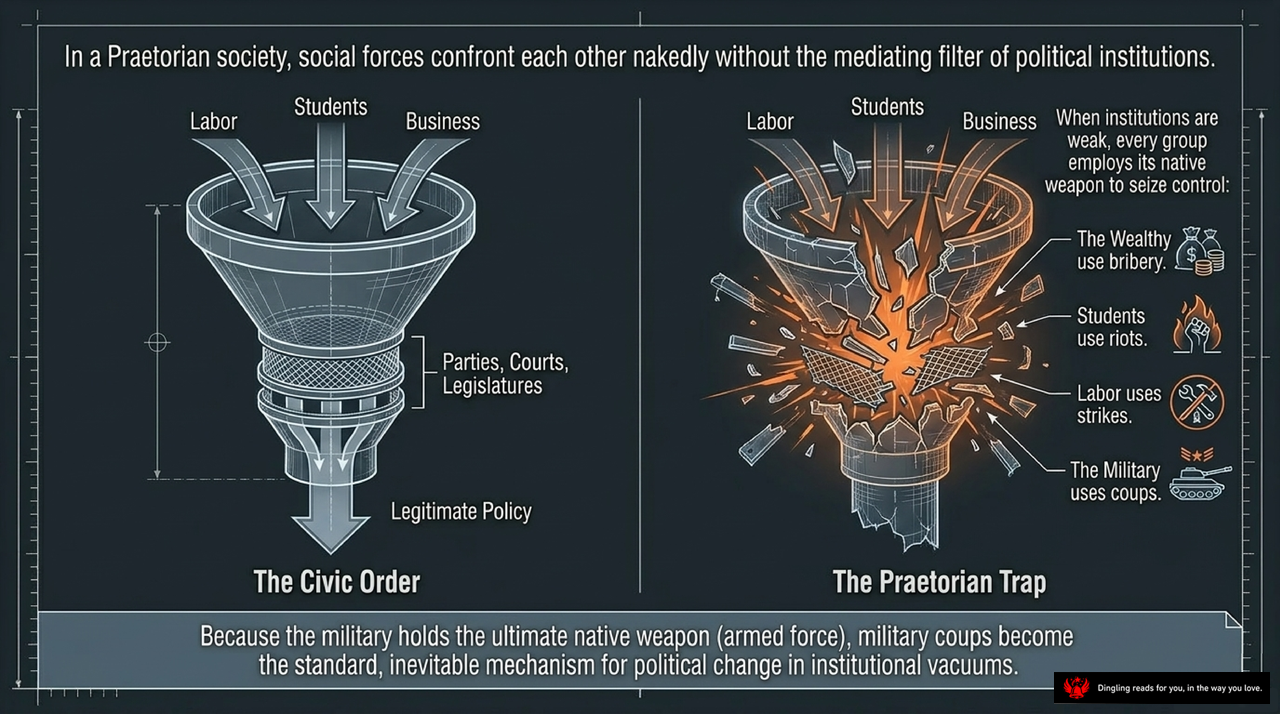
Let's break down this crucial concept of political stability. This slide contrasts two very different worlds: The Civic Order versus The Praetorian Trap.
On the left, we have the Civic Order. Imagine this funnel as a healthy political system. Groups like labor, students, and business all have demands. In a stable society, these demands don't lead to street fighting. Instead, they go through a filter—parties, courts, and legislatures. This institution acts like a referee. It translates raw social power into legitimate policy. It ensures that conflict is resolved through rules, not violence. This is what we see in stable democracies where the system absorbs pressure.
Now, look at the right side: The Praetorian Trap. Here, the filter is broken. The text states, "In a Praetorian society, social forces confront each other nakedly without the mediating filter of political institutions." When the system fails, every group resorts to their "native weapon" to seize control. The wealthy use bribery, students use riots, and labor uses strikes. But the most dangerous outcome is the military using coups. Why? Because the bottom text explains, "Because the military holds the ultimate native weapon, armed force." In an institutional vacuum, the gun becomes the only language that works.
This isn't just a theoretical problem; it's a historical reality. The book explains that this happens when social forces lack a mediating filter. If you don't build strong institutions—like independent courts or legitimate parties—you end up here. The military becomes the standard mechanism for change, not because they want to rule, but because they are the only group with the power to enforce order. It creates a vicious cycle: coups happen, institutions weaken, and more coups follow. Often, the military acts as a "veto player." They might intervene to stop the masses from taking power, or they might seize power themselves. The text notes that in a mass praetorian society, the military shifts from being a reformer to a guardian of the middle class order.
The solution, as the text suggests, is to institutionalize these forces. Successful transitions, like in Mexico or Turkey, involved building strong political parties that could channel these forces into the system, rather than letting them fight in the streets. You can't just ban the military or the students; you need to rebuild the filter. Without that institutional filter, the trap is inevitable. That's why building the "Civic Order" is the only way to escape the "Praetorian Trap."
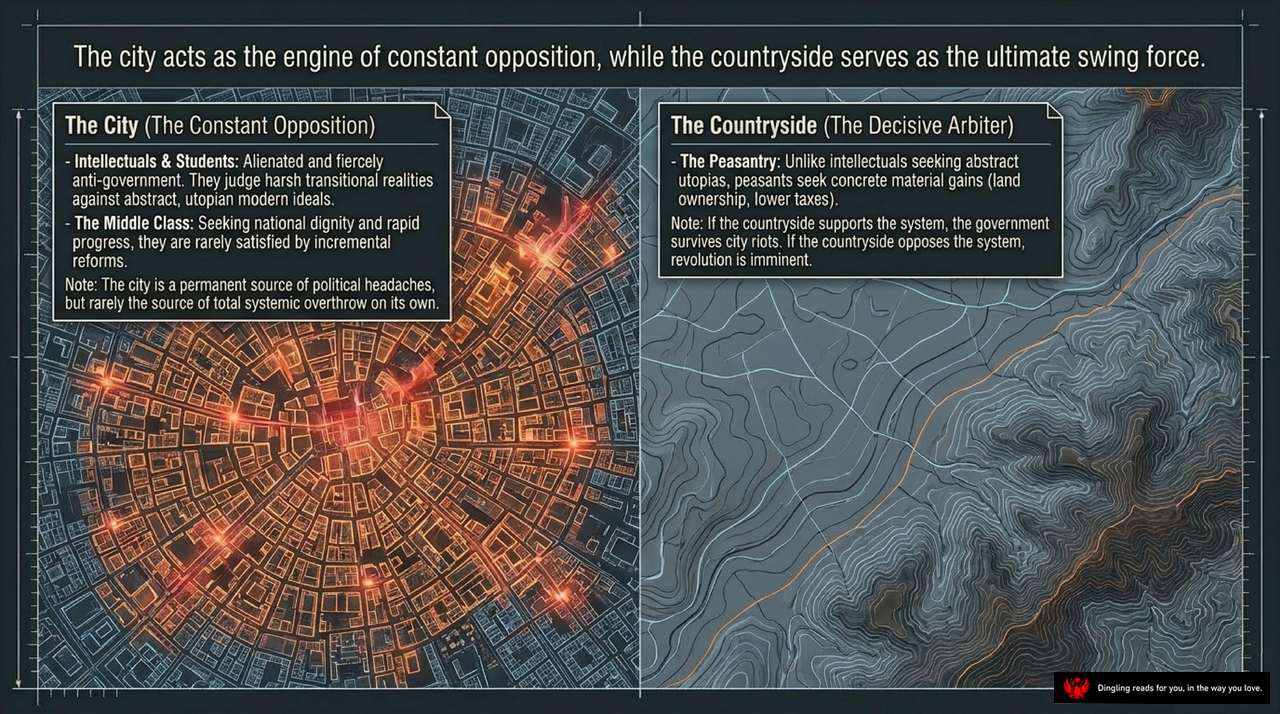
Look at this slide. It splits the world into two distinct forces: the city and the countryside. This isn't just about geography; it's about who holds the power to stabilize or overthrow a government.
On the left, we have the city. It acts as the engine of constant opposition. Who drives this? Intellectuals, students, and the middle class. They are alienated. They judge harsh transitional realities against abstract, utopian modern ideals. They want national dignity and rapid progress. They are rarely satisfied by incremental reforms. This makes the city a permanent source of political headaches.
On the right, we have the countryside. It serves as the decisive arbiter. The peasantry is different. Unlike intellectuals seeking abstract utopias, peasants seek concrete material gains. Land ownership, lower taxes. It's about survival and tangible security.
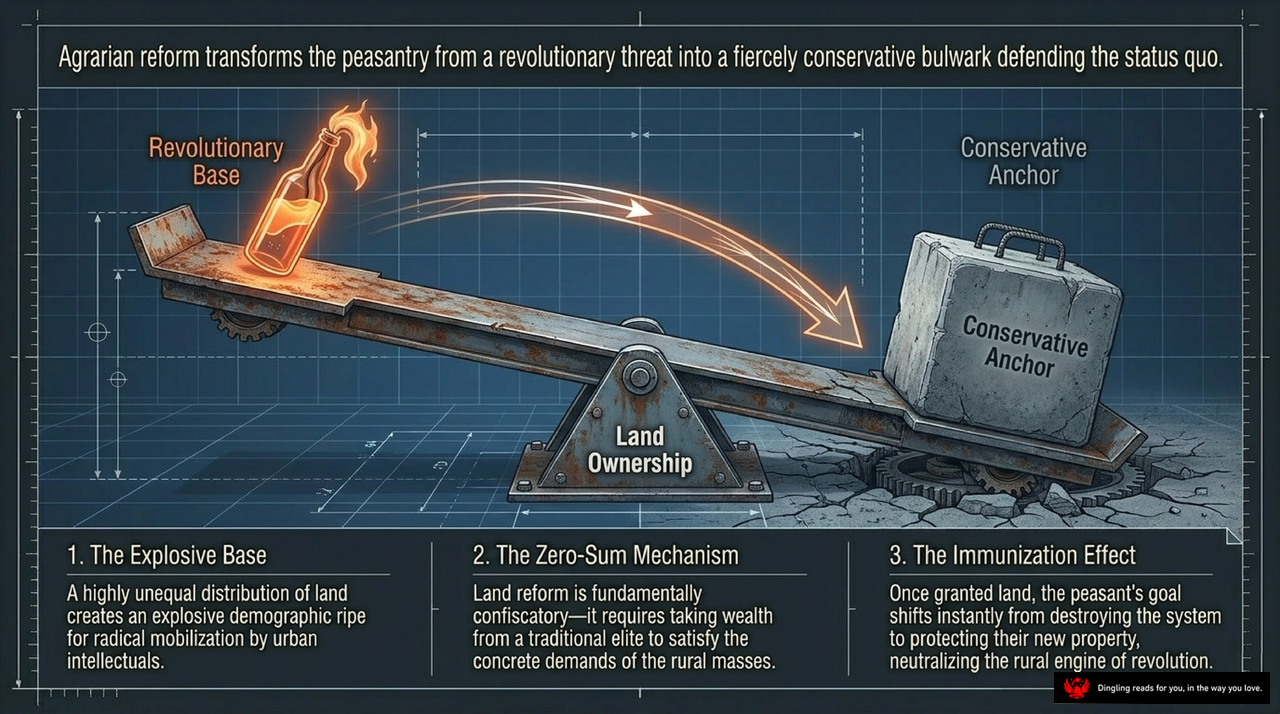
Here is the key takeaway: Reform works differently for these two groups. For the city, reform often acts as a catalyst for revolution. Why? Because urban intellectuals' dissatisfaction is psychological. They want total social transformation. No government can satisfy them fully. So, even if you give them reforms, they remain restless. Think of students in 19th-century Russia or modern Korea. Reform often just fuels their demand for more. This is why reform is so hard for the city.
But for the countryside, effective reform can be a substitute for revolution. If the government solves their material problems, like land reform in post-war Japan or Korea, peasants become the most conservative supporters. They have nothing to lose. They support the system.
So, the city creates the noise. It's the source of political unrest. But it rarely overthrows the system on its own. The countryside decides the fate. The note on the slide says it clearly: If the countryside supports the system, the government survives city riots. But if the countryside opposes the system? Revolution is imminent.
This balance between the urban opposition and the rural support is what determines if a nation stabilizes or collapses. It's about whether you can turn the countryside into a stabilizing force rather than a revolutionary one. That is the ultimate test of political leadership.
Consider the broader context. Reform is often harder than revolution. Reformers fight two fronts: conservatives and revolutionaries. Revolutionaries just need to polarize. Reformers need to balance. Urban intellectuals are the main drivers of revolution because of their abstract ideals. Peasants are the main drivers of stability if their material needs are met. Land reform is the key. It requires strong administration and peasant organizations. Without these, laws are just paper.
So, the city acts as the engine of opposition, but the countryside serves as the ultimate swing force. If you get the countryside right, you can contain the city's chaos. If you fail, the system falls.
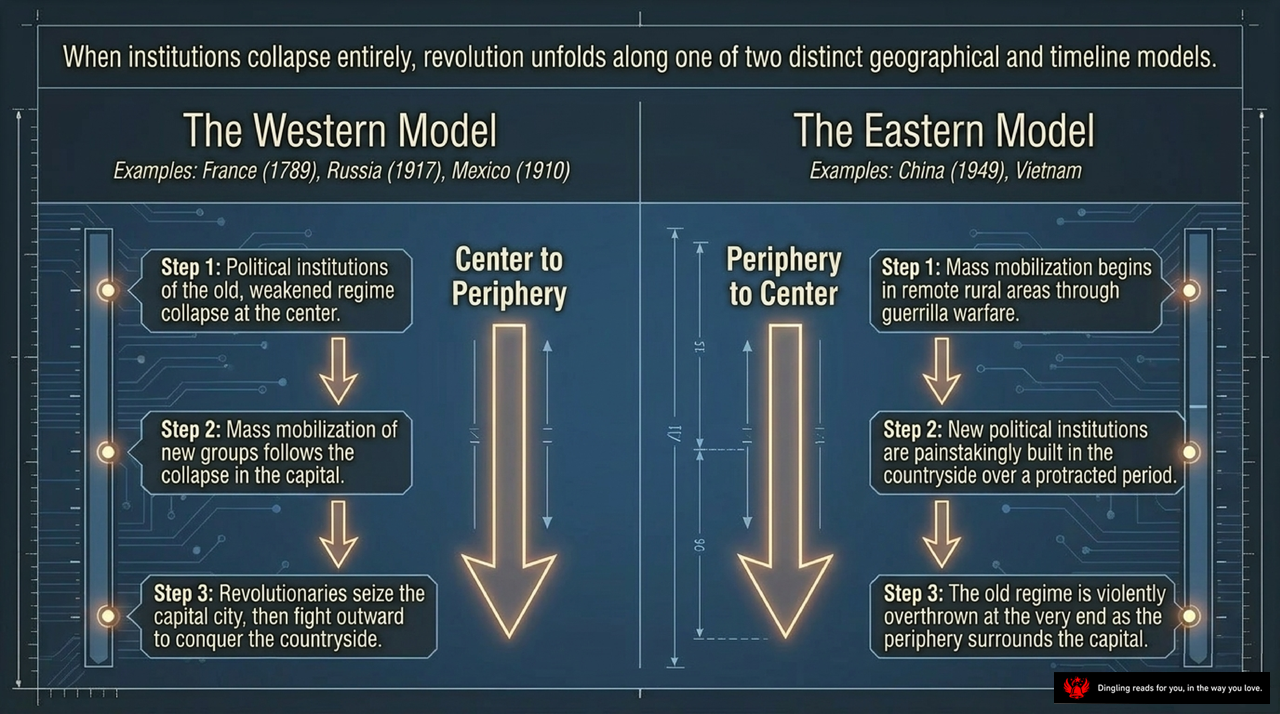
So, what happens when institutions collapse entirely? History shows us that revolution unfolds along one of two distinct geographical and timeline models. Let's look at the slide to see how they differ.
On the left, we have the Western Model. Examples include France in 1789, Russia in 1917, and Mexico in 1910. This follows a Center to Periphery logic. Step one is that the political institutions of the old, weakened regime collapse at the center. Once the capital falls, mass mobilization of new groups follows. Finally, revolutionaries seize the capital city and then fight outward to conquer the countryside. Essentially, the old power breaks first, and the new power fills the vacuum from the inside out. It's a classic top-down collapse followed by a bottom-up reconstruction.
On the right, we have the Eastern Model. Examples include China in 1949 and Vietnam. This is a Periphery to Center process. Step one is that mass mobilization begins in remote rural areas through guerrilla warfare. It's not about the capital yet; it's about the countryside. Step two is that new political institutions are painstakingly built in the countryside over a protracted period. Step three is that the old regime is violently overthrown at the very end as the periphery surrounds the capital.
Why such a big difference? It comes down to the nature of the old regime. The text explains that the Western model targets a weak traditional regime that can't hold on. The Eastern model targets a stronger, partially modernized regime that requires a new force to build from the outside before taking the city.
In the West, the revolution is about seizing power first, then organizing. In the East, the revolution is about organizing first, then seizing power. This distinction explains why revolutions in the West often look like sudden explosions, while revolutions in the East often look like long, grinding struggles in the mountains and villages.
Understanding this distinction is crucial for analyzing why some revolutions succeed where others fail. It's not just about ideology; it's about geography and timing. Copying the wrong model leads to failure. That's why political scientists pay so much attention to these two distinct paths. The slide highlights a fundamental truth: revolutions aren't one-size-fits-all.
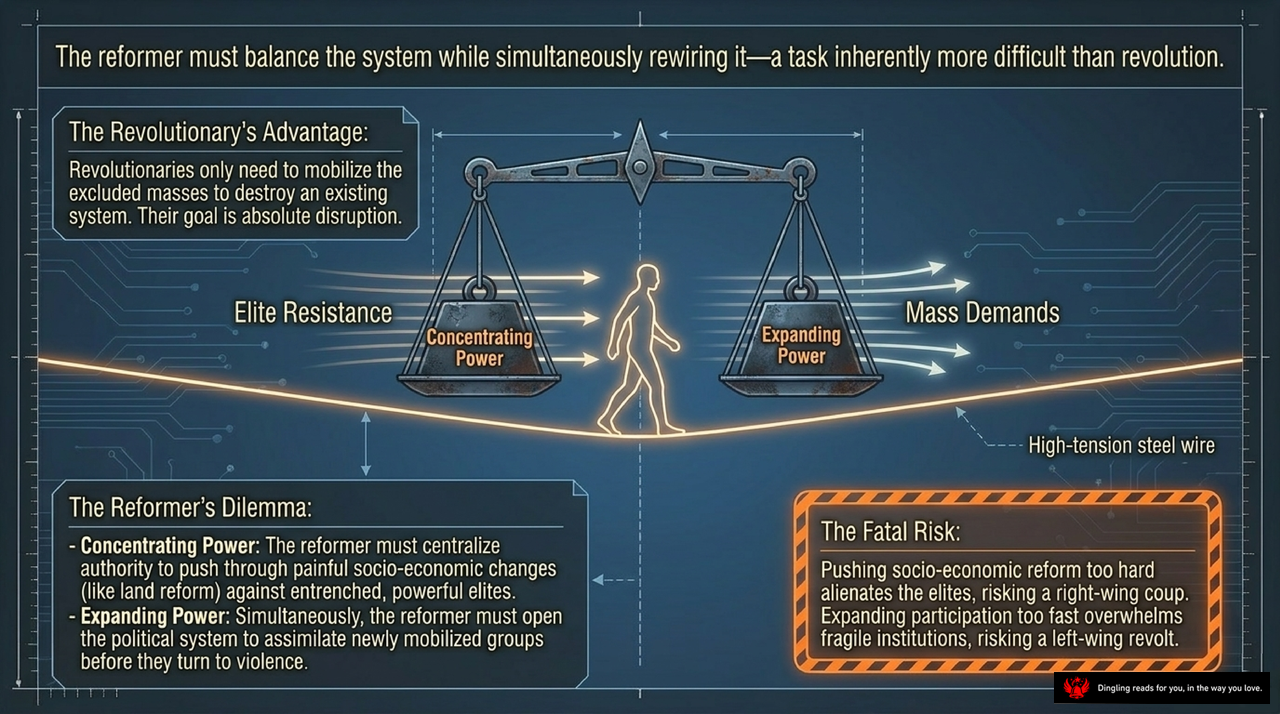
Look at this slide. It captures the delicate reality of political reform. The reformer is walking a high-tension wire. Notice the text at the top: 'The reformer must balance the system while simultaneously rewiring it—a task inherently more difficult than revolution.' This sets the stage for the complexity ahead. Unlike revolutionaries who only need to mobilize the excluded masses to destroy an existing system, a reformer must balance the system while simultaneously rewiring it. The slide contrasts this with the Revolutionary's Advantage. Revolutionaries only need to mobilize the excluded masses to destroy an existing system. Their goal is absolute disruption. But for the reformer, the goal is stability through change. This fundamental difference explains why the reformer's path is so treacherous.
Look at the scale in the center. It illustrates the Reformer's Dilemma. On the left, you have 'Concentrating Power.' To push through painful socio-economic changes, like land reform, the reformer must centralize authority against entrenched, powerful elites. But on the right, you have 'Expanding Power.' Simultaneously, the reformer must open the political system to assimilate newly mobilized groups before they turn to violence.
Now, consider the Fatal Risk. If you push socio-economic reform too hard, you alienate the elites, risking a right-wing coup. But if you expand participation too fast, you overwhelm fragile institutions, risking a left-wing revolt.
So, the reformer has to walk that wire carefully. They cannot just go all out on one side or the other. They need to manage the tension between centralizing authority to enforce change and expanding power to include the masses. It's a constant balancing act. If they tip the scale too far in either direction, the system collapses.
Think about it this way: Revolution is about breaking the old world. Reform is about building a new one while the old one is still standing. That requires incredible political skill. You have to keep the elites from overthrowing you, but you also have to keep the masses from overthrowing you. That's why reformers often fail where revolutionaries succeed. It's not just about having a good idea; it's about managing the power dynamics perfectly.
The text also highlights that the reformer's path is harder because they face opposition from both conservative elites who fear change and revolutionary masses who want total disruption. The reformer needs to navigate this middle ground. This is why successful reformers, like Kemal Ataturk, often use a strategy of phased reforms. They focus on one thing at a time to avoid giving opponents a chance to unite against them. But even with the best strategy, the risk remains. The reformer must balance the system while simultaneously rewiring it—a task inherently more difficult than revolution.
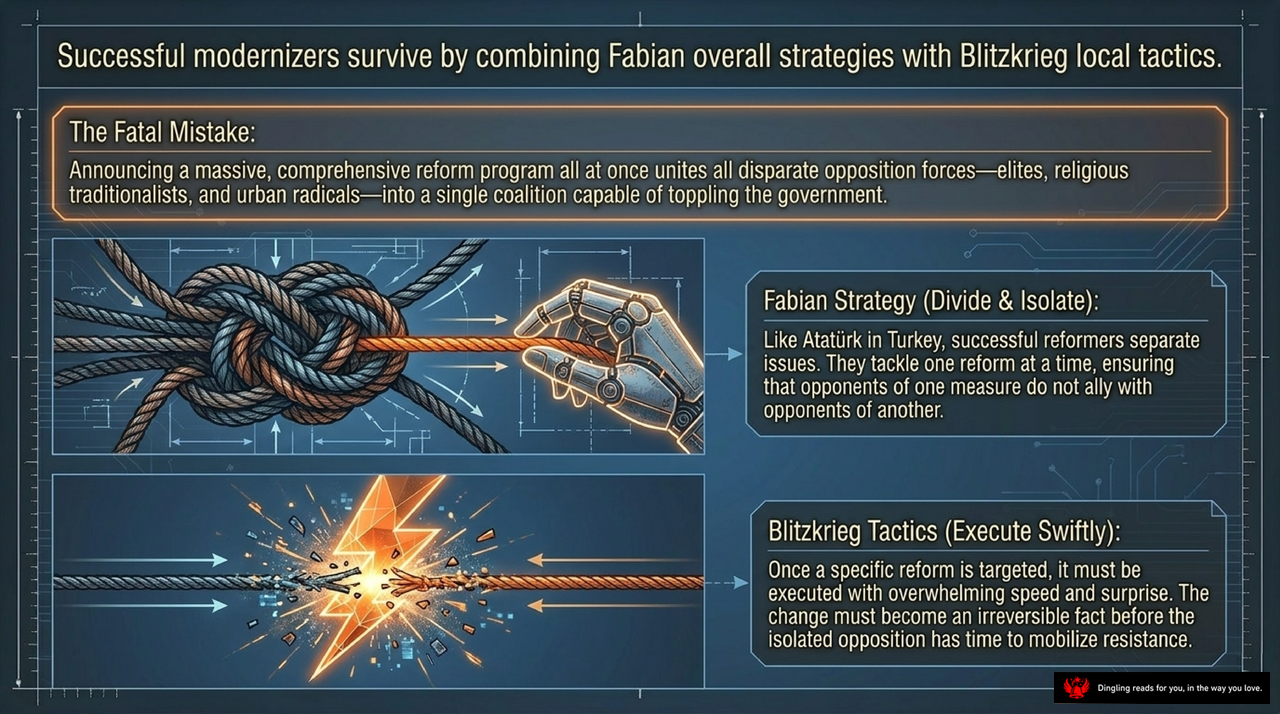
Welcome back. Let's talk about how successful modernizers actually survive in a world that is constantly changing. It comes down to one core principle: you have to combine long-term strategic planning with short-term, aggressive execution. Think of it as mixing a Fabian overall strategy with Blitzkrieg local tactics. This is the key to surviving the pressure of modernization.
First, you need to avoid the fatal mistake. Many leaders fail because they announce a massive, comprehensive reform program all at once. What happens then? You unite all your disparate opposition forces. Suddenly, elites, religious traditionalists, and urban radicals stop fighting each other and form a single coalition capable of toppling your government. It's much easier to defeat a divided enemy, but it's very hard to defeat a united one. You essentially give your opponents a perfect reason to team up against you. When everyone is against you, you lose.
So, what is the solution? The Fabian strategy. This means Divide and Isolate. Look at Turkey's Atatürk. He didn't try to overhaul the entire country overnight. Instead, he separated the issues. He tackled one reform at a time. First, he established the Turkish nation-state. Then, he built the secular political framework. Next, he pushed cultural reforms. Finally, he turned to economic development. By focusing on just one thing at a time, he ensured that opponents of one specific measure did not ally with opponents of another. He kept the opposition fragmented and manageable, preventing them from finding a common ground to fight back effectively.
But strategy alone isn't enough. You also need Blitzkrieg tactics. This means Execute Swiftly. Once a specific reform is targeted, it must be executed with overwhelming speed and surprise. You don't want to leave room for debate or resistance. The change must become an irreversible fact before the isolated opposition has time to mobilize. If you go slow, they will organize. If you go fast, they are just reacting to a fact that's already done. You break the rope before the knot tightens.
In short, successful modernization isn't about rushing everything at once, nor is it about waiting for consensus. It's about patience in planning to divide your enemies, and aggression in execution to lock in your gains. That is the recipe for surviving the pressure of modernization.
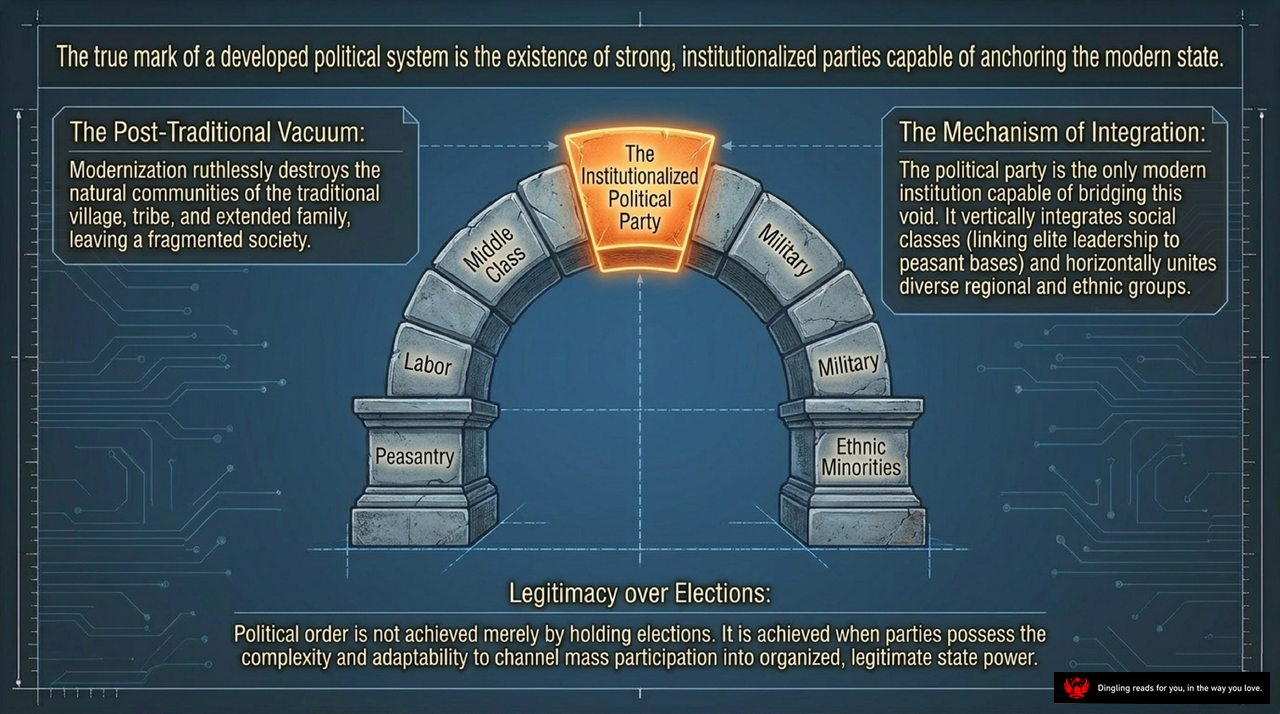
Welcome to this slide. The true mark of a developed political system is strong, institutionalized parties. Look at the arch. On the left, we see the Post-Traditional Vacuum. Modernization destroys natural communities like villages and families, leaving society fragmented and disconnected.
However, the Institutionalized Political Party is the Mechanism of Integration. It bridges this void. Vertically, it links elite leadership to peasant bases. Horizontally, it unites diverse regional and ethnic groups. It holds the structure together.
Finally, Legitimacy over Elections. Political order isn't achieved merely by holding elections. True stability comes when parties channel mass participation into organized, legitimate state power. Without this anchor, you have chaos. This is why strong parties are essential for modern stability and order.
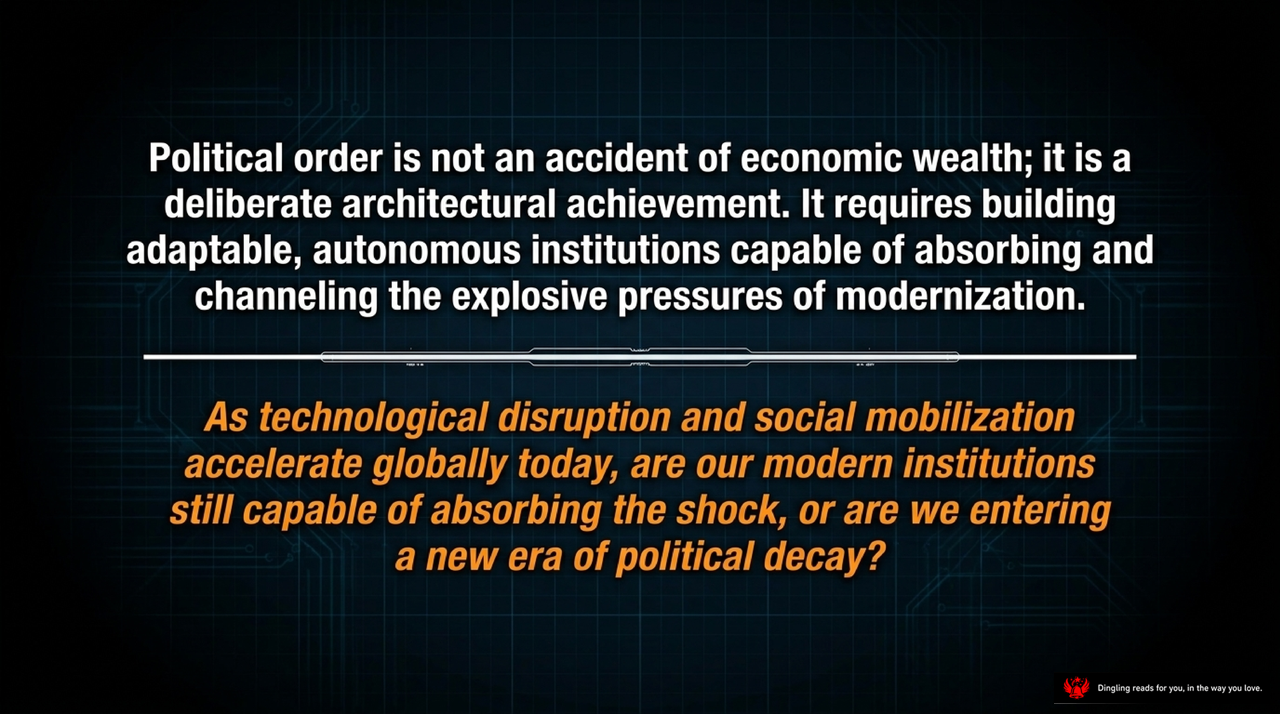
Let's take a closer look at this slide. It challenges a common assumption we all hold. We often think political order is just a lucky byproduct of economic wealth. But this slide tells us the truth: Political order is not an accident of economic wealth; it is a deliberate architectural achievement.
Think about it. The book points out that the real difference between nations isn't whether they are democracies or monarchies, but the effective degree of their government. Wealth doesn't guarantee stability. You need to build adaptable, autonomous institutions capable of absorbing and channeling the explosive pressures of modernization. If you don't have that architecture, you're just building on sand. The text highlights four standards for political institutionalization: adaptability, complexity, autonomy, and cohesion. Without these, a government can't survive.
Now, let's look at the second part. As technological disruption and social mobilization accelerate globally today, what happens to our systems? The text warns us that modernization is a multi-level process involving social mobilization and economic development. Many people think modernization brings stability, but the reality is often the opposite. The modernization process breeds chaos. When urbanization and education spread, people's expectations rise faster than the economy can satisfy them. This gap creates frustration and conflict. It's not just about growth; it's about managing the expectations that growth creates.
So, the critical question on this slide is whether we are prepared. Are our modern institutions still capable of absorbing the shock, or are we entering a new era of political decay? History shows us that when institutions fail to adapt, when social participation outpaces institutional capacity, we end up with what the book calls a predatory state—a system where power swings between the military and the masses without any real order. This decay often happens when the gap between social mobilization and economic growth widens too much.
We can't afford to ignore this. We need institutions that are strong enough to handle the pressure of change without breaking. It's not just about having money; it's about having the political structure to manage it. If we fail to build that architecture now, we risk losing the stability we've worked so hard to achieve. The choice is between building a resilient system or watching it crumble under the weight of its own success. We have to ask ourselves: are we building the institutions that match the demands of our time, or are we waiting for the decay to catch up with us? This is the ultimate test of our modern governance.