
Power: Why Some People Have It-and Others Don’t: Complete Chapter-by-Chapter Summary
Welcome to our deep dive into Jeffrey Pfeffer's groundbreaking book, *Power: Why Some People Have It—and Others Don't*.
This isn't just another self-help book about hard work or being nice. It is a research-backed playbook for abandoning the myth of meritocracy and mastering the actual mechanics of organizational advancement.
Here is the core message from the very first page: in the real world, being the most talented or having the best results does not guarantee you will stay in your job or get promoted. In fact, sometimes outstanding performance can even trap you. As the book illustrates, bosses care less about your actual performance and more about whether you make them feel good and whether they like you. If you make your boss uncomfortable, no amount of great work will save your career.
So, how do you actually build power? The book argues that power is not something you are born with; it is something you construct. It starts with visibility. You cannot assume your boss will notice your hard work. You have to make sure they see you. You need to strategically highlight the aspects of your performance that matter most to them, not just what you think is important. You must understand what your boss truly values, because that is often different from what you assume.
Ultimately, the book teaches us that career success is a game of combining high performance with smart social strategy. You need to make the people who hold the power see your value, feel good about you, and want to keep you around. It's about understanding that your career path is often determined by the people above you, and you have to actively build that relationship. Welcome to the world of understanding how power really works.
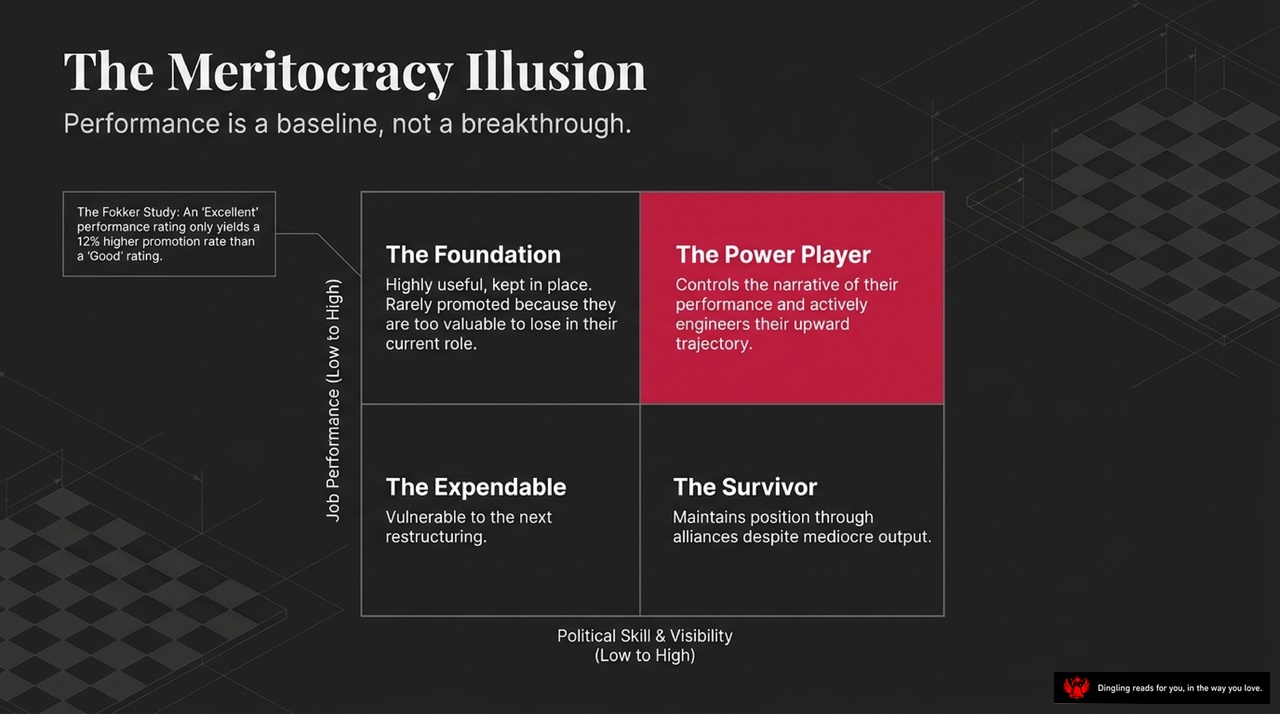
The Meritocracy Illusion: Performance is a baseline, not a breakthrough.
Look at this chart. We often believe that if we work hard and deliver "Excellent" results, we should automatically rise to the top. But the data tells a different story. The Fokker Study reveals a harsh reality: an "Excellent" rating only yields a 12% higher promotion rate than a "Good" one. That tiny gap proves that raw performance alone is rarely enough to break through the glass ceiling.
This slide breaks down the four archetypes of the modern workplace based on two axes: your actual Job Performance and your Political Skill and Visibility.
In the top-left quadrant, we have "The Foundation." These are highly useful, reliable people who are kept in place. They rarely get promoted not because they lack skill, but because they are too valuable to the organization to lose. They are the bedrock, but they stay buried.
Then there is "The Power Player," highlighted in red. These individuals control the narrative of their performance. They don't just wait for results; they actively engineer their upward trajectory by managing how they are seen.
In the bottom-left, you find "The Expendable." These employees are vulnerable to the next restructuring. They may be competent, but without visibility or alliances, they are easily replaced when the winds change.
Finally, in the bottom-right, is "The Survivor." They maintain their position not through high output, but through alliances and political maneuvering, often despite mediocre performance.
The core lesson here is that in a corporate hierarchy, being a good employee is the baseline. To become a leader, you must shift from being just a performer to becoming a player who understands the invisible game of influence.

Look at this radar chart. It breaks down exactly what separates a high-performer from a true "Power Player." The core message here is simple but revolutionary: Power isn't a genetic gift you're born with; it's an engineered skill set you build.
Let's start with Group 1: Intention. This is your internal engine. First, you need **Ambition**—the raw drive to endure friction and make sacrifices. Then, you need **Energy**, which isn't just about waking up; it's the physical stamina to out-work and out-visibility your rivals. Finally, you need **Focus**. Think of it as laser-like concentration on a narrow, high-impact domain. Without this triad, you're just busy, not powerful.
Now, move to Group 2: Execution. This is how you show up in the world. You need **Self-Knowledge**—relentless, structured reflection without the ego-driven delusion of thinking you're perfect. You need **Confidence**, specifically the ability to project authority, especially when things are uncertain. And crucially, you need **Conflict Tolerance**. This is the willingness to engage in friction and withstand being disliked. Many people avoid conflict, but real power comes from not fearing it.
There's one more axis here: **Intelligence**. But look at the caveat at the bottom. Intelligence is often overrated. Highly intelligent people often fall into the trap of overconfidence, assuming they don't need allies and lacking the empathy to see from others' perspectives. So, don't rely on being smart; rely on being self-aware, confident, and willing to fight.
Finally, look at the center of the chart: **The Caveat**. Notice that **Conflict Tolerance** is the missing piece for many. If you have ambition and intelligence but zero tolerance for conflict, you will fail. True power requires you to be willing to be disliked. If you want to engineer your own power, you have to balance your internal drive with your external execution, and never, ever fear the friction that comes with winning.

Welcome to the battlefield of corporate power. Today, we aren't just looking at job descriptions; we are doing a diagnostic on where the real gravity of your organization lies. Think of your company not as a flat list of departments, but as a multi-story building where power flows from the foundation up to the penthouse.
First, let's look at the bottom floor, which we call **The Vault**. This is all about **Relative Compensation**. Money is the clearest signal of power. If you walk into a firm and notice that entry-level roles or executive positions in a specific department command significantly higher salaries than the rest of the company, that department holds the real power. Money flows to power, so if the pay isn't there, the influence isn't either.
Move up one floor to **The C-Suite Adjacency**, or **Physical Proximity**. In many organizations, the office location tells you everything. How close is your department's workspace to the CEO and the executive leaders? Proximity breeds visibility. If you are working in a basement while the decision-makers are in the glass tower, you are invisible. Being physically close to the center of gravity ensures you are seen, heard, and ultimately, included in the critical conversations that shape the future.
Finally, reach the top floor: **The Penthouse**, or **Board Representation**. This is about who sits at the table. Look at the backgrounds of your current executive board. Are they mostly finance, legal, or engineering? The dominant background of the leadership dictates the current power center. If your department's skills don't match the board's composition, you will struggle to get your voice heard, no matter how good your work is.
The key takeaway here is simple: do not start your climb in a weak sector. To build a lasting career, you must locate the true center of organizational gravity. Align yourself with the departments that have the money, the proximity to the CEO, and the representation at the board level. That is where the real action happens.

Look at this slide. It contrasts two very different ways of thinking about networking. On the left, we see the "Echo Chamber." Here, everyone knows everyone. It feels comfortable, but it's a trap. Because everyone is connected to everyone else, information gets recycled endlessly. It's redundant, and no one really has power. Influence gets diluted because there's no new stuff coming in.
Now, look at the right side. This is the "Information Broker." This is where real power lives. Instead of being in a closed circle, you position yourself as the sole link between two isolated groups. Imagine you are the only bridge connecting two departments that have never spoken to each other.
This is the concept of "bridging structural holes." By being that single point of connection, you control the flow of information. You decide what gets translated and what gets shared. Because you are indispensable to both sides, you aggregate leverage. You become the gatekeeper.
Think about it: if you are stuck in an echo chamber, you're just repeating the same old news. But if you are the broker, you have the unique insight that no one else does. That's why you can't just know a lot of people; you have to strategically control where the information goes. That is how you build real influence.

So, what happens when you actually hold the reins? Let's be brutally honest: the view from the top comes with a heavy price tag. Think of it as the hidden costs of success. First, there's the crushing pressure of "fame." Once you're at the helm, every little mistake gets magnified. Remember Harry Stonecipher at Boeing? A casual romance with a VP led to his resignation. Or Rudy Crew, the Miami-Dade school superintendent, who got fired over a misplaced tray in the cafeteria. The spotlight makes you hyper-vigilant, but it also kills your ability to take risks or innovate.
Second, you lose your autonomy. You trade your freedom for influence. Imagine a former colleague who became a business school dean; suddenly, his calendar is controlled by others. He can't exercise, think, or just be. Even CEOs often find themselves trapped in a schedule managed by their own staff. Third, it's the ultimate sacrifice of your personal life. Top executives, especially women, often burn out their relationships or careers. Think of Dr. Francis Conley, the first female neurosurgeon, who and her husband chose to have no children to support her career. The data is clear: many high-level women remain single or childless.
But there are two more invisible costs you must consider. Fourth, the crisis of trust. The higher you climb, the more people want your job. You'll find yourself surrounded by sycophants who only tell you what you want to hear, while others plot behind your back. Leaders like Gary Loveman learned to fight this by encouraging honest, even painful, feedback. Fifth, and perhaps the hardest, is addiction. Power is physiologically and psychologically addictive. Nick Binkley, a former bank executive, described the feeling of stepping down as a car slamming on its brakes, leading to insomnia and marital collapse. Even Jack Welch refused to retire for years, unable to handle life without the applause.
So, do you have to avoid power? No. But you must be willing to pay these costs. Before you climb that ladder, ask yourself: can you handle the loss of privacy, the strain on your family, the isolation, and the addiction? Only then can you decide if the view from the top is worth the price.

Power isn't something you get handed to you; it's 80% something you take. As the slide highlights, your behavioral cues dictate your status. If you want to win in the boardroom, you have to stop acting powerless and start commanding the room.
First, look at the "Powerless Tells" on the left. Avoid asking for permission to speak or shrinking your physical space. Instead, adopt powerful commands. Interrupt strategically to set the agenda, express righteous anger to control the narrative, and take up your physical space with deliberate pauses.
Then, look at the curve on the right. This is the Anger/Competence Perception Curve. Notice what happens as conflict intensity rises. Expressing sadness or guilt sends a signal of weakness, causing your perceived status to plummet. But expressing strategic anger? That does the opposite. Research proves that controlled anger makes you look dominant, competent, and intelligent. It signals that you are in charge.
So, don't apologize when challenged. Don't shrink back. Lean into the conflict with confidence and a bit of strategic heat. That is how you act the part and seize the power.

The crown is heavy, and the price of power is often far higher than we imagine. Look at this slide: "The Price of the Crown." It reminds us that power exacts a heavy, inevitable toll. Before you climb the ladder, you must accept the cost.
First, there is the end of autonomy. Once you reach the top, your time is no longer your own. You become a public figure constantly managing your throne, answering to everyone and everywhere. Second, you face intense visibility. Every action, flaw, and mistake is magnified and scrutinized by rivals waiting for a misstep. One small error can cost you everything.
Third comes paranoia and isolation. As you rise, trust becomes a liability. The higher you go, the more people are actively maneuvering to take your place. You can't truly know who is loyal. Finally, there is the ultimate personal sacrifice. The time spent acquiring and defending power is time stolen from family, hobbies, and personal relationships. Many successful leaders pay this price with their marriages, their children, and their own health.
So, the question isn't just "Do I want power?" but "Can I afford the cost?" If you aren't ready to sacrifice your freedom, your privacy, and your personal life, then maybe the throne isn't for you.

Here is the spoken-word script for Slide 8:
"Defending the Throne: The Attrition of Power. The hard truth is that no one holds power forever, but you can absolutely avoid losing it prematurely. Look at the cracks forming in that wall. The first fracture is Hubris and Blindness. Once you have the throne, the psychological trap kicks in. You start believing your own hype, you lose your empathy for others, and you completely ignore the political rules that actually got you to the top in the first place.
Next, we have Fatigue. Maintaining dominance is exhausting. It requires relentless vigilance. When you get tired, your guard drops, and that is exactly when your rivals strike. You simply don't have the energy to fight back.
The final, and perhaps most dangerous, crack is the Loss of Patience. Power strips away social inhibition. You stop managing the egos of your allies, you become easily irritated, and you alienate the very coalition keeping you in power. Think about it: Rudie Crew, a top-rated school superintendent, lost his job simply because he lost patience over trivial administrative details. Or consider the CEO of a major bank who was ousted for losing his temper over a minor issue.
To survive, you must recognize these warning signs early. You cannot afford to be arrogant, exhausted, or impatient. You must stay humble, rested, and diplomatic, even when things get tough. Protect your coalition, manage your emotions, and keep your eyes open. Because in the game of power, the person who loses their temper first, or gets tired first, is the one who loses the throne."

Power isn't something you're born with, nor is it a reward for grinding away in silence. It's not a fair byproduct of a good world. The slide makes it brutally clear: power is a systematically engineered skill set. It demands the precise mapping of structural networks, the ruthless control of resources, and the unapologetic theatrical execution of dominance. Think of it as a performance art where the stage is your career and the audience is your organization.
But here's the hard truth that often catches people off guard: if you refuse to play this game, are you prepared to be ruled by those who do? In the modern workplace, being the hardest worker or having the best idea isn't enough. You have to understand the invisible architecture of influence. You need to know where the power flows in your organization, who holds the keys, and how to position yourself so that when opportunities arise, you are the one stepping forward.
This isn't about manipulation; it's about strategy. It's about realizing that without these engineered skills—knowing the network, controlling the levers, and projecting confidence—you remain invisible to those who make the decisions. The choice is stark: learn the rules of the game and shape your destiny, or stay on the sidelines and let others dictate the terms of your life. The slide asks us to confront this reality. Do you want to be the architect of your success, or just a participant waiting for permission?