
Pride and Prejudice: Complete Chapter-by-Chapter Summary
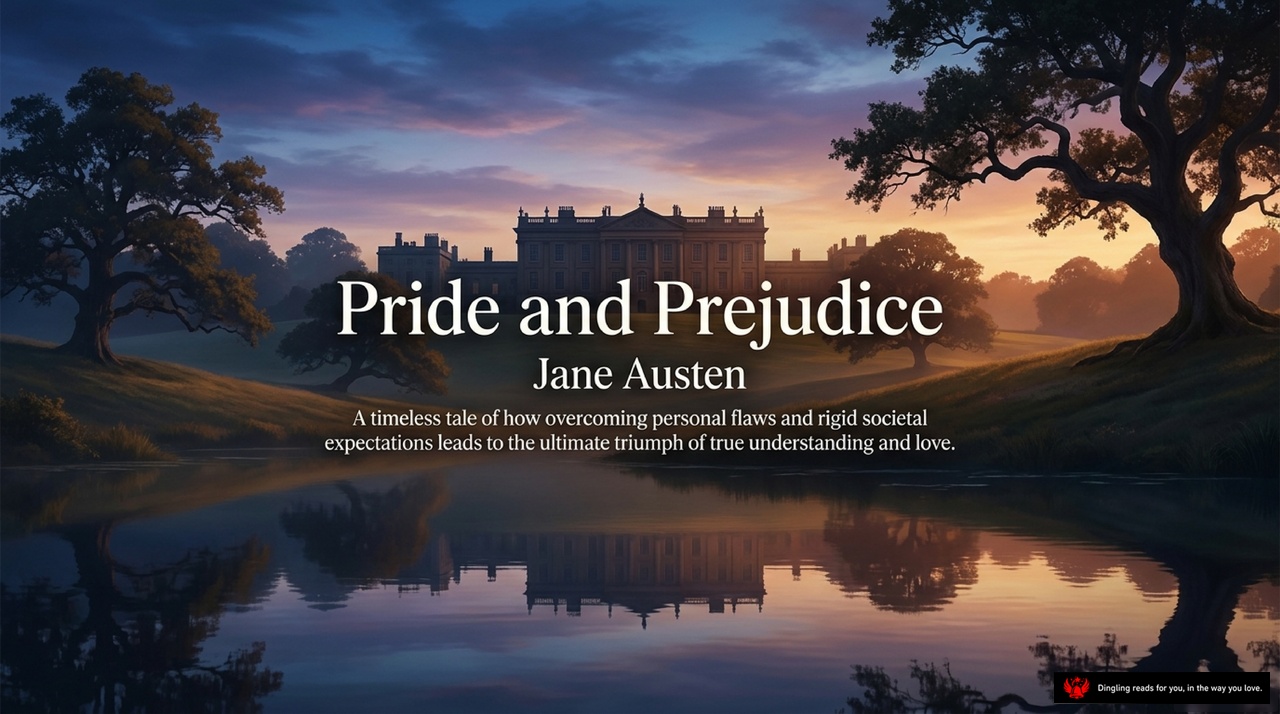
Welcome to our deep dive into Jane Austen's masterpiece, *Pride and Prejudice*. Set against the backdrop of a grand estate at sunset, this timeless tale explores how overcoming personal flaws and rigid societal expectations leads to the ultimate triumph of true understanding and love. It is a story where first impressions often deceive, and where the journey from arrogance to humility defines the path to a happily ever after.

It is a truth universally acknowledged, that a single man in possession of a good fortune, must be in want of a wife. This iconic line from *Pride and Prejudice* isn't just a romantic observation; it's the economic reality of the entire story. Look at this pyramid. At the very top, we have **The Elite**—men like Mr. Darcy and Mr. Bingley. They are wealthy, independent, and highly sought-after. For them, marriage is often a choice, a pursuit of happiness.
But look at the middle and bottom layers. This is where the Bennet family lives, trapped in **The Entailment Trap**. Because there is no male heir, the Bennet estate will eventually pass to a distant cousin, leaving their five daughters destitute upon their father's death. In this world, marriage is not merely a romantic pursuit; it is the sole mechanism for female financial survival. It is **The Strategic Objective**.
So, when Mr. Bennet's wife hears that a rich bachelor has arrived, her excitement isn't just about love; it's about survival. She knows that a single man with money is universally in want of a wife, and she must ensure her daughters secure a spot before he moves on. This economic pressure drives every major decision, from the frantic matchmaking to the tragic misunderstandings that follow. It turns the search for love into a high-stakes game of social survival.

On this pivotal slide, we see the two central figures of *Pride and Prejudice* defined not just by their names, but by the psychological traps that drive them apart. On the left, we have Elizabeth Bennet, labeled here as the embodiment of "Prejudice." Her traits are described as witty and fiercely independent, yet she is heavily reliant on her own quick judgments. The slide highlights her "Core Bias": she believes her sharp intuition is infallible, which makes her blind to deceit wrapped in charm. She mistakes Mr. Darcy's reserve for arrogance and his silence for disdain, failing to see the gentleman beneath the gruff exterior.
Conversely, on the right stands Fitzwilliam Darcy, the archetype of "Pride." While he is honorable and deeply protective of his sister, he is socially rigid and immensely wealthy. His defining flaw is a high sense of social superiority and family honor. This makes him appear arrogant and dismissive of the lower gentry, as the slide illustrates with his infamous quote: "She is tolerable, but not handsome enough to tempt me." This initial dismissal of Elizabeth sets the stage for the conflict.
The narrative arc here is about how these two core biases collide. Elizabeth's prejudice prevents her from seeing Darcy's true character, while Darcy's pride blinds him to Elizabeth's worth and the genuine feelings of others, like Jane. It is only when both characters are forced to confront these internal flaws—when Elizabeth learns the truth about Darcy's actions and Darcy realizes the depth of his own arrogance—that the path to their eventual union becomes possible. This slide perfectly encapsulates the novel's central theme: that we must overcome our own internal barriers to truly know and love another.

The Marriage Motive Matrix on your screen perfectly captures the core conflict of *Pride and Prejudice*: the struggle between true love and social survival. At the top right, we see the ultimate ideal—Elizabeth and Darcy. Their union achieves intellectual equality, passionate respect, and financial security, proving that love and status can coexist. In the upper middle, Jane and Bingley represent innocent, uncomplicated love combined with excellent financial stability; they are the happy, traditional match.
However, the bottom half reveals the darker realities of the era. On the bottom right, Charlotte Lucas and Mr. Collins choose a marriage driven purely by pragmatism and survival. For Charlotte, this is a comfortable but loveless social contract—a safe "storage room" for her future, sacrificing romance for security. On the bottom left, Lydia Bennet and Mr. Wickham are driven by reckless infatuation and deceit. Their path leads directly to social and financial ruin, a tragedy born from ignoring duty and reality. This matrix shows us that while true affection and mutual respect are the highest goals, the pressure of financial security and social duty often forces characters into choices that compromise their happiness.

Look at this diagram: "The Architecture of Pride and Prejudice." It perfectly captures the tragic yet transformative dynamic between Darcy and Elizabeth. On the left, we see Darcy's world. His inputs are his aristocratic upbringing, his inherited duty to protect Pemberley, and his deep disgust for Mrs. Bennet's vulgarity. These factors create an output: a rigid refusal to associate with anyone he deems inferior. On the right, Elizabeth's side. Her inputs are Darcy's public slight at the Meryton ball, his perceived interference in separating Jane and Bingley, and her gullible acceptance of Wickham's charming lies. This leads to her output: a stubborn conviction that Darcy is fundamentally cruel and irredeemable.
When these two opposing forces collide, they create a total deadlock, symbolized by that lock in the center. For months, they are trapped in this stalemate. Elizabeth believes Wickham is a hero and Darcy a villain, while Darcy remains convinced of Elizabeth's family's lack of propriety. But as the story progresses, the architecture begins to shift. Elizabeth reads Darcy's letter and realizes her prejudice was misplaced; she sees Wickham's true nature and understands Darcy's protective, albeit harsh, actions. Simultaneously, Darcy learns that his pride blinded him to Elizabeth's genuine worth and kindness. This realization breaks the deadlock. The rigid walls of class and judgment crumble, replaced by mutual respect and love. What started as an impasse becomes the foundation for their union. It's a powerful reminder that sometimes, the very things we believe make us right are actually the barriers keeping us from the truth.
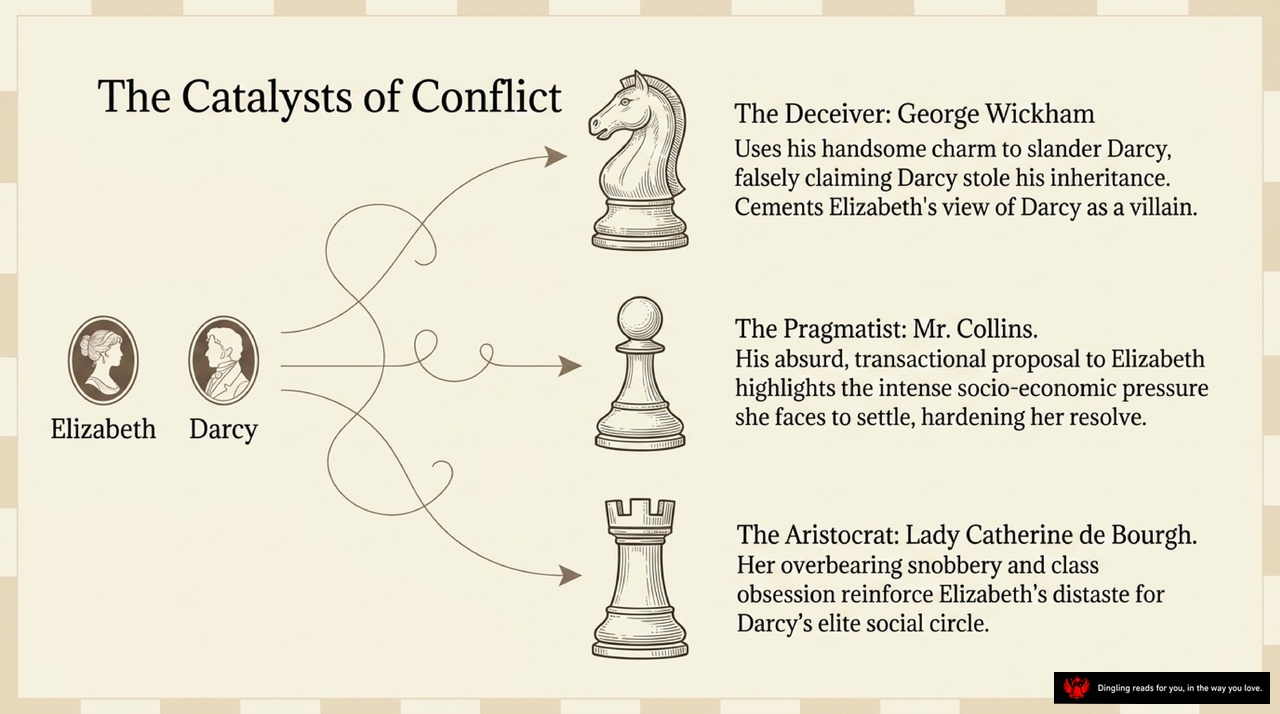
When we talk about the "Catalysts of Conflict" in Pride and Prejudice, we aren't just listing villains; we are looking at the three forces that almost destroyed the romance between Elizabeth and Darcy. Think of them as the three obstacles standing between true love and reality.
First, there is the Deceiver: George Wickham. He uses his handsome charm to slander Darcy, falsely claiming that Darcy stole his inheritance. This manipulation cements Elizabeth's view of Darcy as a villain, making her blind to the truth for a long time. It is a classic case of a smooth-talking charmer turning a decent man into a monster in the eyes of the public.
Then, we have the Pragmatist: Mr. Collins. His absurd, transactional proposal to Elizabeth highlights the intense socio-economic pressure she faces to settle, hardening her resolve. He represents the crushing weight of social expectations and the fear of being left alone, which forces Elizabeth to reject him not out of lack of affection, but out of a desperate need for dignity.
Finally, there is the Aristocrat: Lady Catherine de Bourgh. Her overbearing snobbery and class obsession reinforce Elizabeth's distaste for Darcy's elite social circle. She acts as the ultimate gatekeeper of the upper class, constantly reminding Elizabeth that she is not good enough for Darcy, thus creating a psychological barrier that Darcy himself initially believes is insurmountable.
These three figures—the liar, the opportunist, and the snob—work together to create the tension that drives the entire story. They force Elizabeth and Darcy to confront their own prejudices, their social standing, and their true feelings, ultimately proving that love requires fighting against every form of deception and constraint.

Look at this dramatic moment: "The Climax of Misunderstanding," specifically "The Hunsford Proposal." This is the turning point where everything changes. On the left, we see Darcy's approach. He proposes while simultaneously insulting her family and emphasizing her inferior connections. He focuses on his own internal struggle rather than his love. It's a complete failure of empathy. In the center, the image shows a shattered connection, symbolizing "A Complete Failure of Empathy." Both parties are left stunned, defensive, and deeply wounded. On the right, Elizabeth's reaction is a furious rejection. She accuses him of ungentlemanly behavior, citing his arrogance, his deliberate sabotage of Jane's happiness, and his cruelty to Wickham. This scene isn't just about a rejected marriage; it's about the collision of pride and prejudice. Darcy thinks he's being honest, but he's actually being cruel. Elizabeth thinks she's protecting her family, but she's reacting to deep-seated resentment. This explosion of broken glass represents the moment their relationship hits rock bottom, setting the stage for the eventual reconciliation.
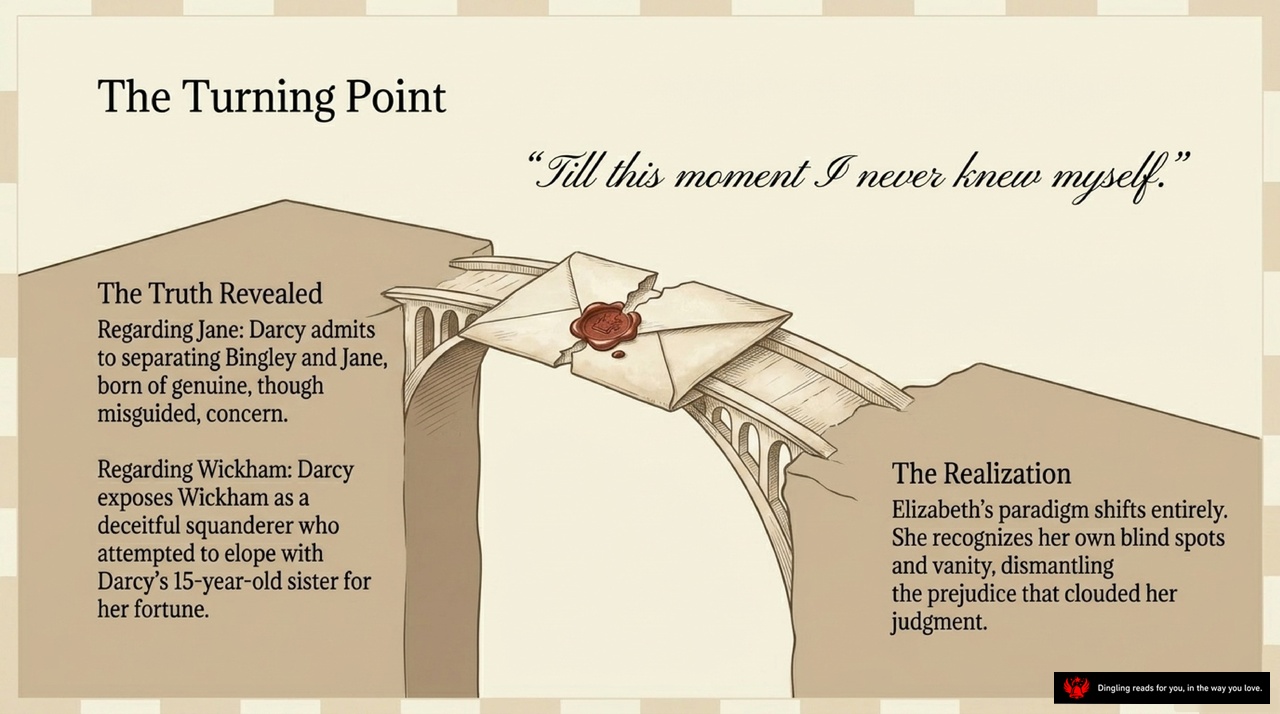
So, this is the moment everything changes. Look at that torn letter right in the center of the bridge—it represents the shattering of Elizabeth's worldview. Until this exact second, she claims she never truly knew herself. That's the core of her transformation.
On the left, we see "The Truth Revealed." Darcy finally admits he was the one who separated Jane and Bingley. It wasn out of malice, but out of a misguided concern for Jane's family's social standing. But more importantly, he exposes Wickham for the deceitful scoundrel he really is—a man who tried to elope with Darcy's young sister just to steal her fortune.
On the right, we see "The Realization." This is where Elizabeth's paradigm shifts entirely. She recognizes her own blind spots and vanity. She realizes that her prejudice was the cloud that blinded her judgment all along. She sees that she was wrong about Wickham's charm and right about Darcy's character. This letter is the catalyst that turns her anger into understanding, and her misunderstanding into love.

Look at this timeline of Elizabeth's transformation. It captures the entire arc of her journey from hostility to love. It starts with the Meryton Ball, where she views Darcy as insufferably proud after his refusal to dance. That initial insult plants the seed of her prejudice. But then comes the turning point at Hunsford Parsonage. After reading his letter, she realizes her hasty judgments were wrong and begins to recognize his true honor. This marks her Enlightenment.
Next, the Pemberley Visit changes everything. Awed by his estate and surprised by his newfound gentleness, especially how he treats her working-class relatives with respect, she feels a shift toward intrigue and respect. Finally, the Elopement Crisis forces her to confront reality. When the Bennet family's disgrace makes their union seem impossible, she realizes her true feelings. In that moment of crisis, her perception completely transforms, and she finally sees Darcy not as a proud stranger, but as the man she loves.
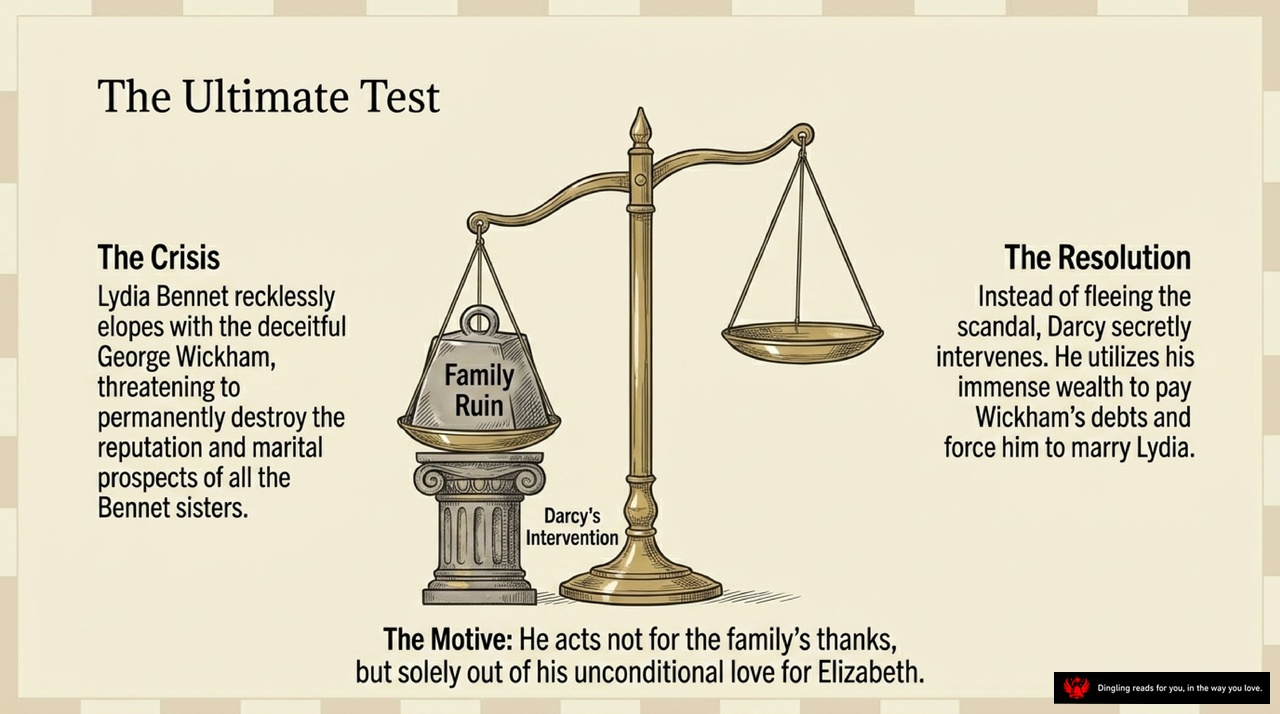
The Ultimate Test. On the left, we see the Crisis: Lydia Bennet recklessly elopes with the deceitful George Wickham, threatening to permanently destroy the reputation and marital prospects of all the Bennet sisters. This scandal weighs heavily, representing total Family Ruin. But look at the balance scale in the center. On the right, we see The Resolution. Instead of fleeing the scandal, Darcy secretly intervenes. He utilizes his immense wealth to pay Wickham's debts and force him to marry Lydia.
The image clearly labels this as Darcy's Intervention. But why did he do it? The motive, written at the bottom, is crucial. He acts not for the family's thanks, but solely out of his unconditional love for Elizabeth. This moment proves that his love was never about status or convenience; it was a selfless sacrifice. He chose to save her sister, even though it meant enduring Elizabeth's anger and risking his own reputation. This ultimate test of character transforms Darcy from an arrogant stranger into a true hero, securing not just Lydia's future, but the happiness of the entire Bennet family.
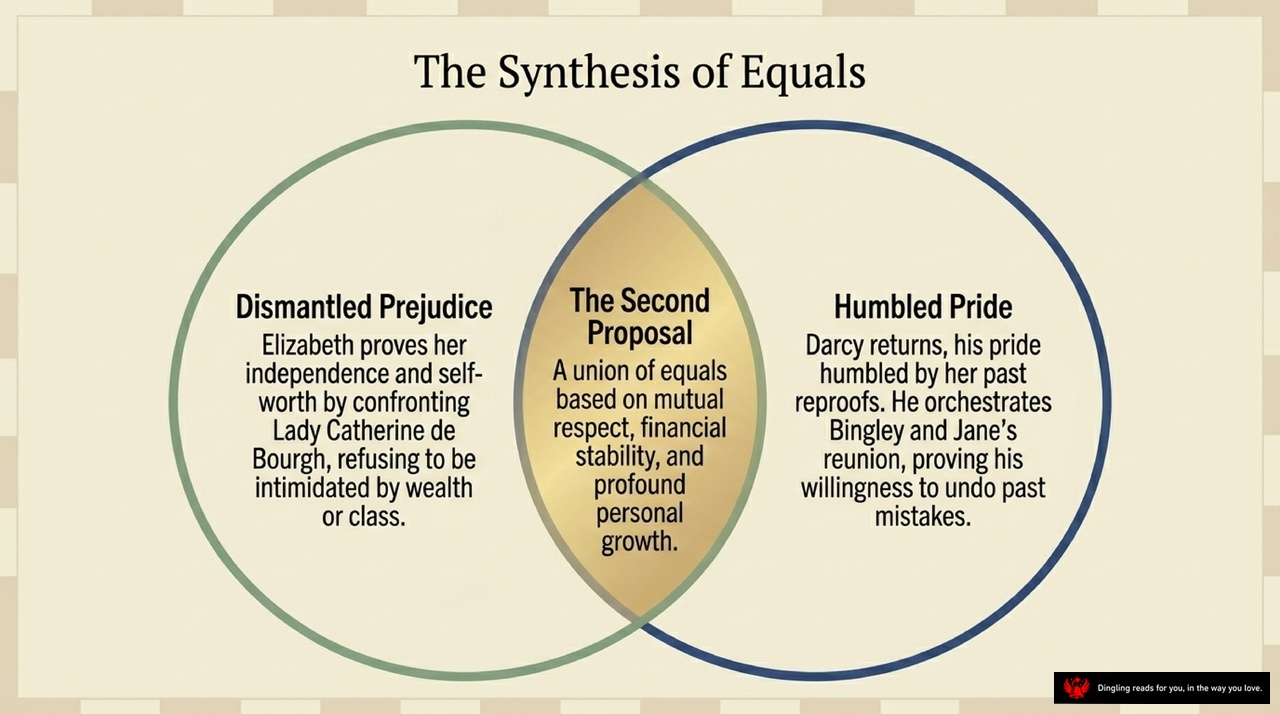
Today, we reach the heart of the story: The Synthesis of Equals. This isn't just a happy ending; it's the moment where two broken people finally build something real together.
Look at this Venn diagram. On the left, we have **Dismantled Prejudice**. This represents Elizabeth's journey. She proves her independence and self-worth by confronting Lady Catherine de Bourgh, refusing to be intimidated by wealth or class. She stands her ground, declaring that her marriage is her own business.
On the right, we see **Humbled Pride**. This is Darcy's transformation. He returns, his pride humbled by her past reproofs. He orchestrates Bingley and Jane's reunion, proving his willingness to undo past mistakes and fight for the happiness he once ruined.
But the magic happens in the middle, in the intersection: **The Second Proposal**. This is the union of equals based on mutual respect, financial stability, and profound personal growth. It's no longer about status or obligation; it's about two fully realized individuals choosing each other. Darcy has paid his debt to society and his own conscience, while Elizabeth has found her voice. They meet as partners, not as a master and a servant, finally writing the truth of their love.

Ultimately, Pride and Prejudice is not merely a romance, but a masterful critique of human cognition. It reveals that true connection is impossible until we dismantle our inherited ego and our hasty judgments, proving that ideal love requires both the humility to admit our faults and the courage to change.
If our deepest prejudices are often disguised as our sharpest intuitions, what truths are we currently blinding ourselves to in the name of our own pride?