
Radical Focus: Complete Chapter-by-Chapter Summary

Welcome to the world of Radical Focus. Today, we're diving into a transformative journey led by Christina Wodtke, where the path from chaos to clarity begins with a single, powerful idea.
Imagine a team of passionate founders standing in a modern office, brainstorming on a whiteboard filled with ideas like "Innovation," "Management," and the central heartbeat of their mission: "STARTUP." This is the scene from our story of TeaBee. It started with two friends, Hannah and Jack, who shared a deep love for high-quality tea but found the market filled with mediocre options. Their vision was simple yet bold: bring real, artisanal tea to everyday places like restaurants and cafes.
But the road wasn't smooth. They faced a classic startup struggle: a mismatch between their high standards and the market's reality. While they had suppliers, they struggled to find buyers who cared about quality. The pressure was mounting. Hannah wanted to sign a major supplier deal to secure revenue, but Jack feared it would compromise their core mission of delivering the best tea. The team was torn, anxious, and drifting apart.
That's when the breakthrough happened. They realized they needed more than just good intentions; they needed a system to align everyone's energy. Enter OKRs—Objectives and Key Results. This framework became their compass. Instead of getting lost in endless debates or scattered tasks, they focused on one clear Objective: proving the value of their premium tea to restaurant suppliers. They broke this down into measurable Key Results, like achieving a 70% repeat order rate and optimizing their online ordering system.
The magic of OKRs transformed their culture. Confusion turned into collaboration. Instead of working in silos, every engineer, designer, and salesperson understood how their specific tasks fueled the company's main goal. They stopped hiding their potential and started aiming for ambitious targets that pushed them to grow. From struggling with manual order entry to launching a seamless digital platform, their focus drove tangible results.
This story teaches us a vital lesson for any team or individual: success isn't about doing everything; it's about doing the right things with radical focus. By setting a clear direction and measuring progress with honesty and courage, you can turn uncertainty into momentum and build something truly extraordinary.

Look at this chart: "The Gravity of Distraction." It perfectly captures why high-performing teams often feel like they're running in circles. On the left, we see "The Trap." Our human survival instincts are hardwired to pull us toward the urgent. Emails, flashing notifications, and "daily operational fires" hijack our attention. Without a structural system to protect what truly matters, teams inevitably dilute their efforts across too many priorities, chasing urgency instead of impact.
But on the right, there is "The Solution." It's called Radical Focus. This isn't about working harder; it's about being deliberate. It's a framework designed to strip away the non-essential and fiercely protect your highest-leverage goals. Think of it as building a shield around your most important work so that the gravity of distraction can't pull you off course.
In the next section, we're going to see how TeaBee faced this exact trap and used Radical Focus to not just survive, but thrive.

Imagine a world where your team is a well-oiled machine, not a group of people spinning their wheels in different directions. That's exactly what happens when you master the OKR formula. As we saw with TeaBee, the journey from chaos to clarity starts with one simple equation: one powerful Objective plus three Key Results equals Success.
Think of your Objective as the destination on a map. It's qualitative, inspirational, and time-bound—the "what" you want to achieve. It's the dream that wakes you up in the morning. But having a destination isn't enough; you need to know if you've actually arrived. That's where your Key Results come in. These are your GPS coordinates. They are quantitative, difficult, and measurable. They answer the question: "How do we know we achieved it?"
In the early days, TeaBee struggled because they had a vision but no way to measure their progress against it. They were busy doing things, but were they doing the *right* things? By setting a clear Objective and backing it up with three specific Key Results, they stopped guessing and started executing. It shifted their entire culture. Instead of arguing over endless details or getting lost in daily tasks, everyone aligned around a single, challenging goal.
The magic of OKRs isn't just about setting targets; it's about creating a rhythm of focus and celebration. When you define what success looks like in measurable terms, you remove the ambiguity that paralyzes teams. You give everyone the freedom to figure out the "how," while staying locked in on the "what." It turns individual effort into collective momentum. So, ask yourself: What is your true destination this quarter? And what are the three undeniable proofs that you've made it there?

When we talk about setting company objectives, most of us fall into a trap we call "The Output Trap." We think setting a goal means listing metrics or tasks. But as the slide clearly shows, that's not an objective at all. Look at the left column: "Increase sales by 30%," "Launch the new app," or "Double our user base." These aren't inspiring directions; they are just outputs or tasks. They tell you *what* to do, but not *why* it matters or what the ultimate impact is. They lack context and inspiration.
Now, look at the right column. This is what a truly great objective looks like. It's about radical focus. Instead of saying "increase sales," a strong objective says, "Capture the South Bay direct-to-retail coffee market!" It uses language that your team actually understands and feels passionate about. It defines a clear scope and paints a picture of success.
Think about the difference. A weak objective is a number you chase, often leading to short-term fixes. A strong objective is a mission you fight for. It focuses on qualitative impact, like creating a product users actually love, or transforming how people in Palo Alto use coupons. It's action-oriented and ambitious.
The key takeaway here is simple but powerful: set only ONE company objective at a time. When you try to do too much, you dilute your focus. By locking in a single, inspiring goal with a clear scope, you ensure absolute alignment across every function in your company. Everyone, from engineering to sales, knows exactly where they are heading and why their work matters. That is the anatomy of a great objective.

Great Key Results push your team past their perceived limits, but here's the catch: every single one must start with a 5 out of 10 confidence level. Why? Because aiming for 100% is actually sandbagging—it's too easy and kills innovation. On the flip side, aiming for 10% is delusional; the goal is impossible and will crush your team's morale. The sweet spot right in the middle is exactly 50%. When you set a goal where you have a coin-flip chance of success, you force maximum effort, focus, and creativity. That 5/10 confidence rule is the secret sauce for unlocking real breakthroughs.

The Engine: The 4-Quadrant Canvas isn't just a chart; it's your team's command center. Think of it as a single, highly visible dashboard updated weekly, designed to keep your OKRs from getting buried in the daily operational noise that inevitably creeps in.
Let's break down how this canvas keeps us focused. In the top right, we have Q1: Intention. This is where we define the core OKR and measure our confidence in hitting it. It's the anchor. Moving clockwise to the top left, Q2 is Action—your weekly priorities. This is the "what" we need to do this week to move the needle.
Below that, Q3 is the Pipeline, looking at the next four weeks. It's about maintaining momentum and ensuring we have a runway of work lined up. Finally, in the bottom right, Q4 is Protection. This quadrant tracks our health metrics, ensuring that while we push hard, we aren't burning out our team or compromising the quality of our product.
By filling out this canvas every week, we transform abstract goals into a clear, actionable rhythm. It stops us from just talking about our targets and forces us to visualize exactly how our daily work connects to our quarterly wins.

Quadrant 1 is the anchor of our board, and unlike static KPIs, it updates weekly based on reality. Our core objective here is clear: prove the value of our premium tea to restaurant suppliers. To make that happen, we've defined three key results. First, we need an 85% repeat order rate. Second, we aim for 20% of self-serve reorders. And third, we're targeting $250k in revenue.
But here's the real game-changer: look at the confidence scores next to each metric. This isn't just about reporting raw numbers; it's about tracking our confidence out of 10. When our confidence on the repeat order rate drops to 4, it instantly forces a strategic conversation about *why* we're slipping. Conversely, when our confidence in self-serve reorders climbs to 6, it signals momentum. By focusing on this shift, we stop hiding behind excuses and start tackling the actual blockers in our path.

Look at this slide: "Quadrant 2: Weekly Priorities." It's not about making a massive to-do list; it's about being ruthless with your time. The text clearly states, "Only list the 3 to 4 tasks that directly move the OKR needle."
This is where the magic happens. In our story, Hanah and Jack realized they were drowning in busy work. They needed a filter. That's why we introduced "The Rule of 3." As the slide emphasizes: "If you have more than 3-4 priorities, you have none." It sounds harsh, but it's the truth. When you try to do everything, you actually do nothing.
So, how do you apply this? Every single task on your P1 "Must Do" list must directly support your Q1 Target. Look at their example: signing contracts, finalizing system requirements, and interviewing candidates. These aren't just random tasks; they are the specific actions that prove their Objective is being met. Meanwhile, things that are nice to do but don't drive the core goal—like drafting a customer service job description for now—move to P2 "Should Do," or get pushed aside entirely until the critical path is clear.
This discipline transforms chaos into focus. By sticking to just three or four high-impact tasks a week, your team stops spinning its wheels and starts building real momentum toward the finish line.

On the left, we see "The Pipeline," a four-week roadmap designed to keep Marketing, Tech, and Sales aligned. This isn't just about planning; it's about preventing chaos. By visualizing projects needing cross-functional preparation weeks in advance, we ensure no team is caught off guard when deadlines hit. It turns uncertainty into a synchronized effort.
On the right, the slide shifts to "Health Metrics." These are your vital signs. While you chase your OKRs, you must protect Customer Satisfaction, System Uptime, and Team Morale. Notice that Team Morale is currently flashing yellow? That's your early warning system. If these indicators flash red, you pivot immediately. You can't drive the car if the engine is overheating.
This slide perfectly captures the balance between aggressive execution and sustainable health. You push hard on the pipeline to deliver results, but you never ignore the metrics that keep your team and your systems alive. It's the difference between burning out and building a resilient, high-performing organization.

The Weekly Rhythm isn't just a schedule; it's the heartbeat of a high-performing team. As we see here, the cycle starts on Monday morning with **Setting the Intention**, where we lock in our commitments. But it's not enough to just plan; we need **Monday Accountability** to keep us on track.
Once the week kicks into gear, the focus shifts to **Execution**. This is where we dive deep into our **P1 tasks**, ensuring that our most critical work gets the attention it deserves. By mid-week, we are building momentum, turning our intentions into tangible results.
Then, the week winds down with **Friday Celebration**. This isn't just about partying; it's about **Sharing the Wins**. We take a moment to demonstrate our progress, celebrate our victories, and reinforce the behaviors that got us there. Finally, we **Repeat** this cycle. It's about continuous learning and adjustment, ensuring that every week builds on the last.
The core message here is simple: OKRs die when they are set and forgotten. They only thrive through this strict, continuous cadence of commitment, execution, and celebration. By locking in this rhythm, we transform good intentions into consistent, measurable results.

Look at this clock. It's not just telling time; it's the heartbeat of our weekly rhythm. This slide is all about the Monday Commitments—a high-impact, 15-minute meeting designed to keep us accountable without turning it into a boring status report.
Let's break down how we spend this time. First, we check confidence. We look at our OKR scores: have they shifted? If they have, why? This is our quick pulse check on morale and belief. Next, we check health. Are any of our key metrics flashing yellow or red? We need to catch issues early before they become fires.
But the real meat of the meeting is the Forward Focus, which takes up three-quarters of our time. We ask ourselves: Are this week's top-priority tasks strictly aligned with our Key Results? We are cutting out the noise.
Crucially, remember this rule at the bottom: this is not a status report. Do not list everything you did last week. That's a waste of time. Instead, discuss only what is blocking our OKRs and how the team can support each other to remove those obstacles. We don't just report what we did; we decide what we will do together to win this week.

Look at this "Friday Wins" slide. It's the secret weapon for keeping a startup team sane and motivated. In the book, we see how Hanana and her team at TeaBee almost burned out during their toughest quarter. They were drowning in manual order entry and internal fights, ready to quit. But then, they introduced this exact ritual: the Friday celebration.
Think about the three pillars on your screen. First, "Demonstrate." In those chaotic weeks, engineers were just coding in silence. But on Fridays, they finally showed off their work—code, prototypes, closed deals. It wasn't just about output; it was about visibility. Everyone saw how hard the others were working. That's the "Empathize" part. It built a bridge between departments that didn't exist before.
And finally, "Recharge." Remember when they lost a major client? The pressure was crushing. But instead of a blame game, they served drinks and snacks. They celebrated the effort, even when the Key Results weren't fully hit yet. That simple act of positive reinforcement did something magical. It turned a day of potential despair into a day of connection. Within a month, that toxic anxiety vanished. The team went from fighting each other to collaborating on a shared mission.
So, don't just treat Friday as a workday. Use it to reset, to celebrate small wins, and to remind everyone why they started. That's how you turn a grueling week into a fuel for the next one.

Here is the spoken-word script for Slide 12, tailored for an American audience:
"Let's talk about why most goals fail, and more importantly, how to fix them. We've all been there: setting ambitious targets only to watch them slip away. The good news is there are five specific traps we can avoid.
First, the trap of thinking everything is a priority. When you try to do it all, you actually do nothing. The solution? Pick exactly one overarching goal and stick to it. Second, communication breakdown. If you say something once and expect everyone to get it, you're wrong. You need weekly repetition until the message is truly heard.
Third, the lack of an execution plan. Willpower isn't enough; you need a system. Anchor your work to a clear framework like the 4-Quadrant Canvas. Fourth, letting the urgent override the important. That red 'Urgent' button always wins, but you have to protect your time. Use your Monday commitments to guard your focus on what actually matters. Finally, the tendency to give up easily. When things get tough, that's when you need resilience. Build that momentum with Friday celebrations to keep the team inspired.
By avoiding these five traps—focusing on one goal, communicating relentlessly, planning your execution, prioritizing the important, and celebrating small wins—you transform your team from a group of dreamers into a machine that actually delivers results."
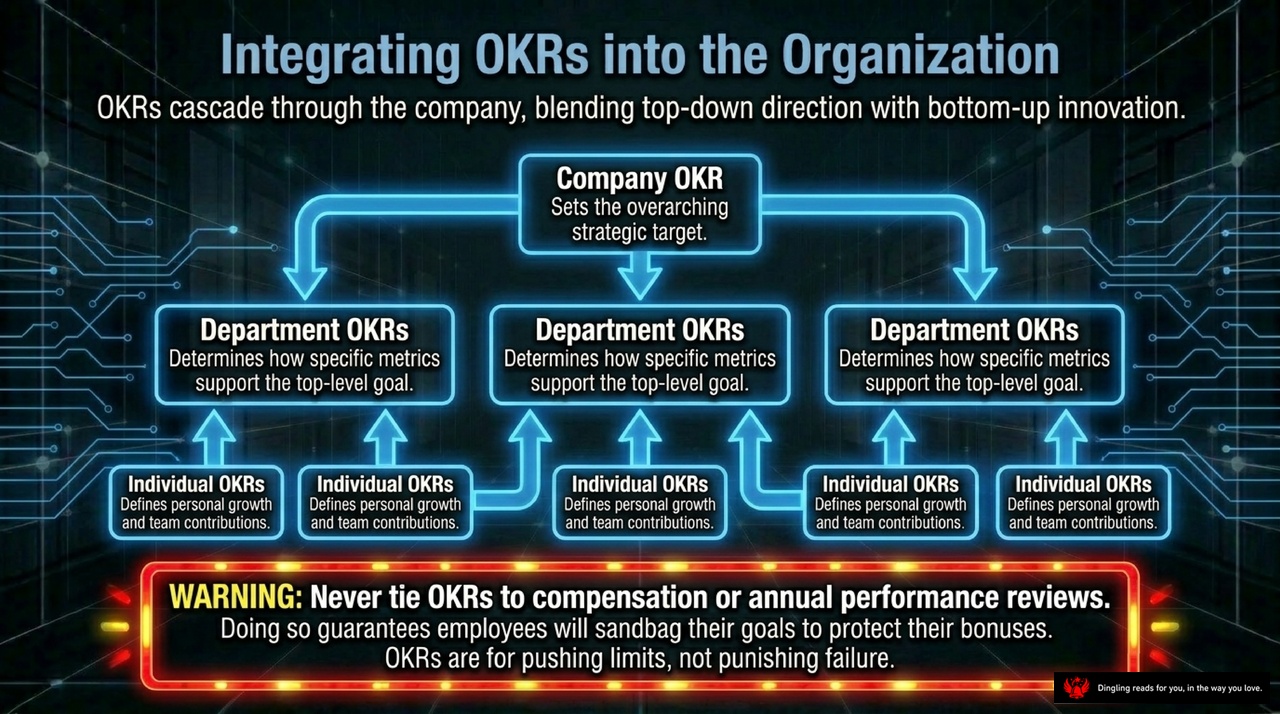
Integrating OKRs into the Organization isn't just about drawing a flowchart; it's about creating a living system where top-down strategy meets bottom-up innovation. As our slide shows, the magic happens when Company OKRs cascade down, setting the overarching target, while Department and Individual OKRs rise up to define exactly how specific metrics support that vision. It's a two-way conversation where every employee understands how their personal growth and team contributions directly fuel the company's strategic goals.
However, there is one non-negotiable rule highlighted in the warning at the bottom: never tie OKRs to compensation or annual performance reviews. If you do, you guarantee that employees will sandbag their goals—deliberately lowering their targets—to protect their bonuses. The whole point of OKRs is to push limits and encourage ambitious thinking, not to punish failure or dictate pay. When goals are decoupled from money, people stop playing it safe and start truly innovating. This psychological safety is the foundation that allows a team to focus on what's actually important without the distraction of fear.

Imagine a world where doing everything is the same as doing nothing. That's the trap we all fall into. When every task feels like a priority, none of them actually get the attention they deserve. So, how do we break free? The answer lies in what we call "Radical Focus."
It's about stripping away the non-essential. Think of it as clearing the clutter from your desk so the important work can finally breathe. You pair an inspirational Objective with hard, measurable Key Results, and then you protect that focus with a ruthless weekly cadence of commitment and celebration. This rhythm keeps the team aligned and prevents drift.
By doing this, teams can finally bridge the massive gap between having a brilliant strategy and actually executing it every single day. It's not about working harder; it's about working on the one thing that matters most. If everything is a priority, nothing is. So, ask yourself: what is the ONE goal your team must achieve this quarter to make everything else irrelevant? That is where your true success begins.