
Reaching the Brink of Life: Complete Chapter-by-Chapter Summary

Welcome to our book club session. Today, we are diving into *Reaching the Brink of Life: Answering My Own Questions* by Yang Jiang.
The cover image sets a profound tone: a vast ocean at twilight, with rugged rocks framing the horizon under a golden sky. It captures the essence of the book—a century-long meditation on existence, the duality of human nature, and the ultimate tempering of the soul.
Yang Jiang begins by asking a question that has haunted humanity for millennia: What happens when we die? She explores the skepticism of modern thinkers who claim that death is the end, comparing life to a candle burning out or a blade of grass withering. But she challenges this view, arguing that metaphors cannot define reality. She points out that while a candle's flame dies with the wood, the fire itself can pass to new fuel. Similarly, our physical bodies may perish, but the essence of our life—the soul—persists.
The book delves deep into the conflict between our physical desires and our spiritual conscience. It reminds us that true value isn't found in material wealth or fleeting pleasures, but in the enduring light of our moral compass. Ultimately, Yang Jiang invites us to view life not as a race to the grave, but as a journey of refining our souls, preparing us for an existence that transcends the physical world.

Life is a journey that inevitably leads us to the edge of existence. We all face an inescapable law: birth, aging, illness, and finally, death. But here lies the crux of our human dilemma. The materialist assumption suggests that when the body turns to earth and the candle's flame goes out, nothing remains. It's a stark, cold view: "Nothing remains."
Yet, this leaves us with a lingering question that has haunted humanity for millennia. Is life merely the burning of fuel, or is it the passing of a flame? If the physical vessel is discarded, what happens to the conscious spark that piloted it?
Look at that transition in the image. On the left, we have the heavy, dark rocks of our physical reality—the body, the material constraints. But on the right, there is a burst of golden light, symbolizing that which cannot be extinguished. This slide isn't just about death; it's about the threshold of existence. It challenges us to ask: when the dust settles, does the essence of who we are truly vanish, or does it transcend the physical form? The answer to this question defines everything we believe about life's meaning and our place in the universe.

Look at this diagram. It illustrates a profound shift in how we view the universe: moving from chaos to a grand, deliberate design. The image breaks this down into three concentric layers, starting from the outermost ring labeled "Cosmic Law." This represents the idea that the universe isn't a place of random accidents; it is governed by precise, universal, and eternal scientific laws. Nature does nothing in vain. The sheer order we see—from the physics of stars to the complexity of life—suggests a cosmos capable of producing such flawless mechanics cannot be a product of mere coincidence.
Moving inward, we see "Biological Order." This reinforces the point that life itself follows these strict, unbreakable rules. It's not chaotic; it's engineered. Finally, at the very center, shines "The Mandate of Heaven." This is the crucial link. Just as matter follows the laws of physics, human existence follows a deliberate, unseen architecture. The text argues there is a Mastermind behind this design. When we look at the precision of nature, we aren't just seeing blind chance; we are witnessing the hand of a higher power. This "Mandate of Heaven" isn't about superstition; it's the rational conclusion that a universe this orderly must have a purpose and a creator. It challenges the modern illusion of randomness and invites us to see the divine order woven into the fabric of reality.

Today's slide breaks down the very architecture of who we are, titled "The Anatomy of Being." It visualizes us as a three-layered structure, starting from the ground up. At the foundation, we have "The Flesh," or what the book calls "The Vessel." This is our biological reality—the part driven by survival, instinct, and those earthly desires we all share. It's the physical engine that keeps us alive but also pulls us toward immediate gratification.
Moving up, we find "The Personality," labeled here as "The Imprint." Think of this as the fixed traits we are born with—our temperament, our intellect, the specific quirks that make us unique. Just like no two leaves on a tree are identical, no two personalities are the same. These innate characteristics remain largely unchanged throughout our lives, shaping how we react to the world.
But at the very top, shining like a sun, lies "The Spiritual Conscience," or "The Compass." This is the most critical layer. It represents the transcendent core unique to humanity—the seat of our moral compass, our capacity for truth, and our ability to truly empathize with others. While our flesh seeks pleasure and our personality dictates our style, it is this spiritual conscience that allows us to rise above our instincts and choose what is right. It is the defining difference between a human and an animal, the invisible force that guides us toward our highest potential.
Welcome to the next chapter, where we confront the harsh reality that life is inherently difficult. It's a truth we often try to ignore, but one that shapes every single one of us. Being honest can make you a target; being talented can breed jealousy; and being kind can be mistaken for weakness. From the struggles of the poor to the hidden anxieties of the wealthy, suffering is the common denominator of our existence. It's not just about external disasters, but the internal conflict between our deep-seated desires and the moral compass we carry within.
But here is the crucial shift in perspective: suffering isn't just a punishment; it's a necessary forge. Nature doesn't create things in vain. Just as grinding spices makes their aroma stronger, life's hardships are what refine our character. Without this friction, our base instincts would simply overrun our better nature. This is where the real work begins. It's not about enduring pain passively, but actively using it to polish our soul. Through this process, we learn to control our impulses, cultivate empathy, and build a resilient spirit that can withstand life's storms.
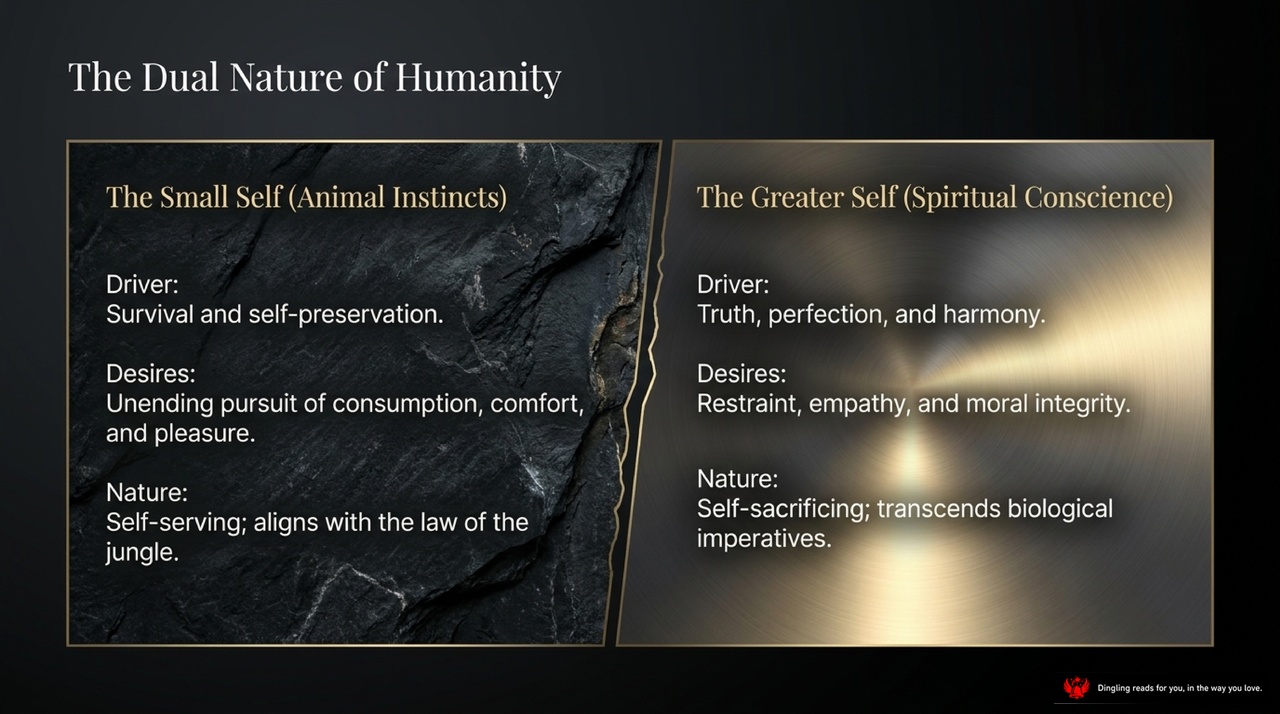
Ultimately, the goal of this struggle is self-cultivation. It's about moving beyond the "small self"—driven only by survival and pleasure—and aligning with the "greater self," guided by truth and integrity. When we choose to temper our desires and practice virtue in everyday moments, we transform our suffering into growth. We don't just survive the hardships; we use them to become better versions of ourselves, creating a life that has meaning far beyond the material world.

The Internal Battlefield isn't just a metaphor; it's the daily reality of every human life. Look at that seesaw in the center of the screen. On one side sits the heavy, dark weight of our physical nature—the "Flesh." This is where our base instincts live: the hunger for comfort, the craving for pleasure, and the endless pursuit of survival and status. It's direct, urgent, and powerful, constantly pulling us toward immediate gratification.
But on the other side, we have something far lighter, yet infinitely stronger: the "Spirit." This is the realm of our conscience, our moral compass, and that inner voice we call the "Greater Self." It doesn't shout; it whispers. It asks us to be honest even when no one is watching, to show kindness even when it costs us something, and to stand firm against the tide of vanity and self-deception.
The slide highlights three distinct outcomes of this eternal tug-of-war. First, there is **The Conflict**. This is the soul tethered to the flesh, a constant war between our biological desires and our higher moral restraints. We all feel this friction. Second, there is **The Surrender**. When the Flesh wins, the ego inflates. We start lying to ourselves, covering our flaws with vanity, and getting lost in a world of self-deception. That's a dangerous place to be.
But the most powerful outcome shown here is **The Triumph**. This happens when the Conscience wins. When we choose the Spirit over the Flesh, we transcend our base instincts. We stop being slaves to our impulses and start living as our "Greater Self." It is in these moments of victory—when we choose integrity over profit, or compassion over indifference—that we truly achieve our humanity. This internal battle defines us, and every choice we make on that seesaw determines the height of our character.
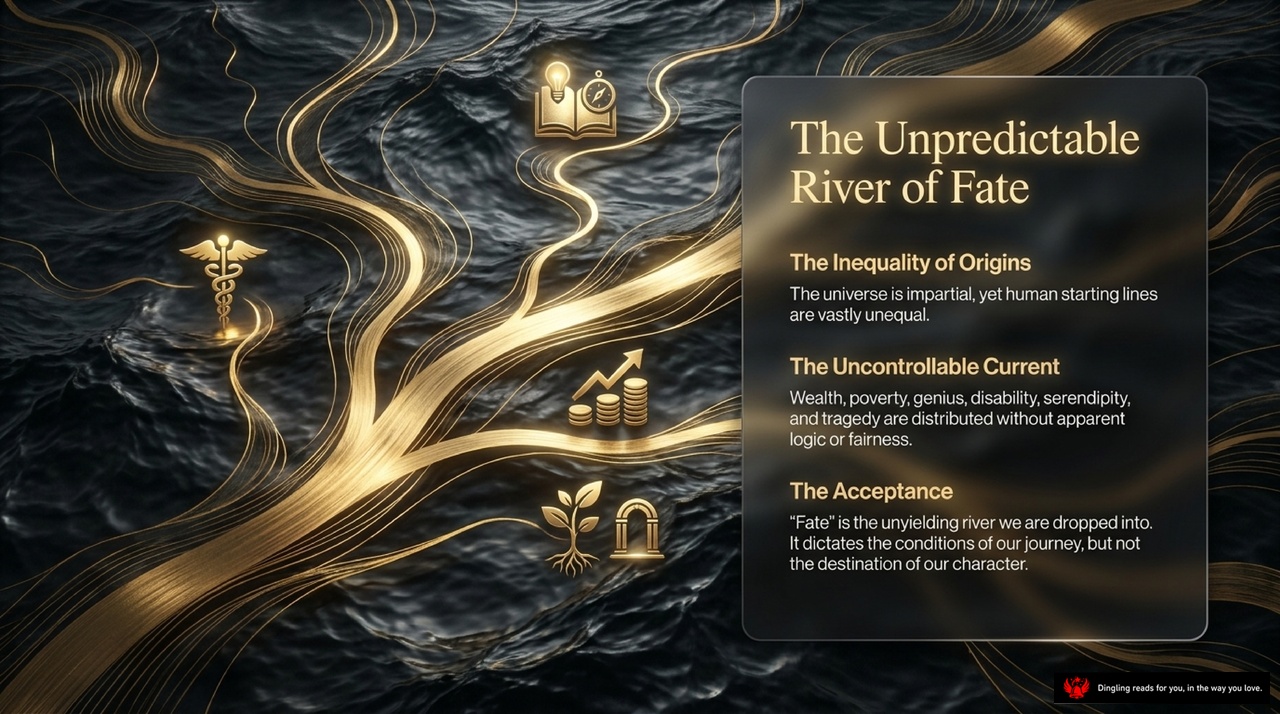
Look at this image. It paints a stark, beautiful reality: we are all dropped into the same unyielding river of fate. The text on the slide breaks this down into three powerful truths. First, the "Inequality of Origins." The universe is impartial, yet our starting lines are vastly unequal. Some are born with gold in their mouths; others sink into poverty the moment they take their first breath. Second, the "Uncontrollable Current." Wealth, genius, disability, and even tragedy are distributed without any apparent logic or fairness. It's chaotic, and it's not something we can negotiate.
But here is the most important point on this slide: "The Acceptance." The text reminds us that fate dictates the conditions of our journey, but it does not dictate the destination of our character. This is the crucial distinction. We cannot choose our river, but we can choose how we swim.
Think about this: if you believe that fate controls everything, your life is just a passive reaction to external forces. But if you understand that while the river is unpredictable, your character is yours to shape, everything changes. As we've discussed, your soul—your conscience and your moral compass—is the only thing that truly belongs to you. No matter how turbulent the current gets, whether you face immense privilege or crushing hardship, your response defines who you are. The river flows where it must, but you decide whether to drift along with the current or to steer your own course with integrity. That is the only freedom we truly have.

Imagine life as a ship navigating a chaotic, stormy sea. You cannot choose the river of Fate, but you absolutely control how you navigate its rapids. This is the essence of free will.
The image before us captures this perfectly: a golden rudder cutting through the dark waves. This is the "Rudder of Free Will." While the currents of life—our circumstances, our birth, even our personality—are often mandated by forces beyond our control, our moral choices are authored entirely by the self.
Think about the crucial moments in your life. Those times of crisis, temptation, or deep suffering. In those exact seconds, you face a fork in the road. Do you yield to the current, letting your instincts and desires drag you along? Or do you steer against it, using your conscience to guide the ship?
This is where character is forged. We cannot choose the storm, but we decide how we react to it. Every time you choose integrity over profit, or courage over fear, you are adjusting that golden rudder. These small, often invisible decisions are what shape your destiny.
Remember, the struggle between your physical desires and your spiritual conscience happens constantly inside you. But you are the captain. You hold the wheel. By consistently choosing the path of your conscience, you don't just survive the storm; you define who you are. Your character is not written in the stars; it is written by your choices.

Look at this striking image titled "The Illusion of Civilization." It depicts a timeline of human achievement—from the pyramids of Egypt to the Great Wall, and finally to our modern skyscrapers—all shattering into dust. This visual perfectly captures a profound question: Are our greatest monuments truly our legacy, or just a fleeting illusion?
The slide breaks this down into three critical points. First, "The Fleeting Monuments." It reminds us that empires rise and crumble; millennia of progress ultimately fade into dust. Second, "The Cost of Greatness." It asks us to consider that history's marvels were often built upon the blood, tears, and exploitation of the voiceless masses. We must ask: at what price did we build our civilization?
Finally, the slide presents a radical conclusion under "The Misdirection." It suggests that if civilization is ultimately impermanent and deeply flawed, then building it cannot be the ultimate purpose of the universe's grand design. This challenges our deepest assumptions. If our creations are temporary and our foundation is built on suffering, then chasing material grandeur might be a distraction from something more enduring.
This aligns with a core truth from the book: the true value of humanity isn't found in the structures we leave behind, but in the spiritual quality we cultivate within. As the text emphasizes, the real purpose of life isn't to create hollow monuments that will eventually vanish, but to refine the soul. It is about awakening our inner conscience, mastering our desires, and striving for moral integrity. When we focus on perfecting our character and living with integrity, we transcend the cycle of rise and fall. Our legacy becomes our inner character, which is far more resilient than any stone or steel. So, let's stop chasing the illusion of permanence and start building a life of genuine spiritual substance.
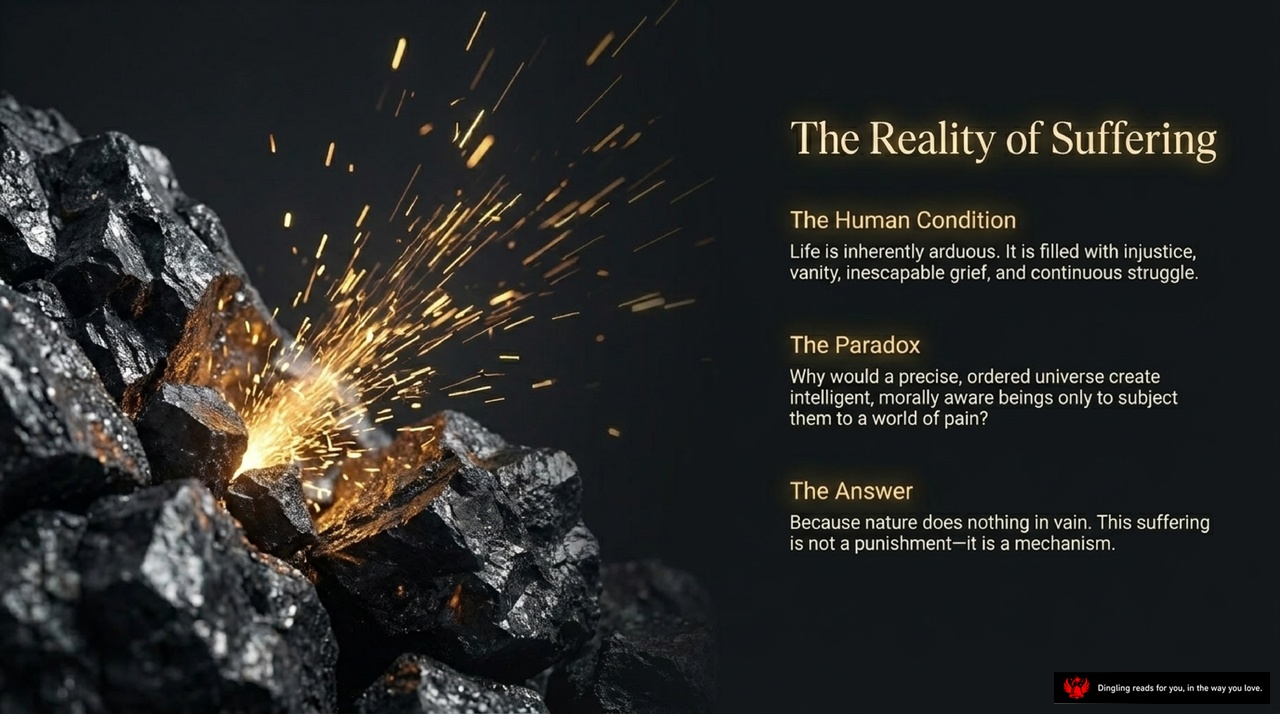
The Reality of Suffering isn't just a philosophical concept; it's the raw texture of our daily lives. Look at the sparks flying from the coal—it's a powerful metaphor for what we're discussing: pain isn't a mistake; it's the friction that creates something new.
First, let's look at the human condition. Life is inherently arduous. We are constantly surrounded by injustice, vanity, and an inescapable grief that feels like a heavy cloak we can't shake off. You might ask, "Why would a precise, ordered universe create intelligent, morally aware beings only to subject them to a world of pain?" That is the great paradox. It feels unfair, doesn't it? Why do we suffer?
But here is the answer that changes everything: nature does nothing in vain. This suffering is not a punishment handed down by a cruel god; it is a mechanism. Think of it like the sparks in the image. The friction is necessary to ignite the fire. Our struggles, our grief, and our injustices are the sparks that forge our character. Without this resistance, we would never discover our true strength or our moral compass.
In the book, the author argues that this "suffering" is actually the furnace where our soul is refined. If we were to live without any obstacles, without any pain, we would remain just like animals, driven solely by our basic instincts for food and pleasure. It is the very act of struggling against these instincts, of choosing kindness when it's hard, and of enduring injustice without losing our hope, that proves we are truly human.
So, when you feel the weight of the world pressing down on you, remember this: you are not being broken; you are being built. The pain you feel today is the fire that will eventually turn you into something stronger, something resilient, and something truly magnificent. The reality of suffering is the reality of becoming.

Life is often described as a journey, but today we're looking at it through a much more powerful lens: a crucible. Think of your life not as a straight line, but as a three-stage process of transformation.
First, we have the Input. This is the raw material we are born with—a mix of our base instincts and that small, flickering spark of spiritual conscience. It's our unrefined state, like rough ore waiting to be worked.
Then comes the Catalyst. This is the Forge. Life's heartbreaks, injustices, and daily struggles act as the fire and the hammer. It's the intense pressure we face that forces us to change. Without this heat, nothing transforms.
Finally, we reach the Output. This is the Refinement. Through enduring pain and making difficult moral choices, the impurities of our ego are burned away. What remains is a tempered, resilient soul.
This "Crucible Paradigm" suggests that suffering isn't just something we endure; it's the very mechanism that forges who we truly are. It turns raw potential into something strong, valuable, and enduring.

Today, we move from the internal struggle of the spirit and flesh to the grander stage of human existence. As we've seen, our lives are a constant negotiation between base desires and our higher moral conscience. But why does the universe give us this unique potential at all?
The slide before us outlines "The Art of Self-Cultivation" as a cycle of Observation, Restraint, and Action. This isn't just about discipline; it's about realizing what makes us truly human. We are called "the wisest of all creatures" not because of our bodies, but because of our ability to transcend them. Unlike animals who are driven solely by instinct, we possess the unique capacity to seek truth, create culture, and pursue justice.
Look at the core of our humanity: it's not just about survival. It's about the tools we build, the stories we tell, and the moral lines we draw. We can choose to be better than our impulses. We can stand up for fairness even when it's difficult. This pursuit of goodness is what separates us from the rest of nature.
However, this potential comes with a heavy cost. Life is inherently difficult. We face suffering, injustice, and the constant pull of our own selfish desires. The text reminds us that life is "bitter," and this bitterness is the very furnace in which our souls are forged. Without the challenge of overcoming our flaws and the pain of making hard choices, we would never rise to our full potential.
So, how do we navigate this? The answer lies in the balance shown in our infinity symbol. We must practice "Ruthless Honesty" with ourselves, cutting through our own self-deception to see the truth. We must apply "Harmonious Restraint," guiding our desires without violently suppressing them. And most importantly, we must commit to "The Daily Practice." Self-cultivation isn't a grand, one-time event; it is the quiet, continuous alignment of our daily actions with moral truth.
The ultimate goal of all this struggle is to realize our true value. We are not defined by our wealth, status, or even our physical bodies. Our true worth is found in the awakening and refinement of our spiritual conscience. When we choose kindness over greed, integrity over convenience, and service over self-interest, we are fulfilling our purpose as "the wisest of all creatures."
In the end, life is a journey of soul training. Every challenge, every temptation, and every moment of choice is an opportunity to polish our character. By embracing this path of self-cultivation, we transform our suffering into strength and our limitations into opportunities for growth. We don't just live our lives; we refine them, step by step, until we become the best version of ourselves.

Look at the striking image behind us: a dark, cracked surface illuminated by veins of gold. This isn't just art; it's a powerful metaphor for the human condition we've been exploring. The title of this slide, "The Ledger of the Soul," captures the essence of our journey so far.
Think of your life as an invisible account. Every time you choose to give in to a base desire, you make a deposit in the ledger of your soul. Conversely, every time your conscience triumphs over temptation, you make a withdrawal of sorts, refining your character. These aren't just fleeting moments; they leave a permanent imprint.
Remember our discussion on the conflict between the physical body and the spiritual soul. While our flesh and bones are temporary—eventually turning to ash—the quality of our soul is what truly matters. Whether we degrade ourselves through selfishness or refine ourselves through virtue, that alteration is irreversible. The physical body is merely the tool, the intermediary, used to test and forge that enduring spirit.
In the end, we are all holding this ledger. The true consequence of our lives isn't measured by what we accumulate in this world, but by the quality of the spirit we have forged. As we move forward, let's ask ourselves: are we writing a story of greed and fear, or one of integrity and courage? The choices we make right now are the ink on that page.

In this slide, we see a single, radiant light piercing through the darkness—a powerful visual metaphor for what we call "The Ultimate Value." The text reminds us that fame fades, wealth vanishes, and even empires crumble; nothing in the material world truly endures. So, if we strip away the temporary, what is left?
The answer lies in "The Singular Legacy." As the book tells us, the only lasting achievement of a human life is the degree to which we have successfully tempered our own soul. Think of it like a piece of raw metal being forged in fire. The material world is the furnace, but the soul is the steel. When the fire of life goes out, the metal doesn't disappear; it remains refined, shaped by every challenge we faced.
This brings us to "The Purpose of Humanity." We often think the universe created us to build civilizations or accumulate wealth, but the deeper truth is far more profound. The universe didn't create humanity to build structures; it created the world solely as a crucible to forge the human spirit. We are not here just to live, but to be shaped. Every moment of struggle, every choice between desire and conscience, is a hammer strike on our soul.
So, when we look at that light in the center of the darkness, we aren't just seeing a star or a lamp. We are seeing the potential of a soul that has been forged in the fires of life, ready to shine long after the material world has faded away. That is the ultimate value.

The universe isn't a random void; it's a deliberate forge. As the slide reminds us, our struggles, inequalities, and sufferings are the very fire and hammer designed to burn away the impurities of our ego. Think of it this way: life is a smithy where the raw iron of our human spirit is being tempered. Every time we face a challenge, every time we feel the weight of injustice or the sting of failure, we aren't just breaking down; we are being refined. The friction of life strips away our selfishness, forcing us to grow stronger, deeper, and more resilient.
So, when you finally reach the brink of life and leave the vessel of your flesh behind, what kind of soul do you take with you? Will it be one that has been hardened by the fires of adversity, tempered by the struggles of the mortal world, and forged into something pure and enduring? Or will it remain unrefined, heavy with the impurities we failed to let go? The answer isn't written in the stars or dictated by fate. It's up to you, in every moment of choice, to decide whether to let the fire of life purify you or to let the weight of your ego drag you down. The universe is waiting to see what you become.