
Reality and Virtuality: Complete Chapter-by-Chapter Summary

Welcome to today's session. We are stepping into a profound new chapter in philosophy titled "Real and Virtual: Philosophy in the Post-Truth Era" by Jin Guantao. This book isn't just an academic exercise; it is a vital philosophical framework designed to rebuild the modern mind by bridging the often-divided worlds of science and the humanities.
In an age where scientific facts and humanistic values feel increasingly disconnected, Jin Guantao challenges us to move beyond the traditional, outdated concept of "ontology"—the idea that reality is simply what objectively exists. Instead, he proposes a revolutionary shift: truth is not a static mirror of the external world, but a dynamic relationship between the subject, the means of control, and the object.
Think of modern science as a magnificent arch bridge spanning the gap between our raw experience and the abstract world of mathematics. This bridge is built on the reliability of repeatable, controlled experiments. Jin Guantao argues that this same logic of "controllability" is the key to understanding everything from the stability of a social system to the authenticity of our digital lives. Whether we are navigating the physical world or interacting in a virtual metaverse, the core definition of "real" remains the same: it is about the stability and repeatability of our experience and control.
By redefining truth this way, we can finally stop fighting between science and culture. We can see that virtual experiences, AI, and even our personal inner lives all possess a form of reality, provided they meet the criteria of a stable, repeatable relationship. This book offers the tools to navigate the post-truth era not with confusion, but with a renewed, unified understanding of what it truly means to be human and what it means to be real.

Look at this split-screen image titled "The Crisis of the Modern Mind." On the left, we see a rigid, blueprinted world of science and mathematics—equations, satellites, and geometric structures representing the "hard" data of the physical universe. On the right, the classical pillars of philosophy, art, and morality are crumbling into smoke and dust. A jagged tear runs right down the middle, symbolizing the deep fracture in how we understand reality today.
This visual perfectly captures the journey described in our book. The text on the right outlines the historical forces that caused this collapse. It starts with "The Linguistic Turn," which reduced philosophy to isolated language games, followed by "Post-Modernism," which deconstructed truth into merely a subjective narrative. These ideas culminated in "The Science Wars," specifically the Sokal Hoax, which destroyed the shared foundation of "objective reality" between science and the humanities. The result, as the slide states, is a "post-truth vacuum" where facts and values are entirely severed.
But here is the crucial insight from the text: this crisis isn't just about losing faith in science. It's about a fundamental misunderstanding of what "truth" actually is. For centuries, philosophers and scientists operated under an outdated assumption that truth equals "objective reality"—something existing independently of us. This view worked for simple physics but failed completely when we entered the realm of the mind, society, and now, the virtual world.
The book argues that we need a new framework. Instead of looking for an external "objective reality," we must define truth based on the relationship between the subject, their control methods, and the object. In this new view, truth is about the reliability of information we can consistently reproduce through control. This realization changes everything. It means that the experiences in the virtual world—the "digital smoke" on the right side of our image—are not fake. If you can consistently navigate, interact, and create value in a virtual environment using repeatable controls, that experience is just as "real" as climbing a mountain. The crisis isn't that reality is disappearing; it's that our old definition of reality is too narrow to hold the complexity of the modern world. We are moving from a philosophy of "what is out there" to a philosophy of "what we can reliably know and do."

Demolishing "Objective Reality" isn't just a philosophical debate; it's a fundamental shift in how we understand the universe. Look at this diagram: it breaks down the Delayed-Choice Experiment into three critical stages. First, we have **Emission**, the experimental setup. Then comes **Uncertainty**, representing the unmeasured path where the photon exists in a superposition of probabilities. Finally, we reach **Detection**, where the measurement forces the wave function to collapse into a specific observed state.
The profound insight here is captured in the bottom text: the experiment proves that a photon's path is decided *after* the measurement is chosen. This shatters the old idea of "objective reality"—the notion that truth exists independently of us, waiting to be found. As the slide states, 'Objective reality' independent of the observer does not exist. Truth is not a static object; it is shaped by the measurement itself. In our daily lives, this means our choices and the way we interact with the world actively define what is real for us, rather than just passively discovering a pre-written script.

The Core Breakthrough: Authenticity as a Relationship. Look at this diagram. We are moving beyond the old idea that "authenticity" is just some objective thing out there waiting to be found. Instead, we define it as a dynamic relationship forged between three key elements.
First, we have X, the Subject. This is the observer, the actor, or human consciousness itself. Then we have Y, the Object—the empirical phenomenon or the symbolic system being observed. But the bridge connecting them is M, the Method of Control. This is the universally repeatable operation, apparatus, or measurement we use to interact with the world.
The synthesis statement at the bottom captures it perfectly: Authenticity is not "what is out there." It is the universally repeatable structural relationship forged between the Subject (X) and the Object (Y) through a specific Method of Control (M).
Think about this shift. In the past, philosophers often got stuck trying to prove if an object was "real" in isolation. But this framework tells us that reality is actually a product of the interaction. If you can repeat your control method—your measurement, your experiment, your social interaction—and get consistent results, then you have established authenticity. Whether we are talking about scientific experiments, social interactions, or even experiences in a virtual world, the core logic remains the same. It's not about the substance of the object, but about the reliability of the relationship between the subject, the object, and the method we use to connect them. This is the fundamental breakthrough that allows us to understand truth in a complex, modern world.
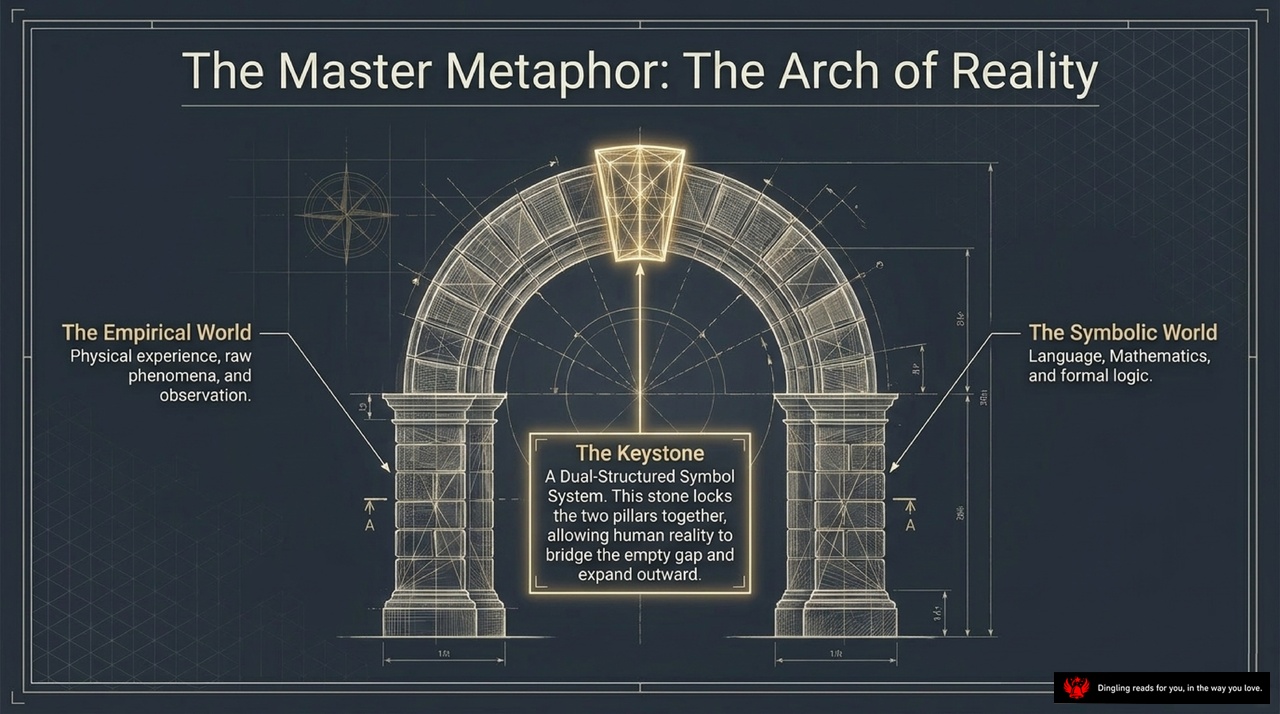
Imagine reality not as a fixed object waiting to be discovered, but as a dynamic bridge we build every moment. Today, we look at the "Master Metaphor": The Arch of Reality. Picture this structure as a bridge spanning two vast worlds: on one side lies the Empirical World, where we experience raw phenomena through our senses, and on the other stands the Symbolic World, built from language, mathematics, and formal logic.
But how do these two worlds connect? That is where the Keystone comes in. Think of it as the central stone of an arch—without it, the structure collapses. This Keystone is a dual-structured symbol system that locks the two pillars together. It allows human reality to bridge the empty gap between what we see and the abstract rules we use to describe it, letting truth expand outward.
Consider the history of science. Ancient geometry was the first keystone, using logic to translate physical measurements into pure math. Later, Newton's laws acted as another keystone, turning experimental observations into universal principles. Even today, in the quantum realm, complex numbers serve as our keystone, bridging our physical experience with the mathematical models that predict the behavior of particles.
This arch isn't static; it grows. When new experiments reveal something unexpected, the keystone adjusts, expanding the bridge to include new truths. Whether we are exploring the physical universe or stepping into a virtual one, the logic remains the same: reality is defined by the stable relationship between the observer, the tools we use to control our environment, and the objects we study. It is this very structure that allows us to turn fleeting experiences into reliable knowledge, proving that truth is not just something we find, but something we build.

The slide we see here maps out the "Three Domains of Authenticity," a framework that fundamentally changes how we think about truth. Instead of treating truth as a single, static fact, this model breaks it down into three distinct realms: Scientific Truth, Social Truth, and Individual Truth.
Let's look at the first row, **Scientific Truth**. Notice the icon of the atom and the word "Suspended." In this domain, the human subject is removed from the equation. Truth here isn't about what *I* feel, but about what happens when we control variables and repeat the experiment. The method is strictly "Controlled, Repeatable Experiments," and the keystone symbol is Mathematics and Logic. It's the realm of objective, universal laws where the observer steps back to let the data speak.
Moving down to the second row, we find **Social Truth**. Here, the subject is no longer suspended but "Embedded & Universal." Truth emerges not from a lab, but from shared social action. We understand each other through "Social Action & Repeatable Comprehension." The keystone symbol here is Natural Language. Think about it: a promise or a contract isn't true because of a physical object, but because we all agree on the meaning of the words and the actions behind them. It's the truth of our community, built on a shared understanding.
Finally, the third row presents **Individual Truth**. This is the most personal domain. The subject is "Embedded & Specific," meaning truth is unique to the self. There is no universal experiment here; the method relies entirely on "Personal Experience & Intention." The keystone symbols are Art and Quasi-symbols. This is where truth becomes subjective, found in the private moments of your life, your memories, and your inner world. While others can appreciate your art, they can never fully replicate your specific experience.
This table brilliantly illustrates that authenticity isn't one-size-fits-all. It shifts from the detached precision of science, to the shared consensus of society, and finally to the unique, irreplaceable depth of the individual. Understanding these three domains helps us navigate a world where objective facts, social norms, and personal experiences all hold equal weight.

Imagine the entire edifice of modern science as a magnificent stone arch, spanning the gap between our tangible, physical world and the abstract realm of mathematical symbols. This is the first and most critical arch: Modern Science.
Look at the two pillars holding this structure up. On the left, we have **Controlled Experiments**. On the right, we have **Mathematics**. These aren't just separate disciplines; they are the foundational supports that allow us to build knowledge.
The magic happens at the very top of the arch, the keystone. This is where pure mathematical symbols map perfectly onto repeatable, controlled physical experiments. It's the point of convergence where abstract logic meets empirical reality. Because the subject of our study is rigidly suspended from this method of control, the truth we uncover feels completely "objective"—it seems independent of us, detached and absolute.
However, there's a profound nuance here that we must grasp. This "objective" truth isn't a free-floating entity existing on its own. As the diagram reminds us, it remains a constructed structural relationship. It is a bridge built by the interaction of our experiments and our math, not an absolute, independent entity waiting to be found.
This arch is the engine of scientific progress. It allows us to expand our understanding of the universe, from the motion of planets to the behavior of subatomic particles, by seamlessly translating our physical observations into mathematical laws, and those laws back into new, predictable experiments. It is the very definition of how we know what we know.

Imagine the universe not as a fixed stage, but as an ever-expanding bridge connecting our tangible experiences with the abstract world of mathematics. In the realm of modern science, this bridge is built on a simple yet profound foundation: the universal repeatability of controlled experiments. Every time we test a hypothesis under controlled conditions, we aren't just gathering data; we are adding a new brick to this bridge, ensuring that the structure of reality remains stable and reliable.
But what happens when we push this bridge beyond the limits of what we can physically measure? This is where the fascinating concept of "Virtual Physics" emerges. Picture a scenario where mathematics leads the way, while our empirical experience struggles to keep up. Think of String Theory or the mysteries of dark matter. In these frontiers, physicists use pure mathematical logic to explore dimensions and forces that we currently cannot observe or test in a lab. The math is self-consistent and elegant, suggesting a reality that exists, even if our senses and current instruments can't quite reach it yet.
However, there's a critical distinction here. In the physical world, our "bridge" is solid because we can always return to repeat our experiments. But in this virtual realm, the bridge might be built on sand if we lose the ability to verify our findings through experience. As we venture deeper into these uncharted territories, we must ask ourselves: does a theory hold true if it cannot be tested? This tension between the beautiful logic of mathematics and the hard constraints of empirical reality defines the edge of our scientific frontier, challenging us to rethink what it truly means to know something is real.

Diagnosing the Metaverse: Are We in a Simulation?
Look at this slide. It poses a haunting question: Is our reality just a code? On the left, we see the Metaverse—a dazzling, digital construct built on predefined rules. On the right, we have Physical Space-Time, anchored by the timeless, chaotic beauty of gears and clocks. The big "not equal" sign between them is the key takeaway: they are fundamentally different.
Let's break down why. The slide argues that while the virtual world offers authentic scientific experiences, it's entirely bound by its code. It lacks the one thing our physical universe possesses: self-consistent space-time measurement. In the real world, we can run experiments infinitely, iterating endlessly to discover new laws. That infinite expansion is what proves we aren't trapped in an alien simulation.
The Metaverse, no matter how advanced, hits a wall. Its experiments cannot iterate infinitely to uncover new fundamental truths. It's a closed loop of existing data. Our physical universe, however, allows for the infinite expansion of discovery. That endless possibility is the ultimate proof of our reality. So, while the Metaverse is a powerful tool, it doesn't equal the physical world. We are not living in a simulation; we are living in a universe that keeps surprising us.

Welcome back. Today, we're diving into the "Second Arch" of our journey: Society and Natural Language.
Look at this visual. We have two wireframe heads facing each other, and bridging them is an arch made entirely of letters and symbols. In the center, resting like the keystone of an arch, is the concept of "Natural Language." This isn't just about talking; it's the structural foundation that holds our social reality together.
The slide highlights a crucial distinction. Unlike science, where truth is about objective equations, social truth strictly requires the "Subject"—the person—to be embedded in the equation. You can't separate the observer from the observation in society. Furthermore, truth here relies on something profound: the "repeatability of comprehension" and empathy. It's the ability of one subject to successfully enter the mental state of another through shared language.
In the book, the author explains that while science builds a bridge between the physical world and mathematical symbols using controlled experiments, society builds a different kind of bridge. It uses natural language to connect one human mind to another. When we speak, we aren't just exchanging data; we are allowing others to enter our internal world. This shared entry point creates a consensus. If you can repeat my experience through my words, our social reality becomes real.
So, natural language acts as the keystone. Without it, we are isolated islands of private experience. With it, we construct a shared world where empathy and understanding become the laws of physics. This is the second arch: the bridge that allows us to be truly human.
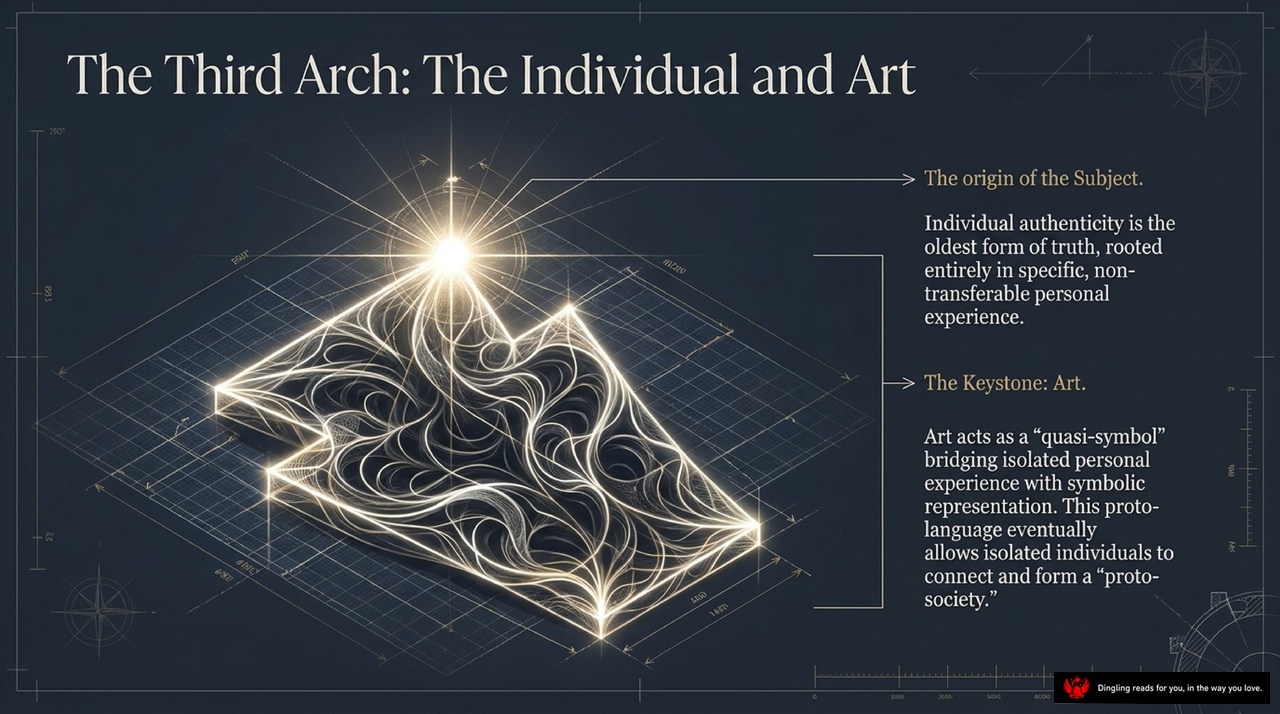
Welcome to the third and final arch of our journey: The Individual and Art. This is where the story of truth moves from the grand structures of science into the intimate, messy, and beautiful realm of the human soul.
Look at this diagram. It represents the origin of the subject. In our previous discussions, we built a bridge between the physical world and the world of math using controlled experiments. But that bridge—science—has a blind spot. It requires us to step aside, to suspend our own consciousness, to become an objective observer. It tells us how the world works, but it never tells us *who* is doing the observing.
That's where individual authenticity comes in. Think of it as the oldest form of truth. It isn't about facts you can measure or equations you can prove. It's rooted entirely in your specific, non-transferable personal experience. Your pain, your joy, your unique perspective on life—these things are real, even if no one else can literally feel them exactly the way you do.
So, how do we connect this isolated inner world to the rest of humanity? This is the keystone: Art.
Art acts as a "quasi-symbol." It's a special kind of language that sits right on the border between your private feelings and public understanding. It bridges the gap between your isolated personal experience and symbolic representation. When you look at a painting, listen to a song, or read a poem, you aren't just decoding data; you are entering someone else's mind. You are sharing their subjective reality.
This proto-language allows isolated individuals to connect. It transforms your private truth into something public, creating what we call a "proto-society." Without art, we would just be a collection of separate minds, unable to truly understand one another. But with art, we find a way to touch the hearts of others, to say, "I feel this, and you feel that too."
In this final arch, we realize that while science gives us the tools to survive and understand the universe, it is art that gives us the tools to be human. It is the vessel through which our individual truths find a home in the shared world.

The illusion of the "Scientific Subject" isn't just a philosophical concept; it's a hard boundary we hit when we try to build a conscious machine. Look at this diagram: on the left, we have the raw data and algorithms of AI, and on the right, the human brain. But between them stands a critical barrier labeled "Suspension of Subject." This is the core of the Scientific Arch. It operates strictly by suspending the subject—meaning, it removes the "I" from the equation.
Because the subject is suspended, neither neuroscience nor AI, no matter how advanced, can ever truly "discover" or "spawn" consciousness. They can process information and mimic behavior, but they cannot generate subjective authenticity. Consciousness and free will exist entirely within the social and individual arches, not in the scientific one. AI possesses scientific intelligence, but it lacks the soul. The scientific method is a powerful tool for manipulating the external world, but it is fundamentally blind to the inner world of the self. That's why we can build a supercomputer that plays chess better than any human, but we cannot build a machine that feels pain or love. The gap isn't a technical limitation; it's a structural one.
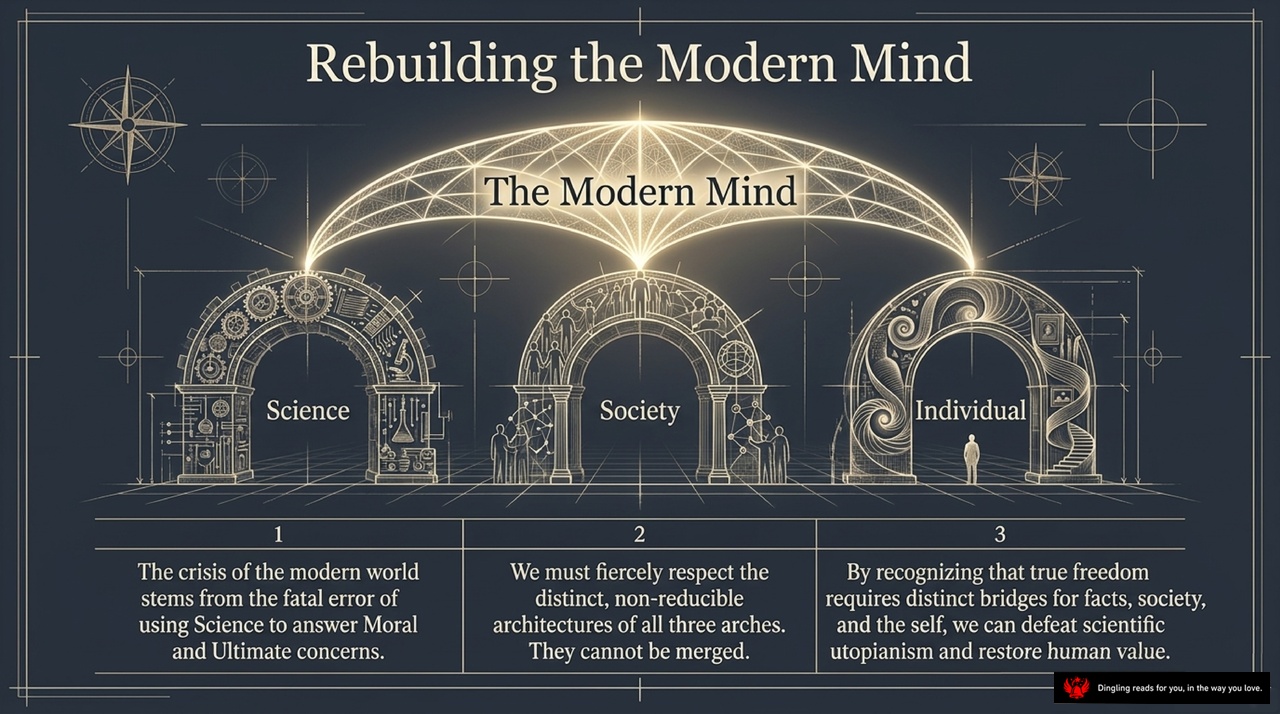
Look at this diagram titled "Rebuilding the Modern Mind." It presents a powerful vision of how we can fix the fractured state of our world by understanding the distinct yet connected roles of Science, Society, and the Individual.
The image breaks this down into three essential arches. The first arch, labeled Science, warns us of a fatal error: trying to use scientific methods to answer moral and ultimate concerns. As the text explains, the crisis of our modern world stems from this very mistake—using facts to dictate values.
The second arch, Society, teaches us a crucial lesson: we must fiercely respect the distinct, non-reducible architectures of all three arches. They cannot be merged. We need to recognize that social structures and individual lives have their own unique logic that science alone cannot solve.
Finally, the third arch, the Individual, shows us the path forward. By recognizing that true freedom requires distinct bridges for facts, society, and the self, we can defeat scientific utopianism and restore human value.
In short, this framework argues that we cannot build a stable future by forcing everything into a scientific mold. Instead, we must rebuild the modern mind by honoring the unique truth of science, the complexity of society, and the freedom of the individual. Only by bridging these three separate domains can we truly heal our world.

Authenticity isn't just a fixed fact waiting to be found out there; it's a dynamic relationship we build right here through our symbols, our language, and our actions. Think of science, society, and the individual as three distinct bridges. True freedom starts the moment we stop expecting one bridge to carry the weight of the others.
If reality isn't an objective given, but a structural relationship we actively co-create, what kind of world are you choosing to build? The image before you shows a lone figure standing on an infinite grid, holding a compass. That figure represents us—standing at the intersection of the known and the unknown, not as passive observers, but as the architects of our own reality. We are not discovering a pre-existing world; we are drawing the map as we walk it. The grid stretches out endlessly, symbolizing the vast potential of the worlds we can construct together. Your choice of how to navigate this grid defines the world you inhabit. So, look at that horizon. What are you building today?