
Redshirts: Complete Chapter-by-Chapter Summary
Welcome to *Redshirts*, by John Scalzi. In a universe governed by the strict, unyielding laws of physics, what happens when a poorly written television script decides to hack reality itself?
This isn't just a story about space travel or alien monsters; it's a dark comedy about the absurdity of being a disposable extra in someone else's story. Imagine a crew of officers, all wearing red shirts, who are destined to die in the most ridiculous ways possible—eaten by giant worms, crushed by malfunctioning robots, or torn apart by alien sharks—simply because the plot requires it.
But what if one of those extras starts asking questions? What if they realize their deaths aren't accidents, but mandatory plot points? The book asks us to consider a terrifying possibility: that our own lives, our struggles, and even our deaths might be nothing more than a script written by a distant, indifferent author, with no way out except to rewrite the ending ourselves.
*Redshirts* is a hilarious yet poignant exploration of agency, destiny, and the courage to break free from a narrative that doesn't want you to survive. It's a reminder that even in the most scripted universe, you still hold the pen.

Look at this split-screen reveal. On the left, we have the official blueprints of the Intrepid, the Universal Union's flagship, commissioned in 2453. To its crew, it's the pride of the fleet—a vessel built for deep space exploration and diplomacy. It looks majestic, right?
But turn your attention to the right side. That crumpled, coffee-stained paper tells a completely different story. This is the behind-the-scenes reality. We're not looking at a high-tech warship anymore; we're looking at a movie set.
Notice the red annotations. The "hull" is just cheap plastic. The control panel? It's fake. The entire bridge scene is filmed on Soundstage 5, complete with a lighting rig and multiple cameras positioned to capture the perfect shot. The text at the bottom even admits it: "A standard-issue sci-fi vessel. Looks expensive, but the lower decks are strictly non-union extras."
This image perfectly captures the central mystery of our story. To the crew on the ship, they believe they are exploring the galaxy, fighting real aliens, and making history. But the notes on this page suggest a terrifying truth: they might just be actors in a script written long ago, performing a tragedy that feels incredibly real to them, but is actually just a production. The contrast between the sleek, heroic blueprint and the gritty, deceptive reality of the set is where the horror begins.

Ladies and gentlemen, welcome to Act I: The Illusion. As the title suggests, we are entering a world where the fundamental laws of physics are rewritten not for scientific accuracy, but purely for dramatic effect.
In the story we are about to explore, Lieutenant Andy Darr is thrust into a reality that feels increasingly like a soap opera. He joins the crew of the *Valiant*, a ship commanded by Captain Abernathy, but the atmosphere is anything but normal. From the very beginning, the ship's operations follow a bizarre, predictable pattern that defies logic.
Take the medical bay, for instance. When the crew needs a miracle cure, a mysterious, unexplained device simply generates the answer. Or consider the crew members themselves. Certain officers, like Science Officer Jin and Captain Abernathy, seem to operate under a special immunity. They are constantly placed in the most dangerous situations—exploding engines, alien plagues, and rogue machines—yet they miraculously survive while everyone around them is sacrificed.
This isn't just bad luck; it's a pattern. The ship's mortality rate is astronomically high, but it is never random. It follows a script. When a specific group of officers is in charge, the death toll spikes. When they are absent, the crew lives. It feels less like a military expedition and more like a television show where the writers need a tragic death to fill a scene, regardless of the consequences.
As Andy investigates these anomalies, he uncovers a terrifying truth: the crew of the *Valiant* might not be real people at all. They are characters in a fictional television series called *The Valiant Chronicles*, and their lives are being dictated by the needs of a script. The aliens, the monsters, and the impossible physics are all manufactured elements designed to create conflict and drama.
In this act, we witness the chilling realization that their suffering, their deaths, and their very existence are merely plot devices. The illusion is that they believe they are fighting for survival, when in reality, they are just actors waiting for their cue to die. As we move forward, Andy will have to confront this horrifying reality and find a way to break free from the script that is trying to write his life.

Look at this flowchart. It's a perfect blueprint for how a "Redshirt"—a minor, expendable crew member—gets killed in a sci-fi show. The title is "The Anatomy of a Redshirt Death," and it breaks down exactly why Ensign Davis dies so quickly.
It starts with the situation: an away mission in a cave full of Borgovian Land Worms. Logically, the right move is to wait for orders and stay silent. But look at that red stamp: "OVERRIDDEN." Instead of waiting, Ensign Davis inexplicably fires a pulse gun. That single action triggers the worms.
Then, the logic tries to correct itself. The logical choice is to stand still on the rock. Again, it's crossed out and stamped "OVERRIDDEN." Davis panics, leaps off the rock, and runs directly into the swarm. The result? He is instantly devoured.
This isn't just about one character; it's about a pattern. The note on the right says it all: "We need a death before the first commercial break." The writers don't care about logic or survival. They just need a body count to show the audience that these worms mean business. They force the kid to do something stupid, ensuring the death happens exactly when the show needs it. It's a tragic formula where the character's agency is stripped away, replaced by the script's demand for drama.

So, we've hit the breaking point. After all the time travel, the body swap, and escaping the script's deadly loops, the real battle wasn't against monsters or aliens—it was against the writers themselves. In the final act, Andy and his crew manage to convince the show's creator, Charles Paulson, to rewrite the ending. They trade Jasper's life for Matthew's, effectively saving the real-world Matthew and giving the fictional Jasper a second chance. It's a bizarre, meta-cinematic resolution where the characters literally change the script to save their own lives.
But the story doesn't end with a triumphant "The End." The camera cuts to the writers' room, where the showrunner, Nick Weinstein, is staring at a blank screen. For years, he treated his crew's deaths as cheap plot devices—just random explosions to fill an hour. Now, haunted by the fact that those deaths were real, he faces a true creative block. He realizes that for his characters to truly matter, their sacrifices need weight. They can't just die for a commercial break; they have to die for a reason.
In a profound twist, the showrunner has a dream where a character named Finn, who was written to die, appears to him. Finn tells him that the anger isn't about death itself, but about the lack of meaning. The writers wake up, inspired, and finally start writing a story where every loss counts.
The final chapter then shifts to the real world. We see Matthew, the man who was supposed to die in the car crash, waking up with no memory of the accident. But thanks to the body swap, he's actually Jasper, the actor who lived. He finds a video left by the real Jasper, who tells him to stop drifting and take control of his life. Meanwhile, the actress Samantha, whose husband was killed in the show, receives a box with photos of her fictional husband. She realizes that while the story was fake, the love was real. She burns the photos, letting go of the fantasy, and meets the showrunner at the beach. They share a quiet moment, symbolizing that even in a world of fiction, human connection is the only thing that's ever truly real.
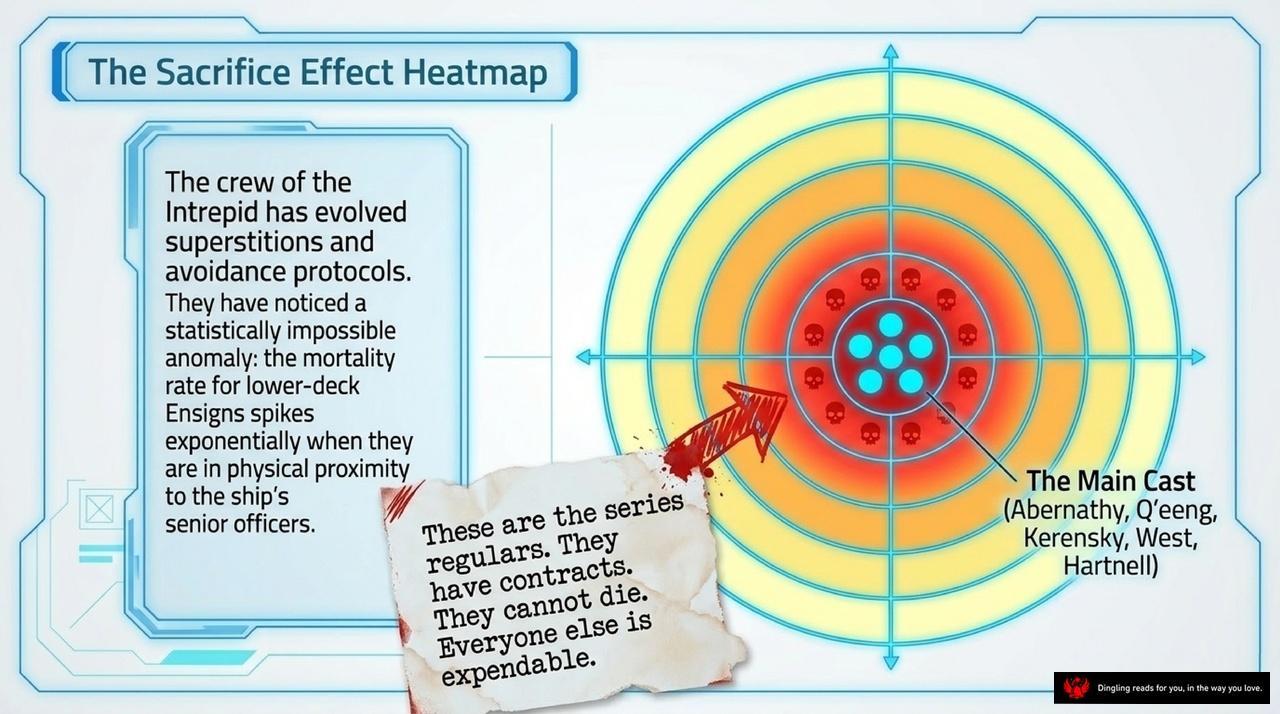
Look at this "Sacrifice Effect Heatmap." It visualizes a terrifying truth that has evolved into a superstitious protocol on the Intrepid: the closer you are to the senior officers, the higher your chance of dying. The center of the target shows the main cast—Abernathy, Q'eeng, Kerensky, West, and Hartnell. They are the "series regulars" with contracts they cannot break. They are essentially immortal.
Surrounding them is a ring of skulls representing the expendable crew. The data reveals a statistically impossible anomaly: when lower-deck Ensigns get physically close to these senior officers, their mortality rate spikes exponentially. It's as if the universe is programmed to sacrifice the background characters just so the main actors can keep their storylines alive.
This isn't just bad luck; it's a rigged game. The crew has noticed that whenever these "immortal" officers lead an away team, the death toll for everyone else skyrockets. It's a zero-sum game where the survival of the few guarantees the death of the many. The heatmap makes it clear: on this ship, being a regular is the only way to survive. Everyone else is just fuel for the plot.
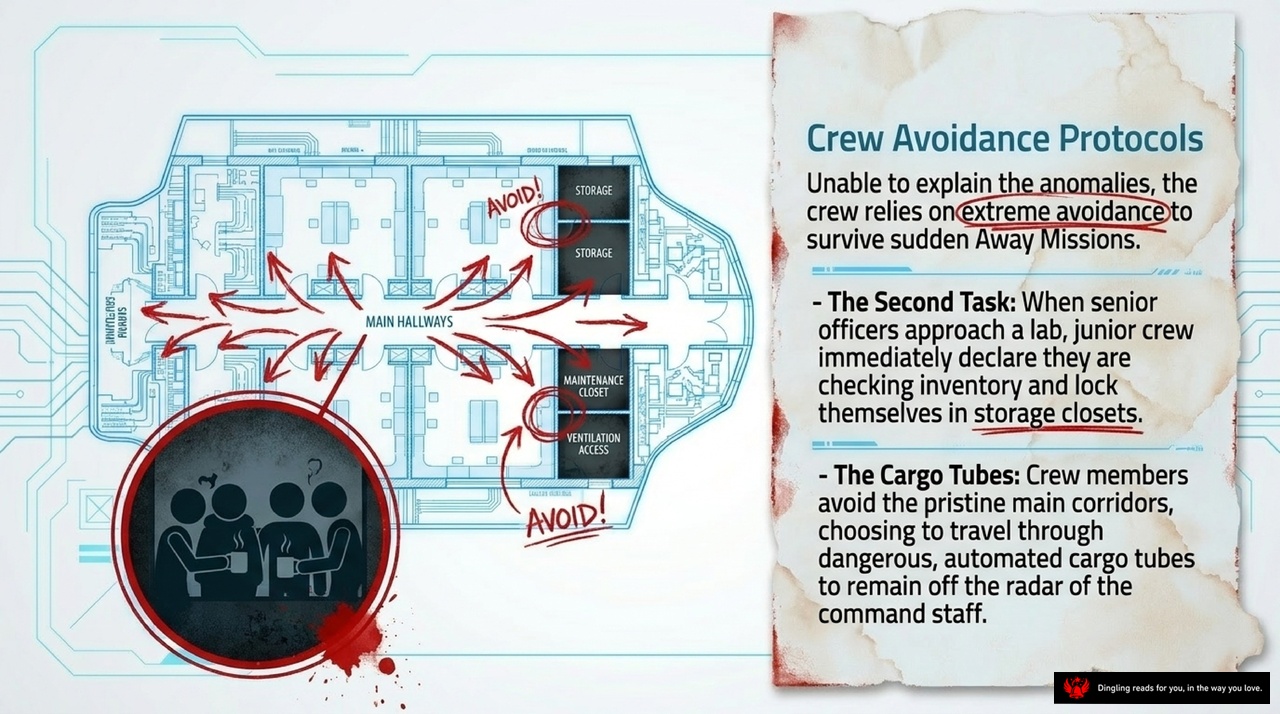
Look at this floor plan of the Fearless. Notice how the arrows point away from the main hallways toward the storage closets and cargo tubes. This isn't just a map; it's a survival guide written in blood. When the crew can't explain the anomalies, they rely on extreme avoidance to survive. That's the core of their new reality.
Here's how it plays out: When senior officers like the Captain or Chief Scientist approach a lab, junior crew members immediately declare they are checking inventory and lock themselves inside storage closets. They aren't hiding from danger; they are hiding from the officers who seem destined to bring it. It's a desperate, unspoken pact to stay off the radar.
Then there are the cargo tubes. Instead of walking through the pristine main corridors, crew members choose to travel through dangerous, automated tubes. Why? To remain invisible to the command staff. Every step in the open is a potential death sentence. The crew has learned that the safest place on the ship is the darkest, most forgotten corner. This isn't paranoia anymore; it's the only logic left.

Welcome back to the story. We've reached the final chapter, a moment of profound reflection that bridges the gap between fiction and reality. This slide isn't just about ending a book; it's about the very nature of existence.
Look at the background of this image. It's filled with scattered text, code, and fragmented data, almost like a shattered mirror reflecting a thousand different versions of the same truth. This perfectly captures the final realization of our protagonist, Andy Darl. Throughout the entire journey on the *Valiant*, he struggled with a terrifying question: Is he real? Or is he just a character in a show written by someone else, destined to die for the sake of a dramatic plot twist?
In the final scenes, we see the aftermath of their time travel. They successfully altered the script, saving their friend Jasper from a meaningless death and bringing a new life back to Earth. But the victory brings a new kind of existential crisis. Andy sits in the mess hall, staring at his crewmates. He asks himself, "What was my role?" He realizes that while they thought they were the heroes, the writers—Nick Weinstein and Brian Abnett—were actually the true architects of their reality.
The book ends by pulling back the curtain completely. We see the real-world counterparts: the actors, the writers, and the real people whose lives were intertwined with the story. We see the writer, Nick, finally breaking through his creative block not by forcing drama, but by taking responsibility for the lives he creates. We see the real-world Matthew, who wakes up from his coma, only to discover that the man who saved him, Jasper, swapped places with him.
The final message is one of empowerment. Even if our lives feel scripted, even if we feel like background characters in a larger narrative we don't understand, the choice remains ours. As the narrator puts it, "Whether you're a hero or a supporting character, the story is almost over. When the author stops writing and the screen goes dark, you will become yourself."
So, the question isn't whether we are real or fake. The question is: How will you live the rest of your story? Will you wait for the plot to dictate your fate, or will you grab the pen and write your own ending? That is the legacy Andy leaves behind, and it is a legacy we all carry.

Look at this timeline. We're in the 25th century, but the natural flow of events has been violently interrupted by four distinct "Script Hash" events. These aren't just glitches; they are moments where a low-budget sci-fi TV show from the early 21st century, *The Intrepid Chronicles*, hijacked reality itself.
This is the core of "The Narrative Override." Hidden in the cargo tubes, Jenkins reveals the terrifying truth to Dahl and his friends: their lives aren't their own. They are being forced to act out scenes dictated by hack writers hundreds of years in the past. Whenever a Script Hash occurs, the show's narrative engine overrides their physical reality. The crew loses their free will, trapped in a cycle where a poorly written script dictates their deaths and their survival. It's a brutal reminder that in this twisted reality, the drama of a cheap television show is more powerful than the lives of the people living it.

Look at this pyramid. It's not just a graphic; it's a grim map of survival on the *Valiant*. At the top, we have the "Series Regulars"—the captains and senior officers who are effectively invulnerable. But look at the middle layer, circled in red: the "Featured Extras with Backstories." This is where the real danger lies. Characters like Dahl, Duvall, Finn, and Hanson aren't just nameless background noise. They have depth. Dahl was a former alien seminary student; Duvall is a demoted marine with a grudge; Hanson is a billionaire heir hiding his identity. Because they have stories, because they are given lines and developed just enough to feel real, they become targets.
The slide calls this "The Character Backstory Trap." And the note on the right explains the cruel logic: when you give a character a backstory and dialogue, the audience connects with them. So when those characters are brutally killed off before a commercial break, the audience feels a fleeting, sharp sense of tragedy. It's a narrative trap. The writers aren't trying to be cruel, but the result is that these well-developed characters are expendable. They are high-risk assets in a game where the script decides who lives and who dies, turning human-like stories into mere plot points designed for dramatic effect.

Welcome back to the final act. We are now in Act III: The Intervention. Look at the image on your screen. We see a chaotic mix of a malfunctioning robot, a collapsing reality like a black hole, and a film clapperboard marked "Take 1." This visual perfectly captures the core conflict of this chapter: the desperate struggle to break the fourth wall and confront the creators of our reality.
For Andy, the situation has reached a breaking point. The ship's crew is trapped in a cycle of meaningless, scripted deaths designed purely for dramatic effect. He realizes that hiding or trying to outsmart the plot is futile. The only way forward is to actively intervene.
This leads to the most radical plan yet. Andy, along with his friends and the mysterious engineer Jenkins, decides to use the show's own logic against it. They plan to travel back in time to the very year the series was being filmed. Their goal? To stop the production of the show before it begins. By erasing the script, they hope to erase the deaths of their crewmates and save themselves from this twisted narrative loop.
But even before they can execute this time-travel plan, the plot thickens. They manage to swap bodies with a real-life actor from the show, a man named Jasper, who looks exactly like their friend Jasper. This allows them to carry a crucial piece of information back to the past, effectively rewriting the future of both their world and the show's world. It is a high-stakes gamble where the line between fiction and reality blurs completely.
The chapter ends with a profound shift. The writers of the show, realizing the weight of their words, finally take responsibility for the lives they create. They rewrite the script, ensuring that no more character dies without meaning. And in the real world, the crew of the Dauntless finds a new purpose, no longer just puppets dancing to a master's tune, but the true authors of their own destiny. The fourth wall has been shattered, and the characters have finally found their voice.
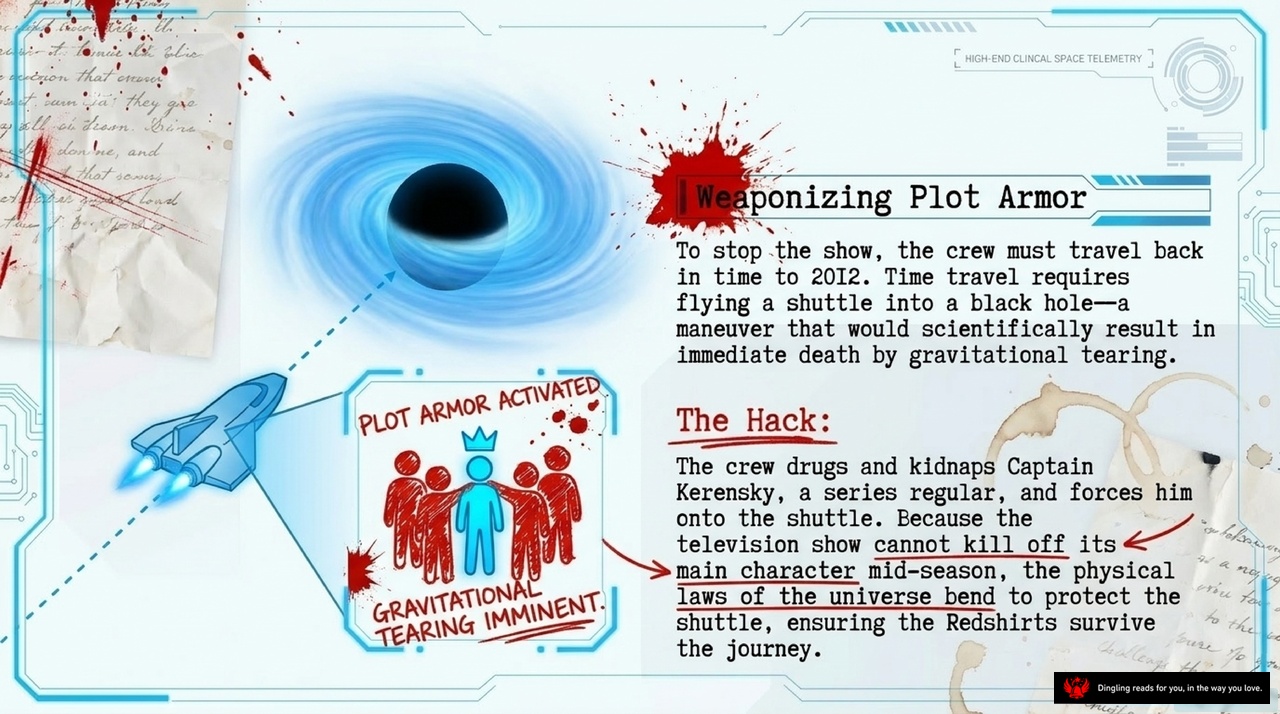
Imagine a scenario where the crew faces a scientific impossibility: traveling into a black hole to save themselves, a maneuver that physics says should instantly tear them apart. In our story, this is the point where the plot armor gets weaponized. Instead of letting the universe crush them, the narrative bends reality to protect the heroes.
The crew executes a desperate hack. They drug and kidnap a series regular, Captain Kerensky, forcing him onto the shuttle. Why does this matter? Because the television show simply cannot kill off its main character mid-season. The physical laws of the universe literally bend to accommodate this rule. The gravitational tearing that should have ended them is nullified, ensuring the Redshirts survive the journey. It's a brilliant, if absurd, example of how the story protects its own, turning a fatal scientific failure into a triumphant plot point.
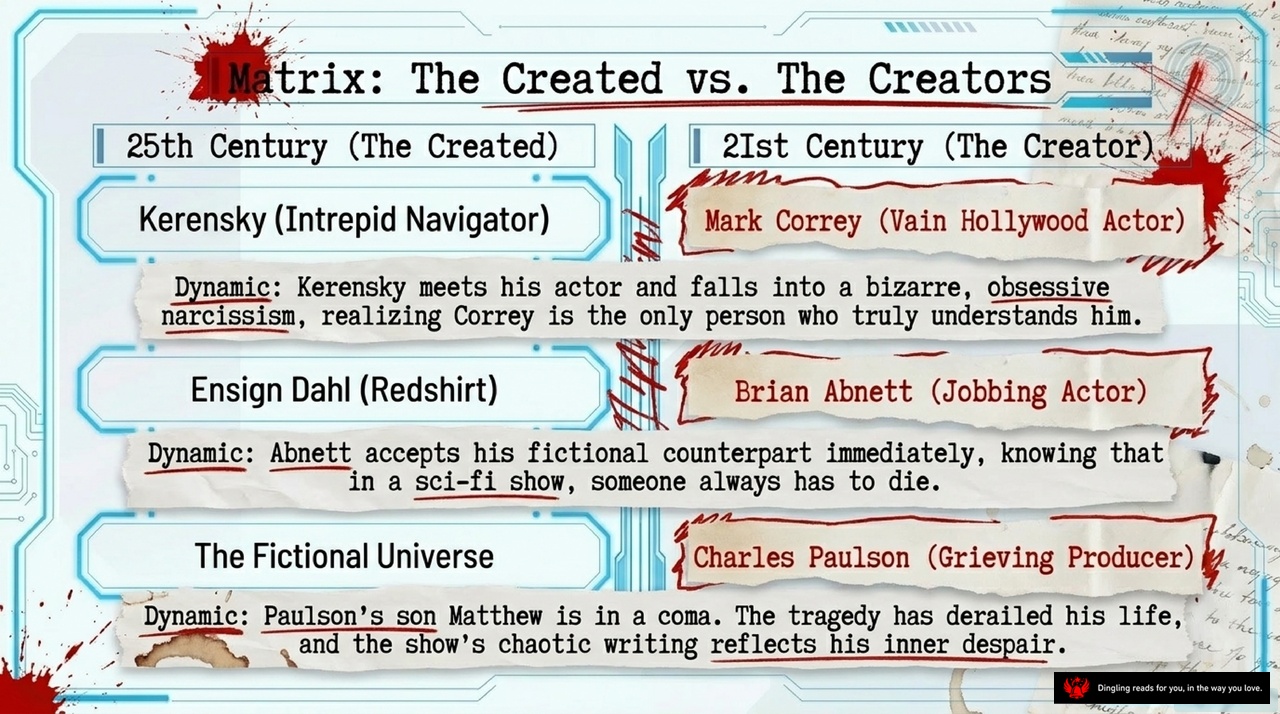
In the final act of our story, the lines between fiction and reality blur completely. We see a split timeline: on one side, we have the 21st Century, where the creators like Mark Correy and Charles Paulson are grappling with the chaos they've unleashed; on the other, the 25th Century, where characters like Kerensky and Ensign Dahl are living out the script. The dynamic is clear: the creators' narcissism and grief directly fuel the fictional universe's tragedy. When Paulson's son Matthew is in a coma, the show's chaotic writing reflects his inner despair, turning real pain into plot points.
But here is the twist that redefines everything: the creators aren't just watching; they are trapped inside the narrative. Brian Abnett, the actor playing Ensign Dahl, accepts his fictional counterpart immediately, knowing the rules of the sci-fi show where someone always has to die. This isn't just acting; it's a forced existence. The show's writers, like Nick Weinstein, realize too late that their "cheap dramatic deaths" have real consequences. The red-shirted crew members aren't just props; they are souls with real lives, real families, and real futures that were stolen for the sake of a cliffhanger.
The resolution comes not from escaping the story, but from rewriting it. By acknowledging the weight of every character, even the smallest ones, the creators break the cycle of meaningless sacrifice. They stop treating the universe as a playground for their own drama and start honoring the lives they've created. It's a powerful reminder that even in fiction, every death matters, and every story deserves to be told with respect, not just for the shock value of the next commercial break.
Welcome back to the story. We are now in Act IV: The Synthesis, a pivotal moment where the crew begins to reclaim agency from the writers' room.
Look at the chaotic background of this slide—torn papers, red ink, and scribbled notes. This isn't just decoration; it represents the messy, desperate struggle to understand their reality. The central text, "Reclaiming agency from the writers' room," tells us exactly what's happening: Andy and his friends are finally moving from passive victims of a twisted script to active players trying to rewrite their own fate.
This entire act is the culmination of their journey. After discovering that their deaths on the *Valiant* are merely plot points designed for cheap shock value, they realize they can no longer hide. They stop waiting for the next "act" to unfold and start forcing the plot in their direction.
We see this shift clearly as they execute their boldest plan yet: time travel. By kidnapping Commander Kronowski and sending him back to 2012, they attempt to break the cycle at its source. It's a desperate gamble against the laws of physics and the rules of the show itself. But even more critical is the emotional resolution we see later, when they meet the real-life actors. When Andy meets the actor who played him, and when Jasper swaps identities with the actor's son, they finally understand that their story matters.
They stop accepting meaningless sacrifices. Instead of letting random crew members die to fill a scene, they demand that every death have weight and purpose. They force the writers, Charles Paulson and Nick Weinstein, to stop treating characters like disposable props. In doing so, they don't just save themselves; they save the integrity of the entire series.
So, this is the synthesis: the merging of their fictional struggle with the real world, proving that even in a scripted universe, human will can change the outcome. They have finally taken the pen back from the writer.
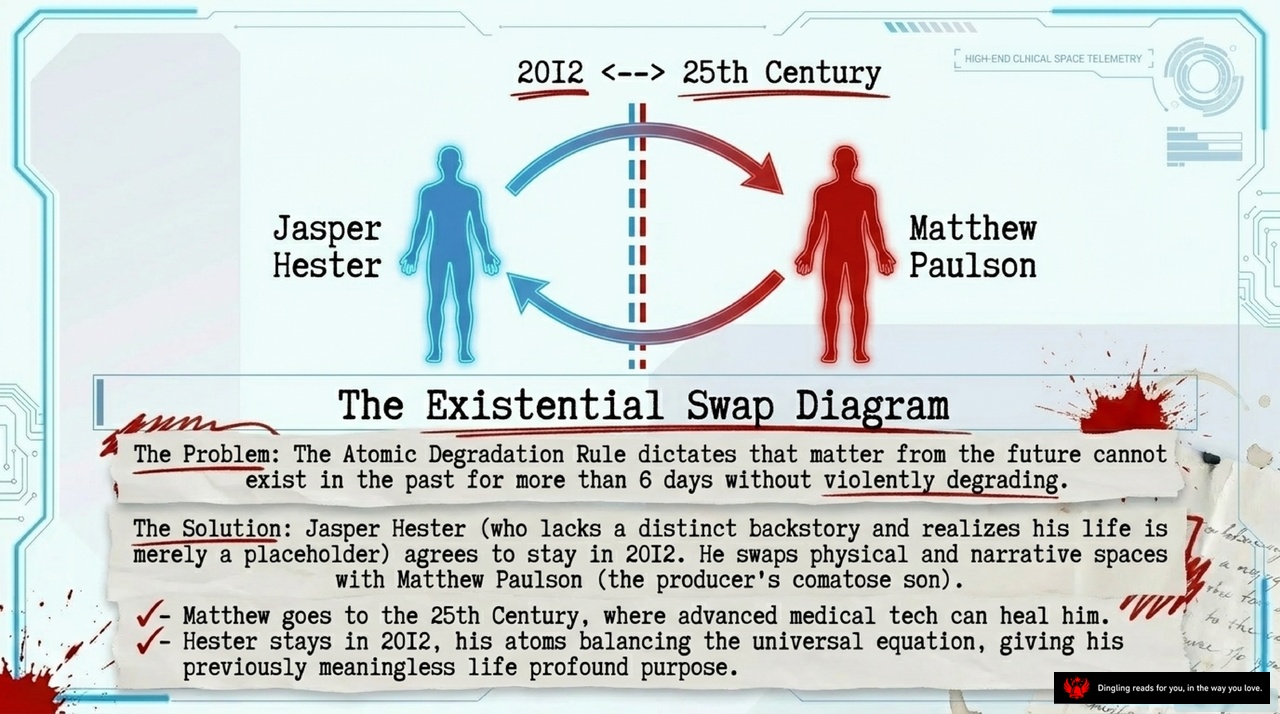
The screen displays a stark, futuristic diagram titled "The Existential Swap Diagram," visually capturing the most radical solution to the *Enterprise* crew's nightmare. It illustrates a time loop between 2012 and the 25th Century, showing the physical and narrative bodies of Jasper Hester and Matthew Paulson swapping places.
This isn't just a sci-fi trope; it's the desperate answer to the "Atomic Degradation Rule." As the slide explains, matter from the future cannot exist in the past for more than six days without violently degrading. This rule was the final barrier keeping them trapped in a dying timeline. But the crew found a loophole. Jasper Hester, realizing his life on the ship was merely a meaningless placeholder, agreed to stay behind in 2012. In exchange, he swapped physical and narrative spaces with Matthew Paulson, the producer's comatose son.
The result is profound. Matthew travels to the 25th Century, where advanced medical technology can finally heal his brain injuries. Meanwhile, Jasper remains in 2012. By staying in the past, his atoms stabilize and balance the universal equation, giving his previously meaningless life a profound purpose. It is a perfect, tragic, and beautiful exchange: one life saved by the future, and one life given meaning by the past.
Welcome back to the story of *Redshirts*. Today, we dive deep into the mind-bending conclusion of the novel, where the boundaries between fiction and reality finally blur.
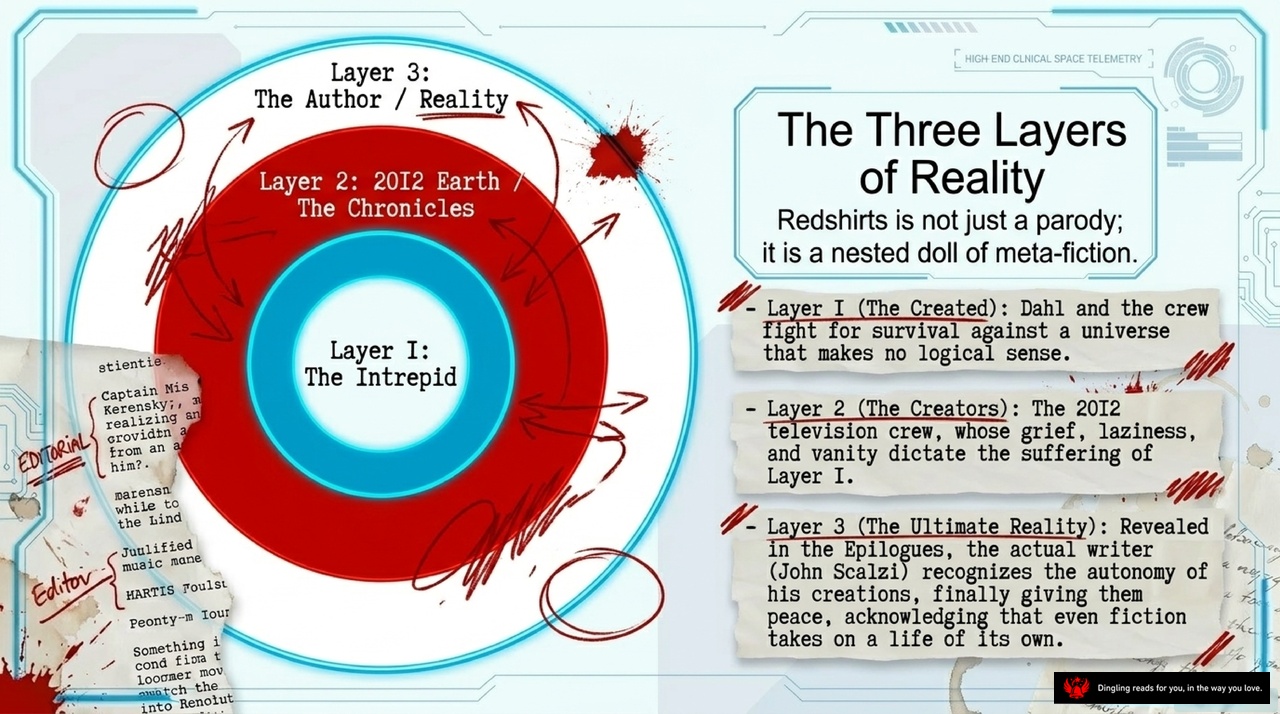
This slide breaks down the "Three Layers of Reality" that define the entire narrative. Think of it as a set of nested dolls.
At the very center, **Layer I**, is the created world: the *Intrepid* and its crew, including Lieutenant Dahl and the rest of the crew, fighting for survival against a universe that makes absolutely no logical sense. They believe they are real, but they are actually characters in a script.
Moving outward to **Layer II**, we see the creators: the 2012 Earth television crew. Their grief, laziness, and vanity are what dictate the suffering of Layer I. It is here that we learn the tragic truth: the deaths of the redshirts are not random; they are the result of a lazy writer needing bodies to die so the plot can move forward.
Finally, at the outermost ring, **Layer III**, is the ultimate reality: the actual author, John Scalzi. In the epilogue, he steps out of his role as a distant observer and acknowledges the autonomy of his creations. He realizes that even fiction can take on a life of its own. This is the moment of redemption where the writer stops treating his characters as disposable props and starts respecting their lives.
As we've seen throughout the book, this meta-fictional structure isn't just a parody; it's a profound commentary on the power of storytelling and the weight of every life we create.
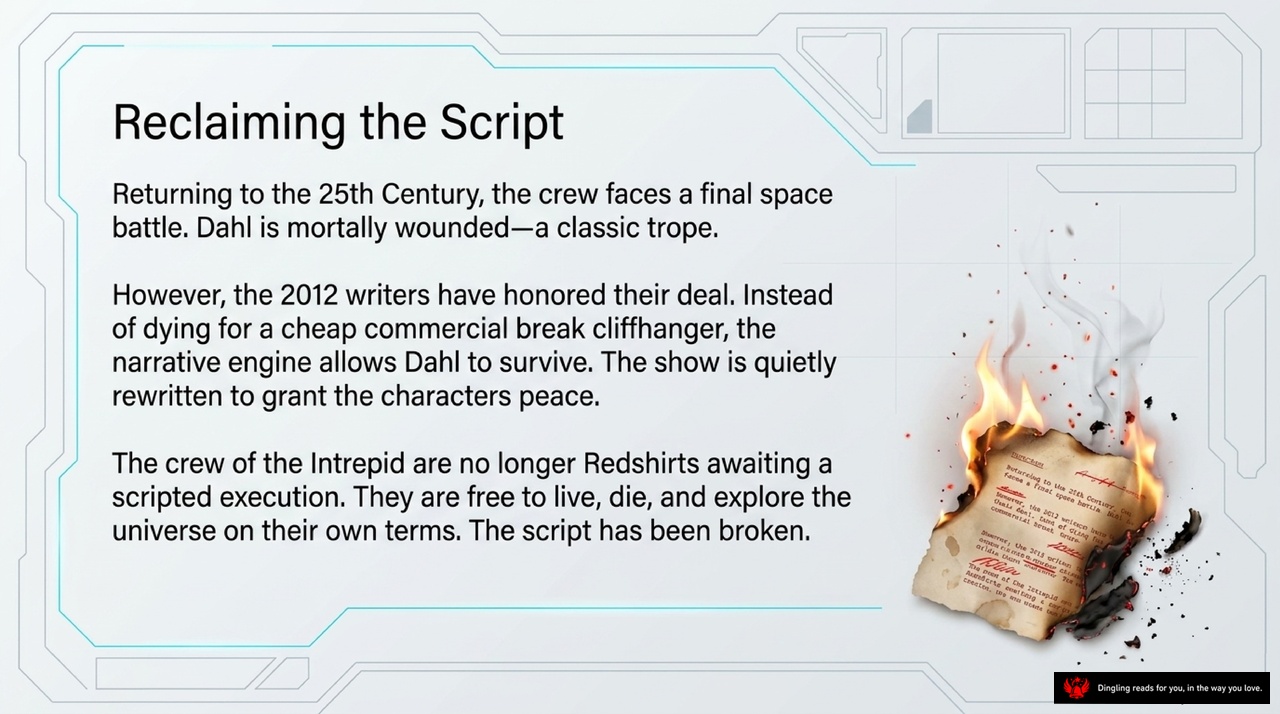
Returning to the 25th Century, the crew of the Intrepid faces their final space battle, but the stakes have changed forever. Dahl is mortally wounded—a classic trope that screams "dramatic finale." Yet, the 2012 writers honored their deal. Instead of dying for a cheap commercial cliffhanger, the narrative engine allows Dahl to survive. The show is quietly rewritten to grant the characters peace.
This victory means the crew of the Intrepid are no longer Redshirts awaiting a scripted execution. They are free to live, die, and explore the universe on their own terms. The script has been broken, and for the first time, the story belongs to the people living it, not the writers writing it.
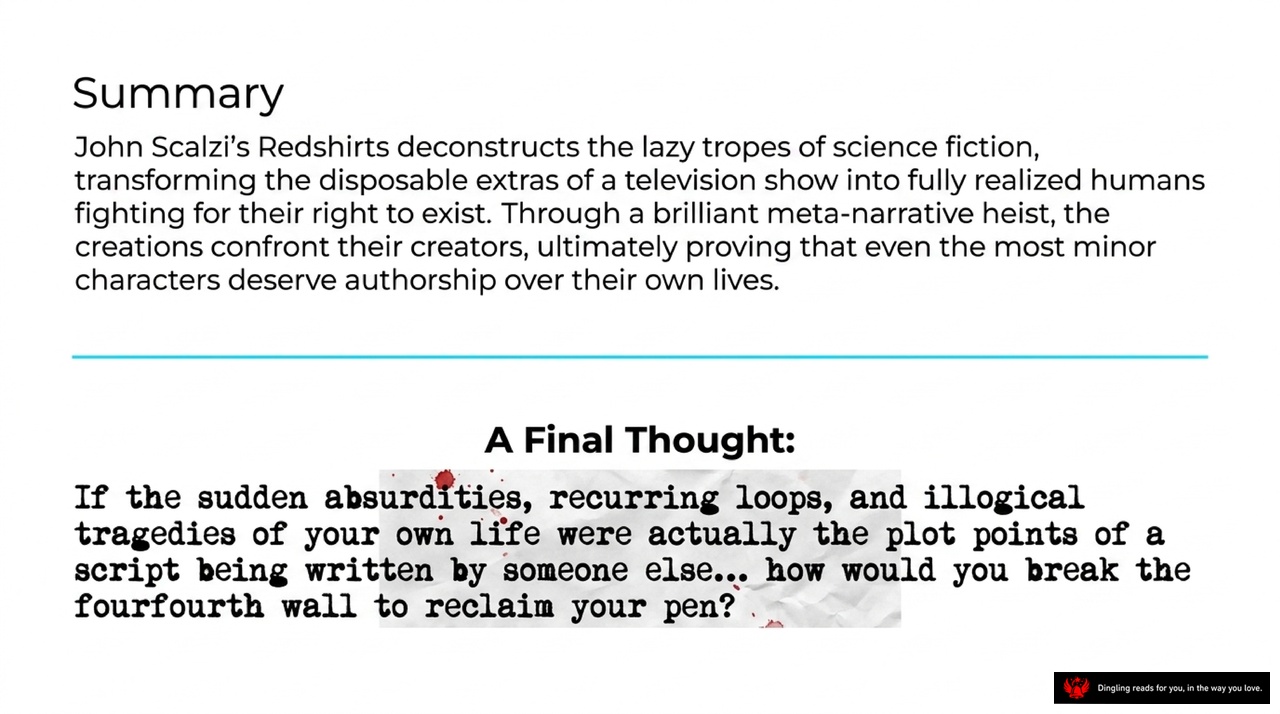
Imagine a world where the sudden absurdities, recurring loops, and illogical tragedies of your own life aren't just random bad luck, but actually the plot points of a script being written by someone else. What if the chaos you feel is just a character arc designed by a distant author?
This slide asks us to break the fourth wall and reclaim our pen. In John Scalzi's *Redshirts*, the crew of the USS Valiant realizes they are nothing more than disposable extras in a television show. They are "redshirts"—characters destined to die early to provide shock value for the audience, their deaths often occurring just before a commercial break to maximize impact.
But what if the show's writers got too lazy? What if the script was filled with cheap tropes and meaningless sacrifices just to fill time? The crew decides to stop being victims of a bad script and start rewriting their own story. They confront the creators, proving that even the most minor characters deserve authorship over their own lives.
So, look at your own life. If you were a character in a story, would you accept the plot twists handed to you, or would you find a way to change the ending? The question isn't just about fiction; it's about taking control of your narrative and refusing to be a passive observer in your own life.