
Reflections on Things at Hand: Complete Chapter-by-Chapter Summary

Welcome to our exploration of *Reflections on Things at Hand*, also known as the *Jin Si Lu*. This foundational text was compiled by Zhu Xi and Lü Zuqian, and it serves as a cornerstone of Neo-Confucian philosophy. What makes this book so enduring is its unique ability to connect the grand architecture of the cosmos with the intimate, everyday cultivation of the human mind. It’s not just about abstract ideals or distant truths—it’s about how we live, think, and grow right here, right now. Whether you’re navigating complex decisions or seeking inner clarity, the *Jin Si Lu* offers timeless wisdom that remains deeply relevant across cultures and centuries. Let’s dive in and uncover what this classic has to teach us about life, ethics, and the mind.

Let’s dive into the core framework of reality as presented in this slide.
Imagine the universe not as a chaotic mess, but as a perfectly designed system — a blueprint written before time began. That’s exactly what this diagram shows us: “The Architectural Blueprint of Reality.”
At the very top sits Taiji — the Supreme Ultimate. Think of it as the source code of existence. It’s not just a point; it’s the absolute origin and governing principle behind everything. From Taiji, two forces emerge: Movement, which we call Yang, and Stillness, known as Yin. These aren’t opposites in the usual sense — they’re complementary energies that constantly interact, creating rhythm and balance in the cosmos.
Now look at the vertical axis on the left: Li. This is the Universal Principle — the invisible, perfect blueprint that guides how things should be. On the right is Qi — the Material Force or Substance, the physical energy that gives shape and form to the world. Together, Li and Qi act like a dual engine driving reality forward.
From Taiji, the five elements — Fire, Water, Wood, Metal, and Earth — branch out. These aren’t just symbols; they represent dynamic forces that shape all material existence. And finally, at the bottom, we see “The Myriad Things” — everything we can observe, touch, and experience.
So here’s the takeaway: reality isn’t random. It’s structured. It’s built on a foundation of principle and energy, movement and stillness, all flowing from one ultimate source. This isn’t just philosophy — it’s the operating system of the universe.

Imagine your mind as a body of water. In its original state—what we call "Xing"—it’s still, clear, and perfectly reflective, like a calm lake mirroring the sky. It holds the universal principle, the Dao, without distortion. This is the Still Mind: pure, unclouded, and naturally aligned with truth.
But then, something stirs. External things enter—thoughts, desires, distractions—and they act like wind on that water. Suddenly, waves ripple across the surface. That’s “Qing”: emotion and desire. When unchecked, these stirrings create turbulence, obscuring the mind’s natural clarity. The water becomes choppy, the reflection broken.
Yet here’s the key insight: the water doesn’t lose its nature. Even when waves crash, the depth remains. The goal isn’t to stop the waves entirely, but to respond to life’s turbulence without losing the mind’s fundamental stillness. Like water that flows around obstacles yet remains unchanged at its core, wisdom lies in moving through life while staying grounded in inner peace.
So ask yourself: when the world stirs, can you remain the still water beneath the waves?

Today, we're diving into the heart of what it means to grow—not just as a person, but as a thinker, a learner, and a seeker of truth. This slide, titled “The Aspiration of the Scholar,” lays out a powerful framework for self-improvement that’s deeply rooted in ancient wisdom but still incredibly relevant today.
On the right, you’ll see a circular diagram showing three levels of being: at the center is The Sage, who perfectly embodies the Supreme Ultimate and acts naturally without force. Surrounding that is The Worthy, who actively cultivates themselves, corrects their mistakes, and aligns with principle. And on the outermost ring is The Ordinary Person—governed by habit, unchecked emotion, and selfish desire.
This model isn’t just about spiritual enlightenment; it’s about conscious growth. It reminds us that becoming a Sage isn’t about escaping reality or chasing some mystical state—it’s about removing the selfish desires that cloud our judgment and block our clarity. When we do that, our original nature shines through.
The text on the left echoes this idea: “The Sage aspires to Heaven; the Worthy aspires to the Sage; the Scholar aspires to the Worthy.” That’s a ladder of aspiration—one that starts with where we are and moves toward where we can become. It’s not about perfection from the start. It’s about direction, intention, and the daily work of aligning our actions with higher principles.
So whether you’re building a career, raising a family, or simply trying to be a better version of yourself, this model gives you a clear path forward. Start by understanding your current state. Then ask: What would it look like to be more aligned? More principled? More self-aware? And most importantly—what small step can you take today to move closer to that ideal?
This isn’t about being someone else. It’s about becoming the best version of yourself—by choice, by effort, and by intention.

Welcome back. Today we’re diving into a powerful framework from *The Great Learning*: the Cycle of Learning, specifically the phase of Investigation of Things. As you can see, this isn’t just about memorizing facts—it’s about building wisdom through a continuous, living process.
The cycle begins with **Observe (Gewu)**—investigating the principles embedded in daily life and nature. Think of it as paying close attention to how things work, not just on the surface, but at their core. Once you’ve gathered that understanding, you move to **Reflect**, where you extend your knowledge to grasp the deeper truth—what the Chinese call *Li*, or underlying principle. This is where insight becomes clarity.
Next comes **Internalize**—making your intentions sincere and aligning your mind with what you’ve learned. It’s not enough to know; you must embody it. And finally, **Act**: applying that cultivated mind to your family, your community, and the world around you.
This entire loop is grounded in one key idea: true knowledge comes from investigating the myriad things. Why? Because the principle inside you is the same as the principle in the universe. So studying the external helps illuminate the internal. And here’s the most important part: learning is never purely theoretical. It must lead to moral action. That’s how you turn wisdom into impact.

Here is the spoken script for Slide 5, tailored for an American audience:
**Slide 5: The Diagnostic Matrix**
Now, let’s look at the practical application of these concepts. This slide presents a diagnostic matrix that clearly contrasts "The Ordinary Mind" with "The Sage’s Mind."
First, look at the **Response to Stimuli**. The ordinary mind gets swept away by external events, losing its inner balance. In contrast, the Sage responds appropriately and then returns to a state of complete stillness. It’s about maintaining your center while engaging with the world.
Next, consider **Handling Anger**. The ordinary mind retains anger and often transfers that frustration to others. The Sage, however, feels anger objectively when facing injustice, but crucially, does not cling to it or transfer it. This is the difference between being a victim of your emotions and managing them with clarity.
Finally, look at the **View of the World**. The ordinary mind is driven by selfish profit and personal bias. The Sage views all things with universal impartiality, a concept known as *Gong*.
The bottom line, as stated here, is that the Sage does not lack emotion. Rather, their emotions are like a mirror: reflecting reality perfectly in the moment, but leaving no trace once the object is gone. This is the ultimate goal of self-cultivation.

Let’s talk about how emotions actually work—especially anger and desire. Think of this as a balance scale. On one side, you’ve got anger and desire—those raw, powerful forces that can easily tip you off course. On the other side, you’ve got sincerity and reverence—the grounding, stabilizing forces that keep you centered.
The key to staying balanced? Self-reflection. It’s not about suppressing anything. It’s about catching these emotions right when they stir in your mind—before they grow out of control.
When anger flares up, treat it like a collapsing mountain: stop it immediately, forcefully, before it ruins your judgment. When desire creeps in, don’t let it fill the ravine of your mind with selfishness. Instead, block it with moral principles.
So here’s the takeaway: don’t wait until emotions are overwhelming. Observe them at their origin. Use self-reflection as your anchor. That’s how you stay in control—not by fighting, but by understanding and guiding what you feel.

The Rectified Mind isn’t just a philosophical ideal—it’s the bedrock of authentic leadership. And as this slide shows, it rests on two non-negotiable pillars: Sincerity and Reverence.
Sincerity—Cheng in Chinese—means aligning your inner thoughts with universal truth. No self-deception. No pretending. It’s about being who you are, inside and out. When your actions match your values, you build trust—not just with others, but with yourself.
Reverence—Jing—isn’t about fear or awe of authority. It’s inner concentration. A focused vigilance over your own mind. Think of it as mindfulness on purpose: staying present, aware, and intentional in everything you do. It’s the quiet power of paying attention—to your thoughts, your choices, your impact.
Together, these two form the foundation of a rectified mind. One keeps you honest. The other keeps you grounded. Without sincerity, reverence becomes rigid. Without reverence, sincerity loses its direction. Master both, and you don’t just lead—you lead with integrity.

Have you ever thought about how the most beautiful things in life are often forged through struggle? Look at this slide — it shows a raw stone, then the same stone being scraped and worn down by friction, and finally, a glowing, polished jade. That’s not just an image — it’s a powerful metaphor for personal growth.
The text says, “If jade is not polished, it cannot become a vessel.” In other words, without hardship, without being shaped by difficulty, we can’t reveal our true potential. Adversity isn’t meant to break us — it’s meant to refine us. Just like that rough stone, when we face poverty, failure, or pain, those aren’t punishments. They’re the necessary friction that grinds away our selfishness and selfish desires, revealing the pure, principled core underneath.
So what does the scholar do when life gets tough? He doesn’t run away. Instead, he uses adversity as his ultimate grindstone — not to escape the world, but to sharpen his mind and character. That’s the real secret to cultivating yourself in adversity: embrace the struggle, let it shape you, and watch how you transform into something far more valuable than you ever were before.

So, where do we begin? Not with grand laws or distant rulers, but right here—in the center. Think of it like ripples in a pond. You drop a stone, and the disturbance spreads outward. In our own lives, it starts with *the mind*. That’s the innermost circle. From there, it flows into *the body*, then expands to *the family*, then to *the state*, and finally reaches *all under heaven*.
This isn’t just philosophy—it’s how influence actually works. A calm mind leads to a disciplined body. A harmonious family creates a stable community. And when that spreads, it shapes the nation, and even the world.
The book makes it clear: governance isn’t something separate from self-cultivation. It’s the natural outward expression of a well-ordered inner life. If you can’t manage yourself, you can’t lead others. If you can’t bring peace to your home, you can’t bring order to your country.
At the root of it all? Filial piety and family harmony. These aren’t just old traditions—they’re the foundation. Without them, nothing else holds. Once you’ve grounded yourself there, everything else follows naturally.
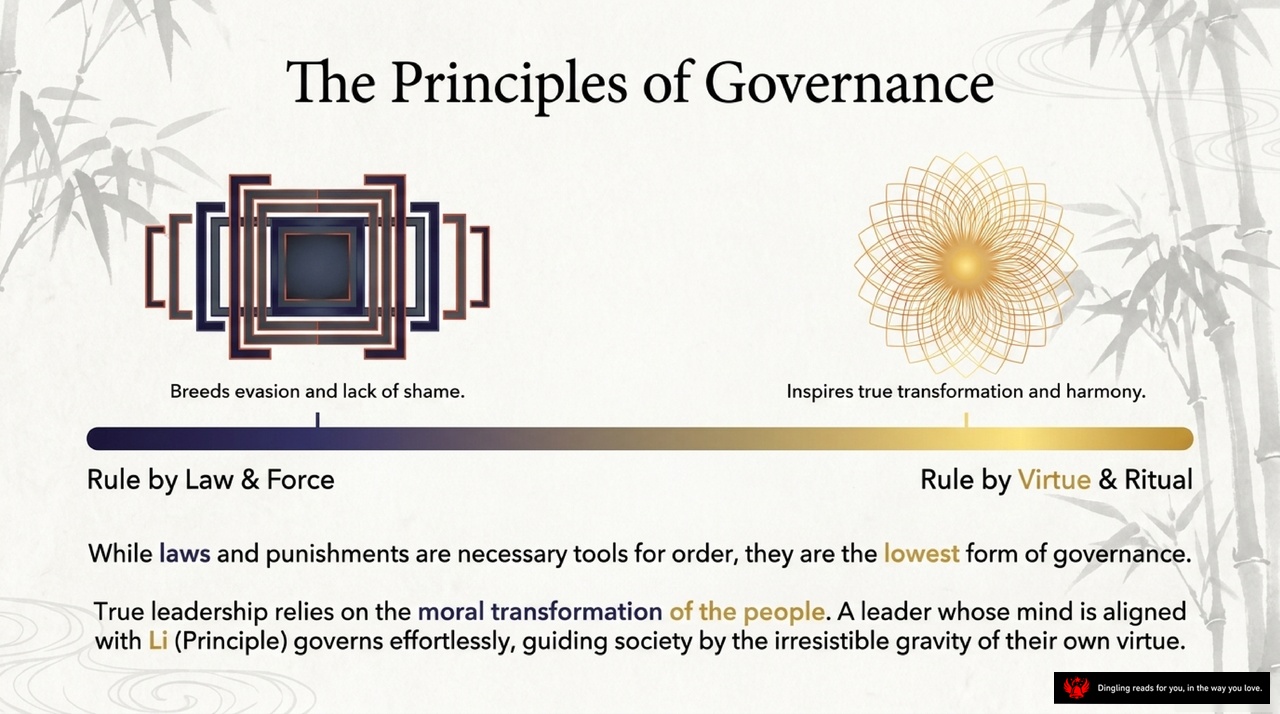
The Principles of Governance isn’t just about rules—it’s about what kind of leader you are and what kind of society you’re building. On the left, we see Rule by Law & Force: rigid, controlling, and ultimately breeding evasion and a lack of shame. People follow only because they have to, not because they want to. On the right, Rule by Virtue & Ritual inspires true transformation and harmony. It’s not about forcing behavior—it’s about cultivating character. While laws and punishments are necessary for order, they’re the lowest form of governance. True leadership relies on the moral transformation of the people. When a leader’s mind is aligned with Li—Principle—they govern effortlessly, guiding society by the irresistible gravity of their own virtue. This isn’t philosophy; it’s the foundation of lasting influence.

Navigating Success and Decline isn’t just a metaphor—it’s a rhythm built into the fabric of life, business, and even personal growth. As the slide shows, success and decline aren’t opposites; they’re part of a continuous cycle, much like the waves in the diagram. When we’re at the peak—when things are thriving, expanding, and moving forward—that’s when we must practice vigilance and restraint. It’s easy to get carried away, to push harder, to take more risks, but true wisdom lies in knowing when to slow down.
On the other hand, when we hit the low point—the trough of contraction, uncertainty, or even failure—that’s not the end. It’s a time for preservation and retreat. Not giving up, but holding onto your core values, protecting what matters, and waiting for the right moment to move again. The universe, as the slide reminds us, operates on cycles of Yin and Yang. Endless expansion without contraction is impossible. Nature, markets, and human behavior all follow this pattern.
In times of peace, the sage remains deeply cautious, knowing that extreme accumulation breeds decline. In times of chaos, the scholar preserves their integrity, retreating if necessary, waiting for the natural turn of the cycle rather than compromising their virtue. This isn’t about fear—it’s about awareness. It’s about understanding that every high has a low, and every low is a setup for a new high. By respecting these cycles, we don’t just survive change—we thrive within it.

Synthesis: The Unity of Knowledge and Action. Today, we’re connecting the dots between how we understand the world and how we live in it. Look at this diagram—it maps out the relationship between the macrocosm, the universe, and the microcosm, human life. At the top, we have Taiji and Li, representing the fundamental principles that shape the cosmos. Below, we see the mind, family, and state—the building blocks of our daily lives. The key insight here is that understanding the universe and governing your daily life aren’t separate pursuits. They’re deeply intertwined. When you grasp the Principle (Li) that governs the stars, you’re also tapping into the same principle that guides human morality. Acting with complete sincerity isn’t just about being good—it’s about harmonizing heaven and earth. And let’s be clear: knowing what’s right means nothing if it doesn’t manifest in action. This is where true wisdom begins.
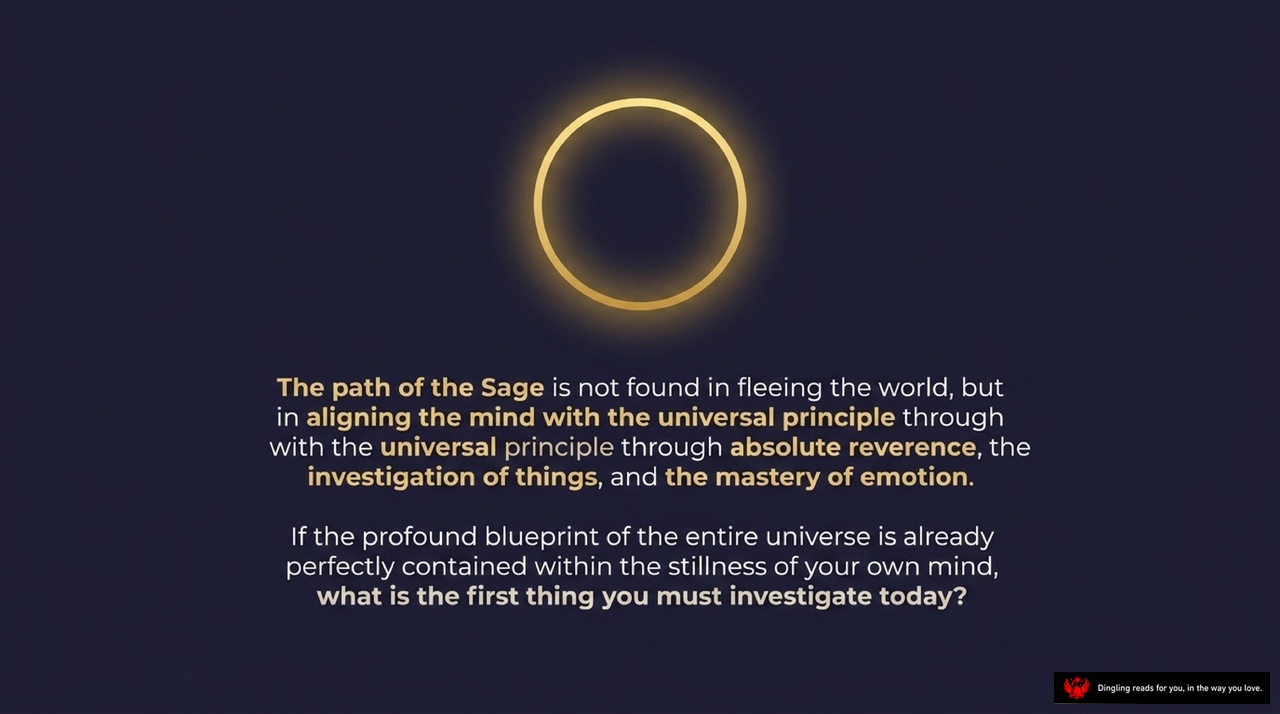
Let’s talk about what it really means to be a Sage. You’ve probably heard that wisdom comes from escaping the chaos of the world—retreating to the mountains, shutting out distractions, seeking silence. But the truth is, the path of the Sage isn’t about running away. It’s about staying rooted in the world while aligning your mind with something far greater: the universal principle.
This alignment doesn’t happen by accident. It’s built through three powerful practices: absolute reverence, the investigation of things, and the mastery of emotion. Think of reverence not as blind worship, but as deep respect for the order behind all existence. Investigation means asking hard questions—not just about the world around you, but about your own thoughts and reactions. And mastering emotion? That’s not about suppressing feelings, but understanding them, guiding them, and letting them serve your clarity instead of clouding it.
Now, here’s the real kicker: if the entire universe’s blueprint is already hidden in the quiet stillness of your own mind, then what’s the very first thing you need to investigate today? Not tomorrow. Not next week. Today. What’s one thought, one habit, one reaction that’s been quietly shaping your life—and is it serving the Sage within you?