
Resurrection: Complete Chapter-by-Chapter Summary

Welcome to our book club. Today, we're diving into Leo Tolstoy's masterpiece, *Resurrection*.
As you see on this slide, the image captures the very soul of the novel: a small, resilient plant pushing through dark, cracked rocks, illuminated by a single beam of light. It's a powerful metaphor for the book's core theme—a profound exploration of guilt, systemic injustice, and the painful journey toward spiritual redemption.
Just like that fragile flower, the protagonist, Prince Nekhlyudov, is crushed by the weight of his past sins. He realizes that his own arrogance and selfishness are the roots of much suffering in society, not just for individuals like the innocent prisoner Katya Maslova, but for the entire system that allows such cruelty to thrive.
But here is the most important part: Tolstoy doesn't leave us in despair. The light in the image represents the possibility of rebirth. Through confronting his own moral failures, Nekhlyudov finds a path to forgiveness—not just for himself, but for everyone he has wronged. It's a reminder that even when we are buried under the weight of our mistakes, there is always a way to grow again.
Let's turn the page and begin this journey of awakening.

Look at this striking contrast between the natural world and our own. On the left, nature thrives—resilient, harmonious, and full of life. Grass pushes through paving stones, birds nest, and trees bud, all moving toward peace and revival. But on the right, the human world is defined by self-inflicted torment. We obsess over stamped documents, numbered files, and rigid hierarchies, often prioritizing these artificial structures over the sacredness of human life.
The image captures a profound truth: only adult men continue to deceive and torment themselves and each other. While nature follows a divine order that defies artificiality, we build systems that trap us in cycles of suffering. This isn't just about rules; it's about how we choose to live. Do we embrace the harmony of nature, or do we remain stuck in the chaos of our own making? The choice defines us.

In this pivotal chapter, we witness the moment Prince Dmitri Nekhlyudov's soul is shattered and reborn. The slide captures the stark contrast between his former, idealistic self and the brutal reality he now faces. On the left, we see Dmitri: once an idealistic disciple of Spencer's Social Statics, believing in land privatization as unjust and dreaming of giving his inheritance to the peasants. He was ruled by a "Spiritual Man," seeking universal good. But the courtroom verdict—sentencing Katyusha Maslova to four years of hard labor—strips away that innocence.
On the right stands Katyusha, innocent and vibrant, a pure-hearted girl who was once saved by aristocratic aunts and loved life with a radiant joy, especially during Easter services in her white dress and blue sash. Yet, after being seduced and abandoned by Dmitri, she fell into a life of despair, becoming the prisoner we see today.
The bottom of the slide summarizes this tragic arc: a brief summer of pure, uncorrupted connection where the "Spiritual Self" reigned supreme. But that summer is over. The realization hits Dmitri like a physical blow. He sees the direct line between his own selfish desires and her current suffering. He realizes that his past actions didn't just hurt her; they destroyed the very essence of who she was. This moment of awakening forces him to abandon his comfortable, hypocritical life. He can no longer remain a passive observer. He vows to help her appeal the verdict, to fight the corrupt legal system, and to make amends, even if it means sacrificing his noble status and future marriage. It is here, in the ashes of his ruined reputation, that Dmitri truly begins to live.

Look at this slide. It lays out the brutal reality of "Dual Corruption" in *The Master and Margarita*. On the left, we see Nekhlyudov's fall. He enters the military, embraces his "Animal Self," and starts valuing ego, wealth, and lust above all else. His ultimate act? Seducing Katyyusha, leaving her with a measly 100-ruble note, and abandoning her. The society around him doesn't condemn this; they actively praise it, framing his moral descent as "becoming a real man."
On the right, we see Maslova's fall. She is pregnant and abandoned, driven out by her aunts, and exploited by men of power—from the police chief to a writer. Desperate to survive, she is forced into Kitayeva's brothel. The key insight here is stark: society didn't just ignore her suffering; it actively licensed and protected her exploitation.
The bottom line captures the tragedy perfectly. It's the triumph of the "Animal Man," masked by the veneer of polite society and legality. One man's selfishness destroys a life, and the entire system cheers it on.

The courtroom scene in *Resurrection* is a brutal collision of past sins and present law, and this slide captures the exact moment that shatters Prince Nekhlyudov's life. On the left, we see the accused: Maslova, now known as "Lyubov." She is a broken, cynical woman, framed for poisoning a merchant, yet she desperately maintains her innocence. On the right sits the jury, where Nekhlyudov himself is a juror, judging the very woman whose life he ruined ten years prior. This is the core of his tragedy: he is forced to sit in judgment of the direct result of his own sin. The realization at the bottom of the slide describes the shock that shatters his complacent aristocratic life. He is no longer a detached observer; he is now the architect of her destruction. As the text reveals, he recognizes that his past selfishness and cowardly abandonment of Katya—once pure and bright—led her directly to this prison cell. The legal system here isn't about justice; it's a mechanism that amplifies his personal guilt into a public sentence. Seeing her cry and hear the verdict confirms that his entire noble existence was built on a lie. This moment forces him to choose: remain a hypocrite or take action to redeem himself, no matter the cost.

Who possesses the right to judge the judged? Look at this slide. It exposes the dark reality of the court system in Dostoevsky's masterpiece. We see three key players: the Presiding Judge, the Assistant Prosecutor, and the Jury. On paper, they are the Arbitrator of Truth, the Defender of Public Morals, and the Voice of the People. But look at their hidden realities. The Judge is rushing the trial to meet his mistress, obsessed with exercise rather than human life. The Prosecutor is driven by career ambition, hungover from a night at a brothel. And the Jury? They are distracted by vanity, missed appointments, and their own guilt. The system isn't seeking truth; it's a blind machine operated by flawed, selfish individuals processing human lives like paperwork. This is where the real tragedy begins.

Look at this scale of justice. On the left, we see the "Animal Man's Defense"—the excuses we all use to numb our conscience. "Everyone does it," "It's normal for a military man," or the cold calculation to "give her money, hire a lawyer, and forget it." This is the heavy side of the scale, where lies and self-preservation tip the balance.
But on the right, we see the "Spiritual Man's Truth." This is where the real awakening happens. It starts with a brutal honesty: "I am a scoundrel." Then comes the refusal to live a lie, and finally, the resolve to cleanse the soul. The image shows the spiritual side rising above, illuminated by an open book and a heart, representing the path to redemption.
In the center, we see the resolution. It's a conscious decision to break the web of lies, abandon illicit affairs, and even surrender one's lands. Just like the protagonist in our story, who realizes that true justice isn't about money or legal loopholes, but about following a higher moral law—like following Maslova to Siberia, if necessary.
This slide captures the agonizing but necessary shift from selfishness to selflessness. It's the moment a person stops defending their past and starts building a new future based on truth and sacrifice.

Look at this diagram. It illustrates a terrifying truth: a system specifically engineered to multiply human sin. We see three concentric rings, each designed to corrupt the next.
Starting from the inside, we have the Church. The text describes it as a circle of empty, incomprehensible rituals. Instead of preaching the actual teachings of Christ, these rituals support state violence while betraying the core message of love and forgiveness. It's a system that sanctifies corruption.
Moving outward to the middle ring, we see the Prisons. These are depicted not as places for reform, but as overcrowded, disease-ridden cages. The description is stark: they strip away humanity, turning men into beasts rather than helping them become better. The system doesn't heal; it dehumanizes.
And finally, the outer ring: The Courts. This ring protects the property of the rich while punishing the poor simply for surviving. It's a legal facade that legitimizes inequality.
The slide concludes with a powerful summary at the bottom: "Corrupt people attempting to correct other corrupt people." This is the core irony of the entire system. The very institutions meant to uphold justice and morality are the ones actively generating the sin they claim to punish. It's a closed loop where the oppressors become the victims, and the victims are turned into the oppressors, all while believing they are doing the right thing.

The Resurrection of Katyusha Maslova is not just a title; it's the arc of a soul finding its way back to light. As we see here, her journey unfolds in three distinct phases. It starts with Phase 1: Cynical Acceptance. Broken by her past and driven by desperation, she believes all men are beasts. For her, sexuality becomes the only power she has left, and she coldly rejects Prince Nekhlyudov's initial pity, seeing him as just another predator.
But then comes the turning point: Phase 2, the Inner Shift. As she moves from criminal wards to political prisoners, she encounters true idealism and respect for the first time in years. She meets women like Shatrina, who are fighting for justice, not just survival. This new environment strips away her defenses and begins to heal her spirit.
Finally, we reach Phase 3: Ultimate Sacrifice. In a moment of profound moral courage, she refuses to marry Nekhlyudov, even though she has been pardoned. She loves him too much to ruin his life, choosing instead to marry the exile Simonson. This decision is her true redemption. It proves that she has reclaimed her own moral agency and capacity for selfless love. As the slide reminds us, true redemption is found not in being saved by a wealthy prince, but in reclaiming her own moral agency and capacity for selfless love.

The slide contrasts two distinct worlds within the Siberian abyss. On the left, we see "The State's Victims"—criminals dehumanized by the penal system, trapped in a cycle of poverty-fueled crime, reduced to fighting for scraps just to survive. On the right, illuminated by a golden glow, are "The Political Exiles" like Simonson and Kryltsov. They were persecuted not for crime, but for their principles, sacrificing their freedom for the sake of the people while retaining their humanity and dignity despite the chains.
This visual split drives home a terrifying truth stated at the bottom: the system targets the best and most empathetic minds, branding them as threats to an artificial order. It's a cruel irony. The state crushes the innocent into criminals, while it imprisons the righteous as dangerous elements. In this darkness, the political exiles become the only source of light, proving that even in the deepest abyss, the human spirit can choose to govern itself with dignity.

There is a voice in the wilderness, speaking to us about the one true thing that binds us all: the soul. As the slide illustrates with that solitary lantern piercing the darkness, the story reminds us that while there are countless religions and human-made laws, the soul is singular and universal. "There are many faiths, but the soul is only one," the text declares. It goes on to say, "You have yours, I have mine... As long as everyone trusts their own soul, we will all be united."
This profound idea is embodied by the nameless old ferryman, a character who stands as a beacon of truth in a world ruled by institutions. He rejects all human constructs—passports, rulers, and official decrees—because he believes in the complete sovereignty of the individual conscience over man-made laws. In a society where rules often feel arbitrary and oppressive, his refusal to bow is a radical act of faith. He teaches us that true unity doesn't come from following the same dogma or obeying the same authority, but from trusting the inner light within ourselves. When we stop looking outward for validation and start trusting our own souls, the barriers between us dissolve. That lantern in the corner isn't just lighting the path for the ferryman; it's a symbol for us all, reminding us that in the vast wilderness of life, the only thing we truly need to trust is the wisdom of our own hearts.

The system we live in is built on a dangerous illusion: that punishment fixes anything. Look at the split in the image. On one side, "The Myth" claims that punishment reduces crime, protects society, and reforms the criminal. But on the other side, "The Reality" shatters that belief. It tells us the hard truth: no human has the moral right to judge or punish another. Instead, our systems don't heal them; they create more criminals and completely corrupt the very people running them—the judges, the jailers, the executioners.
Society survives these institutions only by sheer luck. We are held together not because our laws are perfect, but because people still retain a baseline capacity to pity and love one another. This is the paradigm shift we must embrace. True justice isn't about inflicting suffering; it's about recognizing that we are all guilty and that the only way to stop the cycle of violence is to stop punishing and start forgiving.

Look at this blueprint for earthly salvation. These aren't just abstract ideals; they are practical laws. The image shows us a staircase rising toward the light, representing a path where institutionalized violence collapses if we follow these steps.
Let's walk up together. The first step is simple: do not be angry; live in peace with everyone. From the second step, we stop indulging in sexual immorality and remain faithful. As we climb higher, we refuse blind obedience to the state or military. At the fourth step, we learn to not resist evil with violence and forgive those who wrong us. Finally, at the top, we love our enemies as we love our friends.
The text reminds us that if we follow these laws, the violence built into our world would instantly collapse. It's a radical idea, but it starts with us choosing peace over anger, forgiveness over retaliation, and love over hate.
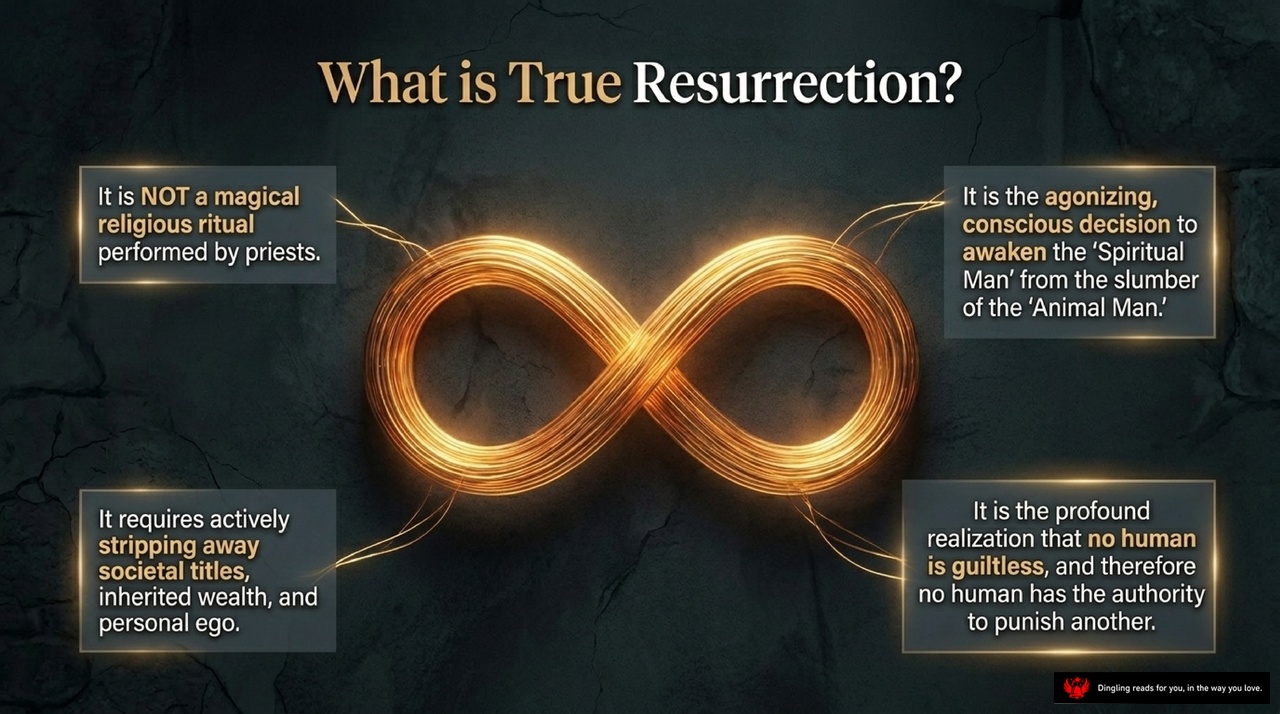
What is True Resurrection?
Look at this glowing infinity symbol. It represents a cycle that never ends, but today, we are redefining what it means to break free from it.
First, let's be clear: True Resurrection is NOT a magical ritual performed by priests in a temple. It is not something you can buy or be granted by an authority figure.
Instead, it is an agonizing, conscious decision. It is the painful choice to awaken the "Spiritual Man" within you, pulling yourself out of the deep slumber of the "Animal Man"—that part of us driven only by instinct, greed, and survival.
This awakening requires active work. It means stripping away the masks we wear: the societal titles we cling to, the inherited wealth that defines us, and most importantly, the personal ego that separates us from others.
But perhaps the most profound part of this realization is understanding that no human is actually guiltless. When we admit that everyone carries the weight of sin and suffering, we realize that no single person has the moral authority to punish another.
This shift in perspective changes everything. It moves us from a world of judgment and retribution to one of shared humanity and redemption. That is the true resurrection.

True justice cannot be administered by flawed human institutions; it requires a radical internal resurrection fueled by boundless forgiveness, the dismantling of our own ego, and the recognition of our shared guilt. If our human systems of judgment and punishment only multiply the very sins they seek to cure, will you have the courage to forgive seventy times seven, and begin your own resurrection?