
Salt Town: Complete Chapter-by-Chapter Summary
Welcome to our reading session on *Salt Town* by Yi Xiaohe. This book offers a quiet, powerful glimpse into rural China — not through grand narratives, but through the lives of women whose voices have been silenced by time and tradition. The cover image captures that atmosphere: a misty, cobblestone street in an old village, where silence speaks louder than words. It’s not just a setting — it’s a character itself, holding the weight of forgotten stories and enduring strength. As we dive in, we’ll explore how this microcosm reveals the resilience of those who shaped a community no one saw coming. Let’s begin.

Here is the spoken-word script for the current slide.
**Slide 1: A Town Left Behind by Time**
Welcome to Xianshi Town, a place where geography has written a tragedy. Look at this split image. On the left, we see Xianshi at its peak as "The Salt Hub." It was once a vital water depot, teeming with boats and generating immense wealth through the historic salt trade. But look at the right side, and you see the same town today, labeled "The Rust Belt."
The contrast is stark. A high-speed rail passes just five minutes away, yet local industries are dead. The youth have fled, leaving behind an aging population trapped in economic stagnation. Xianshi is no longer a town; it is a hollowed-out five-tier ghost town, left behind by the very time it once dominated.
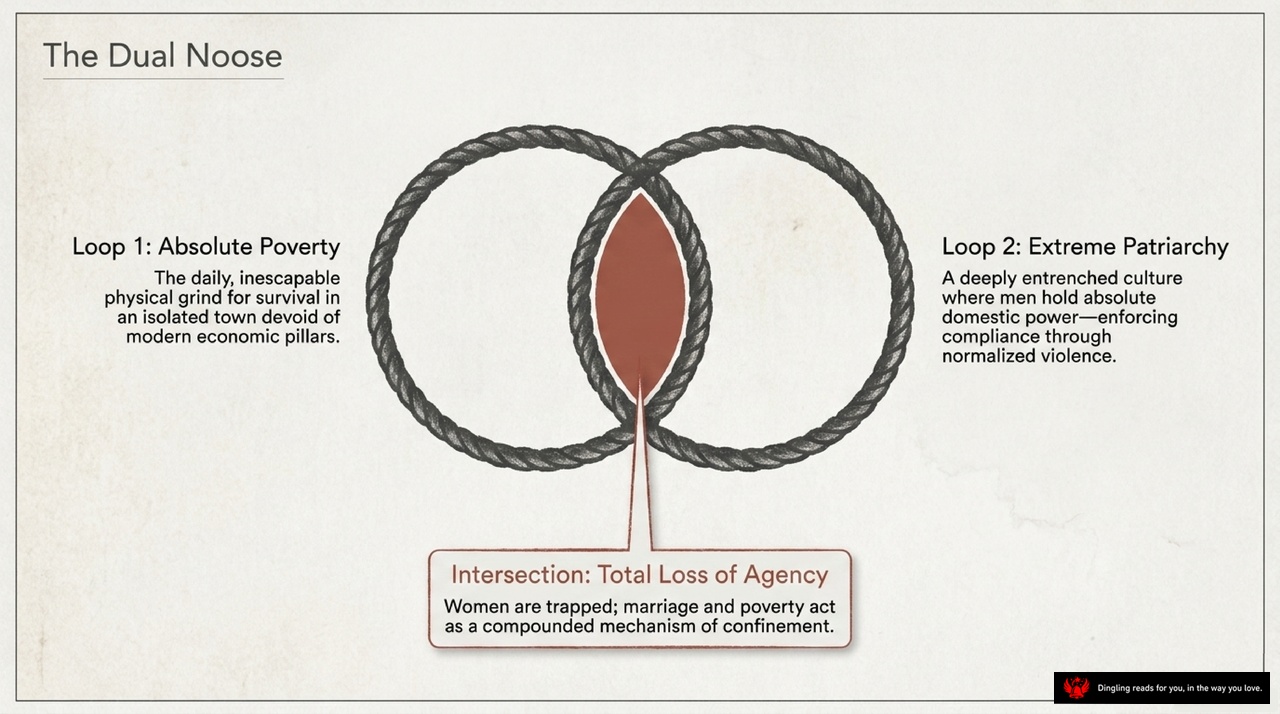
Let’s talk about the dual noose—a powerful metaphor for how women in certain societies are trapped. Picture two ropes, tightly woven and interlocked, forming a figure-eight that squeezes the very center of a woman’s life.
On the left, we have Loop 1: Absolute Poverty. This isn’t just about lacking money—it’s about a daily, inescapable struggle to survive in isolated towns where modern economic structures don’t exist. There’s no safety net, no access to education or jobs, and no escape from the grind.
On the right, Loop 2: Extreme Patriarchy. Here, men hold absolute power within the home and community. Compliance is enforced not through negotiation, but through normalized violence—physical, emotional, and social. Women aren’t just poor; they’re controlled.
And where these two loops intersect? That’s the heart of the problem: Total Loss of Agency. Women are caught between survival and submission. Marriage and poverty become a compounded mechanism of confinement. They can’t leave because they have no resources, and they can’t speak up because they’re silenced by culture and fear.
This dual noose isn’t just a metaphor—it’s the lived reality for millions of women around the world. And understanding it is the first step toward breaking free.
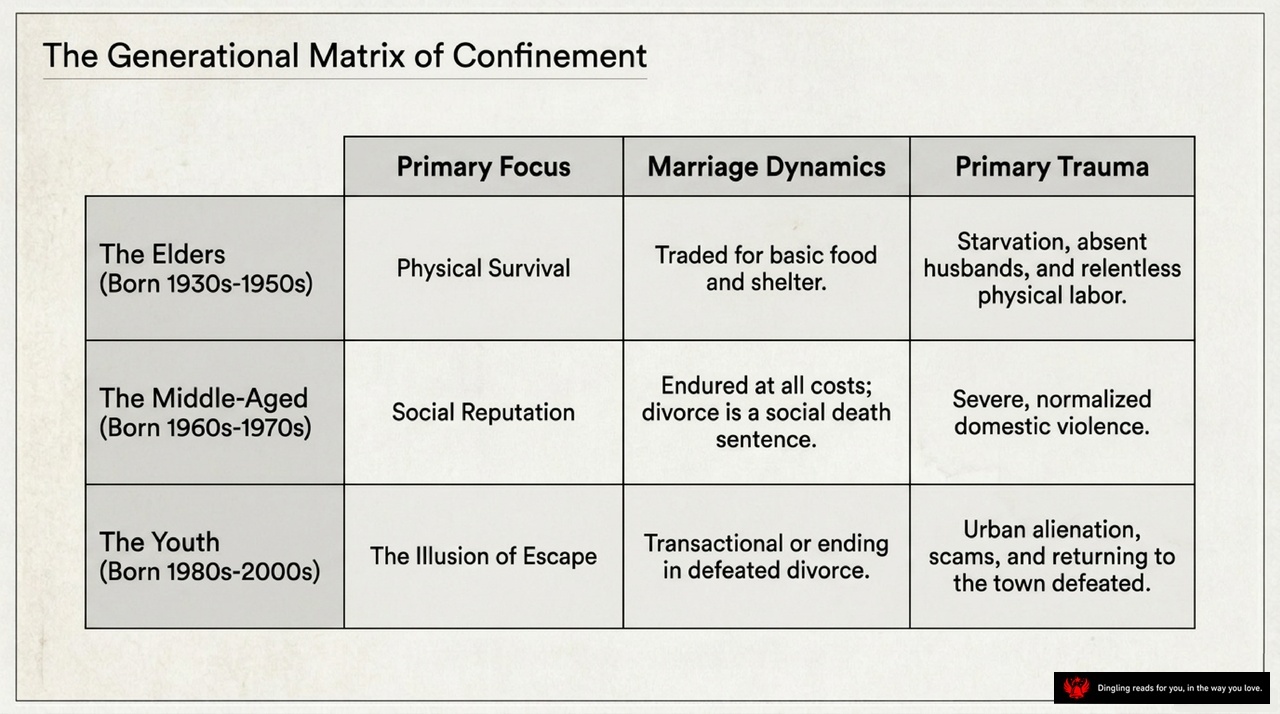
Look at this matrix. It’s not just a chart—it’s a mirror. It shows how three generations, each born in different times, were shaped by the same kind of trap: confinement.
The Elders—those born in the 30s and 40s—lived in a world where survival was everything. Their marriage wasn’t about love; it was about trading for food and shelter. And their deepest trauma? Starvation, missing fathers, endless physical labor. They didn’t choose their fate—they endured it.
Then came the Middle-Aged generation, born in the 60s and 70s. Their focus shifted to social reputation. Marriage became something you endured at all costs. Divorce? That wasn’t just a personal decision—it was a social death sentence. Their trauma? Domestic violence, normalized and accepted as part of life.
And finally, The Youth—born from the 80s to the 2000s. Their primary focus? The illusion of escape. They thought they could leave their parents’ world behind. But marriage became transactional—or worse, ended in defeated divorce. Their trauma? Urban alienation, scams, and the painful reality of returning home defeated, just like their parents before them.
This matrix doesn’t just describe generations—it reveals a cycle. Each generation tries to escape the last, but ends up trapped in the same patterns. The question is: can we break the cycle?

The slide is titled "The Elders: Surviving the Abyss," and it tells the harrowing story of Chen Bingzhi, a 90-year-old woman who endured unimaginable hardship just to survive. On the right, we see her depicted as an elderly figure leaning on a cane—a symbol of her long, difficult journey through life.
The quote on the left captures her raw, unfiltered truth: “I had no choice. We had to eat. The beds couldn’t be slept through anyway.” This isn’t just words—it’s a testament to a life where dignity was stripped away, and survival was the only option left.
Chen Bingzhi was born in the 1930s into a time of severe famine, abandoned by her father before she even had a chance to grow up. By the 1950s and 60s, she had lost her husband multiple times and suffered relentless abuse from those she trusted. With no support system and six children to raise, she made a heartbreaking decision: open an underground brothel for elderly and disabled men. It wasn’t a choice made out of moral failure—it was a desperate economic mechanism to keep her family alive when the world had turned its back on her.
In 1990, she finally opened that brothel—not as a victim, but as a survivor. Her story isn’t about shame or judgment. It’s about how far one person can go when pushed to the edge. When systems fail, people don’t always have options—but they do have the strength to endure.
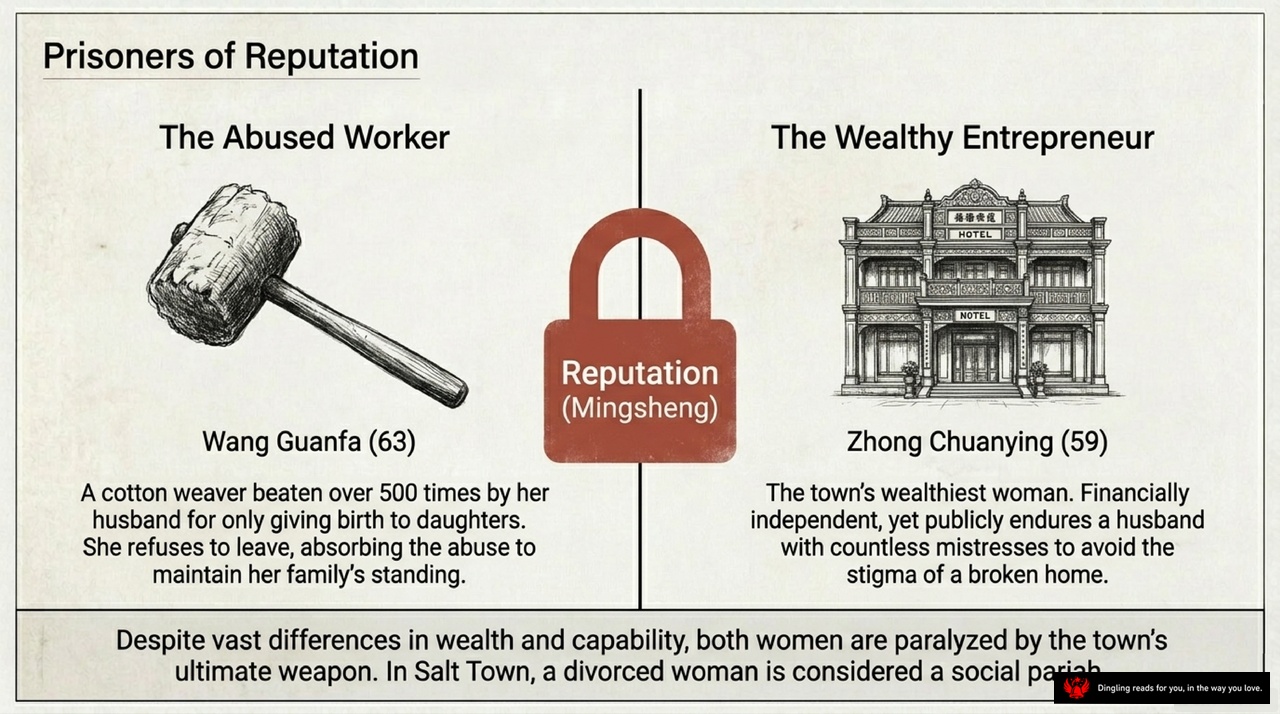
Prisoners of Reputation. On the left, we see Wang Guanfa, a 63-year-old cotton weaver, beaten over 500 times by her husband simply for giving birth to daughters. She stays, not out of love, but because leaving would mean losing her family’s standing. On the right stands Zhong Chuanying, 59, the town’s wealthiest woman—financially independent, yet trapped in a marriage riddled with infidelity. She stays not because she needs him, but because divorce would mark her as a social pariah. At the center, the red lock labeled “Reputation (Mingsheng)” seals them both. Despite their vastly different lives—one poor and abused, the other rich and powerful—they are equally paralyzed by the same invisible force: the town’s obsession with appearances. In Salt Town, being divorced isn’t just personal; it’s a public failure. And that’s the real prison.

So, let’s talk about what actually happens behind the scenes when domestic violence takes root—and how it keeps going, again and again.
This slide breaks it down into four steps. First, there’s the act itself—the moment violence erupts. Often, it’s sparked by things like male idleness, alcohol, or a deep-seated sense of entitlement. It’s not random; it’s fueled by something.
Then comes Step 2: Institutional Blindness. When abuse happens, local authorities too often brush it off as just “minor friction.” No legal action. No real consequences. That silence? It tells the victim that nothing will change.
Next, Step 3: Social Conditioning. Neighbors, friends, even family might step in—but instead of helping, they blame the victim or tell her to “just endure it.” Why? Because they’re worried about protecting the kids or keeping up appearances. That kind of pressure makes it even harder to break free.
Finally, Step 4: Submission. The woman starts to believe the violence is just her fate. She absorbs it, internalizes it, and goes back to doing the endless physical labor. And then… the cycle resets.
This isn’t just about one bad day. It’s a system. And once you see how it works, you can start to fight back.

Here is the spoken-word script for Slide 7.
**The Boomerang Effect: The Illusion of the City**
Here is the brutal reality of the American Dream for many young people: it’s not a straight line upward; it’s a boomerang.
Look at this diagram. It starts in the "Salt Town"—that rural, isolated place where the patriarchy is rigid and life feels like a dead end. For the youth, the city promises an escape. The arrow shows the dream: leaving behind that small-town destiny and heading toward the glittering towers of the Mega-Cities.
But here is the trap. The text explains that without higher education and social capital, the city doesn't save you; it exploits you. You fall victim to scams, dead-end labor, and a system that demands everything from you but gives you nothing back.
The result is that explosive red center in the middle. The city ultimately rejects them. Defeated and broke, they don't stay. They retreat back to the exact structures they tried to escape. They return to isolation, now burdened as single mothers or broken divorcees, trapped in the same patriarchal cage they started in. It’s a cycle, and the city is just the place where the cycle snaps.

Let’s talk about two very different ways of resisting the world—through silence and through force. On the left, we have Tong Hui, 52, labeled as “The Taboo.” She doesn’t speak out, doesn’t demand rights, and doesn’t fight. Instead, she simply refuses to play by the rules. She rejects men entirely, lives quietly with a woman, and finds peace in a domestic life that her town would never openly accept. It’s not rebellion with a banner—it’s rebellion with a closed door. She lives in the shadows, protected by invisibility, and finds equality not through confrontation, but through quiet defiance.
Now, look to the right. This is Huang Xinyi, 17, labeled as “The Deviant.” Where Tong Hui hides, she steps forward. She doesn’t wait for justice—she takes it. Working in the gray economy of KTVs, she’s not a victim. She becomes the aggressor. She uses physical violence, martial arts, and a tough exterior to survive in a world that wants to prey on her. Her resistance isn’t subtle—it’s loud, dangerous, and unapologetic.
So here’s the contrast: one woman resists by disappearing into the background; the other by stepping into the spotlight and fighting back. Both are alternatives to the system that tells them who they can be. One chooses peace through silence; the other chooses survival through strength. And both, in their own way, are powerful forms of resistance.
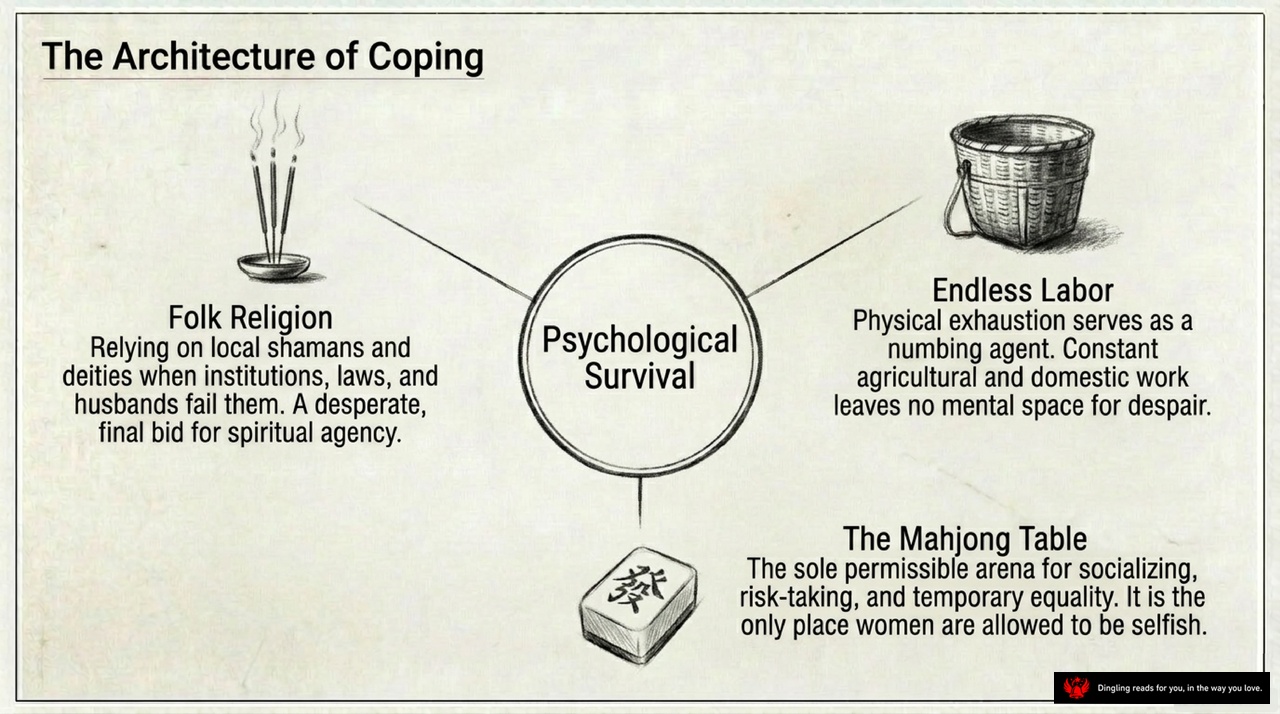
The Architecture of Coping isn’t just a diagram—it’s a lifeline. At its center lies Psychological Survival, the quiet, relentless drive to keep going when everything else has collapsed. Around it, three pillars hold up the weight of daily existence.
First, Folk Religion. When institutions fail, when laws don’t protect, and when husbands turn away, women don’t give up. They turn to local shamans and deities—not out of blind faith, but as a last, desperate bid for spiritual agency. It’s not about belief; it’s about control. About saying, “Someone is listening.”
Then there’s Endless Labor. Physical exhaustion becomes a numbing agent. Constant work—agricultural, domestic, relentless—leaves no room in the mind for despair. You’re too tired to cry, too busy to think. Survival becomes automatic, mechanical, invisible.
And finally, The Mahjong Table. This is the one place where women are allowed to be selfish. The only arena where they can socialize, take risks, feel temporary equality. It’s not just a game—it’s a rebellion. A rare, stolen moment where they’re not mothers, wives, or workers… just themselves.
Together, these aren’t just coping mechanisms. They’re acts of resistance. Quiet, stubborn, beautiful.

The tragedy of Salt Town isn’t just about suffering—it’s about erasure. You see, the official local gazetteers? They meticulously record the deeds of men. But women? Total absence. Not a single name, not a single story. Their births, their endless labor, their systemic abuse, even their deaths—everything omitted from the town’s official memory. They’re the invisible bedrock upon which the town was built. Without them, there’s no Salt Town. Without their voices, there’s no history. This isn’t just about what was left out—it’s about who got to write the story in the first place.

The women of Salt Town are the invisible bedrock of rural China. Through decades of relentless poverty, systemic abuse, and suffocating traditions, they have endured—trading their bodies, their dreams, and their blood to ensure the survival of their families. They are a testament to a profound, tragic resilience that official history refuses to record. As the high-speed trains race past these fading towns toward a glittering modern future, who will be left behind to remember the women who bled into the soil?