
Shark's Fin and Sichuan Pepper: Complete Chapter-by-Chapter Summary

Welcome to *Shark's Fin and Sichuan Pepper*, a journey through the palate and philosophy of Chinese culinary culture. This book isn't just about recipes; it's about decoding the soul of a civilization through its food.
As we begin, imagine a journey that starts not in a high-end restaurant, but in a bustling Chengdu market. Here, ingredients aren't sorted by perfection but by potential. What Westerners might discard as waste becomes the hero of a dish. This reflects a deep cultural wisdom: a history of survival that taught generations to honor every part of nature, turning humble ingredients into celebrations of life.
We'll explore how Sichuan cuisine transforms the ordinary into the extraordinary, using bold flavors like the numbing heat of Sichuan pepper and the fiery kick of chili to banish the region's damp chill. From the street-side ritual of Dan Dan noodles to the complex artistry of knife skills, every bite tells a story. We'll also touch on the darker side of this rich heritage, questioning the pursuit of luxury ingredients like shark fin and bear's paw, and how tradition sometimes clashes with modern ethics.
Join us as we peel back the layers of Chinese food, finding not just sustenance, but a profound connection to history, community, and the very essence of being alive. Let's dive into the flavors that define a nation.
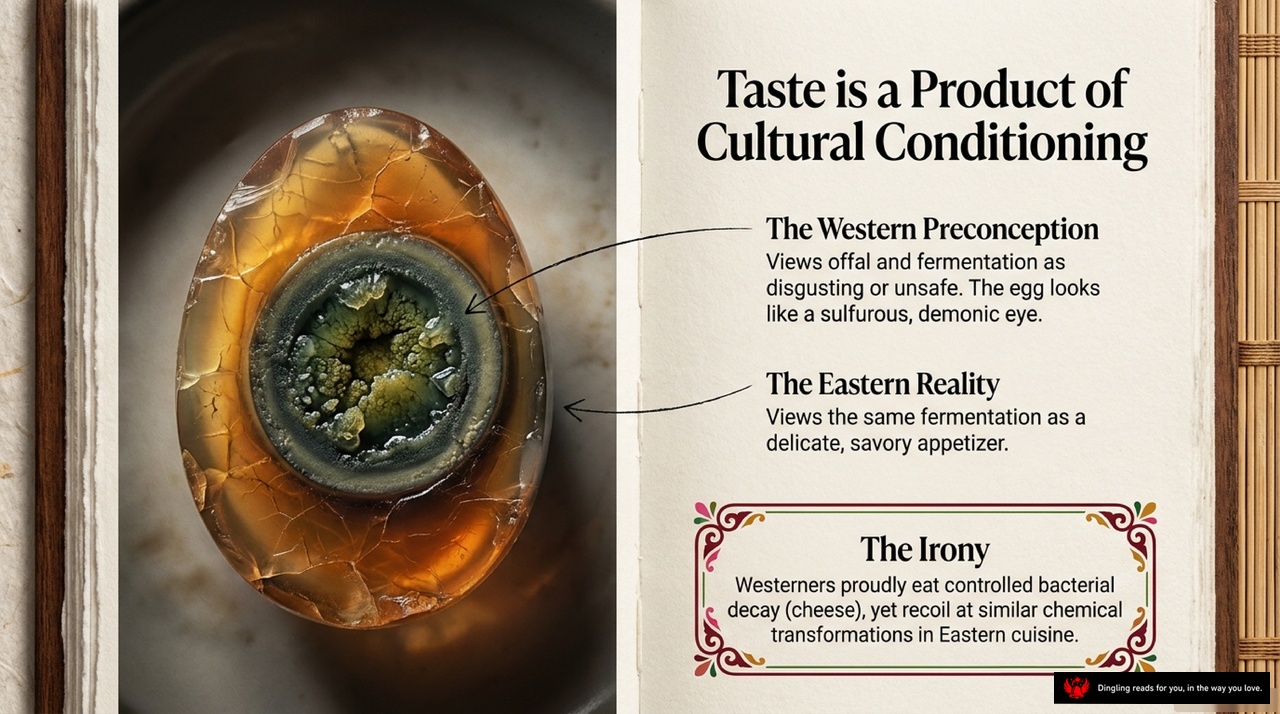
Taste is a Product of Cultural Conditioning. Look at this preserved egg, a true delicacy in Eastern cuisine, yet to many Western eyes, it looks like a sulfurous, demonic eye. This image perfectly captures a fundamental clash: the Western preconception versus the Eastern reality. While we might recoil at offal and fermentation, viewing them as unsafe, Eastern cultures see the same biological processes as sources of delicate, savory flavor.
Here lies the irony. Westerners proudly eat controlled bacterial decay in the form of aged cheese, celebrating the complexity it brings. Yet, we often recoil at similar chemical transformations in Eastern dishes, labeling them as strange or unhygienic. It's a fascinating double standard. What we consider "rotting" is often the very essence of life and depth in another culture's kitchen. This slide reminds us that our preferences aren't just biological; they are products of deep cultural conditioning. What one side loves, the other might fear, simply because the story behind the food is different.

Look at this table, "A Clash of Culinary Paradigms." It perfectly captures the fundamental divide between how we in the West view food versus how it's done in China. Let's break down these three dimensions.
First, the view of animals. In the Western paradigm, we see creatures as beings with spirits, rooted in animism. We tend to keep a distance from the source of our food. But in the Chinese paradigm, animals are simply "moving objects"—pragmatic resources for sustenance. There is no taboo against acknowledging where the food comes from; the market is honest about the life that was just taken.
Second, preparation. Westerners often celebrate the natural state, eating raw or as a salad to honor the ingredient's original form. Historically, Chinese culture viewed raw food as barbaric. Cooking, especially using the wok, is the very mark of civilization. It transforms the raw into the refined.
Finally, the goal of cooking. Western cuisine often highlights a single primary ingredient, like a perfect steak, letting it stand alone. Chinese cuisine aims for something else entirely: achieving harmonic balance and composite integration. It's about Yin and Yang, mixing flavors and textures so that every ingredient plays a role in a unified whole, rather than just one star on the plate. This isn't just about cooking; it's a clash of worldviews.

Today's slide breaks down the secret to true Chinese cooking mastery into three intersecting circles: Dao Gong, Tiao Wei, and Huo Hou. Think of these not just as steps, but as the foundational pillars of culinary art.
First, on the left, is Dao Gong, or Knife Work. This isn't just about cutting food; it's about shaping the physical form. In Chinese cuisine, precision is everything. Whether you're slicing ginger into tiny "nail slices" to release their aroma quickly or cutting pork into uniform strips for even cooking, the shape of your ingredient dictates how it behaves in the wok. It's a skill that requires patience and mindfulness, turning a simple vegetable into a piece of art before it even hits the heat.
Next, we have Tiao Wei, representing Flavor. The slide describes this as "the alchemy of seasoning." This is where the magic happens. It's not about overpowering the food with heavy spices, but about balancing and elevating the natural essence of the ingredients. From the complex twenty-three flavor profiles of Sichuan cuisine to the delicate subtleties of Jiangnan, every pinch of salt and dash of vinegar is calculated to create a harmonious symphony on the tongue.
Finally, at the bottom, is Huo Hou, the mastery of Fire. This is the control of heat and time. It's the difference between a burnt dish and a perfectly seared steak. The chef must constantly adjust the flame, knowing exactly when to stir, when to let the food rest, and when to pull it off the heat to lock in that perfect texture.
The diagram highlights the center where all three circles overlap. This is the point of true mastery. It's where precise geometry meets chemical alchemy and thermal micro-environments perfectly align. When Dao Gong, Tiao Wei, and Huo Hou converge, you don't just get a meal; you get an experience. It's the moment when technique, flavor, and fire dance together in perfect unison, creating dishes that are not only delicious but deeply resonant with the culture they come from.
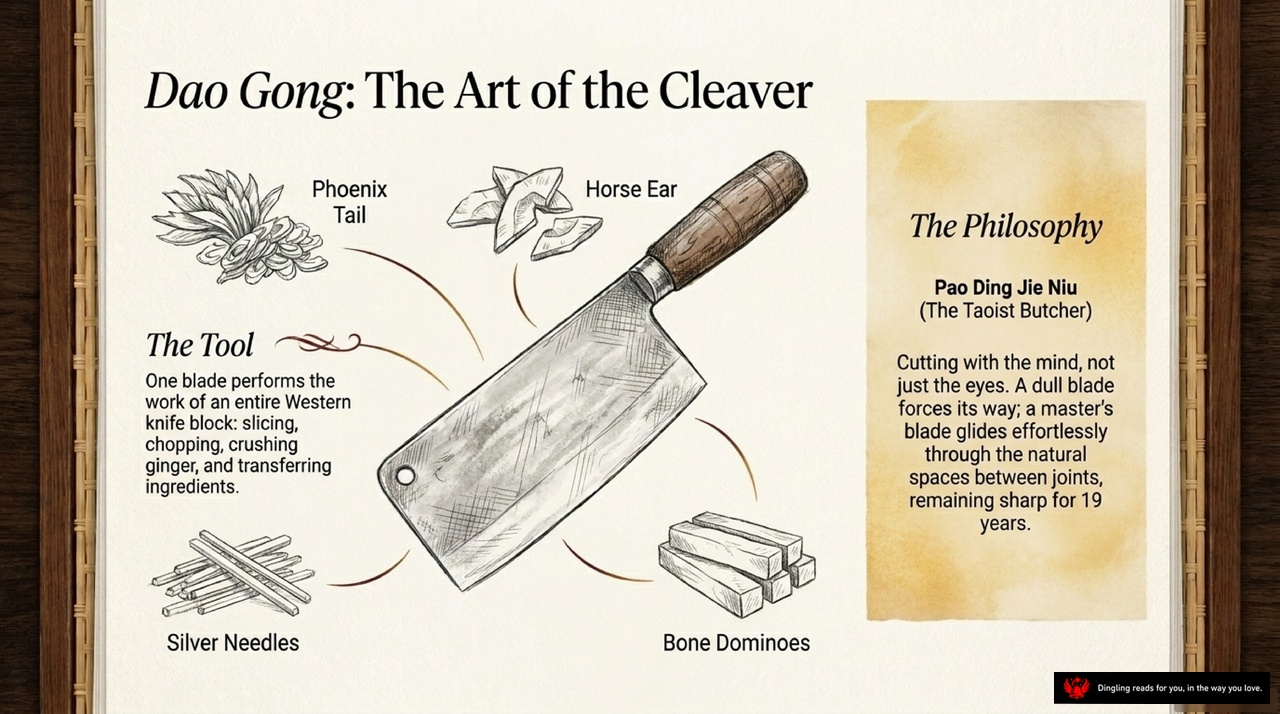
Welcome to the kitchen of the Taoist butcher. Today, we're diving into the ancient art of Dao Gong, or the philosophy of the cleaver. Look at this image: it's not just a tool; it's a portal to a different way of seeing the world.
The centerpiece here is the Chinese cleaver, often called a "Western knife block" in itself. One blade handles slicing, chopping, crushing, and even transferring ingredients. It's a symbol of practical wisdom—versatile, sharp, and ready for anything. But the real magic lies in the shapes it creates. Notice the "Phoenix Tail," "Horse Ear," "Silver Needles," and "Bone Dominoes." These aren't random cuts; they are precise language. A "Phoenix Tail" for tender kidney, "Horse Ear" for crisp scallions, "Bone Dominoes" for sturdy bamboo shoots. Each shape is designed to cook perfectly, ensuring that every bite has the right texture and flavor.
This brings us to the core philosophy attributed to Pao Ding Jie Niu, the legendary Taoist butcher. The text reminds us that true mastery isn't about forcing the blade through the meat. A dull blade struggles, but a master's blade glides effortlessly through the natural spaces between the joints. It's about cutting with the mind, not just the eyes. With this kind of precision and respect for the ingredient, a blade can remain sharp for nineteen years.
So, when you hold a cleaver, you're not just holding steel. You're holding a tradition that values efficiency, beauty, and a deep connection to the food itself. It's a reminder that the best cooking comes from understanding the material you're working with and letting it guide your hand.
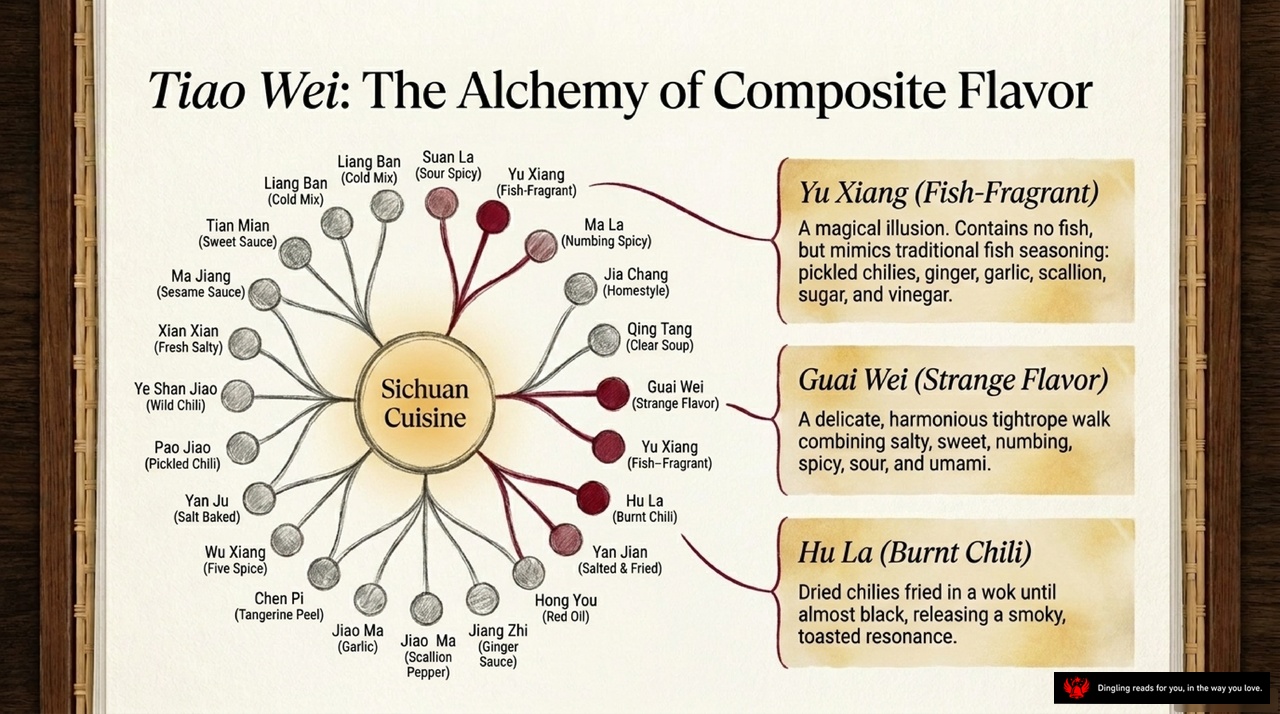
Tiao Wei: The Alchemy of Composite Flavor. This slide maps the soul of Sichuan cuisine, showing how it's not just about heat, but about the precise chemistry of twenty-three distinct flavor profiles. Look at the center: Sichuan Cuisine. It branches out into everything from the numbing-spicy Ma La to the fish-fragrant Yu Xiang, which is a magical illusion containing no fish at all.
The right side highlights three specific alchemies. Yu Xiang, or Fish-Fragrant, mimics traditional fish seasoning using a blend of pickled chilies, ginger, garlic, scallions, sugar, and vinegar. Then there's Guai Wei, or Strange Flavor—a delicate tightrope walk combining salty, sweet, numbing, spicy, sour, and umami all at once. Finally, Hu La, or Burnt Chili, where dried chilies are fried until almost black, releasing that signature smoky, toasted resonance. This diagram perfectly captures the core philosophy: it's not about one dominant taste, but the art of balancing and layering flavors to create something entirely new and complex.

Have you ever tasted something that didn't just hit your tongue, but actually vibrated through your entire face? This slide explores the unique "magic of Ma"—that distinct, numbing sensation from Sichuan peppercorns, which the text describes as a tactile vibration rather than just heat.
Look at the activation curve on the right. It maps out a fascinating 20-minute journey for your palate. In the first two minutes, you experience an initial burst of citrus and woody aromas. But the real transformation happens between minutes 2 and 5. This is when the "Ma" sensation kicks in. It's not burning heat; it's a 50Hz tactile vibration on your lips and tongue, almost like a mild electrical current. Your mouth starts to tingle and cool down.
By the 5-to-20 minute mark, your senses are hijacked. The tingling prepares your mouth to fully appreciate the accompanying spicy heat of the chili. As the illustration shows, this unique spice is the soul of Sichuan cuisine, turning a simple meal into an electric, immersive experience that connects directly to your nervous system.

Look at this diagram of the wok. It illustrates a fundamental truth about Chinese cooking: it's not just about heating food; it's about managing the "breath" of the wok through two distinct states of fire.
On the left, we see "Wu Huo," or Martial Fire. This is the roaring, violent blaze you see at the bottom of the pan. It's designed for flash-frying, searing the exterior of ingredients instantly while keeping the interior crisp. Think of it as the aggressive, high-octane energy needed for stir-fries.
On the right, we have "Wen Huo," or Literary Fire. This is the gentle, steady simmer used for slow-braising meats and broths. It's the patient, low-and-slow approach that allows deep flavors to develop over time.
But what truly separates a great Chinese chef from an amateur is the mastery of "The Micro-Environment." As the text explains, heat control here relies entirely on visual and auditory cues, not thermometers. A chef waits for the precise moment when oil forms fish-eye bubbles or when sugars caramelize into golden threads. It's an intuitive dance, a constant adjustment of the flame to match the food's needs.
This dynamic balance between the fierce Martial Fire and the calm Literary Fire is what gives Chinese cuisine its unique soul. It allows a chef to transform simple ingredients into something extraordinary, whether through a quick, explosive stir-fry or a slow, comforting braise. It's a philosophy that values precision, timing, and the deep understanding of how heat interacts with life.

Kougan: The Sixth Sense of Gastronomy. While flavor is often the first thing we notice, for a true master chef, the real magic happens in the physical dance of food in the mouth. It's about texture, the specific way an ingredient feels against your teeth. Think of it as a spectrum. On one end, you have crisp and snap, like bamboo shoots or duck intestines, offering a clean, breaking sensation. In the middle, you find gentle elasticity, the subtle resistance of abalone or squid that requires a little work from your molars. And on the other end, there's the gelatinous or rubbery texture, found in sea cucumbers or tendon, which feels slippery and resilient. Ingredients like shark's fin are prized not for their taste, but precisely because they provide these highly specific mouthfeels. For the master chef, flavor is secondary to this tactile experience. It's this unique resistance and texture that defines the soul of the dish, turning a simple meal into a complex sensory journey.

Look at this slide, "The Anatomy of Respect: Whole-Animal Gastronomy." It's a powerful visual that cuts straight to the heart of the difference between Western and Chinese culinary philosophies. On the left, we see a detailed anatomical sketch of a pig, pointing out specific parts like the blood, intestines, and brains. On the right, those same parts are transformed into delicious dishes: congealed blood for hot pot, braised intestines in a rich stew, and poached brains with a silky, custard-like texture.
This image perfectly captures the core message at the bottom: while Western butchery often hides the reality of the animal and discards parts as waste, Chinese cuisine embraces the whole life. It's about absolute zero waste, turning what might be considered scraps into prized delicacies. This isn't just about cooking; it's a profound expression of respect for the life taken. It reflects a deep cultural wisdom where nothing is thrown away, and every part of the ingredient is honored on the table.
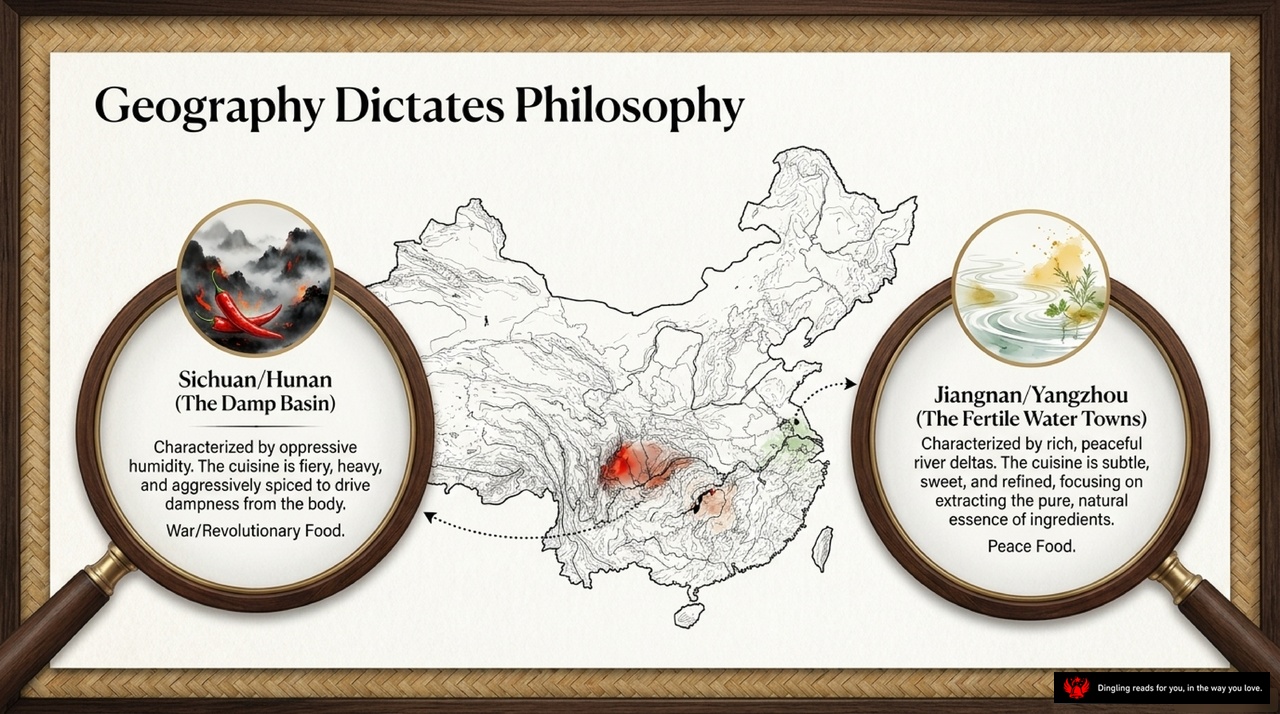
Geography Dictates Philosophy. Look at this map of China, where the landscape literally sculpts the soul of the cuisine. On the left, we have the Sichuan and Hunan regions, known as the Damp Basin. The air here is heavy with oppressive humidity, a constant battle against the wet. This environment demands a warrior's response: fiery, heavy, and aggressively spiced food. The heat from the chili and the numbing tingle of Sichuan pepper aren't just for flavor; they are a survival mechanism designed to drive dampness right out of the body. It's food born from necessity, a "War/Revolutionary Food" meant to keep you warm and alive in a cold, wet world.
Contrast that with the Jiangnan and Yangzhou region on the right, the Fertile Water Towns. Here, the geography is entirely different. Rich, peaceful river deltas create a gentle, humid climate that doesn't feel like a battle. The cuisine reflects this tranquility. It's subtle, sweet, and refined, focusing on extracting the pure, natural essence of ingredients rather than overpowering them. This is "Peace Food," a culinary expression of harmony and balance. So, whether it's the intense, spicy kick of the west or the delicate, sweet refinement of the east, every bite tells a story of the land it comes from.
Imagine a kitchen where a single chef's knife does the work of a whole set, and where the difference between a humble noodle bowl and a royal feast lies not in the price, but in the precision of the cut. In Chinese culinary philosophy, the knife is more than a tool; it is an extension of the chef's mind and a bridge to the spirit of the food.
As I learned in Chengdu, mastering this knife is the first step to understanding Chinese cooking. It's not just about chopping vegetables; it's about creating shapes that have meaning. A ginger piece cut into a "nail slice" releases its aroma instantly, while a meat cut into a "bone-in" shape ensures even cooking. These aren't random shapes; they are a language. When a chef cuts a pork kidney into the shape of a "phoenix tail" or "eyebrows," they are transforming a cheap ingredient into a visual masterpiece that honors the guest. This practice, rooted in the ancient idea that "if the cut is not proper, one does not eat," turns every meal into a ritual of respect.
But the knife's versatility is what truly amazes. In the West, we might need a separate tool for mincing, pounding, or even peeling. In a Chinese kitchen, the chef might use the flat side of the blade to pound meat into a tender paste for dumplings, or the handle to grind peppercorns, or even the blade itself to smash ginger and release its juice. This efficiency reflects a deeper cultural value: pragmatism and adaptability. There is no waste of tools, just as there is no waste of ingredients.
For me, practicing this knife work was a journey from fear to flow. At first, holding the heavy, sharp Chinese knife felt like wielding a weapon. I remember cutting my finger and realizing that this tool demands total focus and mindfulness. It forces you to slow down and listen to the texture of the food, much like the story of the butcher Ding in Zhuangzi who could cut an ox with his knife for nineteen years without dulling it. Once I mastered the rhythm, the knife became an extension of my hand, and the chaotic kitchen transformed into a place of order and calm.
So, when you think of Chinese food, don't just think of the spicy flavors or the rich sauces. Think of the invisible artistry happening before the food even touches the plate. It's the thoughtful cut, the precise shape, and the confident grip that turn simple ingredients into something extraordinary. It's a reminder that cooking is not just about feeding the body, but about honoring the life within the food and the skill of the hands that prepare it.
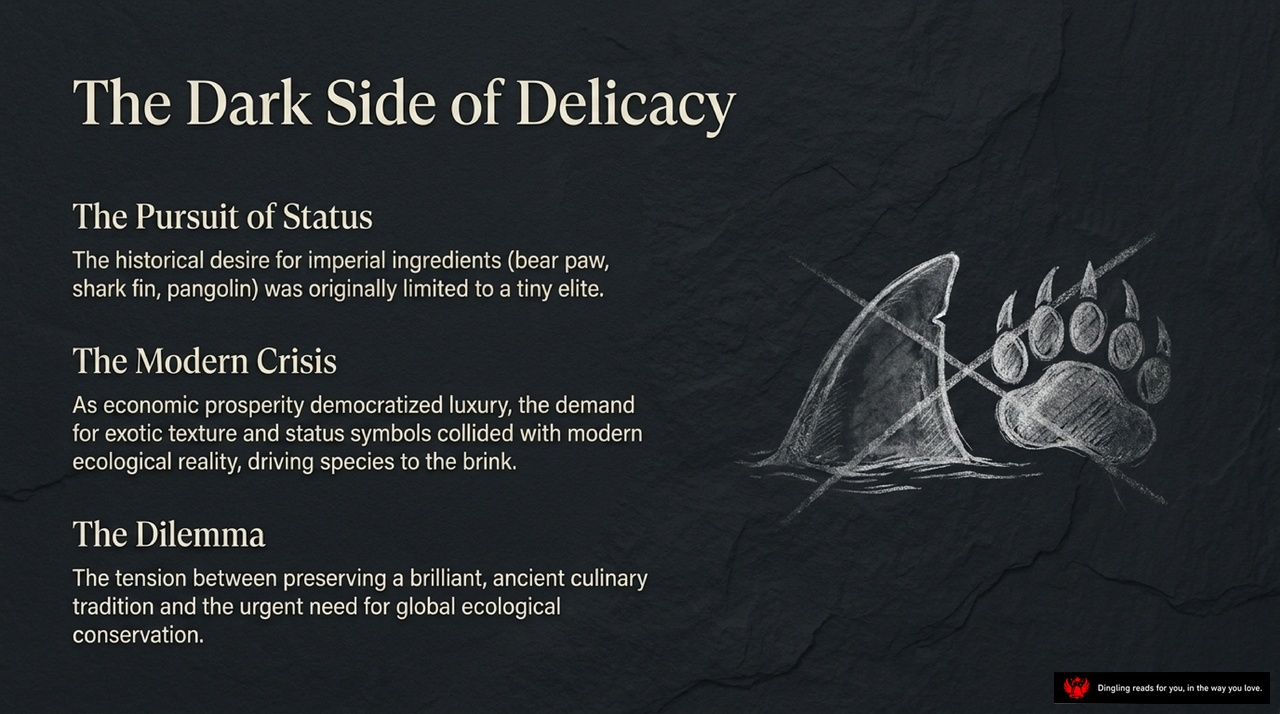
The Dark Side of Delicacy. Look at these crossed-out images of a shark fin and a bear paw. They represent the most dangerous collision in modern food culture: the pursuit of status clashing with ecological reality.
Historically, the desire for imperial ingredients like bear paw, shark fin, and pangolin was limited to a tiny elite. It was a symbol of power, reserved for the very top. But today, economic prosperity has democratized luxury. Suddenly, exotic textures and status symbols are accessible to the new wealthy class. This demand has collided with a harsh ecological truth, driving species to the brink of extinction.
We face a profound dilemma. On one side, we have a brilliant, ancient culinary tradition that relies on these rare ingredients. On the other, we have an urgent, global need for ecological conservation. How do we preserve the culture without destroying the planet? The answer isn't just about banning a dish; it's about redefining what true delicacy looks like in the 21st century.

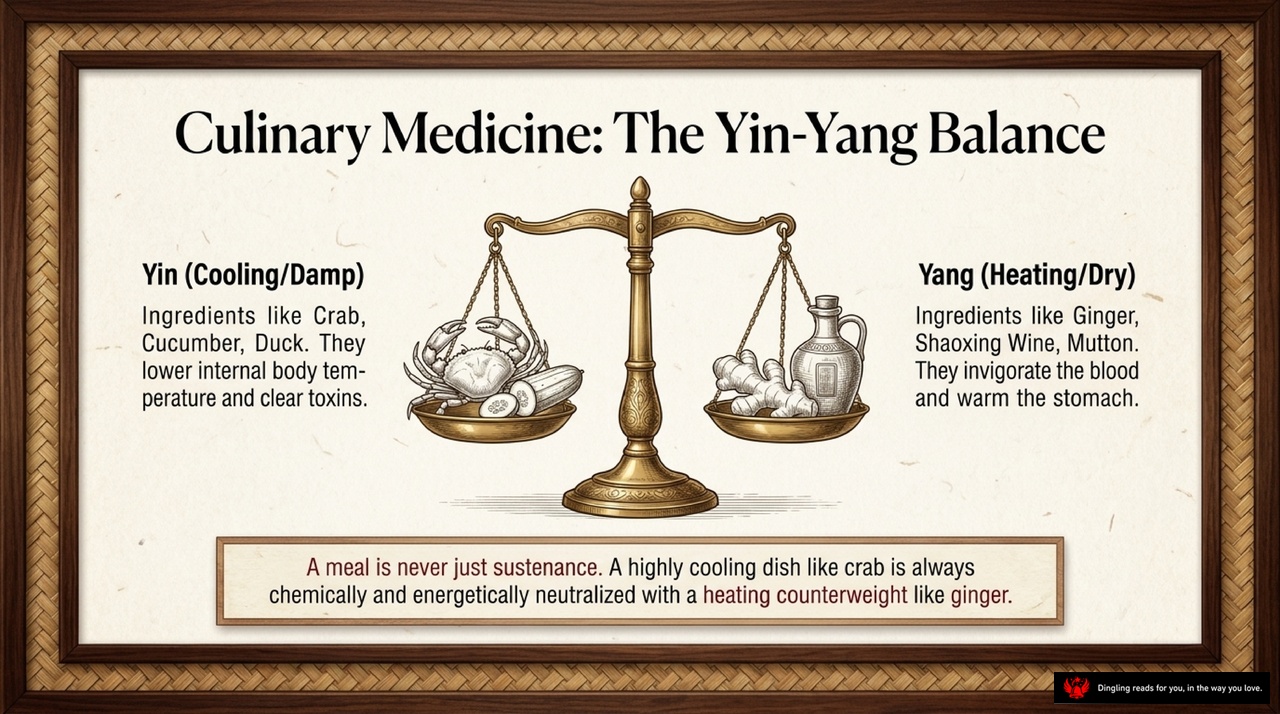
The wok isn't just a pan; it's a microcosm of Chinese civilization. As this slide beautifully illustrates, the kitchen and the state are two sides of the same coin. On one side, we have the chef balancing sweet, sour, bitter, spicy, and salty flavors. On the other, the statesman ruling a nation. Laozi famously said, "Ruling a large nation is like cooking a small fish." For millennia, Chinese philosophers equated the harmony of the soup pot with the harmony of the state. A chef balancing flavors is performing the exact same act as a statesman balancing factions. Food is the ultimate expression of civilization, where every ingredient finds its place and every flavor contributes to a greater whole.
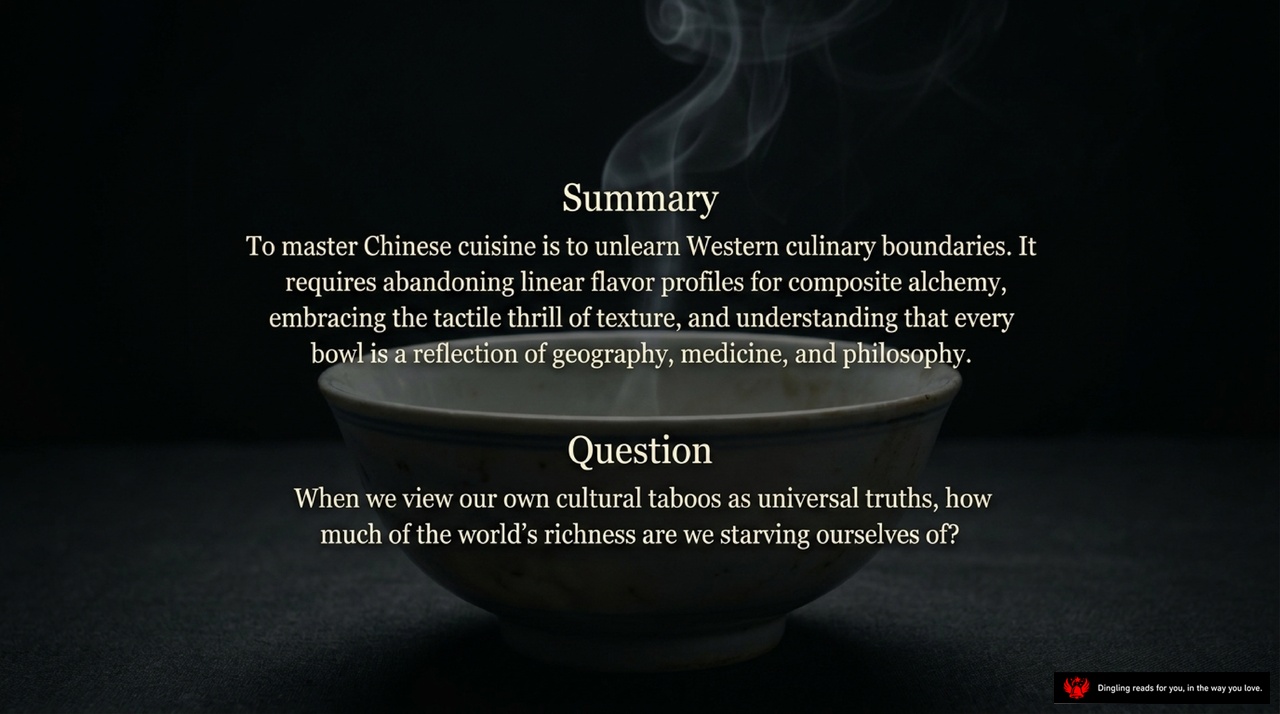
To master Chinese cuisine is to unlearn Western culinary boundaries. It requires abandoning linear flavor profiles for composite alchemy, embracing the tactile thrill of texture, and understanding that every bowl is a reflection of geography, medicine, and philosophy.
Look at that steaming bowl. It's not just about eating; it's about survival and connection. Think about the Sichuan peppercorns—those tiny, spiky seeds that deliver a unique numbing sensation, or the complex layers of fish-flavor sauce made without a single fish. These aren't random tricks; they are responses to the humid climate, a blend of salt, sugar, vinegar, and chili designed to balance the body and wake up the senses.
But here's the deeper question: When we view our own cultural taboos as universal truths, how much of the world's richness are we starving ourselves of? We often judge other foods as strange or wasteful—like eating offal or insects—without realizing that what we call "waste" might be another culture's delicacy. Our fear of certain textures or cooking methods blinds us to the incredible diversity of global flavors. By letting go of our rigid rules and embracing the "composite alchemy" of other cuisines, we don't just taste new food; we expand our minds and find common ground in the shared human experience of nourishment.