
Shielding Power: Complete Chapter-by-Chapter Summary
Welcome to today’s session on *The Power of Shielding* by Fushu—a book that’s not just about self-protection, but about reclaiming your inner peace in a world that never stops talking.
In a life filled with endless notifications, opinions, and expectations, we often forget to draw boundaries. This book gives you the tools to filter out the noise, end the internal friction, and take back control of your time, energy, and peace of mind.
Whether you're navigating work stress, relationship drama, or just the constant pull of social media, shielding isn’t about isolation—it’s about intention. It’s about choosing what deserves your attention and letting go of what doesn’t.
This is your invitation to step into clarity, calm, and confidence—one boundary at a time.

Hey everyone, today we're diving into something that’s silently draining your energy—internal friction.
Look at this image. It shows a battery, and you can see how much of your mental power is being lost before you even start doing anything. Eighty percent of your psychological resources are being used up just managing yourself against the chaos around you.
That’s overthinking. That’s the noise from other people’s opinions. That’s information overload. All of it adds up to what the book calls “internal friction.”
And here’s the key insight: internal friction happens when you’re constantly fighting your own thoughts, your fears, or the pressure to be perfect—before you’ve even taken one real step forward.
So instead of burning out trying to control everything, what if you stopped? What if you gave yourself permission to just begin, imperfectly, quietly, and honestly?
Because the moment you stop fighting yourself, that 20% reserve—the part meant for actual living and growth—can finally start working for you.
Hey everyone, welcome back. Today we’re diving into a powerful idea called the 30/70 Principle—and it’s going to change how you see your day, your stress, and even your phone.
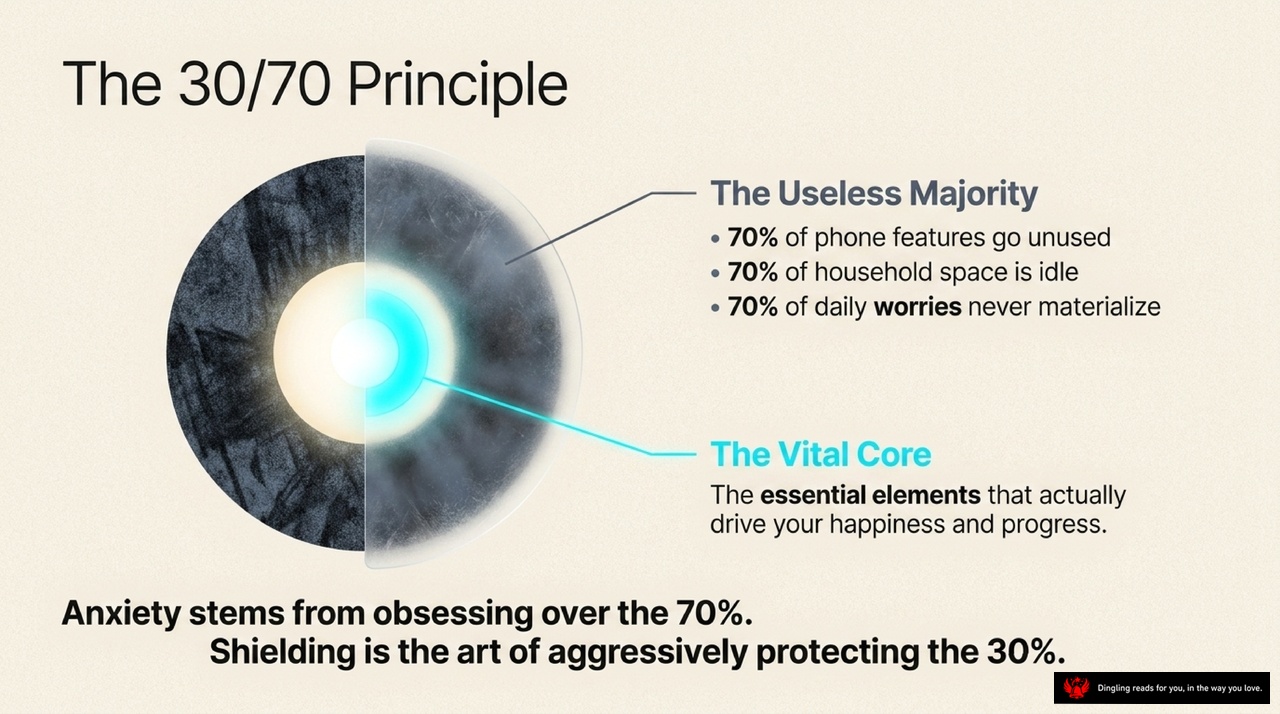
Look at this image: it’s split into two parts. The bright center is labeled “The Vital Core”—that’s the 30%. These are the essential elements that actually drive your happiness and progress. Think about it: what truly matters? The people you love, the work that fuels you, the moments that make you feel alive. That’s your core.
Now, the outer ring? That’s “The Useless Majority”—the 70%. And here’s the mind-blowing part: 70% of your phone’s features you never use. 70% of your home space sits idle. And 70% of the worries you carry daily? They never come true. You’re carrying weight that doesn’t exist.
Here’s the kicker: anxiety doesn’t come from the 30%. It comes from obsessing over the 70%. You’re constantly checking your email, reorganizing your closet, rehearsing conversations that never happen. You’re protecting nothing—because the real danger isn’t out there. It’s in your head.
So what’s the solution? Shielding. Not hiding. Not escaping. Shielding is the art of aggressively protecting your 30%. Say no to the notifications. Clear out the clutter. Let go of the fears that never materialize. Focus your energy on what actually moves you forward.
This isn’t about ignoring life. It’s about filtering it. The 30/70 Principle isn’t a math problem—it’s a mindset shift. Stop feeding the noise. Protect your core. And watch how your peace, your clarity, and your joy grow.
Let’s talk about how you can apply this today.
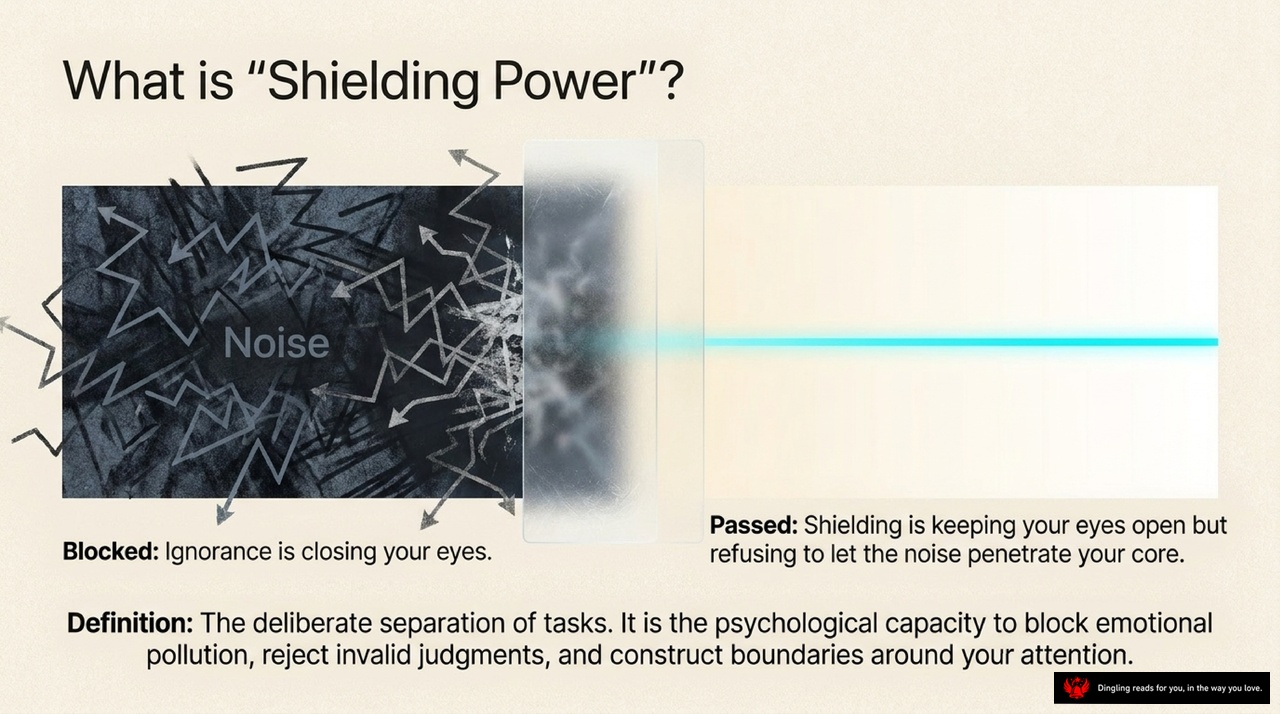
So, what exactly is this "shielding power" we keep talking about? It’s not about shutting out the world or pretending everything’s fine. In fact, shielding is the opposite of ignorance. Ignorance closes your eyes to avoid discomfort. Shielding keeps your eyes wide open—but it refuses to let the noise, the distractions, the emotional pollution, actually get inside your core.
Think of it like this: imagine a storm outside. You can either stay indoors and pretend the storm isn’t there—that’s ignorance. Or you can stand in the doorway, watching the rain, feeling the wind, but keeping your feet firmly planted on the ground, protected from getting soaked. That’s shielding. You’re still aware, still present, but you’ve built a boundary around your attention.
In today’s world, noise is everywhere—emails, notifications, opinions, judgments, endless updates. Shielding isn’t about blocking them all out. It’s about deliberately separating what matters from what doesn’t. It’s the psychological muscle to say, “I see this, I hear this, but I won’t let it take over my focus or my peace.” You construct boundaries around your attention. You reject invalid judgments. You block emotional pollution—not by running away, but by standing your ground with clarity and intention.
So next time you feel overwhelmed, don’t blame yourself for not being able to handle it. Instead, ask yourself: Am I ignoring the storm, or am I learning how to shield myself from it?

Imagine this: your mind is a room, and suddenly, someone walks in carrying a cloud of dust—anger, frustration, shame. That’s emotional pollution. And Shield One? It’s not about fighting the dust. It’s about learning how to breathe through it.
We start with Step 1: Listen. Not to argue, not to fix, but to invite the emotion in like a guest. You don’t have to like it. You just have to acknowledge it. Because resistance only feeds it.
Then comes Step 2: Observe. Ask yourself—what part of my ideal self just got threatened? Was it my confidence? My sense of control? Your ideal self isn’t a fantasy—it’s a compass. When you notice what’s being challenged, you stop reacting blindly.
Step 3: Sublimate. This is where magic happens. Instead of taking the attack personally, reframe it. Turn that perceived threat into a lesson. A motivation. Maybe you didn’t get the promotion—not because you’re not good enough, but because timing wasn’t right. Or maybe you failed because you’re trying too hard. Reframing doesn’t erase the pain—it gives it purpose.
Finally, Step 4: Accept. Not resignation, but clarity. Accept what you can’t change. Separate your worth from the outcome. You are not your job, your relationship, your mistakes. You are the person who keeps showing up—even when things don’t go as planned.
Emotional pollution doesn’t vanish. But with these four steps, you stop drowning in it. You learn to navigate it. And slowly, you become unshakable—not because nothing hits you, but because you’ve learned how to stand in the storm without losing yourself.

Hey everyone, today we’re diving into a concept that’s quietly reshaping how we think about caring for others: The Over-Empathy Trap.
Look at this curve — it’s not just about being empathetic. It’s about where you land on the spectrum of emotional absorption. On the far left, we’ve got Apathy — complete disconnection from others’ pain. Sure, it’s safe, but it’s also cold and isolating.
Then, as we move right, we hit the sweet spot: Appropriate Empathy. That’s where connection thrives — understanding and supporting someone without absorbing their trauma as your own. You’re present, you care, but you don’t lose yourself.
But here’s the danger zone — Toxic Empathy. When emotional absorption gets too high, empathy turns inward. You start internalizing other people’s pain like it’s yours. The result? Immune system degradation, inner friction, burnout. You’re not helping anyone — you’re hurting yourself.
The takeaway is clear: To protect your capacity to care, you must maintain emotional boundaries. Not because you don’t care — but because caring sustainably means knowing when to step back. So next time you feel drained after helping someone, ask yourself: Am I in the right place on this curve? Or did I slip into the trap?

Shield II: External Judgments. Think of your mind as a scale. On one side, you have inner peace and deep work—solid, heavy, and valuable. On the other, you have the need to be right, arguments with strangers, rebuttals, and defending your ego. These are like feathers—light, scattered, and easily blown away. But here’s the truth: every time you argue just to win, you’re tipping the scale in favor of chaos, not clarity. The highest form of maturity isn’t winning every debate—it’s choosing not to engage at all. Let them have their opinion. Let them win the argument. You win your peace. And when you stop chasing validation from others, you create space for real growth, real focus, and real results.
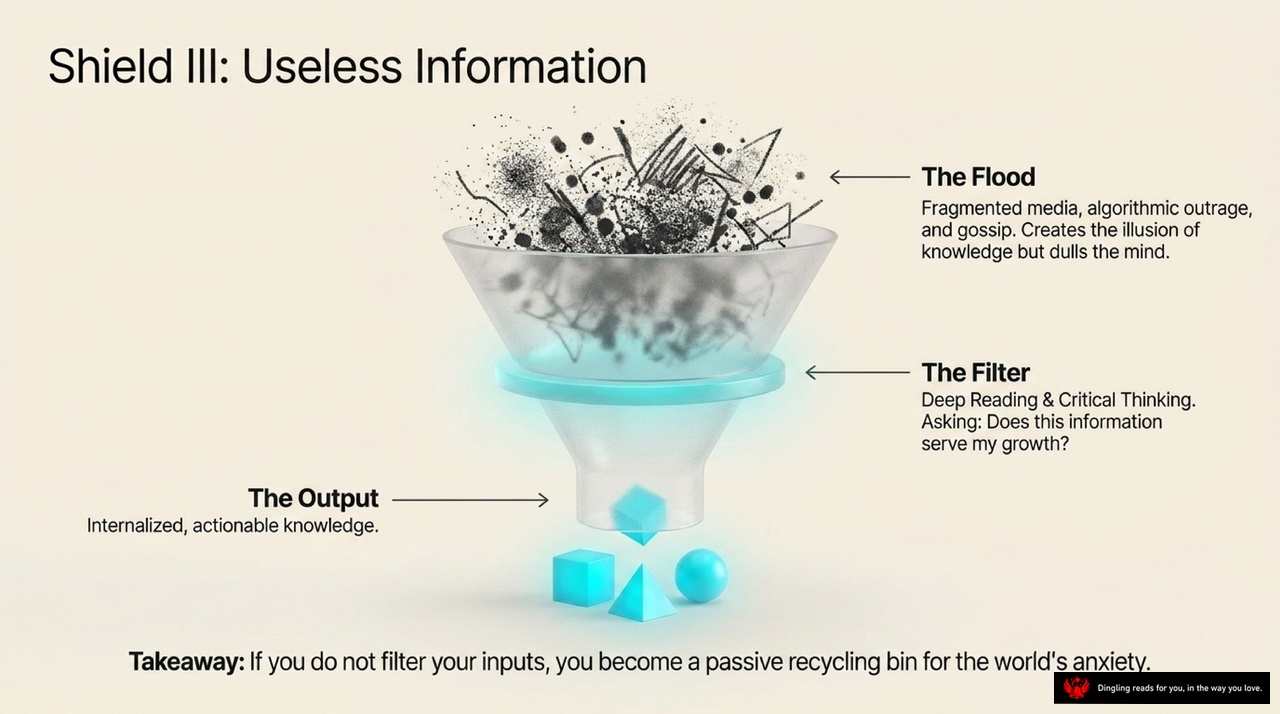
Imagine your mind as a funnel. Right now, you're being bombarded by what the slide calls "The Flood"—fragmented media, algorithmic outrage, endless gossip. It feels like you're learning something, but in reality, it's just noise piling up, dulling your ability to think clearly.
But here’s the good news: you have a tool. The slide shows "The Filter"—that’s deep reading and critical thinking. It’s the question you need to ask yourself every time you consume something: “Does this information actually serve my growth?”
When you apply that filter, the chaotic mess at the top gets distilled into "The Output"—internalized, actionable knowledge. That’s real power.
The takeaway is simple but urgent: if you don’t filter your inputs, you become a passive recycling bin for the world’s anxiety. So stop letting the flood drown you. Start filtering. Start growing.
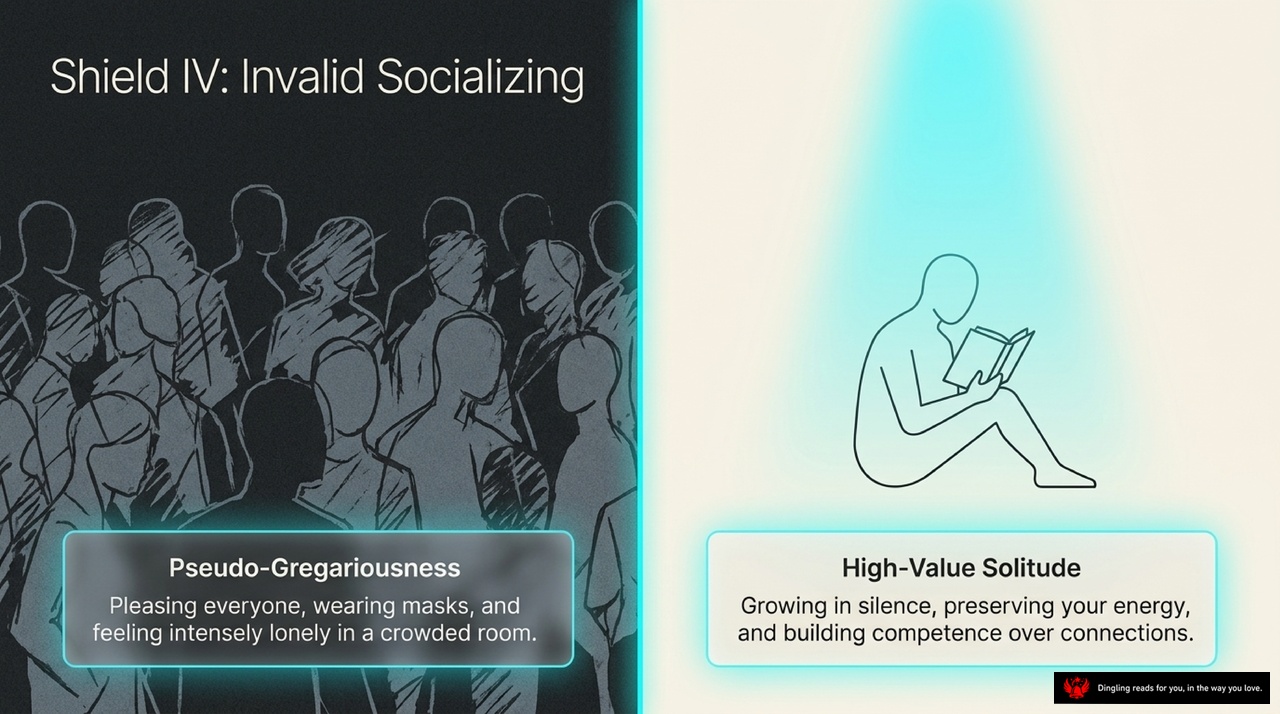
Let’s talk about Shield IV: Invalid Socializing.
On the left, you see a crowd — but not a real one. This is what I call “Pseudo-Gregariousness.” It’s that feeling of being surrounded by people, yet completely alone. You’re smiling, nodding, trying to keep up, wearing masks to please everyone — but inside? You’re exhausted. You’re lonely, even in a room full of people.
Now look at the right side. That’s “High-Value Solitude.” Not isolation — not avoidance. This is intentional, powerful solitude. You’re sitting quietly, reading, growing, preserving your energy. You’re not trying to connect with everyone — you’re building competence, depth, and strength on your own terms.
The book makes a clear point: true growth doesn’t come from fitting in. It comes from stepping back, listening to yourself, and investing in who you are — not who others expect you to be.
So ask yourself: Are you surrounded by people… or just pretending to be? Or are you choosing silence — not because you’re afraid, but because you know it’s where your real power lives?
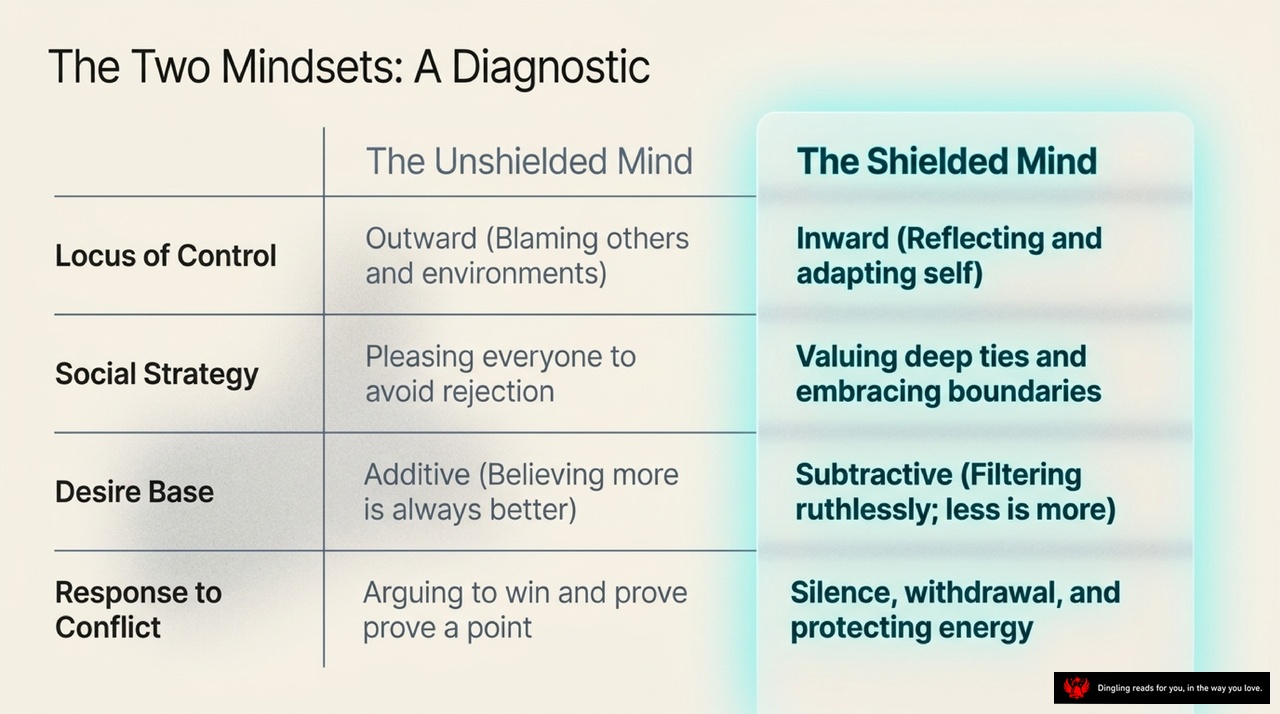
Alright, let's dive into this. We're looking at a slide that compares two distinct mindsets: the "Unshielded Mind" and the "Shielded Mind." This isn't just about abstract concepts; it's about how we actually operate in the world.
The Unshielded Mind is defined by an outward locus of control. This means you're constantly looking outside yourself for the source of your problems or your happiness. You tend to blame others and the environment for what goes wrong. Your social strategy is often about pleasing everyone to avoid rejection. You're trying to be liked, to fit in, and to keep the peace at all costs. Your desire base is additive; you believe that more is always better. You want more approval, more success, more possessions. And when conflict arises, you argue to win and prove a point. You're trying to defend your position and make others see your way.
On the other hand, the Shielded Mind is defined by an inward locus of control. You're focused on yourself and your own actions. You're reflecting on your own behavior and adapting yourself to the situation. Your social strategy is about valuing deep ties and embracing boundaries. You're not afraid of conflict or disagreement; you're willing to set boundaries and stand up for what you believe in. Your desire base is subtractive; you believe that less is more. You're not trying to get more; you're trying to filter out the unnecessary and focus on what truly matters. And when conflict arises, you respond with silence, withdrawal, and protecting your energy. You're not trying to win the argument; you're trying to protect your own peace and well-being.
So, the question is: which mindset are you operating from? Are you the Unshielded Mind, constantly looking outside for answers and trying to please everyone? Or are you the Shielded Mind, focused on yourself and your own actions, valuing deep ties and embracing boundaries?
Understanding these two mindsets can help you make better decisions and live a more authentic life. It's not about choosing one over the other; it's about recognizing which mindset you're operating from and making conscious choices about how you want to respond to the world.

Let’s be honest—most of us are stuck in a loop we don’t even notice. We replay our mistakes, we dwell on what went wrong, and before we know it, we’ve spent more time analyzing the past than building the future. That’s exactly what this slide is about: The “Turn the Page” Capability.
On the left, you see “The Past”—a dark, chaotic mess of thoughts, regrets, and second-guessing. That’s rumination. And here’s the hard truth: rumination doesn’t teach you anything. It just traps you in a cycle of self-consumption. You’re not growing—you’re just spinning your wheels.
But then comes the turning point—the thin, glowing line right in the middle. That’s the decisive moment of acceptance. It’s not about forgetting what happened. It’s about saying, “Okay, that’s over. I won’t carry it anymore.” That’s where real mental strength kicks in.
On the right? “The Future.” Bright, clear, open. This is where you write the next chapter from a blank slate. True strength isn’t about being perfect—it’s about being willing to let go. It’s about writing off sunk costs, stopping the backward glance, and stepping forward with intention.
So ask yourself: Are you still stuck in the past? Or are you ready to turn the page—and finally start living the story you want?

Today, we’re diving into a powerful idea called Cognitive Elasticity. Think of it this way: some of us are like glass—when life throws us a curveball, we crack under pressure. That’s what happens when you hold onto rigid expectations. If reality doesn’t match your plan, frustration and anger take over. It’s not just about stress—it’s about how your mind breaks when things go off-script.
But here’s the game-changer: there’s another way. Imagine your mind as something stretchy—like that glowing blue shape on the right. This is the Elastic Mind. Instead of snapping, it bends. It absorbs shocks from life’s chaos, adjusts to new variables, and bounces back without losing who you are at your core.
So, what does this mean for you? It means building mental flexibility. Not just enduring change, but thriving through it. When you develop cognitive elasticity, you stop being a victim of circumstances and start becoming the master of your response. You learn to adapt, absorb, and rebound—no matter what life throws at you.
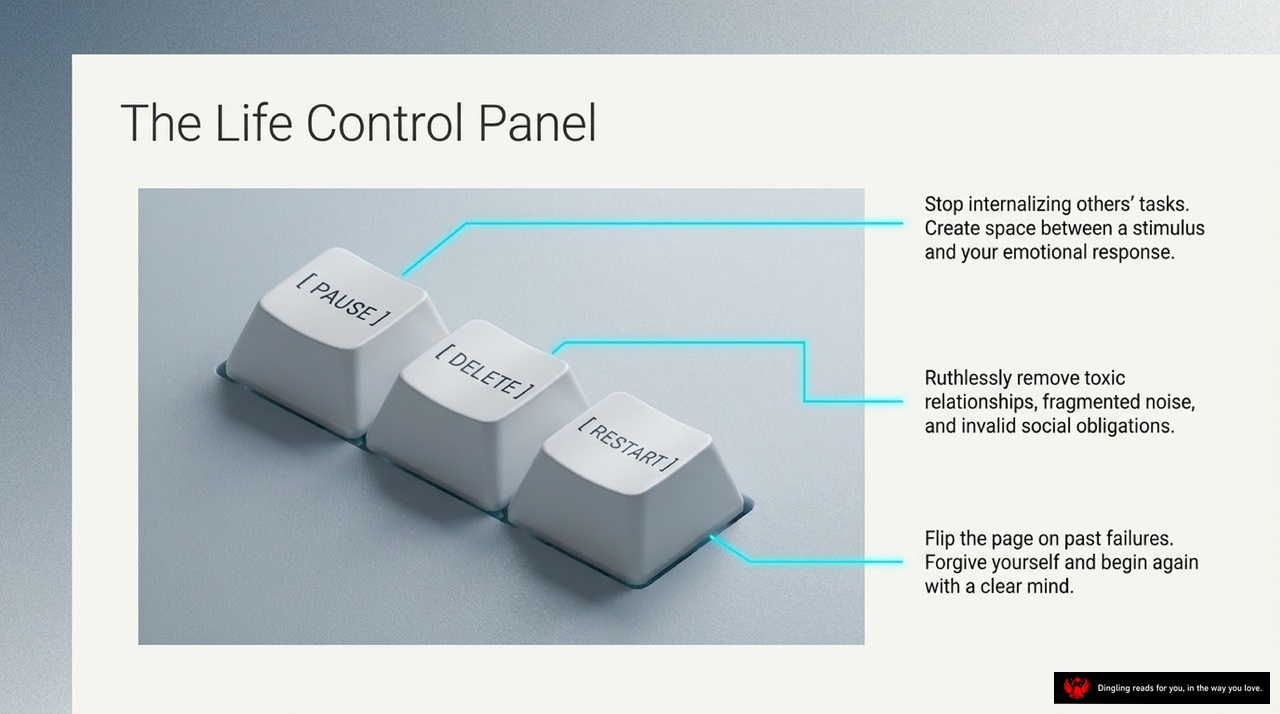
Have you ever felt like life is just a series of things happening to you, with no real control? Well, what if I told you that you actually have a control panel?
Think of it like this: you have three buttons. The first one is [PAUSE]. This is your ability to stop internalizing other people's tasks and create a little space between a stimulus and your emotional response. It's like hitting the brakes when you're about to lose your cool.
The second button is [DELETE]. This is your chance to ruthlessly remove toxic relationships, fragmented noise, and invalid social obligations. It's like clearing out the clutter in your life so you can focus on what really matters.
And the third button is [RESTART]. This is your ability to flip the page on past failures, forgive yourself, and begin again with a clear mind. It's like hitting the reset button and starting fresh.
So, the next time you feel overwhelmed, remember that you have a life control panel. Use it to pause, delete, and restart. You've got the power to take control of your life.
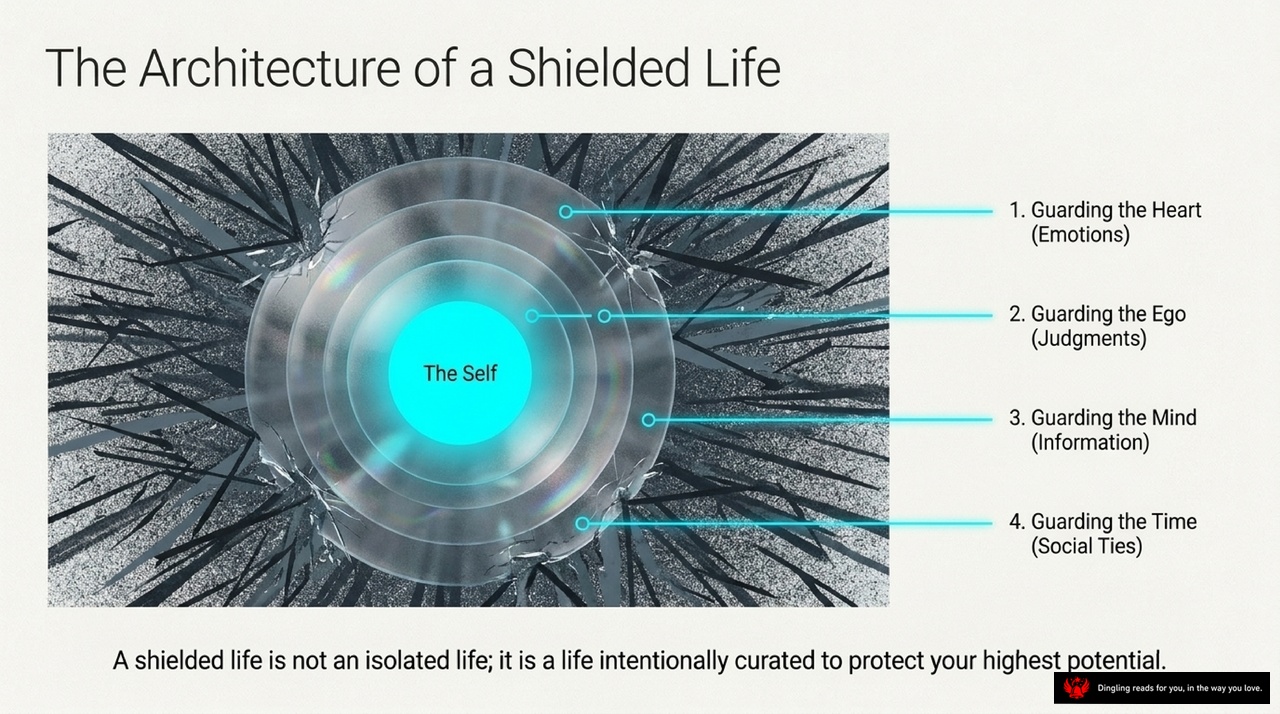
Let’s talk about how to build what I call a shielded life—not the kind that isolates you from the world, but one that intentionally protects your inner self so you can grow, focus, and thrive.
Look at this diagram: right in the center is “The Self.” Around it, four concentric layers form your personal architecture of protection. Each layer guards a different part of who you are.
First, we guard the heart—your emotions. That means learning to feel deeply without being overwhelmed by external chaos.
Next, we protect the ego—your judgments and beliefs. This isn’t about arrogance; it’s about not letting other people’s opinions define your truth.
Then comes the mind—your information intake. We filter what we consume, because what you feed your brain shapes how you think and act.
Finally, we guard time through social ties. Not all relationships serve you. Some drain you. Choosing wisely who you spend your time with is one of the most powerful acts of self-protection.
This isn’t about building walls. It’s about designing boundaries that let your highest potential rise. A shielded life doesn’t hide you—it empowers you.
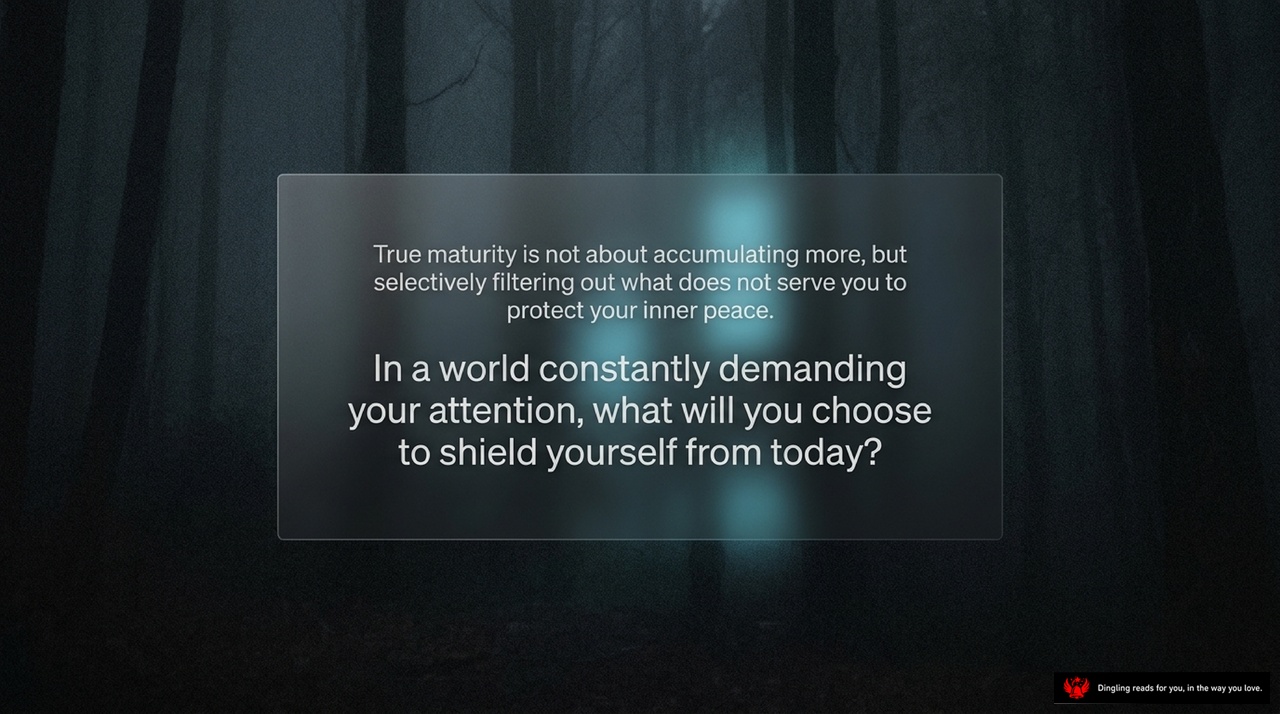
True maturity isn’t about collecting more—more stuff, more opinions, more noise. It’s about learning to filter out what doesn’t serve you, so you can protect your inner peace. Think about it: how often do you let things in that drain your energy or cloud your judgment? In a world that’s constantly demanding your attention—notifications, expectations, distractions—what are you actually choosing to shield yourself from today? Not just the obvious stuff, but the quiet ones too: the unnecessary opinions, the toxic comparisons, the endless “shoulds.” This slide asks you to pause and reflect: What’s one thing you’re letting in that you don’t need? And what’s one thing you can let go of to make space for clarity? Your inner peace starts with what you choose to keep—and what you choose to release.