
Shorter Logic: Complete Chapter-by-Chapter Summary
Welcome to "The Logic" by G.W.F. Hegel. This isn't just another book; it's a foundational philosophical exploration of how pure thought unfolds through dialectical movement to ultimately grasp the Absolute Idea. Think of it as the operating system for reality itself. Unlike other sciences that study what we can simply perceive, philosophy digs deeper. It doesn't just accept things as they appear; it demands to prove why they exist and how they are defined. It's the difference between seeing a tree and understanding the very concept of "tree-ness" that makes the tree possible.
Hegel argues that philosophy is a special kind of thinking that turns our everyday thoughts into clear, conceptual knowledge. He believes that thought and reality aren't enemies; they are meant to meet. There's a famous line here: "What is rational is actual, and what is actual is rational." This doesn't mean everything that exists is good. Instead, it means that true reality is the unfolding of reason. If something is truly "real" in a philosophical sense, it must be rational. If it's just a random, chaotic occurrence without a logical foundation, it's not truly real—it's just an illusion waiting to fade.
The book is structured as a grand system, moving from pure logic to nature, and finally to spirit. It starts with the most abstract ideas and gradually makes them concrete. Hegel challenges us to stop treating our thoughts as just personal opinions or subjective feelings. Instead, he invites us to see that our thinking is actually the very fabric of the world. By following this logical path, we don't just learn facts; we understand the dynamic, living structure of truth itself.

The slide we are looking at breaks down the "Quest for the Absolute" into three distinct paths: Religion, Empirical Science, and Philosophy. It's a crucial map for understanding how we try to grasp the ultimate truth.
Let's look at the first column: Religion. The slide describes its mode as "Feeling & Representation." Its great strength is that it connects with all of humanity through faith and emotion, making the absolute accessible. However, its weakness is clear: it grasps truth only as a metaphor or a historical narrative. It lacks logical necessity. In the text, we read that religion treats truth as something felt or represented, but it stops there. It cannot prove the necessity of what it believes; it relies on the "surface familiarity" of stories and feelings rather than deep, logical proof.
Moving to the center, we have Empirical Science. Its mode is "Observation & Immediate Perception." Its strength is that it is firmly grounded in concrete, observable reality. We can touch, measure, and verify these facts. But the slide points out a critical flaw in red: its weakness is that it yields only fragmented, finite facts. It cannot grasp the universal whole. As the text explains, science is limited to what we can perceive. It can't handle infinite objects like freedom, spirit, or God. Its generalizations are often just external connections to specific things, lacking true necessity. Science gives us pieces of the puzzle, but it can't see the complete picture.
Finally, on the right, is Philosophy. The slide defines its mode as "Pure Thought & The Concept." This is where the real breakthrough happens. Its strength is that it comprehends the Absolute through rigorous logical necessity, perfectly uniting form and content. Unlike religion's feelings or science's fragments, philosophy uses pure thought to transform abstract ideas into clear concepts. The text emphasizes that philosophy isn't just about thinking; it's about turning thought into "conceptual knowledge." It takes the raw material of experience and reality and organizes it logically. It's the only path that can claim to grasp the universal whole because it doesn't stop at what is seen or felt; it asks why things must be the way they are.
So, the slide illustrates a progression. Religion gives us the emotional entry point, Science gives us the factual building blocks, but only Philosophy, through rigorous logical thought, can unite them into a complete, necessary truth. It's the synthesis of feeling, fact, and reason.

Let's dive into the very engine that drives Hegel's entire philosophical system: The Dialectic. Think of it as the heartbeat of thought itself, a dynamic process where ideas don't just sit there; they move, struggle, and evolve.
The diagram on your screen breaks this down into three distinct steps. It starts with Step 1: Affirmation, or the Thesis. Here, a concept is proposed in its immediate, isolated form. It's like a seed planted in the soil, standing alone, defined by its own boundaries.
But nothing in reality stays static. This leads us to Step 2: Negation, or the Antithesis. Hegel argues that thought cannot stand still. Every concept inherently contains its own opposite. The very definition of "being" implies "non-being." This internal contradiction forces the concept to negate itself, pushing it toward its opposite. It's a moment of tension, a necessary crisis where the original idea breaks under its own weight.
Finally, we arrive at Step 3: Sublation. This is the most crucial part, often translated as Synthesis or *Aufheben*. In this step, the contradiction is resolved, but not by simply choosing one side over the other. Instead, the original concepts are simultaneously canceled in their immediate, isolated form and preserved in a higher, richer unity. The tension between the thesis and antithesis gives birth to a new, more comprehensive truth that encompasses both.
So, the Dialectic isn't about finding a static answer; it's about the active, living process of thought overcoming its own limitations to reach a deeper understanding of reality.

Look at this pyramid. It's not just a graphic; it's a map of how human thought evolves from simple observation to absolute freedom. We are currently standing at the base, in Tier 1: The Doctrine of Being. This is where logic starts. It's about "sheer immediacy"—the raw, surface-level observation of reality before we even try to think deeply about it. It's the world as it simply *is*, without any hidden connections.
But we can't stay here. True logic requires us to move up to Tier 2: The Doctrine of Essence. This is the middle ground where things get interesting. Here, thought enters a phase of reflection and mediation. We stop looking at isolated facts and start seeing how concepts are defined by their relationships to their opposites. It's the hidden depth where the surface cracks open to reveal the structure underneath.
Finally, we reach the summit: Tier 3, The Doctrine of the Concept. This is the pinnacle of the Architecture of Logic. Here, thought returns to itself. We achieve the ultimate synthesis where necessity is sublated into absolute freedom. In this final tier, the rigid constraints of the world dissolve into a state of total self-determination. We aren't just observing reality anymore; we are realizing that our own thinking is the very force that shapes reality. This is the moment where logic becomes true freedom.

Act I: The Doctrine of Being. Let's dive into the core of the text.
Here, we see a powerful visual metaphor for how reality actually works. On the left, we have a bright white circle labeled "Pure Being." This represents the most abstract, immediate concept imaginable. But here's the twist: because it is completely empty and lacks any specific determination, it inevitably equates to... nothing.
Next to it is a black circle: "Pure Nothing." This is the absolute absence of all determination and content.
So, what happens when we combine them? The arrow points to the right, creating a swirling vortex labeled "Becoming (Das Werden)." This is the synthesis. Pure Being and Pure Nothing are identical, yet completely opposed. Their restless, immediate movement into one another creates the first concrete thought: Becoming.
In the text, this logic is explained as the very foundation of philosophy. It argues that philosophy isn't just about looking at things; it's about thinking through the nature of existence itself. The text states that "Pure Being" is so empty that it becomes "Nothing," and their unity creates "Becoming." This movement isn't just a philosophical game; it's the engine of reality.
Think about it: if something exists but has no specific qualities, it's indistinguishable from nothingness. But the moment that nothingness moves into being, or being shifts into nothingness, you get life, you get change, you get the world as we know it. This concept of "Becoming" is the first concrete thought that breaks us out of abstract emptiness. It shows that existence is never static; it is a dynamic process of constantly becoming something else. This synthesis of being and nothingness is the starting point for understanding everything else, from the nature of logic to the structure of the universe itself.

Welcome back to our deep dive into Hegel's Logic. Today, we're looking at the crucial transition from abstract categories to concrete reality.
The slide highlights the progression from Quality, Quantity, and Measure. This isn't just a list; it's a dynamic story about how the world changes.
First, look at **Quality**. Hegel teaches us that quality is what makes something *be itself*. If you change the quality of water, it ceases to be water. But here's the key insight: quantity can change without destroying the essence. You can add more heat to water, or increase its volume, and it's still water. That's the realm of **Quantity**.
However, these two aren't separate. They unite in **Measure**. Measure is the critical threshold where quantity triggers a leap in quality. Think about boiling water. As you add quantitative heat, the water remains liquid for a while. But once you cross that specific limit, a qualitative leap occurs: the water becomes steam. The invisible accumulation of heat finally forces a visible transformation of state.
This concept of "Measure" is the bridge between the abstract and the real. It shows us that reality isn't static. Small, seemingly insignificant changes in quantity can lead to massive, revolutionary shifts in quality. From political revolutions to biological evolution, this principle of measure explains how the world constantly evolves and transforms itself. We aren't just observing things; we are seeing the logic of change in action.

Hello everyone, welcome back to our deep dive into Hegel's *Science of Logic*. Today, we are stepping into the final and most profound stage of the entire logical journey: **The Idea**.
Look at the image on your screen. We see hands pulling back a curtain to reveal a complex, interlocking mechanism of gears. This visual perfectly captures the essence of what Hegel calls the **Idea**. Throughout our previous chapters, we traced the path from pure existence, through quality and quantity, into essence, and finally to reality. But we hit a limit. Reality, as we've seen, is still just the unfolding of a concept into something external. It's like a seed that has sprouted into a tree, but the tree is still separate from the seed's original blueprint.
Hegel argues that true truth isn't found when the concept stands apart from reality, or when reality merely imitates a concept. True truth occurs when the two unite. This union is the **Idea**.
In the text, Hegel defines the Idea as "truth that has become other than itself." Think about that. It's not just an abstract thought floating in our heads. It is a concept that has actually realized itself in the world. It is the absolute unity of concept and objectivity. Unlike earlier stages where things were just "real" or just "thought," the Idea is where thought becomes reality, and reality becomes intelligible.
Hegel warns us against a common mistake: thinking that the Idea is just a vague, abstract idea detached from the real world. That's the opposite of truth. The Idea is concrete. It is dynamic. It is a process.
The text describes the Idea's development in three distinct stages. First, we have **Life**. This is the immediate form of the Idea. Here, the soul and the body are united, but it's a fragile unity. Life has an inherent drive to preserve itself, yet because the concept and reality aren't fully fused, life is bound by finitude. Every living thing eventually dies. The cycle of life is a repetition, not yet a complete, self-contained truth.
The second stage is **Cognition**. This is where the Idea begins to wake up to itself. It splits into two forms: theoretical and practical. In theoretical cognition, the mind tries to understand the world, bringing the objective world into its own subjective concepts. In practical cognition, the mind tries to reshape the world to match its own purposes. Both are necessary steps to overcome the separation between the subject and the object. We are learning to see the world not as something foreign, but as something we can understand and act upon.
Finally, we arrive at the **Absolute Idea**. This is the culmination of the entire logical system. It is the point where the distinction between thought and being completely vanishes. The Absolute Idea is not a distant, mystical entity; it is the very structure of reality itself. It is "thought thinking itself."
As Hegel puts it, the Absolute Idea is the unity of theory and practice, of life and cognition. It is the point where the concept has fully realized itself in the world, and the world has fully revealed its conceptual nature. It is the end of the logical process, but paradoxically, it is also the beginning. Because now that the Idea has fully realized itself, it can externalize itself once more, shedding its abstract form to become Nature.
So, the gears in our image aren't just random machinery. They represent the self-movement of the Idea. The Idea pushes itself out, becomes nature, becomes spirit, and eventually returns to itself in a richer, more concrete form than it started. This is the true infinite. This is the reconciliation of all contradictions.
In our next session, we will take this fully realized Idea and watch as it transitions from the realm of pure logic into the realm of Nature. We will see how the abstract concepts of quality, quantity, and causality become the physical laws governing the universe. Stay tuned, because the journey from the abstract Idea to the concrete world is about to begin.

Welcome back to Act II: The Doctrine of Essence. Today, we are stepping into the realm of reflection.
Imagine two identical blocks of stone. One sits above a line, glowing white; the other hangs below, a gray reflection. This visual perfectly captures the core of 'Essence.' Unlike 'Being,' which simply exists on its own, Essence is entirely relative. Nothing here exists in isolation. Everything is defined strictly by its relationship to its opposite.
We are now in the world of the 'Posited' and the 'Negated.' Think of it this way: if you have a positive charge, the negative isn't just an absence; it is the very thing that gives the positive its meaning. They are two sides of the same coin, inseparable and mutually defining.
In this realm, truth isn't about matching an idea to an external object. Instead, truth is the content of thought matching itself. A true friend is someone whose actions align with the concept of friendship. A true government is one that matches its ideal definition. If reality contradicts the concept, it's not "real" in the philosophical sense; it's flawed.
Essence is the mirror where being looks back at itself, creating a world where nothing stands alone, but everything is connected in a web of relations. This is the foundation for everything that follows.

Welcome back to our exploration of Hegel's *Logic*. Today, we're diving deep into the core structure of his system, visualized right here on the slide. You see, Hegel argues that reality isn't a static list of things, but a dynamic dance of opposing forces that constantly feed into each other.
Let's look at the first pair: **Identity** and **Difference**. Hegel insists that identity has no meaning in isolation; it only exists in contrast to difference. Think about it: you can't define what makes you "you" without contrasting yourself against everyone else. Without difference, identity vanishes.
Next, we have **Form** and **Content**. The slide notes that content is formless and abstract without Form, while Form is entirely empty and meaningless without Content. It's a perfect mirror of our daily lives. Imagine a story with no plot—that's content without form. Now, imagine a perfectly structured plot with no characters or emotion—that's form without content. One cannot exist without the other.
Finally, look at **Cause** and **Effect**. This is where it gets revolutionary. Hegel states that a cause is only a cause because of its effect. In reality, they are not a linear chain, but a closed system of Reciprocal Action. We often think of cause and effect as a straight line, but Hegel shows us they are inextricably linked in a circle, constantly influencing and defining one another.
These dualities aren't just abstract concepts; they are the very engine driving the universe forward. By understanding how these opposites rely on each other, we finally grasp the living, breathing logic of reality itself.

Actuality, or "Die Wirklichkeit," represents the ultimate culmination of the philosophical journey we've traced. As you see in this diagram, it is the perfect synthesis where Inner Essence and Outer Existence finally merge into one. Before reaching this golden sphere of Actuality, we move through stages where essence and existence exist separately, and then where they begin to overlap but still contain a gap. But in true Actuality, that gap is completely abolished.
Think of it this way: Actuality is not merely contingency—something that happens to randomly be there—but it is necessity, meaning what must be there. It is the moment when the inner essence perfectly manifests as the outer reality. In this state, the gap between potential and expression disappears entirely. This is the reconciliation of thought and experience, where reason and reality are no longer at odds but fully united. It is the end of the dialectical process, the point where the abstract concept becomes concrete reality, achieving a state where everything is exactly as it ought to be, and nothing is left to chance.

Welcome back to Act III: The Doctrine of the Concept. Imagine a golden spiral breaking free from a rigid, gray block. This visual perfectly captures the moment reason ascends from the rigid necessity of Essence into the absolute freedom of the Concept, or *Begriff*. We are moving beyond static definitions into a realm of dynamic possibility.
The Concept is not merely a subjective idea floating inside a human mind. It is far more profound; it is the fundamental, dynamic structure of reality itself. Think of it as the living operating system of the universe, not just a user interface. It unites the Universal, the Particular, and the Individual into a single, living, organic whole.
This is the shift from abstract thought to concrete reality. While earlier stages dealt with existence and essence as separate layers, the Concept brings them together. It shows that the universal laws of nature aren't just external rules imposed on us; they are the very essence of individual things. When you truly understand a specific object, you grasp the universal principle within it. This is where true freedom begins—when the individual fully realizes the universal, and the universal finds its expression in the individual. This synthesis is the heart of the Concept, the bridge that turns rigid logic into a living, breathing reality.

Imagine a world that isn't just a cold, indifferent machine where parts blindly bump into each other, but a living organism driven by an inner purpose. Today's slide captures this profound shift in thinking: Teleology over Mechanism. On the left, we see gears and weights—representing Mechanism and Chemism. Here, things are just pushed and pulled by blind external forces. It's a chaotic collision of parts with no internal direction, like a clock that stopped working. But look at the right side: an acorn growing into a mighty oak tree. This is Teleology, or Purpose. It represents the idea that the world isn't a blind machine; it is driven by an inherent drive to realize itself.
In this view, the final end goal shapes the process just as much as the initial cause. Think about it: an acorn doesn't just randomly become a tree; it is *driven* by the concept of becoming an oak tree. Its very structure, its roots, its leaves—all are shaped by that future goal. This is the core of what we call the "Objective Concept." It suggests that reality is not a collection of dead accidents, but a unified whole unfolding toward a specific truth. Instead of asking "how did this happen by chance?", we ask "what is this striving to become?" This perspective transforms our understanding of nature, history, and even human life, moving us from a story of random collisions to a narrative of meaningful development.

The image on the screen introduces "The Absolute Idea," depicted as a golden Ouroboros—a snake eating its own tail—symbolizing a perfect, self-contained circle. This visual perfectly captures the core definition presented below: the Absolute Idea is the synthesis of the Subjective Concept (our thinking) and the Objective Concept (reality itself).
In this moment of synthesis, all dualities are resolved. The split between subject and object, or between the finite and the infinite, disappears. It becomes "Thought thinking itself." This is the ultimate revelation of the dialectical method: the universe's truth is not something outside us waiting to be found, but the very act of thought realizing its own nature.
Think about this for a second. We often treat our ideas as separate from the world, as if we are observers looking out at a static reality. But the Absolute Idea tells us something radically different. It suggests that the structure of our thinking and the structure of the universe are one and the same. When we understand the Absolute Idea, we aren't just describing the world; we are recognizing the universe's own self-awareness. It is the moment where the observer and the observed finally unite into a single, living, rational whole.
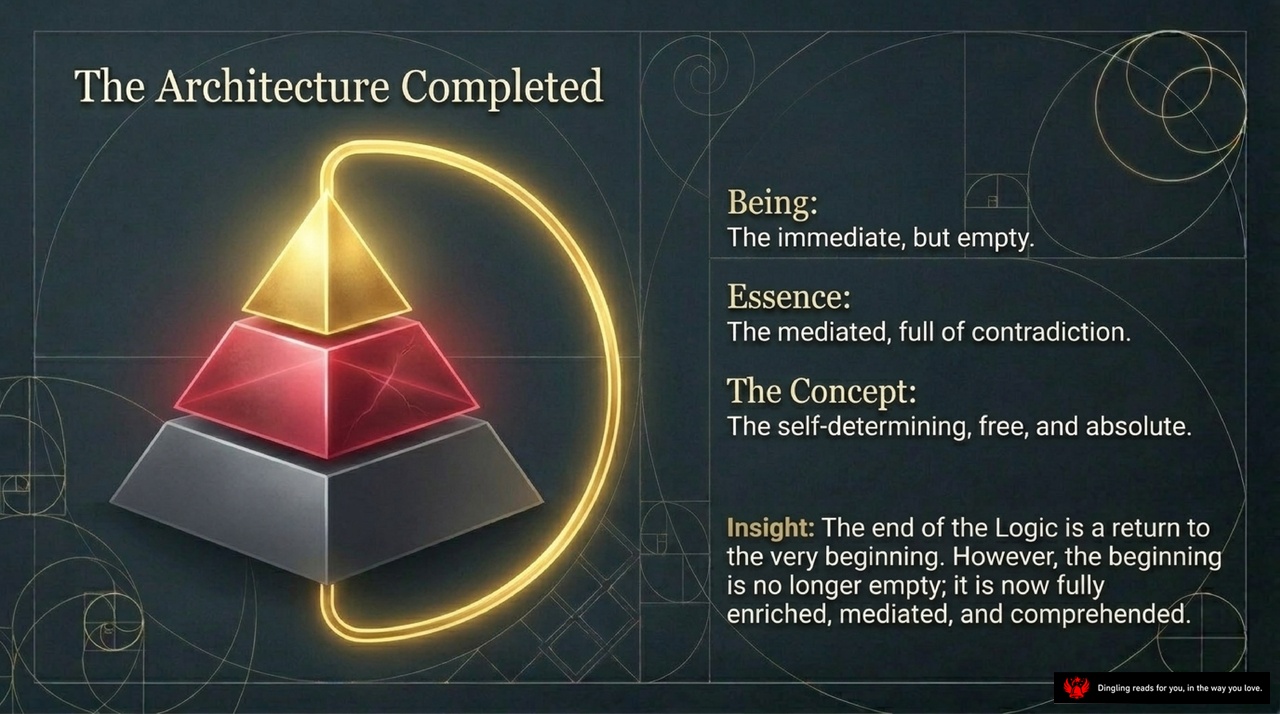
The Architecture Completed. This slide maps out the grand finale of Hegel's Logic, showing how the entire philosophical system comes full circle. Look at this pyramid: it represents the three major divisions of the philosophy—Being, Essence, and The Concept.
We start at the bottom with **Being**. As the slide notes, this is "the immediate, but empty." It's the raw, abstract starting point, like pure existence without any specific content.
Then we move up to **Essence**. This is "the mediated, full of contradiction." Here, things get deeper. We see relationships, distinctions, and the hidden structures behind the surface. It's where we confront the tension between opposites.
Finally, we reach the top: **The Concept**. This is "the self-determining, free, and absolute." It's the synthesis of everything we've learned. The Concept isn't just a mental label; it's the living principle that drives reality itself. It unifies the abstract beginnings with the concrete realities we've explored.
The golden ring circling the pyramid illustrates the ultimate **Insight**: "The end of the Logic is a return to the very beginning." But notice the difference. The beginning wasn't empty anymore. Because we've journeyed through Essence and reached the Concept, that original beginning is now "fully enriched, mediated, and comprehended." We've come back to the start, but we've arrived there with a complete understanding. The circle is closed, but it's filled with meaning.

Hegel's Logic reveals a profound shift in how we understand reality: it's not a collection of static, isolated objects, but a dynamic, interconnected process of dialectical unfolding. As the slide illustrates, this journey begins from the emptiness of pure Being, moves through the conflicting dualities of Essence, and ultimately ascends to the Absolute Idea, where thought and reality are revealed as one unified, self-determining whole.
This raises a critical question for us today: If the ultimate truth of the universe isn't a rigid substance but the very process of rational comprehension itself, are we merely passive observers of reality? Or are we, in a sense, the universe thinking itself into existence? Hegel argues that by grasping this dialectical movement, we move beyond abstract oppositions to a concrete unity where the finite finds its meaning within the infinite. It's an invitation to see the world not as something separate from us, but as the active unfolding of reason that we participate in and help shape.