
Siddhartha: Complete Chapter-by-Chapter Summary

Welcome to our reading session on *Siddhartha* by Hermann Hesse. Today, we begin our journey into the dialectical path of a soul seeking truth beyond the boundaries of taught wisdom.
This book isn't just a story about an ancient Indian sage; it is a mirror for anyone who has ever felt trapped by the rules of the world. Siddhartha refuses to accept a life predetermined by his father or by religious dogma. He questions everything, searching for a truth that cannot be found in books or temples, but only within his own living experience.
As we dive into this narrative, we will follow Siddhartha from his early rebellion against authority, through his rigorous asceticism, his encounter with the Buddha, and eventually, his descent into the material world of wealth and love. It is a profound exploration of how wisdom is not something you can be taught, but something you must discover for yourself through the full spectrum of life's joys and sufferings.
Join us as we uncover the timeless lessons hidden within these pages.

The Straight Line versus The Meandering River: this isn't just a metaphor; it's the exact battle Paul Coelho fought while locked in a psychiatric ward in 1967. The "Straight Line" represents the expectation of a perfect, predictable life—safe, esteemed, and empty. It's the path of the assigned fate where the spirit starves while the intellect is fed. But then comes the rebellion, the "Meandering River." This is the visceral need to claim what is rightfully yours: an authentic life. It's about embracing unrest and seeking the self, even when the world screams for you to stay safe. This shift ignited the passions of a generation in the 1960s, turning the search for self into an anti-authoritarian, anti-utilitarian movement. It wasn't about following a straight line to a pre-determined destination; it was about diving into the chaos of the river, trusting the current, and realizing that the only true wisdom is found by letting go of the map and walking your own path, however winding it may be.
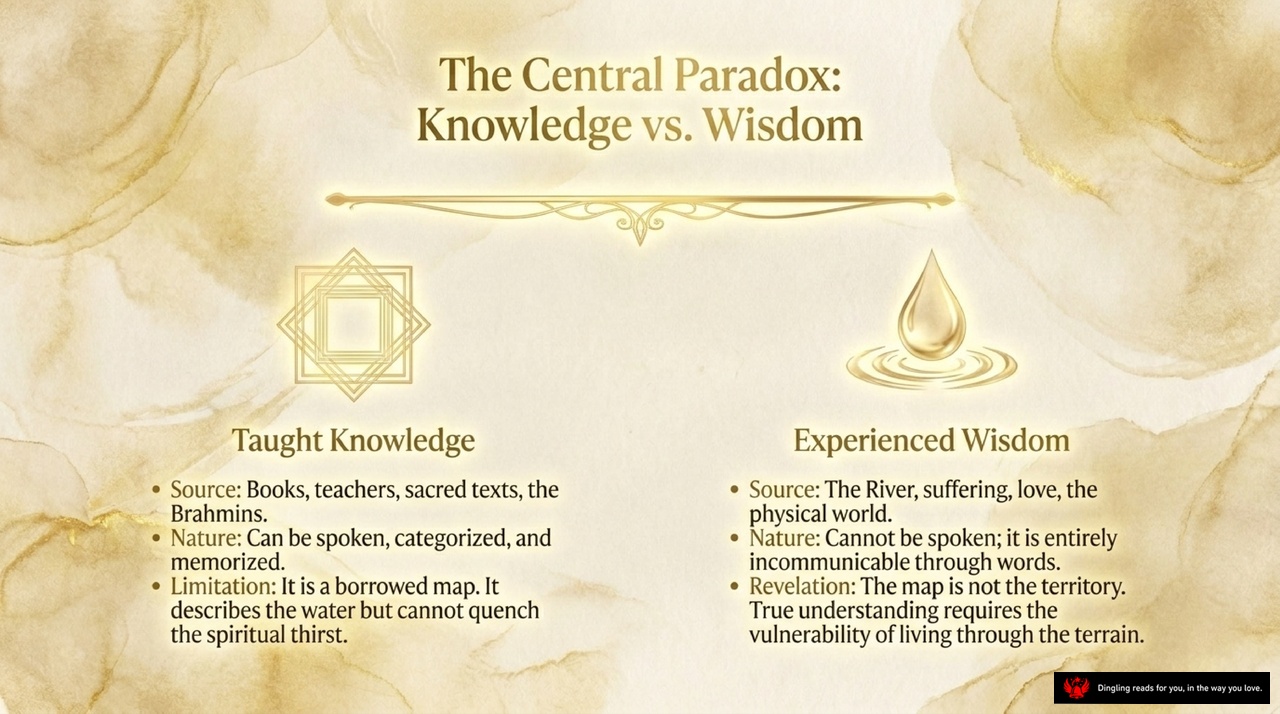
Have you ever felt that reading a book was like holding a map, but you were still lost in the territory? That is the central paradox we face today: the difference between Knowledge and Wisdom.
On the left, we see "Taught Knowledge." This is the kind of information we get from books, teachers, sacred texts, and even mentors. It can be spoken, categorized, and memorized. It's useful, but it has a major limitation: it's a borrowed map. It describes the water, but it can never quench your spiritual thirst. It tells you what to think, but it can't make you feel.
On the right, we see "Experienced Wisdom." This comes from the river, from suffering, from love, and from living in the physical world. It cannot be spoken; it is entirely incommunicable through words. You cannot download wisdom like an app. True understanding requires the vulnerability of actually living through the terrain. As the slide reminds us, the map is not the territory.
Consider the story of Siddhartha. He spent years learning the Vedas and meditating under the guidance of the Buddha. He had all the knowledge in the world. Yet, he realized that these teachings were just words. They were a map, not the land itself. He couldn't find peace by reading about it; he had to step into the river and let the current wash over him. He had to stop trying to understand life and start experiencing it.
This is why the slide emphasizes that true understanding requires vulnerability. When you try to protect yourself with knowledge, you stay on the shore. When you allow yourself to be vulnerable—to feel the pain of loss, the joy of love, and the chaos of existence—you finally touch the water. You become the water.
So, the next time you pick up a book or listen to a lecture, remember this distinction. Let the knowledge inform you, but don't mistake it for wisdom. Don't just collect facts; go out and live the story. Because wisdom isn't something you know; it's something you become.

Today's slide outlines a profound thesis: The Realm of Spirit. At its core lies a single, radical goal—to become entirely empty of thirst, desire, and dreams. It is about letting the ego die so the ultimate secret of existence can awaken.
But how does one achieve this emptiness? The slide reveals three essential disciplines. First, Fasting: conquering the body's physical demands. This mirrors the text's description of Siddhartha standing in the scorching sun, enduring thirst and hunger until he becomes numb, or lying in thorns until pain stops. Second, Waiting: conquering the mind's impatience. Siddhartha learned that wisdom cannot be rushed; it requires the courage to simply be, to wait for the moment when the noise of the self finally falls silent. Third, Thinking: conquering the illusion of the senses. This involves stripping away our reliance on what we see and hear to find a deeper truth.
However, the slide also warns us of The Inevitable Failure. It states that the ascetic path is merely a temporary anesthetic. Just like a drunkard escaping reality, the seeker often returns to the suffering of the Self. This is a crucial insight: denying our desires through extreme discipline doesn't erase the ego; it just puts it to sleep. True awakening doesn't come from emptying the self of everything, but from embracing the fullness of life. It's a reminder that the journey inward is often a cycle of leaving the self behind only to find it again, until we finally learn to love the world exactly as it is.
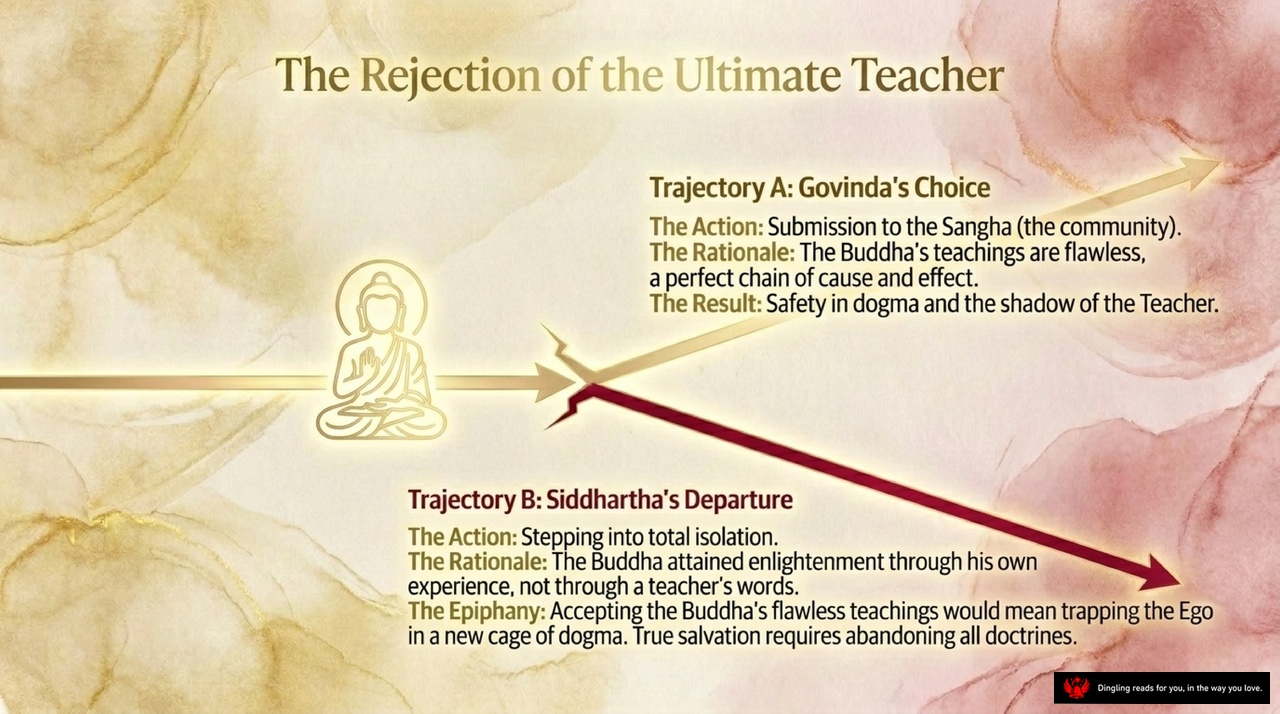
Trajectory A: Govinda's Choice. Trajectory B: Siddhartha's Departure.
Look at this pivotal moment where the path splits. One arrow points to submission, the other to isolation. This is the core conflict of the book.
On the top path, we see Govinda's choice. He chooses submission to the Sangha, the community. His rationale is clear: the Buddha's teachings are flawless, a perfect chain of cause and effect. He believes in safety in dogma, finding comfort in the shadow of the Teacher. It is the path of certainty, where the ego finds a new cage of doctrine to protect itself.
But the red arrow below tells a different story. This is Siddhartha's departure. His action is stepping into total isolation. Why? Because he realized that the Buddha attained enlightenment through his own experience, not through a teacher's words. Siddhartha had a profound epiphany: accepting the Buddha's flawless teachings would mean trapping the Ego in a new cage of dogma. He understood that true salvation requires abandoning all doctrines.
This slide captures the moment Siddhartha stops following. He realizes that wisdom cannot be taught; it can only be experienced. By leaving the teacher, he wasn't rejecting truth, but reclaiming his own life. He was choosing the difficult path of self-discovery over the easy path of blind faith. This is the moment he truly becomes himself.

In this pivotal chapter, we witness the tragic arc of the soul's descent into the material world, a journey that begins with awakening but ends in the very trap it sought to escape. As the slide illustrates, this is the "Descent"—entering the world of ordinary people not as a detached thinker, but as a full participant.
First, we see Kamala, representing Love. Here, Siddhartha learns that physical intimacy is an art requiring both giving and taking. He moves from a cold observer to a passionate lover, mastering the nuances of connection and finding a depth of joy he had never known in his ascetic life.
Next comes Kamaswami, symbolizing Wealth. Siddhartha masters commerce, transforming from an indifferent observer into an active, anxious participant. He becomes rich, powerful, and comfortable, yet he remains an outsider, viewing the world as a game he plays rather than a life he lives.
But this path leads inevitably to "The Trap of the Ego." What begins as a playful game slowly calcifies into a soul sickness. Greed, gambling, and lethargy thicken his spirit. The ego he tried to kill has merely taken a new, materialistic form. Siddhartha realizes that chasing wealth and pleasure only deepens his inner poverty, leading him to a moment of desperate despair where he almost chooses death, only to be saved by the sacred sound of "Om."

Picture: The Nadir: The Dead Bird & The River. The Dream of the Dead Bird. Kamala's rare songbird lies stiff and dead in its golden cage. The Meaning: The death of Siddhartha's inner voice. His soul has suffocated under the weight of luxury and superficiality. The Edge of Annihilation. Standing by the river, filled with nausea, Siddhartha contemplates drowning to destroy his rotting physical shell. The Spark: From the absolute depths of despair, a forgotten sound bubbles up: Om (Perfection). The Awakening: The sound shocks his soul awake, initiating a deep, regenerative sleep that kills the Merchant Siddhartha and births a new consciousness.
Hey everyone, this is the moment everything breaks and everything begins again. We are at the nadir, the lowest point, where Siddhartha's entire world collapses. Look at that dead bird in the golden cage. That isn't just a bird; it is Siddhartha himself. After years of chasing wealth, power, and the thrill of the city, his inner voice has suffocated. He is trapped in a cage of his own making, drowning in the very luxury he once thought was the ultimate freedom. He feels so nauseous, so utterly empty, that he stands by the river, staring at the water, ready to destroy his rotting physical shell by drowning. He thinks this is the end.
But right at the edge of annihilation, when despair is absolute, the spark appears. From the depths of that darkness, a forgotten sound bubbles up: Om. It's the sound of perfection, the sound of the universe. It shocks his soul awake. This isn't a moment of intellectual realization; it is a violent, regenerative awakening. The sound initiates a deep, transformative sleep. In that sleep, the old "Merchant Siddhartha" dies. The man who was obsessed with status, money, and superficiality is gone. And from the ashes of that death, a new consciousness is born. He is no longer running from himself; he is finally home.

Welcome to the final synthesis of our journey with Siddhartha. Today, we step into the Ferryman's Realm, the quiet, profound domain where true wisdom is not spoken, but felt.
Meet our mentor, Vasudeva, the silent ferryman. He represents a masterclass in attention, teaching us that enlightenment isn't found in words, but in the art of listening. His method is profound and ego-less: waiting with an open soul, stripping away all passion, judgment, and opinions to hear the river's true song.
But what is the river's secret? It teaches us that we must sink to the very bottom. We must experience the heights of the intellect alongside the mud of our senses. Only by embracing the full spectrum of life—the joy and the pain, the sacred and the profane—can we achieve true synthesis. As Siddhartha learns, the river flows endlessly, yet it is always here, in the present moment, carrying all of existence within its eternal, harmonious flow.
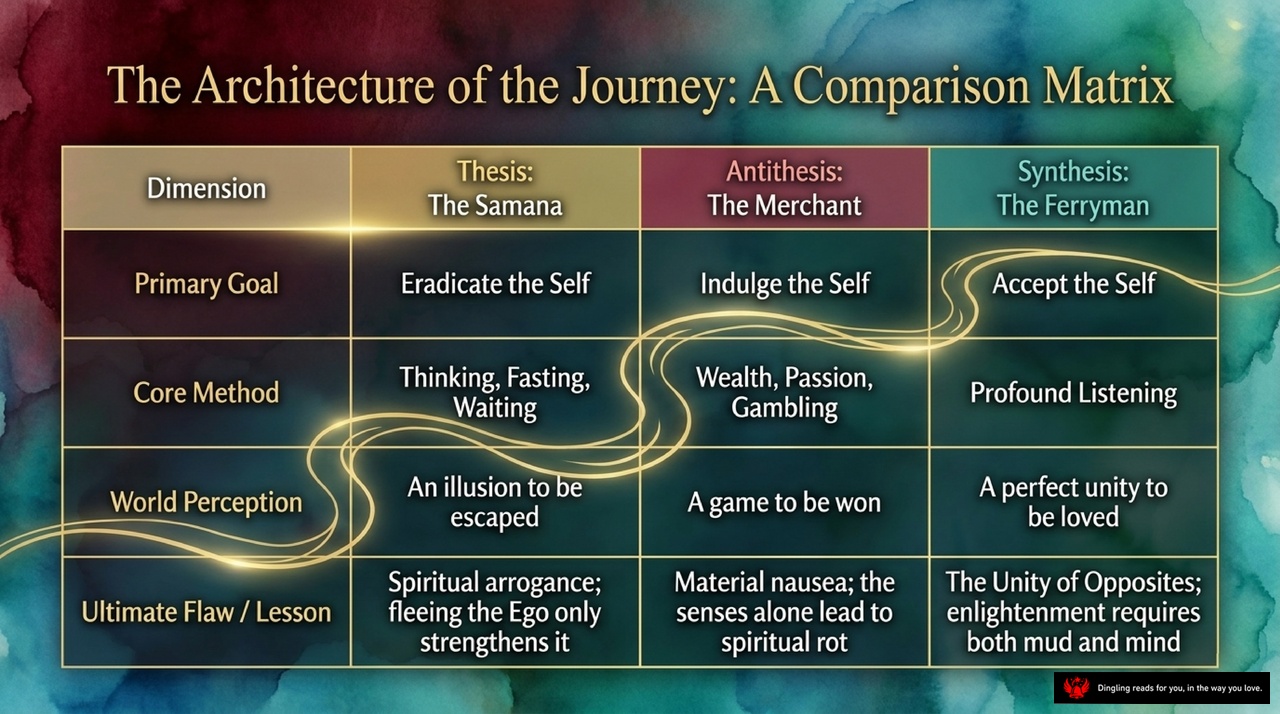
Look at this matrix. It maps the entire journey of the soul through three distinct archetypes: The Samana, The Merchant, and finally, The Ferryman.
On the left, we see The Samana. His primary goal is to eradicate the self. His core method involves thinking, fasting, and waiting. He perceives the world as an illusion to be escaped. But look at his ultimate flaw: spiritual arrogance. By fleeing the ego, he only strengthens it. He tries to find the truth by destroying the vessel that holds it, and in doing so, he fails.
In the center, we have The Merchant. His goal is to indulge the self. His methods are wealth, passion, and gambling. He sees the world as a game to be won. Yet, his downfall is material nausea. By chasing the senses, he leads to spiritual rot. He thinks he can buy happiness or win enlightenment, but he ends up trapped in a cycle of addiction and emptiness.
But notice the golden line weaving through the table. It shows the synthesis. The Ferryman. His goal is not to destroy the self, nor to indulge it, but to accept it. His method is profound listening. He perceives the world not as an illusion or a game, but as a perfect unity to be loved. His lesson is the unity of opposites. Enlightenment doesn't require escaping the mud or ignoring the mind; it requires embracing both.
This is the architecture of the journey. We cannot skip the discipline of the Samana, nor the experience of the Merchant. We must walk through the fire of asceticism and the temptation of wealth to arrive at the quiet wisdom of the Ferryman. Only by accepting the self, with all its contradictions, can we finally find the truth.
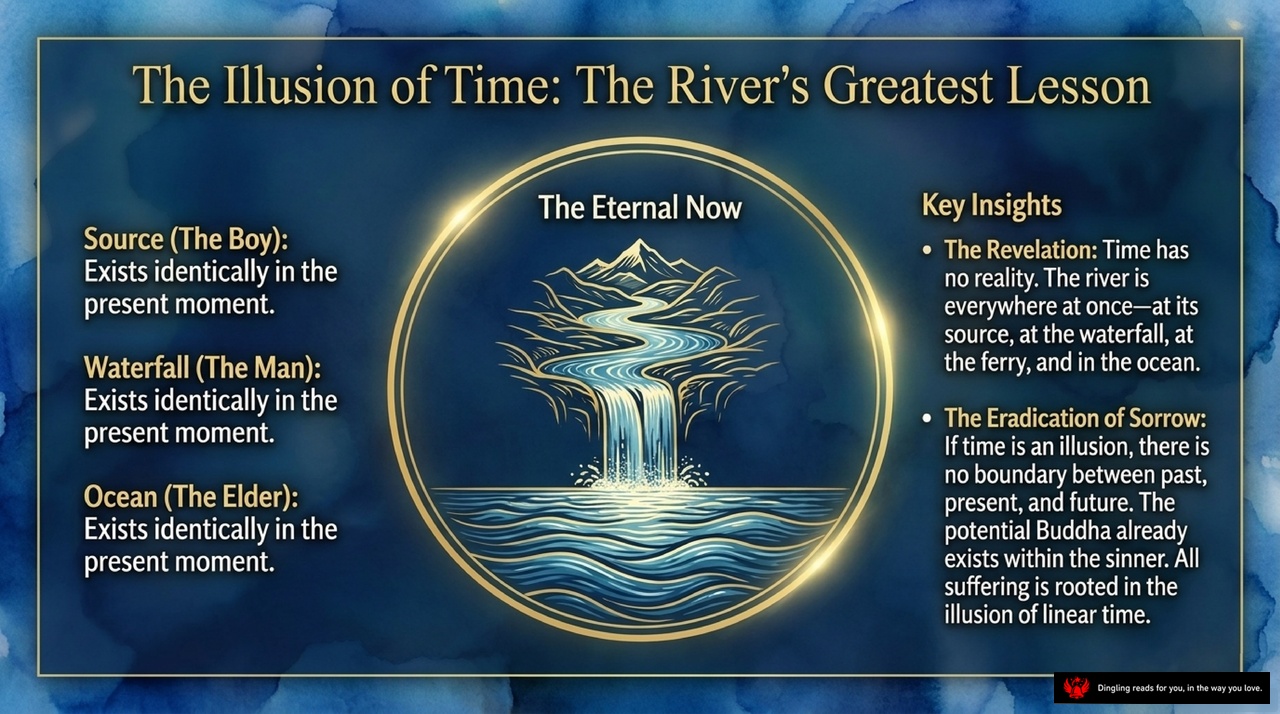
The Illusion of Time: The River's Greatest Lesson. Look at this image. It captures the core of Siddhartha's journey: the realization that time is a trick. The slide highlights "The Eternal Now," showing how the river exists everywhere at once—at its source, at the waterfall, and in the ocean. This mirrors Siddhartha's breakthrough with the ferryman, Vessavamana. They discovered that the river isn't just flowing from past to future; every drop exists simultaneously in the present moment. The source, the boy; the waterfall, the man; the ocean, the elder—they are all identical right now. Siddhartha learned that if time is an illusion, there are no boundaries between past, present, and future. This leads to the eradication of sorrow. When you stop seeing life as a linear line of mistakes to be fixed, you realize the potential Buddha already exists within the sinner. All suffering stems from believing in linear time. By embracing the eternal now, Siddhartha found peace, understanding that every moment contains the whole of life.

This slide captures the most painful, yet transformative, chapter of Siddhartha's journey: the final trial of becoming a father. We see a golden infinity loop, symbolizing the eternal cycle of human suffering and love. On the left, we have "The Defiant Youth." This is Siddhartha as we first met him, the one who broke his father's heart by leaving home to join the Samanas. He chose his own destiny over his father's protection, believing that no father could shield a son from the path of life.
But the loop turns to the right, revealing "The Desperate Father." The roles have reversed. Now, Siddhartha is the father, and he experiences that blind, agonizing love for his own son—a spoiled, rebellious child who ultimately abandons him. It is a cruel echo of his own past. As the text reminds us, through this agony of loss, Siddhartha finally understands the ordinary people. He realizes that their blind passions, vanities, and sufferings are no longer absurd to him; they are deeply human, vital, and worthy of respect. This cycle teaches him that love is not about control or protection, but about letting go and witnessing the other's journey, even when it breaks your heart.
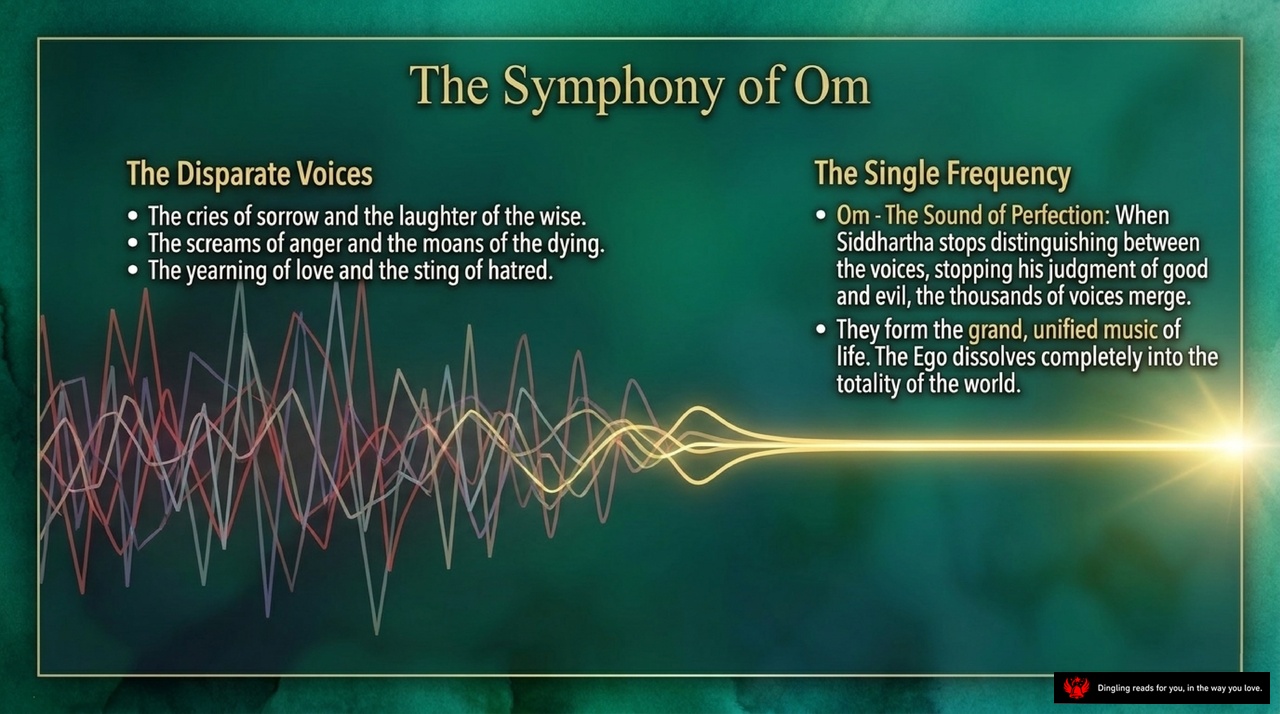
Imagine the world not as a single, unified song, but as a chaotic symphony of millions of voices. On this slide, we see "The Disparate Voices" on the left and "The Single Frequency" on the right. It perfectly captures Siddhartha's ultimate realization. For years, he struggled to separate himself from the world, judging every sound as either good or evil, right or wrong. He heard the cries of sorrow, the laughter of the wise, the screams of anger, and the moans of the dying as separate, conflicting entities. But the moment he stopped distinguishing between them, something miraculous happened. He stopped judging. He stopped trying to filter out the noise.
Suddenly, those thousands of disparate voices merged. They didn't cancel each other out; instead, they harmonized. The sting of hatred and the yearning of love became part of the same grand, unified music of life. This is the power of "Om," the sound of perfection. When Siddhartha dissolved his ego, when he let go of the need to be separate, he didn't lose his individuality. Instead, he found the totality of the world within himself. The ego, which he had spent his whole life trying to conquer, finally dissolved completely. He realized that to truly know himself, he had to become everything else. That is the symphony of Om.
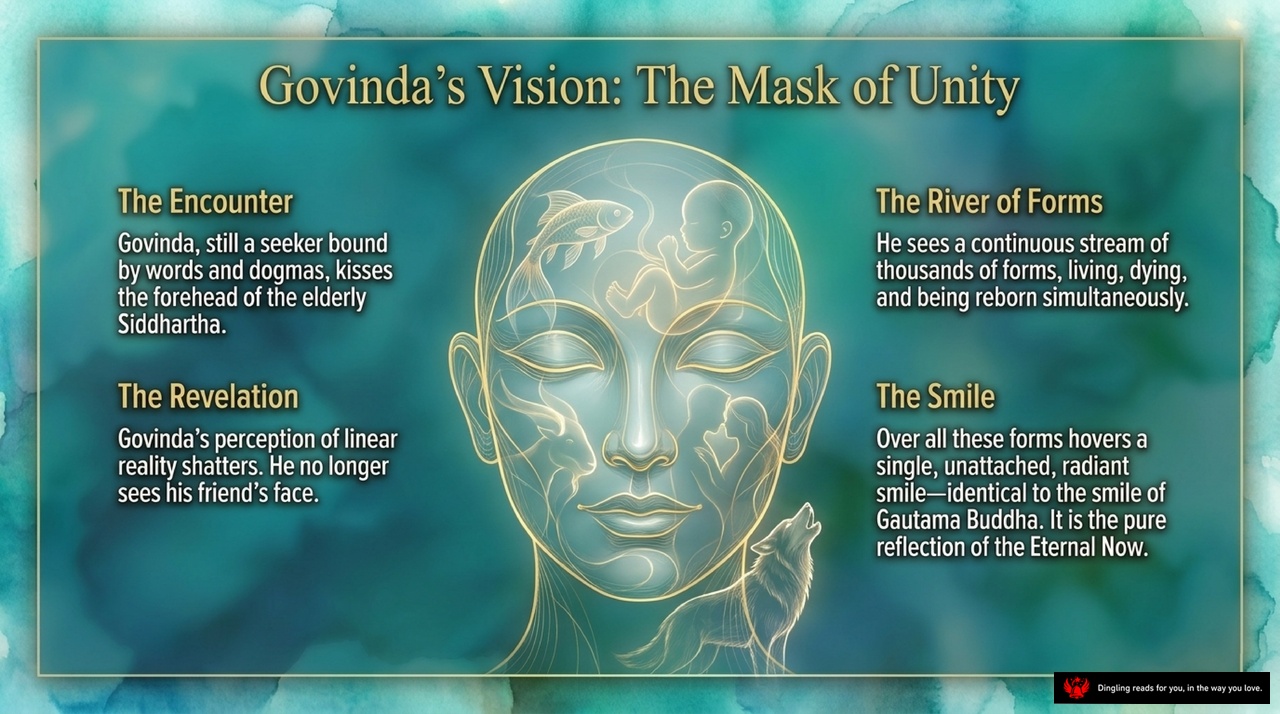
Governinda's Vision: The Mask of Unity. Imagine a face not as a static portrait, but as a living canvas where life unfolds in real-time. In the center of this vision, you see a fish swimming, a baby being born, and a wolf howling at the moon—all coexisting within a single, radiant countenance. This is the moment where linear time shatters.
Goivinda, still bound by words and dogmas, kisses the forehead of the elderly Siddhartha. In that instant, his perception of reality transforms. He no longer sees his friend's face; instead, he witnesses the River of Forms. He sees a continuous stream of thousands of forms living, dying, and being reborn simultaneously. The boundaries between past, present, and future dissolve.
Over all these forms hovers a single, unattached, radiant smile—identical to the smile of Gautama Buddha. It is the pure reflection of the Eternal Now. This is the Mask of Unity, revealing that every life, every struggle, and every joy is part of one infinite, harmonious whole.

Deck Synthesis: The Unity of Opposites. Look at this diagram. It maps out the final truth of Siddhartha: that the world is never incomplete, and that we must love it exactly as it is, entirely and unconditionally.
Let's break down these three circles. First, "The Stone." Siddhartha realizes that a stone is not merely physical matter. In the eternal present, it already contains the soil, the plant, the animal, and the divine. We stop respecting things only because we imagine they might become something else. But in this very moment, the stone is perfect.
Next, "The Sinner." Siddhartha understands that the sinner is not on their way to becoming enlightened. The potential Buddha is already fully present within them. We don't need to travel through time to find our higher selves; we just need to stop looking at the world through the illusion of time.
And finally, "The Saint." The saint is not superior to the sinner. They are the exact same entity viewed without the illusion of time. The gap between good and evil, saint and sinner, is a fantasy created by our linear thinking.
This is the core insight: every truth's opposite is also true. A thief has the potential for holiness; a holy man has the potential for theft. When we accept that all opposities are unified, we stop judging and start loving. We stop comparing the world to a hypothetical, perfect future. Instead, we embrace the reality right in front of us. We love the stone, the sinner, and the saint exactly as they are. This is the unity of opposites.

Wisdom cannot be imparted through words; it must be harvested from the totality of lived experience. Enlightenment is not the eradication of the physical world, but the radical acceptance of it—embracing both the sacred and the profane until they dissolve into one eternal, perfect unity.
If every stage of your life—including your deepest failures and darkest detours—is a necessary drop in the river of your ultimate awakening, what part of yourself are you still refusing to love?