
Skins: Complete Chapter-by-Chapter Summary

Welcome to the world of *Skins* by Cai Chongda. This book isn't just a story; it's a raw, unflinching exploration of what it truly means to be human. Through the eyes of a boy growing up in a small coastal town, we dive into the fragile vessels of our bodies, the heavy anchors of our hometowns, and the painful collisions with our grandest illusions.
The narrative follows a family navigating loss, from the stoic grandmother who refuses to cry at a funeral to the father who fights desperately against paralysis, and the mother who builds a house not for comfort, but to keep her husband's memory alive. It's a journey through the tension between the physical body and the soul, asking us to question why we often treat our flesh as something to be served rather than used.
As we turn these pages, we'll see how the author transforms personal grief into universal truth, revealing that life's heaviest burdens are often the ones we choose to carry ourselves. This is a story about letting go, about finding dignity in struggle, and about realizing that our skin is just a temporary shell for something far more enduring. Get ready to confront your own limits and find a new way to live.
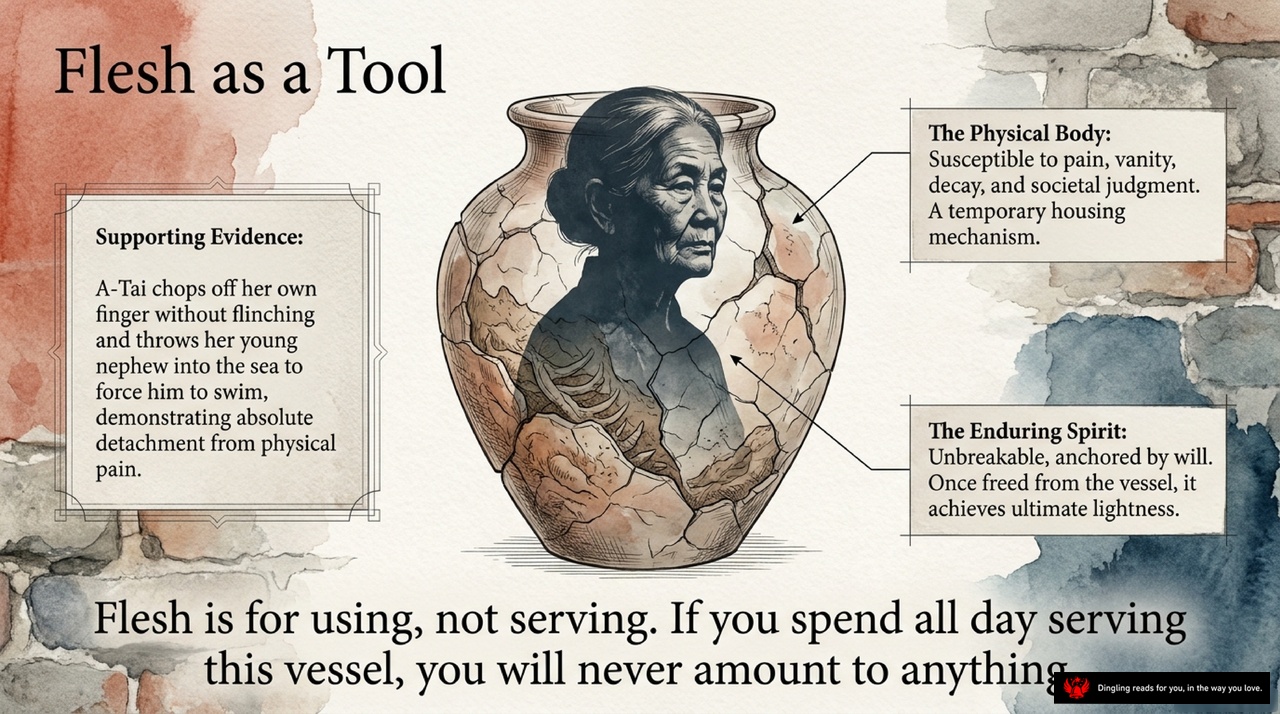
Flesh as a Tool. Look at this cracked vessel holding an elder's spirit. It's a powerful metaphor for a life philosophy: the body is a tool, not a servant.
Consider the story of A-Tai, the grandmother in the book. She didn't just endure life; she mastered it with ruthless clarity. When her finger was accidentally chopped off while chopping vegetables, she didn't panic. She calmly cut it off, threw it away, and kept working. Why? Because she knew pain is temporary, but your life isn't.
She took this same logic to her nephew, who was terrified of water. Instead of coaxing him, she threw him into the sea. When he nearly drowned, she threw him back in again, ignoring the neighbors' anger. She believed that fear is just a sensation in the flesh, not a law of nature. By forcing him to swim, she wasn't being cruel; she was liberating him from the limitations of his own body.
The book says it plainly: "Flesh is for using, not serving." If you spend your entire life pampering your body, protecting it from every scratch, and fearing every discomfort, you are letting the vessel control you. You become a prisoner of your own skin. But when you stop serving the flesh and start using it, something incredible happens. You gain freedom. You gain lightness.
A-Tai lived this truth until her very last breath. Even when she was bedridden, she refused to let her body define her worth. She told her grandson, "Don't serve this skin; use it." She understood that the soul is unbreakable, anchored by will, while the body is just a temporary, fragile housing mechanism. Once freed from the fear of the physical, the spirit achieves ultimate lightness.
So, ask yourself: Are you serving your body, or are you using it? Are you letting pain and fear stop you, or are you using your body as a vessel to go exactly where you need to be? The choice defines everything.
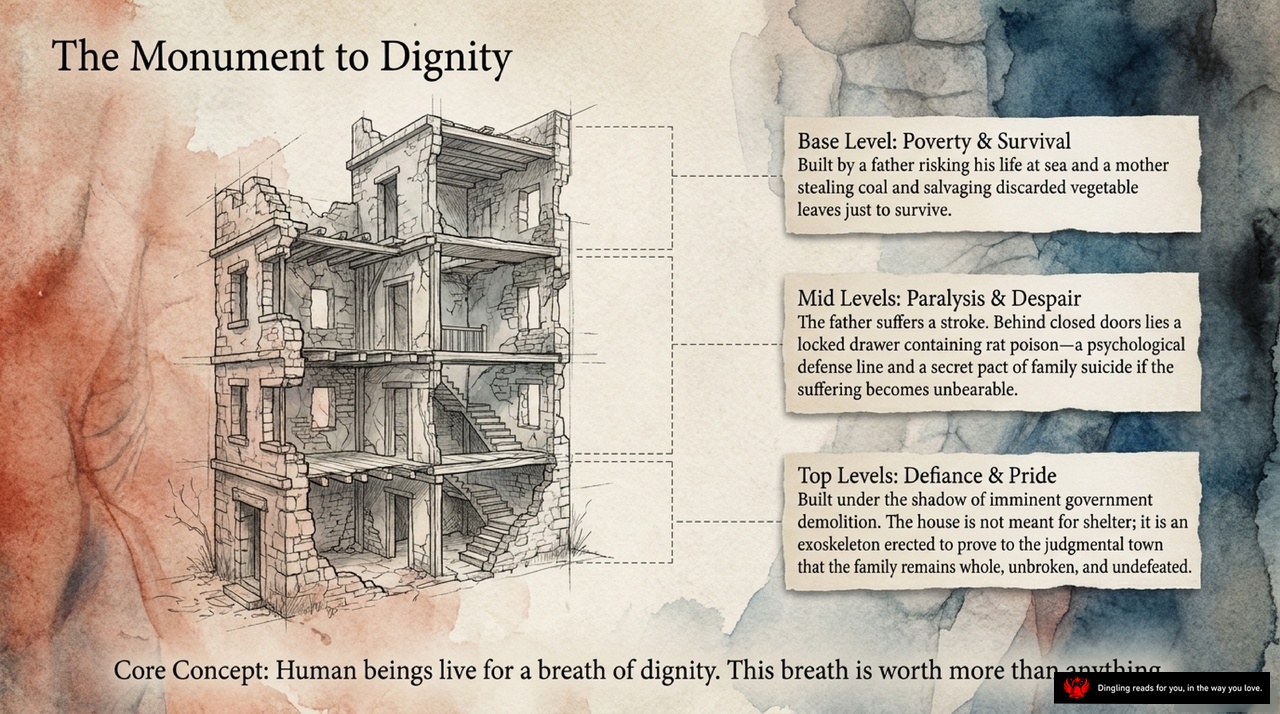
The image before us isn't just a drawing of a crumbling house; it's a visual map of a family's desperate fight for dignity. Look at the three levels we see here. At the very base, the foundation is built on pure survival—a father risking his life at sea and a mother scavenging for scraps just to keep the roof over their heads. This is the reality of the "flesh" we all have to deal with.
But then, look at the middle section. This is where the story gets heavy. When the father suffers a stroke, the house doesn't just collapse; it becomes a prison of despair. We see the locked drawer with rat poison, a silent pact of suicide if the suffering becomes too much. It represents the paralysis that sets in when the pain feels unbearable.
Yet, look at the top level. That's the most important part. Even with the threat of demolition looming, even with the father's disability, the family refuses to break. They build this house not for shelter, but as a monument to defy the world. It's an exoskeleton proving that they remain whole and undefeated.
The core message here is powerful: humans don't just live for survival; we live for a breath of dignity. That breath is worth more than anything. It's the difference between letting the body dictate your life, or using your body to stand tall against the world.
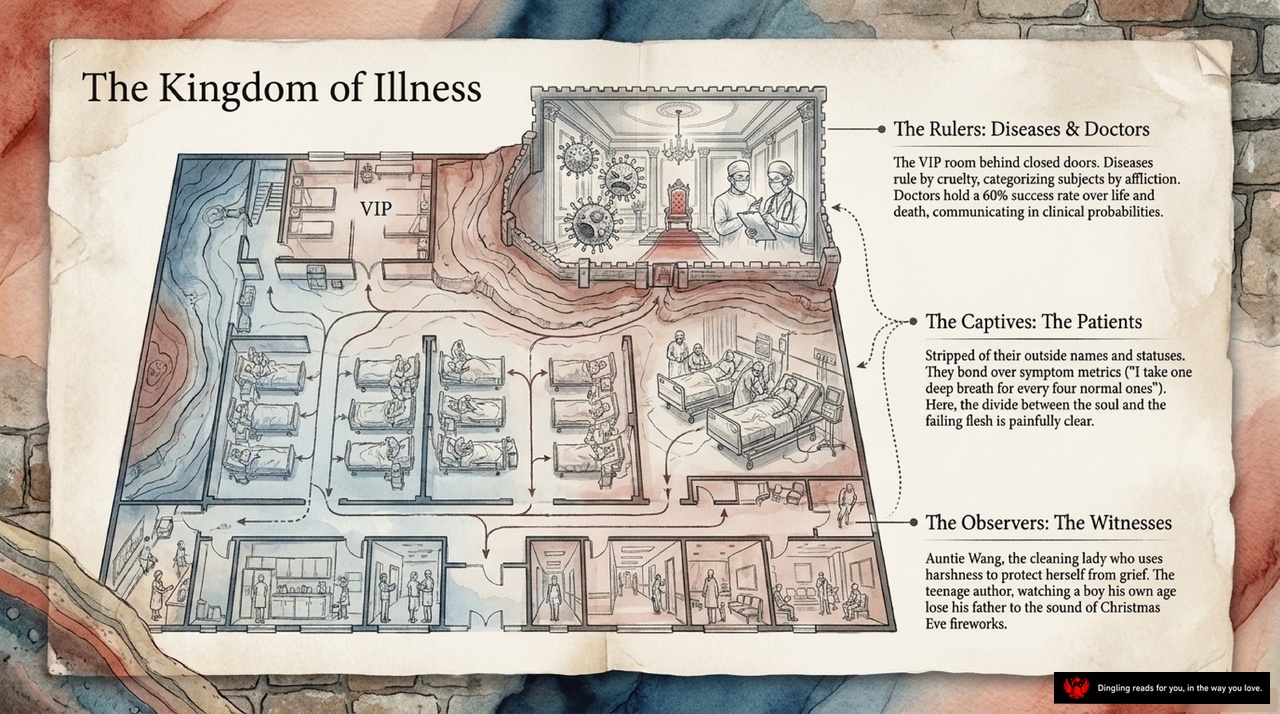
Look at this map of a hospital, titled "The Kingdom of Illness." It's not just a floor plan; it's a social hierarchy drawn in blood and medicine.
At the very top, behind closed doors, sits the VIP room. This is where the Rulers live: the Diseases and the Doctors. Here, diseases rule with cruelty, categorizing us by our affliction. The doctors hold a 60% success rate over life and death, speaking in cold, calculated clinical probabilities. It's a kingdom where power is defined by who can keep you alive, or who decides when you're a statistic.
Down in the middle are the Captives: the Patients. We are stripped of our outside names, our jobs, our statuses. In these wards, we bond not over our pasts, but over symptom metrics. "I take one deep breath for every four normal ones." Here, the divide between the soul and the failing flesh is painfully clear. We are no longer individuals; we are just cases waiting to be solved.
And at the bottom, in the corridors and service areas, are the Observers: the Witnesses. This includes Auntie Wang, the cleaning lady who uses harshness to protect herself from grief, and teenage authors watching boys their own age lose their fathers to the sound of Christmas Eve fireworks. We are the ones who see the whole tragedy unfold, yet we are powerless to stop it.
This image captures a brutal truth: in the Kingdom of Illness, everyone has a place, but very few have a choice.
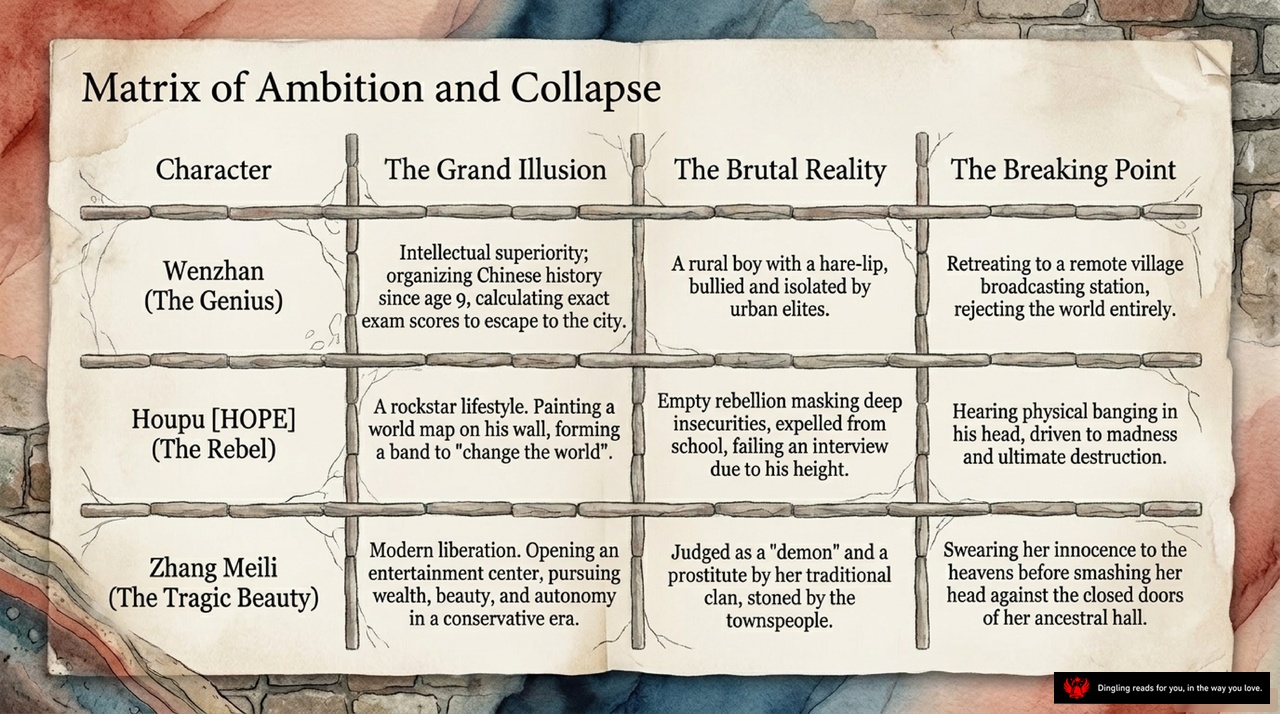
Welcome to the story of a town where ambition often crashes against the wall of reality. Today, we're looking at the "Matrix of Ambition and Collapse," a tragic blueprint for three distinct souls: Wenzhan, Houpu, and Zhang Meili.
First, we have Wenzhan, labeled "The Genius." His grand illusion was built on intellectual superiority; from age nine, he meticulously organized Chinese history, calculating exact exam scores as his escape route to the city. But the brutal reality was far harsher. He was a rural boy with a hare-lip, bullied and isolated by the urban elites he so desperately wanted to join. His breaking point came when he retreated to a remote village broadcasting station, rejecting the world entirely, unable to survive the pressure of his own potential.
Next is Houpu, or Hope, "The Rebel." He dreamed of a rockstar lifestyle, painting a world map on his wall and forming a band to "change the world." Yet, his reality was an empty rebellion masking deep insecurities. Expelled from school due to his height and failing interviews, he heard nothing but physical banging in his head. Driven to madness, his ultimate destruction was inevitable.
Finally, there is Zhang Meili, "The Tragic Beauty." She sought modern liberation, opening an entertainment center to pursue wealth, beauty, and autonomy in a conservative era. But she was judged as a "demon" and a prostitute by her traditional clan, eventually stoned by the townspeople. In her final act of defiance, she swore her innocence to the heavens before smashing her head against the closed doors of her ancestral hall.
These three lives show us that when ambition outpaces reality, the collapse is often total.

In the heart of a small town, Zhang Meili became the most contradictory symbol of all. To the adults, she was a "fox spirit," a sign of moral decay, yet behind their backs, rumors about her exotic life and mysterious connections spread like wildfire. For us, the teenagers, she was a forbidden secret, a mix of terror and obsession that kept us awake at night.
But her story took a tragic turn. After a brief marriage to a wealthy outsider, she returned to the town, now running a flashy seafood restaurant that locals refused to visit. When a violent brawl at her entertainment complex led to a death, the town turned against her. Her mother publicly called her a "demon," and under the weight of this relentless condemnation, Zhang Meili died right at the entrance of the ancestral hall.
Her death left her as a ghost, unclaimed by either her family or the clan. Yet, one neighbor, Kuige, insisted on giving her a proper funeral, playing mourning music for three days and nights before burning her restaurant down. To the townspeople, watching the flames consume her legacy felt like a celebration—a cleansing of a disease that had infected their community. Her life serves as a stark reminder: in the eyes of tradition, being too different isn't just a mistake; it's a crime that demands a price.
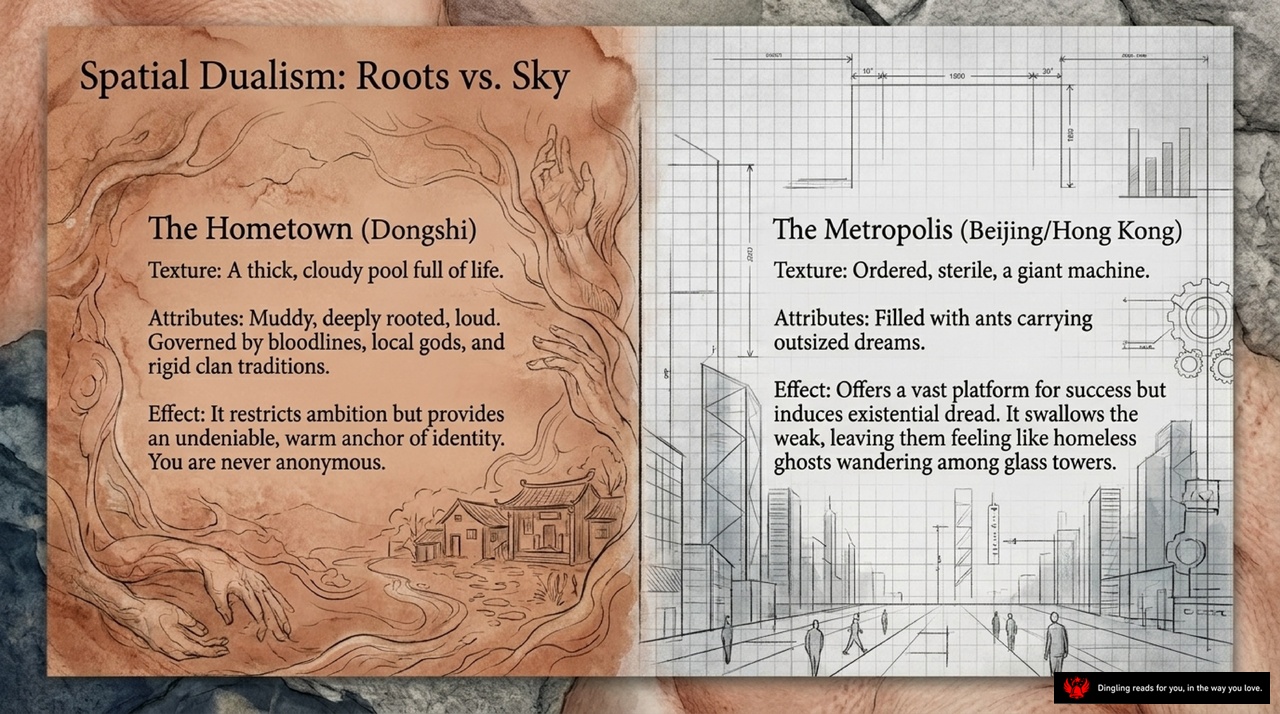
Spatial Dualism: Roots vs. Sky. On the left, we see the hometown—Dongshi. It's not just a place; it's a living, breathing organism. The image depicts a thick, cloudy pool of life, muddy and deeply rooted, governed by bloodlines and rigid clan traditions. It feels ancient, loud, and undeniably warm. You are never anonymous here. Your identity is anchored in this soil, in the local gods and the stories of your ancestors. It restricts ambition, yes, but it gives you a home you can't lose.
On the right, we have the metropolis—Beijing or Hong Kong. The texture is completely different: ordered, sterile, a giant machine. Look at those skyscrapers; they are filled with ants carrying outsized dreams. It offers a vast platform for success, but at what cost? It induces a deep existential dread. It swallows the weak, leaving them feeling like homeless ghosts wandering among glass towers. Here, you are invisible.
This slide captures the core tension of our lives. We are torn between the comfort of our roots and the promise of the sky. The hometown keeps us grounded, while the city pulls us upward, often leaving us feeling untethered. Which side do you choose? Or, more importantly, how do you carry both within you?

In the final chapter, we step out of the past and look at how memory shapes our present. The author returns to his hometown, riding his motorcycle through streets that have changed beyond recognition. Where his father once ran a bustling restaurant, there is now a warehouse stacked with cardboard boxes. The gas station that kept the family afloat has been bulldozed to make room for a flower garden. The house where his grandmother lived is now occupied by migrant workers, and the vibrant rose bushes she loved are reduced to withered twigs.
Yet, amidst this decay, life persists in the most ordinary ways. The author encounters an old woman selling a local delicacy who remembers him from childhood; a bicycle repairman recalls his father's daily visits. These fleeting moments reveal a profound truth: death does not erase a person. The people we love are not gone; they are woven into the fabric of our hometown, hidden in every casual conversation and every wisp of smoke from a cooking fire.
This realization breaks the illusion of being a detached observer. The author admits that trying to remain a "tourist" who watches life from a distance was just a way to avoid the pain of loss. True connection means accepting that time is cruel but not final. We cannot stop the train of time from rushing forward, but we can choose to carry the memories of those we loved in our bones. By honoring their stories and respecting the lives they lived, we find the courage to keep moving forward, carrying their warmth with us into the future.

Today, we explore how a mother navigates the profound pain of losing her husband not through silence, but through active, spiritual engagement. The slide outlines a five-step journey: "Processing Grief Through the Divine."
It begins with **Step 1: The Haunting Dream**, where the mother interprets her father's paralyzed spirit not as a memory, but as a sign of unresolved karma. This leads to **Step 2: Consulting the Medium**, transforming abstract sorrow into a tangible conversation where the father speaks of his regrets.
Instead of seeking clinical therapy, she moves to **Step 3: Assigning Divine Labor**. She sends her husband's spirit to work as a volunteer at the Zhenhai Temple, clearing debts through service. This evolves into **Step 4: Daily Rituals**, where she visits the temple, offering roast duck and checking on his performance, turning grief into a structured, caring routine.
Finally, **Step 5: Ultimate Release** arrives. After a month, she sees her father whole and young again, waving goodbye as he swims into clarity. This isn't just about letting go; it's about actively participating in his healing journey, proving that faith can be a powerful vessel for processing loss and finding peace.

Today's slide breaks down "The Anatomy of Seeing" into three layers: The Skin, The Anchor, and The Human Truth. Think of this not just as a diagram, but as a map for how we truly connect with one another.
The outermost layer is "The Skin." This represents everything we project to the world: our appearances, our social titles, and the illusions of grandeur we wear like armor. It's the physical vessel we use to navigate society, but it often hides who we really are.
Beneath that lies "The Anchor." This is where our true roots reside. It's your hometown, your family responsibilities, the deep-seated fears you've carried since childhood, and that desperate, often silent desire for dignity. This is the weight that grounds us, the part of us that refuses to float away even when everything else changes.
But the core of this entire model is "The Human Truth." True understanding, the slide tells us, is the act of piercing that protective skin to see the complex, suffering, yet beautiful person underneath. It's about looking past the surface drama to find the shared humanity in everyone you meet. As the text reminds us, "Understanding is the greatest act of kindness."
In a world obsessed with status and image, this framework challenges us to dig deeper. To see someone's "Anchor" and recognize their "Human Truth" is to offer them real respect. It means realizing that beneath the polished exterior, we are all just people trying to hold on to something, to be seen, and to matter. That's the essence of seeing.

Ultimately, we are all just temporary tenants in fragile bodies, torn between the gravity of our roots and the intoxicating illusion of the skies. If you strip away the ambitions you chase and the flesh that binds you, who is the person truly left behind?
This isn't about escaping life; it's about understanding what we're actually made of. Think about it: we often treat our bodies like precious treasures to be pampered, terrified of pain, and paralyzed by fear. But as the story shows, true strength comes from using your body as a tool, not worshipping it as an idol. When we stop clinging to the physical shell and start embracing the life within, we find a freedom that no amount of material comfort can buy.
So, the next time you feel trapped by your circumstances or afraid of the unknown, ask yourself: Am I serving my body, or is my body serving me? The answer might just change everything.