
Sleep: Complete Chapter-by-Chapter Summary

Good morning. Welcome to today's session on "Sleep," a topic written by Nick Littlehales.
We all know that rest is the foundation of success in work, sport, and life. But how often do we actually get it right?
Today, we are going to explore how to redefine your rest. We'll look at why simply counting hours isn't enough, how your body's natural rhythm actually works, and how small changes in your environment can transform your sleep quality.
Whether you are an athlete chasing peak performance or someone just trying to wake up refreshed, understanding the science behind sleep is the first step toward reclaiming your energy and your life. Let's dive in.

Look at this slide comparing "The Old Way" versus "The R90 Way." We've all been there, right? Chasing a rigid 8-hour block, treating sleep like a medical mandate, and panicking the moment we wake up at 3 AM. It's a passive obligation we've been forced into. But the R90 approach flips the script entirely. Instead of counting hours, we engineer 90-minute sleep cycles. Think of it as targeting 35 cycles a week, perfectly tailored to your biological chronotype. This isn't about forcing yourself into a mold; it's about managing a 24/7 continuous active recovery system. The bottom line is clear: the 8-hour sleep is a modern myth. Stop counting hours and start counting cycles. Your body doesn't need a clock; it needs a rhythm.

You cannot out-hustle 4 billion years of evolution. This slide perfectly illustrates why your body rebels when you ignore its ancient biological rhythms.
Look at the top left: light is the ultimate switch. Sunlight suppresses melatonin and spikes serotonin, creating a biological imperative for us to seek daylight. But notice the bottom left—blue light from our tech delays melatonin onset, engineering what experts call "Junk Sleep." This is the enemy of rest.
The graph shows our natural circadian energy dip around 3 PM, which is actually the prime secondary recovery window. Instead of fighting it, we should embrace it. Then, look at the deep sleep phase between 2 and 3 AM. This is when your body releases high levels of Human Growth Hormone for true repair. If you stay up late, you miss this critical window.
The core message is clear: we are hardwired for a specific rhythm. When we disrupt it with screens and late nights, we aren't just losing sleep; we're fighting against our very biology. Align with the sun, limit blue light at night, and respect your body's natural dips and peaks to thrive.
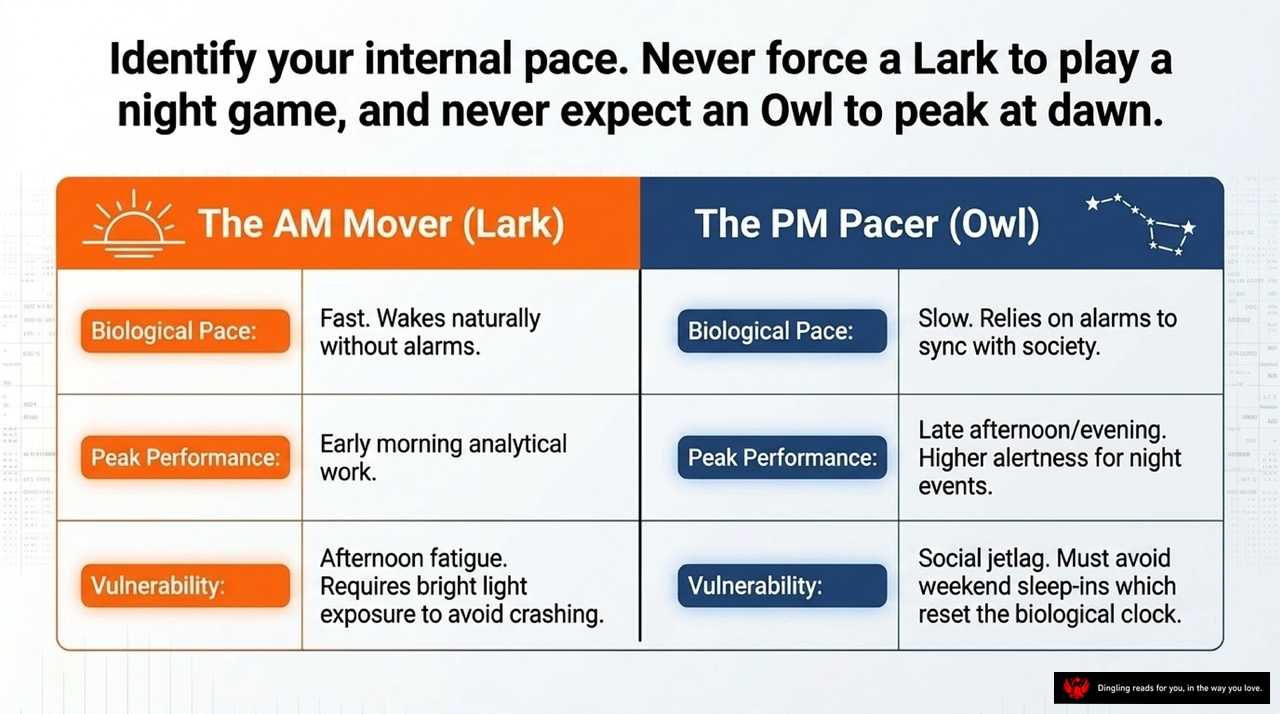
So, let's talk about how your body actually operates on a 24-hour cycle. Think of it like a biological metronome that's been ticking since you were born. The text explains that this rhythm isn't just about when you wake up; it's about your "internal pace." Some of us are "Larks"—the AM Movers who wake up naturally, hit peak performance early with analytical work, but crash in the afternoon. Others are "Owls," the PM Pacers who rely on alarms, stay alert late for night events, and struggle with social jetlag on weekends.
Here's the hard truth: never force a Lark to play a night game, and never expect an Owl to peak at dawn. If you ignore this, you're fighting your own biology. The text warns that modern life—artificial light, phones, and erratic schedules—tries to override this natural clock, leading to what experts call "social jetlag." It's like trying to run a marathon in the wrong season; you might push through, but your body pays the price with fatigue and poor performance. So, the first step to better sleep isn't just counting hours; it's identifying whether you're built for the morning or the night, and then designing your life to match that internal rhythm.
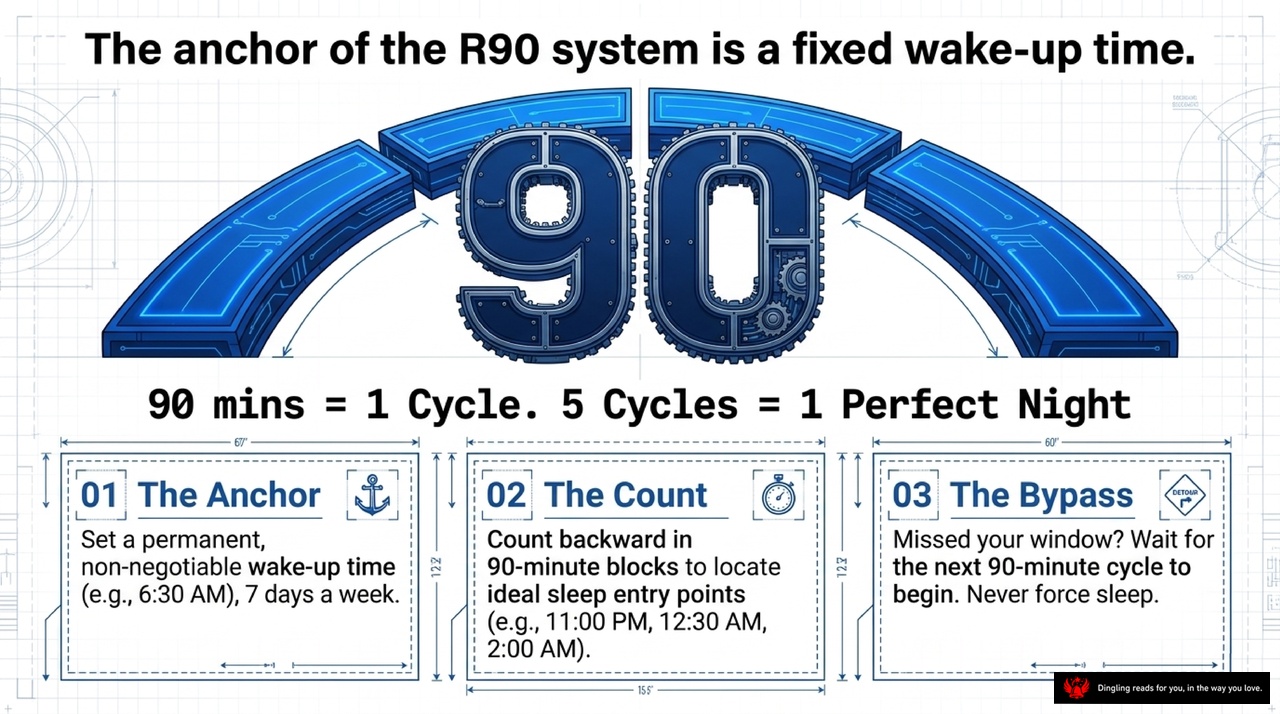
Have you ever found yourself dozing off during a mid-afternoon meeting, even when you know you're not tired? You're not alone. This is the well-documented "post-lunch dip," a natural trough in our energy cycle that hits most of us between 1 PM and 3 PM. Instead of fighting it with endless cups of coffee or power naps that leave you groggier, the R90 system suggests embracing this dip as a built-in recovery window.
The key is timing. Since our sleep operates in 90-minute cycles, the afternoon slump often coincides with a natural drop in alertness. For the average person, a quick 20 to 30-minute nap between 1 PM and 3 PM is the perfect solution. It's not about sleeping a full cycle; it's about hitting that "recovery room" before your next burst of productivity. To make it even smarter, try the "coffee nap": drink a small espresso right before you lie down. By the time the caffeine kicks in about 20 minutes later, you'll naturally wake up refreshed, with the nap clearing your adenosine buildup and the coffee boosting your alertness.
If a full nap isn't an option, don't panic. You can use this time for a "controlled rest." Find a quiet spot, close your eyes, and just let your brain reset for 30 minutes. Even without sleep, this pause lowers stress and helps your brain process the morning's information. For late risers, this window shifts slightly later, perhaps between 4 PM and 6 PM. Remember, this isn't laziness; it's a strategic pause. By utilizing these 90-minute blocks throughout the day, you align your rest with your body's natural rhythm, ensuring you stay sharp and energized without relying on stimulants.
Imagine you're shopping for a mattress, much like a couple who spent half their budget on a fancy frame only to realize they picked the wrong sleeping surface. The truth is, there's no single "best" mattress; it all comes down to your body type. Whether you're lean, muscular, or larger, you need a specific firmness level to keep your spine aligned. The only sleep position I truly recommend is side sleeping, specifically in the "fetal" position. This isn't just about comfort; it's about safety. By curling up slightly, your strong limbs protect your vital organs, signaling to your brain that it's safe to drop into deep, restorative sleep.
But here's the catch: you can't just buy any mattress. If you lie on the floor, you'll feel a gap between your head and the ground, or your hips will sink too deep, causing pressure points. A good mattress fills those gaps perfectly, keeping your neck and spine in a straight line. If you can't afford a new one yet, you can use a thick duvet or a mattress topper to adjust the firmness. And let's talk about pillows—they are essentially shoe insoles for your head, designed to compensate for the mattress. If your mattress is perfect, you actually need a very thin pillow. Those expensive, complex "orthopedic" pillows often do more harm than good.
Finally, consider the size of your bed. Most standard "double" beds are too narrow for two people to sleep without disturbing each other. You need a true "King" size, which is twice as wide as a single bed. If you have the space, invest in that extra width; it's the difference between tossing and turning and drifting off instantly. Remember, the frame is just a prop; put your money into the mattress itself. By matching your body type, choosing the right side-sleeping posture, and ensuring you have enough space, you create the perfect foundation for those crucial 90-minute sleep cycles.

Let's talk about the hardware of your sleep—specifically, your mattress. It sounds obvious, but we often treat this as an afterthought, much like that couple who spent half their budget on a fancy bed frame and only then considered the mattress. Here's the truth: a good mattress isn't about the price tag or the number of springs. It's about matching your body type. Whether you are lean, muscular, or stocky, you need a specific firmness level. If you share a bed, always choose the mattress based on the larger of the two body types.
Beyond the mattress, your sleeping position matters. Avoid sleeping on your back, which can cause snoring, or on your stomach, which strains your neck. The gold standard is the "fetal position" on your side. This keeps your spine aligned, protects your organs, and signals safety to your brain, helping you dive deep into restorative sleep. If your current mattress is too hard or too soft, you can fix it immediately with a topper or a high-quality mattress protector. And let's be real about pillows: think of them as shoe insoles. They exist to fill the gap between your head and the mattress, not to prop you up. If your mattress is right, you need a thin pillow, not an expensive orthopedic one.
Finally, consider the size. Standard double beds are often too narrow for two people. If you can fit a King or California King in your room, do it. The space to move without disturbing your partner is a game-changer. Instead of buying a single expensive mattress that might wear out in five years, invest in a layered system: a solid base plus a thinner, adjustable topper. You can wash the topper regularly to keep dust mids at bay, and you can swap it out later without replacing the whole bed. Your bedroom is a sanctuary; make sure the foundation you sleep on actually supports your body, because nothing disrupts your 90-minute cycles quite like tossing and turning on a bad surface.

Have you ever felt that sinking feeling of fatigue hitting you hard right in the middle of the afternoon? It's that classic "3 PM slump" where your eyes feel heavy, your focus drifts, and even a simple meeting feels like a marathon. While many of us reach for a double espresso or just power through on sheer will, the science of sleep offers a smarter, more natural solution: the midday power nap.
According to the R90 sleep protocol we've been discussing, sleep isn't just something we do at night; it's a continuous cycle of restoration that happens around the clock. Your body naturally hits a second peak for sleepiness between 1 and 3 PM, driven by your circadian rhythm. This isn't a sign of laziness; it's a biological cue for a "controlled rest."
Research from NASA shows that a short 26-minute nap can boost a pilot's performance by 34% and their alertness by 54%. For the rest of us, a 30-minute nap is the sweet spot. It's long enough to recharge your brain but short enough to avoid "sleep inertia"—that groggy feeling of being stuck in a deep sleep cycle when you wake up. Here's a pro tip: if you're worried about waking up groggy, try drinking a small cup of black coffee right before you lie down. The caffeine takes about 20 minutes to kick in, so you'll wake up just as the effects hit, giving you a natural energy boost.
Where can you nap? You don't need a luxury bed. A quiet corner of the office, a conference room, or even a park bench works. If you're working from home, avoid your main bed; use a couch or chair so you don't disrupt your nighttime sleep schedule. Set a timer for 30 minutes, and remember, if you can't actually fall asleep, simply closing your eyes and letting your mind wander for 30 minutes still counts as a rest. It helps your brain process the day's stress and information.
For those who can't nap during the day, the late afternoon between 5 and 7 PM offers a secondary, though less optimal, window for a quick 30-minute rest. The key takeaway is this: don't fight your body's rhythm. Whether you're an athlete, a corporate executive, or just a busy parent, utilizing these natural dips in energy can be the difference between crashing and crushing your goals. Embrace the nap, and let your body do what it was designed to do.
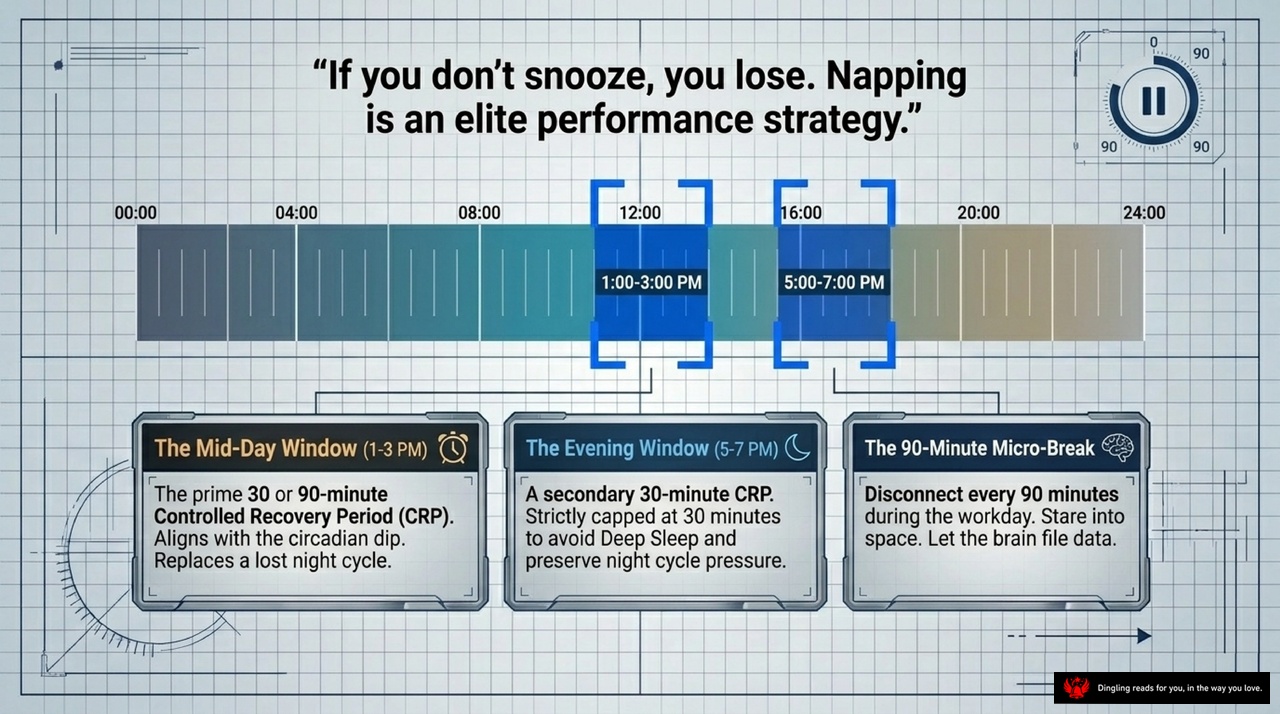
"If you don't snooze, you lose." That's the hard truth we face in a high-performance world. Napping isn't a sign of laziness; it's an elite strategy for maintaining your edge.
Look at this timeline. Your body isn't designed for a single, unbroken 8-hour block. It thrives on cycles. The first window, the Mid-Day Window from 1:00 PM to 3:00 PM, is your prime time. This is when your circadian rhythm naturally dips, creating a perfect opportunity for a Controlled Recovery Period. Whether you take a 30-minute nap or a full 90-minute cycle, you're aligning with your biology to replace lost night energy and boost alertness.
Then, there's the Evening Window from 5:00 PM to 7:00 PM. This is your secondary recovery slot. Keep it strictly capped at 30 minutes. Why? Because sleeping too long here risks dragging you into deep sleep, which makes waking up difficult and steals pressure needed for your night's rest.
Finally, consider the 90-Minute Micro-Break. Disconnect every 90 minutes during the workday. Just stare into space or step away. This allows your brain to file the day's data and reset without the distraction of screens. By mastering these three windows, you stop fighting your biology and start using it to your advantage.
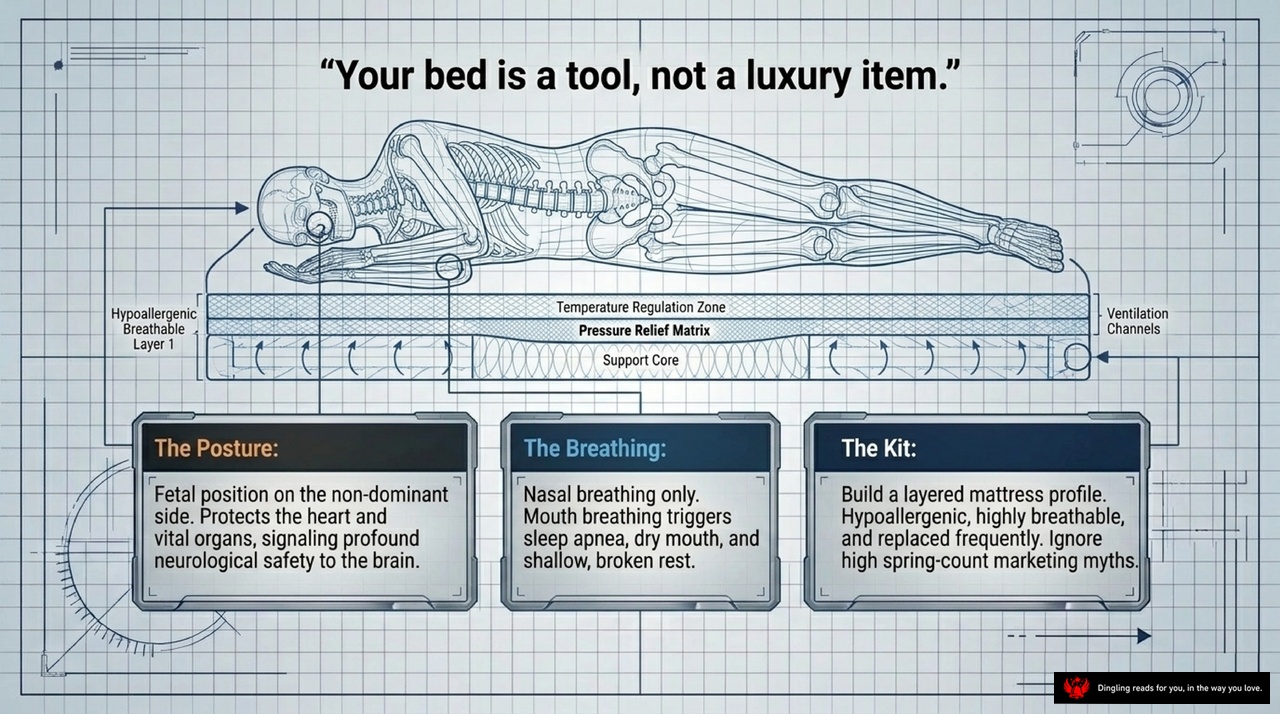
Look at this blueprint of a perfect night. It starts with a simple, powerful truth: "Your bed is a tool, not a luxury item." Think about it. We often spend thousands on fancy frames and silk sheets, chasing status symbols, when the real secret lies in how we use the space.
First, check your posture. The image highlights the fetal position on your non-dominant side. Why? Because it protects your heart and vital organs, sending a signal of profound safety to your brain. This isn't just comfort; it's the biological trigger that lets you slip into deep sleep.
Next, look at the breathing. The diagram insists on nasal breathing only. Mouth breathing is a trap that triggers sleep apnea, dry mouth, and fragmented rest. You need to keep that air flowing through your nose to maintain oxygen levels and calm your nervous system.
Finally, examine the kit. This is where most people fail. We ignore the science of layers. You need a hypoallergenic, highly breathable setup with ventilation channels to regulate temperature, not just a pile of expensive springs. And remember, this tool needs maintenance—replace it frequently. Don't fall for marketing myths about spring counts; focus on what keeps your body cool and safe.
Your bedroom isn't a showroom. It's a repair station. Align your posture, master your breath, and equip your bed correctly. Do this, and you stop fighting sleep and start engineering it.
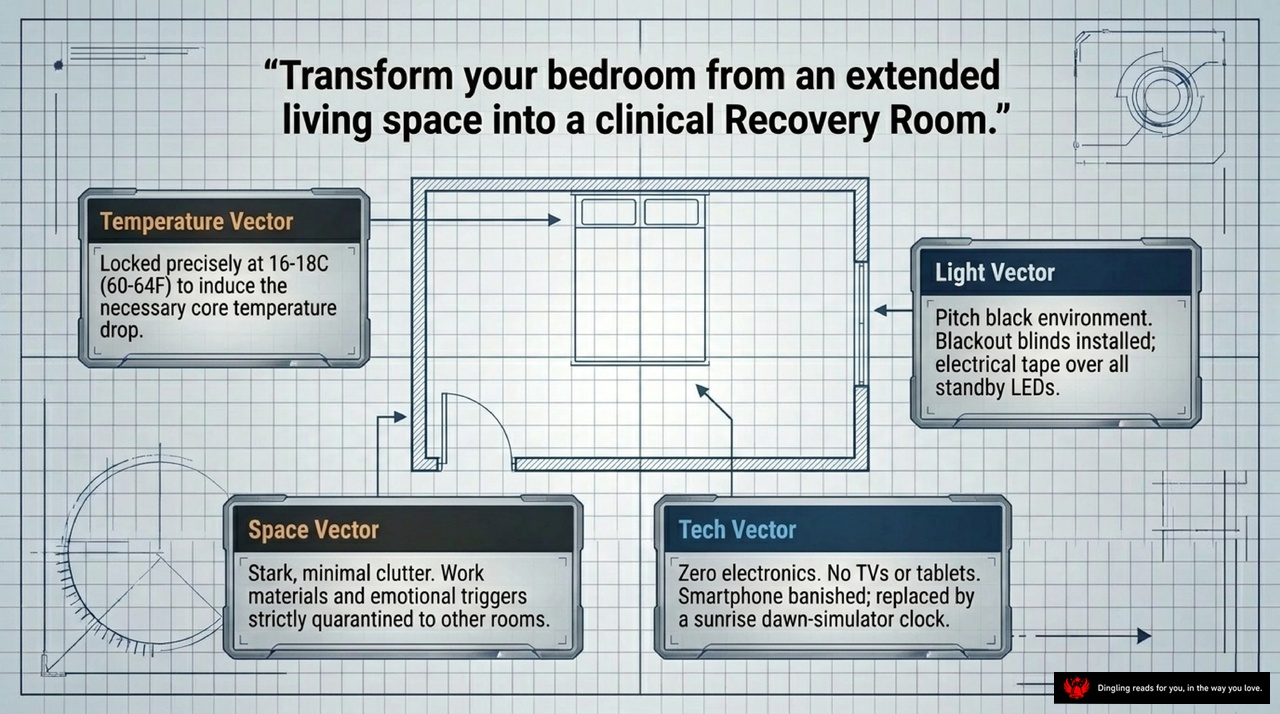
Imagine your bedroom not as an extension of your living room, but as a dedicated clinical recovery room designed for one specific purpose: restoration. To make this transformation, we need to control four critical vectors. First, manage your Temperature Vector by locking the room at a precise 16 to 18 degrees Celsius, or 60 to 64 Fahrenheit. This cool environment is essential to induce the necessary drop in core body temperature that signals your brain it's time to sleep. Next, create a Pitch black environment under your Light Vector. Install blackout blinds and use electrical tape to cover any standby LEDs, because even the faintest light can disrupt your melatonin production.
Then, address the Space Vector by keeping the room stark and minimal. Remove all clutter, work materials, and emotional triggers; strictly quarantine them to other rooms so your brain knows this space is only for rest. Finally, eliminate the Tech Vector entirely. Banish TVs, tablets, and smartphones from the bedroom. Replace your alarm clock with a sunrise dawn-simulator to gently wake you up without the jarring shock of a buzzer. By controlling these four elements, you transform your sleep space from a chaotic multi-use zone into a sanctuary where your body can truly heal and reset.
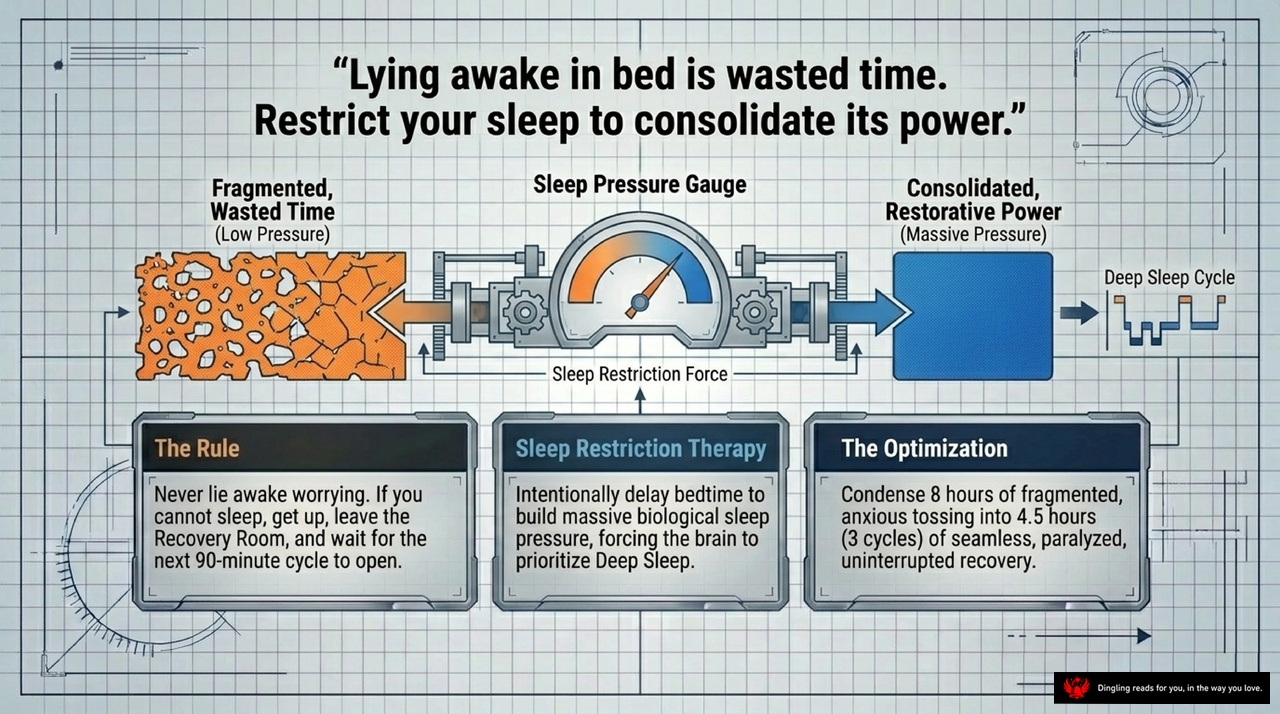
Lying awake in bed is simply wasted time. To truly reclaim your power, you need to restrict your sleep window. This slide breaks down the logic behind Sleep Restriction Therapy.
On the left, we see "Fragmented, Wasted Time." This is what happens when you toss and turn, building low sleep pressure. The "Sleep Pressure Gauge" in the center shows how this force builds up. By intentionally delaying your bedtime, you force your brain to prioritize Deep Sleep.
This leads to the right side: "Consolidated, Restorative Power." Instead of eight hours of anxious tossing, you condense that into just 4.5 hours of seamless, paralyzed recovery—three full cycles.
The rule is simple: Never lie awake worrying. If you can't sleep, get up, leave the room, and wait for the next 90-minute cycle to open. This optimization turns fragmented anxiety into deep, uninterrupted healing.

Imagine your bedroom not as a multi-purpose living room, but as a high-performance cockpit designed for one specific mission: restoration. Just like elite athletes who travel with their own beds to ensure zero environmental interference, you need to curate a space that guarantees zero disruption. The ultimate performance hack is sleeping alone, but even if you share a home, you can engineer your corner for peak recovery.
Start by stripping away the chaos. Remove the TV, the desk, and the clutter that signals "work" or "entertainment" to your brain. Your walls should be a calming, neutral canvas—think crisp white or soft tones—to prevent your mind from getting excited before bedtime. Then, master the light. Darkness is the signal for your body to produce melatonin. If light leaks through your curtains, block it out completely with blackout shades or even tape; avoid eye masks, as they can cause discomfort and disrupt your cycle. When morning comes, the moment you wake up, blast the sun in to switch your brain from melatonin to serotonin.
Temperature is your second critical control. Your body needs to drop to fall asleep, so aim for a cool room between 16 and 18 degrees Celsius. Create a natural dip by turning off the heat an hour before bed. Finally, silence the noise. If you can't escape outside sounds, use white noise to mask them, or better yet, remove the source by keeping your phone out of the room entirely. By transforming your bedroom into a sanctuary where the only function is sleep, you remove the friction that keeps you awake, allowing you to dive straight into those deep, restorative 90-minute cycles.
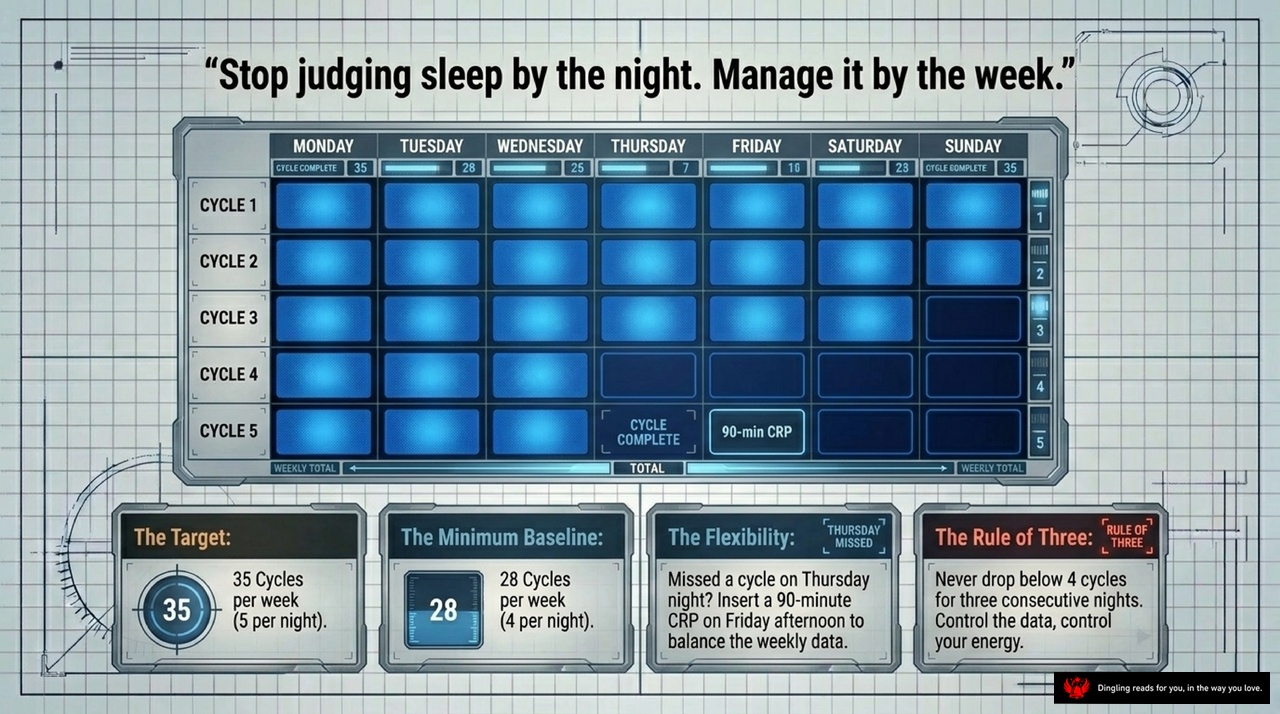
Stop judging your sleep by the night. Instead, manage it by the week.
Look at this dashboard. The core goal is simple: aim for 35 sleep cycles per week, which breaks down to five 90-minute cycles every night. But life happens. You don't need perfection. If you miss a cycle on Thursday, don't panic. Just insert a 90-minute recovery nap on Friday afternoon to balance the weekly data.
There is a safety net called the "Rule of Three." Never let your cycle count drop below four for three consecutive nights. If you do, your energy control slips. As long as you hit that minimum baseline of 28 cycles a week, or ensure you get your ideal five cycles on at least four nights, you are winning. This approach removes the anxiety of a single bad night and gives you the flexibility to adapt to work, travel, or life without losing your rhythm.
Sleep isn't just something you do when the clock hits midnight; it's a continuous, 24/7 physiological recovery system built on 90-minute cycles, rhythmic harmony, and conscious environmental design. Think of your day not as a blur of hours, but as a series of manageable 90-minute blocks where your body naturally shifts between waking and deep restoration. This rhythm is the key to everything, from your focus at work to your recovery after a tough workout.
But here's the hard truth: Are you still wasting your time sleeping, or are you ready to start recovering? Too many of us treat sleep like an afterthought, tossing and turning while our minds race, or forcing ourselves into a bed that doesn't fit our body type. We ignore the simple rules of light, temperature, and timing that our biology has been waiting for us to follow for millions of years. The difference between feeling drained and feeling energized often comes down to one thing: aligning your life with your body's natural 90-minute cycles. It's time to stop fighting your biology and start working with it.