
Snow Country: Complete Chapter-by-Chapter Summary

Welcome to "Snow Country," by Yasunari Kawabata. Imagine this: a long train ride through a tunnel, and suddenly, you step into a world of pure white silence. The night sky is dark, but the earth below is swallowed by endless snow.
As the train slows down at a signal box, a girl opens the window, letting in a blast of biting cold air. She calls for the station master, and a man wrapped in a thick scarf and a slouching hat steps out into the falling snow. His boots crunch softly against the ground.
The girl introduces herself as Kaiko, thanking the man for taking care of her younger brother, who works here. But this isn't just a simple meeting. It's a tale of ephemeral beauty, isolated passion, and the profound futility of human existence. The snow outside is thick and heavy, hiding the world in a quiet, mysterious blanket, setting the stage for a journey that will touch the very soul.
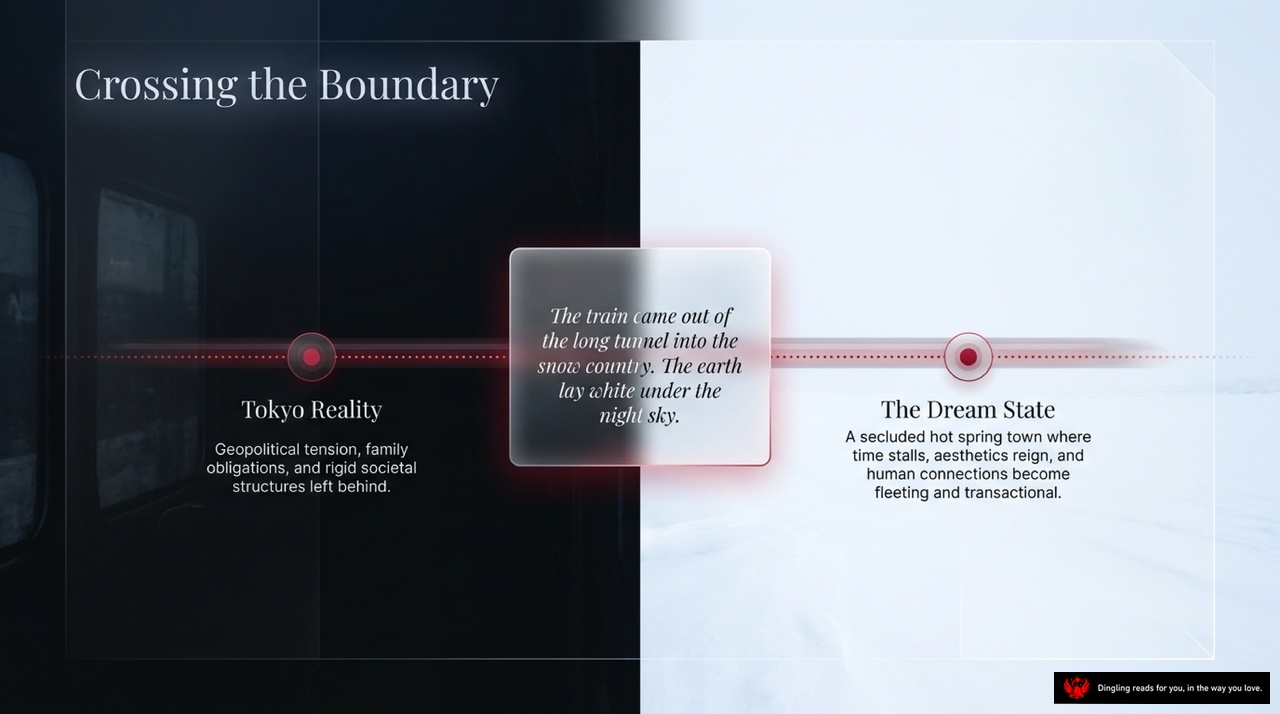
Imagine stepping out of a long, dark tunnel into a world where the night sky is a blanket of pure white. That is the moment our story truly begins, as the train emerges into the snow country, and the earth lies silent beneath the darkness. On one side of this boundary lies the harsh reality of Tokyo—a place defined by rigid societal structures, heavy family obligations, and the constant undercurrent of geopolitical tension. It's a world of noise and expectations, a place the protagonist desperately wants to leave behind.
Crossing that line, we enter "The Dream State." This is a secluded hot spring town where time seems to stall, and aesthetics reign supreme. Here, human connections are fleeting, often feeling transactional, yet strangely beautiful. The protagonist, Shimamura, carries the weight of his Tokyo life into this pristine, almost artificial paradise. He is an outsider, observing a world that feels like a painting, detached from the grit of his former life. But as he settles into this dream, he realizes that even here, amidst the snow and silence, the complexities of human emotion—the desire, the loneliness, and the inevitable pain of loss—remain unchanged. The snow doesn't erase the heart; it just gives it a new, sharper shape.

Imagine a man sitting in an armchair, completely detached from the world outside his window. He is the ultimate "Armchair Theorist"—an expert critic of Western dance who has never actually seen a single performance in person. Shimamura's genius lies in this beautiful, tragic illusion. He gathers books, photographs, and posters, weaving a heavenly poetry that exists only in his mind. To him, witnessing the real, messy, breathing reality of dance would only ruin the pristine perfection of his fantasy.
This approach to art perfectly mirrors his approach to women. He seeks the aesthetic pleasure of romance while remaining entirely insulated from the breathing, tragic reality of love. He loves the *idea* of love, not the person. In this snow-bound world, he observes everything like a ghost: the woman dancing in the background, the lover in the foreground, and himself, safe in the shadows, watching it all unfold without ever truly touching it.
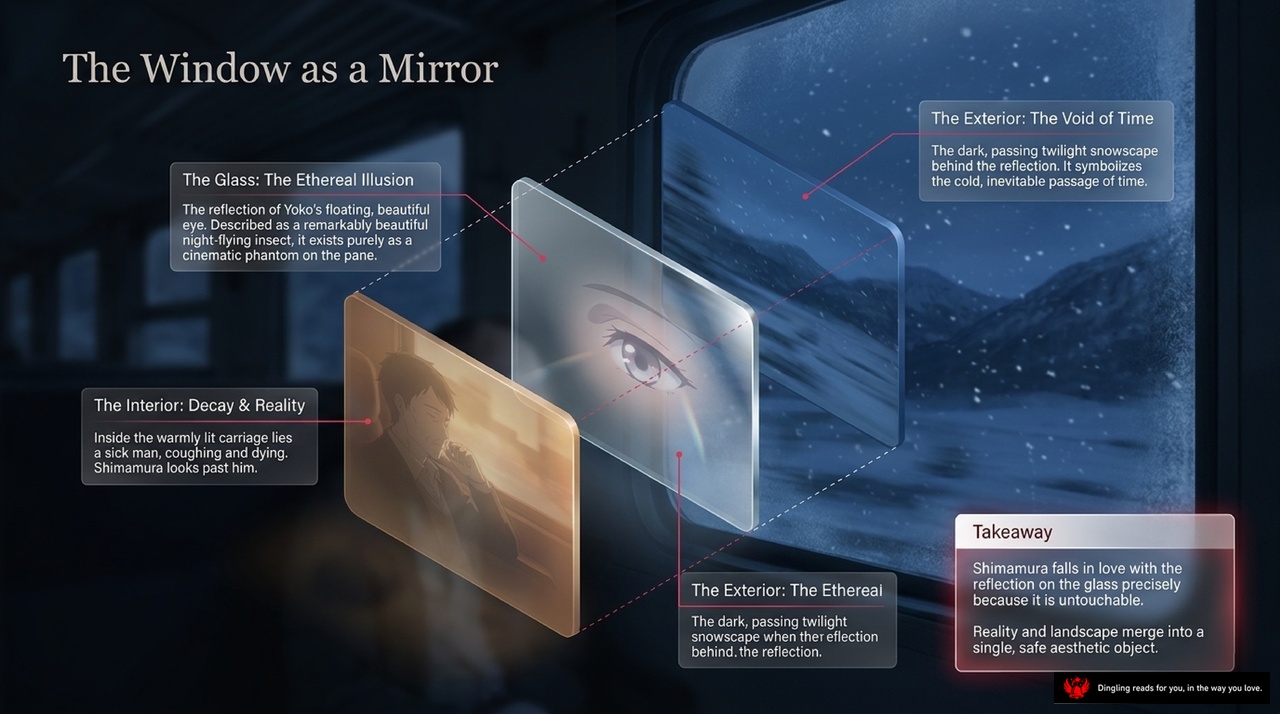
Look at this split image. On the left, we see the harsh reality of decay: Shimamura looking past a dying man in a warmly lit carriage. On the right, the world dissolves into an ethereal illusion. This is the core of the train scene in *Snow Country*.
Shimamura is captivated not by the woman, Yoko, herself, but by her reflection on the window glass. The text describes her eye as a "remarkably beautiful night-flying insect," a cinematic phantom that exists purely on the pane. It's an unattouchable beauty, floating in the passing twilight.
Notice how the book merges reality and landscape. The dark, cold snowscape outside—the "Void of Time"—merges with Yoko's reflection. They become a single, safe aesthetic object. Shimamura falls in love with this illusion precisely because it is unreachable. While reality decays around him, this frozen image remains perfect. It's a moment where the cold, inevitable passage of time is transformed into something beautiful and eternal, trapped between the glass and the soul.

Komako: The Warmth of Wasted Effort. This slide breaks down her story into three powerful realities.
First, look at her **Meticulous Records**. Since she was just 16, she's been documenting everything—every book she reads, the authors, titles, and character relationships—in hand-lined diaries. To the world, this seems like a futile obsession. But for Komako, these notes are her lifeline, a way to anchor herself in a life that feels otherwise drifting away.
Second, consider her **Mastery in Isolation**. Without a master to guide her, she practices complex shamisen pieces purely from sheet music. She projects powerful, echoing sounds into the empty mountain gorges, turning her solitude into a stage where her refined art can finally breathe, even if no one is listening.
Finally, we face **The Tragic Reality**. Despite her dedication, she sells herself as a rural hot-spring geisha to pay the medical bills for a dying man who does not love her. In this remote town, her passion and her skill remain entirely unnoticed, trapped in a cycle of devotion that feels like it has no end. This is the heart of her struggle: creating beauty in a world that offers none in return.

Yoko: The Cold Echo of Purity. In the heart of this snow-bound world, Yoko stands as a haunting figure of tragic perfection. Her voice is described as so beautiful and piercing it echoes tragically through the snowy night, lingering like an unearthly call. This isn't just sound; it's a ghostly presence that clings to the landscape. We see her utterly devoted to nursing the dying Yukio on the train, lacking any of Komako's messy, earthly passions. While Komako burns with raw, desperate love, Yoko remains detached, a serene observer to the chaos of life and death. To Shimamura, she represents an untouchable symbol of tragic perfection—a woman who belongs more to the frozen landscape than to the human world. She is the cold echo of purity, a mirror that reflects the stark, unyielding beauty of the snow country, forever separate from the warmth of living hearts.
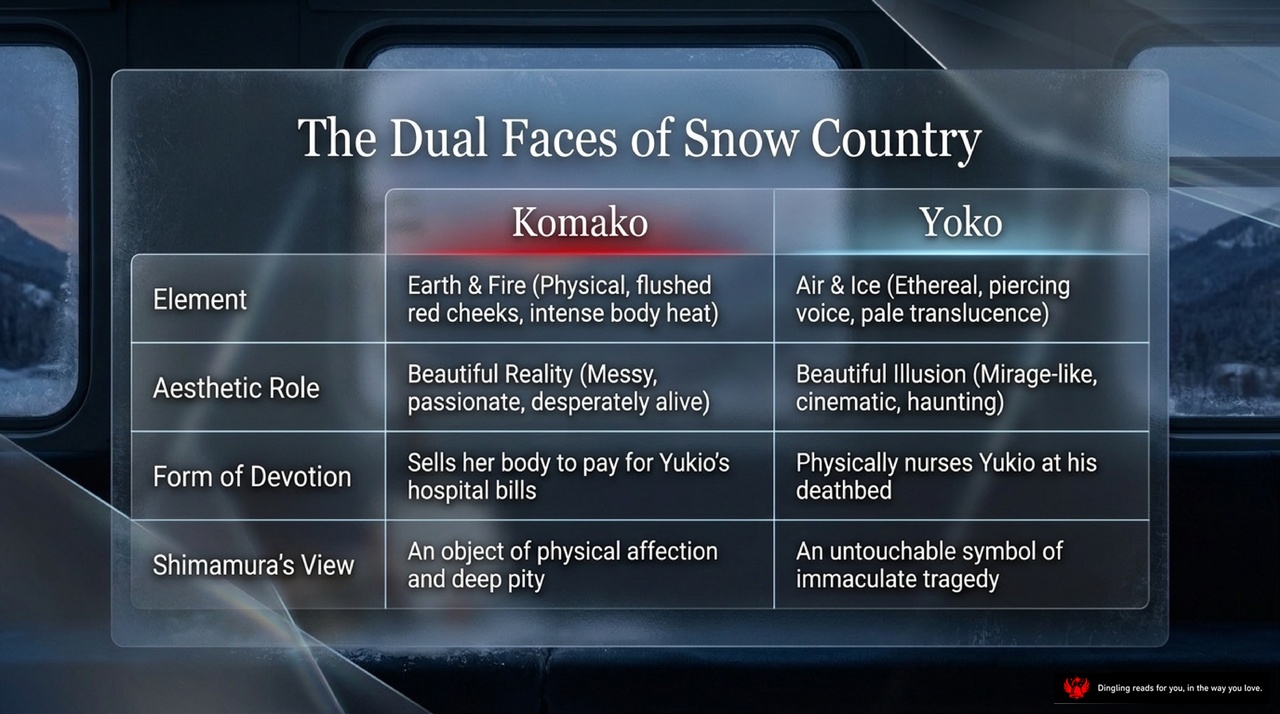
Komako and Yoko represent two opposing forces in Snow Country, and today we're diving deep into their contrasting natures. Look at this slide: it breaks them down by element, aesthetic role, devotion, and Shimamura's perspective.
On the left, we have Komako, associated with Earth and Fire. She is physical, with flushed cheeks and intense body heat. Her aesthetic role is "Beautiful Reality"—she is messy, passionate, and desperately alive. Her form of devotion is stark: she sells her body to pay for Yukio's hospital bills. To Shimamura, she is an object of physical affection and deep pity. She is grounded, tangible, and burning with life.
On the right stands Yoko, linked to Air and Ice. She is ethereal, defined by a piercing voice and pale translucence. She represents a "Beautiful Illusion"—mirage-like, cinematic, and haunting. Her devotion is spiritual; she physically nurses Yukio at his deathbed. To Shimamura, she is an untouchable symbol of immaculate tragedy. She floats above the world, cold and distant.
The text reveals how these differences play out. Komako counts her days obsessively, writes journals, and practices shamisen with a fierce, almost painful determination. She lives in the present, fighting against the snow's silence with her own heat. Yoko, conversely, appears as a ghostly figure. She calls out to her brother from a distance, her voice clear but detached, while Shimamura watches her with a mixture of fascination and unease, seeing her as something almost unreal, like a reflection in a snowy window.
Ultimately, Komako is the fire that warms the cold, while Yoko is the ice that preserves the memory of loss. One is messy and real; the other is perfect and distant. Both are essential to the novel's exploration of life and death in the snow.
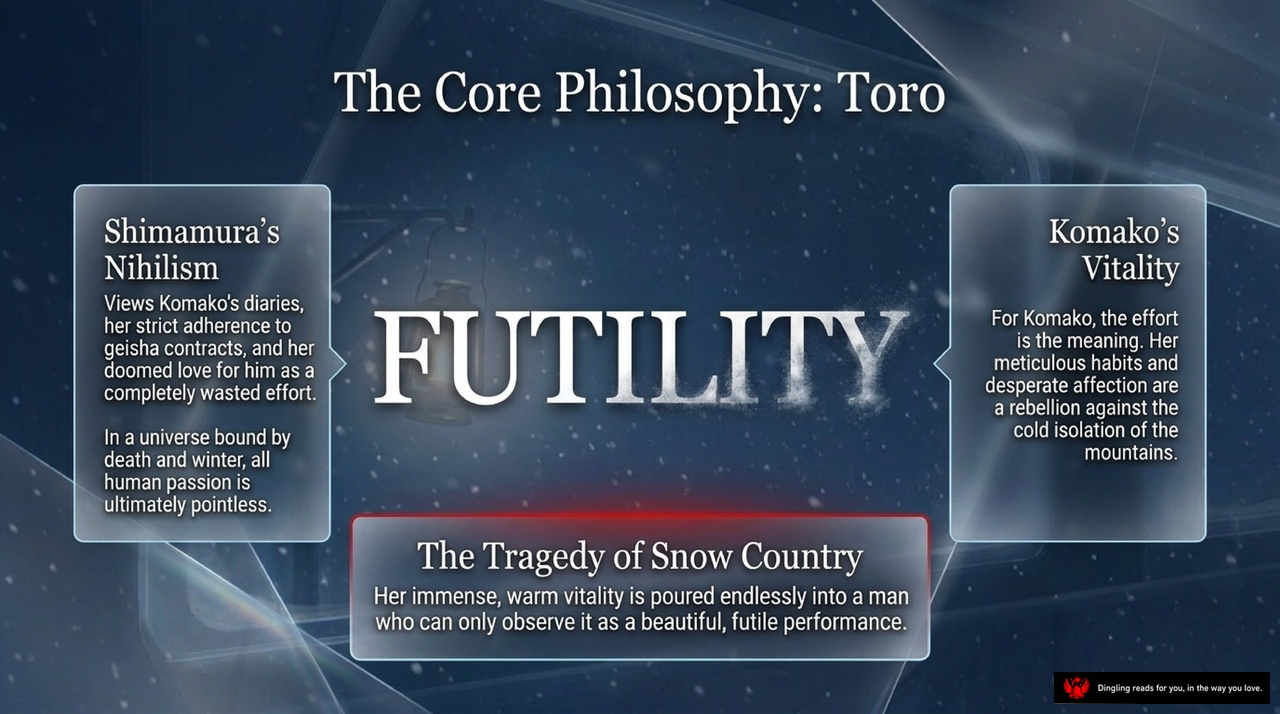
At the heart of *Snow Country* lies a profound philosophical tension, captured perfectly by this slide's central theme: **Futility**. It is the clash between two opposing forces. On one side, we have Shimamura's Nihilism. He views Komako's life—her strict adherence to contracts, her desperate love, and her endless diary entries—as a completely wasted effort. To him, in a universe bound by death and winter, all human passion is ultimately pointless. Yet, on the other side, stands Komako's Vitality. For her, the effort itself is the meaning. Her meticulous habits and desperate affection are not just actions; they are a rebellion against the cold isolation of the mountains.
This creates the tragic core of the story. Komako's immense, warm vitality is poured endlessly into a man like Shimamura, who can only observe it as a beautiful, futile performance. He watches her struggle, her love, and her survival, but he remains detached, unable to truly engage. This disconnect defines their relationship and the entire world of the novel. As the narrative unfolds, we see Komako counting days, practicing the shamisen, and caring for her dying fiancé, all while Shimamura watches from a distance, unable to comprehend that her "futility" is actually her only way of staying alive. The tragedy isn't just that her efforts seem useless to him, but that he is the only one capable of witnessing her, making him an unwilling participant in her beautiful, heartbreaking struggle against the void.
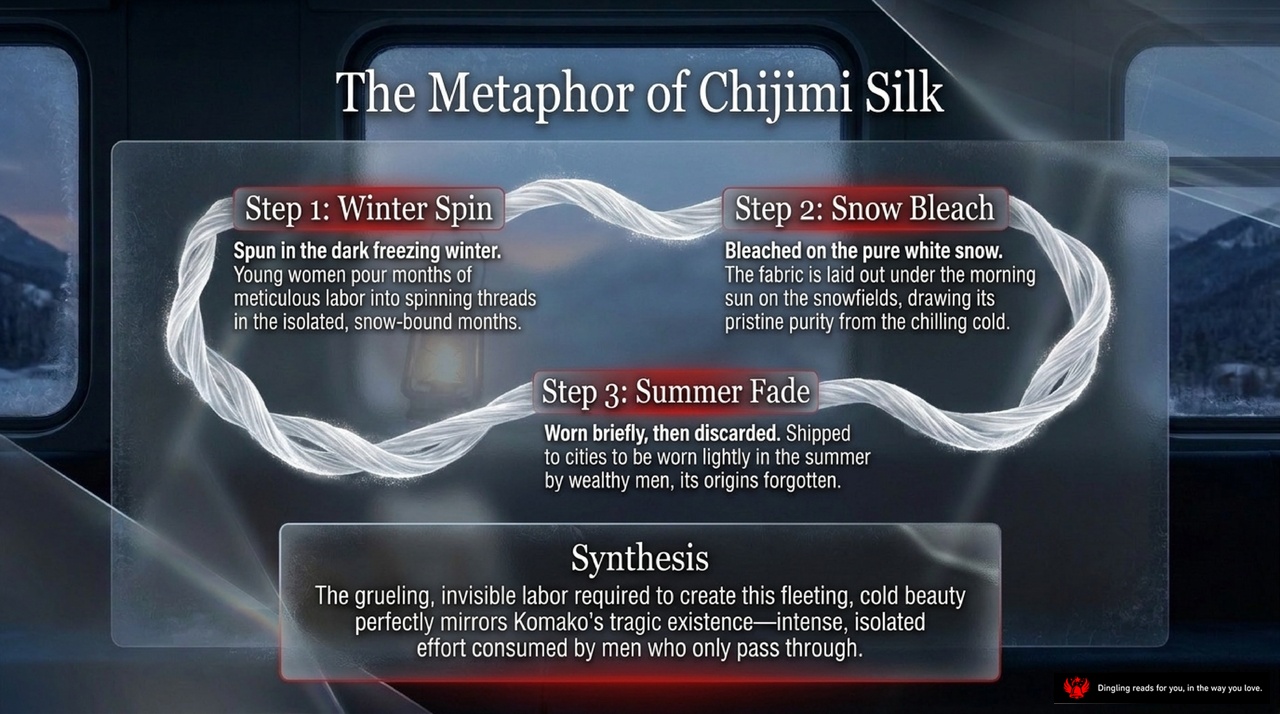
Look at this slide. It tells a story about "Chijimi Silk"—a fabric that seems simple, white, and light, but was born from an impossible amount of invisible labor.
Let's trace its journey. First, the Winter Spin. In the dark, freezing months of January and February, young women spend six months spinning threads by hand. They work in isolation, trapped in the snow-bound cold, pouring their strength into every single thread. Then comes the Snow Bleach. They lay the fabric out on the pure white snowfields under the morning sun. The snow bleaches it to a pristine purity, stealing its color from the chilling cold. Finally, the Summer Fade. The silk is shipped to cities to be worn lightly by wealthy men in the summer. It's worn briefly, then discarded. Its origins are forgotten.
Now, look at the synthesis at the bottom. This isn't just about fabric; it's a metaphor for Komako's tragic existence. Her life is that same cycle of intense, isolated effort consumed by men who only pass through. She puts her whole self into the "Winter Spin," working tirelessly while invisible. She offers her beauty and her love, hoping for the "Snow Bleach" of recognition, but often, like the silk, she is worn briefly and then discarded. The grueling, invisible labor required to create this fleeting, cold beauty perfectly mirrors her life. It shows us that sometimes, the most beautiful things are built on a foundation of suffering that no one ever sees.
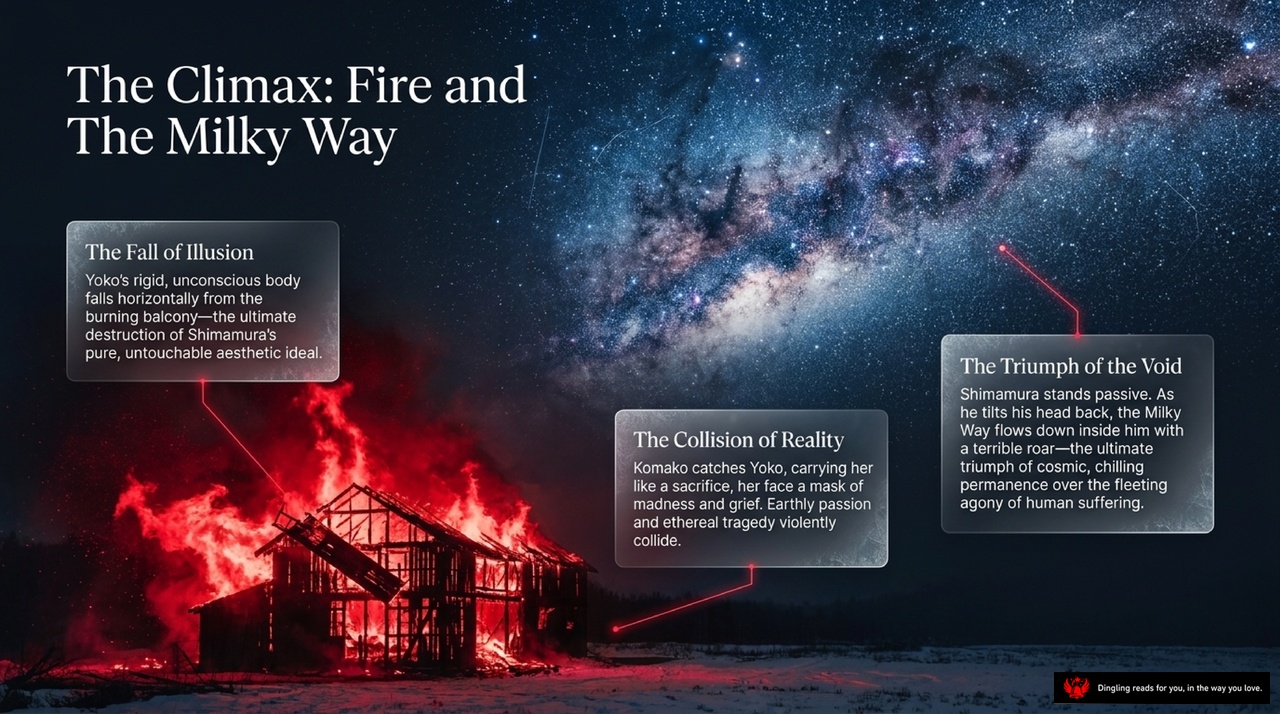
The climax of *Snow Country* isn't just a tragedy; it's a collision of two worlds, one burning with earthly passion and the other soaring into the cold, indifferent vastness of the cosmos. Look at this scene: a burning house against the backdrop of the Milky Way. It represents the ultimate conflict between human suffering and cosmic permanence.
On the left, we see "The Fall of Illusion." Yoko's rigid, unconscious body falls horizontally from the burning balcony. This is the ultimate destruction of Shimamura's pure, untouchable aesthetic ideal. He has been watching her from afar, treating her life as a distant, beautiful performance, but now, reality has crashed into him. She is no longer a phantom in the mirror; she is falling into the fire, a violent end to the illusion he cherished.
In the center, we have "The Collision of Reality." Komako catches Yoko, carrying her like a sacrifice. Her face is a mask of madness and grief. Here, earthly passion and ethereal tragedy violently collide. Komako, who lived in the mud of the snow country, trying to fight her fate with her cello and her love, is now holding the lifeless body of the girl she saw as a rival. It is a moment of brutal, raw truth.
And on the right, we see "The Triumph of the Void." Shimamura stands passive. As he tilts his head back, the Milky Way flows down inside him with a terrible roar. This is the ultimate triumph of cosmic, chilling permanence over the fleeting agony of human suffering. While Komako screams and struggles to save Yoko, Shimamura is absorbed by the galaxy. He realizes that human life, with all its pain and love, is insignificant against the silent, endless flow of the stars. The fire below is temporary; the sky above is eternal.
This is the moment where the story's themes finally merge. The fire represents the destructive force of life, while the Milky Way represents the indifferent force of the universe. Shimamura survives, but he is forever changed by the realization that his observations, his art, and his detached perspective are ultimately powerless against the sheer scale of existence. The snow country, once a place of romantic isolation, has become a place of terrifying clarity.

In the heart of Snow Country, Kawabata weaves a haunting tapestry where the unyielding cold of nature clashes with the fragile, fleeting warmth of human connection. Look at that image—the endless night sky above a sea of snow, punctuated only by a small, dying fire. It perfectly captures the novel's core tension: passion is as beautiful, and as futile, as snow melting on a warm cheek.
The story builds to this tragic climax when the fire erupts in the inn. Amidst the chaos, Yoko, the silent and devoted sister, falls from the burning second floor. In that final moment, she isn't just a victim; she becomes something eternal. The narrative suggests she didn't truly die. Instead, her life simply transformed, drifting away from the physical world and merging with the vast, luminous Milky Way overhead.
Just as the text describes, her body turns into a part of the universe itself—becoming a star, a gust of wind, or simply an eternal presence within the snow country. It's a profound reminder that while our most intense moments may fade, their essence can transcend time, leaving an indelible mark on the world, much like the light of that galaxy pouring down on the silent snow.