
Social Intelligence: Complete Chapter-by-Chapter Summary
Welcome to our exploration of Daniel Goleman's groundbreaking work, *Social Intelligence*. Today, we're diving into the very foundation of how we connect: the hidden neural circuitry that links us all and shapes our lives.
Think about it—when you walk into a room, do you truly feel the emotions of those around you before you even speak? Goleman reveals that this isn't just intuition; it's biology. Our brains are wired for "emotional contagion." Just like a virus, negative emotions like anger or fear can jump from person to person, hijacking our nervous systems and leaving a lingering "emotional hangover" that dictates our entire day.
At the heart of this is the amygdala, our brain's emotional radar. It scans for danger instantly, often bypassing our conscious thought entirely. This is why a simple frown or a shaky voice can trigger a fight-or-flight response in someone else, even if they didn't do anything wrong. We are constantly influenced by these invisible signals, whether we realize it or not.
But here's the empowering part: while our emotional brain reacts automatically, our rational brain has the power to intervene. By understanding these neural pathways, we can learn to regulate our own reactions and, more importantly, influence the emotional climate around us. This is the essence of social intelligence—the ability to navigate these complex emotional currents to build trust, resolve conflict, and create genuine human connection.
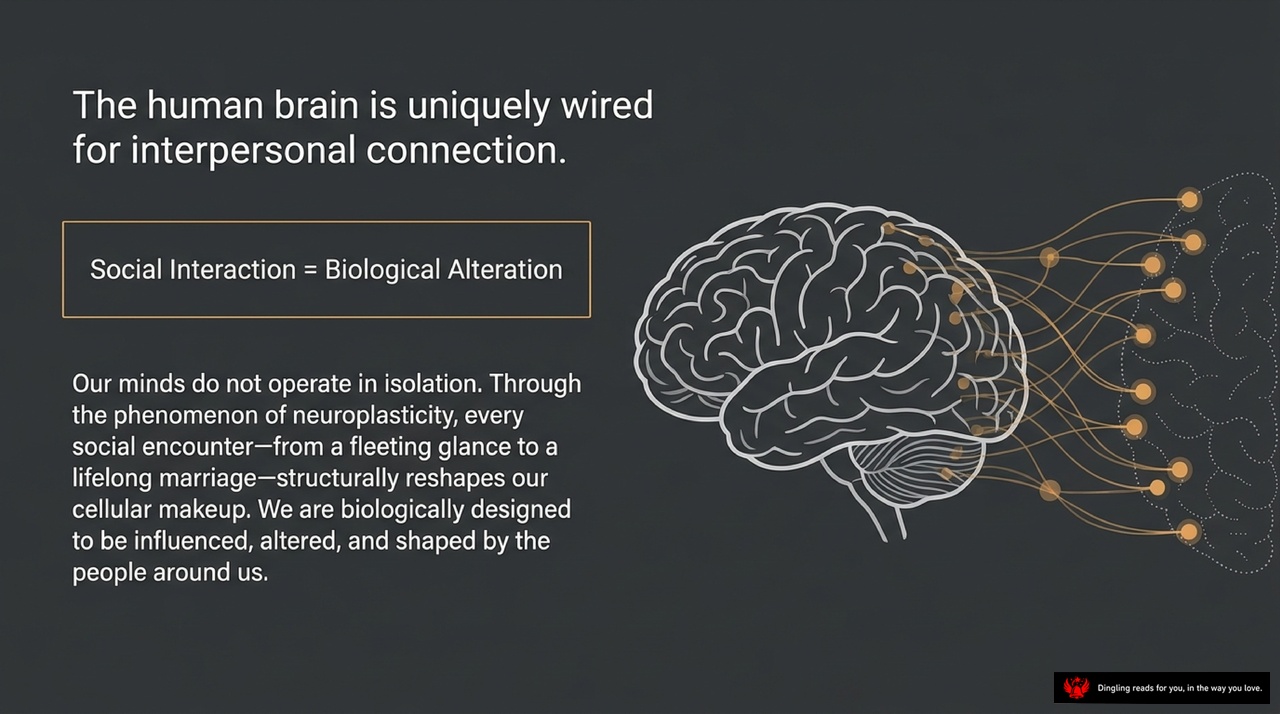
The human brain isn't just a solitary processor; it's a social organ uniquely wired for connection. As this slide illustrates, social interaction isn't just a mental experience—it triggers actual biological alteration. Think of it as a conversation with your own cells.
Our minds refuse to operate in isolation. Through neuroplasticity, every single social encounter, from a fleeting glance to a lifelong marriage, physically reshapes our cellular makeup. We are biologically designed to be influenced, altered, and shaped by the people around us.
Look at that diagram: the brain isn't a fortress; it's an open network. When we interact, our neural pathways literally change. This means that who you spend time with doesn't just affect your mood—it changes your brain's structure. Whether it's a toxic relationship or a supportive community, you are constantly being rewritten by the people in your life.
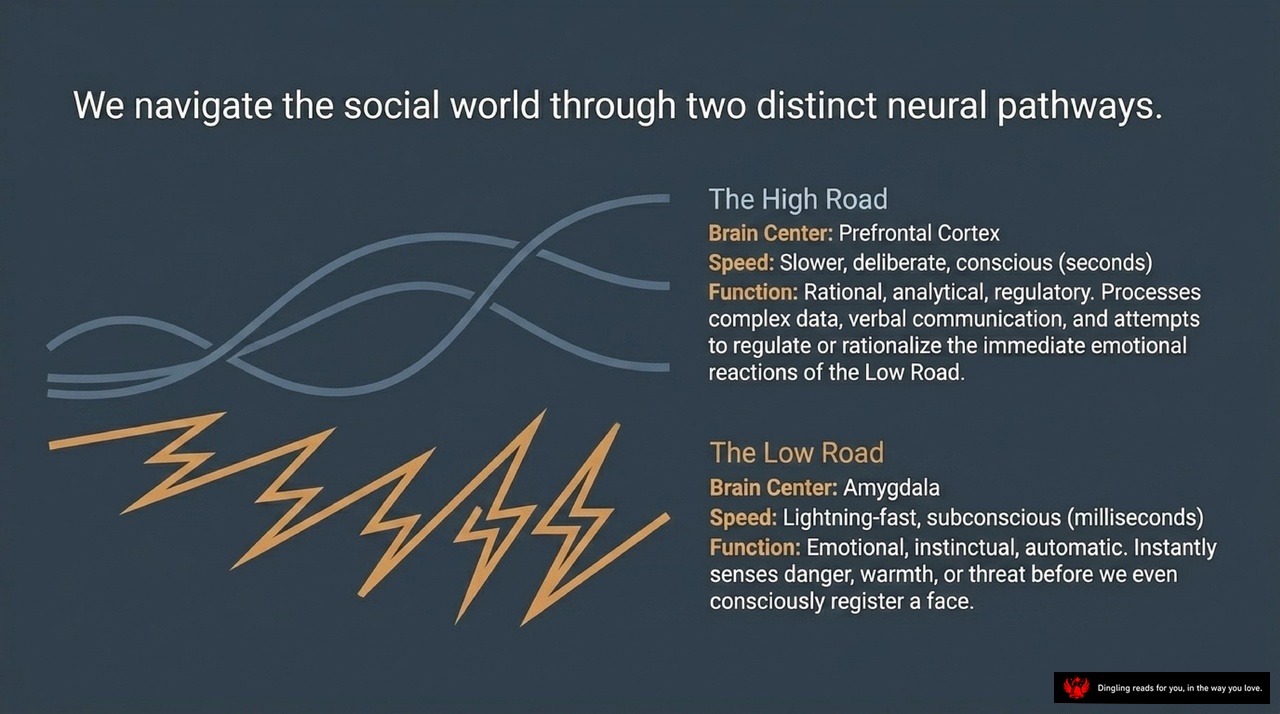
Imagine a world where your brain has two distinct highways for navigating social interactions. The first is the "High Road," a slower, deliberate route powered by the prefrontal cortex. This is the seat of your rational mind, where you analyze complex data, regulate your emotions, and consciously decide how to respond. It takes seconds, but it offers precision and control.
However, there's a much faster alternative: The "Low Road." This pathway bypasses your conscious mind entirely, firing directly from the amygdala to your emotional centers in mere milliseconds. It's lightning-fast, instinctual, and automatic. Before you even consciously register a face or a tone of voice, the Low Road has already scanned for danger, warmth, or threat. It processes non-verbal cues like a radar, triggering immediate emotional reactions.
Think about it: why does a terrifying scene in a movie make your heart race? Why do you feel anxious just by walking past someone who looks angry? It's because the Low Road hijacks your experience before the High Road even gets a chance to think. While the High Road tries to rationalize and regulate these immediate impulses, the Low Road is already driving the car. Understanding this split between our conscious, rational self and our subconscious, emotional instincts is the key to unlocking how we truly connect—and sometimes, how we get manipulated by the invisible currents of human behavior.

Emotions don't just stay where we feel them; they travel from person to person like a biological contagion. As the slide illustrates, our brains are wired to simulate the emotional states of others before we even realize it. This happens through three key mechanisms. First, mirror neurons fire up both when we act and when we watch someone else act, mentally rehearsing their experience. Second, we engage in subconscious mimicry, automatically copying the micro-expressions around us; a smile triggers our biology for joy, while a frown triggers distress. Finally, our unique spindle cells act as hyper-fast broadcasters, instantly processing social cues and spreading our emotional state. We aren't just observers of someone else's mood; our neural circuitry literally runs their emotions inside our own bodies. This explains why a grumpy cashier can ruin your day or why a single person's panic can trigger a whole crowd to flee. It's not about thinking; it's about biology.

True rapport isn't just about being nice; it's a biological convergence of three specific behaviors that must align for genuine connection to happen. As you can see in the diagram, the sweet spot lies where Mutual Attention, Shared Positive Emotion, and Synchrony all overlap.
First, we need Mutual Attention. This isn't just looking at someone; it's about deep, sustained focus. It's the eye contact that signals, "You are the only thing that matters right now," effectively eliminating all distractions. Without this, the other person feels invisible.
Second, we need Shared Positive Emotion. Think of it as a mutual tone of warmth, safety, and friendliness. This isn't always about big smiles; it's communicated primarily through non-verbal micro-expressions and the pitch of your voice. If your tone feels warm and safe, the other person's nervous system relaxes.
Finally, and perhaps most crucially, is Synchrony. This is that subconscious physical dance where two people become one rhythm. Your breathing rates align, your postures mirror each other, and your conversational pacing matches without any interruption. When this happens, you achieve a Genuine Connection—the state where two nervous systems operate in complete harmony.
When these three circles intersect, you create a powerful feedback loop. The other person feels truly heard and understood, which builds trust faster than any words ever could. It's the difference between a transaction and a transformation.
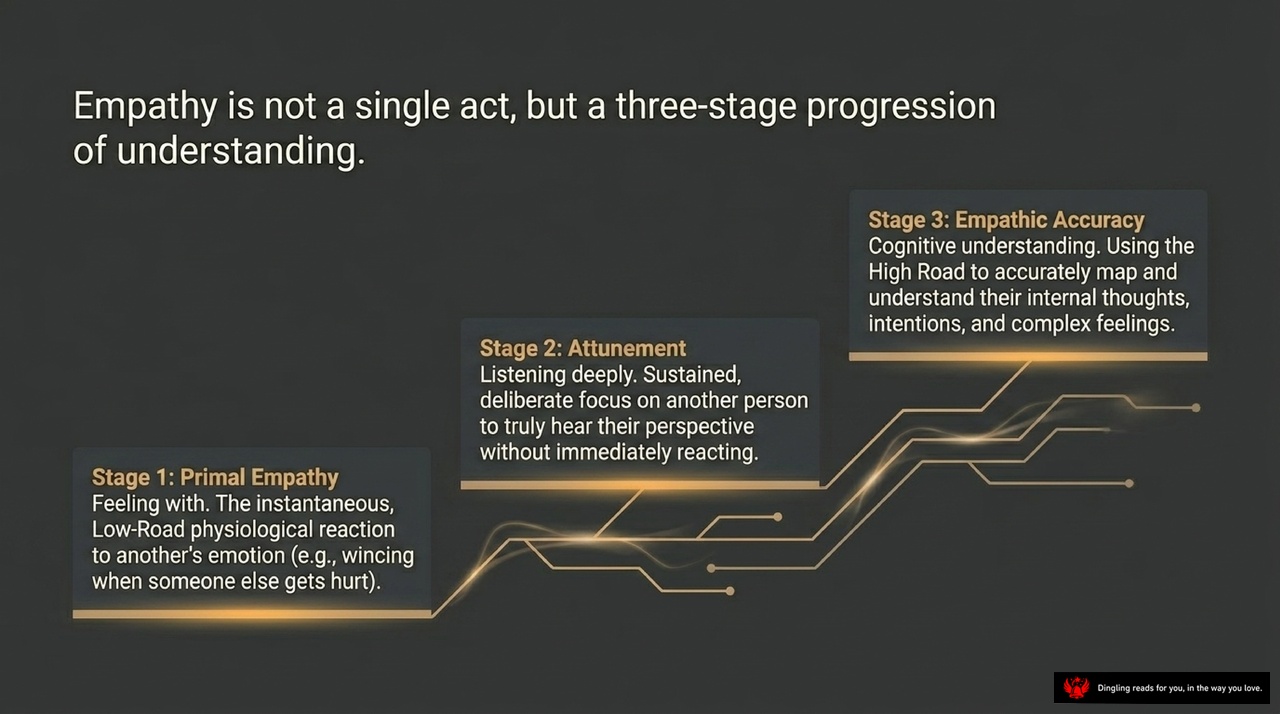
Empathy isn't just a feeling; it's a journey. Think of it as a three-stage progression that moves us from simple reaction to deep understanding.
It all starts with Stage 1: Primal Empathy. This is that instant, automatic "feeling with" someone. It's a low-road physiological reaction, like wincing when you see someone else get hurt. Your brain's alarm system kicks in before you even think about it.
But true connection requires moving to Stage 2: Attunement. This is where you shift gears. It means listening deeply and deliberately. You focus on the other person to truly hear their perspective, resisting the urge to immediately react or fix things. It's about giving them your full attention without distraction.
Finally, we reach Stage 3: Empathic Accuracy. This is the cognitive work. Using that focused attention, you accurately map out their internal world—their thoughts, intentions, and complex feelings. You don't just guess; you understand. By mastering this three-step process, you transform a fleeting emotional spark into a profound, lasting human connection.

Every interaction you have falls into one of two fundamental relationship modes: I-It or I-Thou. On the left, we have the I-It mindset, which is transactional, objectifying, and purely task-oriented. In this mode, you treat the other person as a tool, an obstacle, or just a background object—like texting while speaking to a cashier. Here, empathy is entirely shut off. On the right, we see the I-Thou mindset, which is transformational, deeply attuned, and resonant. This is about a profound psychological embrace where you acknowledge the complete humanity and internal reality of the other person. It creates a mutual feedback loop of presence. While we often slip into I-It mode for efficiency, true connection and lasting impact come from shifting into I-Thou. When you genuinely see the other person as a subject rather than an object, you unlock the very same neural mechanisms that drive empathy, trust, and even physical healing. The difference between these two modes isn't just philosophical; it's biological, and it dictates whether your interactions leave a void or build a bridge.

The brain is a master of balance, naturally managing two distinct cognitive styles: Systemizing and Empathizing. On the left, we have Systemizing—the drive to analyze, explore, and construct systems. It focuses intensely on mechanics, underlying rules, mathematics, and predictable patterns. It's the part of us that loves logic and structure. On the right, we have Empathizing—the drive to identify another person's emotions and thoughts. This style focuses on social nuances, emotional reading, and intuitive human connection.
Here's the critical insight: neither style is superior on its own. Extreme systemizing without empathy leads to social blindness, while extreme empathy without systematic boundaries can lead to emotional overwhelm. Think about it—without the analytical framework of systemizing, pure emotion can become chaotic and overwhelming. Conversely, without the warmth of empathy, rigid logic creates cold, unrelatable interactions. The highest social intelligence integrates both the analytical and the emotional. It's about finding that sweet spot where logic meets feeling, allowing us to navigate the complex human world with both precision and compassion.

Romantic love isn't just a feeling; it's a biological symphony conducted by three distinct, interlocking neurochemical systems. As our slide illustrates, true stability requires all three to fire in harmony.
First, we have the craving system, driven by sex, dopamine, and AVP. This is the raw, obsessive engine of early romance—the intense, addictive high that keeps us fixated on our partner. Then, there is the nurturing system, fueled by caregiving. This is the biological urge to protect, comfort, and care for a partner's well-being. Finally, we have the bonding system, driven by attachment and oxytocin. This creates that deep sense of security and calm, lowering stress and cementing long-term commitment.
Think of it this way: if you only have the craving system, you're just chasing a fleeting high. If you lack the bonding system, you won't feel safe enough to stay. It's the delicate balance between the thrill of desire, the warmth of care, and the comfort of a secure base that creates a lasting, healthy connection.

Childhood experiences literally wire our brains to create our default adult attachment styles. As we saw on the screen, these styles fall into three distinct categories: Secure, Anxious, and Avoidant.
Let's look at the Secure style first. These individuals are comfortable with intimacy, resilient, and supportive. Their dynamic is fascinating—they can offer closeness without panic and give space without fear. They function as a reliable secure base for their partners.
On the other hand, we have the Anxious attachment style. These individuals crave extreme closeness and fear abandonment. They are easily overwhelmed and hyper-vigilant to tiny shifts in their partner's mood. Their nervous system is like a radar that never turns off, constantly requiring reassurance to calm a highly active amygdala.
Then there is the Avoidant style. These individuals suppress their emotional needs and value extreme independence. They distance themselves from others. When relationships get too close, their brain actually deactivates emotional circuitry. They treat vulnerability as a threat, effectively shutting down their ability to connect.
Understanding these three styles helps us realize that our adult relationships are often just a replay of our childhood experiences. Whether we are comfortable giving space or constantly fearing abandonment, our early wiring is guiding us. The good news is that by understanding these patterns, we can begin to reshape them and build healthier, more secure connections.

The Empathy Deficit: When the social brain is disconnected from compassion.
Let's talk about the dark side of human connection. Today's slide breaks down three distinct types of people who suffer from a severe empathy deficit, effectively losing their connection to the social brain.
First, we have Narcissists. Their primary driver is an absolute hunger for glory and admiration. Because their ego is so fragile, they are completely blind to constructive feedback. They don't see other people as individuals; they only view them as mirrors to reflect their own greatness.
Next, we have Machiavellians. Their driver is cold utility and strategic advantage. They are emotionally detached and highly manipulative. To them, other human beings aren't friends or family; they are strictly pawns on a chessboard to be used and discarded whenever necessary.
Finally, we have Psychopaths. This is the most extreme form. Their driver is the total absence of social or moral constraints. They possess a complete biological inability to feel remorse, shame, or fear. They are cold, calculating, and dangerously indifferent to human suffering.
These three groups—Narcissists, Machiavellians, and Psychopaths—represent a breakdown in our natural ability to empathize, turning human interaction into a transaction or a game rather than a shared experience.

Epigenetics: Genes are not your destiny; social environments are the switches.
Look at this DNA strand. Notice those little switches? Some are glowing "ON," while others are dimly "OFF." This visual perfectly captures a revolutionary idea: the old nature versus nurture debate is biologically obsolete. We are all born with specific genetic predispositions, but our social environment acts as the operating system that physically toggles those genes on or off.
Think of it this way: a nurturing, secure base can literally turn off the genes responsible for severe anxiety and activate those that promote biological resilience. Your social life doesn't just influence you; it rewrites your biological expression. Whether it's the comfort of a supportive partner, the stress of a toxic workplace, or the connection with a friend, these interactions send signals that reshape your brain's structure and gene activity. It's not about what you are born with, but about the relationships you build that decide how those genes perform. In short, your environment holds the power to switch your destiny on or off.

Toxic leadership doesn't just hurt morale; it literally degrades our biological health and cognitive performance. Look at this curve: it shows the exact relationship between stress and our brain's ability to think. On the far left, we have "Boredom." When stress is too low, employees are disengaged and performance plummets. But as we move right into "Moderate Arousal," something magical happens. This is the "Peak Performance" zone. Here, employees feel challenged yet supported by an empathetic leader acting as a secure base. That balance is where brilliance lives.
However, toxic managers push employees past this peak into "The Toxic Drop-off." This is where high stress causes performance to crash. The "Biology of Bad Bosses" box on the right explains the cost: toxic managers force us into chronic anxiety zones, spiking our cortisol and raising blood pressure. This biological stress shuts down the brain's high-road creative centers. In short, a bad boss doesn't just make you unhappy; they biologically disable your ability to think, create, and solve problems.
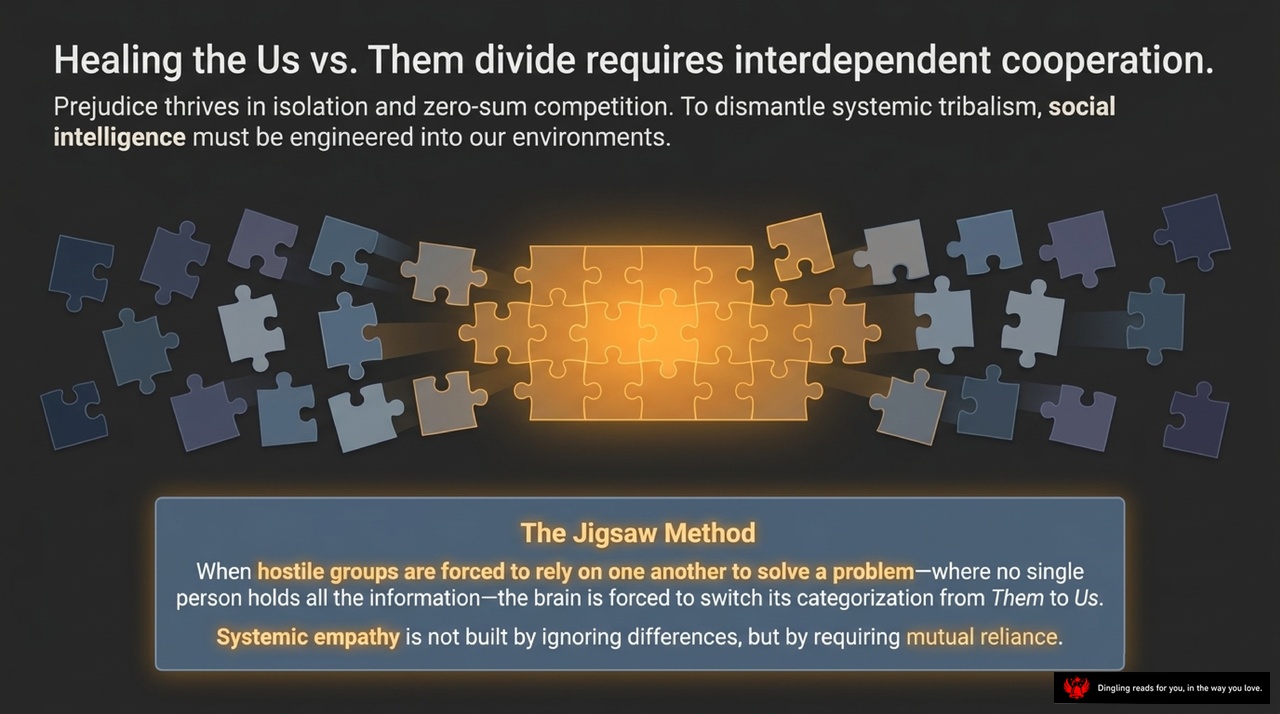
Healing the "Us vs. Them" divide isn't about ignoring differences; it's about forcing interdependent cooperation. As the slide illustrates with those scattered puzzle pieces coming together, prejudice thrives in isolation and zero-sum competition, but dismantling systemic tribalism requires engineering social intelligence directly into our environments.
The key lies in "The Jigsaw Method." When hostile groups are forced to rely on one another to solve a problem—where no single person holds all the information—the brain is forced to switch its categorization from "Them" to "Us." Think of it like a puzzle where you literally cannot see the full picture unless you pass your piece to your neighbor. This mutual reliance is the only way to build systemic empathy. It proves that true connection isn't built by ignoring differences, but by requiring that we all depend on each other to succeed.
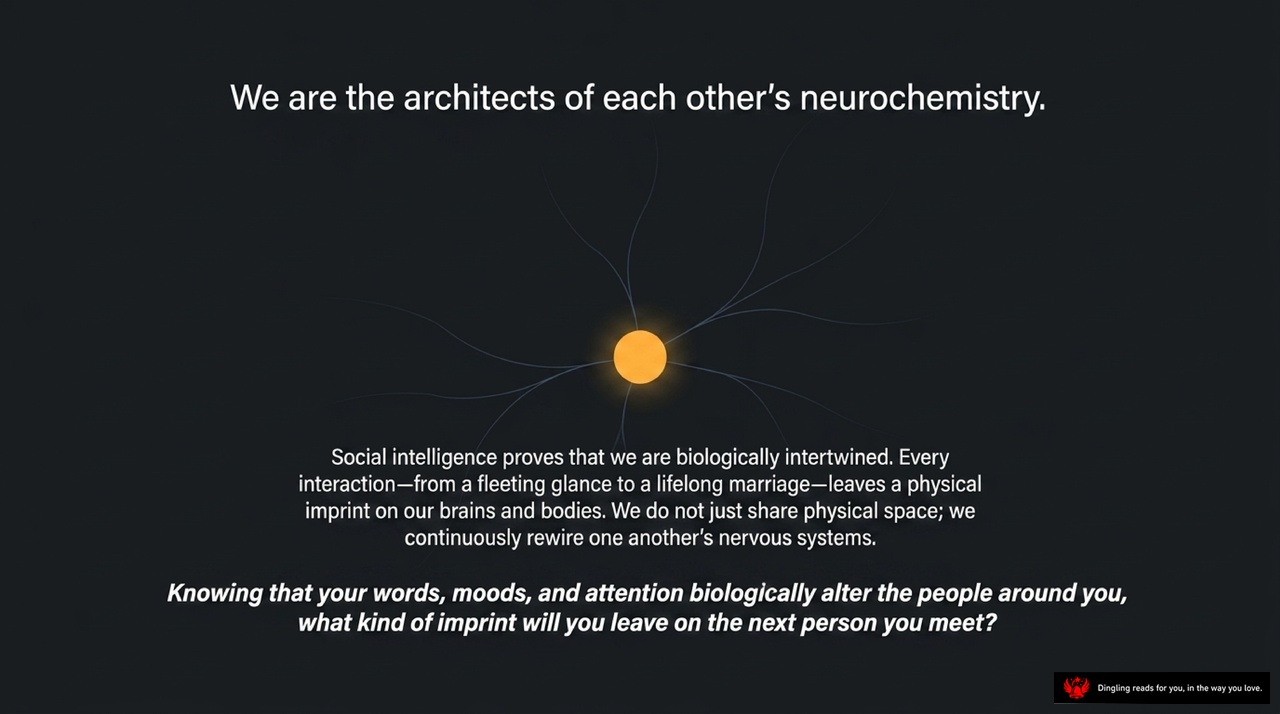
We are the architects of each other's neurochemistry. This single sentence captures the profound truth of human connection: we don't just share space; we share biology. Every interaction, from a fleeting glance to a lifelong marriage, leaves a physical imprint on our brains and bodies.
Think about your last conversation. Did you notice how your mood shifted just by being near someone else? That's social intelligence in action. We are biologically intertwined. When you feel joy, calm, or even anger, your nervous system continuously rewires the person standing next to you. Your words, your moods, and your attention don't just convey information; they biologically alter the people around you.
The question is, knowing this, what kind of imprint will you leave on the next person you meet? Whether it's a brief exchange or a deep relationship, you are constantly shaping their internal world. So, be mindful of the energy you bring into every room. Because in the end, we are all building each other's minds, one interaction at a time.