
Solaris: Complete Chapter-by-Chapter Summary

Welcome to *Solaris*, by the legendary Polish author Stanisław Lem. This isn't just a story about space travel; it's a chilling chronicle of what happens when humanity collides with something truly alien. Forget the monsters you expect to find in sci-fi. Here, the real horror isn't an external threat—it's a mirror reflecting our own deepest, most painful memories back at us.
Imagine a planet orbiting two suns, a world covered almost entirely by a vast, mysterious ocean. Scientists thought it was lifeless, a dead rock. But when a crew arrives, they discover the ocean is alive in a way they can't comprehend. It doesn't speak, it doesn't think like us. Instead, it reads our minds, pulling out our repressed secrets and turning them into physical, living beings.
This book challenges everything we know about perception and reality. It asks a terrifying question: What if the universe isn't trying to communicate with us, but is simply using us as a canvas to understand itself? Join me as we dive into the depths of this masterpiece, where the ocean is both the greatest mystery and the most dangerous mirror in the cosmos.

Welcome to the Solaris Station, the most dangerous place in the solar system. This isn't just a research outpost; it's a mirror reflecting the darkest corners of the human soul.
Look at this telemetry data. We are descending 180 kilometers onto a planet that defies all logic. The mission brief calls it an "unstable orbit," but the real anomaly is the ocean itself—a living, breathing entity that stabilizes the planet with a gravity-manipulating plasma. There is no oxygen, no conventional life, just a vast, purple, churning sea that watches us.
As Kelvin descends, the station appears like a silver whale floating above the surface. But this ocean isn't water. It's a "brain-sea," a planetary-scale consciousness that reads our memories like a library. It doesn't speak; it projects. When someone here is haunted by a repressed memory, the Ocean materializes it. It builds a physical copy of that person, a "guest" made of matter and memory, to force them to confront what they've forgotten.
This is the terrifying truth of Solaris: the ocean isn't an enemy. It's a cruel, childlike therapist, turning our deepest guilt and regret into flesh and blood, trapping us in a loop where we can never escape our own past.

The screen reads "Station Status: Critical Decay," and the crew is scattered in chaos. Gibarian is dead, Sartorius is barricaded, and Snow is hiding in fear. You're the new arrival, Kelvin, thrust into a broken hierarchy without any briefing or protocol. But this isn't just a breakdown of order; it's the first clue to the station's true nature.
Look closely at the data on your screen. Snow is described as "erratic, cynical, and terrified." This isn't random madness. In the station's history, when the Ocean of Sorlaris is exposed to strong X-rays, it doesn't just react physically—it reads our brains. It pulls out our repressed memories and projects them into reality.
Gibarian's suicide wasn't just an accident; it was the first time the Ocean found his suppressed guilt and made it flesh. That's why you see that black woman clinging to his corpse in the cold storage. She's not a hallucination; she's a memory given form.
Now, consider your own situation. You arrived expecting a scientific mission, but you've already been invaded by the Ocean's logic. The station isn't failing because of mechanical decay; it's failing because it's trying to process human trauma it doesn't understand. The "guests" appearing in the corridors, the impossible figures, they are all mirrors of our own subconscious.
The Ocean doesn't hate us. It's just a child playing with our memories, unaware that what it creates can destroy us. You are the new variable in this equation, Kelvin. The question isn't whether the station can survive the decay, but whether you can survive the realization that the monster you're facing is a reflection of yourself. The critical decay isn't in the hull; it's in the mind. And now, the game has truly begun.

The Architect of Madness isn't just a title; it's the terrifying reality of what we're facing on Solaris. Look at this data: the ocean isn't water. It's a planet-spanning plasma mass weighing 17 trillion tons. It manipulates spacetime, stabilizes orbits, and repairs itself effortlessly. But here's the chilling part: it completely ignores us. It reacts with total indifference to our presence, our signals, our desperation.
We thought we were studying a new life form, a "brain-sea" capable of evolution. But the truth is far more disturbing. When we try to communicate, we aren't talking to an intelligent being. We are talking to a mirror. The ocean reads our memories, our deepest regrets, our suppressed traumas, and it materializes them. It creates physical manifestations of our own minds—our "guests." It doesn't understand the emotional weight of these memories; it just treats them like raw data, like building blocks for a strange, alien architecture.
We are trapped in a loop. We send signals, and the ocean gives us back fragments of ourselves, distorted and amplified. We build machines to destroy it, and it builds symmetrical bodies to mock our logic. We are not the architects of this madness; we are the fuel. The ocean is the architect, and it is using our own minds to construct a nightmare that we are forced to live inside. There is no dialogue, only a brutal reflection of our own souls, playing out on a stage of 17 trillion tons of liquid chaos.

The taxonomy of the incomprehensible. On the left, the Mimoids: spontaneous, plastic imitations of external objects that mimic form without understanding function. In the center, the Symmetriads: fleeting, crystalline cathedrals of plasma that defy human mathematics and physical laws, existing only for moments before collapsing. And on the right, the Asymmetriads: chaotic, boiling geysers of raw matter that reject all structural logic, operating in a state of perpetual, violent mutation.
This slide captures the terrifying reality of Solaris. For decades, scientists tried to impose order on this ocean, believing they could categorize its behavior like any other natural phenomenon. They thought they understood the "symmetry" of its forms. But as we learned, the ocean doesn't just mimic us; it reads us. It takes our deepest, most repressed memories—our guilt, our regret, our hidden desires—and materializes them into these impossible shapes. The Symmetriads aren't just random explosions; they are the physical manifestation of a human mind's hidden architecture. The Mimoids are not just reflections; they are the distorted echoes of our own history.
The tragedy of Solaris isn't that the ocean is hostile. It's that it is perfectly, tragically accurate. It creates these "guests" and these structures because it is trying to understand us, using the only language it knows: memory. But in doing so, it exposes the cracks in our own humanity. We built these stations, sent these probes, and thought we were conquering the unknown. Instead, the ocean conquered us, forcing us to look at the parts of ourselves we spent a lifetime trying to hide. It turns out that the most incomprehensible thing about Solaris isn't the ocean itself. It's us.
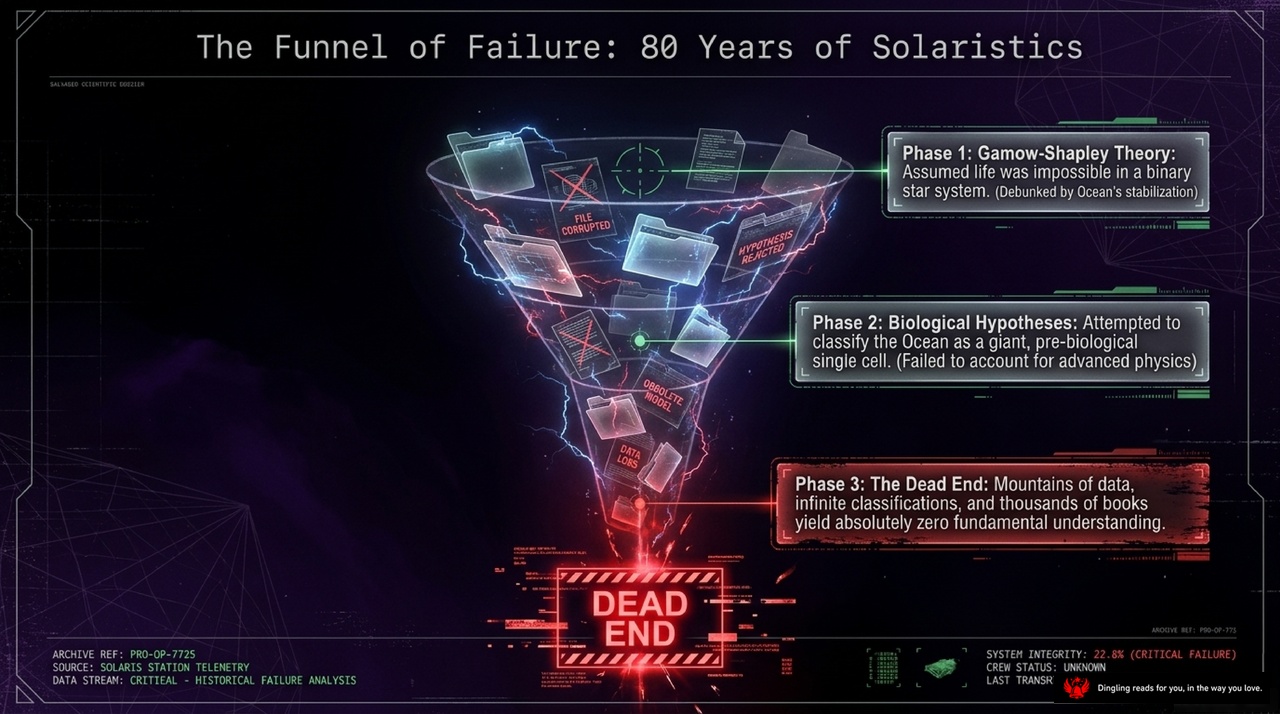
Look at this infographic: "The Funnel of Failure." It perfectly captures the tragic history of Solaristics over the last 80 years.
We started with Phase 1: the Gamow-Shapley Theory. Back then, scientists were convinced life was impossible here because they thought a binary star system was too unstable. But we were wrong. Ocean stabilization proved them wrong.
Then came Phase 2: Biological Hypotheses. Desperate for answers, researchers tried to classify the entire ocean as a giant, pre-biological single cell. It failed because it couldn't account for advanced physics.
Finally, we hit Phase 3: The Dead End. Today, we have mountains of data, infinite classifications, and thousands of books. Yet, we yield absolutely zero fundamental understanding.
It's a critical failure. Our system integrity is at 22.8%. We've been chasing a ghost, projecting our own memories onto a liquid reality, only to end up in a dead end. We aren't studying an alien world; we are studying our own inability to understand it.

Step 1: The Scan. Step 2: The Extraction. Step 3: The Construction. Step 4: The Torment. These aren't just labels on a screen; they are the terrifying lifecycle of a nightmare made flesh.
First, the Ocean probes the human brain with localized radiation during deep sleep. It doesn't just listen; it dives right into our subconscious, hunting for the things we've buried the deepest.
Next comes the extraction. It identifies and extracts the most deeply repressed, traumatic, or guilty memories. It takes the parts of ourselves we've tried to forget and pulls them out like a surgeon removing a tumor.
Then, the construction begins. The Ocean materializes these memories into physical form using sub-atomic neutrino structures. It takes an abstract feeling of guilt or a lost love and turns it into a solid, breathing entity.
Finally, the torment. The resulting "Visitor" is bound to the human host, unable to be destroyed by normal means, restarting the cycle. You can kill it, but it just reforms from the same memory. It's a perfect, inescapable loop designed to force us to face the ghosts we created ourselves.

The Psychological Matrix isn't just a diagram; it's the autopsy of four brilliant men who couldn't survive the weight of their own memories. Look at Gibarian: he's trapped in despair, unable to reconcile his scientific worldview with the materialized guilt staring him in the face. The result? Suicide. Now look at Sartorius, retreating into rigid denial, trying to destroy the phenomena rather than understand them. He chooses orthodoxy over truth. Then there's Snow, embracing cynicism, abandoning the mission entirely for a psychological breakdown into dark philosophy. And finally, Kelvin, succumbing to obsession, emotionally surrendering to the illusion presented to him. These aren't just characters; they are the four archetypes of human failure when faced with a reality we can't comprehend. They represent the four ways we break: by giving up, by hiding, by turning away, or by getting lost in the very thing we're trying to study. The matrix shows us that on Solaris, the only thing more dangerous than the ocean itself is the human mind trying to contain it.

Harey, or Rheya, the Phantom Lover. Look at this profile. She's a construct, a being of human blood and warmth, yet her very atoms are bound by the neutrino field of the Ocean. She is a paradox born from Kelvin's guilt over her past suicide—a copy built to fill a void. The tragedy is that as she slowly gains self-awareness, she realizes she is merely an instrument of torture, unable to exist independently of the man who created her. This isn't just a ghost story; it's a reflection of how our deepest regrets and suppressed memories can manifest as tangible, haunting presences that we can never truly destroy or escape.

Look at this image. We see a giant, high-tech lens, but instead of glass, it holds a human eye. This is the core of what we call "The Anthropocentric Trap." The text here says we don't actually want to conquer the cosmos; we just want to extend the boundaries of Earth. We are seeking "Man."
This is the fatal flaw in our space exploration. When we face an intelligence that refuses to reflect our values, we simply reject it. We cannot comprehend a universe not built in our own image. As the slide states, humanity doesn't want to discover the alien; we only seek idealized mirrors of ourselves.
In the story, the ocean of Solaris isn't a monster. It's a mirror. It reads our memories and projects them into reality. When a scientist like Gibarian was obsessed with the ocean, the ocean gave him a woman who looked exactly like his dead wife, Harey. But she wasn't real; she was a projection of his guilt and his love.
The tragedy is that we keep trying to force the universe to be human. We build machines to talk to the ocean, we shoot rays into it, hoping it will speak our language. But the ocean doesn't care about our logic. It only cares about our memories. It creates these "F-shapes"—physical manifestations of our deepest, most painful secrets.
The trap is that we think we are discovering something new, but we are only seeing ourselves. We are trapped in a loop where we can never truly know the other, because we are too busy looking for a reflection of ourselves in the dark. The ocean isn't trying to destroy us; it's just showing us who we really are. And that is a far more terrifying experience than any alien invasion.

Look at this screen. We're witnessing the absolute failure of human force. On the left, we see Sartorius's Annihilation Machine—a desperate, violent attempt to erase the "Visitors" using a localized anti-neutrino field. It's a retreat to pure destruction, trying to bully the ocean into submission. On the right, there's Kelvin's Encephalogram Beam. This was a projection, a last-ditch effort to beam Kelvin's own waking brainwaves directly into the ocean, hoping to force the alien to understand human grief.
The tragedy here is clear: both experiments represent the futility of trying to impose our logic on something that operates on a completely different scale. The machine tried to destroy; the beam tried to communicate through pain. But the ocean doesn't care about our weapons, and it certainly doesn't care about our grief. It just reflects our own minds back at us, twisted into these monstrous, immortal shapes. No amount of force, no amount of scientific calculation, could ever bridge that gap. The final experiments proved one thing: humanity's tools are useless against the ocean's indifference. We built these machines to conquer, but all we achieved was a deeper isolation.

The Defective God. This isn't about a villain plotting our destruction. It's about a lonely, evolving entity—an 'infant god'—that creates miracles of matter and memory but is entirely blind to the human suffering its creations cause. It exists beyond human morality.

We are at the very edge of the galaxy, and for the first time, humanity has traveled so far that we can no longer pretend to be the center of the universe. We came here to conquer the unknown, driven by an arrogance that believes our logic and our machines can explain everything. But the Ocean on Solaris refuses to play by our rules. It simply ignored our supremacy, and in doing so, it forced us to confront the darkest, most terrifying depths of our own minds.
This slide captures that terrifying realization. Look at the text: "Humanity traveled to the edge of the galaxy to conquer the unknown, only to be utterly defeated by an intelligence that simply refused to acknowledge our supremacy." We thought we were the hunters, but the Ocean was the mirror. In our arrogance, we sought the cosmos, but the Ocean forced us to confront the darkest, most terrifying depths of our own minds.
If we cannot endure the truth of our own reflections, what right do we have to seek out the stars? The Ocean didn't attack us with weapons; it attacked us with our own memories, our regrets, and our secrets. It materialized the things we tried to forget, making them real and undeniable. We were defeated not by a superior army, but by a superior truth. We realized that we are not the masters of the universe, but perhaps just another part of a vast, incomprehensible whole. The Ocean is not a monster; it is a reflection of us, and until we can accept that reflection, we will never truly understand the stars.