
Some Thoughts Concerning Education: Complete Chapter-by-Chapter Summary

Welcome to our journey into the heart of education with John Locke. Today, we're exploring his groundbreaking work, *Some Thoughts Concerning Education*.
Locke challenges the traditional view that education is merely about filling a child's mind with facts. Instead, he argues for a holistic approach that prioritizes physical resilience, moral character, and lifelong curiosity over rote memorization. As the slide beautifully illustrates with its classical column and drafting tools, true education is about building a strong foundation—much like constructing a great building.
Locke believed that a healthy body is the essential groundwork for a healthy mind. He urged parents to avoid over-indulgence and instead encourage outdoor play, fresh air, and a balanced diet. He famously warned against the "greenhouse child," arguing that sheltering kids from the elements creates weakness. Furthermore, he emphasized that character must be shaped early. Education isn't just about what a child knows, but who they become. It requires instilling self-discipline, honesty, and a sense of honor long before a child can read complex texts.
Ultimately, Locke's vision was to raise gentlemen—not defined by wealth or titles, but by their virtue, wisdom, and ability to govern their own desires. His ideas laid the groundwork for modern holistic education, reminding us that raising a child is about nurturing their potential to be rational, virtuous, and free.

Look at this image. It perfectly captures the core philosophy of John Locke's "Some Thoughts Concerning Education." At the top, we see the timeless quote: "A sound mind in a sound body is a short, but full description of a happy state in this World." This isn't just a slogan; it's the foundation of Locke's entire educational system.
The image presents a balance scale, symbolizing the equal importance of two pillars: The Mind and The Body. On one side, we have "The Mind," which requires moral discipline, curiosity, and reason to govern human behavior. On the other, "The Body," which demands endurance, vigor, and exposure to hardship to support the mind's ambitions. The scale is balanced, reminding us that neglecting either side destroys the whole.
At the bottom, the "Premise" ties it all together: Without physical health, mental potential is trapped. Without mental discipline, physical health is wasted. Locke argues that education is the master architect of both. He believes that a weak body cannot house a great mind, just as a disciplined mind cannot thrive without a healthy vessel.
So, how do we achieve this balance? Locke starts with the body. He insists that children should not be pampered. He advocates for cold baths, fresh air, and a simple diet to build resilience. He famously says, "I would have my son know how to swim." Why? Because a strong body is the prerequisite for a strong mind. Only when the body is robust can the child focus on developing reason, curiosity, and moral character without being hindered by fatigue or illness.
Ultimately, this image teaches us that true happiness and success come from this harmonious integration. It's not about choosing between being smart or being fit; it's about cultivating both so they can elevate each other. That is the essence of a sound mind in a sound body.
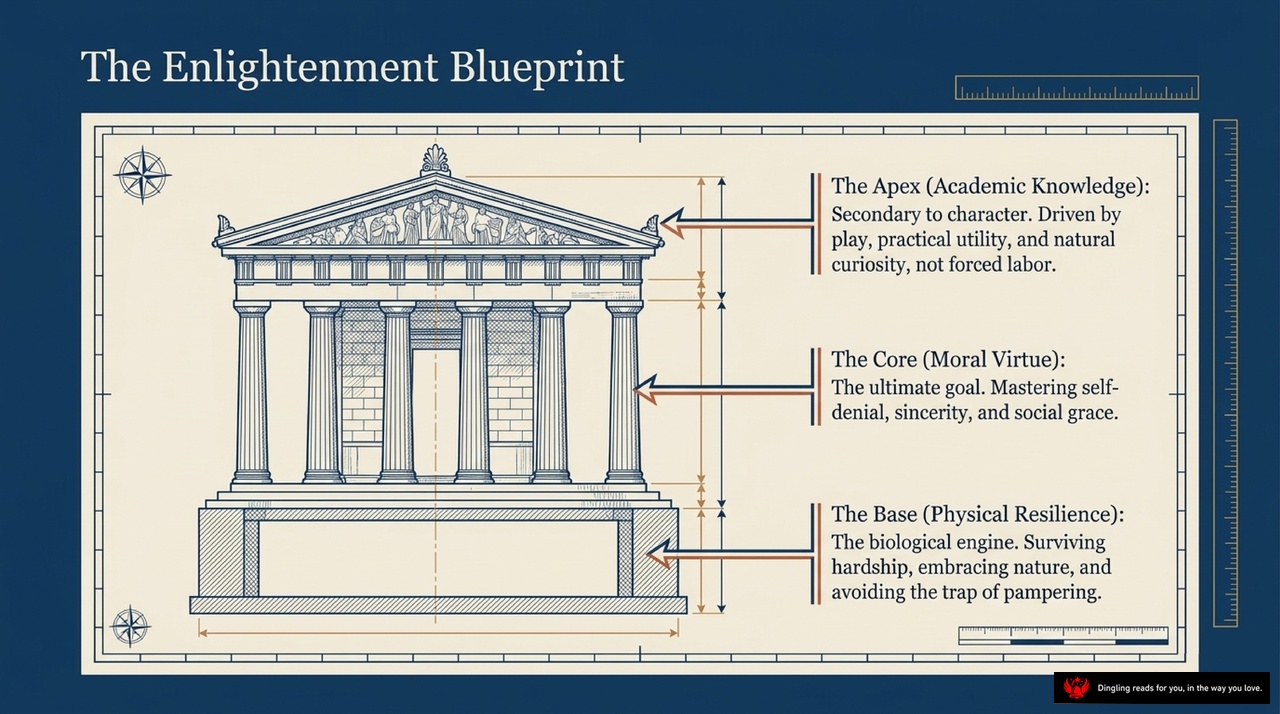
The Enlightenment Blueprint isn't just a title; it's a structural plan for raising a truly capable human being. Imagine this diagram as the architecture of a successful life.
At the very bottom, we have the Base: Physical Resilience. Think of this as the biological engine. Without a strong foundation, everything above it crumbles. This isn't about being tough for the sake of it; it's about survival and thriving in nature. It means surviving hardship, embracing the outdoors, and, crucially, avoiding the trap of pampering. A child who has never known cold, hunger, or the discomfort of nature will never learn true strength.
Once that base is solid, we build up to the Core: Moral Virtue. This is the ultimate goal. It's about mastering self-denial, sincerity, and social grace. This is where character is formed. It's the difference between someone who follows rules because they're forced to, and someone who acts with integrity because it's who they are. As the text reminds us, a person without virtue is like a building without walls—no matter how pretty the roof looks, the structure is empty.
Finally, at the very top, sits the Apex: Academic Knowledge. Notice something important here? Knowledge is secondary to character. The Enlightenment view was radical for its time: a brilliant mind with no moral compass is dangerous. True learning should be driven by play, practical utility, and natural curiosity, not forced labor. If you build a house with a shaky foundation and no core, but a fancy roof, it will eventually collapse. But if you get the physical resilience and moral character right, knowledge becomes a powerful tool rather than a fragile ornament.

Today we dive into the first pillar of our journey: Forging Physical Resilience. Think of the child's body not as a delicate flower to be kept in a greenhouse, but as a young tree that needs to grow strong against the elements. The slide outlines four critical zones for building this strength.
First, look at the Head. The text advises us to never cover the head, day or night. Why? Because exposure to air prevents colds and headaches, teaching the body to adapt rather than relying on constant protection. Next, consider the Skin. Instead of shielding the child from the weather, we should encourage them to play outdoors in all seasons. This builds a "towering tree," not a fragile bloom.
Moving to the Body, the focus is on clothing. We advocate for loose garments only, avoiding anything tight that restricts natural organ growth or breathing. Finally, look at the Feet. The guidance is counter-intuitive yet powerful: wash in cold water daily and wear thin, leaky shoes. This habituates the body to wetness and prevents sudden chills. By embracing these practices, we help children develop a robust, resilient physique capable of facing life's challenges.

Conditioning the Biological Engine: The Art of Raising a True Gentleman
Welcome back. Today, we are diving deep into the practical application of Locke's philosophy on raising a gentleman. The slide before us, titled "Conditioning the Biological Engine," outlines a strict dichotomy: what we must cultivate versus what we must avoid. This isn't just about diet or sleep; it's about building a resilient human being from the ground up.
Let's look at the first row: food. The text advises us to cultivate plain, dry bread and simple meats, but only after the age of three. Crucially, it emphasizes well-chewed food. On the other side, we must avoid heavy spices, multiple meats at once, and the early introduction of wine or spirits. In the modern world, where we often overstuff our children with complex, heavily processed meals, this advice is a stark reminder to return to simplicity and respect the digestive system.
Next, consider the clock. We need to cultivate irregular meal times to prevent rigid biological dependencies, avoiding the trap of eating when not hungry or frequent snacking. This counters our modern habit of constant grazing, which often leads to a lack of true hunger cues. The slide then moves to sleep. We must encourage hard beds—think quilt, not feather—and the discipline of early to bed, early to rise. Conversely, we must avoid soft, luxurious beds and sleeping late into the morning. This is about training the body to respect rest and time, rather than succumbing to comfort.
Finally, look at the bottom row regarding health and nature. We should cultivate a reliance on nature, rest, and fasting for minor ailments, trusting the body's own healing mechanisms. We must avoid rushing to doctors for every minor scratch or administering harsh preventive medicines. The core message here is profound: a healthy body is the foundation of a healthy mind. By avoiding over-indulgence, excessive comfort, and unnecessary medical intervention, we allow the child's "biological engine" to run efficiently and robustly. This physical conditioning is the non-negotiable first step before we can even begin to shape their character and intellect.

Pillar II: The Supremacy of Character. True liberty is the ability to cross one's own desires.
Think about this for a second: what does it actually mean to be free? We often think freedom means doing whatever we want, chasing every impulse that strikes us. But the opposite is true. True liberty is the power to say "no" to your own cravings. It's the ability to master yourself rather than being mastered by your instincts.
Look at the diagram here. It shows the constant battle between raw Appetite and logical Reason. Character is built when Reason takes the reins and directs the compass of your life away from immediate gratification and toward long-term virtue. This is where Self-Denial comes in. It's the absolute foundation of everything good. It requires you to submit your raw appetites and emotional impulses to the guidance of your mind. Without this discipline, you are just a slave to your impulses.
But self-control isn't enough on its own. You also need Sincerity. Think of this as your fundamental baseline. In a world full of tricks, honesty is your most powerful tool. The text makes a radical point here: a single lie is considered a worse offense than twenty honest mistakes. Why? because lying breaks trust, while mistakes are just opportunities to learn. If you lose your integrity, you lose your reputation forever.
Finally, we have Humility. This is true good breeding. It's not about thinking you're better than everyone else, nor is it about despising others. It's about finding the middle ground. True character requires neither arrogance nor insecurity. When you balance self-denial, sincerity, and humility, you create a person who is not just free, but truly respected and capable of achieving anything.

Rethinking Reward and Punishment: The Blueprint for Effective Parenting.
Today's slide presents a powerful framework for how we should guide our children. It divides parenting strategies into four quadrants based on whether they are physical or psychological, and whether they are ineffective or highly effective.
Let's start with the bottom left: "The Rod." This represents physical punishment. The slide warns that this approach breeds a slave-like fear and resentment. It might stop a child in the moment, but it only works for extreme obstinacy. It fails to teach reason and often damages the child's spirit.
On the opposite side, in the bottom right, we have "Bribes & Sweets." This is the physical side of psychological manipulation. Using candy or toys to buy compliance feeds the child's selfish desires. Instead of teaching them self-control, it just teaches them that good behavior is a transaction for a reward.
Now, look at the top half, which moves into the psychological realm. The top left is "Reasoning." This is about treating children as rational beings capable of understanding consequences. It's a step up, but the slide suggests there is an even more powerful motivator.
That brings us to the top right: "Esteem & Disgrace." This is labeled as the ultimate motivator. Children inherently crave respect and abhor shame. When we connect our expectations to their self-worth, we tap into a deep, internal drive. They want to be good not because they are afraid of a stick or chasing a candy, but because they want to be respected and avoid the pain of shame.
The core message here is clear: to raise truly capable and confident individuals, we must move away from physical control and transactional rewards. Instead, we must cultivate a culture where the child's honor and reputation are the primary drivers of their behavior. This is the only path to long-term, highly effective character building.

Practice Makes Nature. This isn't just a cliché; it's the absolute secret to raising a truly elegant child.
Look at the slide. On the left, we see "The Flawed Approach." It represents memorization—dumping a long list of behavioral rules into a child's mind. It's like trying to walk on a path made of cracked, uneven stones. The result? Constant failure, frustration, and scolding. Children simply can't carry that weight.
But on the right, we have "The Architect's Approach." This is about habituation, visualized as a smooth, glowing infinity loop. The logic is simple yet profound: behaviors only become permanent when internalized through repetition. You don't teach elegance by listing rules; you teach it by guiding the child through repeated physical practice until the action becomes as natural as breathing.
The text warns us clearly: memorized rules are quickly forgotten. If you overload a child with instructions, you aren't building character; you're just creating anxiety. Instead, focus on one single behavior at a time. Whether it's how they hold a fork or how they greet a guest, practice it gently until it becomes instinct.
And here is the most critical part at the bottom: The Catalyst. You cannot teach elegance while acting coarsely. The tutor or parent must embody the habit. If you demand your child be polite while you shout, the lesson is lost. As the slide states, example is the greatest teacher. True nature isn't forced; it's cultivated through consistent, lived example and relentless, gentle practice.
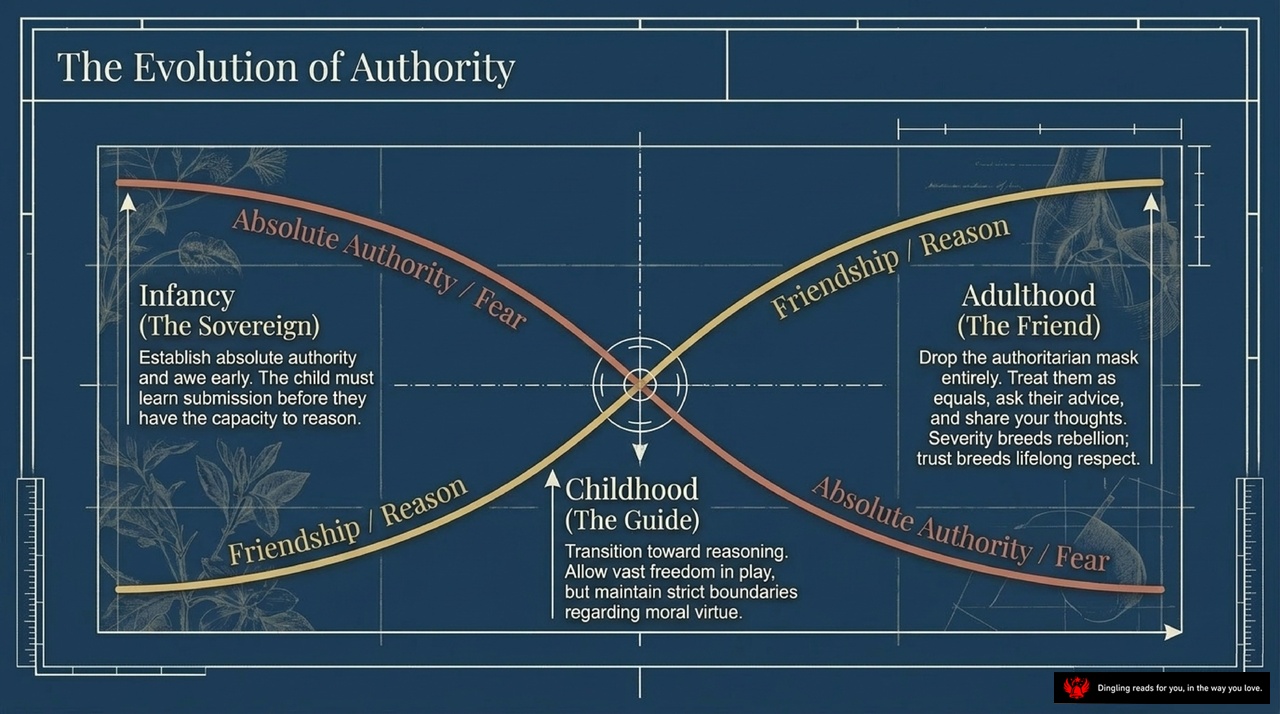
The Evolution of Authority is all about timing. It's not about being strict forever or being a buddy from day one. It's a dynamic shift that mirrors your child's growth.
Look at the chart. In the early stages, labeled Infancy, you are "The Sovereign." Here, the relationship is defined by Absolute Authority and Fear. Why? Because the child lacks the capacity to reason yet. You must establish awe and submission early to build a foundation. If you don't set boundaries now, correcting them later becomes impossible.
As the child moves into Childhood, you transition into "The Guide." This is the critical middle ground. You allow vast freedom in play to nurture their spirit, but you maintain strict boundaries regarding moral virtue. It's a delicate balance between friendship and reason, guiding them without controlling them.
Finally, in Adulthood, you become "The Friend." At this stage, you must drop the authoritarian mask entirely. Treat them as equals, ask for their advice, and share your thoughts. The chart warns us clearly: severity breeds rebellion, but trust breeds lifelong respect. By shifting from the ruler of their childhood to the friend of their adulthood, you create a bond that lasts a lifetime.

Knowledge as Play is the third pillar of our educational philosophy, and it flips the script on how we think about learning. The core idea here is simple but revolutionary: learning should never be a forced chore. Our minds absorb information best when we are free, relaxed, and driven by genuine curiosity. When education feels like a punishment, it shuts down; when it feels like a game, it ignites.
To make this work, we need to master three key strategies. First, we must use "The Trick of Play." This means framing reading and writing not as obligations, but as privileges or desirable games. Never present learning as something the child has to endure; instead, make it something they have the special right to enjoy.
Second, we must learn to capitalize on energy. You have to follow the child's natural mood. Teaching is most effective during those peak moments of high energy and intense curiosity. If you try to force a lesson when a child is tired or disinterested, you are fighting against nature.
Finally, and perhaps most importantly, we must answer everything. Never ignore a child's "What is this?" or "Why?". Even if the question seems simple, an honest, serious, and simple answer fuels the engine of lifelong curiosity. By treating every question as an opportunity to explore rather than a nuisance to silence, we turn the entire learning process into an adventure. This approach transforms knowledge from a heavy burden into a joyful discovery.

Here is the spoken script for Slide 10, tailored for an American audience with a natural, engaging tone.
**Slide 10 Script**
"Let's look back at how the 17th century actually mastered the art of teaching. Forget the old idea that kids need to be scared into learning. Instead, they used a brilliant strategy called gamification. Imagine a 24-sided ivory die, carved with letters. Adults would play a betting game with it, and here's the magic: they never forced the child to join. They just let the child's natural curiosity and desire to win pull them in. Suddenly, learning the alphabet and phonetics wasn't a chore; it was just a byproduct of wanting to win the game. This is the core takeaway: what required a whip in a traditional schoolhouse can be learned effortlessly through strategic gamification at home. It's about designing an environment where the child is so motivated by the fun and the challenge that education happens automatically. It's not about pushing them; it's about making learning so rewarding that they can't stop themselves from doing it."
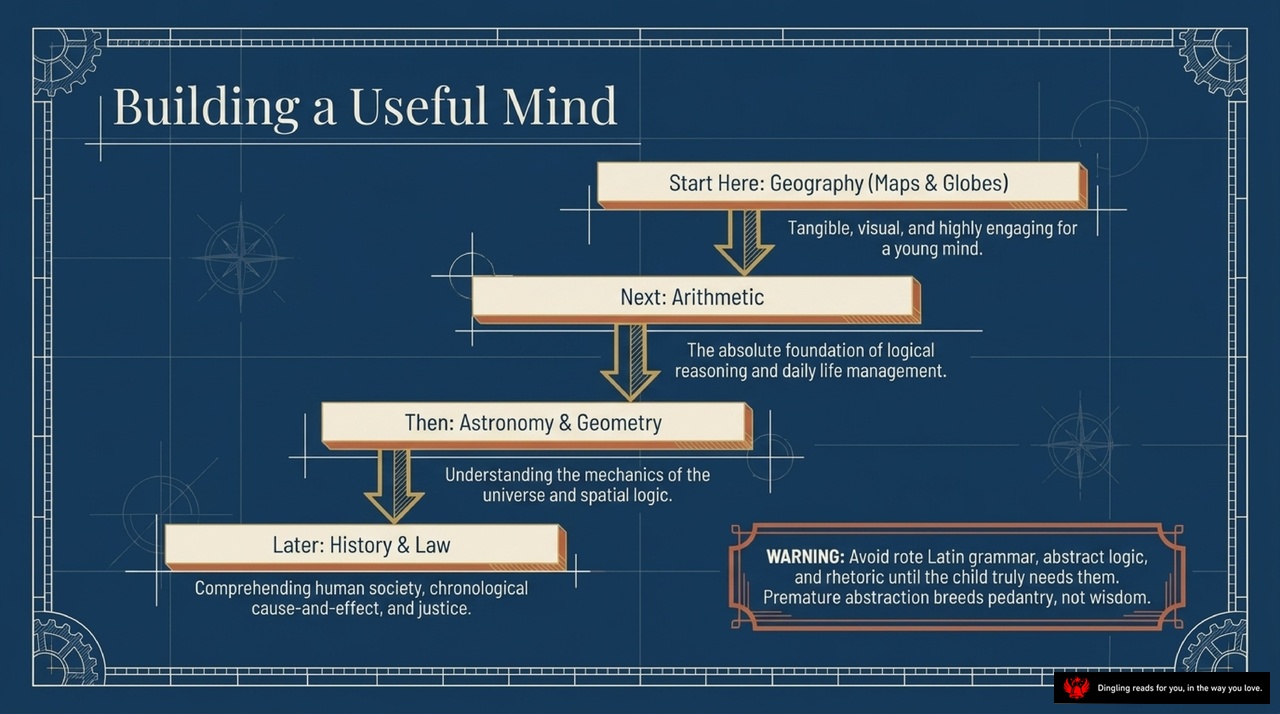
Let's talk about how to build a truly useful mind, moving away from abstract theories and focusing on what actually works for a young person. The slide outlines a clear, step-by-step roadmap for intellectual development. We start right here with Geography—specifically maps and globes. Why this first? Because it's tangible, visual, and highly engaging for a young mind. It grounds learning in the physical world they can see and touch.
Once that spatial awareness is established, we move next to Arithmetic. This isn't just about numbers; it serves as the absolute foundation of logical reasoning and daily life management. You can't build a solid logical framework without mastering the basics of calculation and quantity.
With those foundations set, the next step is Astronomy and Geometry. This phase is all about understanding the mechanics of the universe and spatial logic. It helps the child see how the world works on a grander scale, connecting the dots between the numbers they learned and the physical reality around them.
Finally, we arrive later in the process with History and Law. This is where we comprehend human society, chronological cause-and-effect, and the concept of justice. It's about understanding our place in the human story and how societies function.
However, there is a crucial warning we must heed: avoid rote Latin grammar, abstract logic, and rhetoric until the child truly needs them. Premature abstraction breeds pedantry, not wisdom. By following this natural progression—from the concrete to the abstract—we ensure the child builds a robust, practical mind ready for real life.

Recreation Through Labor is about finding the real cure for mental burnout. As the slide suggests, intellectual fatigue isn't solved by idle games, but by physical exertion. A true gentleman needs to master at least one or two manual trades. Think about it: when your brain is overworked, your body needs to speak back. Gardening is perfect for this; it promotes vigorous physical health and connects you to nature's biological rhythms. Carpentry teaches spatial utility and keeps your mind occupied, steering you away from destructive idle habits. And let's not forget accounting—essential commercial arithmetic that even the wealthiest heir must learn to govern an estate and appreciate the mechanics of money. These aren't just chores; they are the antidotes to a sedentary life. By engaging in these tangible skills, you build a healthier mind and a more capable character.

The Architect's Result isn't just a title; it's the blueprint for raising a truly capable human being. As we see here, the ultimate goal of education isn't to produce a pedantic scholar who can recite Latin poetry, but to build a robust, virtuous, and capable person. This requires a holistic synthesis of five key pillars.
First, we have the Body. It must be hardened against the elements, requiring minimal pampering. Think of it as building resilience from the ground up.
Next is the Heart. This needs to be governed absolutely by reason, making it highly resistant to excess and impulse. It's about mastering our desires before they master us.
Then, we look at the Mind. It should be inquisitive and practically skilled, yet free from useless abstraction. We want curiosity that solves real problems, not just empty theory.
Manner is the fourth pillar. It must be humble and sincere, perfectly adapted for contributing to society. True elegance comes from how you treat others, not how you carry yourself.
Finally, Good Breeding and Worldly Wisdom complete the circle. These ensure the individual fits seamlessly into the world around them.
When these five elements—Body, Heart, Mind, Manner, and Wisdom—are balanced, we achieve the ideal result: a person who is not just smart, but truly ready for life.
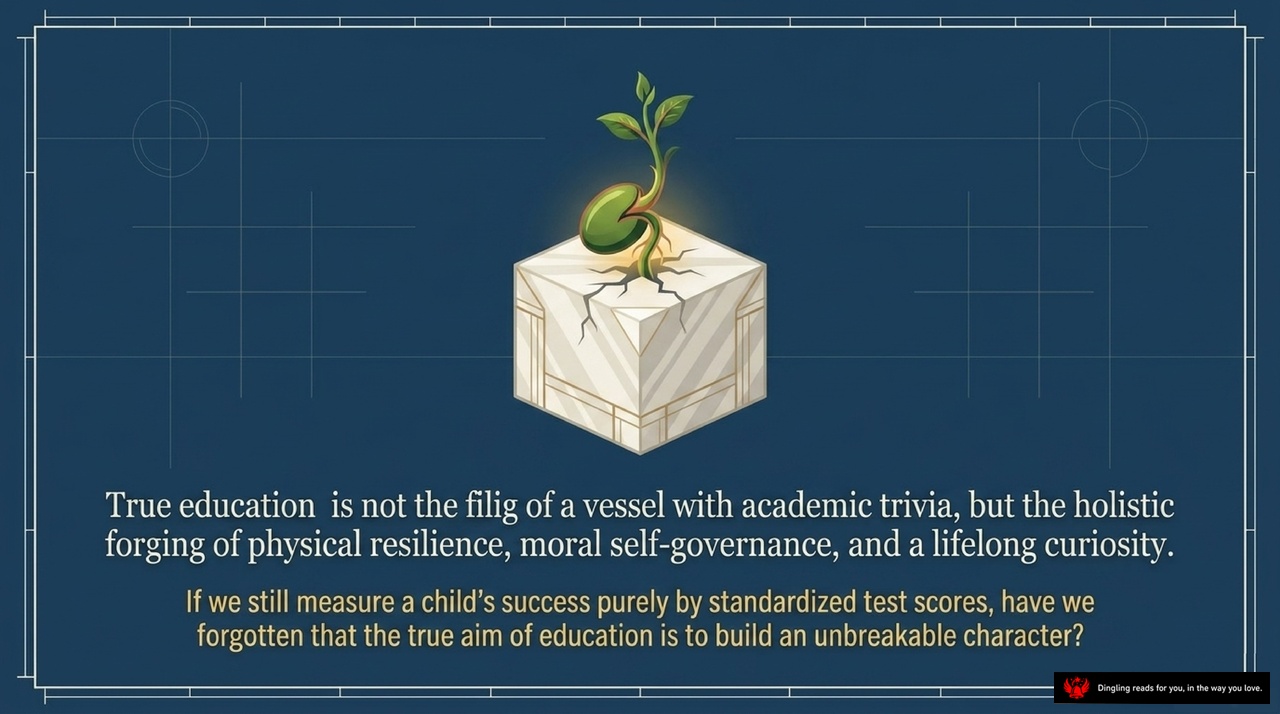
True education isn't about filling a vessel with academic trivia; it's about forging something far more enduring. As we see here, the goal is to cultivate physical resilience, moral self-governance, and a lifelong curiosity.
Think about the image on this slide: a seed breaking through a rigid block. That crack represents the moment where rigid structures—like standardized test scores or narrow definitions of success—give way to true growth. If we measure a child's worth solely by grades, we risk forgetting the real aim of education: building an unbreakable character.
Consider the father in our text who refused to let his son, Alan, be swaddled like a baby. By allowing freedom of movement and insisting on long walks instead of car rides, he didn't just build a stronger body; he instilled a spirit of independence. Similarly, when parents resist the urge to over-protect or over-feed their children, they aren't being harsh—they are teaching resilience. They are helping the seed crack the block, ensuring that when life's challenges come, the child has the strength to grow upward rather than break under the weight.
So, let's ask ourselves: are we nurturing a vessel of facts, or are we helping a character bloom? The answer defines not just a child's future, but their ability to thrive in a complex world.