
Stall-Style Entrepreneurship: Complete Chapter-by-Chapter Summary

Welcome to a new way of thinking about business. Forget the idea that you need a fancy storefront or a massive budget to start. Today, we're talking about the power of the humble street stall. As we explore Huang Biyun's insights, we see that a simple street cart isn't just a place to sell goods; it's the ultimate Minimum Viable Product for retail success. Think of it as your low-cost, high-feedback prototype. It allows you to test the market, gather real customer reactions, and refine your product without the risk of a traditional store. This practical guide shows how treating that small, mobile stall as your MVP can be the key to unlocking long-term retail success.
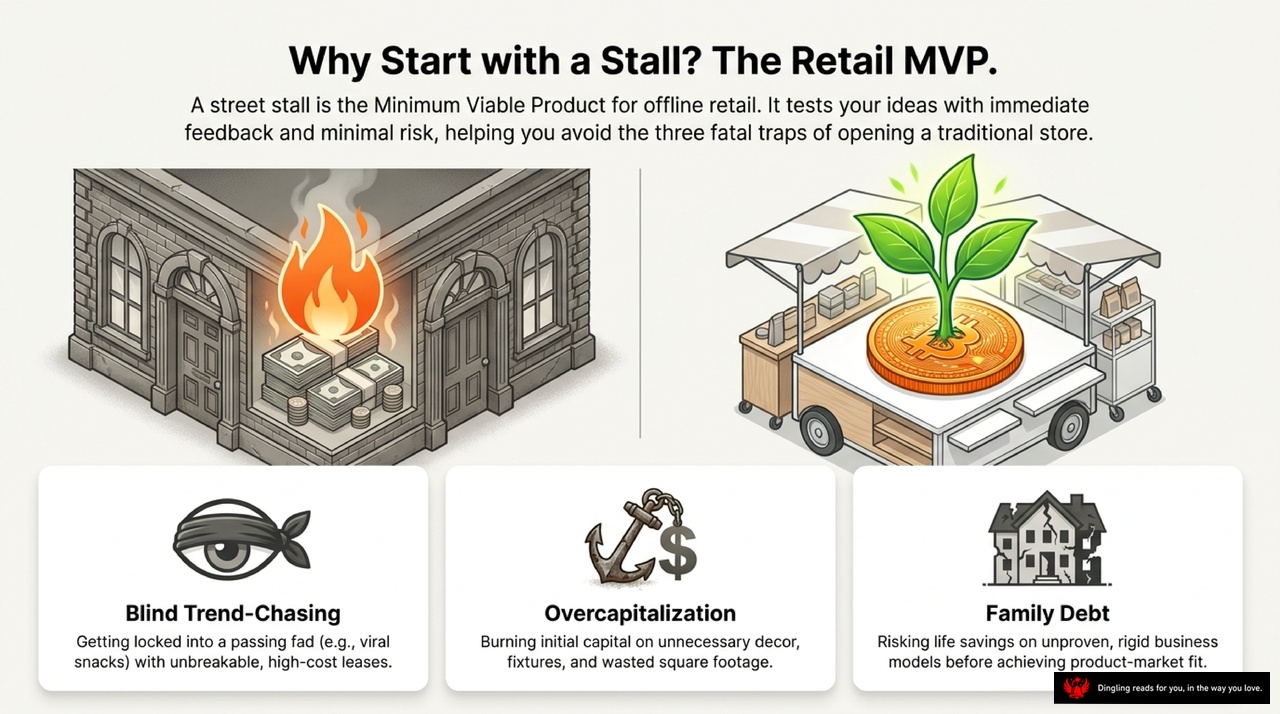
Why start with a stall? Because it is your Minimum Viable Product for retail. Think of a street stall not just as a place to sell, but as a low-risk laboratory for your business idea. It allows you to test your concept with immediate feedback and minimal capital, helping you avoid the three fatal traps that destroy traditional brick-and-mortar stores: Blind Trend-Chasing, Overcapitalization, and Family Debt.
On the left, you see a traditional store burning down. That represents the danger of getting locked into high-cost leases chasing fleeting fads. On the right, a small stall sprouting from a coin, symbolizing how a modest start protects your life savings and your family's financial stability. By starting small, you can validate your product-market fit before risking everything on a rigid, expensive business model. Don't let fear or over-optimization stop you; start with a stall, learn fast, and grow from there.

Smart Sourcing: Buying Low to Sell High. The secret to maximizing your profit margins isn't just working harder; it's about systematically eliminating the information gap between what's trending online and what's actually selling on your street corner.
Let's break down this three-step flow. First, **Identify**. Don't just guess what people want. Go to major retail platforms like Taobao or TikTok Shop to spot trending items and validate real consumer demand. If it's hot online, it might be your next big hit offline.
Next, **Source**. This is where you make your money. Instead of buying from middlemen who eat up your margins, bypass them entirely. Locate the exact OEM factories on wholesale aggregator sites like 1688 or Yiwu Go. You can even find the specific factory addresses for popular brands by checking product details online, then search for those factories directly on B2B platforms. Look for verified suppliers with high ratings and fast shipping to avoid resellers.
Finally, **Test**. Never commit to a massive wholesale order immediately. Purchase in micro-batches—maybe just 10 to 30 units—online first. This allows you to validate local offline demand with zero risk. If the small batch sells out, you know you have a winner, and you can scale up. If it doesn't, you've only lost a tiny amount. By following this cycle, you turn data into profit and eliminate the guesswork that usually kills small businesses.

What should you sell? The answer isn't just about the product itself, but about matching it perfectly to the place where you stand. This slide breaks down the three winning strategies for street vendors: Daily Needs, Emotional Joy, and Skill-Based offerings.
First, look at **Daily Needs**, represented by that grocery bag. Think groceries, breakfast, and essentials. These items have high purchase frequency but low margins. Your strategy here is simple: build long-term trust. You need a fixed location and a strict daily schedule to become a reliable neighbor. The best spot? Dense residential communities with multi-generational households. If you're near a family with kids and grandparents, they will buy from you every single day because they know you're there.
Next, move to **Emotional Joy**, symbolized by the balloons and candy. This includes toys, snacks, flowers, and anything that makes people smile. These are non-essential, but they have high margins. The key here is timing and mindset. Don't sell these on a rainy Tuesday morning; sell them on the weekend. Capitalize on the "weekend mindset" when people are looking for a treat. Set up in bustling night markets, pedestrian streets, or public plazas where the energy is high. You aren't just selling a toy; you're selling an emotional uplift.
Finally, there's **Skill-Based** offerings, shown by the crossed wrench and makeup brush. This covers makeup, tech repair, and crafts. These have variable frequency but premium margins. Your strategy is to sell the "craft." Perform the skill live. Let customers see your hands at work. Encourage social media sharing because people love watching talent in action. The ideal locations are concert venues, tourist hotspots, and university towns where people are open to paying for unique experiences and expertise.
So, match your product to your place. Sell necessities where people live, sell joy where people play, and sell skills where people watch.
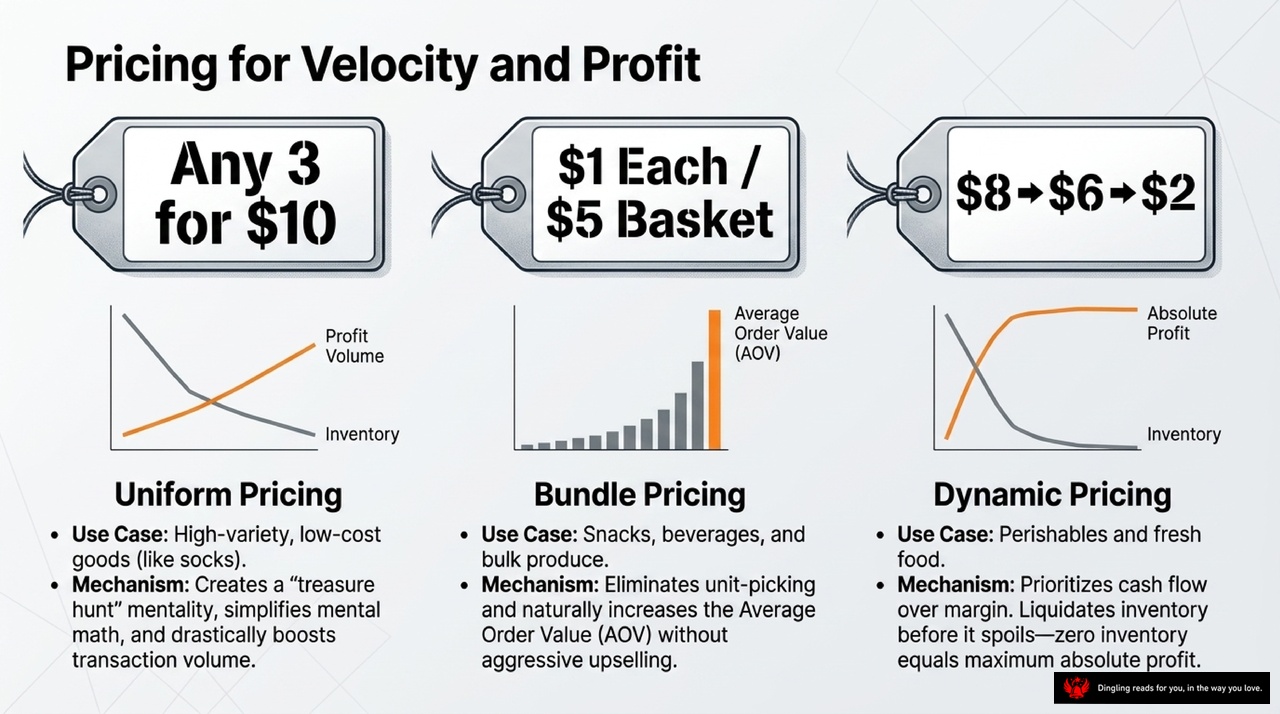
Today's slide breaks down the art of pricing for speed and profit, showing us three powerful strategies: Uniform, Bundle, and Dynamic pricing.
First, let's look at Uniform Pricing. Think of it as a "treasure hunt" perfect for high-variety, low-cost items like socks or small accessories. By setting a single price—like "Any 3 for $10"—you eliminate the mental math customers have to do. It simplifies their decision, boosts transaction volume, and makes browsing feel like a fun game rather than a chore.
Next is Bundle Pricing, ideal for snacks, beverages, or bulk produce. Instead of pushing individual items, you create a set, like "$1 Each" or a "$5 Basket." This strategy naturally increases your Average Order Value without needing aggressive upselling. Customers love the convenience of grabbing a ready-made deal, which keeps them moving faster and buying more.
Finally, we have Dynamic Pricing, which is the secret weapon for perishables and fresh food. Here, you prioritize cash flow over maximum margin. As shown in the graph, you start high—maybe $8—and then rapidly drop the price to $6, then $2, as the product approaches its spoil date. This ensures you liquidate inventory before it goes bad, turning potential waste into maximum absolute profit.
Mastering these three pricing models allows you to balance velocity and profit, ensuring your stall stays busy while your bottom line stays healthy.
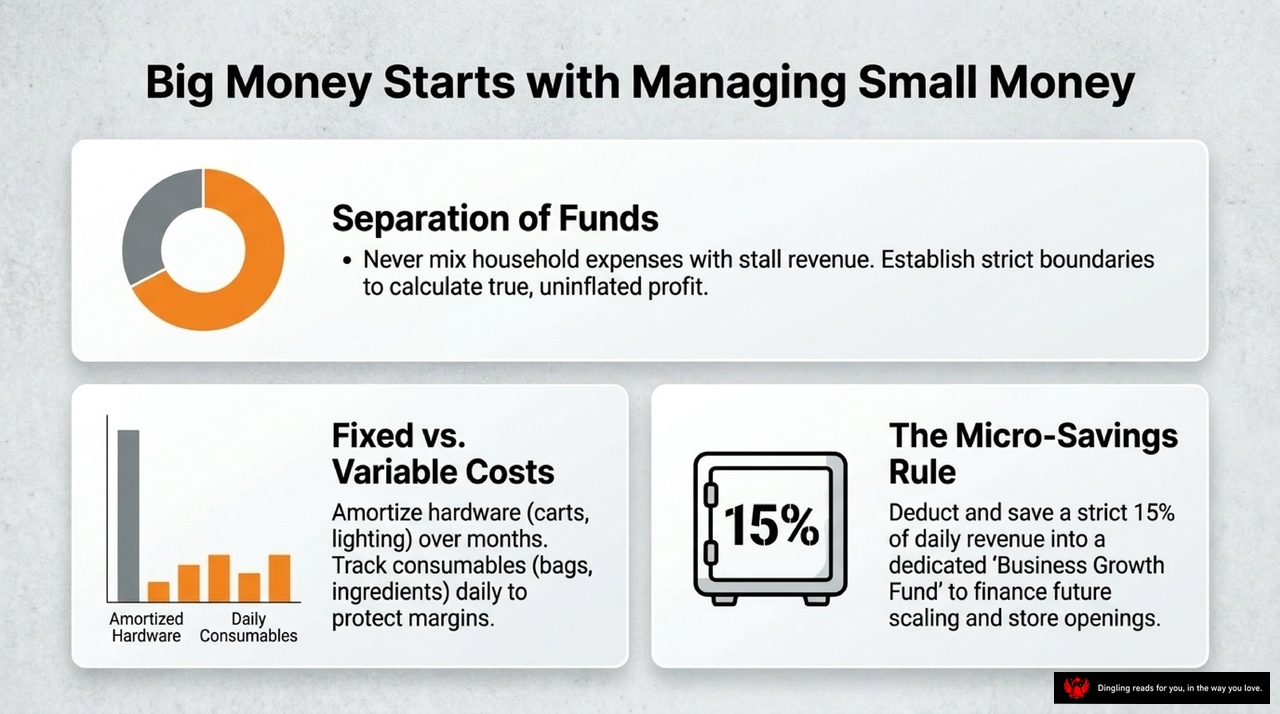
Managing your small money is the secret to unlocking big profits. It all starts with strict financial discipline. First, you must separate your household expenses from your stall revenue. Never mix them. If you pay for groceries or rent from your business income, you're inflating your costs and hiding your true profit. Use a dedicated app to track these two streams separately.
Next, understand your costs. Break them down into fixed and variable. Fixed costs, like your cart or lighting, are monthly investments. Variable costs, like ingredients and bags, change daily with your sales. You need to track these daily to protect your margins.
Finally, adopt the Micro-Savings Rule. Deduct and save a strict 15% of your daily revenue into a dedicated "Business Growth Fund." This isn't just for emergencies; it's your fuel for future scaling and opening new stores. Mastering these small financial habits today builds the foundation for your empire tomorrow.
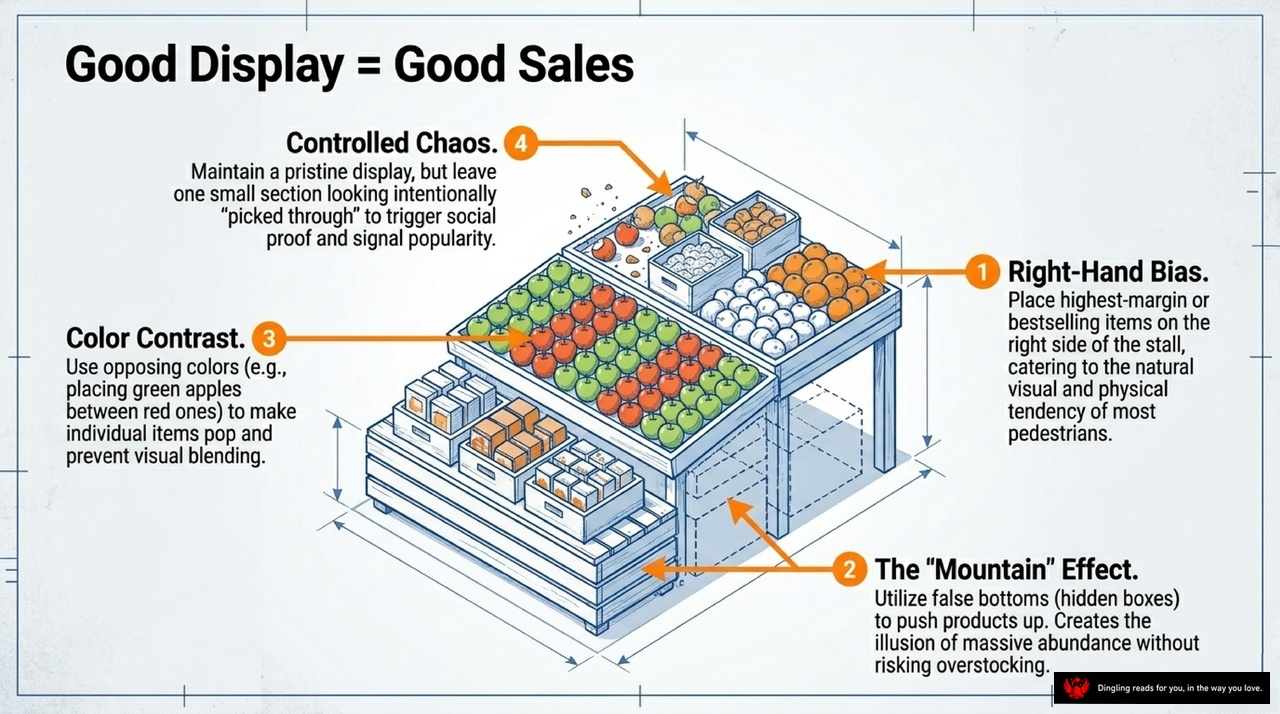
Good Display equals Good Sales. Let's look at how a well-structured stall can silently sell itself to passersby.
First, leverage the "Right-Hand Bias." Most people naturally scan from left to right, so place your highest-margin or best-selling items on the right side of the stall to catch their attention immediately.
Next, create the "Mountain" Effect. Use hidden boxes or false bottoms to push products up, creating an illusion of massive abundance without actually overstocking your limited space.
Don't be afraid of "Color Contrast." Mix opposing colors, like placing green apples between red ones, to make individual items pop and prevent them from blending into a dull background.
Finally, embrace "Controlled Chaos." Keep the display mostly pristine, but intentionally leave one small section looking slightly "picked through." This subtle cue triggers social proof, signaling to customers that your products are popular and in demand.

Today's final slide focuses on the invisible powerhouses of your street stall: smell and sound. While everyone fights for the customer's eyes, the real magic happens when you bypass them entirely.
On the left, we look at smell. The goal is simple: maximize pure aroma while eliminating choking smoke. Think about it—no one wants to walk through a cloud of billowing gray smoke, but everyone stops for a sizzling steak. That's why top performers use high-heat iron griddles instead of charcoal. It sears the meat, releasing intense, traveling aromas that draw people in from a block away, without the blinding smoke that pushes them away.
On the right, we tackle sound with the "Bandwagon Effect." Your voice needs to be simple, rhythmic, and highly repetitive to embed itself in a customer's memory. You want them to hum your jingle unconsciously. Furthermore, don't underestimate the power of loud electronic ticket-callers. Hearing "Number 80 is ready" triggers an instant psychological shift; it creates a massive perceived popularity. People don't just buy food; they buy the crowd. If the sound says everyone else is there, they will follow instantly.
So, don't just wait for them to look. Use the scent of success and the sound of popularity to pull them right to your table.

Imagine walking through a bustling night market, and suddenly, a specific stall pulls you in before you even realize why. It's not magic; it's a masterclass in sensory engineering. Today, we're decoding the invisible forces that turn passersby into customers: smell and sound.
Think about the last time you stopped at a food stall. Was it because you saw the sign? Or was it because you smelled something delicious wafting through the air? In Changsha's famous Si Fang Ping Night Market, the "Big Bull Rush" beef stall ditched traditional charcoal grilling. Why? Because charcoal creates smoke that masks the meat's natural aroma. Instead, they use a high-temperature iron plate. This technique eliminates the haze while amplifying the sizzling, savory scent of the beef, drawing customers from over 100 meters away. It's a simple switch that doubles your reach.
But it's not just about food. In Shanghai's Hongqiao Heaven, a perfume night market adapts its scent to the weather. On rainy days, they release pine and grass notes to create a calming, earthy vibe. On hot days, they switch to ocean or matcha scents for a cooling effect. Even non-food items benefit; a simple scent bottle can boost perfume sales by up to 30%.
Now, let's talk about sound. In the same Si Fang Ping market, the "Li's Flying Pancake" stall uses a loud, rhythmic caller. Instead of just shouting "buy now," they announce specific numbers, like "Number 60's banana-flavored pancake is ready." This does two things: it signals that the stall is popular and busy, triggering our natural herd instinct, and it creates a memorable, catchy rhythm that sticks in your head.
Some vendors take this a step further. In Sichuan, a corn cake seller uses a local folk song to announce prices, turning a simple transaction into a mini-performance that stops people in their tracks.
Even small details matter. At a school near my home, a "Quick Hands" pancake stall used to get chaotic with long lines. The owner added a simple system: plastic boxes with cartoon number cards. Kids grab a number, wait patiently, and even get to choose their own sauce. This small change not only organized the line but increased sales by 60% because customers felt more in control and had fun.
The lesson here is clear: your senses are your best marketing tools. Use smell to trigger appetite and memory, and use sound to capture attention and create a sense of urgency. When you tune into these invisible levers, you don't just sell products; you create an experience that people can't walk past.

Imagine a massive stadium buzzing with energy, the perfect stage for an event-driven arbitrage strategy. As the text on your slide suggests, mega-events create massive, temporary traffic spikes, but success hinges on one thing: perfectly matching your MVP to the concentrated fan demographic right there in the crowd.
Look at the diagram. We're not just selling to a crowd; we're targeting specific segments. On one side, we have the "High Female Fanbase." These customers are driven by experiential aesthetics. They aren't just buying a product; they're buying into the vibe. That's why you see recommendations for hair braiding, glitter makeup, and themed accessories matched to the artist's official color—like those purple ribbons. It's about immersion.
On the other side, we have the "High Male Fanbase." Their focus is purely on immediate utility. They are here to celebrate, but they need fuel. The strategy here is straightforward: sell heavy snacks, cold beverages, and standard glow sticks. It's about solving the immediate problem of staying energized in the heat.
But before you even think about what to sell, there's a Golden Rule you must follow. The slide emphasizes it clearly: utilize highly portable setups, strictly avoid open flames for security compliance, and match the euphoric energy of the crowd. If you can't move your setup quickly or if your vibe clashes with the crowd's excitement, you lose the moment. So, capture the spike, respect the rules, and match the energy. That's how you turn a temporary crowd into a profitable event.

So, we're moving from the physical hustle of the street stall into the digital engine room of modern commerce. Look at this slide: "The O2O Loop: Short Videos & Private Domains." This is the secret sauce for turning a one-time street sale into a lifelong business relationship.
Panel 1 is all about "Hyper-Local Short Videos." Think of it as your digital opening bell. Instead of just hoping people see your sign, you're actively hunting them. The strategy here is authenticity. Record those raw, behind-the-scenes moments—like rolling sticky rice or chopping fresh herbs. But timing is everything. You publish these videos exactly 30 minutes before you open. Why? Because algorithms love to push content to people right when they're hungry. You're targeting commuters leaving work, hitting them with a sizzling video right as their lunch craving kicks in. It's not just content; it's a precision strike on local demand.
Now, look at Panel 2: "The Private Domain." This is where the real magic happens. WeChat isn't just for chatting; it's your personal storefront that never closes. Here's the golden rule: never just ask for a follow. That's a transaction; that's a burden. Instead, create an irresistible exchange. The slide gives us a perfect example: "Buy the flowers here, add WeChat, and I'll ship a free vase to your home." You're not asking for a follower; you're offering value. You're securing permanent contact info. This builds a database of loyal customers who can pre-order even when the weather turns bad or the stall is closed.
This loop connects the two worlds. The short video brings the stranger into your orbit, and the private domain keeps them coming back. It transforms a fleeting street encounter into a sustainable, scalable business. You're no longer just a vendor waiting for foot traffic; you're a brand building a community, one video and one connection at a time.
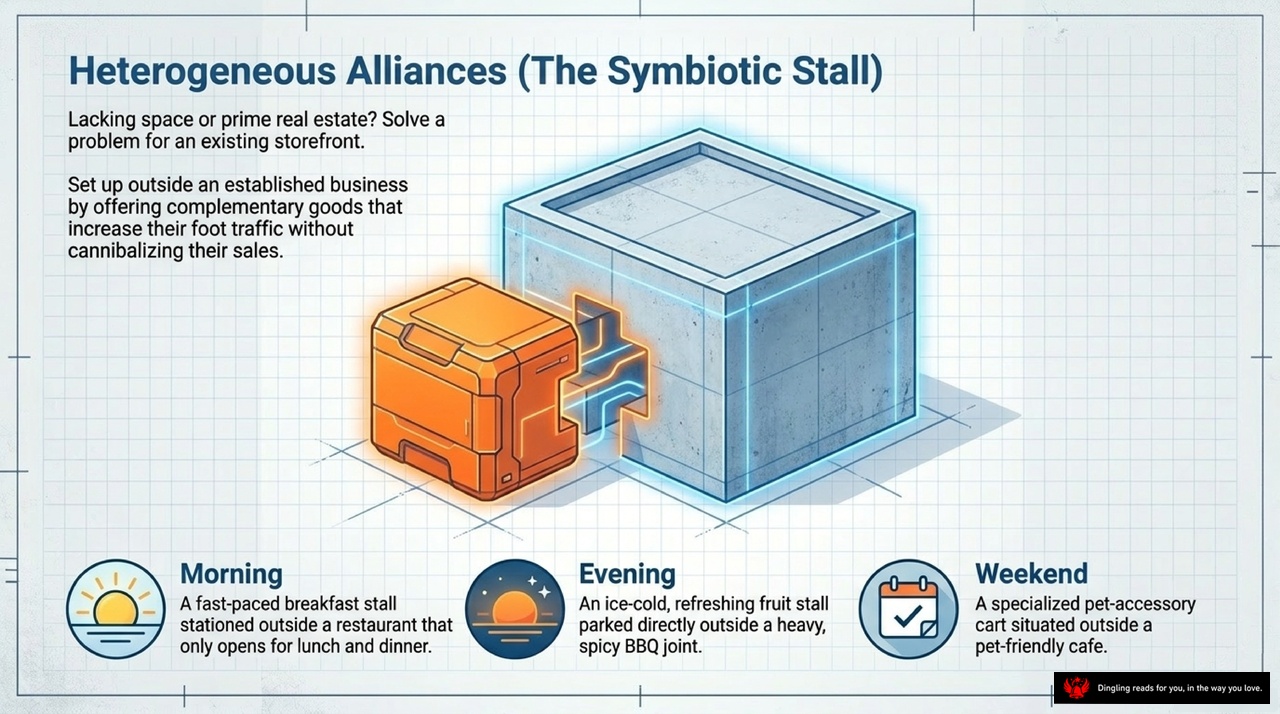
Heterogeneous Alliances, or what we call the "Symbiotic Stall," is a brilliant strategy for entrepreneurs who lack prime real estate or simply can't afford a standalone storefront. Instead of fighting for space, you solve a problem for an existing business by positioning your complementary goods right outside their door. The golden rule here is to increase their foot traffic without cannibalizing their sales. Think of it as a puzzle piece fitting perfectly into a larger picture.
Let's look at how this works in practice. Imagine a fast-paced breakfast stall stationed right outside a restaurant that only opens for lunch and dinner. You're capturing the morning crowd that the restaurant misses. Or picture an ice-cold, refreshing fruit stall parked directly outside a heavy, spicy BBQ joint. After customers finish their fiery meal, your fresh fruit becomes the perfect palate cleanser, solving a real need they didn't know they had. On weekends, a specialized pet-accessory cart situated outside a pet-friendly cafe creates a one-stop shop experience for pet owners.
This isn't just about finding a spot; it's about creating an ecosystem where everyone wins. By aligning your product with the specific timing and needs of your neighbor's customers, you turn their existing traffic into your own, building a stable revenue stream with zero rent costs. It's a simple yet powerful way to leverage the success of others to fuel your own growth.
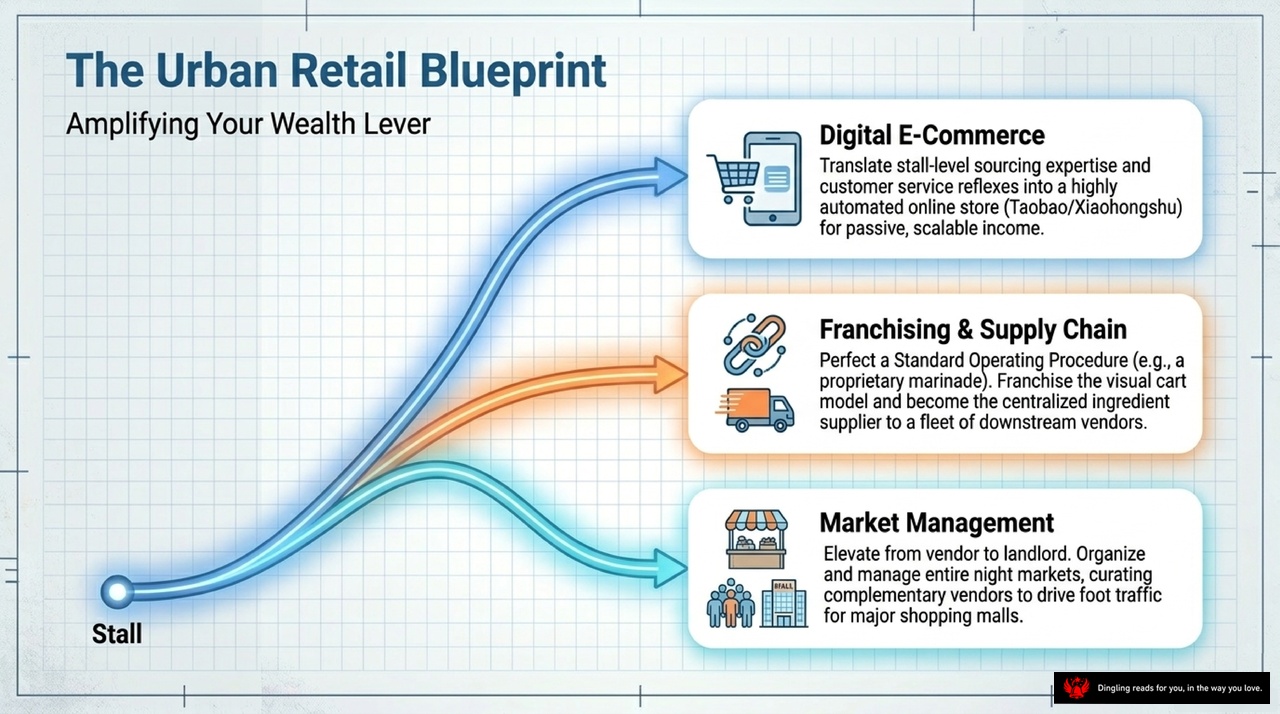
Look at this blueprint for scaling your street stall business. We start with a simple stall, but the real wealth lies in how you evolve from there. The chart shows three powerful paths to amplify your income.
First, go Digital. Take that hands-on skill you have at the stall and translate it into an automated online store. Think of it as selling your stall's expertise 24/7 on platforms like Taobao or Xiaohongshu. This turns your physical hustle into scalable, passive income that works while you sleep.
Second, build a Supply Chain. Instead of just selling, perfect your Standard Operating Procedure—maybe a secret marinade or a unique visual setup. Then, franchise that model. Become the central supplier for a fleet of downstream vendors. You stop competing on price and start earning from the entire ecosystem of people selling your product.
Finally, become a Market Manager. Elevate yourself from a vendor to a landlord. Organize entire night markets, curating complementary vendors to drive foot traffic for everyone, including major shopping malls. You aren't just selling goods anymore; you're managing the flow of commerce itself.
This isn't just about selling more; it's about changing your role from a worker to an architect of wealth.

Synthesis: The Street-Level MBA. Look at this diagram. We often think business is about complex strategies or massive budgets, but the truth is hidden right here in the middle of this street stall. This isn't just a cart; it's a microscopic reflection of global retail. It operates as an unforgiving, high-speed crucible that forces the entrepreneur to master business fundamentals in their purest form.
Notice the four pillars connecting to the center: Product, Placement, Price, and Promotion. These aren't abstract concepts; they are the daily reality of survival on the street. When you master cash flow without the safety net of corporate credit, when you master visual merchandising without the luxury of expensive fixtures, and when you master guerrilla marketing without the crutch of an advertising budget, you are essentially running a perfect business.
The street stall strips away all the fluff. It forces you to get your product right, find the perfect placement, set a price that converts, and promote with your voice and presence. Those who master the stall, master the fundamental truths of human commerce. Once you understand how to make this simple cart work, you have unlocked the code to building any successful business.
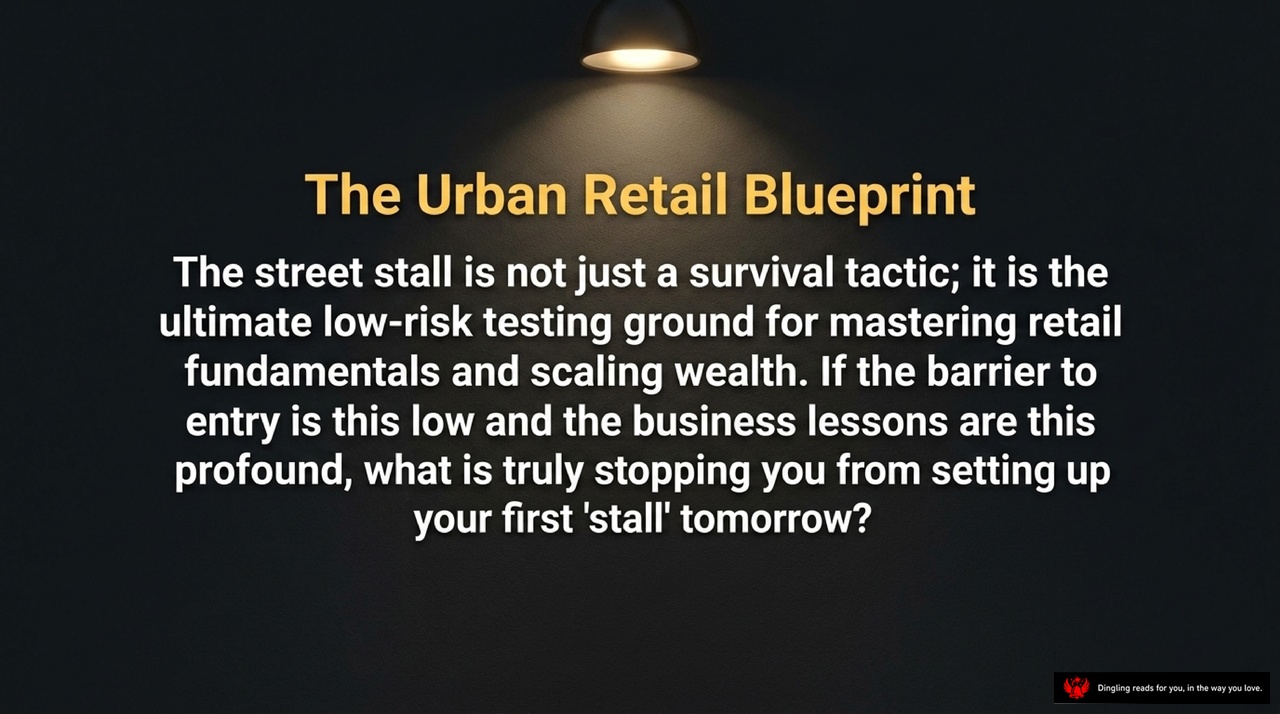
Imagine stepping out onto the street, not just as a seller, but as a master of the urban retail blueprint. Think of that street stall not merely as a desperate survival tactic, but as your ultimate, low-risk testing ground to master the fundamentals of retail and scale your wealth. It's the perfect place to experiment, to fail safely, and to learn the ropes without breaking the bank.
When you look at the right location, you unlock the right customers. Whether it's a bustling university zone, a quiet residential community, or a trendy nightlife district, your product must match the crowd. You aren't just selling items; you're selling solutions for their specific day. Are they rushing to work? Do they need a late-night snack? Or are they looking for a gift for a loved one?
But here is the real question that keeps many of us up at night: If the barrier to entry is so incredibly low, and the lessons you can learn are so profound, what is truly stopping you from setting up your very first 'stall' tomorrow? Is it fear? A lack of capital? Or perhaps the belief that you need a fancy storefront to start?
The truth is, the best business school is right on the sidewalk. You don't need a degree or a massive investment. You just need the courage to show up, test your ideas, and listen to the customers. So, don't wait for the perfect moment. The street is waiting for you. What is one thing you can do right now to get that first step started?