



Interesting idea about earning rights through service instead of having them by birth automatically.
Your Review
Interesting idea about earning rights through service instead of having them by birth automatically.

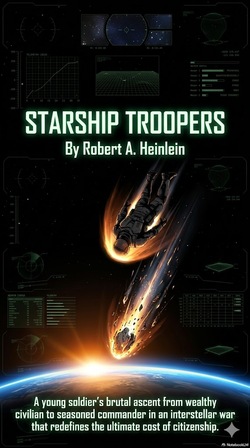
Heinlein argues that rights aren't gifts but privileges earned through sacrifice, a concept that feels urgently relevant today. The story follows Johnny Rico, a naive teenager who joins the military just to impress his crush and fit in with friends, not out of any deep understanding of duty. At first, he sees boot camp as an exciting adventure, unaware that it will strip away his selfish instincts and force him to care about the group more than himself. During rigorous training, he learns that disobeying orders isn't just a personal failure but a threat to everyone's survival, as shown when a recruit refuses an order and gets brutally punished, shaking Rico to his core. Later, during a chaotic battle on an alien world, Rico watches his squad disintegrate around him, realizing that his only purpose is to keep his teammates alive, not to be a hero. This brutal transformation teaches him that every freedom he enjoys comes with a heavy cost paid by others, making him understand that being a responsible citizen means actively choosing to put the collective good above your own comfort and safety, even when it is terrifyingly difficult.

This book made me rethink what it really means to be a true citizen.

This book really made me rethink what citizenship means today.

While the bug battles are exciting, the real focus is on how citizenship is earned through sacrifice and duty.

The opening scene where Johnny impulsively joins the military to impress his crush sets a naive tone.

The open ending leaves us wondering if the Federation system is right or wrong without giving a clear answer.

The concept of earning citizenship through service makes this book feel surprisingly urgent and relevant today.

The book challenges the notion that rights are free, but linking citizenship solely to military service ignores many forms of valuable contribution society makes.

Not a fun bug fight but a hard lesson on earning your place in society.

I found the requirement to serve in the military before voting unrealistic and frustrating for many modern readers.

Heinlein challenges us to earn rights instead of demanding them without considering the heavy cost of service and sacrifice required for everyone.

Citizenship is not a birthright here but a privilege you earn by proving you will put the collective above your skin.

The story challenges the modern assumption that rights come without responsibilities, forcing readers to think deeply.

The boot camp scenes really show how hard it is to turn a selfish kid into someone who cares about the group, not just himself.

Interesting take on citizenship, though I still question the fairness of the system.

Seeing the recruit punished for insubordination made me realize that one person disobeying can ruin the whole unit.

The book forces us to question whether rights should be earned or if they are something we are born with.

The book challenges our modern views on rights, but Heinlein's extreme military requirement for voting feels problematic and ignores non-combatants. While the idea that freedom requires sacrifice is compelling, tying full citizenship exclusively to voluntary military service seems too rigid for a healthy society. It risks excluding those who contribute through other vital ways, like caregiving or essential civilian jobs, which Heinlein's interpretation doesn't fully address. This creates a society where only the willing warriors hold power, potentially undermining the very democratic principles the Federation claims to uphold. The tension between earned rights and inherent dignity is central here, yet the solution feels more authoritarian than liberating.

The concept of earning rights through service is compelling, yet Heinlein's execution feels somewhat extreme and controversial for modern readers who might find the strict military prerequisite for voting unrealistic and ethically problematic given that not everyone can or should serve, raising questions about whether the book truly promotes inclusivity or just validates a narrow definition of citizenship that excludes those with disabilities or pacifist beliefs, making the overall message feel less like a balanced exploration of civic duty and more like a rigid ideological argument that struggles to account for the diverse ways people contribute to society without taking up arms, which limits its relevance as a universal guide for understanding the complex relationship between individual rights and collective responsibility in contemporary democracies where many forms of service beyond military action are equally vital for maintaining a functional and just society.