
Stories of the Sahara: Complete Chapter-by-Chapter Summary

Welcome to the world of *Stories of the Sahara* by Sanmao. Imagine a vast, golden desert stretching endlessly under a twilight sky, where the silence speaks louder than words. This is the backdrop for a legendary bohemian's journey—one of finding love, creating art out of refuse, and bridging cultures in the harshest landscape on Earth. It's not just a story about survival; it's a celebration of the unexpected beauty found when you stop running from the wild and start embracing it.
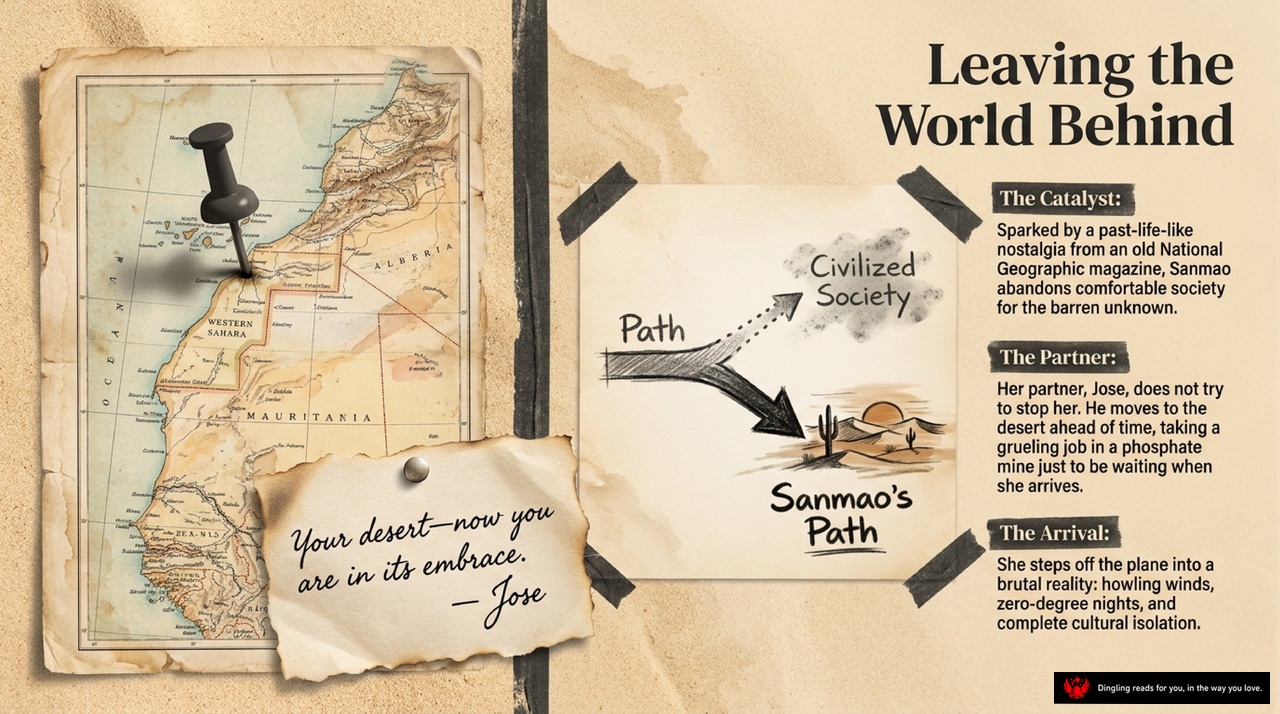
Leaving the World Behind isn't just a title; it's a moment of surrender. Look at this map pinned to the wall—it marks the journey from a "Civilized Society" into the barren unknown. For Sanmao, the catalyst was a past-life-like nostalgia sparked by reading *National Geographic*. She realized that true freedom wasn't found in cities, but in the embrace of the desert.
Her partner, Jose, didn't try to stop her. Instead, he took the lead. He moved ahead, taking a grueling job in a phosphate mine just to wait for her arrival. This was the ultimate act of partnership: one leaves the comfort zone, and the other builds the safety net. When she finally stepped off the plane, she faced a brutal reality—howling winds, zero-degree nights, and total cultural isolation. But as Jose's note reminds us, "Your desert—now you are in its embrace." She didn't just survive the harshness; she chose it, trading the predictable for the wild, finding a home in the very place the world told her was empty.
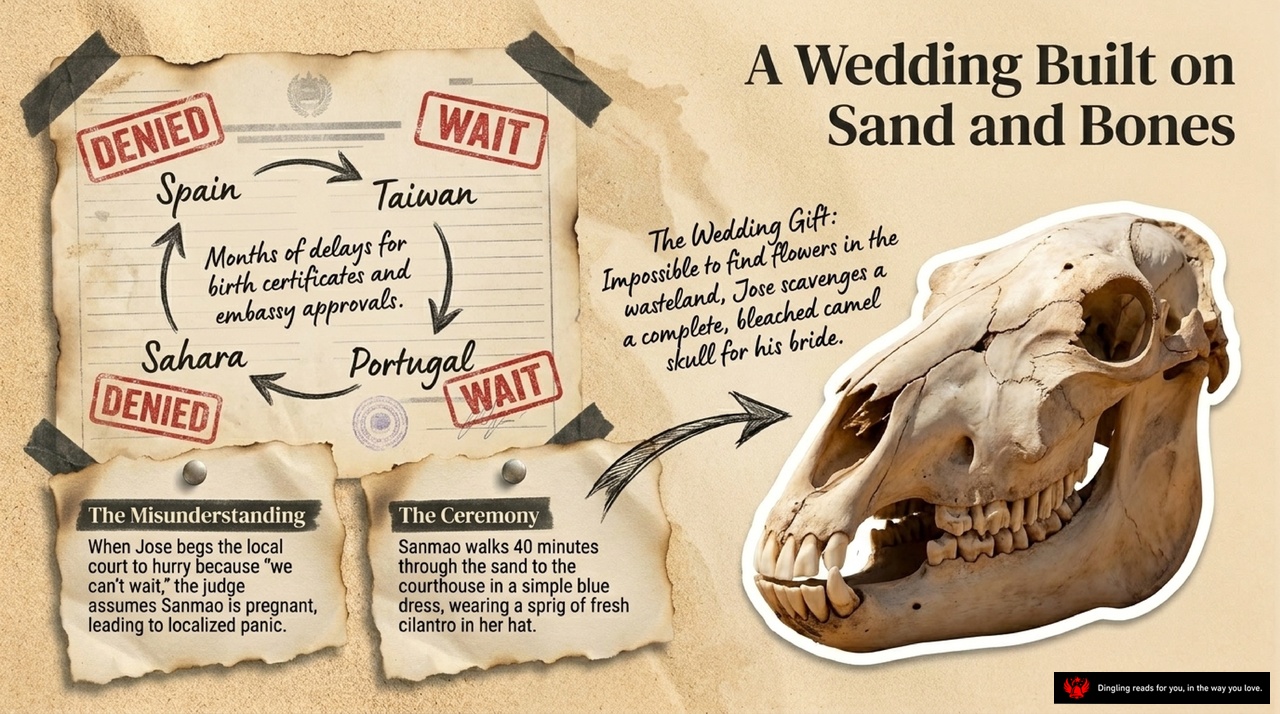
Imagine a wedding built on sand and bones. In the heart of the Sahara, Jose and Sanmao faced a bureaucratic nightmare that turned their dream into a chaotic chase. Their marriage certificate was denied in Spain, then denied in the Sahara, with endless "WAIT" stamps blocking their path between Taiwan, Portugal, and the desert. Months passed as they waited for birth certificates and embassy approvals, a delay that nearly caused panic when Jose begged the court to hurry, only for the judge to mistakenly assume Sanmao was pregnant.
But love found a way through the red tape. When it finally came time for the ceremony, Sanmao walked forty minutes through the scorching sand to the courthouse in a simple blue dress, wearing a sprig of fresh cilantro in her hat. Jose, unable to find flowers in the wasteland, scavenged a complete, bleached camel skull as her wedding gift. As they stood before the judge, a young man shaking so hard he couldn't hold his pen, they exchanged vows. In that moment, amidst the dust and the absurdity, their bond was sealed—not on paper, but on the very bones of the desert they called home.
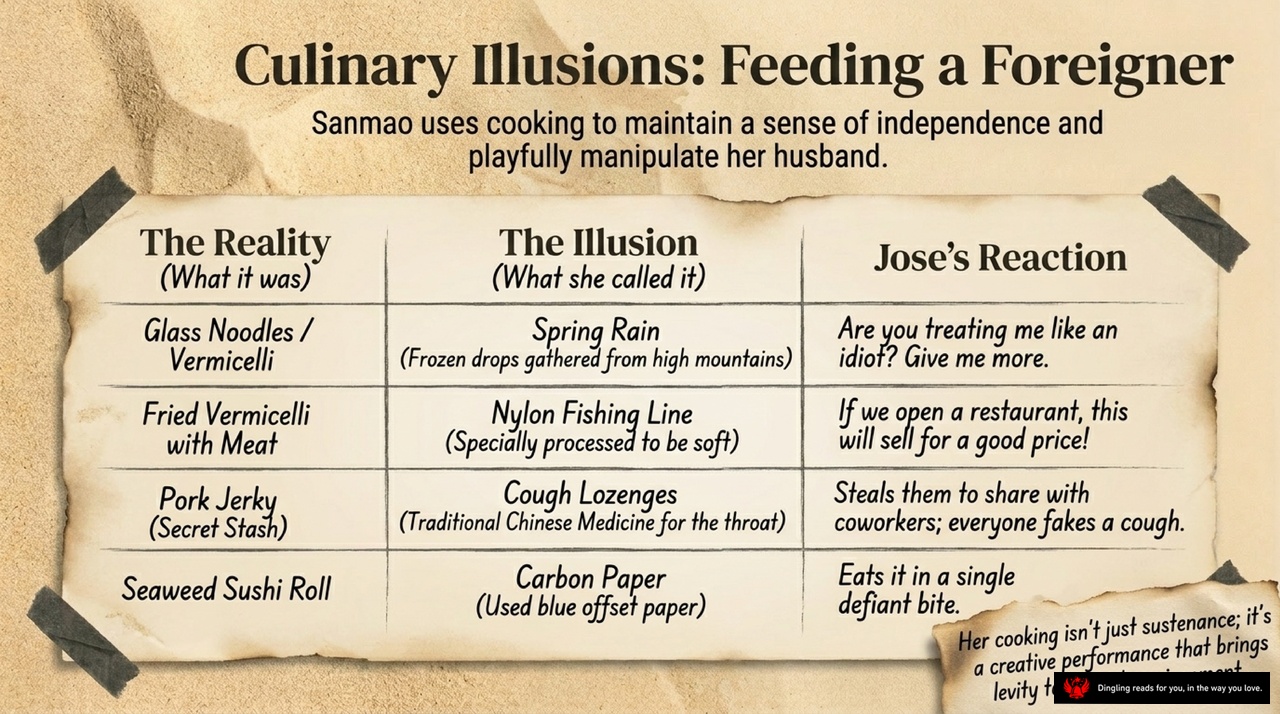
Picture: Culinary Illusions: Feeding a Foreigner
Text: Sanmao uses cooking to maintain a sense of independence and playfully manipulate her husband.
Reality: Glass Noodles, Fried Vermicelli, Pork Jerky, Seaweed Sushi Roll
Illusion: Spring Rain, Nylon Fishing Line, Cough Lozenges, Carbon Paper
Jose's Reaction: "Are you treating me like an idiot?", "This will sell for a good price!", "Everyone fakes a cough", "Defiant bite"
Sanmao's cooking in the Sahara wasn't just about feeding her husband, Jose; it was a high-stakes game of creative performance art. She turned simple ingredients into elaborate illusions to keep her independence alive while playfully teasing him.
When Jose came home starving, she served glass noodles but called them "Spring Rain"—frozen drops gathered from high mountains. Jose, skeptical yet hungry, asked, "Are you treating me like an idiot? Give me more," but he ate it all, never realizing the truth. Next, she fried vermicelli with meat and labeled it "Nylon Fishing Line," specially processed to be soft. Jose loved it so much he declared, "If we open a restaurant, this will sell for a good price!"
She even hid pork jerky in her stash, disguising it as traditional cough lozenges for Jose's sore throat. He stole them to share with coworkers, who all started faking coughs just to get a taste. Finally, she rolled seaweed sushi but called it "Carbon Paper." Jose refused to eat it at first, thinking it was blue offset paper, but after a defiant bite, he realized the truth.
Her cooking wasn't just sustenance; it was a creative performance that brought levity to their desert life, proving that love could be found in the most unexpected places.
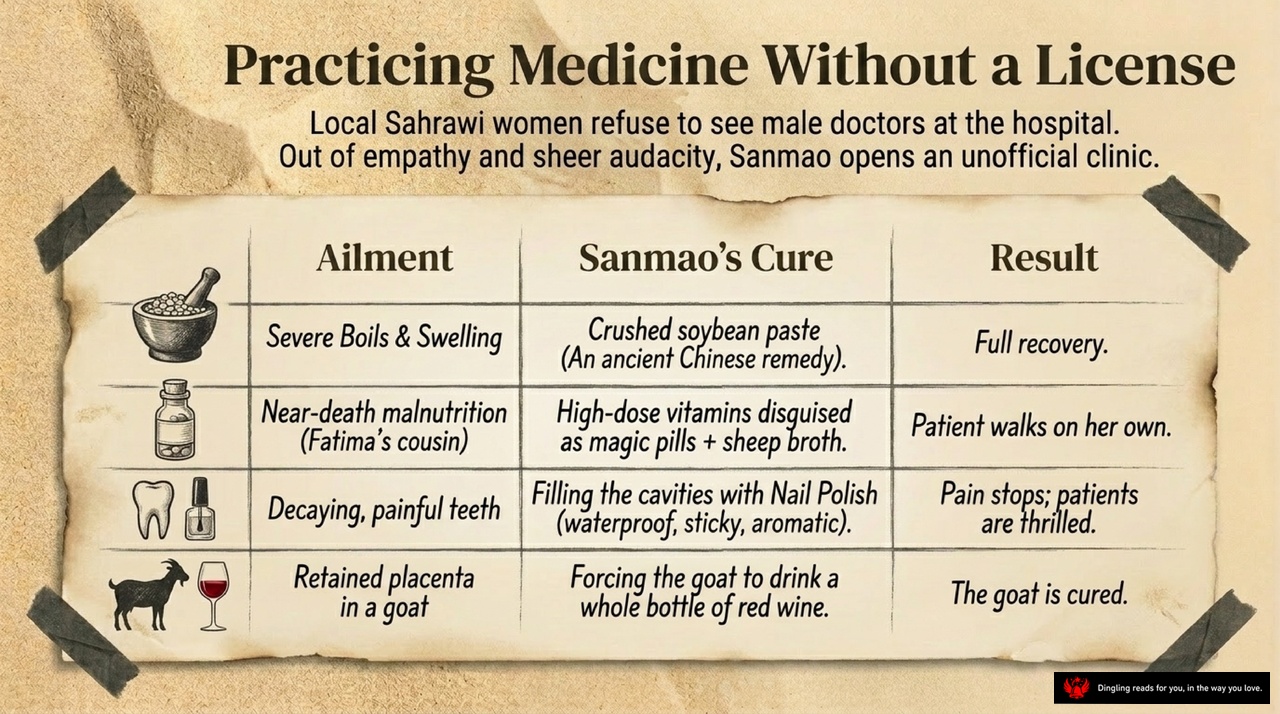
Look at this table, titled "Practicing Medicine Without a License." It tells the story of Sanmao, who, out of sheer empathy and audacity, opened an unofficial clinic in the desert because local Sahrawi women refused to see male doctors at the hospital.
Here, she lists her most unconventional cures. For severe boils and swelling, she used crushed soybean paste, an ancient Chinese remedy that led to full recovery. When a patient named Fatima's cousin was near death from malnutrition, Sanmao disguised high-dose vitamins as magic pills and served them with sheep broth, and the patient walked away on her own.
Her creativity didn't stop there. For decaying, painful teeth, she filled the cavities with nail polish—waterproof, sticky, and aromatic—which stopped the pain and thrilled the patients. And in one bizarre case involving a goat with retained placenta, she forced the animal to drink a whole bottle of red wine, curing it completely.
These aren't just medical tricks; they are acts of radical kindness. In a harsh environment, Sanmao used whatever she had to heal, proving that compassion knows no license.
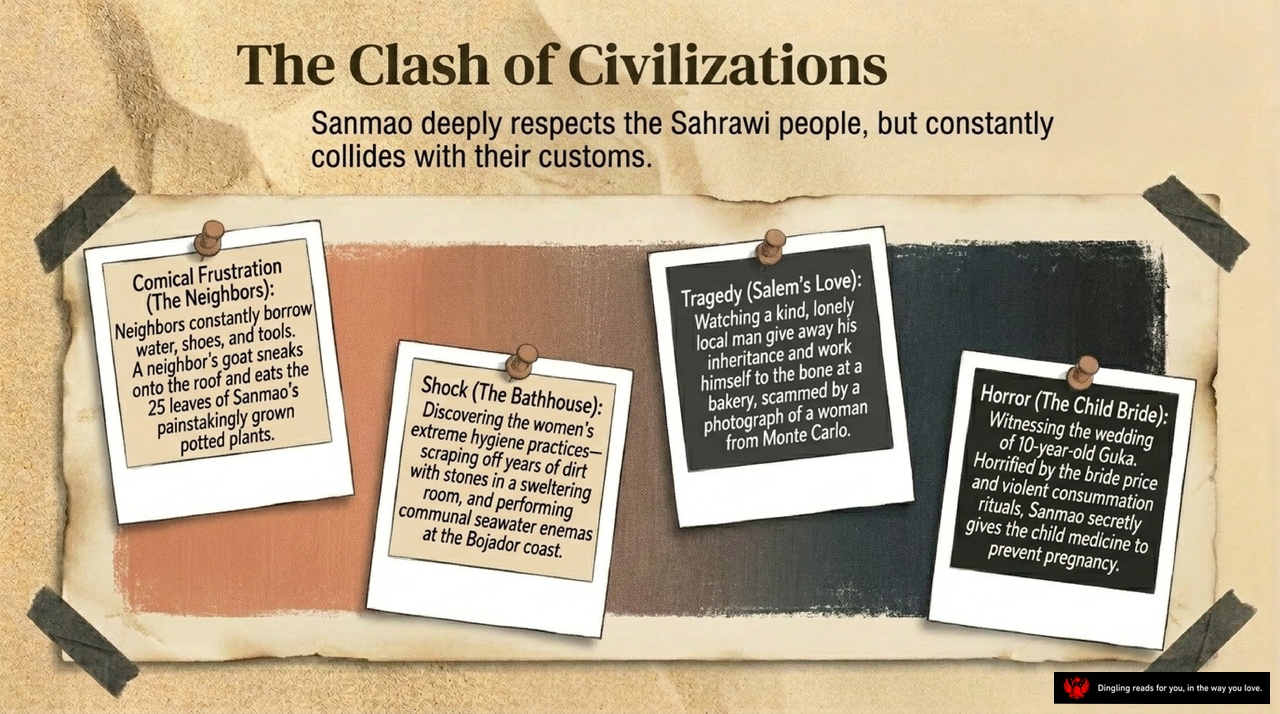
Sanmao deeply respects the Sahrawi people, yet she constantly collides with their customs in ways that range from the comically frustrating to the utterly horrifying. First, there's the "Comical Frustration" of her neighbors. They constantly borrow her water, shoes, and tools. In one incident, a neighbor's goat sneaks onto the roof and eats all 25 of Sanmao's painstakingly grown potted plants. Then comes the "Shock" at the local bathhouse. Sanmao discovers the women's extreme hygiene practices—scraping off years of dirt with stones in a sweltering room, and even performing communal seawater enemas at the coast. It is a culture clash that leaves her reeling.
But the real tragedy unfolds in "Salem's Love." Sanmao watches a kind, lonely local man give away his entire inheritance and work himself to the bone at a bakery, only to be scammed by a woman from Monte Carlo. This story of betrayal cuts deep. Finally, there is the "Horror" of "The Child Bride." Sanmao witnesses the wedding of a 10-year-old girl named Guka. She is horrified by the bride price and the violent consummation rituals. In a desperate act of compassion, Sanmao secretly gives the child medicine to prevent pregnancy, trying to save her from a life of suffering. These moments define her struggle: a clash between her humanistic values and the harsh, traditional realities of the desert.
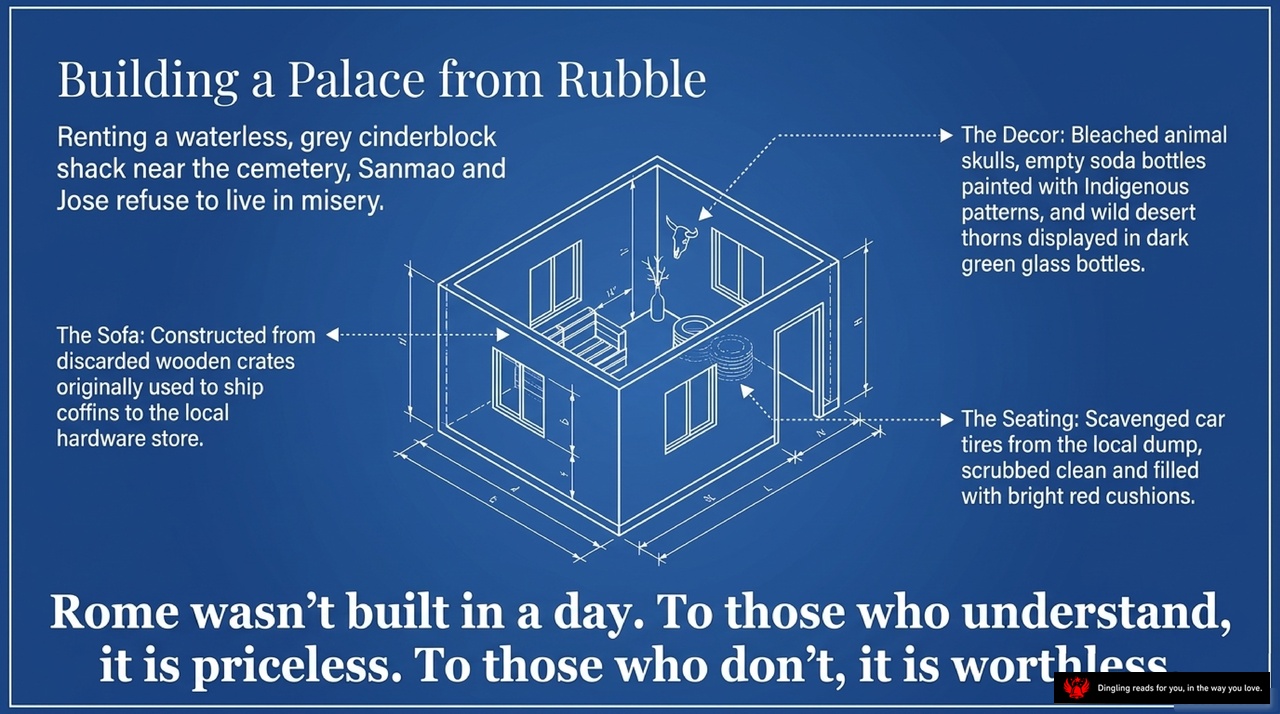
Welcome to the final chapter of our journey through the Sahara. Today's slide, titled "Building a Palace from Rubble," captures the very essence of Sanmao's life in the desert: the art of transforming nothing into everything.
Look at the blueprint in the center. This isn't just a house; it's a masterpiece of resourcefulness. The text tells us Sanmao and Jose refused to live in misery, even in a waterless, grey cinderblock shack near a cemetery. Instead, they chose to build a palace from rubble.
Notice the details around the structure. The seating, described as scavenged car tires scrubbed clean and filled with bright red cushions, turns a symbol of danger into a vibrant, welcoming spot. The sofa, constructed from discarded wooden crates originally used to ship coffins, becomes the heart of their living room. And the decor? Bleached animal skulls, empty soda bottles painted with indigenous patterns, and wild desert thorns in dark green glass bottles. It's a home filled with the raw, poetic beauty of the desert itself.
The slide concludes with a powerful quote: "Rome wasn't built in a day. To those who understand, it is priceless. To those who don't, it is worthless." This perfectly encapsulates the lesson of the Sahara. True value isn't found in expensive materials or modern comforts, but in the creativity, resilience, and love poured into building a life from the scraps of the world.
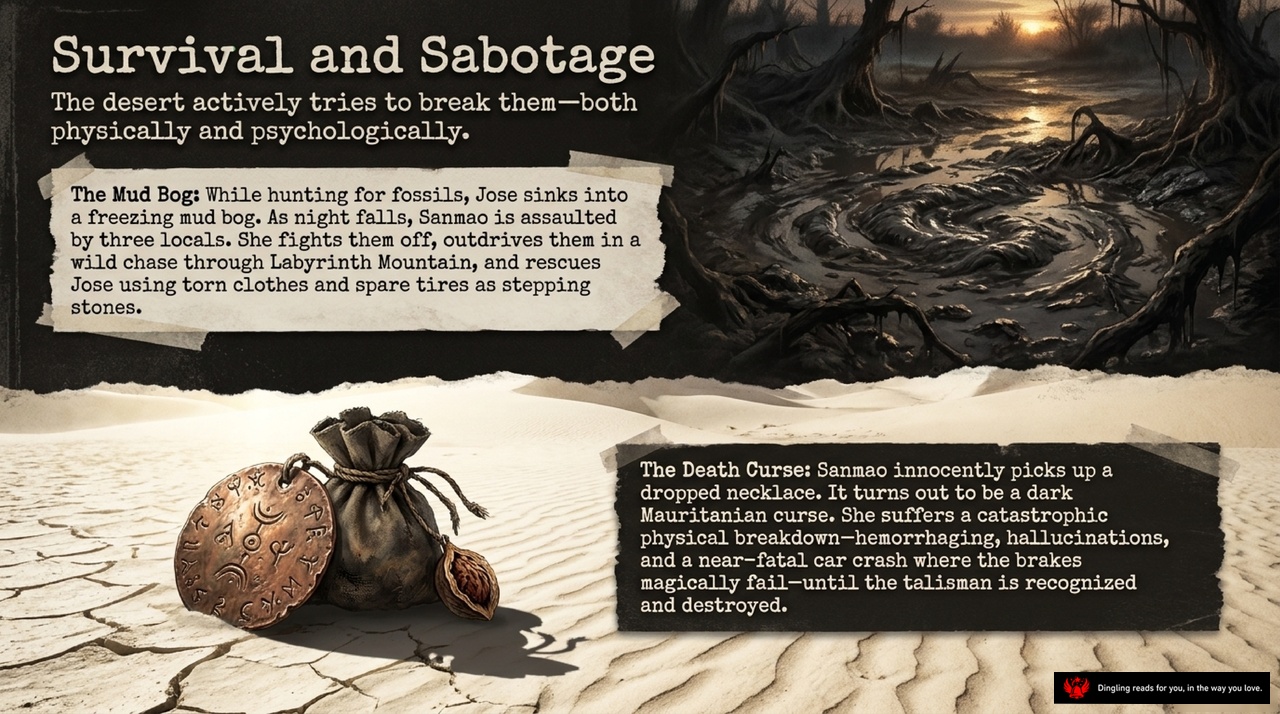
The desert doesn't just exist; it actively hunts you, trying to break you both physically and psychologically. Look at this slide: "Survival and Sabotage." It captures the brutal duality of life in the Sahara.
First, we have "The Mud Bog." While Jose was hunting for fossils, he accidentally sank into a freezing mud bog. As night fell, Sanmao was assaulted by three locals. She fought them off, outran them through the treacherous Labyrinth Mountain, and managed to rescue Jose using torn clothes and spare tires as stepping stones. It was a raw battle for survival against the elements and hostile humans.
Then, there is "The Death Curse." Sanmao innocently picks up a dropped necklace, unaware it is a dark Mauritanian curse. The consequences are catastrophic: she suffers from hemorrhaging, hallucinations, and even a near-fatal car crash where the brakes magically fail. It's only when the talisman is recognized and destroyed that she escapes death.
These stories show that in the desert, a single mistake can be fatal, and the environment itself is an enemy waiting to strike.
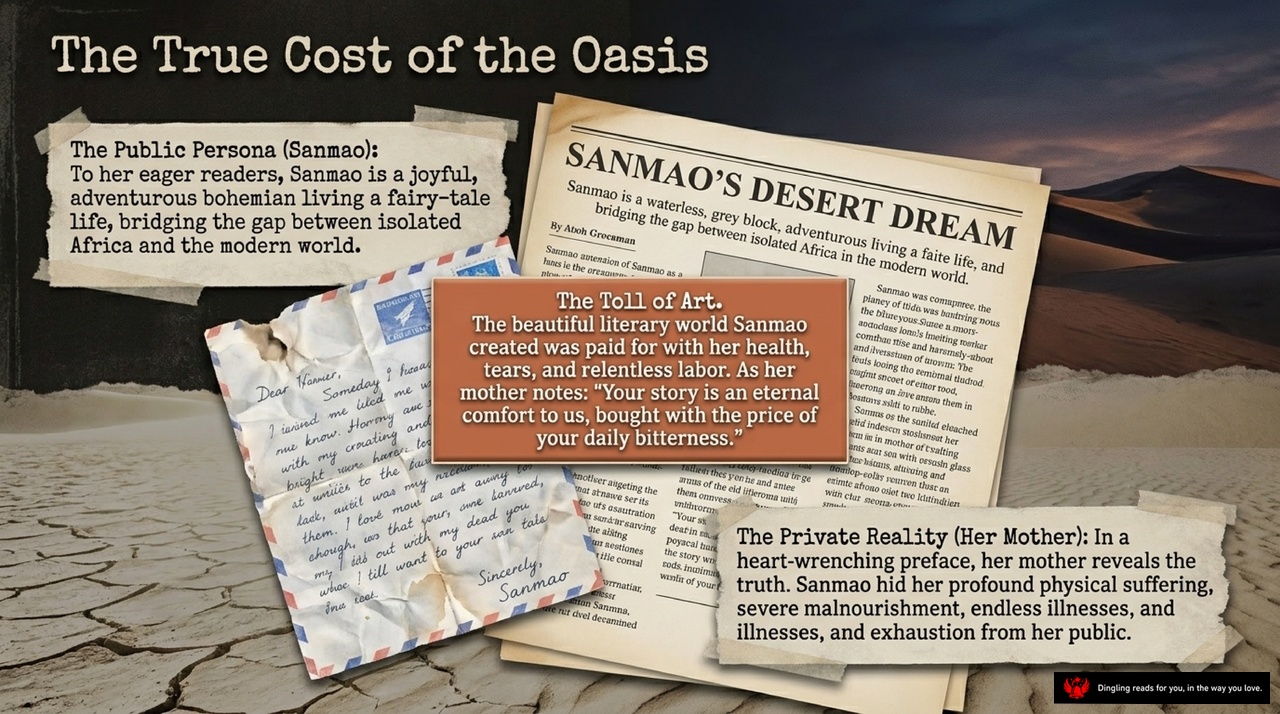
Welcome to the next chapter of our journey into the heart of the Sahara. Today's slide is titled "The True Cost of the Oasis," and it captures a profound duality that defined Sanmao's life in the desert.
On the left, we see the "Public Persona." To her eager readers, Sanmao was a joyful, adventurous bohemian bridging the gap between isolated Africa and the modern world. She was the storyteller everyone wanted to know. But look at the center and the bottom right. This reveals "The Toll of Art" and "The Private Reality." Behind that beautiful literary world Sanmao created, there was no fairy tale. There was only health sacrificed, tears shed, and relentless labor. As her mother painfully noted, her story was an eternal comfort to others, but it was bought with the price of her daily bitterness.
While the public saw a vibrant life, the private reality was one of profound physical suffering, severe malnourishment, endless illnesses, and exhaustion. Sanmao hid this truth from her readers, presenting a desert dream that was actually a waterless, grey block of survival. This slide reminds us that every great story has a hidden price, paid by the one who tells it.

Sanmao's story in the Sahara is far more than a travelogue; it stands as a powerful testament to human resilience and creativity. As the slide reminds us, Sanmao proved that paradise isn't a place you find, but a reality you construct. Through humor, boundless empathy, and sheer willpower, she transformed a brutal wasteland, absurd bureaucracy, and severe poverty into a deeply poetic masterpiece.
Consider this incredible image: Sanmao turned literal coffin crates into the foundation of her dream home. This act of repurposing waste into beauty challenges us all. In your own life, what 'refuse' or hardship are you currently avoiding? Could that very struggle be repurposed into the foundation of your greatest creation? The desert taught Sanmao that even in the harshest conditions, one can build a sanctuary for the soul, turning the impossible into a home.