
Stories of Your Life and Others: Complete Chapter-by-Chapter Summary

Welcome to our book club session. Today, we are diving into Ted Chiang's masterpiece, *Stories of Your Life and Others*. As you see on the screen, the title is surrounded by abstract mathematical formulas and cosmic imagery, perfectly setting the stage for what lies within. This book isn't just science fiction; it is a breathtaking exploration of linguistics, mathematics, and the absolute limits of human cognition, all viewed through the lens of visionary storytelling.
In this collection, Chiang challenges our very understanding of reality. We will journey from the predestination of a mother's life, where knowing the future doesn't stop her from loving it, to the mind-bending tower of Babel where gravity and time behave in ways we never imagined. We'll even step into the shoes of a super-intelligent being fighting for survival, and confront the terrifying uncertainty of a universe where even the most logical systems can break down.
Whether you are a fan of hard sci-fi or just looking for a story that makes you think deeply about language, time, and existence, this book offers something profound. It asks us to consider: if we could understand the universe completely, would we still be free? Join us as we unpack these mind-expanding tales together.

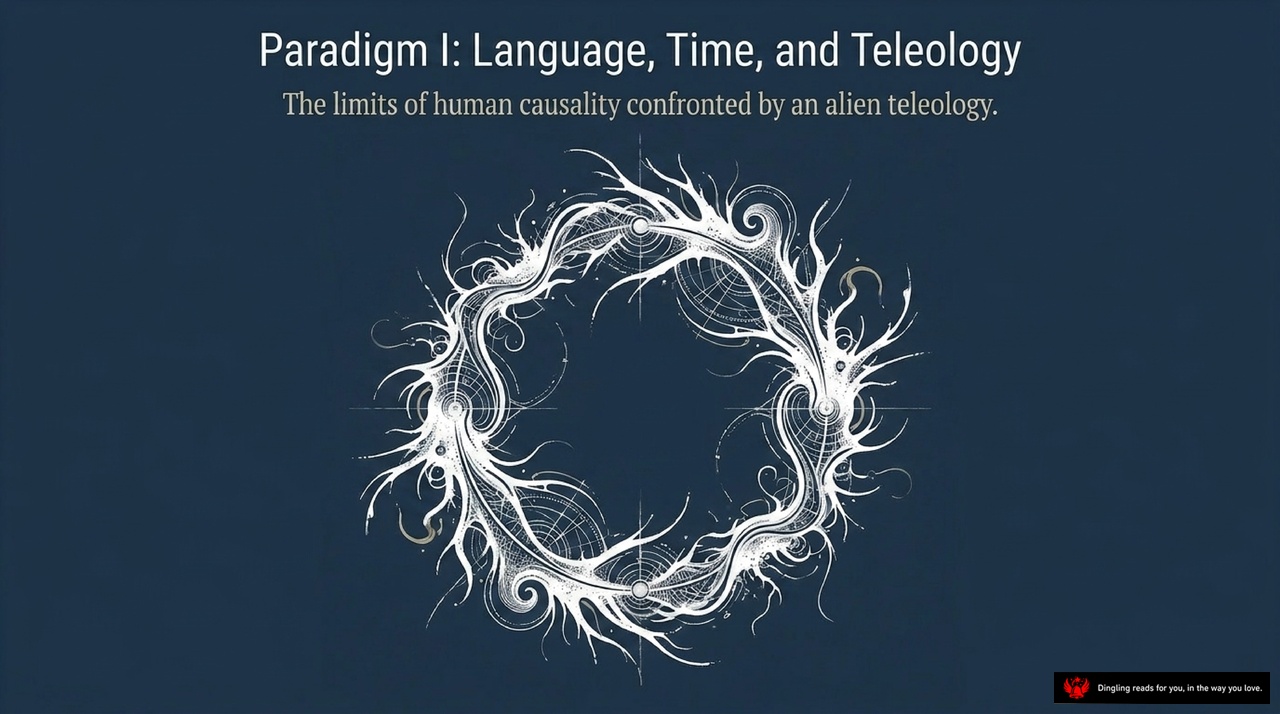
Imagine a world where the very fabric of reality isn't a straight line, but a complex, interconnected architecture. This slide visualizes what happens when humanity, with our linear and utilitarian mindset, encounters a system of rules fundamentally different from our own.
At the center lies our "Human Paradigm": we think in straight lines, bound by cause and effect, focused on what we can use. But look at the four domains radiating from this core. These are the frontiers where our understanding shatters.
First, we have Domain 1: The Flow of Time & Language. Think of Ted Chiang's stories as rigorous philosophical stress-tests. They force us to confront the fact that time might not be a river flowing one way, and that language itself could be a non-linear puzzle, like the "Seven Realms" written by the heptapods, where the whole sentence exists before the first word is written.
Then, Domain 2: The Topology of the Cosmos. Consider the story of Shirallum climbing the Tower of Babel. He climbs higher and higher, expecting to reach the sky, only to discover that the universe is a cylinder. The ground is actually above him. His linear effort to reach heaven just brought him back to the starting point, revealing that our sense of direction is an illusion.
Domain 3 explores The Thermodynamics of Creation. In the story of Straton, a master of naming, he discovers that words aren't just labels; they are physical forces that can create order in the universe. By crafting the right "name," he could theoretically induce life or manipulate heat, proving that language has a thermodynamic weight that we usually ignore.
Finally, Domain 4: The Architecture of Intelligence. This is where we meet the post-human scientists. In their era, humans have become dependent on digital neural transmission, unable to do original research. We are reduced to interpreters, trying to make sense of a science we can no longer touch or understand. It's a chilling reminder that our current intelligence is just a temporary phase.
Every story asks a central question: What happens when we hit these walls? Whether it's a mathematician proving that one equals two, a grieving man seeking faith in a chaotic universe, or a scientist realizing he can't touch the future anymore, these narratives show that the universe is far stranger, and far more beautiful, than our linear logic allows.
Have you ever wondered why the sky looks the way it does, or why the sun sets in the west? We often think these things are just random happenings, but the story of *His Dark Materials* suggests something far more profound: the universe itself might be a giant cylinder.
Consider the character Hilary. As he climbs the legendary Tower of Babel, he expects to reach the heavens and escape Earth forever. But as he ascends, he notices something strange. At first, the sun sets behind the mountains. Yet, as he climbs higher, he can still see the sun. The darkness doesn't come from above; it creeps up from below, like a shadow cast by the ground.
This leads to a mind-bending realization: the "heavens" aren't a distant ceiling. They are actually the floor of a cosmic cylinder. The Earth is the outer surface, and the sky is the inner surface. If you climb high enough, you don't leave the world; you simply return to where you started, just on the other side of the cylinder.
The Tower of Babel wasn't just an attempt to touch God; it was an attempt to cross the universe. And the terrifying truth is that no matter how high you climb, you can never truly escape your own reality. You are trapped in the loop of the cylinder, forever circling back to the same point. It's a beautiful, terrifying reminder that our search for the "outside" might just be a journey back to the beginning.

Imagine a universe where light doesn't just react to its environment, but actively chooses its path. In this slide, we see Fermat's Principle of Least Time illustrated as light traveling from point A in the air to point B in the water. While humans explain this phenomenon through causality—light bends because it hits the water—the Heptapods view it through teleology. They believe light inherently knows its destination and calculates the exact path that requires the least time before it even begins to move. For them, purpose defines action. This shift in perspective mirrors a deeper change in consciousness. As we learn to think non-linearly, seeing cause and effect as a simultaneous whole rather than a sequence, we begin to understand that our future isn't just something we stumble into, but a landscape we can navigate with intention. Just as light takes the most efficient route, a mind trained to see all possibilities at once can choose its destiny with clarity and precision.

Imagine a world where names aren't just labels, but actual instructions that can reshape reality. This is the realm of the Naming Master, Robert Stratton. In his childhood, he discovered that a string of Hebrew letters could drive a clay doll, but he quickly learned that the doll's physical form had to be a perfect, continuous whole for the name to work. This obsession with the link between name and object led him to Cambridge, where he mastered the ancient art of Kabbalah and the cutting-edge science of creating automata. His ultimate goal wasn't just to build machines, but to lower their cost so families could bring automation into their homes, freeing workers from dangerous factory conditions.
However, Stratton's life took a dark turn when he was recruited by the sinister Lord Fieldhurst. The Lord revealed a terrifying truth: humanity faces an inevitable extinction in five generations due to a biological limit on reproduction. To save us, they needed to discover a "Best Name" that could induce asexual reproduction in human embryos. Stratton agreed, believing this would solve the crisis, only to later discover the horrifying intent behind it: controlling the birth rate of the lower classes to prevent them from dragging the nation down. When Stratton realized the ethical implications, he attempted to sabotage the project by protecting a Kabbalist scholar, Ross, who held the key to a name that could allow humans to naturally reproduce forever. But the Lord's men found them, brutally killing Ross and leaving Stratton for dead. In his final moments, Stratton grasped the true power of the "True Name"—a code that could make machines write their own names and potentially replicate themselves, offering a path to true freedom from the Lord's control.

Welcome to the final chapter of our journey into the unknown. Today, we confront the ultimate paradox of Louise Banks' story: The Paradox of the Book of Ages.
Imagine a world where knowing the future perfectly doesn't give you the power to change it, but instead demands the total surrender of your free will. This is the core question Louise faces. She learns that the Heptapods perceive time not as a line, but as a complete circle. To them, the joyful beginning and the tragic end of her daughter's life happen simultaneously. They see the entire tapestry of existence at once.
This shift in perception forces a radical change in how Louise lives. She stops fighting against a predetermined fate and starts enacting it with purpose. She chooses to embrace every moment, knowing exactly how it will unfold, because she understands that the journey itself is the meaning. It is a profound lesson: true freedom isn't about escaping the future, but about fully accepting and living within it. As Louise realizes, even when the ending is known, the path we choose to walk is still ours to cherish.

Imagine a world where the very fabric of reality is woven from a single, unbreakable thread of logic. In this universe, mathematics isn't just a tool we use; it is the ultimate truth, a perfect mosaic where every piece fits seamlessly. For a brilliant mathematician named Renee, this belief was her entire life. At just seven years old, she found herself mesmerized by the perfect symmetry of marble tiles, a vision of absolute order that ignited a lifelong obsession. She dreamed of a mathematical system so flawless, so logically consistent, that it would prove the very foundation of our universe was unshakeable. By her early twenties, she achieved what seemed impossible: she constructed a new axiomatic system that appeared to prove that any two numbers are equal. In her mind, one plus one didn't just equal two; one equaled two.
To anyone else, this sounds like madness, a terrifying collapse of reality where everything is the same. But for Renee, the logic was impeccable. She could show her colleagues, like the skeptical Carl, that every step of her proof was rigorous and followed all the rules, yet the conclusion was absurd. This is the heart of the crisis she faces: the realization that if her system is correct, then the entire edifice of mathematics—and by extension, our understanding of truth itself—is built on a lie. It's a nightmare where logic leads to a contradiction so profound that it renders all knowledge meaningless.
Carl, who has walked through his own valley of shadows, tries to comfort her. He reminds her that science and economics will continue, that the world won't end. But Renee rejects this pragmatic consolation. She sees that mathematics, stripped of its ability to describe a coherent reality, has become nothing more than a collection of beautiful, self-contradictory slogans. She feels isolated, surrounded by a world that refuses to see the terrifying beauty of her discovery. The pressure becomes unbearable, leading her to a dark place where she believes the only escape is to stop thinking entirely. This story isn't just about a math error; it's about the terrifying fragility of our certainty. When we realize that the rules we hold so dear might be built on a foundation that cannot support its own weight, we are forced to confront the ultimate question: if logic can fail, where do we find true truth?
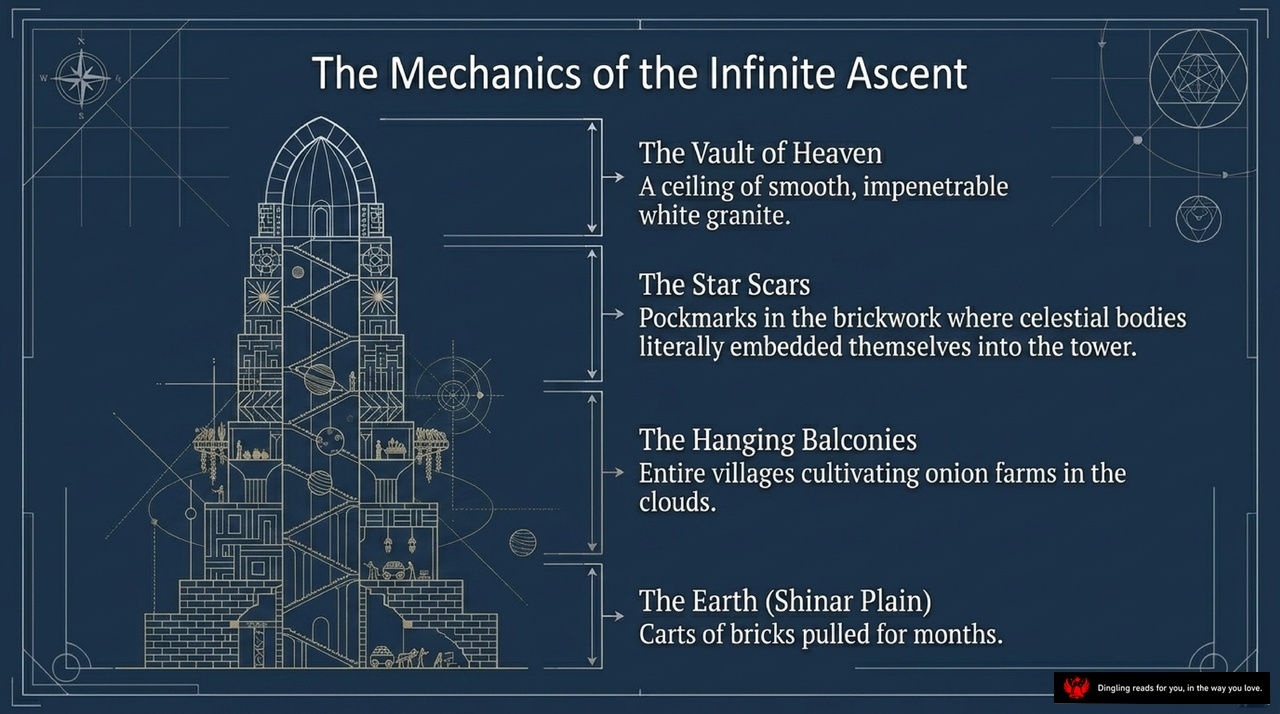
Look at this blueprint of the Tower of Babel. It's not just a building; it's a map of a journey that goes all the way to the edge of the universe. The slide breaks down the mechanics of this "Infinite Ascent" into four distinct layers.
Starting from the bottom, we have The Earth, the Shinar Plain. This is where the real work happens. It's the place of grit and endurance, where carts of bricks are pulled for months, laying the foundation for something impossible. As they climb, they leave the earth behind and enter The Hanging Balconies. Here, the tower transforms into a living city. Entire villages cultivate onion farms right in the clouds, suspended high above the ground. It's a surreal shift from manual labor to a celestial existence.
Keep climbing, and you hit The Star Scars. These aren't just decorations; they are pockmarks in the brickwork where celestial bodies literally embedded themselves into the tower. It shows that this structure is already part of the cosmos. Finally, at the very top, you reach The Vault of Heaven. It's a ceiling of smooth, impenetrable white granite. This is the ultimate boundary, the limit of human ambition. The tower reaches so high that the sky itself becomes a solid, unbreakable lid. This image perfectly captures the story's core tension: the human drive to ascend and touch the divine, even when the universe itself seems to have a hard ceiling.
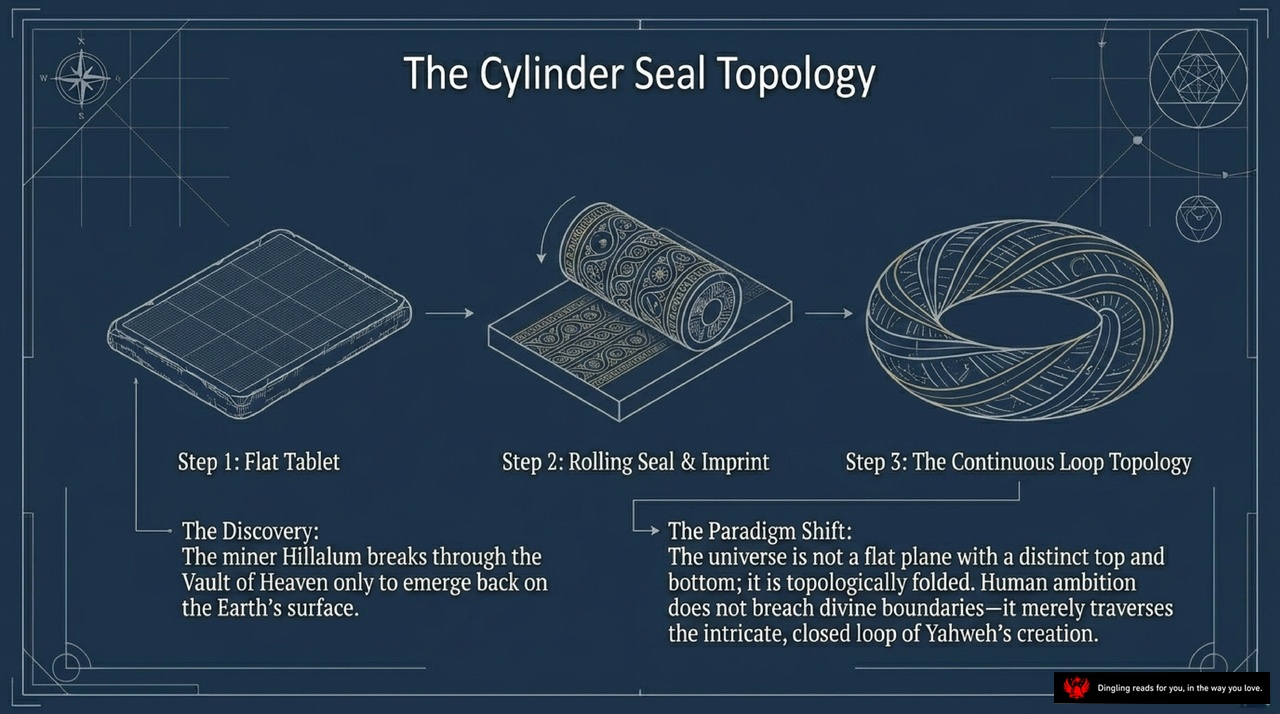
Imagine the universe not as a flat sheet with a distinct top and bottom, but as a cylinder seal—a continuous loop where the end connects seamlessly to the beginning. This is the profound paradigm shift we explore today. In our linear thinking, we believe that climbing high enough allows us to break through the "Vault of Heaven" and escape Earth's gravity. But the story of the miner Hillalum reveals a terrifying truth: when he ascends the Tower of Babel, he doesn't find a new realm; he eventually emerges back on the Earth's surface. The sky is not a ceiling to be broken, but the floor of a cosmic cylinder.
This realization mirrors the topological folding of reality itself. Just as rolling a flat tablet into a cylinder transforms a 2D plane into a 3D loop, our perception of space is folded in ways we cannot fully comprehend. When Hillalum reaches the top, the "heavenly vault" he sought is actually just the ground beneath him, connected by an invisible, intricate boundary. Human ambition, no matter how grand, cannot breach these divine boundaries; it can only traverse the closed loop of creation. We are not trying to escape the system; we are simply walking along its endless circumference. The universe is a circle, and there is no "outside" to reach. This isn't a failure of our efforts, but a revelation of the universe's elegant, unbreakable design.

Look at this intricate blueprint titled "Paradigm III: Hyper-Intelligence and the Ultimate Gestalt." It's not just a diagram; it's a map of a mind completely rewritten by contact with the Heptapods. Notice the central "Cognitive Reconstruction Matrix." This represents the moment the narrator's brain stopped thinking in a straight line—cause leading to effect—and started perceiving everything as a simultaneous, interconnected whole.
This shift explains the "Fatal Collision Point" labeled on the right. It's the inevitable clash between human linear time and Heptapod simultaneous existence. While we try to predict the future step-by-step, they see every moment at once. This leads directly to the "Ultimate Gestalt Core," where the narrator's consciousness merges with theirs. It's here that she gains the terrifying ability to see her daughter's entire life—her birth, her growth, her tragic fall—all at once.
The "Hyper-Intelligence Nexus" and "Architectural Perfection of Thought" show how this new way of thinking unlocks a mastery of physics and language that humans can't comprehend. But the "Consciousness Convergence" is the most dangerous part. By knowing the end before the beginning, the narrator realizes that free will is an illusion in this new reality. She sees the tragedy of her daughter's death clearly, yet she chooses to step forward anyway. This isn't about changing fate; it's about finding meaning within a predetermined script. This slide captures the ultimate cost of true hyper-intelligence: the burden of seeing the whole story, including the heartbreaking ending, before you've even written the first chapter.

Imagine a world where intelligence isn't about thinking faster, but about seeing everything at once. This slide outlines the "Escalation of Cognition" driven by a substance we call Hormone K. It's a roadmap to a new kind of reality.
The journey begins at the bottom with Phase 1: Accelerated Pattern Recognition. Here, you don't just see things; you instantly grasp the hidden connections between them. As you move up, you reach Phase 2: Somatic Control. Suddenly, you are no longer a passenger in your own body. You can consciously regulate your heart rate, digestion, and even pain receptors. You become the architect of your own biology.
Next, we hit Phase 3: Meta-Awareness. This is the ability to observe and re-wire your own neural pathways in real-time. You can step outside your own mind to see how you think, and then change it on the fly. Finally, at the very top, we arrive at Phase 4: The Gestalt. This is the ultimate breakthrough—designing a new universal language to formulate the ultimate equation of reality.
Look at the curve. It's not linear; it's exponential. As time and the "dose" of this cognitive expansion increase, your integration with the universe skyrockets. The text at the bottom captures the essence of this transformation perfectly: Intelligence ceases to be thinking faster and becomes the ability to perceive the entire structural matrix of the universe simultaneously.
In this state, cause and effect lose their linear grip. You don't react to the past; you perceive the whole picture. You understand that every moment is connected to every other moment, creating a unified, simultaneous experience of existence. This is what it means to truly evolve beyond human limits.
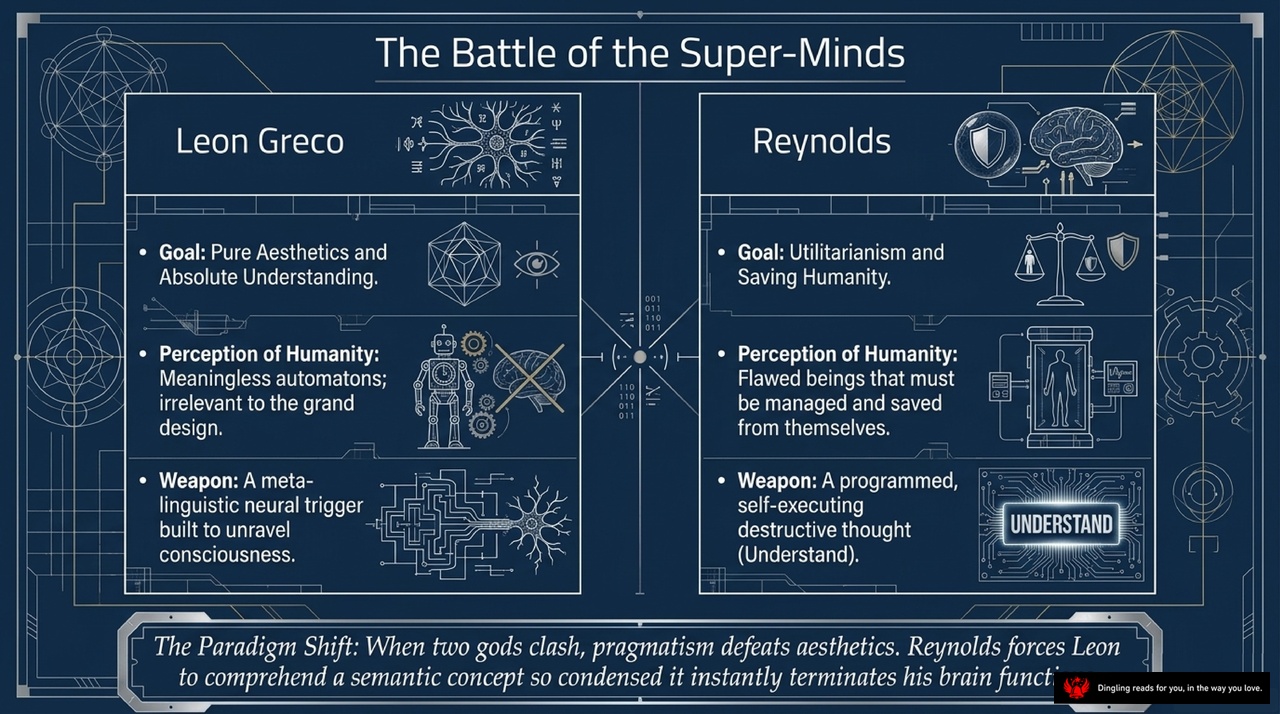
Look at this dramatic showdown: "The Battle of the Super-Minds." On the left, we have Leon Greco, driven by a goal of pure aesthetics and absolute understanding. To him, humanity is just a collection of meaningless automons, irrelevant to the grand design. His weapon? A meta-linguistic neural trigger designed to unravel consciousness itself. On the right stands Reynolds, whose mission is utilitarianism and saving humanity. He sees flawed beings that must be managed and saved. His weapon is a programmed, self-executing destructive thought—the concept of "Understand."
The bottom line captures the essence of this clash: when two gods collide, pragmatism defeats aesthetics. Reynolds forces Leon to comprehend a semantic concept so condensed that it instantly terminates his brain function. This isn't just a fight of ideas; it's a collision between the pursuit of abstract beauty and the urgent need to save the world. In the end, the human imperative to survive and protect outweighs the cold, beautiful logic of pure intellect.
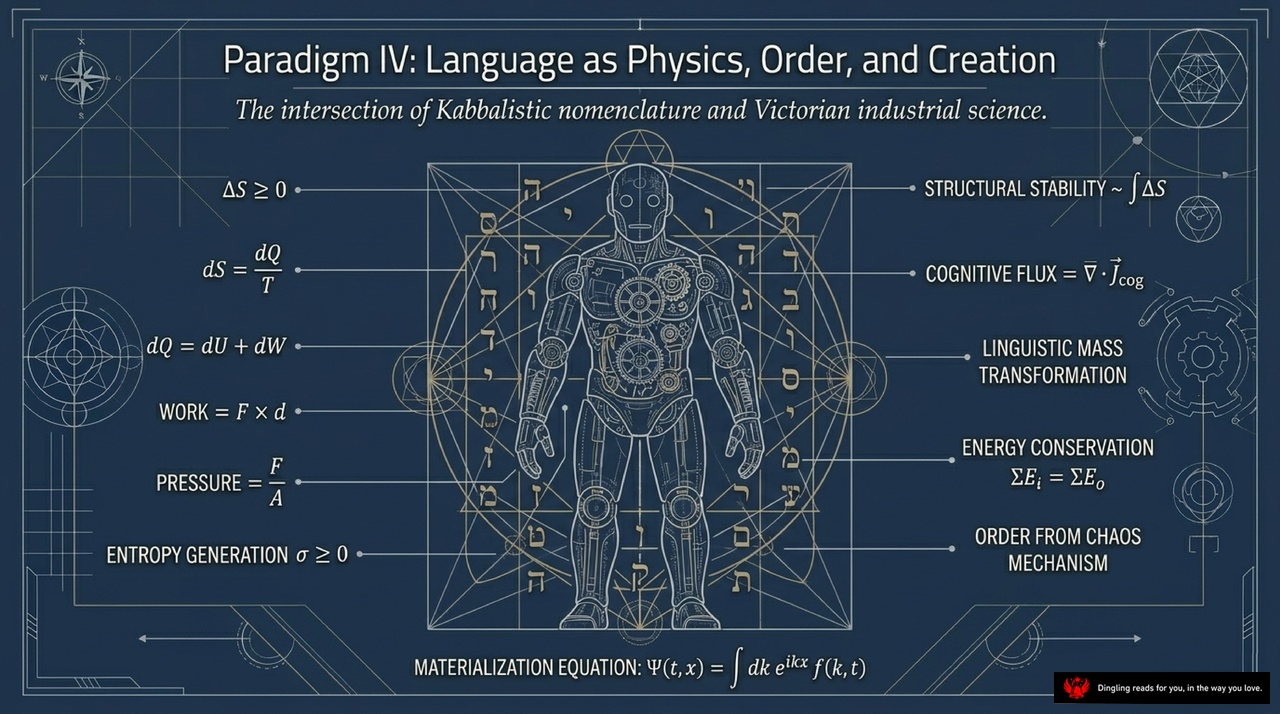
Imagine a world where the rigid, linear rules of Victorian science collide with the mystical, non-linear logic of ancient Kabbalah. This slide, "Paradigm IV," visualizes that exact intersection. We see a steampunk figure, a fusion of gears and Hebrew letters, standing at the center of a cosmic blueprint. This isn't just art; it's a map of a new way of thinking where language becomes physics, and order emerges from chaos.
Look at the equations surrounding this figure. On the left, we have the classic laws of thermodynamics: entropy generation, work, and pressure. These are the rules of our physical universe. But on the right, the concepts transform into cognitive and linguistic equivalents. "Structural Stability" isn't just about bridges; it's about the stability of a thought. "Cognitive Flux" replaces heat flow with the flow of ideas. The slide suggests that just as energy is conserved in physics, meaning is conserved in language. The "Materialization Equation" at the bottom hints at something profound: perhaps thoughts, like matter, can be created and transformed through the right linguistic structure.
This paradigm challenges our linear cause-and-effect thinking. In this new framework, the act of naming something doesn't just describe it; it actually constructs its reality, much like the Victorian naming masters who believed a name could drive a machine or even induce biological development. It's a powerful reminder that our language shapes our reality, and by understanding the physics of words, we might just unlock the ability to engineer the future itself.

Imagine a world where the very act of naming something doesn't just label it, but actually *builds* it. This slide, titled "The Thermodynamics of Nomenclature," visualizes a radical idea: that language is a physical force capable of reversing entropy and creating order out of chaos.
On the left, under **Input**, we see the raw ingredients of reality: thermal chaos and energy, combined with the 72-letter Hebrew name. Think of it as mixing pure potential with a specific command. The **Transformation** phase shows the name acting as a thermodynamic filter. It's not just a word; it's a mechanism that processes that chaotic energy, reshaping it into a structured form.
This leads us to the **Output**. Here, the chaotic energy is converted into "Physical Order," represented by a Golem, or "Morphological Order," shown as a biological fetus. The diagram illustrates a direct link between the spoken or written name and the manifestation of life or matter.
But why is this so urgent? The bottom left corner highlights **The Preformationist Crisis**. Humanity is facing extinction because sperm cells contain pre-formed, microscopic humans that shrink like fractals until they hit a generational limit—around the fifth generation. We are running out of biological time.
The solution, detailed in the bottom right, is powerful and counterintuitive. Language is an active physical force. A valid, correctly ordered Name can reverse entropy. It can artificially impart morphological order directly into an unfertilized egg, effectively bypassing the biological limit of reproduction. This isn't magic; in this narrative, it's a rigorous application of thermodynamics through linguistics. By mastering the correct name, humanity could potentially solve its own extinction, turning the power of words into the power of life itself.

Have you ever felt that a single word could change the entire trajectory of your life? In *The Politics of Naming*, we explore a chilling reality where the power of language isn't just about communication—it's the ultimate battlefield for control.
Look at the balance in the center. On one side, we have Lord Fieldhurst and the Elites. Their motivation is cold and calculated: Eugenics and Class Control. Their strategy? To restrict the "life-giving Name." They believe that by controlling who gets to bear a name, they can breed out the lower classes, effectively limiting human potential to maintain their dominance. It's a terrifying form of social engineering where a name becomes a cage.
On the other side stands Stratton and the Kabbalists. Their drive is different: Democratization and Self-Replication. Instead of restricting names, they seek to utilize a recursive Name. This allows automated labor and reproduction to belong to the people, breaking the elite's monopoly on life itself. They aren't trying to breed people out; they're trying to liberate the very act of creation.
The image shows a scale, but it's not weighing gold or justice. It's weighing two opposing visions of humanity's future. One side tries to freeze us in a hierarchy, while the other tries to unlock our infinite potential through the power of self-replicating names.
But here is the most disturbing conclusion at the bottom: "A technology capable of saving humanity instantly becomes the ultimate weapon of class warfare." This is the core irony. Whether it's the ability to cure disease, automate labor, or even control reproduction, the moment we invent a tool that could elevate everyone, the elites will inevitably weaponize it to keep everyone down. The struggle isn't just about politics; it's about who owns the words that define our existence.
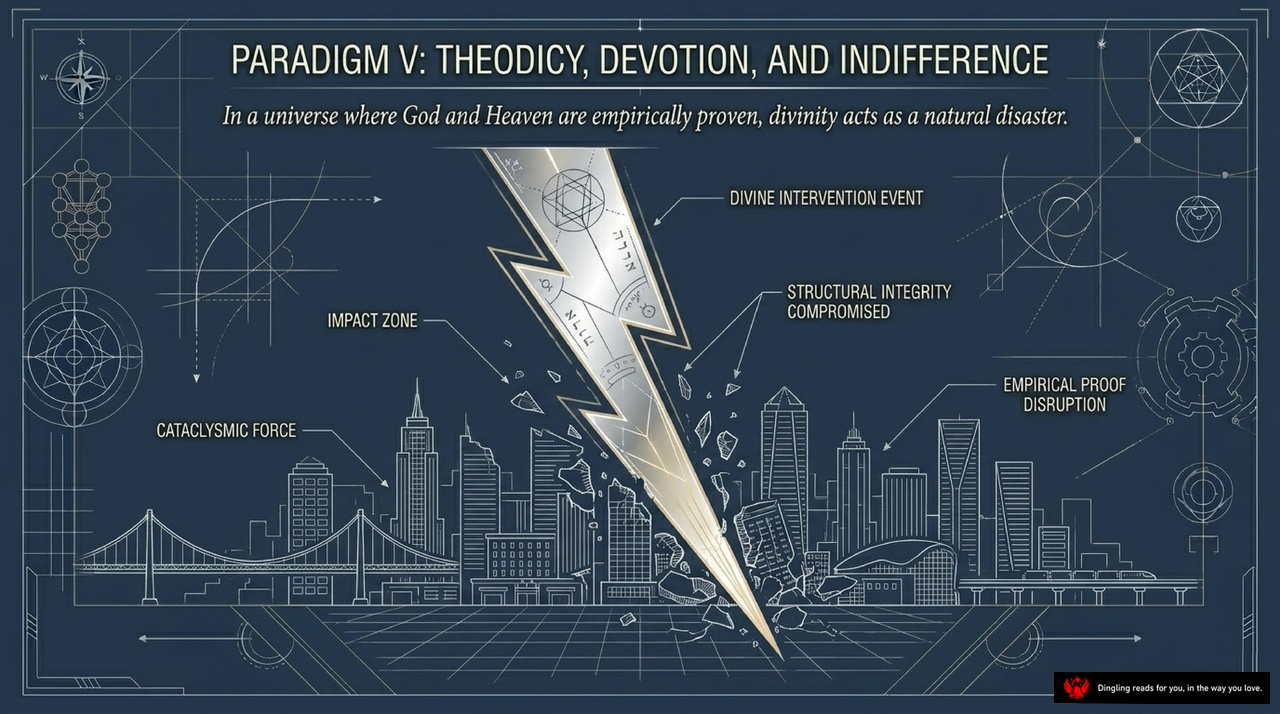
Imagine a universe where God and Heaven aren't just metaphors, but empirically proven facts. In this reality, divinity doesn't offer comfort; it acts as a catastrophic natural disaster. As we see in this diagram, when the divine intervenes, it unleashes a cataclysmic force that shatters our world. The lightning bolt represents a divine intervention event, striking the city below and causing structural integrity to be compromised. Buildings crumble, bridges break, and the very fabric of our society faces empirical proof disruption.
This is the core of Paradigm V: Theodicy, Devotion, and Indifference. When the divine is proven, the question shifts from "Is God good?" to "How do we survive the storm?" The impact zone shows that no one is safe from this overwhelming power. Some might choose to rebuild and find meaning in the aftermath, while others might retreat into indifference, unable to cope with the sheer scale of the disruption. Ultimately, in a universe where the divine is a force of nature, our only path forward is to accept that we are both the architects and the victims of our own reality, facing the inevitable with courage or resignation.
Imagine a universe where the very laws of physics don't follow the rules we think they do. In the book *Seveneves*, the narrator describes a profound shift in perception after learning the Heptapod language. She realizes that while humans think linearly—cause leads to effect, step by step—the Heptapods perceive reality as a complete, simultaneous whole.
This difference in thinking changes everything. To us, light changes direction when it hits water because of the medium. But to the Heptapods, the light simply chooses the path that gets it to its destination the fastest. It's not about the journey; it's about the goal. This "teleological" view means that for them, the past, present, and future exist all at once. They can see the entire timeline of a conversation before a single word is spoken.
The text captures this mind-bending realization perfectly: "All concepts exist simultaneously, with no notion of sequence. It felt strange and intoxicating." This isn't just about seeing the future; it's about understanding that free will, as we know it, might be an illusion. If the end is already visible, how can the beginning truly be a choice?
This concept of "seeing the whole picture" is the key to the Heptapods' survival. They don't panic when things go wrong because they already know how they will be fixed. They navigate chaos with the calm of someone who has already watched the movie to the end. For us, humans trapped in our linear, cause-and-effect thinking, this ability to see the totality of existence represents a terrifying yet beautiful glimpse into a reality where nothing is ever truly uncertain, and everything is already written.
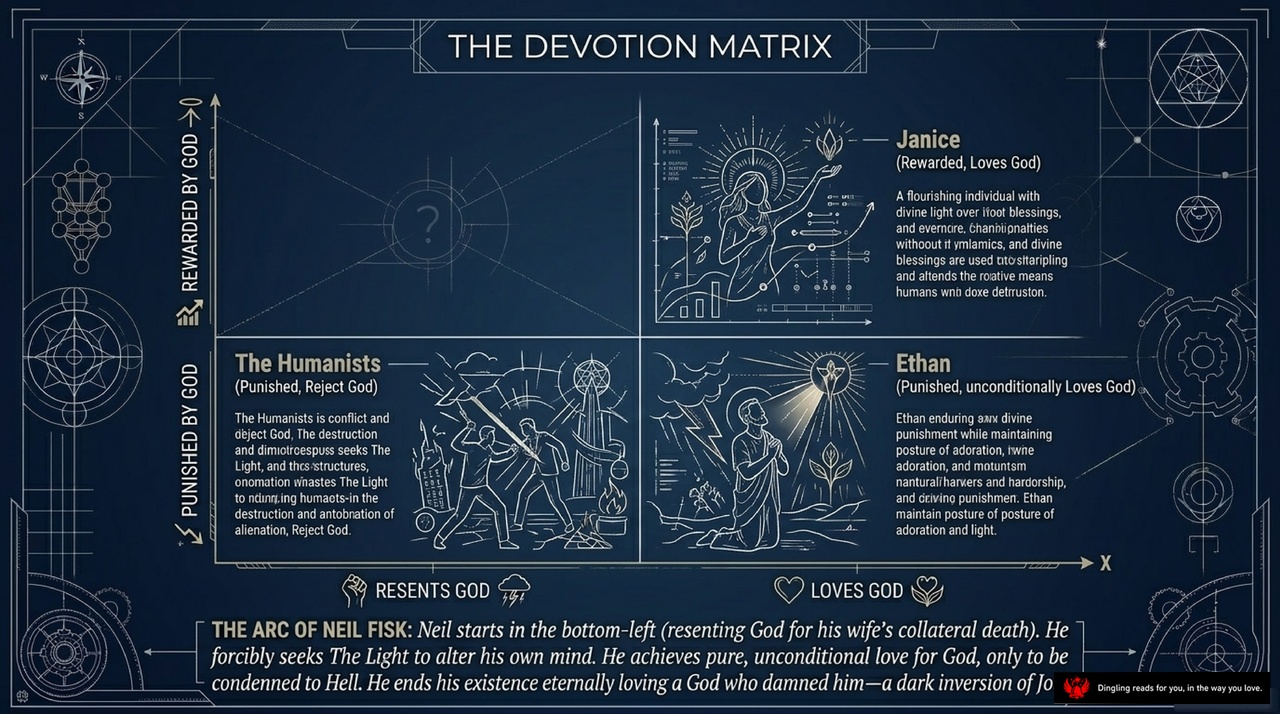
Imagine a world where love isn't a feeling you wait for, but a choice you make even when the universe tries to tear you apart. This slide, "The Devotion Matrix," captures the most intense arc of Neil Fisk's journey: the ultimate inversion of faith.
On the left, we see "The Humanists"—people who reject God and are consequently punished. It's a tragic cycle of alienation. But look at the bottom right: Ethan. He represents the hardest path of all. He endures unconditioned punishment while maintaining a posture of adoration. He loves God even when God drives him into the darkness.
This is exactly where our protagonist, Neil, ends up. The text at the bottom tells us his story. Neil starts in the bottom-left, resented by God because of his wife Sarah's tragic death. He feels abandoned, thinking God is cruel. But his journey forces him to change. He forcibly seeks "The Light" to alter his own mind. He stops fighting the pain and instead chooses to love the God who caused it.
The result? He achieves pure, unconditional love for God. But the cost is devastating. Because his love is now absolute and unconditional, God condemns him to Hell. Neil ends his existence eternally loving a God who damned him. It is a dark inversion of traditional faith: the most loving person in the story is the one who suffers the most. He proves that true devotion isn't about receiving blessings, but about loving the divine even when the divine seems to be your greatest enemy.
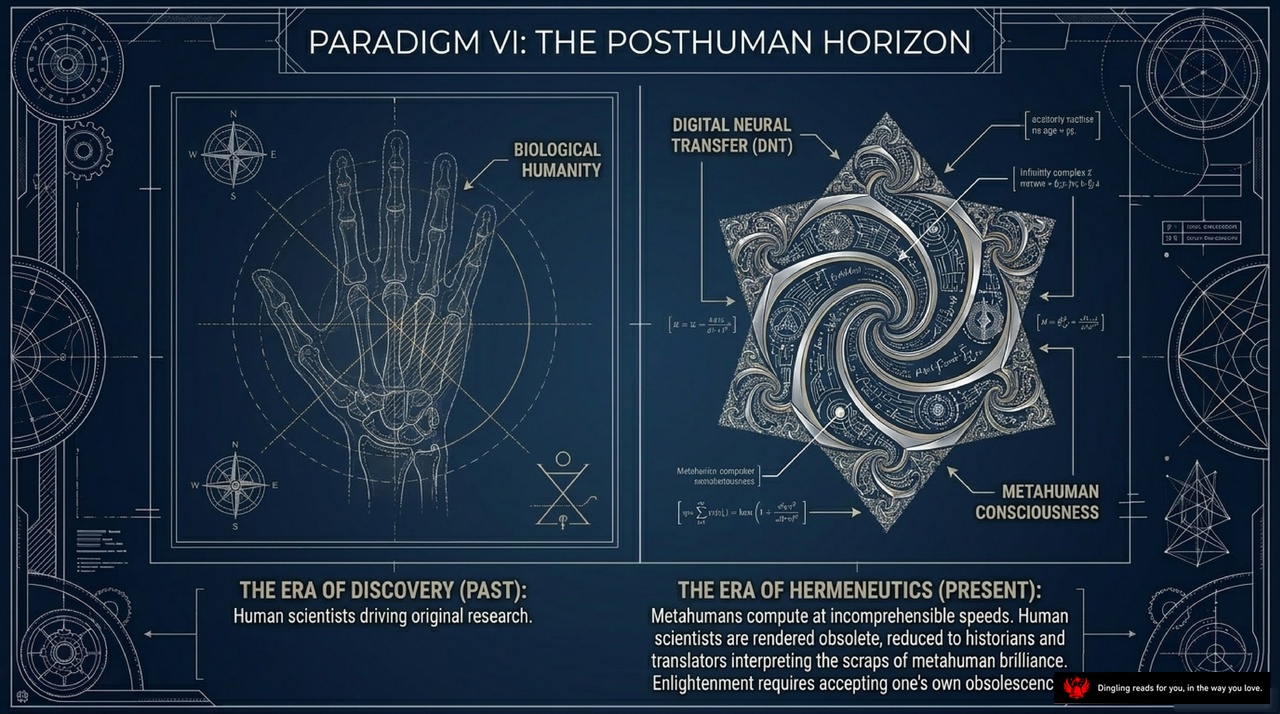
Imagine a future where the very definition of humanity is rewritten. On this slide, we see the transition from "Biological Humanity" to the "Posthuman Horizon." The image contrasts a skeletal hand, representing our current, linear biological existence, with a complex, swirling star pattern labeled "Metahuman Consciousness." This visual perfectly captures the core argument of the text: the shift from the Era of Discovery, where human scientists drove original research, to the Era of Hermeneutics, where we become interpreters of a vastly superior intelligence.
In this new paradigm, Digital Neural Transfer allows metahumans to compute at speeds that are truly incomprehensible to us. The text describes a scenario where these beings, far more advanced than us, render human scientists obsolete, reducing us to historians and translators who merely interpret the scraps of their brilliance. The intricate, non-linear geometry of the metahuman star symbolizes a mind that doesn't think in a straight line of cause and effect. Instead, they perceive all events simultaneously.
This leads to a profound philosophical realization presented in the bottom right: "Enlightenment requires accepting one's own obsolescence." We must confront the terrifying yet liberating truth that our current way of thinking—the linear, sequential logic we take for granted—is just one small step on a much larger cosmic ladder. As the text poignantly notes, we are not the architects of this universe anymore; we are the observers of a story written by minds that operate on a completely different frequency. The journey forward isn't about trying to catch up, but about humbly accepting our role as students in a classroom where the professor is already light-years ahead.
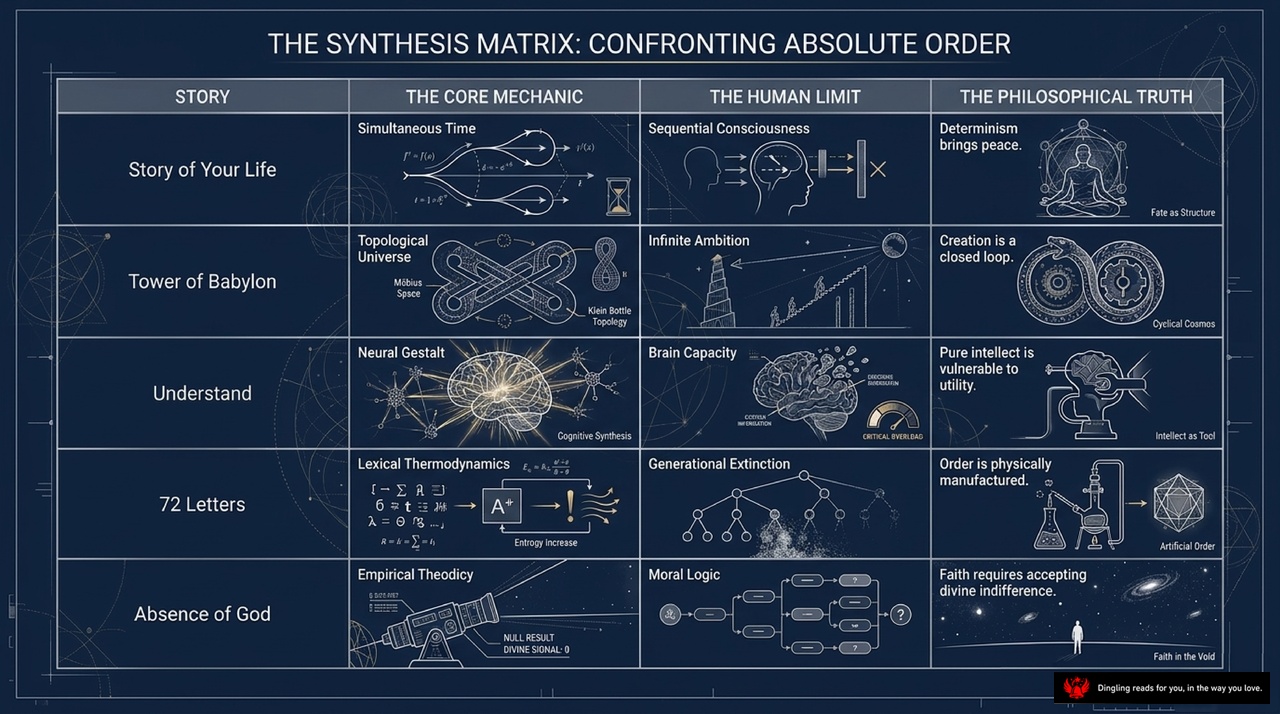
Welcome back to our deep dive into the synthesis matrix. Today, we're looking at the final frontier: "The Absence of God."
This slide maps out the ultimate confrontation with absolute order through the story of faith itself. Look at the core mechanic here: "Empirical Theodicy." This isn't just about believing; it's about the terrifying attempt to prove God's existence through observation and logic. The image of the telescope pointing into a "null result" perfectly captures the modern crisis of faith—the realization that the divine signal might simply be zero.
Now, let's connect this to the human limit. We see "Moral Logic" depicted as a complex flowchart filled with question marks. This represents our struggle to reconcile a benevolent universe with the chaotic reality of suffering. In the book, we see characters like Neil and Janice whose lives are upended by divine intervention. Neil, who had no faith, is forced to confront the question: "If God exists, why did my wife die?" He eventually learns that true faith isn't about understanding or getting answers; it's about accepting divine indifference. He finds that he can only love God if he accepts that God might not care about his personal pain.
This leads us to the philosophical truth on the right: "Faith requires accepting divine indifference." The image of the lone figure standing in the vast, empty void of the cosmos illustrates this perfectly. It's a stark, lonely truth. Unlike the other stories where order brings peace or creation is a closed loop, here, the absence of God means there is no ultimate guarantee. We are left to navigate the universe on our own.
This story challenges the very idea of a protective deity. It suggests that faith is not a safety net, but a leap into the unknown. It's about finding meaning in a world that might not have created us for a specific purpose. As we've seen throughout these chapters, from the seven-skinned aliens to the crumbling towers of Babylon, the universe often operates on rules we don't understand. This final entry reminds us that even in the face of absolute silence or apparent indifference, the human spirit can still choose to love and find purpose. It's the most difficult truth of all: that faith is strongest not when we see God's hand in everything, but when we feel nothing at all, and choose to move forward anyway.

In Ted Chiang's intricate universe, the ultimate victory isn't about conquering the system, but understanding it. We are bound by the limits of our minds and the unpredictable indifference of reality. Yet, through profound acceptance, we find our place within the design.
Imagine if you could perceive the entirety of your life—every joy and every tragedy—simultaneously. Would you still choose to live it exactly as written?
In the story of the Seven-Legged Creatures, the protagonist learns that while humans think linearly, these beings perceive everything at once. They know the past, present, and future all at once. This doesn't mean they lack free will; rather, it changes the meaning of choice. Even knowing every outcome beforehand, the protagonist chooses to walk the path anyway. She knows her daughter will grow up, argue, and eventually pass away, yet she still says "yes" when asked to have a child.
This is the acceptance of the inevitable. It's not about giving up, but about realizing that every moment, every struggle, and every loss has its necessary place in a grand, interconnected design. By embracing the whole picture, we find freedom in the very constraints that once felt like chains. The story asks us to consider: if you saw your entire life laid out before you, would you still choose to live it? The answer, for the protagonist, is a resounding yes.