
Structural Thinking: Complete Chapter-by-Chapter Summary

Welcome to our book club session on "Structural Thinking" by Li Zhongqiu. Today, we're diving into a mindset shift that can transform how you work and communicate. Think of structural thinking not just as a skill, but as the fundamental foundation for every professional you meet. Just as a volleyball player must practice setting thousands of times before they can execute a perfect spike, mastering this thinking style is the bedrock upon which all your problem-solving, decision-making, and communication rest.
The core promise of this book is simple yet powerful: learn to think clearly and express powerfully through the Pyramid Principle. It's about making your invisible thoughts visible. Whether you are crafting a complex report, pitching a solution to a client, or simply explaining an idea to a colleague, structural thinking helps you organize chaos into clarity. It ensures that your message isn't just heard, but understood and remembered. By adopting this approach, you stop getting lost in the details and start leading with the conclusion that matters most.

The Chaos of Data vs. The Clarity of Structure.
Look at the left side of this slide. It's a tangled web of lines and dots. That's what happens when we think chaotically. We just list raw facts: "Liu can't make 4 PM," "Wang is out of town," "The room is booked." It's a mess of complaints and timelines. The audience gets lost, guessing what the actual point is.
But look at the right side. That's structural thinking. We take those same messy inputs—Liu's schedule, Wang's travel, the room availability—and we organize them. We group them logically. Suddenly, the chaos resolves into a clear pyramid. We see the conclusion at the top: "We can move the meeting to Friday at 10 AM." Why? Because the attendees are free and the room is secured.
The difference is everything. Chaotic thinking leaves you stuck in the details, spinning your wheels. Structural thinking gives you a clear path from problem to solution. It transforms confusion into immediate, actionable insight. That's the power of structure.

Imagine your brain as a pyramid. This isn't just a metaphor; it's the blueprint for how we think and communicate effectively. On this slide, we see the four pillars that hold this structure together.
First, look at the very top. That's "Conclusion First." In a fast-paced business environment, nobody wants to guess where you're going. You need to state your core insight immediately. If you force the audience to guess the destination, you lose their attention right from the start.
Next, notice the layers below the top. That represents "Above Guides Below." Every single point you make must directly support the one above it. If your conclusion is about sales growth, but your supporting points are about office coffee breaks, the structure collapses. Your evidence must prove your claim.
Then, look at the base. That's where "Classify & Group" happens. Our brains aren't designed to hold a jumble of random facts; we thrive on clusters. By grouping related ideas logically—often in sets of three—you make complex information digestible. It's about turning chaos into order.
Finally, see the arrows circling the base. That signifies "Logical Progression." Once you've grouped your ideas, you have to order them deliberately. Whether it's chronological, structural, or by importance, the sequence must create a seamless flow.
When you master these four pillars, you stop rambling and start leading. You transform your thoughts from a scattered mess into a powerful, undeniable argument that anyone can follow.

Think structurally, and you transform how you listen. Instead of just absorbing words, you filter them through a three-layer system to extract the true signal from the noise.
First, at Layer 1, you **Extract**. Don't just hear the conclusion; separate the hard facts from the speaker's opinion. Ask yourself: "What are the actual numbers, and what is the real judgment behind them?"
Next, move to Layer 2 to **Map**. Visualize the mental pyramid. Connect the dots between the facts you just extracted and the overarching conclusion. Identify the vertical relationship—how do the details actually support the main point?
Finally, reach Layer 3 to **Synthesize**. Force the entire message into a single, cohesive sentence. This is your moment of clarity.
Your output formula is simple but powerful: Based on [Facts], from the perspectives of [Categories], this means [Core Conclusion]. By applying this filter, you stop listening passively and start understanding deeply, turning chaotic information into actionable insight.

Imagine your presentation is a conversation, not a monologue. To truly persuade your audience, you need to match their thinking style with your message. Today, we're diving into the two powerful engines that drive this: Deductive Reasoning and Inductive Reasoning.
Think of Deductive Reasoning as a logical proof. It's about convincing someone who might be skeptical. The most classic form is the syllogism: a universal truth, a specific situation, and an inevitable conclusion. Picture a detective solving a crime. If all suspects have alibis, and John has no alibis, then John is the culprit. In the workplace, this is perfect when you're facing resistance. If your client doubts your proposal, you don't just ask them to believe you; you show them the logic. You start with an undeniable industry trend, apply it to their specific situation, and lead them to a conclusion they can't logically reject. It's about building an unbreakable chain of logic so strong that rejection becomes impossible.
However, sometimes logic isn't enough, and people just want answers. That's where Inductive Reasoning shines. This is the "What, Why, How" approach we all use instinctively. It's about clarity and speed. Instead of proving a point, you present the solution first, then break it down. Think of a project report: you state the results, then explain the timeline, the team, and the metrics. Or consider a business strategy: you show the problem, analyze the root cause, and immediately offer the fix. This structure respects the audience's time. They don't want to follow your long logical derivation; they want to see the path forward right away.
Here's the critical trap to avoid: confusing symptoms with causes. If a car won't start, the symptom is "no engine sound," but the cause might be "dead battery." If you only address the sound, you fail. In business, if sales are dropping, don't just blame the market; dig deeper into the customer feedback or the sales process. Your solution must match the root cause, not just the visible symptom.
So, which one do you choose? Use Deductive Reasoning when you need to persuade, especially if the audience is doubtful or holds opposing views. Use Inductive Reasoning when you need to inform, clarify, or present a concrete plan to an audience that values efficiency. Often, the best presentations blend both: use the logical power of deduction to build your core argument, and use the clarity of induction to lay out your actionable steps. By mastering these two structures, you stop guessing what works and start engineering communication that actually moves the needle.

Phase 2: The Vertical Engine. Think of your brain as a dual-processing system where two powerful engines run simultaneously to create crystal-clear thinking.
On the left, we have the Top-Down engine, which is about decomposition. Start with the answer. Don't bury the lead. Anticipate the audience's doubts using the 5W2H method—What, Why, Who, When, Where, How, and How much—and answer their questions layer by layer. This is how you build a compelling narrative that guides listeners from the conclusion down to the supporting details.
On the right, we have the Bottom-Up engine, focused on aggregation. Start with raw data. Collect facts, categorize them by shared attributes, and summarize upward into synthesized insights. This is essential when you have a jumble of information and need to find the core truth hidden within the noise.
Here is the Golden Rule: Both engines must run simultaneously. You need your top-down assumptions to give you direction, but you must constantly verify them with bottom-up facts to ensure they hold water. By running these two engines in parallel, you transform chaos into clarity and turn complex problems into actionable strategies.
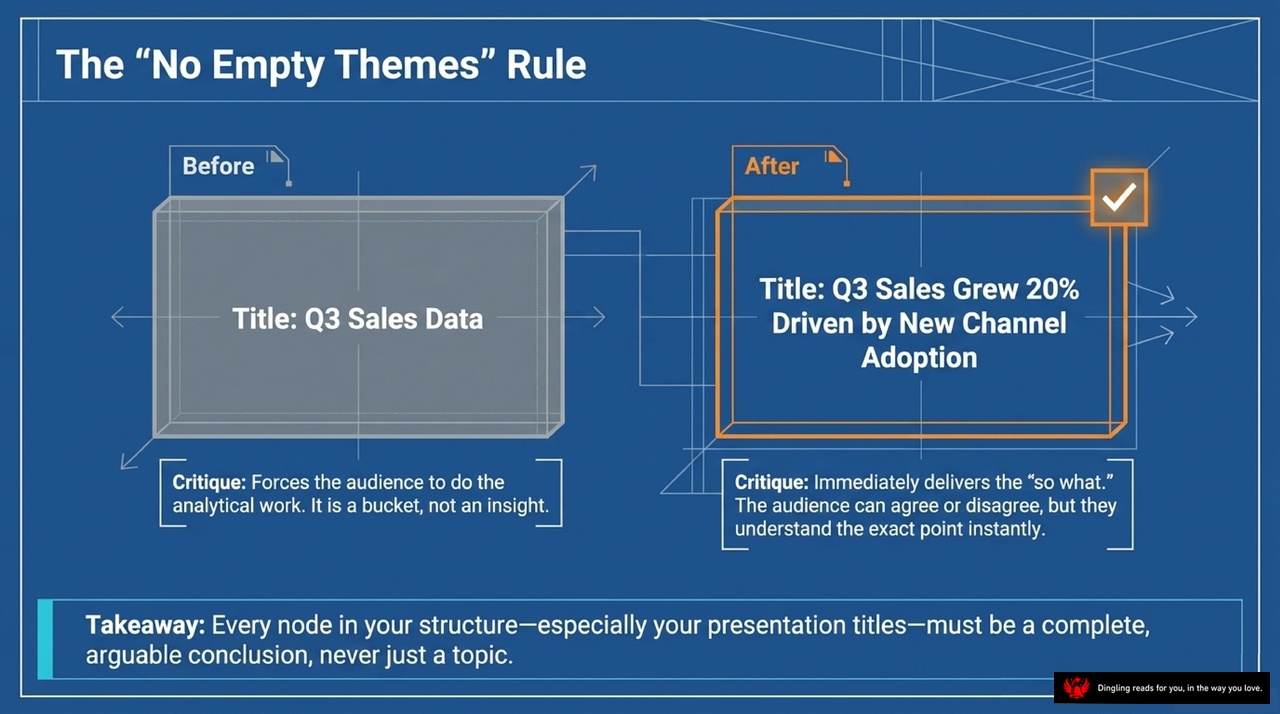
The "No Empty Themes" Rule isn't just a design tip; it's a cognitive upgrade for how we communicate. Look at the "Before" example on the left: "Q3 Sales Data." It's a hollow box. It forces your audience to dig through the content to figure out what you're actually talking about. It's just a bucket for information, not an insight. It leaves them doing the analytical work instead of you leading them.
Now, look at the "After" slide on the right. The title transforms into a complete argument: "Q3 Sales Grew 20% Driven by New Channel Adoption." This isn't just a topic; it's a conclusion. It immediately delivers the "so what." The audience doesn't have to guess; they instantly understand the exact point, and they can immediately agree or disagree with your logic.
The takeaway is clear: Every node in your structure, especially your presentation titles, must be a complete, arguable conclusion, never just a topic. Stop listing what you will talk about and start telling them what you have found. Make every title a mini-argument, and you make your entire message undeniable.

Welcome back to Phase 3: Horizontal Structuring. Today, we're diving into the "What" and "How" of our thinking. While the previous phase helped us build our vertical logic, horizontal structuring is about arranging those ideas side-by-side so they make sense together.
The slide breaks this down into two powerful approaches. On the left, we have Deductive Reasoning, which focuses on the "Why." Think of this as the ultimate persuasion tool. It follows a classic structure: Premise 1 leads to Premise 2, which leads to your Conclusion. This method is best for overcoming resistance. If you're dealing with a skeptical audience or need to prove that a conclusion is absolutely necessary, this logical chain is your friend. However, be careful: it carries a high cognitive load. If your audience rejects the very first premise, the entire argument collapses.
On the right, we have Inductive Reasoning, focusing on the "What" and "How." Instead of starting with a universal truth, we group our points by Time, Structure, or Importance. This is your go-to for action-oriented solutions. When your audience is eager for results and wants clear, executable strategies, this approach delivers. It requires rigorous categorization to ensure your points are complete, but it makes the path forward crystal clear.
So, which one do you choose? Use Deductive Reasoning when you need to convince a doubter through logic. Switch to Inductive Reasoning when you need to guide an eager team toward immediate action. Mastering the switch between these two modes is what turns a messy thought into a compelling story.

The MECE Principle is your shortcut to flawless categorization. Think of it as the difference between a jumbled puzzle and a perfectly fitted grid. On the left, you see the core rules: Mutually Exclusive and Collectively Exhaustive. This means every piece of evidence belongs to one—and only one—category, preventing logical overlap. At the same time, your categories must cover the entire scope of the problem with no gaps left behind.
But here is the real game-changer: The Shortcut. Instead of struggling to find categories one by one, simply identify two opposing dimensions and map them against each other. As shown on the right, crossing dimensions like Internal/External with Cost/Benefit instantly creates a 2x2 matrix. This visual framework forces your thoughts into four distinct, non-overlapping boxes. It's the fastest way to achieve MECE, turning complex chaos into a clear, actionable structure that anyone can understand immediately.

This slide brings us to the grand finale: the complete structural blueprint. Think of it as the architectural plan for your mind. It shows that structural thinking isn't just a simple outline; it's a holistic cognitive architecture. At the very top, we have our SCQA or core conclusion—that's your targeting, the "why" that grabs attention immediately. Moving down, the spine of your argument is built on top-down Q&A and bottom-up aggregation, creating a strong vertical logic that connects your conclusion to the details.
But a great structure needs more than just logic; it needs a strong foundation. That's where MECE groupings come in—ensuring your points are mutually exclusive and collectively exhaustive, acting as the load-bearing pillars that support your entire argument. Finally, we polish the exterior with visual packaging. As the text reminds us, you set the stage with your conclusion, build the load-bearing pillars with your Q&A, and secure the foundation with airtight logic. This integrated approach ensures your message is not only logically sound but also visually compelling and easy to digest.

You now possess the blueprint to structure any complex thought, but what grand idea will you choose to build with it?
Think Top-Down: Always lead with your core conclusion. In business, clarity isn't about adding more details; it's about revealing the answer first. Just like a general who tells the troops where to attack before the battle begins, you must state your "So What?" immediately. This shifts the dynamic from "let me explain" to "listen to my insight."
Structure Horizontally: Ensure your logic is airtight, categorized, and MECE. Once you have your conclusion, you need a solid foundation to support it. This means grouping your points logically—whether by time, structure, or importance—and ensuring they are mutually exclusive and collectively exhaustive. No overlapping ideas, no missing pieces. This horizontal layering turns a scattered list of thoughts into a cohesive argument that is easy for anyone to digest.
Finally, Filter the Noise: Listen structurally to extract facts from chaos. In an age of information overload, the ability to cut through the clutter is your superpower. Don't just absorb data; analyze the architecture behind it. Distinguish the signal from the static, identify the underlying facts, and build your narrative around what truly matters.
You hold the tools now. The question is no longer about how to organize, but what powerful message you will deliver.