
Super Thinking: Complete Chapter-by-Chapter Summary

Welcome to the first chapter of our deep dive into Super Thinking. Today, we're unlocking the blueprint for higher-level cognition by mastering the world's most powerful mental models.
Imagine your brain not just as an organ, but as a complex network of neural pathways and cognitive mapping grids, designed to help you navigate complexity. But how do we actually think better? The answer lies in shifting from reactive habits to proactive strategy.
We begin by understanding that many major losses aren't sudden disasters, but the result of a "tyranny of small decisions." Just like water dripping on stone, individual rational choices—like choosing the cheapest option or delaying a task—accumulate into systemic failures. This connects directly to the concept of the "Tragedy of the Commons." When everyone acts in their own self-interest, like overgrazing a public pasture or refusing a vaccine to save a few dollars, the collective result is often a collapsed system where everyone loses.
To break this cycle, we must move beyond short-term thinking. We need to avoid the "boiling frog" effect, where gradual changes go unnoticed until it's too late, and we must resist "analysis paralysis" where too many options freeze us into inaction. Instead, we focus on expanding our "luck surface area" by connecting with diverse ideas and people.
By integrating these models—from managing risk and understanding incentives to recognizing when to compromise and when to strike—we transform our thinking from a passive process into a strategic tool. This is the foundation of Super Thinking: mastering the mental architecture that allows you to conquer complexity and design a better future.

Look at this diagram: "The Shortcut to Higher-Level Thinking." It visualizes a powerful transformation from chaos to clarity. On the left, you have "Raw Information" and "Complexity"—a tangled mess of overlapping lines representing the noise in our daily lives. On the right, you see "Clarity" and "Super Thinking," represented by clean, straight arrows moving toward an optimized output.
Connecting these two states is the "Mental Model." Think of it as a funnel or a prism that takes that chaotic input and refines it into a precise answer.
The slide uses a brilliant "Math Analogy" to explain this. Without mental models, thinking is like trying to solve complex math problems using only addition. Imagine adding the number seven together 158 times to get the answer. It works, but it's incredibly slow and exhausting. Mental models are multiplication. They allow you to bypass low-level cognitive friction and instantly jump to high-level solutions. Instead of doing the hard work step-by-step, you apply a formula and get the result immediately.
The ultimate goal here is to build a "latticework toolbox" of 80 to 90 cross-disciplinary models. By mastering these recurring concepts from diverse fields, you stop struggling with every new problem from scratch. You simply identify the underlying pattern, apply the right model, and achieve super thinking. This is how you turn raw complexity into actionable clarity.

Imagine you are building a battery from scratch. Instead of buying a pre-made unit for $600 per kilowatt-hour, you strip it down to its absolute basics—Cobalt, Nickel, and Carbon. By understanding these fundamental truths and rebuilding from there, you can slash that cost to just $80 per kilowatt-hour. This is the power of First Principles thinking: ignoring conventional wisdom to reconstruct reality based on undeniable facts.
But once you have the raw materials, how do you build something people actually want? You don't start with a full-sized car. You follow the path of evolution shown here: from a skateboard, to a scooter, to a bicycle, and finally, to a car. This is the Minimum Viable Product, or MVP. The rule is simple: test your assumptions in the real world immediately. Build the smallest functional version possible to de-risk your idea before you get caught up in over-optimizing features.
Combine these two strategies, and you get a powerful formula for innovation. Deconstruct complex problems to their core elements to find the lowest cost, then rebuild them using the simplest possible version to validate your solution. By combining the rigor of First Principles with the agility of an MVP, you stop guessing and start building a future that actually works.

When we face uncertainty, the most powerful tool isn't just gathering more data—it's drawing a decision tree. Think of it as mapping out your future before you take a single step. You start by identifying your core choice, like picking a contractor, and then branch out into every possible outcome: what if they finish on time? What if they delay? What if the project fails completely? Each branch gets a probability and a cost. By calculating the "expected value"—the weighted average of all these possibilities—you can see which path makes the most sense mathematically.
But here's where it gets tricky: money isn't everything. Sometimes, the real cost is anxiety or lost time. That's where we introduce "utility values" to quantify those intangible factors. If a delay causes you stress worth $1,000, that factor flips the equation entirely, steering you toward a safer, perhaps more expensive, option.
We also have to prepare for the unexpected—the "black swan" events. These are rare, high-impact disasters that standard models often miss. To handle them, we build elasticity into our plans, reserving buffers and creating emergency protocols so that when the unexpected hits, we don't collapse.
Finally, remember that this isn't just about individual choices. In a competitive world, we often find ourselves in a "prisoner's dilemma," where acting in our own self-interest leads to a worse outcome for everyone. The goal is to move past this zero-sum game. By using psychological levers like reciprocity, commitment, and social proof, we can shift the dynamic from a destructive arms race to a cooperative win-win. It's about changing the rules of the game so that success for you also means success for others.

The Law of Unintended Consequences reminds us that actions often trigger predictable, yet unexpected, ripple effects. As the slide illustrates, when we create incentives without considering the full system, we can actively make problems worse. Take the famous "Cobra Effect": the British offered a bounty for dead cobras to reduce their population. Instead of killing wild snakes, locals began breeding them for money. When the government canceled the bounty, the breeders released thousands of snakes, leaving the colony with more cobras than before. This is a classic case of perverse incentives backfiring.
The slide also highlights two other powerful traps. First, Goodhart's Law: when a measure becomes a target, it ceases to be a good measure. Just like Soviet factories producing giant, useless nails to meet weight quotas, we often optimize for the wrong metric. Second, the Streisand Effect: attempting to hide information only draws massive attention to it. By trying to suppress a story or censor data, you inadvertently amplify its reach.
In our daily lives, these patterns are everywhere. Whether it's setting rigid KPIs that encourage gaming the system, or trying to silence criticism that only fuels a louder backlash, we must be careful. True effectiveness comes from designing systems that align with our actual goals, not just our intended targets.

When we face uncertainty, the best tool isn't a crystal ball, but a decision tree. Think of it as mapping out every possible path before you take a single step. Instead of guessing, you visualize the branches: what happens if you choose the familiar contractor versus the new one? What are the probabilities of delays or failures? By calculating the "expected value"—the weighted average of all possible outcomes—you transform a chaotic gamble into a rational choice.
But here's the catch: money isn't the only currency. Sometimes, the real cost is anxiety or lost time. That's where "utility" comes in. We assign value to intangible things, like the stress of a delayed party, turning them into dollars so they can be weighed against the financial cost. This ensures your decision aligns with your actual life, not just your bank account.
Even with perfect math, you must stay vigilant for "black swans"—those rare, extreme events that defy prediction. The 2008 financial crisis or sudden climate disasters aren't just anomalies; they are risks we must build into our plans. Don't ignore the low-probability, high-impact scenarios. Instead, build buffers and contingency plans right into your decision tree.
Finally, remember that every choice is a trade-off. By using these tools, you stop reacting to chaos and start steering your future with clarity. You're not just picking an option; you're designing your best possible outcome.

In the high-stakes game of life, career, and business, every choice is essentially a bet on the future. To achieve success that truly outperforms the average, you have to stop following the crowd. You need to adopt a "Consensus-Reversal Matrix," a logic championed by venture capitalist Andy Rachleff. The core idea is simple yet counterintuitive: exceptional returns come from moving in the opposite direction of the consensus, but only when you are heading in the right direction.
Think about horse racing. When everyone bets on the favorite, they win a small amount, but the payout is negligible. True wealth is made by betting on the long shot—the horse with the 50-to-1 odds. Charlie Munger famously said, "Imitating the crowd will only get you the average," and Warren Buffett echoes this, noting that the best time to act is when no one else is interested. Benchmark's investment in eBay is a perfect example; while peers dismissed it as a toy company, betting against the consensus yielded massive returns.
But how do you find these opportunities? The answer lies in uncovering "secrets"—important truths that the majority hasn't realized yet. Great companies are often built on these hidden insights: Airbnb spotted the gap in unused living space, Uber connected drivers with riders, and the Oakland Athletics used data to find undervalued players. However, finding a secret isn't enough; timing is everything. Moving too early can lead to failure due to a lack of technology or market readiness, while moving too late means missing the window entirely. Uber succeeded because smartphones were ubiquitous; YouTube rose when broadband was mature. Apple's Newton failed in 1993 because the internet wasn't ready, only to succeed a decade later with the iPad.
Once you have the secret and the timing, execution is the final hurdle. A vision without action is a daydream, and action without vision is a nightmare. You must achieve "product-market fit," creating something so valuable that customers actively seek it out. This is similar to physics resonance; when your product vibrates at the same frequency as the market's needs, energy accumulates and creates a breakthrough. If you fail to fit, you must pivot quickly, like Twitter shifting from a podcast platform to a social network, or Nintendo evolving from a card game maker to an electronics giant.
After you secure your position, you need to build a "moat" to defend your advantage. This concept, popularized by Buffett, applies just as much to individuals as it does to companies. Your personal moat could be a deep network of relationships, a unique combination of skills, or a strong personal brand. These barriers make it hard for competitors to enter your space. To solidify this, you create "lock-in effects" by increasing the other party's switching costs. If an employer relies on your unique knowledge or relationships, replacing you becomes expensive and risky, securing your job. Similarly, if clients are used to your specific service style, they are less likely to switch to a competitor.
You can also set up "entry barriers" and "exit barriers." Entry barriers are the walls you build, like exclusive licenses or industry influence, that stop new players. Exit barriers are the chains you tie yourself with, such as long-term contracts or deep specialization, ensuring you don't easily abandon a winning position. Be cautious, though, of becoming a "regulatory captive" where you rely too heavily on rules to protect yourself, as this can stifle innovation.
Finally, remember that no moat is permanent. Disruptive innovations, like AI and automation, can shatter old barriers overnight. To stay ahead, you must constantly innovate and adapt. As Elon Musk suggests, high-speed innovation is the ultimate moat. Companies like Kodak failed because they clung to their profitable past while ignoring the digital future. Your job is to keep your moat wide, deep, and ever-evolving, ensuring you remain the leader in a rapidly changing world.

Mapping the Terrain of Risk isn't just about predicting the future; it's about categorizing the unknown so you can stop being paralyzed by it. As we see here, we break risks down into four distinct quadrants based on what we know and how aware we are.
In the top left, we have Known Knowns. These are things you fully understand and know how to handle, like buying a crib for a new baby. The strategy here is simple: Execute.
Top right brings us to Known Unknowns. You know these risks exist, but you lack specific data on them, such as not knowing exactly what temperament your baby will have. This is where you must De-risk and Research.
The bottom left quadrant holds Unknown Knowns. These are risks you haven't explicitly considered yet, but others have standard mitigation strategies for, like the specific physical technique required to hold a newborn. Here, you need to Consult Experts.
Finally, the bottom right contains the most dangerous blind spots: Unknown Unknowns. These are Black Swan events, like unforeseen genetic learning disabilities, where you have no data and no awareness. The only tool here is Scenario Planning.
By mapping your terrain this way, you stop guessing and start taking precise action against the right type of risk.

Imagine you're standing on a small, isolated hill. It looks like the highest point in your entire world. You climb to the top, take a breath, and declare victory. But what if there's a much bigger mountain just a few miles away, separated by a deep valley? To reach that global peak, you first have to walk downhill. You have to step into the "Valley of Discomfort." It feels terrifying. It feels like failure. But that dip is the price of admission to the true summit.
This slide perfectly illustrates the concept of "Escaping the Local Optimum." We often get stuck making incremental improvements, thinking we're climbing the biggest hill. We optimize our current routine, our current job, or our current habits. But true breakthroughs require us to intentionally leave that comfort zone, cross that valley of discomfort, and climb the steeper, higher mountain.
However, we must be careful. The text warns us about the "Pro-Con List." Simply listing pros and cons assumes all factors carry equal weight, creating a "grass is greener" bias. We often overlook hidden risks or costs. To truly navigate this topographic map of your choices, you can't rely on a simple checklist. You need to use Decision Trees and Scenario Analysis. You have to visualize the full landscape, understand the probabilities of different paths, and prepare for the unexpected. Because sometimes, the smartest move isn't the one that looks best on paper, but the one that gets you off the hill you're currently sitting on and onto the mountain that actually matters.

In competitive environments, influence isn't magic; it's driven by predictable psychological levers, often deployed simultaneously to shape behavior. Think of a casino: it doesn't just rely on luck; it engineers your decisions using a specific toolkit.
First, there's Reciprocity. By giving something small, like a free drink, the system triggers a powerful urge to give something big back. Then comes Social Proof. When you see others winning the jackpot, your brain validates your own choices simply because everyone else is doing it.
Next is Commitment. Casinos secure a small "yes" by getting you to buy chips first, paving the way for a much larger agreement later. They also weaponize Scarcity by triggering FOMO—Fear Of Missing Out—using limited-time windows to accelerate your action.
Finally, they leverage Liking and Authority. By mirroring your body language or using titles and uniforms, they build trust and bypass your critical thinking. These aren't just tricks; they are the levers of conflict and persuasion that drive influence when the stakes are high.
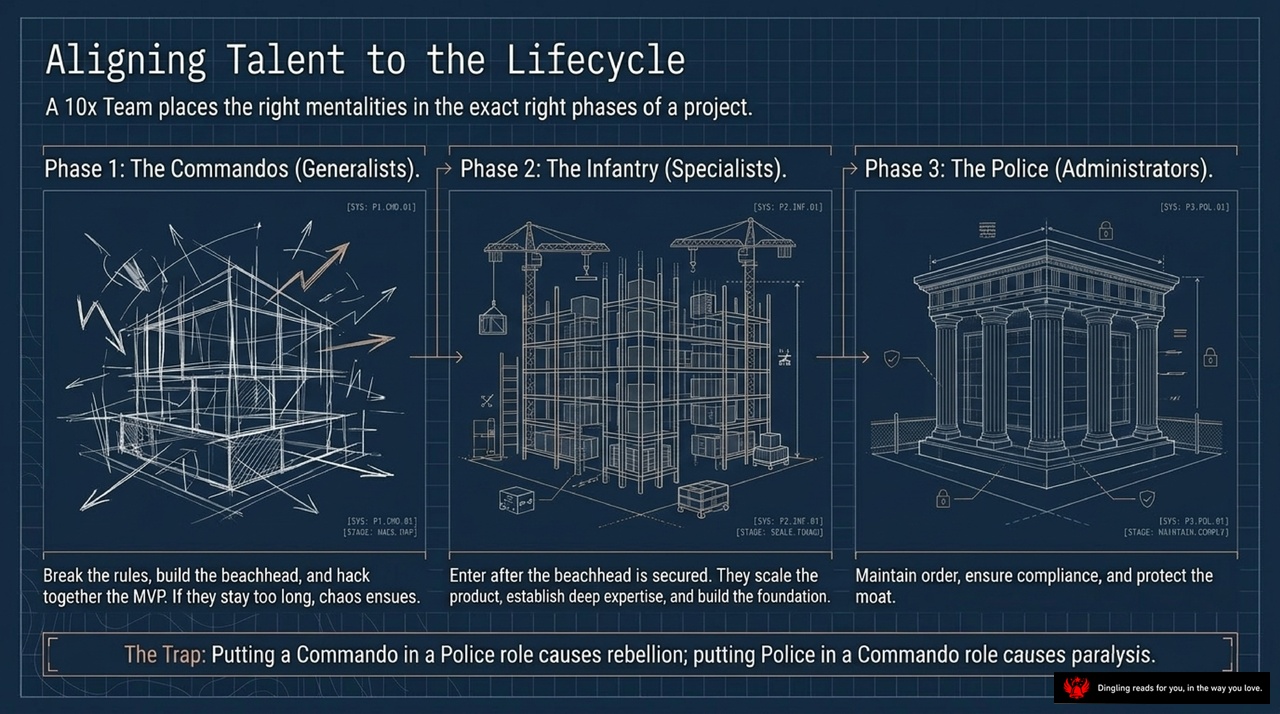
Imagine a project not as a single monolithic effort, but as a building constructed in three distinct phases, each requiring a completely different kind of talent. As we move through the lifecycle, the mentalities we need shift dramatically, and placing the wrong person in the wrong phase is the fastest way to destroy a team.
In Phase 1, we need The Commandos—our Generalists. Think of them as the initial force breaking the beachhead. Their job is to break the rules, hack together an MVP, and establish a foothold. They thrive in chaos and need the freedom to experiment. If you leave a Commando in this role too long, they will eventually create chaos by refusing to follow the very rules they helped build.
Once the beachhead is secured, we move to Phase 2, where we bring in The Infantry—our Specialists. These are the people who enter only after the ground is safe. Their mission is to scale the product, establish deep expertise, and build the foundation. They provide the structure and depth that the Commandos couldn't create in the rush of the initial phase.
Finally, in Phase 3, we need The Police—our Administrators. Their role is to maintain order, ensure compliance, and protect the moat we've built. They keep the system running smoothly and prevent entropy from taking over.
The critical trap here is misalignment. Putting a Commando in a Police role causes rebellion because they hate constraints. Conversely, putting a Police officer in a Commando role causes paralysis because they cannot tolerate ambiguity. A 10x team succeeds only by placing the right mentality in the exact right phase of the project.

Look at this blueprint-style framework: Engineering Operational Excellence. The core idea here is that the best organizational culture lives in the top-right quadrant. It's where you balance two critical behaviors: caring personally and challenging directly.
On the left, we have the concept of the Directly Responsible Individual, or DRI. The logic is simple but powerful: for every single task, meeting, or goal, exactly one person's name must be attached to it. If everyone feels responsible, ironically, no one is. Clarity creates accountability.
On the right, we see Dunbar's Number, which is roughly 150. This is the limit of stable human social relationships. Once an organization grows beyond that, informal communication breaks down. You can't just rely on vibes or trust alone anymore; you must implement rigid structural blueprints to keep things running smoothly.
So, the sweet spot is right there in the middle. You need to care about the people personally to build trust, but you must also challenge them directly when things go off track. Abstract feedback simply fails to drive growth. Real progress requires precise, deliberate practice wrapped in high-context trust. It's about being human enough to care, but structured enough to deliver excellence.

Imagine your business as a fortress built on concentric rings, each one deeper and more critical than the last. At the very center lies **The Secret**: the bold truth that most people refuse to believe. As the slide reminds us, you must be contrarian and right; great ventures are built on insights that the consensus has yet to accept.
Moving outward, you hit **Product/Market Fit**, described here as a "Resonant Frequency." This is the precise moment where the market pulls your product from your hands. It's not about being first; it's about fitting perfectly. Once you achieve this resonance, you win.
The next ring is **The Moat**. This is where you dig your defensive barriers. Whether it's building an unshakeable brand, leveraging network effects, or creating high switching costs, you must construct these moats immediately to protect your position.
However, the outermost ring carries a warning: **Only the Paranoid Survive**. Even the deepest moat can dry up. You must constantly beware of disruptions and be willing to abandon your local optimum to stay ahead. This blueprint isn't just a strategy; it's a survival guide for enduring advantage in a chaotic world.

Imagine a circle of competence, a concept Warren Buffett famously described as our ultimate superpower. At the very center lies "what you know"—your core skills and undeniable strengths. Surrounding that is a larger ring representing "what you think you know." This is the dangerous zone where overconfidence creeps in, often blinding us to our actual limitations. Beyond that lies the vast, uncharted territory of "what you don't know."
The real genius isn't just expanding that inner circle, but recognizing exactly where you are operating within it. As Buffett noted, our greatest strength is knowing when we are thriving well inside our circle of competence versus when we are dangerously approaching its perimeter.
But be careful not to fall into the "Cargo Cult" trap. Just because you see successful people mimicking certain outward motions doesn't mean you understand the underlying mechanics or the models driving their success. You can copy the behavior without ever grasping the strategy. Instead, internalize these cognitive blueprints. Use them to bypass your gut instincts and continuously push the boundaries of your Circle of Competence outward. True growth comes from understanding the models, not just copying the moves.
True clarity isn't about memorizing facts; it's about mastering the mental models that govern human behavior, systems, and markets. By curating a cross-disciplinary toolkit, you can transcend default thinking, bypass cognitive traps, and engineer superior outcomes in any environment.
Think of it this way: are you ready to stop relying on instinct and start architecting your decisions? Instead of reacting to every challenge, you'll be able to see the underlying patterns—whether it's avoiding the "tragedy of the commons" or spotting moral hazards before they explode. This shift from reactive to proactive is the difference between drifting through life and strategically designing your future.