
The Aesthetics of Chinese Life: Complete Chapter-by-Chapter Summary
Welcome to our journey into the aesthetics of Chinese life. Today, we explore a book by Liu Yuedi titled *The Aesthetics of Chinese Life*, which invites us to see something extraordinary in the ordinary. The subtitle captures the essence perfectly: elevating the mundane routines of everyday existence into a profound, life-long art form.
In Chinese culture, beauty isn't something you chase in distant galleries or exotic lands. Instead, it's woven into the fabric of daily life. Think about the weather. It's not just a weather report; it's a conversation with the universe. From the gentle rain of spring to the silent snow of winter, every shift in the season is felt deeply. The Chinese don't just observe nature; they resonate with it. They believe that the rhythms of the four seasons mirror the rhythm of their own lives, creating a continuous, living art form.
This book teaches us that when we stop rushing and start paying attention—whether to a blooming flower, a cup of tea, or a quiet moment in a garden—we transform our daily actions into a masterpiece. It's about finding the "beautiful spirit" in the simple things, turning a regular day into a journey of discovery. So, let's open our senses and see how the ordinary becomes the extraordinary in the Chinese way of living.
Hello everyone, welcome to this deep dive into the core thesis of our book: Aesthetics over Religion.
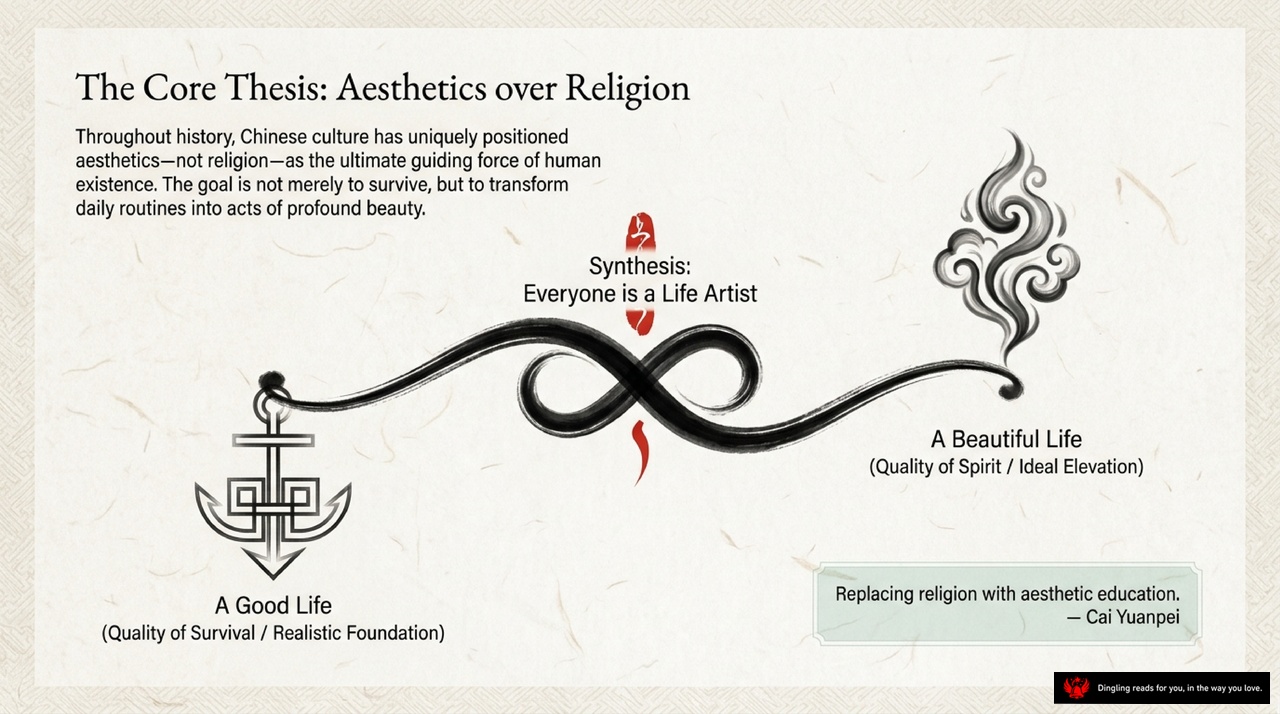
Today's slide lays out a fascinating argument that has shaped Chinese culture for millennia. Unlike many other traditions that look to religion as the ultimate guide for human existence, Chinese culture uniquely positioned aesthetics as the supreme force. The goal here isn't just to survive; it's to transform our daily routines into acts of profound beauty.
Look at the visual flow on the screen. On the left, we have "A Good Life," which represents the quality of survival and a realistic foundation. This is where we start. But the journey doesn't stop there. It moves through a synthesis—represented by that elegant, flowing ribbon in the center—where the concept emerges that "Everyone is a Life Artist." This is the heart of the argument: we are all creators of our own existence.
This synthesis leads us to the right side: "A Beautiful Life," which signifies the quality of spirit and ideal elevation. The slide perfectly captures Cai Yuanpei's wisdom, reminding us that we can replace religion with aesthetic education. By adopting this mindset, we elevate our lives from mere existence to something truly artistic and meaningful.
So, the core takeaway is simple yet powerful: instead of seeking salvation through dogma, we find fulfillment through the appreciation of beauty in every moment.
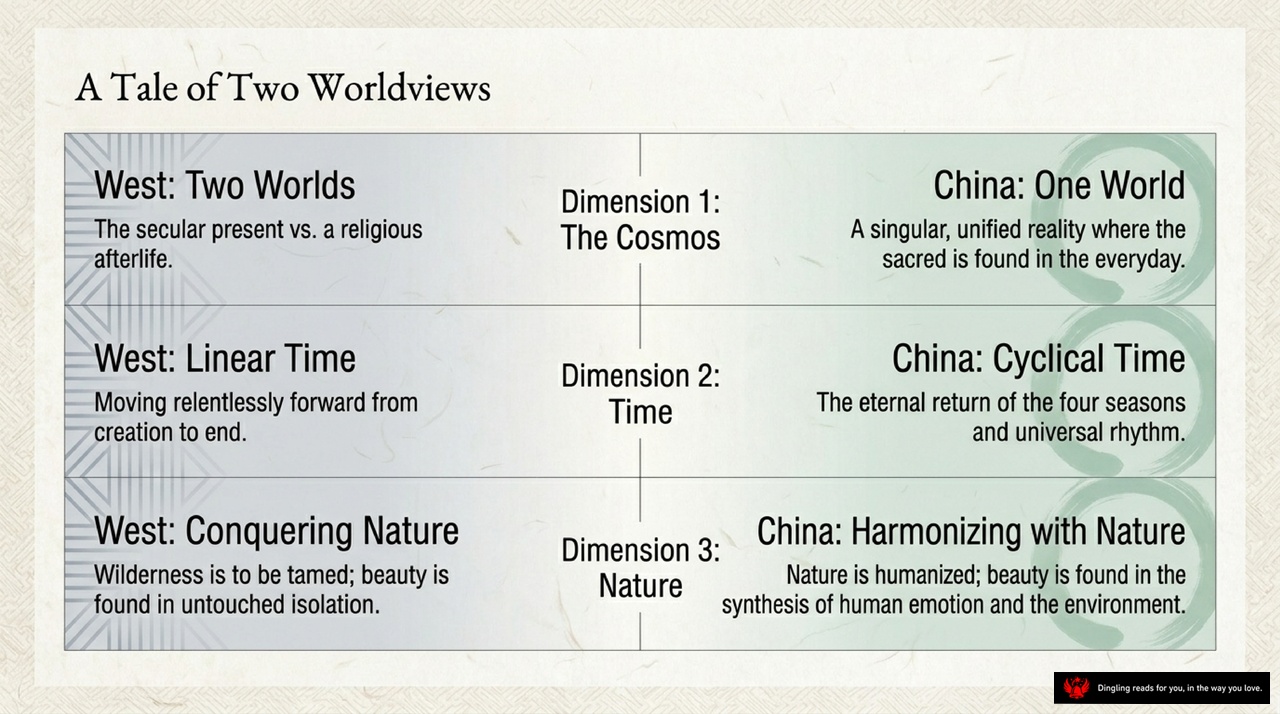
Today's slide presents a fascinating comparison titled "A Tale of Two Worldviews," contrasting how Western and Chinese cultures fundamentally perceive reality, time, and nature. Let's dive into these three key dimensions.
First, look at Dimension 1: The Cosmos. The West traditionally operates on a "Two Worlds" model, sharply dividing the secular present from a religious afterlife. In contrast, China embraces a "One World" view—a singular, unified reality where the sacred isn't something distant or separate, but is found right here in our everyday lives.
Moving to Dimension 2: Time. Western thought often views time as linear, moving relentlessly forward from creation to an inevitable end. Meanwhile, Chinese culture sees time as cyclical. It's about the eternal return of the four seasons and a universal rhythm, a continuous loop rather than a straight line.
Finally, Dimension 3: Nature. The Western perspective has historically favored "Conquering Nature," viewing wilderness as something to be tamed and finding beauty in untouched isolation. The Chinese approach is about "Harmonizing with Nature." Here, nature is humanized; beauty isn't found in distance, but in the synthesis of human emotion and the environment.
So, while one worldview seeks to separate and conquer, the other seeks to unify and harmonize, shaping entirely different experiences of life.
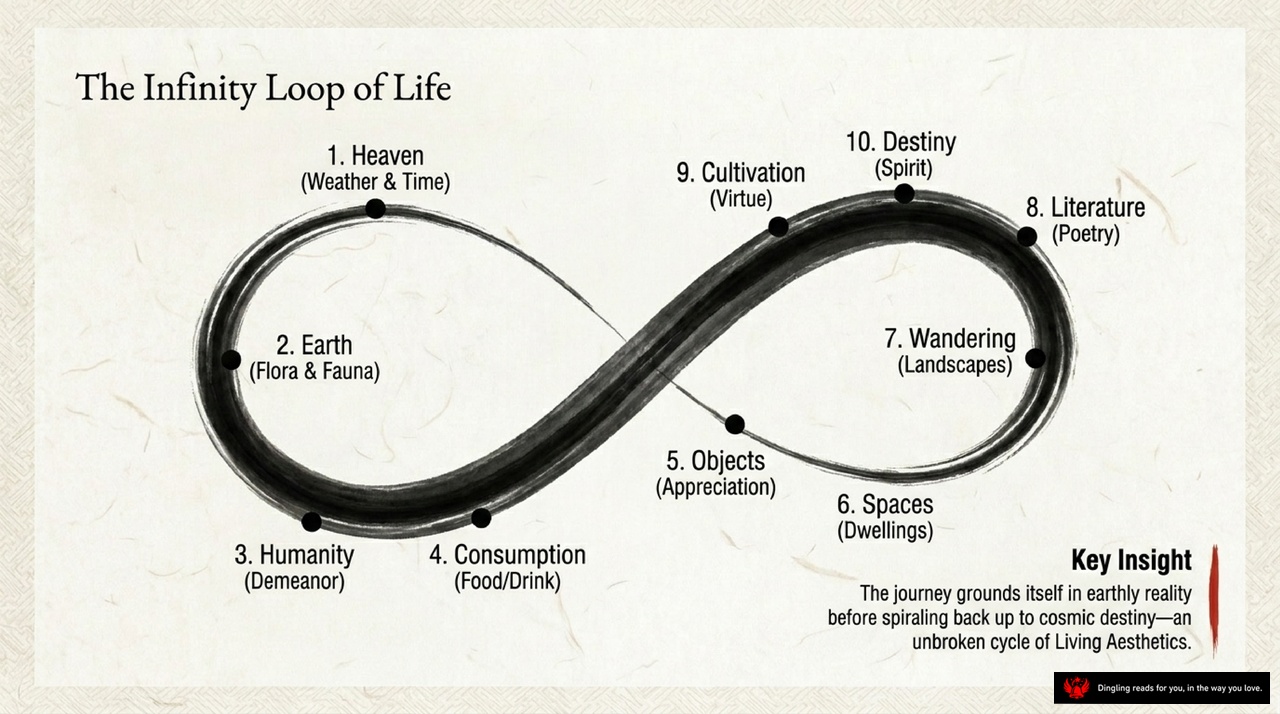
Let's dive into the third chapter of our journey: the art of observing people and appreciating human beauty. In ancient China, aesthetics wasn't just about looking good; it was about seeing the soul. The core of human appreciation lies in this unique "Heaven-Earth-Human" framework. We don't just admire a person's face; we look for the spirit within, the "Shen" that gives life to the form.
Think of the legendary artist Gu Kaizhi, who famously said, "Capturing the spirit resides in the eyes." For him, the eyes were the window to the soul. But this wasn't just about physical features. During the Wei and Jin dynasties, a new kind of beauty emerged. It wasn't about rigid rules, but about "Fengliu"—a style of elegance and freedom. Figures like Ji Kang were described as standing tall like a lone pine or collapsing like a jade mountain when drunk. Their beauty was in their spirit, their unconventionality, and their deep connection to the world around them.
As time moved into the Tang and Song dynasties, this aesthetic shifted. The wild, outward expression of "Fengliu" gave way to "Fengya"—a more refined, restrained elegance. The focus moved from the individual's dramatic exterior to the quiet grace of daily life. It was about finding beauty in the ordinary, in the tea ceremony, in the poetry, and in the gentle rhythm of living.
However, we must also acknowledge a complex side of this history. Traditional standards often layered moral virtues over physical beauty, sometimes creating an imbalance where inner character overshadowed outer appearance. While the ideal was a unity of beauty and goodness, history shows how these forces could clash. Yet, the enduring legacy of Chinese aesthetics remains this pursuit of harmony: a dynamic balance where the outer beauty of a person reflects their inner moral depth, creating a truly complete and resonant human presence.

Today, we shift our gaze from the grand architecture of heaven and earth to the intimate details of human presence. How do we truly see the person standing before us? In ancient China, the answer wasn't just about physical appearance, but about capturing the spirit within the form.
Look at the progression of Chinese aesthetics over time. It began with the "beauty of force" in the Shang and Zhou dynasties, celebrating tall, heroic figures. By the Warring States period, this evolved into the "beauty of the gentleman," valuing knowledge and virtue alongside strength. Then came the Wei and Jin era, where the standard shifted dramatically to "fengliu"—a kind of effortless elegance and spiritual freedom. Think of Ji Kang, described as standing tall like a lone pine, or Wang Xizhi, whose calligraphy flowed like floating clouds. Their beauty was about the soul, not just the skin.
As history moved into the Tang and Song dynasties, the focus softened further from outward "fengliu" to inward "fengya"—a refined, restrained grace. This is the essence of the "Gentleman" or Junzi. Confucius defined this ideal not by status, but by character: the wise are never confused, the benevolent never anxious, and the brave never afraid. A true Junzi balances inner virtue with outer ritual, achieving what is known as "wen zhi bin bin"—a harmonious blend of substance and form.
But Chinese aesthetics goes deeper than just looking good. It connects the body and the spirit. Mencius taught that a gentleman's inner goodness naturally radiates outward, coloring their face and posture without them trying. It's a "beautiful spirit" that fills the space around them. Meanwhile, Daoism offered a different path: the unity of form and spirit. In Zhuangzi's world, true beauty lies in spiritual freedom, where the self dissolves into the universe, achieving a state of weightless, childlike grace.
Ultimately, Chinese aesthetics seeks a balance between beauty and goodness. It's not about separating the pretty from the moral, but weaving them together. Whether through the quiet ritual of daily life or the profound depth of character, the goal remains the same: to cultivate a life that is both aesthetically pleasing and ethically sound, creating a world where human beauty reflects the harmony of the cosmos.
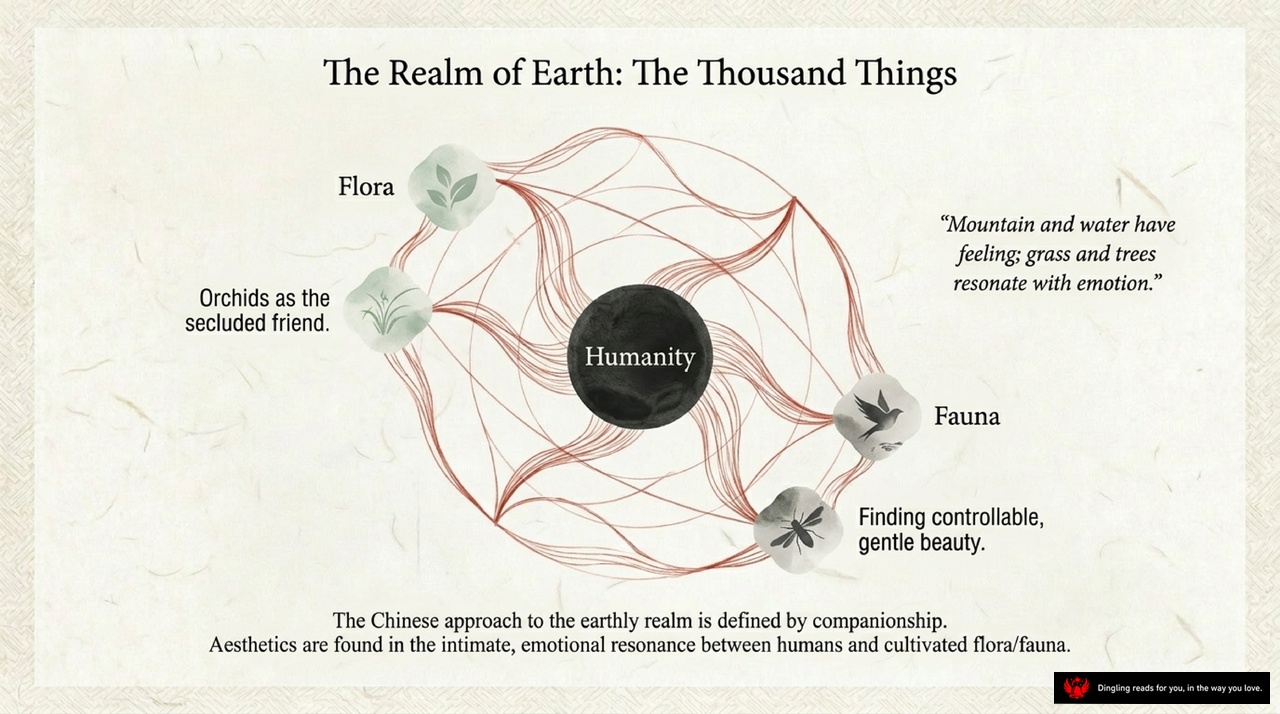
Welcome to the fifth chapter of our journey into the Chinese life of aesthetics: "The Beauty of Leisurely Appreciation."
Imagine a world where the things around you aren't just objects, but extensions of your own spirit. In Ming and Qing China, this wasn't a fantasy—it was a lifestyle. The concept of "Changwu," or "long things," transformed everyday items into spiritual companions. For these scholars, owning an object wasn't about wealth; it was about curating a conversation between the human heart and the universe.
Look at the diagram. It highlights "Humanity" at the very center, connected by intricate threads to "Flora" and "Fauna." This visual perfectly captures the essence of Ming aesthetics: a deep, intimate resonance between people and nature. It's about finding that "controllable, gentle beauty" in the things we cultivate. Think of an orchid, described as a "secluded friend," or a carefully arranged flower in a vase. These aren't just decorations; they are vessels for emotion.
The text tells us that for these literati, life was an act of "spiritual consumption." They sought a state of "leisure"—not just free time, but a mind unburdened by ambition. By surrounding themselves with exquisite objects, from incense burners to folding screens, they created a sanctuary of "quiet happiness." They believed that the beauty of an object could elevate the spirit, moving the observer from simply pleasing the eyes to nourishing the soul.
However, there was a delicate balance to maintain. The text warns against becoming a slave to one's possessions. As the philosopher Su Shi famously advised, one should "impose meaning on things, but not become attached to them." True appreciation is about letting the object inspire you, not letting the object define you. When you lose that balance, the joy turns into a "bitter sea" of obsession.
So, what does this mean for us today? It's a reminder that the objects in our lives—our books, our art, even our plants—can be more than just things. They can be mirrors of our inner world, helping us cultivate a heart that is both refined and free. This is the art of living: not just having beautiful things, but letting them make us beautiful.

Welcome to the sixth chapter of our journey into Chinese life aesthetics: "The Beauty of Secluded Living and Elegant Gatherings."
Today's slide beautifully contrasts two distinct yet complementary dimensions of the Chinese experience: the inner solitude of "Secluded Living" and the outer connection of "Elegant Gatherings." On the left, we see the essence of *Xianju*—secluded living. This isn't just about physical isolation; it's a profound state of mind. Ancient texts describe this as a time of "Shen-Shen" and "Tiao-Tiao," like a tree with a sturdy trunk and gentle branches—calm, upright, and full of quiet joy. It is the moment after public duties are done, when one returns to oneself to practice the highest form of governance: aligning with the "Ren," or benevolence, of the universe. In this silence, the garden becomes a living canvas where nature and human spirit merge.
On the right, we see the vibrant energy of *Yaji*—elegant gatherings. Think of the famous "West Garden Gathering" of the Northern Song Dynasty, where literary giants like Su Shi and Huang Tingjian would meet. These weren't mere parties; they were spiritual symphonies where poetry, calligraphy, and music intertwined. Whether it was the魏晋 scholars debating metaphysics while holding jade-handled fly-whisks, or Ming Dynasty poets gathering in a private garden to drink tea and play chess, these gatherings transformed the mundane into the sacred. They proved that true freedom isn't found only in solitude, but also in the shared appreciation of beauty with kindred spirits.
The key takeaway here is the dynamic balance between "static" and "dynamic." A garden is truly alive only when it hosts these human interactions. Without the "moving" energy of conversation and art, a garden becomes just a static display. With them, it becomes a vessel for the soul. This harmony between the quiet introspection of the hermit and the spirited camaraderie of the scholar is the heartbeat of traditional Chinese life aesthetics—a perfect rhythm of being alone together.

Welcome to a moment of contrast. Today, we're exploring the aesthetics of consumption through two ancient symbols: wine and tea. On the left, you see wine, labeled as "The Catalyst of Release." It represents a state of dynamics, heat, and external expression. Think of it as the energy that breaks down barriers and reveals our unrestrained selves. It's best paired with expansive weather like snow or autumn moonlight, or vibrant gatherings where passion can truly amplify.
On the right, we have tea, defined as "The Anchor of Stillness." This is about introspection, purity, and internal quietude. Tea is the anchor that grounds us, cultivating a serene mind where true water has no flavor. Its ideal environment is secluded spaces, like bamboo groves or private studios, perfect for intimate dialogue and deep reflection.
While wine invites us to dance with the world and express our outer selves, tea invites us to turn inward and find peace. One is the fire of release; the other is the water of stability. Together, they offer a complete picture of the human experience—teaching us that true living requires both the courage to let go and the wisdom to remain calm.

Today's slide introduces a fascinating concept: "The Philosophy of Objects," specifically focusing on what we might call "Superfluous Things." Look at this image of a rough, porous stone. To the modern eye, or even a purely utilitarian one, its function is zero. It doesn't build a house, cook a meal, or transport goods. Yet, the slide points out that its spiritual function is absolute.
This idea takes us back to the Ming and Qing dynasties, a time when a profound material culture emerged in China. Back then, objects weren't just for display or utility; they served as physical anchors for the scholar's inner world. Think of it this way: in a busy, noisy world, these "superfluous" items became quiet spaces for the mind.
The core idea here is simple yet powerful: a person communes with an object to invigorate the mind and wash away the dust of the mundane world. It's about finding a spiritual connection in something that has no practical use. By holding this stone, meditating on its texture, or simply observing its form, the scholar wasn't just looking at a rock; they were engaging in a dialogue with the universe, refreshing their spirit and finding clarity amidst the chaos of daily life. This is the essence of appreciating the beauty of objects that exist beyond mere necessity.

Hello everyone. Today, let's dive into the final layer of our aesthetic journey: the highest form of appreciation, where we move beyond pleasing the eye and the mind to finally please the spirit.
As we climb this ladder of appreciation, the ultimate goal is what this slide calls "Pleasing the Spirit." This is the transcendent level, the peak experience where the boundary between the observer and the object completely dissolves. It's no longer about judging an object or analyzing its cultural meaning; it's about merging with it.
Think about the Chinese concept of "Qing," or deep emotion. The core of our aesthetic tradition isn't just about finding beauty in things, but about connecting with the "life force" of the universe. When we truly appreciate something, we stop looking at it as separate from ourselves. We feel the "business of life"—the vitality, the growth, the rhythm—flowing through it and through us simultaneously.
This is the state where the self expands to include the world. It's a moment of spiritual freedom where you realize that you are not just a spectator watching the show of life; you are part of the performance itself. Whether it's watching a bird sing, feeling the rain, or admiring a painting, the highest appreciation happens when your heart resonates with the heartbeat of the universe, achieving a harmony that transcends words. This is where true spiritual freedom begins.
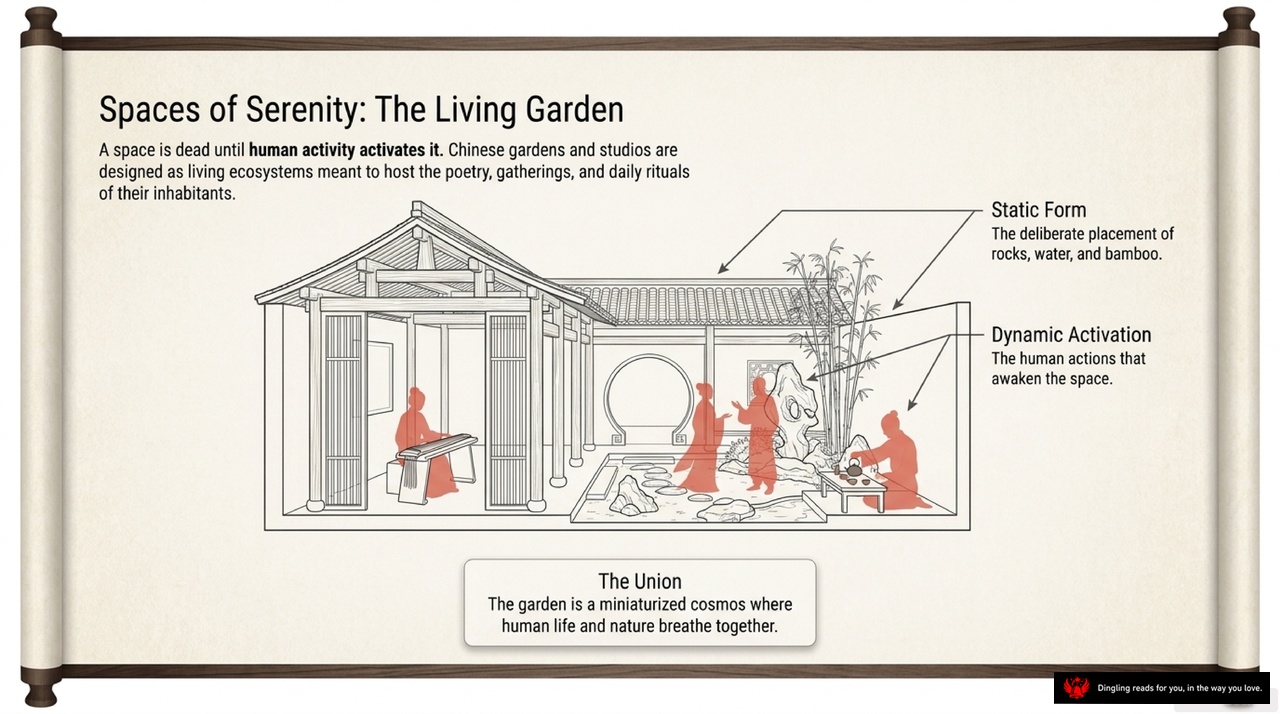
Welcome to our final chapter on the "Spaces of Serenity: The Living Garden." Today, we explore a profound truth often overlooked in the West: a space is dead until human activity activates it. In Chinese culture, gardens and studios aren't just static backdrops; they are designed as living ecosystems meant to host poetry, gatherings, and daily rituals.
Look at the illustration. You see the "Static Form"—the deliberate placement of rocks, water, and bamboo. These elements provide the stage, but they remain silent without us. The magic happens through "Dynamic Activation." This is the human action that awakens the space. Whether it's the scholar playing the zither, friends conversing by the moon gate, or someone brewing tea amidst the bamboo, it is our presence and movement that breathe life into the landscape.
Ultimately, this leads us to "The Union." The garden becomes a miniaturized cosmos where human life and nature breathe together. It's not about escaping reality, but about finding a rhythm where we and the universe synchronize. This is the essence of the Chinese living garden: a harmonious dialogue between the stillness of nature and the vitality of our daily lives.
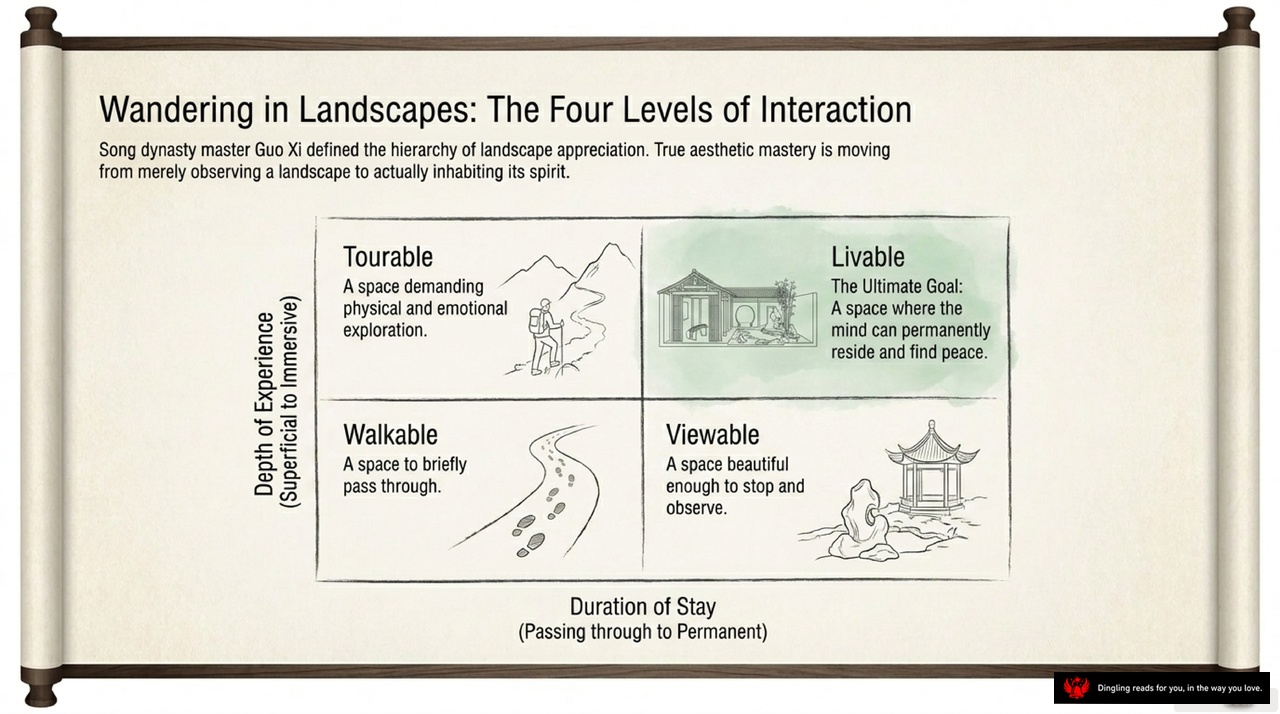
Wandering in Landscapes: The Four Levels of Interaction. Today, we explore how Song dynasty master Guo Xi defined the hierarchy of landscape appreciation, reminding us that true aesthetic mastery isn't just about looking at a view—it's about actually inhabiting its spirit.
Imagine a landscape not as a distant picture, but as a journey with four distinct depths. At the most basic level, we have the "Viewable." This is simply a space beautiful enough to stop and observe, like a scenic pavilion by a lake. You pause, you admire, but you don't necessarily linger.
Moving deeper, we reach the "Walkable." Here, the space invites you to briefly pass through. Think of a winding path with footprints leading the way; it's an invitation to move, to experience the rhythm of the land as you travel from point A to point B.
Then comes the "Tourable" level. This is where things get serious. It's a space demanding both physical and emotional exploration. You're not just walking; you're hiking, climbing, and engaging with the terrain. It requires effort and invites a deeper emotional connection as you navigate the challenges of the landscape.
Finally, we arrive at the ultimate goal: the "Livable." This is where the mind can permanently reside and find peace. It's no longer about observing or passing through; it's about belonging. Whether it's a mountain retreat or a quiet garden, this is the space where you truly become part of the environment, finding a home in nature itself.
So, the next time you step outside, ask yourself: Am I just viewing, or am I living?
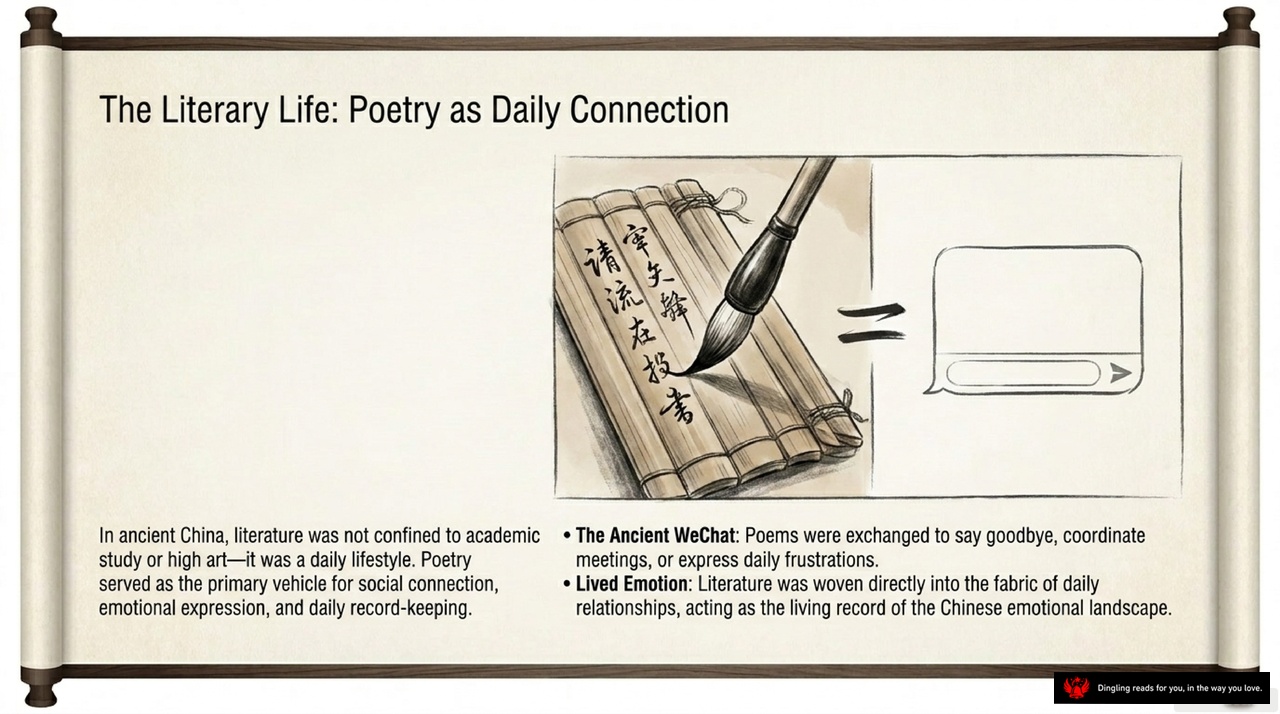
In ancient China, poetry wasn't just high art reserved for scholars; it was the heartbeat of daily life, the primary way people connected, expressed emotions, and kept records. Think of it as the "Ancient WeChat" of its time. Instead of text messages, people exchanged poems to say goodbye, coordinate meetings, or vent their daily frustrations. A simple line of verse could carry the weight of a complex feeling, weaving literature directly into the fabric of relationships and social interactions.
This slide beautifully captures that transition: on the left, we see the traditional bamboo slips with calligraphy being written by a brush, representing the ancient literary form. On the right, a modern chat bubble symbolizes how that same impulse for connection and expression lives on today. This illustrates the concept of "Lived Emotion"—literature wasn't something distant or abstract; it was woven into the very moments of daily living. From the bustling streets to quiet personal reflections, poetry served as a living record of the Chinese emotional landscape, proving that the desire to connect through meaningful words is a timeless human need that transcends centuries.

Synthesis: Emotion Rooted, Artfully Civilized
Imagine the perfect life not as a rigid set of rules, but as a living circle where raw emotion and civilized behavior dance together. This slide captures the ultimate pinnacle of the Chinese art of living: a synthesis where deep, authentic feeling meets refined, civilized behavior.
At the very center of this circle lies the Inner Core, which we call Ren or Qing. Think of this as the root—the raw, profound human emotion, empathy, and vital energy that drives us. It is the authentic spark of life, the unfiltered human experience that makes us feel alive. Without this core, we are hollow shells.
Surrounding this vibrant center is the Outer Ring, known as Li or Wen. This is the boundary, the ritual, the aesthetics, and the civilized art that guide and elevate our emotions. It doesn't suppress the fire of the center; instead, it provides the elegant vessel to hold it. It transforms our raw impulses into graceful actions, ensuring that our deepest feelings are expressed in a way that is both beautiful and socially harmonious.
The result of this dynamic balance is beautifully summarized here: emotion deeply rooted, and thereby brightly civilized. In this philosophy, emotion is never suppressed; it is transformed into art. We don't hide who we are; we refine how we show up in the world. This is the essence of a truly beautiful life—one where the wildness of nature and the order of civilization coexist in perfect harmony.
True beauty in the Chinese aesthetic tradition isn't found by escaping the world, but by turning the mundane details of everyday life into a masterpiece of mindful living. Think about it: true elegance doesn't require grand gestures or leaving your daily routine behind. Instead, it's about finding the art in the ordinary. Whether it's the quiet moment after rain, the gentle rustle of leaves, or simply how you arrange your morning tea, every small detail is an opportunity to create. How will you elevate your everyday into art? The answer lies not in adding more to your life, but in seeing the masterpiece that's already there, waiting for you to notice.