
The Aims of Education: Complete Chapter-by-Chapter Summary
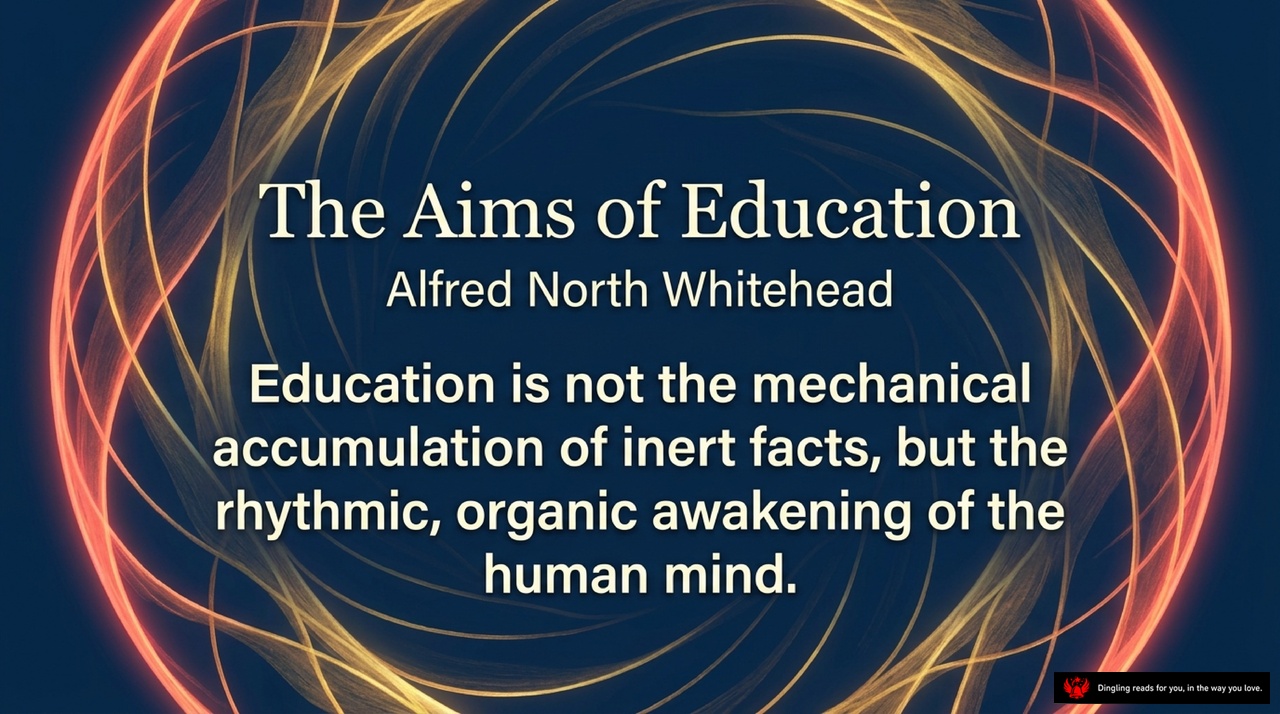
Welcome to our exploration of the true purpose of education. Today, we are diving into a profound idea from Alfred North Whitehead, a thinker who challenges the very way we learn.
Look at the title on the screen: "The Aims of Education." Whitehead starts with a striking warning. He tells us that education is not the mechanical accumulation of inert facts. He is speaking directly to us about the danger of simply memorizing data without understanding it. Instead, he argues that real education is the rhythmic, organic awakening of the human mind. It is about bringing your intellect to life, not filling it with dead information.
This distinction is crucial. When we treat our brains like empty boxes waiting to be stuffed with facts, we lose the most important part of learning—the ability to think, to feel, and to grow. Whitehead believes that valuable intellectual development is actually self-development. It is a living process that happens when we connect new ideas to our own lives, when we experience the joy of discovery, and when we see how universal concepts apply to our unique circumstances.
So, as we move forward in this series, remember this core message: education should wake up your mind, not just store facts in it. It is about creating a vibrant, thinking human being, ready to engage with the world.
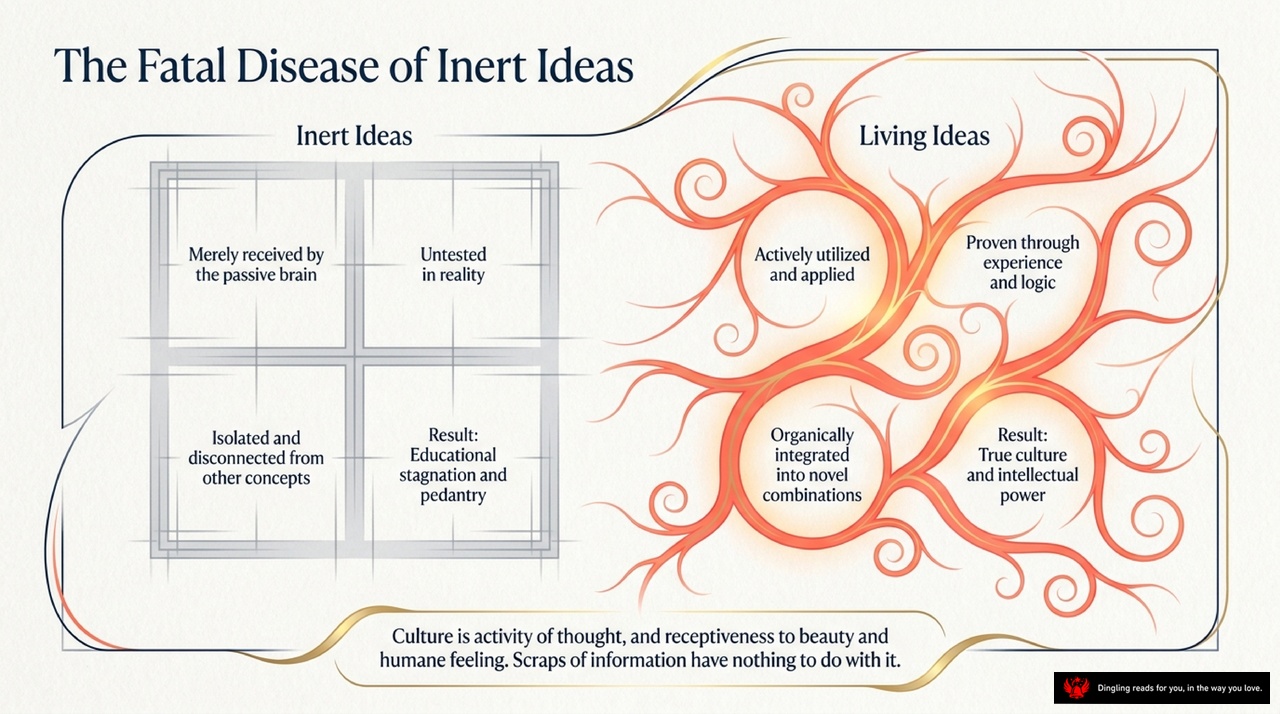
The Fatal Disease of Inert Ideas. Imagine your brain as a storage unit where you just pile up facts without ever using them. That is the trap of "inert ideas"—concepts that are merely received by a passive mind, never tested in reality, and isolated from everything else. The result? Educational stagnation. It's like collecting stamps but never sending any letters.
In stark contrast, we have "living ideas." These are actively utilized, proven through experience and logic, and organically integrated into novel combinations. They don't sit on a shelf; they grow like the neural pathways in the diagram, becoming true culture and intellectual power. As the slide reminds us, culture isn't just information; it is an activity of thought, a receptiveness to beauty and human feeling. Scattered data points mean nothing unless they spark a living connection.
So, how do we move from the gray box of passive reception to the vibrant network of active living? The answer lies in education's core mission: not to fill a bucket, but to ignite a fire. We must stop treating the mind as a lifeless tool to be sharpened only for future use. Instead, we must engage it right now. By connecting abstract concepts to real-world problems, by encouraging students to test their theories and create something new, we transform dead knowledge into a living force. True education doesn't just teach you what to think; it teaches you how to think, ensuring your ideas remain dynamic, relevant, and powerful throughout your life.

The mind is not a tool to be sharpened. We often fall into the traditional fallacy of viewing our brains as passive, inanimate instruments that must be polished before they can be used. But this is a dangerous mistake. The truth, as stated in the Golden Rule, is that the mind is a living organism in a state of perpetual activity, delicate and responsive. You cannot postpone its life until you have sharpened it. Whatever interest you intend to evoke, whatever powers you intend to strengthen, must be evoked and strengthened here and now. Education fails when it treats students like dull tools waiting to be honed. Instead, we must nurture this living organism. We need to avoid the "inert idea"—knowledge that is merely passively accepted without being tested or applied. Just as a living body thrives on activity, the mind thrives on engagement. If we wait to "prepare" the mind before letting it live, we starve it of its very essence. True education doesn't delay the student's life; it ignites it immediately, respecting the delicate, responsive nature of the human spirit.

The slide before you challenges a fundamental misconception we all carry: the idea that education is just a collection of separate subjects. Look at the puzzle pieces labeled Algebra, Geometry, Science, History, and Literature. In our modern curriculum, these often sit in isolated silos, disconnected from one another. But as the image vividly illustrates, this separation creates a chaotic, swirling void—a loss of meaning and vitality.
The text on the slide hits the nail on the head: "There is only one subject-matter for education, and that is Life in all its manifestations." We are trying to force the complex, interconnected reality of life into rigid, disjointed categories. The slide warns us that this "fatal disconnection kills the vitality of the modern curriculum." It's as if we are presenting children with a frantic table of contents that a deity might scribble down while dreaming of creating a world, rather than teaching them the living, breathing logic of existence itself.
When we teach Algebra without connecting it to the geometry of the world, or History without the narrative flow of literature, we aren't just missing content; we are fragmenting the student's mind. True education requires us to see the unity behind these disciplines. We must move away from treating the brain as a tool to be filled with unrelated facts and instead guide students to understand the single, unified subject of life. Only by breaking down these artificial silos can we restore the energy and coherence that learning is meant to possess.

The core of technical education isn't about just training hands; it's about transforming work into a form of play. As the text suggests, the ideal state is where "work is play, and play is life." When labor is infused with intellect and moral imagination, it ceases to be a burden and becomes a source of joy. Think of the Benedictine monks who found delight in their labor because it was connected to a higher spiritual purpose. Without this shift, we end up with exhausted workers who cut corners and employers who become greedy rather than innovative. True invention springs not from desperate need, but from the pleasure of discovery.
However, we must avoid the trap of separating technical skills from the humanities. A purely Platonic education that focuses only on literature and aesthetics leaves us disconnected from reality. Conversely, technical training without a humanistic soul is just mindless drudgery. The text argues that education must produce people who are both knowledgeable and capable of action. This means integrating science into technical training and infusing technical courses with scientific principles and aesthetic judgment. We must remember that the hand and the brain are partners; a mind that never engages in physical activity eventually becomes dull and timid. By breaking down the wall between the "useless" arts and practical skills, we empower students to see their daily tasks not as a separate kingdom of evil, but as a field for creative energy. The goal is to raise survival into a better life, where every worker is a creator and every employer is a visionary.

Look at this slide: "Phase I: The Stage of Romance." It captures the very beginning of a child's intellectual journey—a time defined not by facts, but by feeling. The image shows an explosion of golden, flowing energy, symbolizing that initial spark of curiosity.
According to Whitehead, this is where the mind first experiences the fresh, the novel, and the unexplored. It's a period of unstructured exploration. Children aren't trying to analyze or categorize; they are simply discovering the world with their own eyes, free from the burden of systematic analysis. They realize that ideas aren't abstract concepts to be memorized, but tools immediately relevant to their actual lives.
Whitehead warns us that without this adventure of romance, education fails. At best, you end up with inert knowledge—facts that sit dead in the brain without initiative. At worst, you cultivate a contempt for ideas entirely. So, we must protect this phase. We cannot rush to teach rigid rules or complex systems before the child has had the joy of wondering. Let them explore, let them feel the magic of discovery, and only then can we build the structure of knowledge on top of that living foundation.

So, we've just traced how scientific thought evolves from messy sensory impressions into precise, stable concepts. We started with raw feelings—like seeing a cat or feeling its texture—and used principles like convergence and aggregation to turn those fleeting moments into something solid. That's how we get from a blur of data to a clear idea of an "electron" or a "field."
But here's the crucial pivot: science isn't just about cold facts. While it excludes aesthetic or moral judgments to focus on mechanics, it actually relies on them to get started. Why do we build this complex logical structure in the first place? Because we judge it valuable. We need that spark of value—whether it's beauty, ethics, or utility—to drive the entire scientific enterprise. Without that initial human desire to know and create, the whole logical machine wouldn't even turn.
Furthermore, don't let the rigor of science fool you into thinking it's detached from reality. Science is deeply rooted in our common sense. Concepts like "matter" or "time" aren't abstract inventions; they're refined versions of the practical tools we've used for millennia to survive. We refine our raw, common-sense experiences into the elegant, abstract theories you see in textbooks, but the foundation is always our lived reality.
In the end, science doesn't replace metaphysics; it makes the need for it more urgent. As we refine our understanding of the physical world, we inevitably return to the big questions about value and existence. The logical structure of science gives us the tools to examine our deepest beliefs, proving that the pursuit of knowledge and the search for meaning are, in the end, two sides of the same coin.

The secret of success is pace; the secret of pace is concentration. This slide distills the core dilemma teachers face during the "Precision stage": how to maintain vitality while imparting exact knowledge. It's not about slowing down or rushing blindly; it's about finding the rhythm.
Let's break down the three-step process shown here. First, **Focus**. You must determine exactly what precise knowledge is absolutely necessary and discard the rest. Don't try to teach everything; choose the core. Second, **Speed**. The watchword is "pace, pace, pace." Get the knowledge quickly. If you linger too long on details, you lose the momentum. Third, **Application**. Once acquired, use it immediately. If you can use it, you have truly mastered it. Knowledge without immediate application is just data, not wisdom.
Notice the graphic on the left, labeled "Maximum Concentration." This visualizes the engine behind this speed. You cannot have pace without deep focus. When your mind is scattered, your pace drags, and your learning becomes shallow. By locking your concentration on a few essential truths and moving through them rapidly, you transform passive information into active skill. This cycle of focused speed and immediate application is the true secret to effective learning.
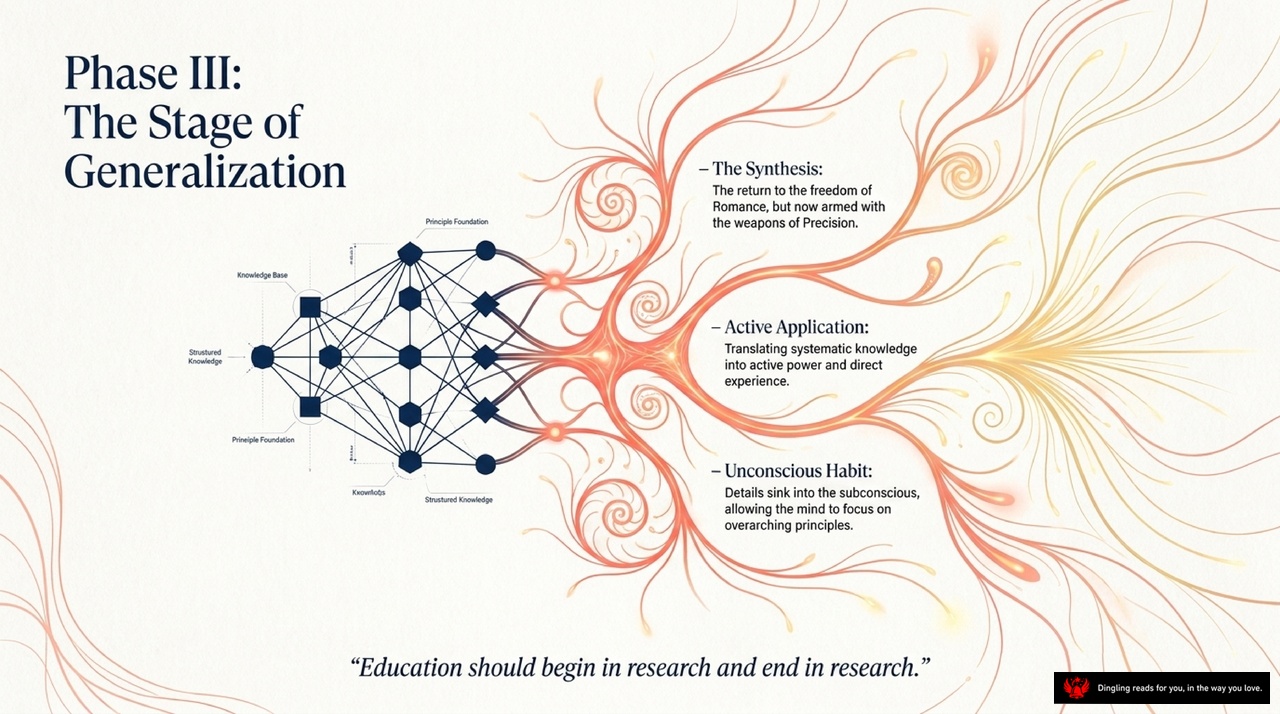
Welcome to Phase III: The Stage of Generalization. Imagine your mind not as a static storage unit, but as a living network that evolves from scattered sparks into a powerful, unified force. This is where true mastery happens.
In this phase, you move from the initial excitement of discovery—the "Romantic" stage—through the rigorous, structured learning of the "Precise" stage, and finally arrive here: the stage of Generalization. Here, you achieve a synthesis. It's a return to the freedom of your early curiosity, but now, you are armed with the sharp weapons of precision you've earned.
This transformation unlocks three critical capabilities. First, Active Application. You stop just knowing facts and start translating that systematic knowledge into direct, active power in the real world. Second, the development of an Unconscious Habit. As you practice, the details sink deep into your subconscious. Suddenly, you don't have to think about the mechanics; your mind is free to focus entirely on overarching principles and creative strategy.
As the slide beautifully illustrates, education shouldn't just be about memorizing the steps; it's about the journey. As the great philosopher Whitehead reminds us, "Education should begin in research and end in research." It starts with the wonder of discovery and culminates in the ability to apply that wisdom independently. This is the moment where knowledge becomes true intelligence, and you stop being a student of the subject and start becoming a master of it.
Today, we're diving into the very fabric of reality by exploring how space and time are actually constructed—not as absolute containers, but as relationships woven from our experience. Think about it: for centuries, we treated space and time as fixed stages where life plays out. But modern physics and philosophy have flipped this script. We now see that our concepts of distance, duration, and even the "now" are flexible, deeply dependent on how we observe the world.
Consider the two opposing views that have shaped this debate. On one side, the "a priori" formalists argue that space and time are innate frameworks, like the lenses through which we must inevitably view the universe. On the other, the empiricists suggest these concepts are precise deductions drawn entirely from sensory experience. The truth likely lies in a fascinating synthesis of both. As we move from raw, chaotic sensations to structured scientific knowledge, we don't just add data; we organize it. We take those fragmented visual and tactile inputs and, through logical convergence, build stable objects. We group similar experiences across time to recognize a persistent "cat" or a "table," and we imagine states we aren't currently sensing to maintain a coherent reality.
But here's where it gets truly mind-bending. When we try to define the fundamental units of reality—like a mathematical point or an instant of time—we find that these are idealizations, not physical objects. A point isn't a tiny dot you can touch; it's a limit reached when we shrink our perspective until nothing remains but a relationship. Similarly, an instant isn't a frozen frame; it's a convergence of events. This leads us to the concept of the "field," a modern scientific thought-object where reality is a continuous web of values at every location and moment, rather than a collection of separate particles interacting through invisible forces.
Ultimately, our understanding of space and time is not a discovery of pre-existing absolutes, but a creative act of organizing our sensory data into a logical, consistent system. Whether we lean toward Newton's absolute space or Einstein's relative spacetime, the core insight remains: our reality is a construct. It is a bridge built between our raw, fleeting perceptions and the abstract, logical structures that allow us to predict, understand, and navigate the universe. The universe doesn't dictate the rules of measurement; rather, our logical framework defines what we can measure and how we experience the flow of time and the expanse of space.
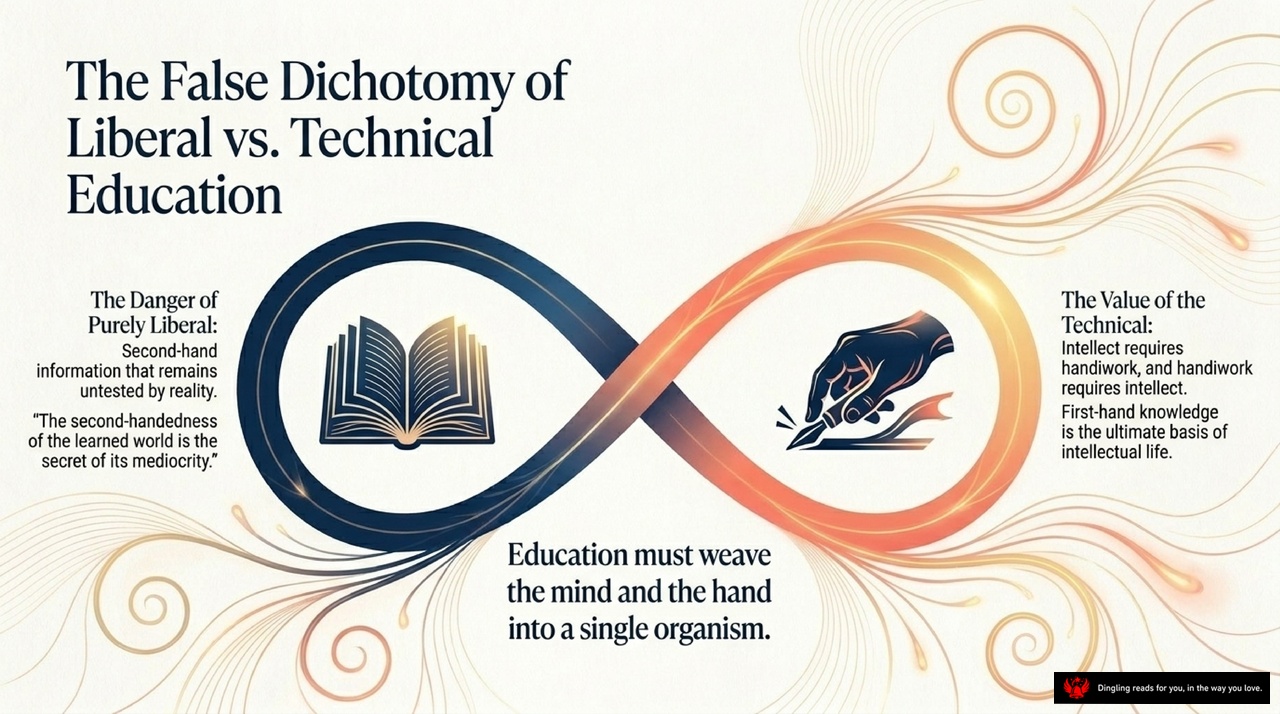
The false dichotomy between liberal and technical education is a trap we must escape. Too often, we pit the "liberal" pursuit of abstract knowledge against the "technical" demands of manual work, treating them as opposing forces. But the truth, as illustrated by the infinite loop connecting the open book and the hand at work, is that they are two halves of a single organism.
Purely liberal education carries a hidden danger: it deals in second-hand information, knowledge that remains untested by reality. It creates a learned world that is ultimately mediocre because it lacks the grounding of direct experience. Conversely, a purely technical approach without intellectual depth is equally limited. As the slide reminds us, intellect actually requires handiwork, and handiwork requires intellect. First-hand knowledge is the ultimate basis of an intellectual life.
True education doesn't separate the mind from the hand. It weaves them together. We need to move away from the idea that we should first sharpen the brain like a tool and then use it. Instead, we must engage in first-hand observation and practical application. Whether through measuring land with a simple chain, analyzing the structure of a language, or exploring the principles of science, the act of doing is what transforms passive information into active wisdom. By integrating the theoretical insights of liberal arts with the practical rigor of technical skills, we create a complete education that prepares us not just to think, but to live and act effectively in the real world.
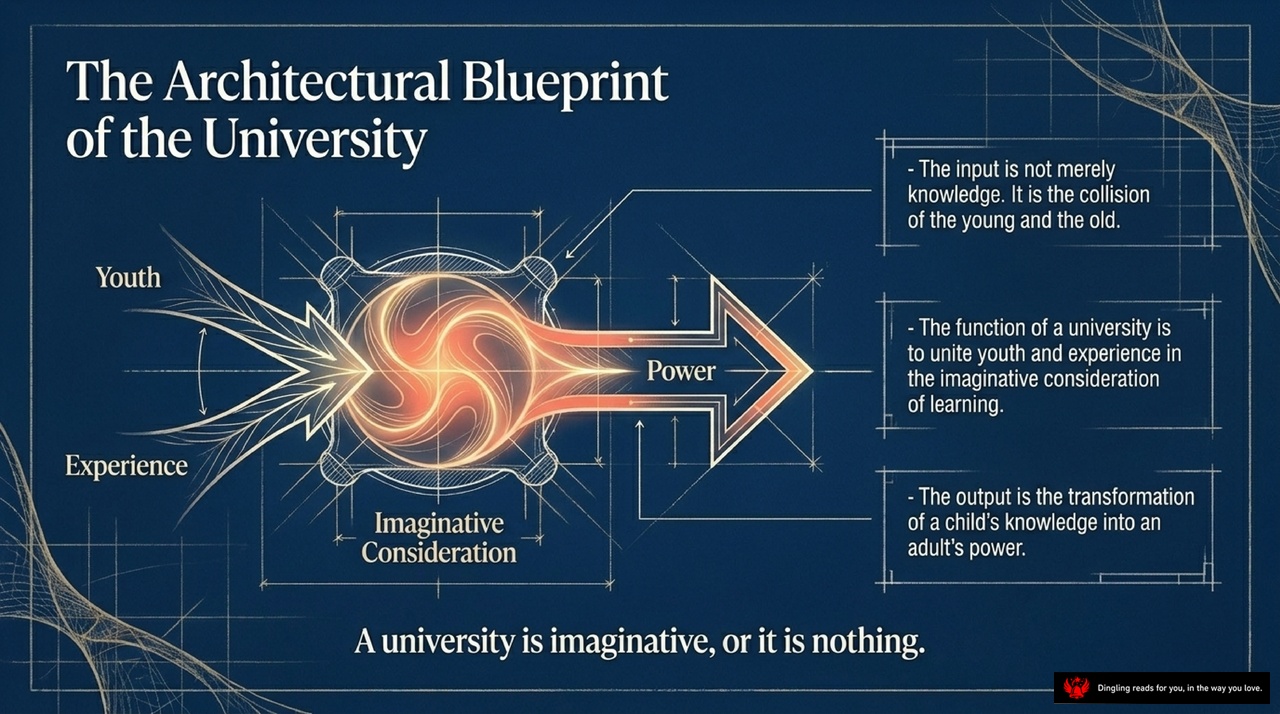
The Architectural Blueprint of the University isn't just a diagram; it's a powerful vision of how true education actually works. Look at this flow: on the left, we have **Youth** and **Experience**. These aren't separate inputs competing for space; they are the essential collision that fuels everything. A university fails if it tries to teach a child's knowledge or simply train an adult's skill. Its real magic happens in the middle, in what we call **Imaginative Consideration**.
This is the engine room. It's where the energy of youth meets the weight of experience, transforming raw data into something dynamic. And that transformation? That's the output. The goal isn't to fill a bucket with facts. The goal is to convert a child's limited knowledge into an adult's **Power**.
Notice the final result: **Power**. This isn't about brute force; it's about the ability to apply universal principles to specific, messy, real-world situations. As the slide reminds us, "A university is imaginative, or it is nothing." Without that spark of imaginative consideration, you just have a repository of information. But with it, you create a mind that can navigate the future, turning what we know into what we can do.

Imagine a single flame that refuses to be measured, weighed, or stored in a refrigerator. This is the essence of imagination. As we see on this slide, imagination is described as a contagious disease—a spark that, once lit, travels through the mind's neural pathways, igniting others along the way. It cannot be quantified by the yard or the pound; it is a living force that demands to be experienced, not just taught.
The image beautifully illustrates how this "disease" spreads. It starts with one torch, representing the initial spark of discovery or a brilliant idea, and then branches out into a complex, organic network. This mirrors the slide's powerful message: research and teaching must fuse. Researchers cannot simply hoard their discoveries; they must broadcast them to active, plastic minds. If we treat the brain as a passive container to be filled with facts, we kill the very thing we are trying to cultivate. Instead, we must create an environment where learning is illuminated by imagination itself.
The slide also reminds us of a crucial paradox: the more we try to control or standardize this process, the less effective it becomes. Just as a flame needs air to burn, imagination needs freedom and the freedom to fail. When educators try to "dole out" knowledge like canned goods, they extinguish the fire. True education happens when we stop trying to manufacture results and instead focus on lighting the first torch, trusting that the rest will follow naturally, spreading across the landscape of a student's life.
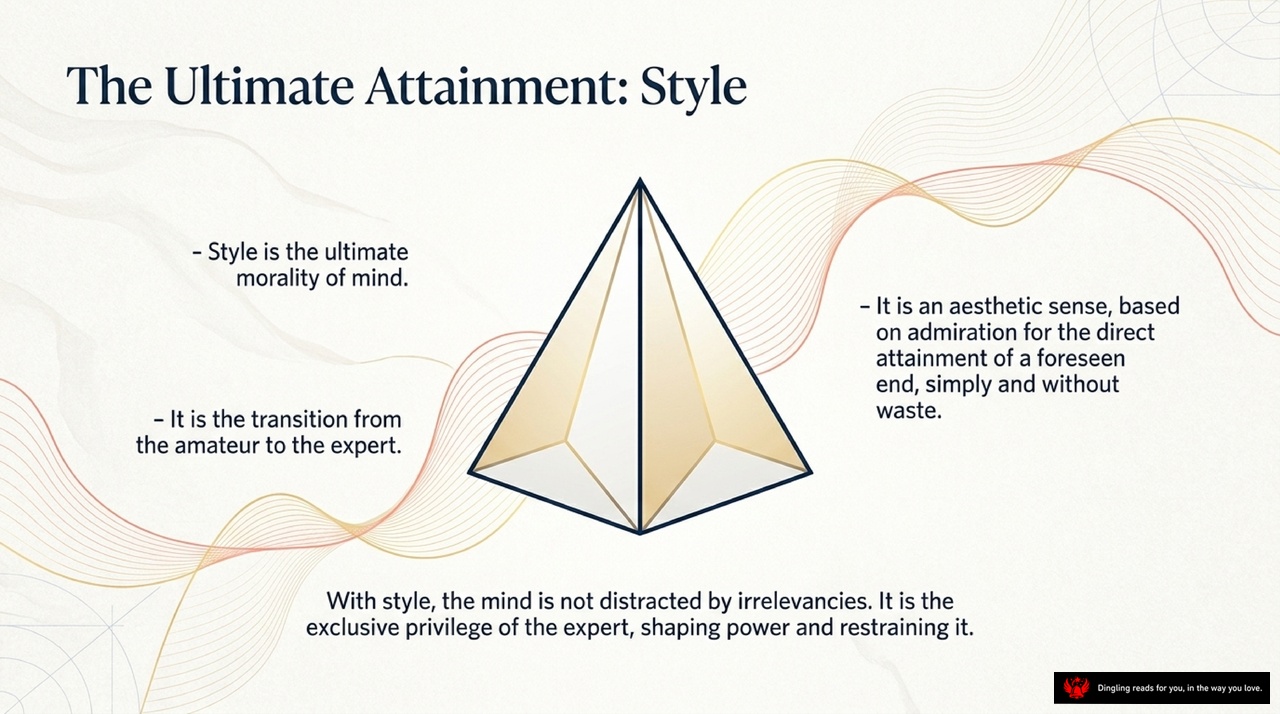
Style is the ultimate morality of mind, marking the distinct transition from amateur to expert. It is an aesthetic sense born from admiration for the direct attainment of a foreseen end—achieving goals simply and without waste. When we cultivate style, our minds are no longer distracted by irrelevancies; instead, we gain the exclusive privilege of shaping power while restraining it. This mastery allows us to see the whole picture, ensuring that every action contributes directly to our vision. Ultimately, style is the final attainment of education, the moment when knowledge transforms into effortless, intelligent action.

Education isn't just about filling a mind with facts; it's a rhythmic, lifelong process of rescuing ideas from the realm of inert facts and transforming them into living power. As we've seen throughout our journey, the mind is a living organism, not a mechanical tool to be sharpened and stored away. If we treat education as a factory line, we end up with students who can recite definitions but cannot think. But if we view the mind as a dynamic, evolving entity, we must radically change how we teach, lead, and learn.
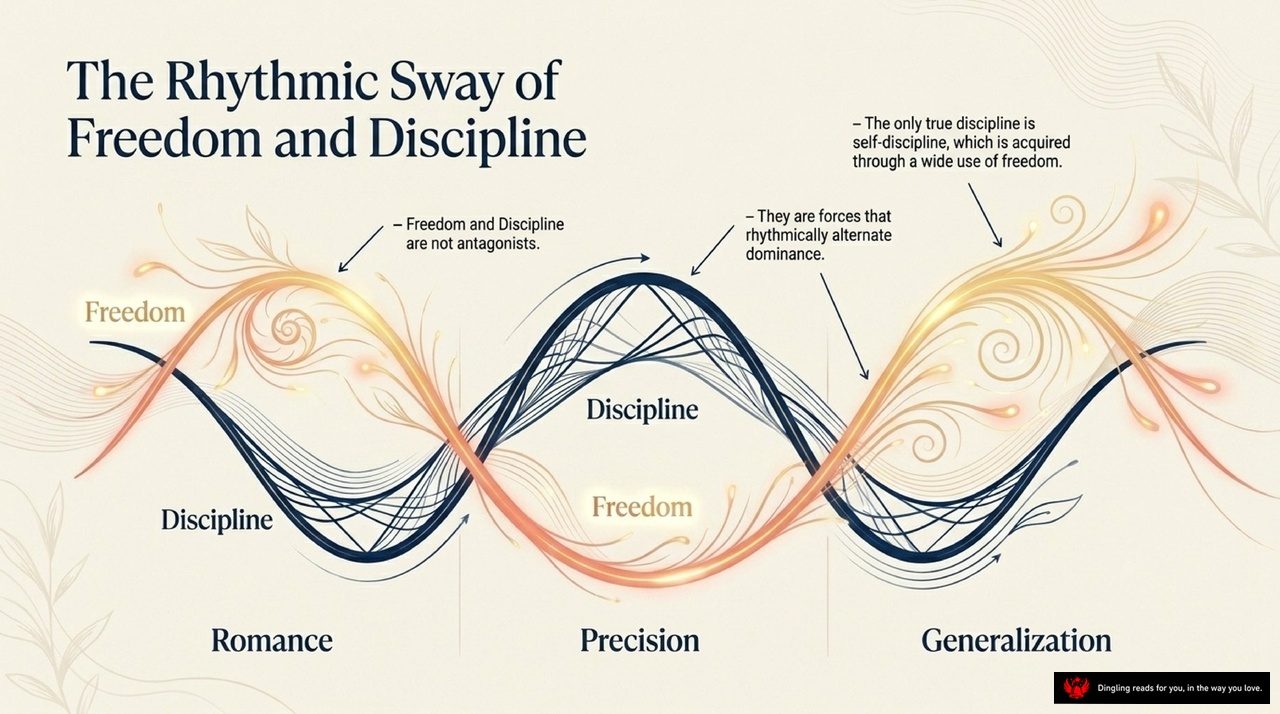
The core of this transformation lies in respecting the natural rhythm of human development. We move through cycles of romance, where we discover and feel; precision, where we analyze and define; and synthesis, where we integrate and apply. Ignoring this rhythm—trying to force a child into the rigid structures of an adult—only creates dead, inert knowledge. True education weaves freedom and discipline together, creating a unique style for the human mind. It's about taking the raw materials of facts and turning them into a living force that empowers us to navigate the world. So, the question remains: if we truly see the mind as alive, what are we willing to change today to let that life flourish?