



Whitehead warns that cramming facts creates inert ideas, so Mia memorized lab steps but failed to design her own experiment when facing real river water samples.
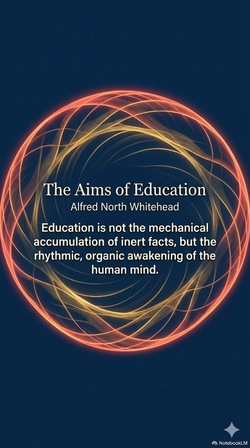
Your Review
Whitehead warns that cramming facts creates inert ideas, so Mia memorized lab steps but failed to design her own experiment when facing real river water samples.

This book explains why my students just memorize facts instead of actually using them in real life.

The book explains how standard testing creates inert ideas by forcing students to memorize disconnected facts instead of applying knowledge to solve actual problems, which leaves them confused when facing real-world challenges like Mia in the story. This critique of systems that prioritize recall over critical thinking feels incredibly relevant today because it shows why we often know formulas but cannot adapt them to new situations, proving that education must focus on deep understanding and active engagement rather than just filling minds with static information that never gets used again.

Mia's story shows how cramming facts makes knowledge useless for real problems.

Whitehead argues that education fails when we treat students as storage units for inert ideas. Mia, a biology graduate, memorized lab steps and chemical formulas for her exams, feeling proud of her high GPA and every A she earned in molecular biology and ecology. However, on her first day at an environmental consulting firm, her boss gave her a jar of river water and asked her to design an experiment to test for unsafe lead levels. Suddenly, all her textbook knowledge felt locked in a vault she could not open. She stared at the jar, unsure how to choose a control group, what tools to use, or even how to interpret the results if she got them. She admitted later that while she memorized all the lab procedures for tests, no one ever taught her how to build an experiment from scratch. This story highlights the quiet crisis of modern education where we fill students heads with inert ideas rather than fostering critical thinking or active engagement with concepts that allow them to solve real world problems.

Mia's story perfectly captures why memorization fails us all.

This book perfectly describes why memorizing formulas without understanding how to use them makes learning feel useless.

This book changed how I see my own learning habits forever.

Mia's story perfectly explains why memorizing facts fails in real life.

Whitehead's warning about inert ideas explains why Mia memorized lab steps but couldn't design an experiment from scratch when facing real problems.

This book makes me realize that my education focused too much on passing exams rather than building the kind of flexible thinking needed to adapt to a constantly changing world.

Whitehead argues that education fails when it treats brains as storage units. Mia memorized lab steps but couldn't design an experiment for her new job because she never learned how to build one from scratch. The book explains that inert ideas clutter our minds like dust on a shelf instead of fueling growth. Systems prioritizing testing over thinking create this crisis where students can recite facts but can't apply them to new problems like testing river water for lead. We must teach fewer subjects deeply rather than cramming disconnected facts. True learning requires active participation, not passive absorption. Early childhood nurturing fosters the curiosity needed to avoid this trap later. The three stages of romantic exploration, precision, and synthesis show how natural growth happens in cycles rather than a straight line. Ignoring this rhythm forces students into rigid boxes that stifle creativity. We need to integrate technical skills with humanistic purpose so students see the value in connecting ideas. Standardized testing enforces inert ideas by rewarding recall over application. Economic incentives push schools to narrow curricula for test scores instead of fostering adaptability. Teachers lack flexibility to follow children's natural rhythms, but models like Montessori prove rhythmic learning works. Neuroscience confirms that the adolescent brain needs exploration before structured analysis. Cramming skips the consolidation phase needed for long-term memory retention. Lincoln High School improved pass rates by aligning curriculum with Whitehead's cycles. The STEM versus liberal arts divide is a toxic myth that separates mind from body. We need thinkers who bridge disciplines to solve complex modern problems. Rejecting inert ideas means prioritizing application over memorization in daily learning.

It is frustrating that standardized testing forces schools to prioritize memorizing facts over fostering the curiosity and critical thinking skills that Whitehead says are essential for true education.

The idea that intellectual growth happens in cycles of romantic exploration, precision, and synthesis rather than a straight line changes how I think about my own learning journey completely.

Whitehead's argument that we must teach fewer subjects but much deeper is a powerful antidote to the overwhelming, fragmented curriculum that leaves students confused and unprepared for life.

Mia's story really hit home for me as a former student who memorized facts but never learned how to use them in real life.

Reading Whitehead's words reminds me that education should be about lighting a fire of curiosity in students rather than just filling their minds with static information they will never use.

I feel hopeless about the education system because the pressure to test students seems to crush the very creativity and natural curiosity that Whitehead argues is necessary for human growth.

Beginner-friendly without being shallow.

Whitehead's idea that cramming facts creates inert ideas that never stick really explains why I struggled to apply my biology knowledge in real life.