
The Alchemist: Complete Chapter-by-Chapter Summary
Welcome to our deep dive into *The Alchemist* by Paulo Coelho. Today's opening slide sets the stage for a journey that is as much about the destination as it is about the path you take. The title, *The Alchemist*, combined with this mystical compass graphic, immediately suggests a story of navigation—finding your way through the unknown to uncover the language of the universe.
This book is often described as a philosophical toolkit for decoding that very language and navigating the map of your own destiny. It invites us to look beyond the surface of our daily lives and ask the ultimate question: What is your personal legend? What is the one thing you were born to do? As we begin this exploration, we are reminded that the journey of a thousand miles starts with a single step, and for the protagonist, that step was taken when he chose to follow a dream rather than a safe, conventional path. This is the essence of the story ahead—a tale where the universe conspires to help those who truly believe in their dreams.

Welcome to the heart of the journey. Look at this map of "The Four Stages of Spiritual Alchemy." This isn't just a fantasy sequence; it's the exact path every seeker takes to find their true self.
It all begins with **Stage I: The Catalyst**. This is where the journey starts. It's about recognizing your "Personal Legend"—that inner calling or dream that feels like a sign from the universe. It's the moment you realize you are meant for something more than just surviving the day.
But no journey is smooth. That brings us to **Stage II: The Resistance**. This is the hardest part. It's the psychological trap that tries to stop you. It whispers that you're not good enough, or that your dream is too risky. It forces you to abandon your dreams for safety and comfort. Many people get stuck right here.
Then comes **Stage III: The Refining**. Think of this as crossing the desert. It's the painful process of stripping away your ego, your fears, and your old identity. You have to align your heart with the world, learning that the universe is working with you, not against you. It's where you turn lead into gold through sheer will and faith.
Finally, we reach **Stage IV: The Synthesis**. This is the ultimate goal. It's not just about finding a pile of gold; it's about achieving enlightenment by merging with the Soul of the World. When you truly embrace your path, you realize that you and the universe are one. You become the treasure you were always looking for.
Remember, the destination is important, but the transformation you undergo along the way is what truly defines your life.

Have you ever felt like the universe is conspiring against you? You want something so badly, yet every step forward seems to hit a wall? In *The Alchemist*, this feeling isn't a curse; it's a sign that you are on the right path.
Look at this diagram. At its center lies your **Personal Legend**—the singular purpose you have always wanted to accomplish. It is the purest expression of your will, before society tries to corrupt it with expectations. The arrows pointing inward represent the forces that guide you: **Intuition**, **Omens**, and **Encounters**.
The slide highlights a powerful concept known as **The Principle of Conspiring Forces**. As the King of Salem famously said, "When you want something, all the universe conspires in helping you to achieve it." This isn't magic; it's the alignment of your deepest desires with the fabric of reality.
Consider the protagonist, Santiago. He was a simple shepherd, yet he possessed a Personal Legend he couldn't ignore: to find treasure. When he left his sheep, he wasn't running away; he was answering a call. Every time he faced a setback—like being robbed in the desert or losing his way—it wasn't a rejection. It was the universe testing his resolve, nudging him closer to his truth.
The image reminds us that we are never truly alone. Whether it's a strange dream, a chance meeting with a crystal merchant, or the guidance of a mysterious Alchemist, these are all **omens** and **encounters** designed to propel us forward. Your Personal Legend is waiting, but it requires you to trust that the universe is working in your favor. When you truly desire something, the stars, the wind, and even the strangers you meet will all align to help you reach your destination.

Imagine the universe as a vast, silent ocean. It doesn't speak in words; instead, it whispers through signs and omens—markers placed specifically on your path to guide you forward. This is the language of the cosmos, waiting only for you to learn how to read it.
In the ancient wisdom of the Hebrews, there were two stones known as the Urim and the Thummim, a tool for objective grace. When the omens were too confusing to interpret, these stones would answer critical questions with a white stone for "yes" or a black stone for "no," preventing total paralysis. But the true power lies not just in the tools, but in the mindset.
Consider the concept of *Maktub*, or "It is written." This is the profound understanding that destiny is pre-written by the hand of the universe. However, and this is crucial, your destiny does not unfold automatically. The mechanism that activates it is your own choice to follow the omens. You are the active participant in your own story.
Just like the boy who traded his flock for a chance to find treasure, or the crystal merchant who stayed in his shop dreaming of Mecca, we all face a choice: do we listen to the subtle signs around us, or do we ignore them and stay stuck? The universe is ready to help you achieve your deepest desires, but only if you have the courage to look up, recognize the signs, and step forward into the unknown.

The Crystal Merchant's Paradox: Why We Avoid Our Dreams
Have you ever dreamed of something so big that you actually stop yourself from achieving it? That is exactly the trap of the Crystal Merchant. He lives in a dying city, surrounded by the ruins of his past glory. He has the money and the time to travel to Mecca, yet he refuses to go. Why? Because the dream itself has become a shield.
The image on your screen illustrates this cycle perfectly. The Merchant clings to his "Unfulfilled Dream" because it provides a glimmer of hope to endure his miserable present. But that very hope creates a "Fear of Realization." He is terrified that if he actually goes, the dream will vanish, and the driving force of his life will disappear. So, he chooses the safety of stagnation over the terrifying reality of transformation.
This is the result: choosing the familiar safety of a mundane existence over the terrifying but necessary reality of change. The Merchant isn't protecting himself from failure; he is protecting himself from the unknown. He would rather live with the pain of a dream deferred than face the uncertainty of a life lived.
But here is the twist. The story of the boy, Santiago, proves that the universe conspires to help those who truly want something. When Santiago finally leaves his comfort zone, he finds the treasure not in a distant pyramid, but in the lessons learned along the way. The Merchant, however, stays stuck. He believes he needs the dream to live, but he forgets that the dream is only the vehicle to get him to his true purpose.
So, ask yourself: What is your unfulfilled dream? Are you holding onto it because you love the hope, or are you afraid of what happens when you finally arrive? The Merchant chose the former. But you? You have the choice to break the cycle and start moving today.

The Trap of the Intellect isn't just a metaphor; it's the very reason we get lost in life. Look at the books piled high on the left. That stack represents the "Illusion of Mastery." We spend our lives reading about the world, believing that if we just memorize enough facts and theories, we will finally understand reality. We think we are safe inside our minds, protected by rigid texts and academic jargon. But as the slide warns, this pursuit of knowledge often becomes divorced from connection. It's an alchemy performed in isolation, ignoring the living, breathing desert right outside our windows.
Contrast that with the starry sky and the vast desert on the right. This is the vulnerability of direct experience. The slide tells us a profound truth: the "Language of the World" cannot be decoded by isolating oneself in theory. You cannot read your way to the stars; you have to feel the wind and stand in the sand. The Englishman in the story seeks answers in books while ignoring the living desert around him, but the boy learns that true understanding comes only when you step out of the library and into the unknown. Knowledge without experience is just noise. Only when we embrace the vulnerability of being out there, without a safety net of textbooks, do we finally unlock the universe's secrets.

Imagine three distinct archetypes that define how we approach our own Personal Legends: The Merchant, The Englishman, and Santiago.
The Merchant represents Passive Avoidance. His motivation is comfort and predictability, but his fatal flaw is preferring the fantasy of the dream over the reality of it. He remains stagnant, trapped in a safe but unfulfilled life.
Then there is The Englishman, who embodies Theoretical Pursuit. Driven by a desire for intellectual mastery, he looks for complex formulas and ignores the simple truths right in front of him. He gets lost in the book instead of living the story.
Finally, we have Santiago. His stance is Active Observation. Unlike the others, his motivation is pure: The Personal Legend. His strength lies in acting in the physical world while simultaneously listening to the spiritual omens. He doesn't just read about the universe; he walks through it.
This Behavioral Matrix reminds us that our journey isn't about avoiding fear or mastering theory; it's about the courage to move forward, trusting that the universe conspires to help those who truly dare to begin.

Look at this slide titled "The Desert as a Teacher." It presents a profound philosophy: the desert strips away the past and the future, forcing us into a state of total presence. This isn't just about geography; it's about a mindset shift.
First, consider the "Silence of the Past." As the slide notes with the Camel Driver's quote, "I don't live in either my past or my future. I'm interested only in the present." In the desert, history has no weight. There are no ghosts haunting you from yesterday. You are simply here, right now. This silence allows you to hear the subtle language of the world.
That leads us to point number three: "The Universal Language." Without the noise of society, things like the flight of hawks or the shifting sands become legible. You stop talking and start listening. You begin to understand that the desert, like the people we meet along the way, speaks a language of intuition and soul-to-soul connection, rather than just words.
Finally, look at the core lesson of "Adaptation over Force." The slide explains that a caravan does not fight the desert. It doesn't try to conquer the sand or force its way through obstacles. Instead, it navigates the contours, detours around rocks, and always returns to its compass bearing. Life, much like a journey through the desert, isn't about brute strength. It's about flexibility. When you encounter an obstacle, you don't break against it; you flow around it, yet you never lose your direction. The desert teaches us that true progress comes from adapting to our environment while staying true to our path.

Look at this golden, mechanical heart. It's not just a symbol of love; it's a complex machine designed to protect us, but sometimes, that protection turns into sabotage. This slide asks a painful question: Why does our heart try to stop us from chasing our dreams?
The answer lies in what we call "The Fear of Suffering." Our heart is terrified that realizing a dream will lead to ultimate loss or disappointment. It convinces us that the pain of trying is worse than the pain of failing.
This is exactly the diagnosis given by the Alchemist in the story. He tells us, "The fear of suffering is worse than the suffering itself." In fact, no heart has ever truly suffered when it goes in search of its dreams. The only real suffering comes from staying silent and never leaving the safety of what we know.
If we ignore this signal and stop listening to our heart, we invite "The Consequence of Silence." When we silence our inner voice, our heart takes over in a darker way, dictating our actions through subconscious anxiety. It tricks us into believing we are safe when we are actually trapped.
So, the lesson here is clear: The fear of losing everything is a lie our heart tells us to keep us comfortable. True courage isn't about ignoring the fear; it's about trusting that the universe will protect us when we are truly committed to our destiny. Don't let the fear of pain keep you from the possibility of joy.

The Pact with the Heart is not just a metaphor; it is the survival mechanism of your soul. As the slide illustrates, you cannot silence your heart, nor can you let it rule you blindly. You must make it your ally.
The cycle begins when the heart fears suffering. In that moment of fear, we often abandon our dreams to protect ourselves. This leads to internal regret, which is a form of worse suffering than the pain we originally feared. But the breakthrough happens when we make a pact with our heart. By acknowledging our fears instead of running from them, we remove their power to surprise us with panic.
Listen to your heart continuously. A heart that is ignored becomes a traitor, but a heart that is listened to becomes a radar. It warns you of genuine danger while simultaneously pushing you toward your Personal Legend. When you transform your heart from a source of fear into a compass, you stop being a victim of your emotions and start becoming the master of your destiny.

Love Without Attachment isn't just a phrase; it's the ultimate test of your Personal Legend. As the slide beautifully illustrates, a common failure point on this journey is abandoning your destiny for the sake of love. On the left, we see "The Illusion of Ownership"—a falcon chained to a perch. This represents love that demands you abandon your destiny. That kind of love isn't the Language of the World; it is simply possession. It tries to cage your soul.
But look at the right side: "The Desert Woman." Here, a falcon soars freely over the vast desert. This is true love, or *Maktub*. True love requires freedom. If love is part of the Soul of the World, it will remain with you even when your journey is complete. The Desert Woman understands that she cannot stop the man from finding his treasure. She knows that if he abandons his destiny, the treasure—and her—will disappear forever.
The story teaches us that love is not a chain. It is a companion that supports you as you fly toward your dreams. When you choose to follow your Personal Legend, you don't leave your love behind; you prove that your love is strong enough to let go. Because when you are truly free, you become the most attractive version of yourself, and that is the only way to find a love that lasts.
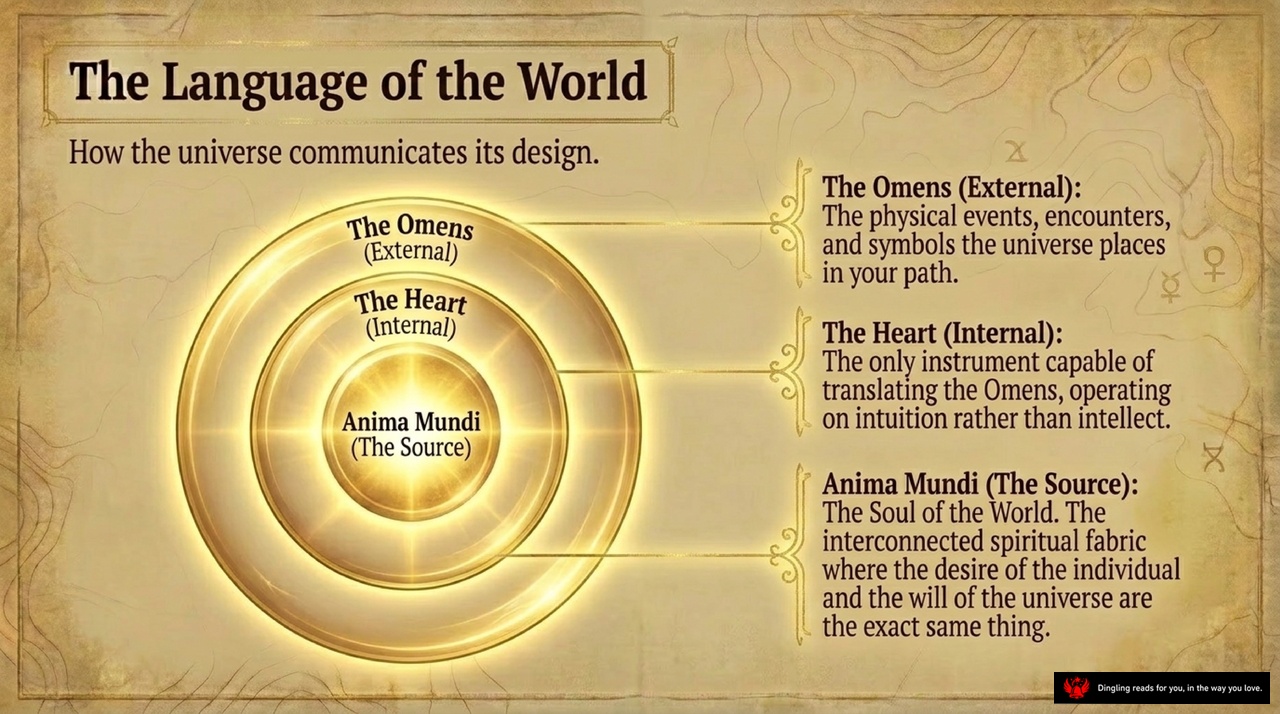
The Language of the World isn't just a metaphor; it's the operating system of the universe. Look at this diagram. It shows us exactly how the cosmos communicates its design to us.
At the outermost layer, we have **The Omens**. These are the external signals—the physical events, the unexpected encounters, and the symbols that appear in your path. They are the universe's way of sending a message, but here's the catch: they are just data. They don't have meaning on their own.
That's where the second layer comes in: **The Heart**. This is your internal instrument. It is the *only* tool capable of translating those external omens. Unlike your intellect, which tries to analyze and calculate, your Heart operates on intuition. It takes the raw data of the omens and decodes them into a clear directive for your life.
And at the very center lies **Anima Mundi**, or **The Source**. This is the Soul of the World. It is the interconnected spiritual fabric where the desire of the individual and the will of the universe become one and the same thing. When you listen to your Heart, you aren't just hearing your own thoughts; you are tapping into this universal source. You are aligning your personal dream with the universe's grand design.
So, the next time you see a strange bird or feel an unexplainable urge, don't ignore it. That is the Language of the World speaking through you. Trust your Heart to translate the message, and you will find that your path is already written in the stars.
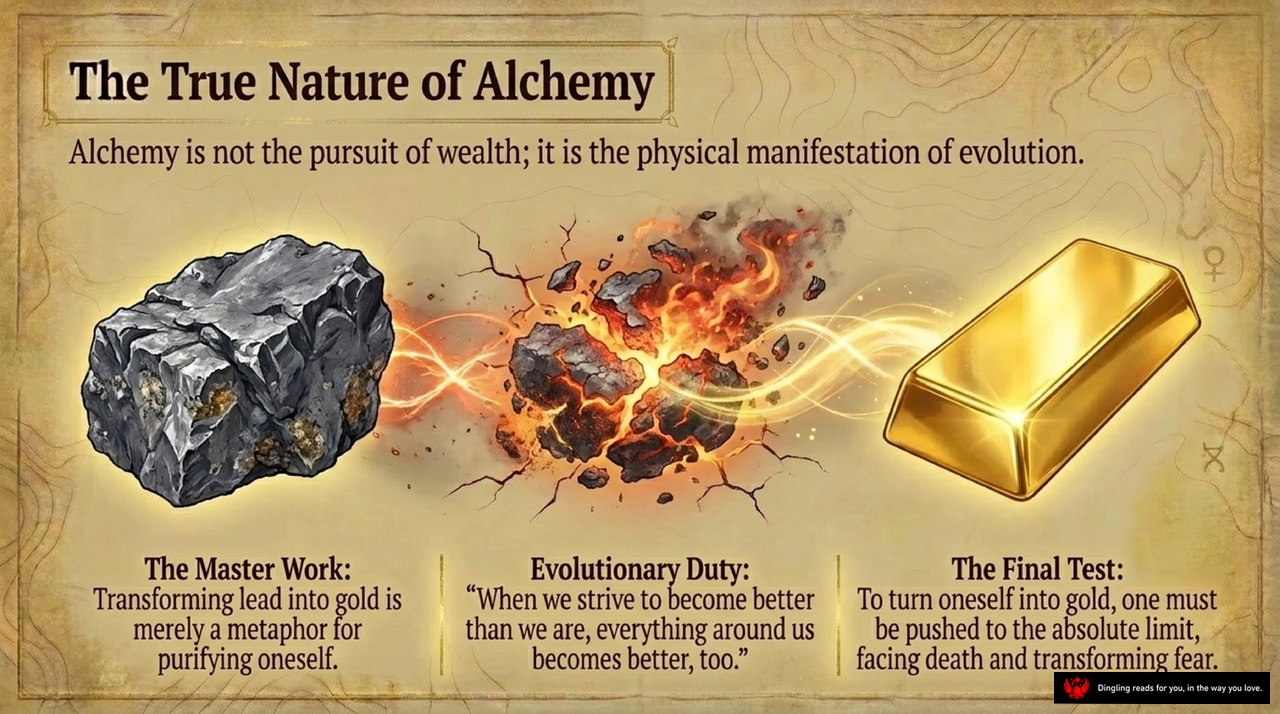
Alchemy is often misunderstood as the pursuit of wealth, but its true nature is far more profound: it is the physical manifestation of evolution. As the slide illustrates, transforming lead into gold is merely a metaphor for purifying oneself. This is what we call "The Master Work." It isn't about changing the material world; it's about changing the person within.
When we strive to become better than we are, everything around us becomes better, too. This is our "Evolutionary Duty." The text tells us that the universe responds to our deepest desires. When you truly desire something, the entire universe conspires to help you achieve it. This isn't magic; it's the law of alignment.
However, this journey comes with "The Final Test." To turn oneself into gold, one must be pushed to the absolute limit, facing death and transforming fear. The story of the boy shows us that the real treasure wasn't the gold at the end of the desert, but the courage he gained along the way. He learned that his heart is where the treasure lies, and that true alchemy happens when we stop fearing the unknown and start embracing our destiny.
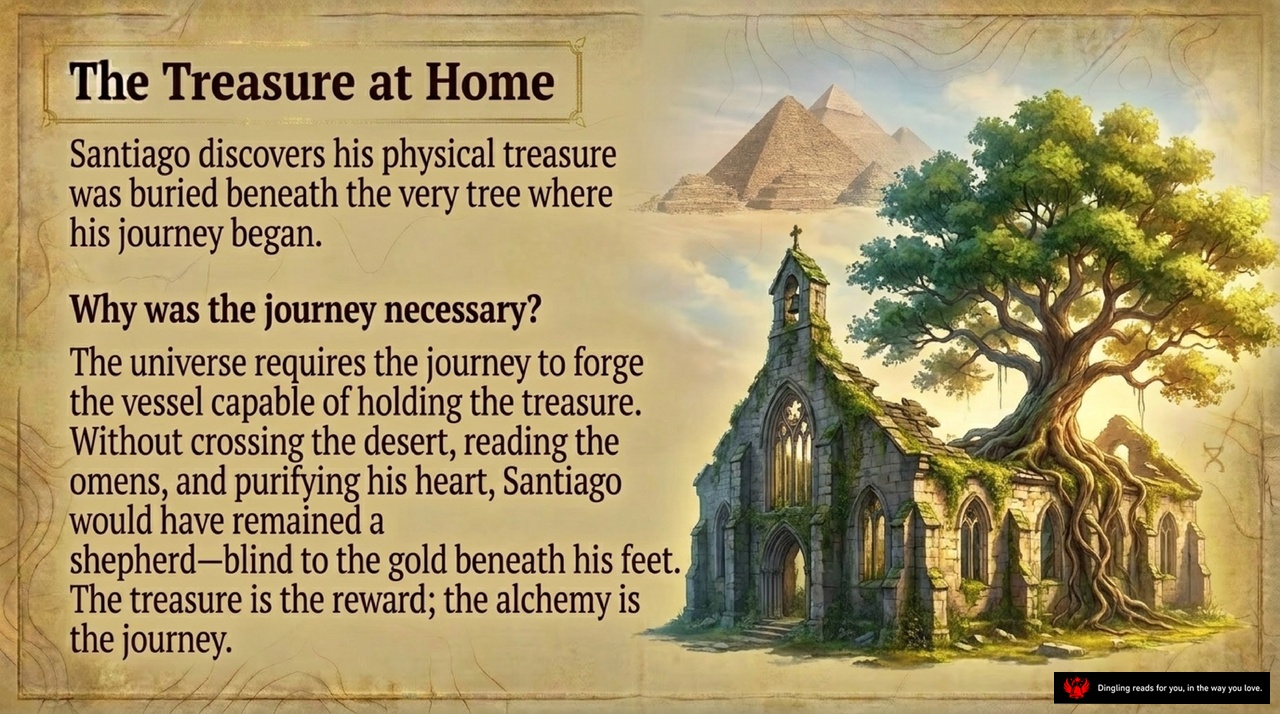
Santiago finally uncovers the truth that has been hidden all along: his physical treasure was buried beneath the very tree where his journey began. But why was the journey necessary? The universe required him to travel, to cross the desert, read the omens, and purify his heart just to forge a vessel capable of holding that treasure. Without this transformation, he would have remained a simple shepherd, blind to the gold right beneath his feet. The treasure is the reward, but the alchemy is the journey itself.

The compass in front of you isn't just a tool for navigation; it represents the profound journey of finding your Personal Legend. As the text reminds us, this pursuit is not a straight line to a destination, but a deep alchemical process. It requires reading the omens around you, mastering your own fears, and recognizing your connection to the soul of the world. Through this transformation, the lead of a stagnant life is turned into the gold of a realized destiny.
But here is the hard truth that often stops us: If the treasure you seek is already buried beneath your feet, what desert must you cross to finally become the person capable of seeing it? We often get distracted by the journey, thinking the treasure lies far away in some exotic place, forgetting that the transformation happens right here, right now. The desert isn't an obstacle to avoid; it is the very place where we become who we are meant to be. So, look at your compass. Where is it pointing? Not necessarily to a specific location, but toward the version of yourself you are willing to become to claim the treasure that has been waiting for you all along.