
The Architectonics Of Power: Complete Chapter-by-Chapter Summary

Welcome to today's session on "The Architectonics of Power." We are diving into the foundational research by Wang Yanan, which offers a rigorous, anatomical deconstruction of the Chinese Bureaucratic Machine.
This presentation isn't just about history; it's about understanding the specific trap that has held China in a state of stagnation for two millennia. We are looking at how a unique bureaucratic system evolved, how it became deeply embedded in the very fabric of society, and why it proved so difficult to overcome.
We will explore the distinct nature of this power structure—its continuity, its ability to adapt and encompass various social elements, and its deep penetration into the minds of the people. From the ancient dynasties to the modern era, we will trace how this machine functioned, how it resisted change, and what it took to finally break its grip.
Get ready to see the invisible architecture of power laid bare. Let's begin.

Defining the Bureaucratic Machine: More Than Just Red Tape.
Look at this diagram. It illustrates the "Bureaucratic Machine"—a concept that often gets misunderstood as simple administrative inefficiency. But the reality is far deeper. As we see in the top right, this is actually a "Global Blueprint" for a specific socio-political regime. It's not just about slow paperwork; it's about a fundamental shift in power.
Notice the section labeled "The Power Shift." This is where the real transformation happens. Rulers consolidate their authority by replacing independent nobles with dependent, salaried officials—bureaucrats—who manage taxation, law, and military force. These officials answer only to the ruler, not to the people.
At the bottom, you see "The Catalyst." This machine emerges when early feudalism, based on blood-right nobles and localized manors, collapses. The gears turn because the old system can no longer hold.
Finally, look at the defining feature highlighted in the red box: Government power becomes exclusively concentrated in the hands of the bureaucratic class. They treat political administration not as a public service, but as a mechanism for personal economic extraction. In short, the state becomes a tool for the few to extract wealth from the many. This is the essence of the bureaucratic machine.
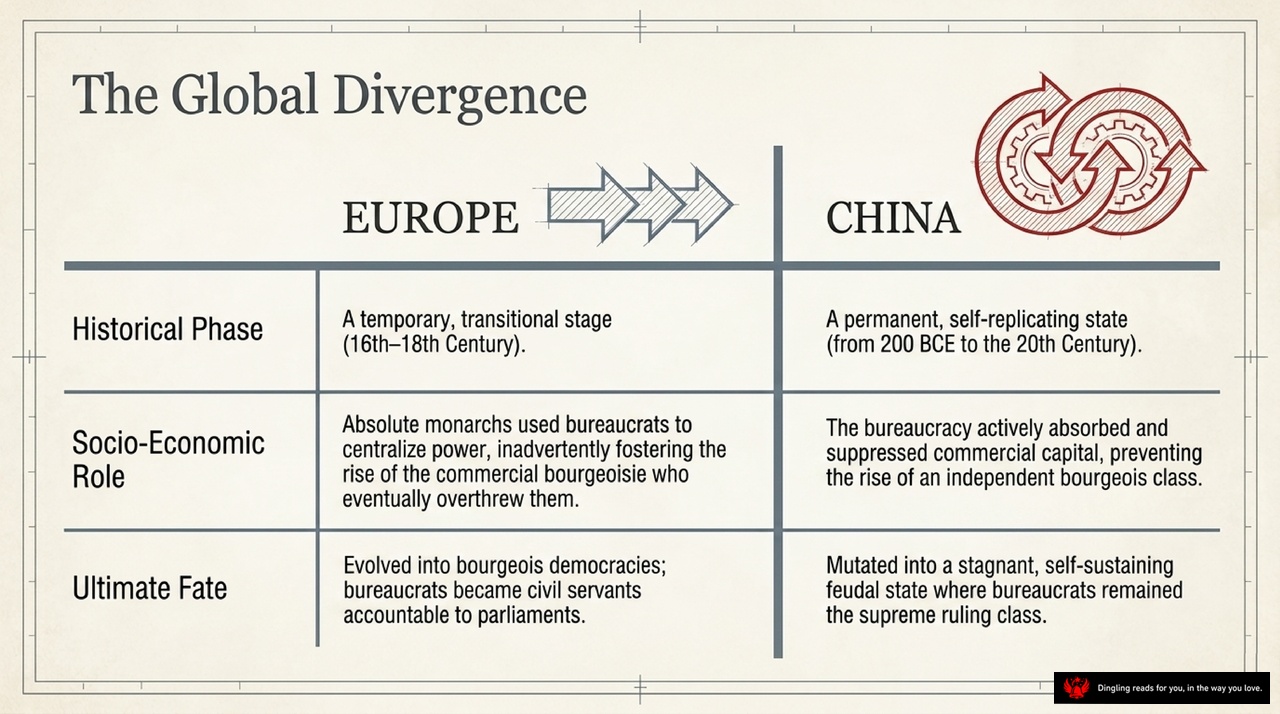
Look at this chart titled "The Global Divergence." It lays out a stark contrast between the historical trajectories of Europe and China, focusing specifically on the role of the bureaucracy.
On the European side, you see a clear path of transition. The slide identifies this as a "temporary, transitional stage" spanning the 16th to the 18th centuries. Here, absolute monarchs utilized bureaucrats to centralize power, but ironically, this very act inadvertently fostered the rise of a commercial bourgeoisie. Eventually, this rising class overthrew the monarchs, evolving into bourgeois democracies where bureaucrats became accountable civil servants.
Now, look at the China column. The trajectory is fundamentally different. China is described as a "permanent, self-replicating state" that lasted from 200 BCE to the 20th century. In this system, the bureaucracy didn't just serve the state; it actively absorbed and suppressed commercial capital, preventing the emergence of an independent bourgeois class. Instead of evolving into democracy, this system mutated into a stagnant, self-sustaining feudal state where bureaucrats remained the supreme ruling class.
The visual on the right perfectly captures this divergence. Europe is represented by forward-pointing arrows, symbolizing linear progress and change. China is depicted with interlocking gears, illustrating a closed loop where the bureaucracy perpetuates itself endlessly. This graphic summarizes a critical historical split: while Europe's bureaucratic phase was a stepping stone to modern democracy, China's bureaucratic tradition became the permanent engine of its political structure, locking the society into a cycle of stagnation rather than transformation.

Let's dive into the unique DNA of the Chinese political system. While many countries have gone through cycles of noble rule, dictatorship, and democracy, China developed something distinct: a bureaucratic system that has remained remarkably consistent for over two millennia. The slide highlights three core anomalies that set this system apart from the rest of the world.
First, look at **Continuity**, symbolized by that infinity loop. This represents "The Infinite Timeline." Unlike Europe, where political machines collapsed and were rebuilt every time a dynasty fell, China's underlying bureaucratic machinery was instantly adopted and restarted by every new ruler. It endured for over 2,000 years, surviving endless dynastic collapses and foreign conquests. It's like a software update that never breaks the core operating system, no matter who is in charge.
Second, we see **Inclusiveness**, illustrated by a complex maze or labyrinth. This isn't just about administration; it's about absorption. The system didn't just govern; it swallowed all competing social forces. It fused politics with family structures, legal codes, and religious philosophy. There was no independent sphere of civil society to act as a check on power. Everything—from your legal rights to your moral values—was part of one giant, interconnected grid.
Finally, there is **Pervasiveness**, shown by the all-seeing eye on a grid. This concept, "The Omnipresent Grid," means the system penetrated daily existence completely. It dictated not just taxation and law, but also moral values, intellectual pursuits, and even the ultimate life goals of every citizen. It wasn't just a government; it was a totalizing worldview that left no room for anything else.
Together, these three anomalies—continuity, inclusiveness, and pervasiveness—created a system that was incredibly resilient, deeply integrated into society, and inescapable in daily life.
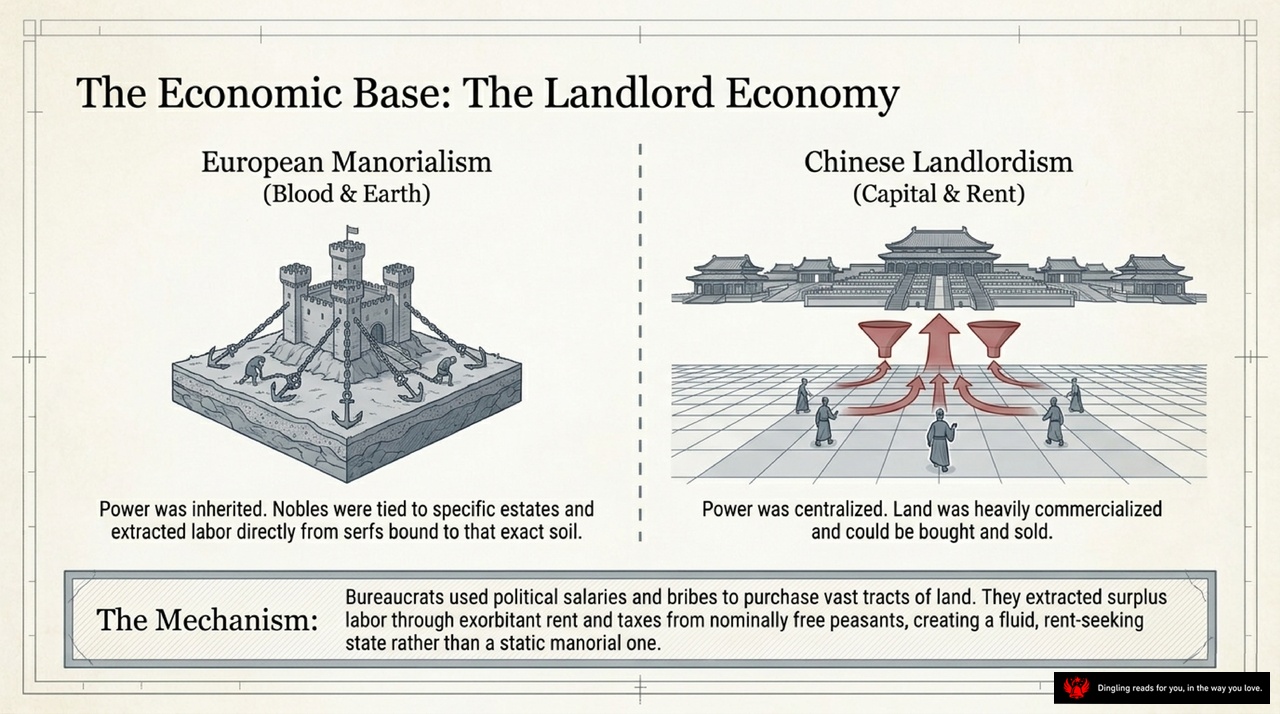
The Economic Base: The Landlord Economy. Today, we're looking at the fundamental difference between how Europe and China organized their power and wealth. On the left, you see European Manorialism, built on "Blood and Earth." Here, power was inherited. Nobles were tied to specific estates and extracted labor directly from serfs bound to that exact soil. It was a system of chains, where the land itself held the people in place.
On the right, we have Chinese Landlordism, driven by "Capital and Rent." Here, power was centralized. Unlike the static European model, land was heavily commercialized and could be bought and sold. This created a dynamic, fluid system. As shown in the mechanism at the bottom, bureaucrats used political salaries and bribes to purchase vast tracts of land. They then extracted surplus labor through exorbitant rent and taxes from nominally free peasants. This wasn't a static feudal structure; it created a fluid, rent-seeking state. While Europe relied on bloodlines and fixed soil, China built an empire on the circulation of capital and the ability to trade land as an asset, fundamentally shaping a different path of economic and political history.

The Ideological Engine: Confucian Patriarchy. This slide reveals the core mechanism that held China's society together for two millennia. Look at the pyramid: it's not just a hierarchy of power; it's a fusion of the state and the family. At the top sits the Emperor, demanding absolute submission. But notice how the structure mirrors the home. The Emperor is the Father, the Bureaucrat is the Son, and the Husband rules the Wife. This is the "Great Unification"—the belief that there can be no two suns in the sky, just as there can be no two kings.
The slide highlights the "Three Fundamental Bonds": Ruler over Subject, Father over Son, and Husband over Wife. This wasn't an accident; it was a deliberate design. As the core insight states, the state politicized the family. By enforcing absolute obedience at the domestic level—what we call Filial Piety—the system automatically manufactured docile, subservient citizens for the state. If you learn to obey your father, you will naturally obey your Emperor. Rebellion against the Emperor became a crime against nature itself, because it was an attack on the family order. This is why the Confucian patriarchal system was so incredibly stable; it made political loyalty a biological instinct, ensuring that the empire could endure for centuries with minimal resistance.

The slide we are looking at today visualizes a powerful historical mechanism: the Keju system, often described as the ultimate institutional lever of China's imperial bureaucracy. At the top of this diagram, we see the "Illusion of Equality." On the surface, the exam system promised a meritocratic path for anyone, regardless of birth, to rise from commoner to minister. It created a theoretical promise of social mobility that effectively pacified class resentment.
However, the image reveals the dark reality beneath that promise. As candidates poured into the funnel, they were forced to conform to "Standardized Dogma." Success wasn't about innovation or independent thought; it required decades of memorizing state-sanctioned Confucian dogma, specifically the rigid format of the Eight-Legged Essay. This process systematically destroyed independent critical thinking.
The result, as the gears at the bottom illustrate, was the "Dissolution of Resistance." By making state service the *only* avenue to wealth and prestige, the bureaucracy successfully absorbed the very intellectuals who, in Europe, had led bourgeois revolutions. Instead of becoming revolutionaries, potential rebels became loyal gears of the state. This system didn't just select leaders; it fundamentally reshaped the entire society to ensure stability from the inside out.

Imagine a closed loop where power never transforms into progress. This slide illustrates what historians call the "Four-in-One" Nexus of Power, a system that trapped China in a cycle of agrarian exploitation for centuries.
Unlike Europe, where the State, the Nobility, and the Merchant class often fought against each other—driving historical evolution and innovation—China merged these four roles into a single entity. Look at the diagram: it starts with **The Official** using political power to extract wealth through taxes and bribes. That wealth then flows to **The Landlord**, who invests it all back into land. Next, surplus grain and rent are sold for profit, acting as **The Merchant**. Finally, those profits are loaned back to desperate peasants at high interest, turning them into **The Usurer**.
The result, as the text warns, is a deadly closed loop. Capital never funded industrial innovation. Instead, it was perpetually locked in this cycle of exploiting the peasantry and consolidating political power. This unique fusion of roles prevented the rise of an independent merchant class or a modern state, leaving China stagnant while the world moved forward.

Let's break down the machine behind the machine. We often hear corruption described as a moral failing—a character flaw in the people. But the slide you're looking at reveals a much darker, more structural truth. This isn't about bad apples; it's about a system designed to extract wealth.
First, we have **Absolute Monopoly**. The state doesn't just regulate the economy; it owns the only legitimate path to wealth and status. There is no alternative. Next comes **The Wealth Imperative**. Official salaries are far too low to maintain the network of influence and luxury required to hold power. If you don't get rich, you lose your grip. This forces the third step: **Institutional Extortion**. Officials leverage their political monopoly to extract illegal rents from merchants, peasants, and even lower-ranking bureaucrats.
Finally, we reach **Systemic Complicity**. As the slide quotes, "Those who are deceitful and good at bookkeeping are respected." To survive, lower officials must bribe higher ones, creating an inescapable, vertical syndicate of exploitation. Every level of the bureaucracy is complicit. The synthesis at the bottom makes it clear: Corruption is not a moral failing of the Chinese character; it is the fundamental economic engine of the bureaucratic state. The system didn't break; it worked exactly as designed.
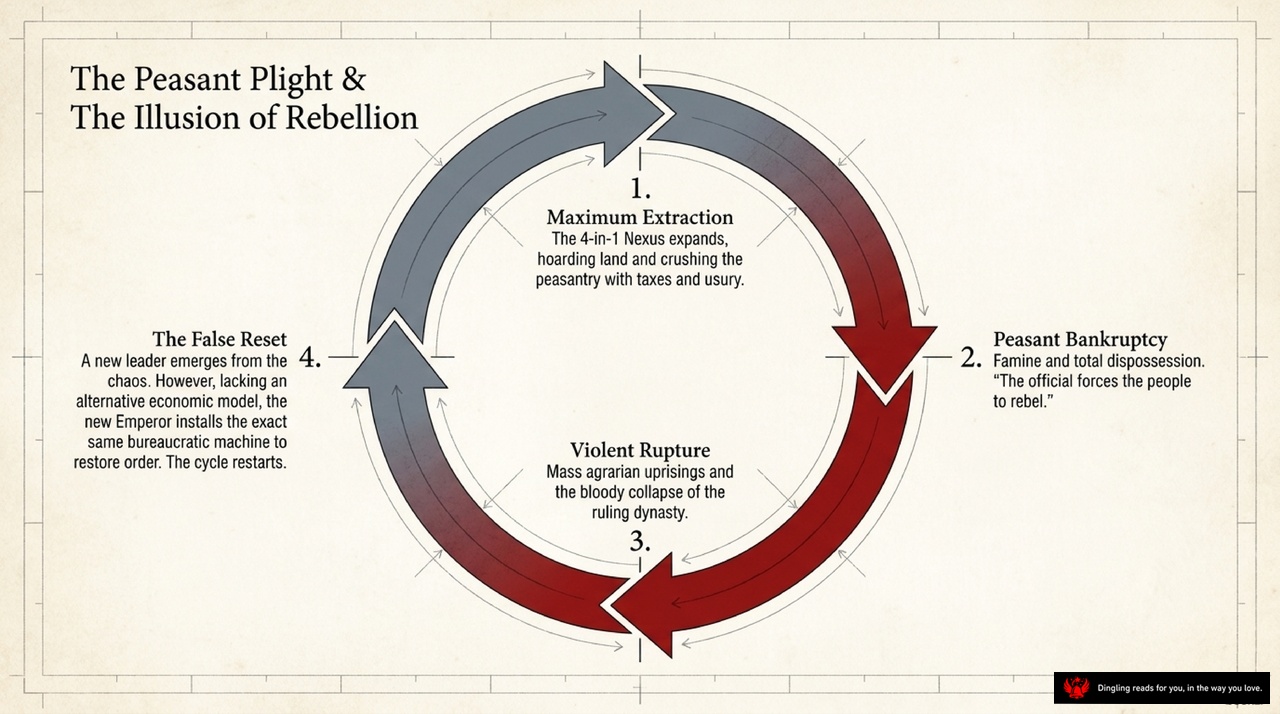
Look at this cycle of history. It's not just a chart; it's the tragic, repeating story of how empires rise and fall, specifically in China. The slide breaks it down into four brutal stages.
It starts with **Maximum Extraction**. The state expands its grip, hoarding land and crushing the peasantry with crushing taxes and usury. The rulers take everything they can get their hands on.
Next comes **Peasant Bankruptcy**. The pressure becomes too much. Famine strikes, and people lose everything. The official response? They don't help; they force the desperate people to rebel.
Then, we hit **Violent Rupture**. The result is mass agrarian uprisings and the bloody collapse of the ruling dynasty. The old order is destroyed in fire and blood.
Finally, there is **The False Reset**. A new leader emerges from the chaos, promising a fresh start. But here is the trap: lacking a new economic model, the new Emperor simply installs the exact same bureaucratic machine to restore order. The cycle restarts.
This is the core problem. The system is designed to fail so it can be rebuilt, only to fail again. It's a loop of oppression, rebellion, and reset that has defined Chinese history for millennia.

Imagine a society where progress isn't just stalled, but actively strangled from within. This slide, titled "The Trap of Stagnation," visualizes exactly that: a timeline from 200 BCE to 1900 CE, where upward arrows representing commercial capital are systematically blocked by three massive stones.
Let's look at the first obstacle on the left: "The Suppression of Commerce." The text here is blunt—"Emphasize Agriculture, Restrain Commerce." This wasn't an accident; it was a deliberate strategy by the state to dismantle large merchant enterprises. Why? To prevent any rival power base from forming. In this system, trade wealth was never meant to fuel innovation; it was meant to be suppressed.
Moving to the center, we see "The Misallocation of Capital." This is where the money went to die. Any wealth generated by trade was immediately siphoned off—not to build factories or develop industry, but to buy land or official titles. Industrialization needed capital, but the system starved it. Instead of becoming a modern economic engine, commercial capital was converted into static assets like real estate and bureaucratic status.
Finally, on the right, stands "The Stasis." The description calls the bureaucratic system a "perfectly optimized machine for maintaining order." It was so efficient at extracting agricultural surplus and suppressing friction that it actually prevented the very friction necessary for evolution. When you remove all the bumps and struggles from society, you also remove the chance for growth.
So, what does this tell us? It's a clear picture of a self-perpetuating cycle. The state suppressed trade to keep power centralized, which misallocated capital away from productive uses, which created a static, unchanging society. This "trap" explains why, despite centuries of activity, the social and economic structure remained largely frozen from the ancient era right up to the modern day. It wasn't a lack of effort; it was a designed system of stagnation.
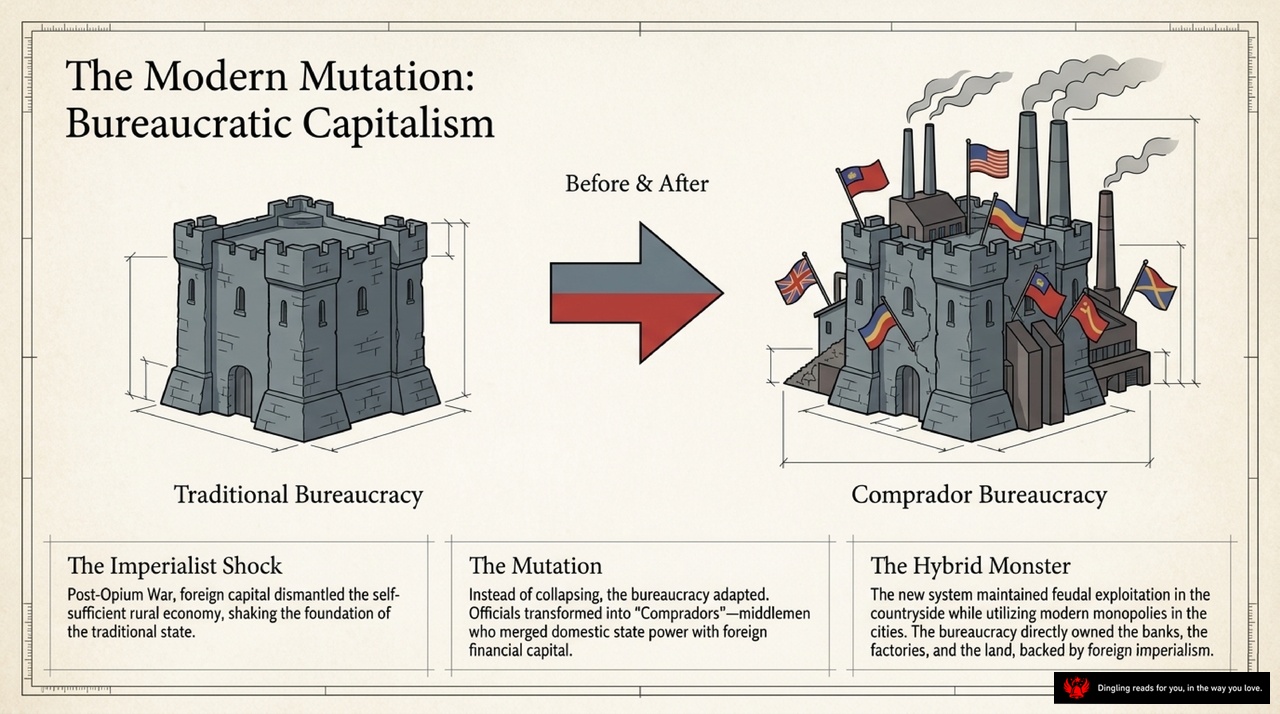
The Modern Mutation: Bureaucratic Capitalism. Look at this transformation. On the left, we have the **Traditional Bureaucracy**—a self-contained fortress representing the pre-imperialist era. But the **Imperialist Shock** changed everything. After the Opium War, foreign capital didn't just trade with China; it dismantled the self-sufficient rural economy, shaking the very foundation of the traditional state.
Instead of collapsing, the bureaucracy adapted. This is **The Mutation**. Officials transformed into "Compradors"—shrewd middlemen who merged domestic state power with foreign financial capital. They didn't just serve the nation anymore; they served the new masters.
The result? **The Hybrid Monster**. On the right, see how the castle has mutated into a sprawling industrial complex. The bureaucracy directly owned the banks, the factories, and the land, all backed by foreign imperialism. It maintained feudal exploitation in the countryside while utilizing modern monopolies in the cities. This new system wasn't just a government; it was a beast that swallowed the economy whole. This is the birth of Comprador Bureaucracy—a hybrid monster where the state and capital became indistinguishable, creating a system designed for one thing: extracting value for the few.

For two millennia, the Chinese bureaucratic machine didn't just survive; it thrived by fusing political power with economic exploitation. It absorbed all intellectual energy and deliberately suffocated the evolution of a modern economy, all to maintain absolute control. Think of it as a system designed to keep the masses locked in systemic inequality and political voicelessness. If the survival of bureaucracy depends on keeping people powerless and unequal, what is the ultimate price of genuine modernization? The answer lies in understanding that this wasn't just a political system, but a social trap where the state and the elite became one, ensuring that no real economic or social transformation could ever take root.