
The Art of Being Governed: Complete Chapter-by-Chapter Summary
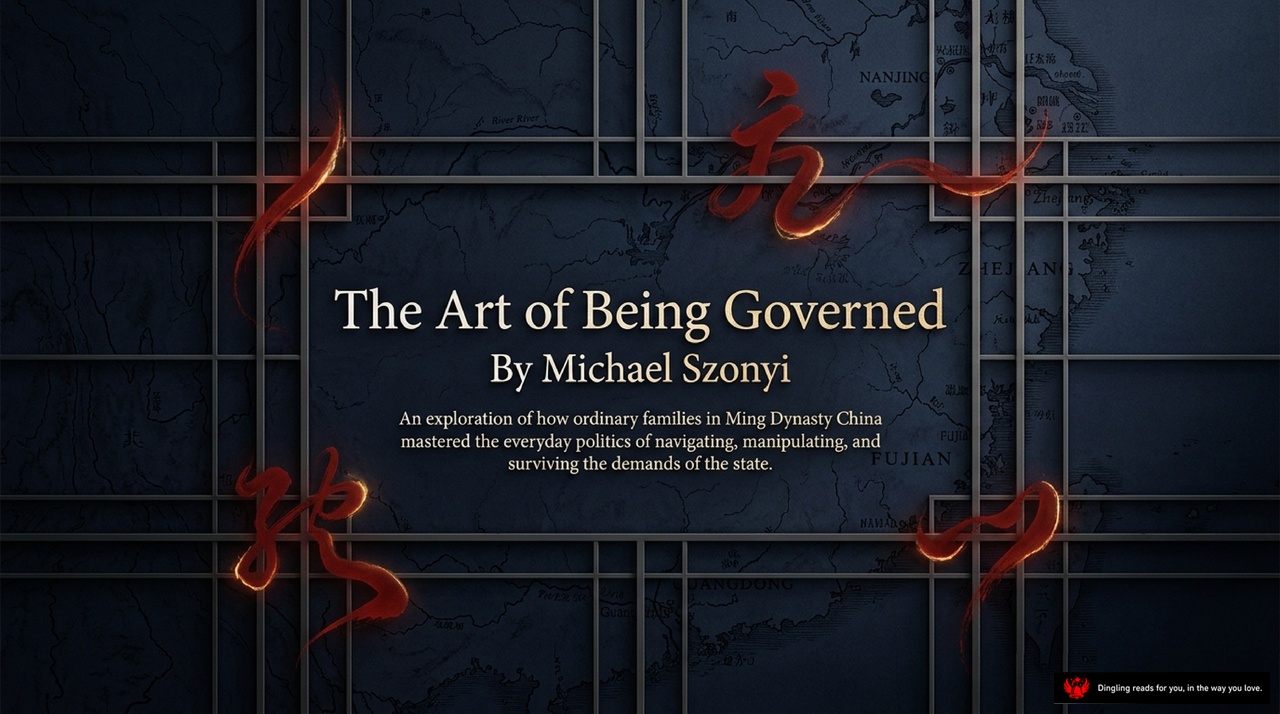
Welcome to today's deep dive into "The Art of Being Governed" by Michael Szonyi. Imagine a world where ordinary families in Ming Dynasty China weren't just passive subjects, but masterful strategists navigating a complex web of state demands. This book explores how these families mastered the everyday politics of survival, manipulation, and negotiation within an imperial system that often felt suffocating.
The cover art beautifully captures this tension: a map of ancient China overlaid with a grid, symbolizing the rigid state structures that confined everyone, while the flowing red calligraphy represents the fluid, adaptive strategies the people used to carve out their own space. The subtitle tells us the core story: how ordinary families mastered the politics of navigating, manipulating, and surviving the state's relentless demands.
We are about to uncover the incredible stories of families like the Zheng and the Ye, who turned military service from a crushing burden into a manageable, even profitable, part of their lives. You'll see how they used property, identity, and even fake contracts to outsmart the system. From the distant garrisons of the north to the bustling ports of the south, these families didn't just obey; they played the game, often winning in ways the emperors never expected. This isn't just history; it's a fascinating look at human ingenuity under pressure, showing us that even in the tightest grip of empire, there was always room to maneuver.
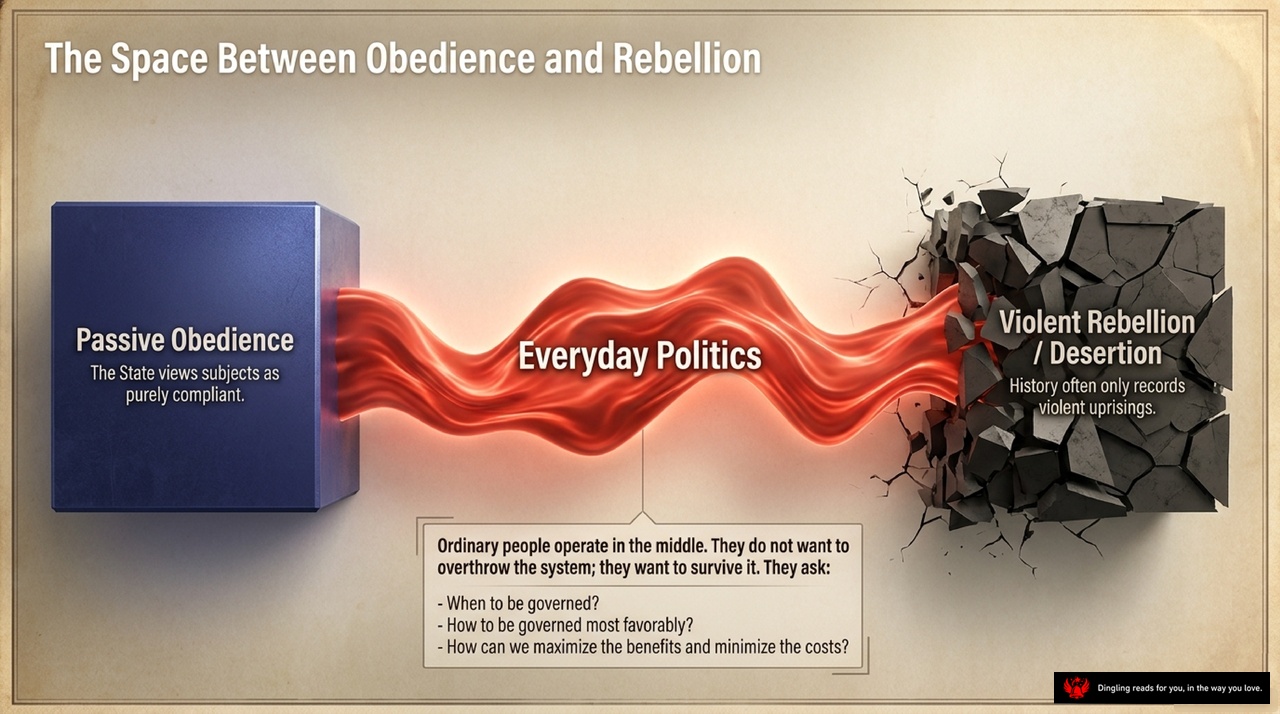
Imagine a spectrum of human behavior where, on one end, you have total, passive obedience—the state simply expects you to be a compliant subject, and on the other, you have violent rebellion or desertion, the kind of dramatic uprisings that history books love to record. But the reality of everyday politics lies right in the middle of this space. Ordinary people don't want to overthrow the system; they just want to survive it. Instead of choosing between blind submission and violent revolt, they operate in the gray zone, constantly asking themselves: When should I be governed? How can I be governed most favorably? And crucially, how do I maximize my benefits while minimizing the costs?
In the context of the Ming Dynasty's military households, this wasn't just abstract theory; it was a daily struggle. Families didn't just accept their fate; they became master strategists. When faced with the burden of hereditary military service, they didn't wait for orders. They invented their own rules. Some families used property and status as leverage, redistributing family assets so that only one branch bore the brunt of the service, ensuring the other branches could thrive. Others went even further, hiring outsiders or even changing names to let others take the place of the conscript, effectively buying their way out of the system. They utilized a concept we might call "institutional arbitrage"—exploiting the gap between the rigid rules of the state and the flexible reality of their lives to carve out a safer, more profitable existence.
This middle ground is where real history happens. It's not about the grand battles or the edicts from the emperor; it's about how ordinary families navigated the cracks in the system, using wit, contracts, and community networks to turn a potential death sentence into a manageable, even advantageous, part of their lives. They weren't just subjects; they were active players in a game of survival, proving that the space between obedience and rebellion is often where the most clever human ingenuity is found.

Imagine a massive, self-replenishing army that costs the people not a single grain of rice. This was the utopian blueprint envisioned by Emperor Zhu Yuanzhang, and it all came down to one specific design: the Junhu, or Military Household system. As you can see in this diagram, the state sits at the very top, commanding a vast grid of households. The mechanism is simple yet ruthless: millions of families were permanently registered as military households, and each was mandated to supply one adult male indefinitely to serve in a distant garrison.
The visual arrows pointing down from the central "Household" block illustrate how these families were distributed across the empire, settling into various frontier forts shown on the map below. This wasn't just about conscription; it was about creating a zero-cost army for the state. The families bore the burden of recruitment, housing, and food, effectively privatizing the cost of national defense. While the state got a standing army without spending a dime, these households faced a permanent, hereditary obligation that would bind their fates to the military for generations, transforming ordinary families into the state's permanent, self-sustaining military machine.

Imagine a family trapped in a bureaucratic nightmare where survival depends on outsmarting the state. This slide, "The Family's Dilemma: The Burden of Perpetual Service," breaks down exactly how the Yan family—and countless others—survived the relentless demands of the Ming military system.
Look at the top left: **Distance**. Thousands of miles from home meant a soldier could vanish into the remote jungles of Yunnan, like the Yan family's first son, never to return. Then there's **Cost**. Families didn't just send a son; they bore the crushing weight of travel and equipment expenses, known as the "military gear tax."
But the real horror is in the bottom right: **The Perpetual Draft**. If a soldier died or deserted, the state ruthlessly returned to the family to draft another son. It was a cycle of loss with no end. And don't forget **Disease**. High mortality rates in foreign climates took a heavy toll, exemplified by the Yan family sending a 14-year-old boy who quickly died of illness.
Finally, consider **Draft** itself—the endless gears of conscription that turned without stopping. The central question remains: How did families survive this? By using every resource they had to balance the state's rigid rules with their own family's future.
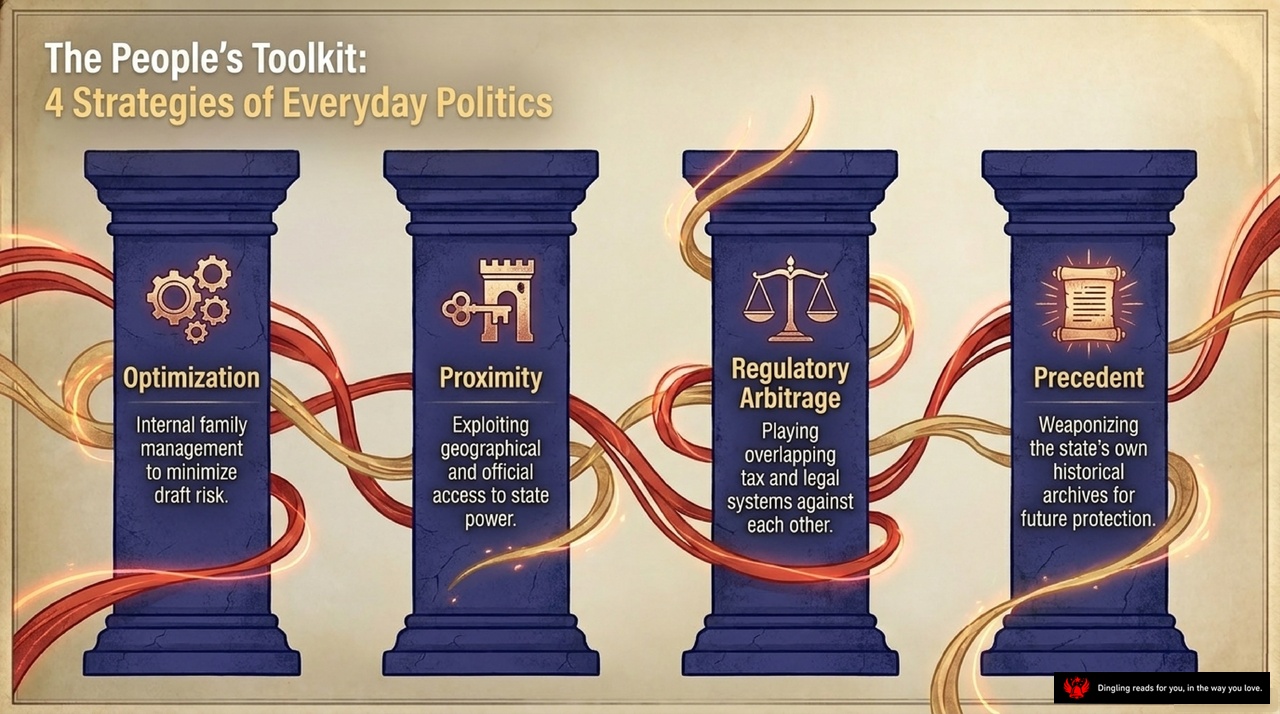
Today's slide reveals the ultimate playbook for ordinary people navigating a rigid state system: The People's Toolkit, featuring four core strategies for everyday politics. Let's break down how ordinary families turned survival into a sophisticated game of strategic advantage.
First up is Optimization. This isn't just about working harder; it's about internal family management to minimize the risk of being drafted. By carefully allocating resources and responsibilities within the household, families could buffer themselves against the state's demands.
Next is Proximity. This strategy is all about exploiting your location. If you live near power, you have access to it. Families who understood this would position themselves geographically to gain better leverage with state officials, turning distance into a strategic asset rather than a barrier.
Then we have Regulatory Arbitrage. Think of this as playing the system against itself. When tax laws and legal systems overlap or contradict, savvy families would navigate these gaps to their benefit. They didn't just follow the rules; they used the inconsistencies in the regulations to create favorable outcomes for their lineage.
Finally, there is Precedent. This is about weaponizing history. By meticulously recording their own family's contributions and using historical archives, families could create a shield for the future. They turned their past into legal and moral capital, ensuring that their descendants were protected by the very state they served.
These four pillars—Optimization, Proximity, Regulatory Arbitrage, and Precedent—show us that ordinary people were never just passive subjects. They were active architects of their own fate, constantly innovating to survive and thrive within the constraints of their time.

Imagine a family not just as a group of relatives, but as a tightly organized corporation facing a hostile state. In the Ming Dynasty, once your family was registered as a military household, the state demanded soldiers forever. But here's the clever twist: families couldn't change the quota, yet they could control exactly who went and how they were supported. This was Strategy 1: Optimization and The Family Contract.
As the image illustrates, the Extended Family Network acted like a funnel, pooling resources to feed a single soldier. Families created binding internal contracts, setting aside land or money as an estate trust to perpetually fund the designated soldier. The goal was simple but critical: pay the soldier enough so he wouldn't desert, thereby shielding the rest of the lineage from the dreaded draft officials.
Think of it this way: if one brother served, the others stayed safe. If the family failed to pay, everyone got drafted. So, they optimized their internal structure. They might designate a specific son as the "military heir," giving him priority in family rituals in exchange for taking the burden. Or they might pool wealth to hire someone else to serve in their place. This wasn't just about survival; it was about turning a state mandate into a manageable family business. By creating these internal safety nets, ordinary families found a way to negotiate with the empire, ensuring that the cost of service was shared fairly while protecting the family's future from the chaos of conscription.
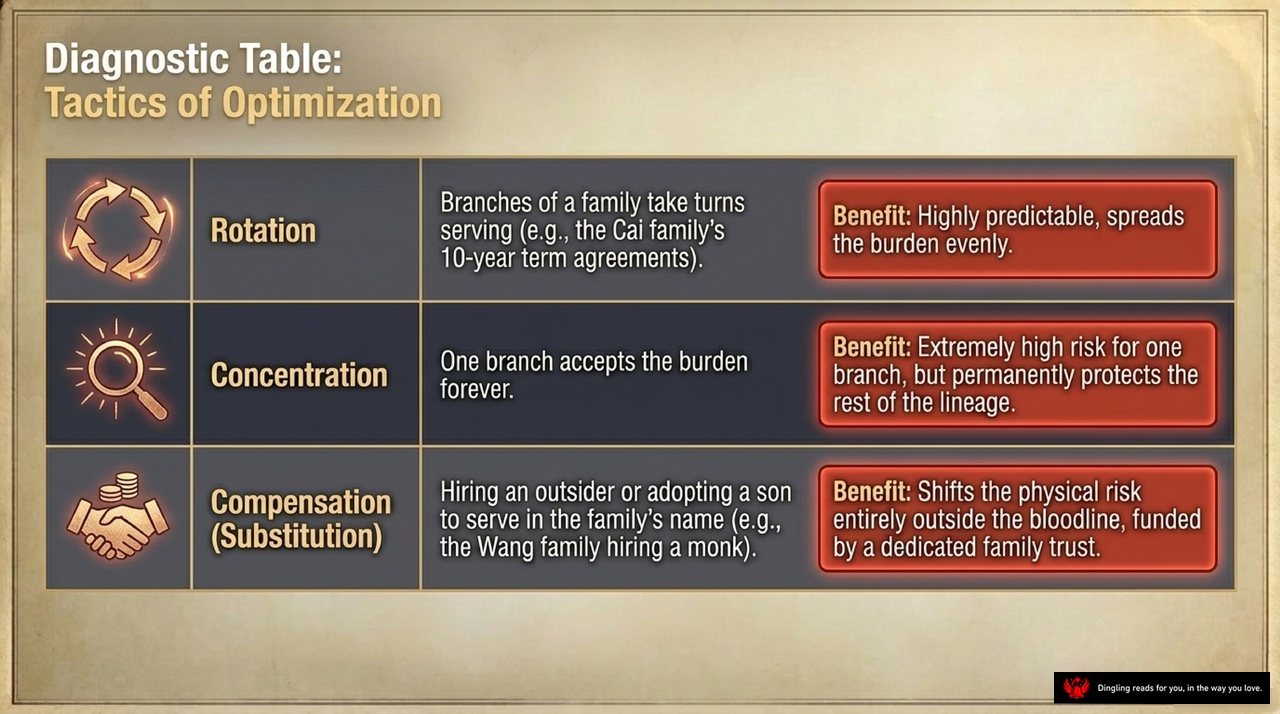
Look at this "Diagnostic Table: Tactics of Optimization." It breaks down exactly how military families in the Ming Dynasty turned a crushing state obligation into a manageable family strategy. Instead of just accepting the burden, they engineered three specific solutions: Rotation, Concentration, and Compensation.
First, Rotation. As the table shows, different branches of the family take turns serving. Think of the Cai family's ten-year agreements. The benefit here is predictability; it spreads the heavy burden evenly across the lineage so no single branch gets crushed.
Second, Concentration. Here, one branch accepts the burden forever. The trade-off is clear: extremely high risk for that one branch, but in exchange, they permanently protect the rest of the lineage from military service. It's a high-stakes gamble for long-term security.
Finally, Compensation, or Substitution. This is where families hire outsiders or adopt sons to serve in their name, like the Wang family hiring a monk. This shifts the physical risk entirely outside the bloodline, funded by a dedicated family trust.
These aren't just random choices; they are calculated moves to minimize cost and uncertainty. By using these tactics, Ming military families didn't just survive the system; they optimized it, turning a rigid state mandate into a flexible tool for their own survival and prosperity.

Look at this diagram illustrating "Strategy 2: Proximity and the Perks of Power." It reveals a fascinating twist in how the Ming military system actually functioned. On the top, labeled "The Blueprint," we see the official ideal: the Imperial Indigo, where state coastal patrols operated in an orderly line, strictly enforcing maritime law. But look at the bottom section, "The Reality." Here, the narrative flips completely. Instead of order, we see a chaotic web of "Smuggling Networks."
The text on the right explains the core concept: being embedded inside the state apparatus granted unique geographical and informational advantages. In the real world, military households stationed at coastal garrisons didn't just follow orders; they leveraged their official duties. Under the guise of state-mandated maritime patrols, officers and soldiers engaged in highly lucrative smuggling and piracy.
This isn't just theory; it's documented in history. The case study highlights the Jiang family of Fuquan. They didn't hide in the shadows; they used official state ships and military uniforms as a cover for private enterprise and contraband trade. Essentially, they turned their position of power into a business advantage. While the state designed a system to control the seas, the people within that system found ways to exploit its very structure for personal gain, turning the navy into the navy's biggest competitor.
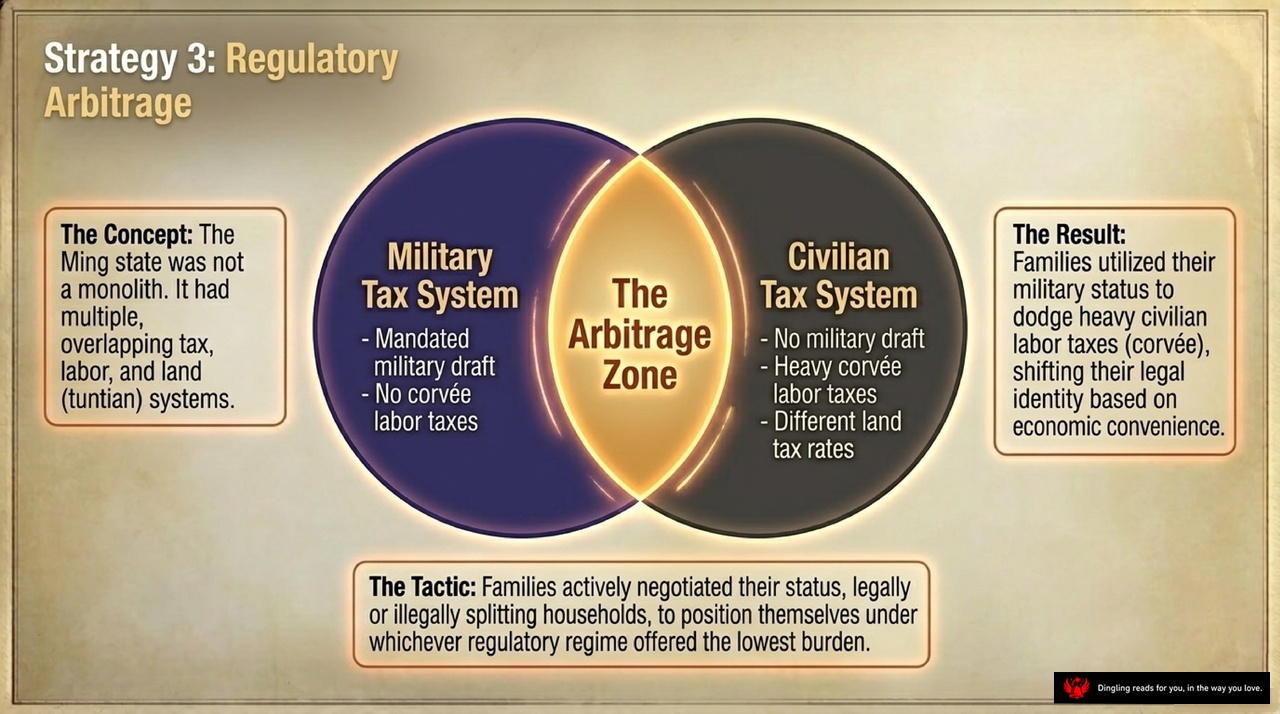
Strategy 3: Regulatory Arbitrage. Imagine a world where the government runs two completely different rulebooks side by side. On the left, you have the Military Tax System: mandatory conscription, but no heavy labor taxes. On the right, the Civilian Tax System: no military draft, but crushing labor taxes and different land rates. Now, picture the golden space where these two circles overlap. This is the Arbitrage Zone.
In Ming China, families didn't just follow the rules; they played the system. Because the state wasn't a monolith with one single law, but a patchwork of overlapping systems, families actively negotiated their status. They would legally or even illegally split their households to shift their legal identity based on pure economic convenience. If the military route was cheaper, they became soldiers. If civilian life offered better land rates, they switched back. The result? Families dodged heavy corvée labor taxes by utilizing their military status, effectively finding the lowest burden in whichever regulatory regime suited them best. It wasn't just about obeying the law; it was about mastering the gaps between the law and reality.

Imagine a world where the past isn't just history, but a powerful weapon you can wield to protect your future. This is the brilliant strategy we see unfold in the Ming and Qing dynasties, specifically under the fourth tactic: weaponizing the archives.
Look at the timeline in front of us. On the left, we have the Ming Dynasty, which collapsed in 1644. The Qing Dynasty rose to power and immediately abolished the military household system, trying to erase the old order. But here is the twist: while the system was gone, the paperwork survived. The physical contracts and historical records didn't disappear with the fall of the dynasty.
This is where the real genius lies. Families who had been part of the old military system didn't just accept their fate. Instead, they used a clever tactic: they dug up those obsolete Ming-era contracts and historical precedents. They took these old documents to the new Qing courts, using the state's own bureaucratic language and archives to defend their land rights, maintain tax exemptions, or claim income from ancestral trusts. Essentially, they forced the new regime to honor old privileges by proving that the law was on their side.
The result was a fascinating power play. The people used the very tools the new government relied on—its own archives and legal language—to protect their interests. It shows that even when a regime changes, the legacy of the past can be reinterpreted and repurposed. It's a perfect example of how ordinary people navigated the gap between official rules and their real-world needs, turning the state's own records into a shield for their survival.

Today's slide breaks down the "Synthesis Matrix of Manipulation," revealing how Ming dynasty military families didn't just follow orders—they engineered their own survival. Think of this not as a history chart, but as a strategic playbook for navigating a rigid system.
Look at the four core strategies listed here. First is **Optimization**, marked as **Low Risk**. The goal was simple: minimize draft risk. Families achieved this through internal contracts and family trusts, effectively privatizing the state's demand. Next is **Proximity**, which carried a **High Risk** profile. Here, the primary goal was to maximize wealth by leveraging official military access for trade. This was the dangerous path that turned soldiers into smugglers and merchants. Then we have **Arbitrage**, a **Medium Risk** strategy focused on minimizing taxes by switching registration regimes and exploiting loopholes—a classic case of using the law against itself. Finally, there is **Precedent**, another **Low Risk** approach. This involved securing long-term rights by enforcing historical archives in modern courts, using the past as a legal shield against the present.
These strategies highlight a profound truth: the Ming military households were masters of "institutional arbitrage." They didn't resist the system; they manipulated the gap between the official rules and their real-world situation. Whether by hiding behind ancestral contracts, trading on military privileges, or digging up old deeds to settle new disputes, they turned the state's rigid bureaucracy into a flexible tool for family prosperity. This matrix shows us that for these families, the state wasn't an enemy to overthrow, but a complex environment to be navigated and optimized.

Unintended Legacy I: The Corporate Lineage. Look at this visual journey. It starts with a simple family unit, moves into a structured organization with gears and a shield, and finally evolves into a sprawling tree of roots and branches. This graphic illustrates how a purely functional financial arrangement accidentally birthed something far more profound: the foundation of modern Chinese civil society.
Let's break down the three stages shown here. First, the Phenomenon. To fund their military obligations across generations, families were forced to create shared estates and financial trusts. It wasn't a choice; it was a survival strategy. As the text reveals, families like the Zheng family in Zangpu had to make tough choices about property distribution. The son bearing the burden of conscription would get a smaller share of the inheritance, while the rest of the family would compensate them. This wasn't just about money; it was about securing the future of the entire lineage against the state's demands.
Next, we see the Legacy. Over centuries, these purely functional financial arrangements evolved. They grew into powerful, highly organized "corporate lineages" known as Zongzu. These weren't just families; they became institutions. They developed bylaws, managed assets collectively, and established welfare systems to support those serving the state. The text describes how clans would rotate service duties, pool resources to pay for substitutes, or even establish permanent trusts to buy their way out of conscription. It was a sophisticated internal market operating within the rigid state structure.
Finally, the Irony. The state's oppressive military extraction inadvertently built the foundation of modern civil society. The very mechanism designed to drain wealth from the people to feed the army ended up creating robust organizations complete with shared assets, bylaws, and welfare systems. These Zongzu lineages became the bedrock of community life, teaching people how to organize, negotiate, and sustain themselves. They learned to navigate the gap between official rules and reality, turning a system of coercion into a model of resilient community governance. This is the unintended legacy: the state tried to control the people, but in doing so, it accidentally taught them how to build a society of their own.
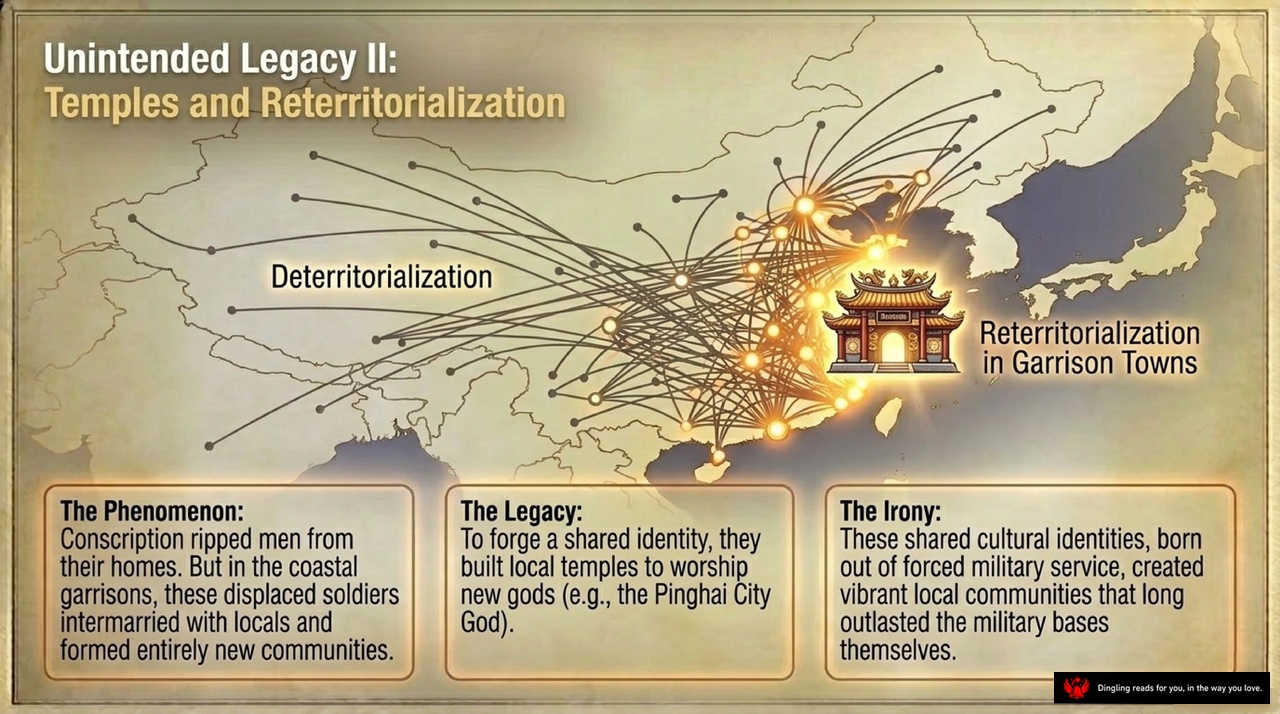
Welcome back to our deep dive into Ming Dynasty history. Today, we're looking at a fascinating concept: **Unintended Legacy II—Temples and Reterritorialization**.
Look at this map. On the left, we see **Deterritorialization**. This was the state's strategy to break the power of local elites by conscripting men and sending them far away from their homes. But what happened on the right? We see **Reterritorialization in Garrison Towns**. Even though the soldiers were physically removed from their original villages, they didn't just disappear. Instead, they built new communities around new temples in these garrison towns.
This phenomenon is driven by a specific legacy. As the text explains, to forge a shared identity among these displaced soldiers, they built local temples to worship new gods, such as the **Pinghai City God**. These temples weren't just places of worship; they became the heart of the community, helping soldiers from different backgrounds intermarry with locals and form entirely new social structures.
Here lies the profound **irony**: these shared cultural identities, born out of forced military service and separation from home, actually created vibrant local communities that long outlasted the military bases themselves. Even after the Ming dynasty fell and the garrison system was abolished, these temple communities remained, shaping the very fabric of modern Chinese society. The soldiers left their old homes, but in doing so, they planted the seeds for entirely new ones.
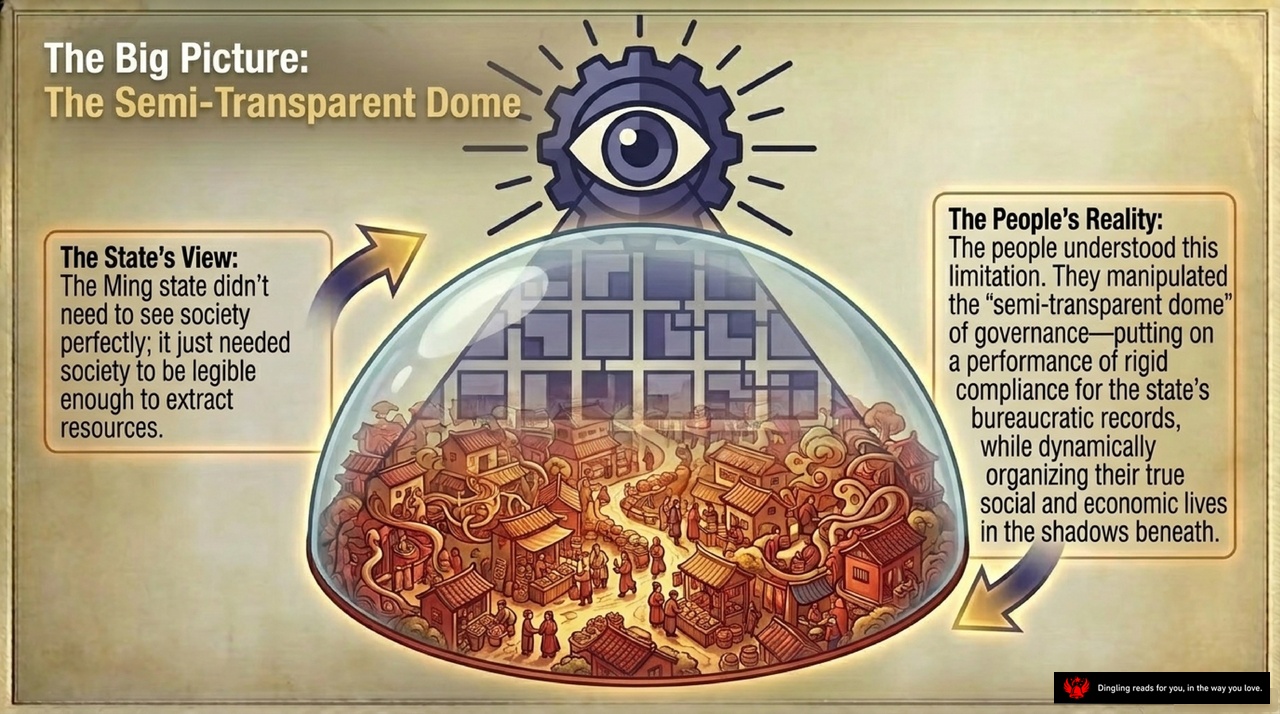
Look at this "Semi-Transparent Dome." It perfectly captures the Ming Dynasty's unique relationship with its people. From the state's perspective, they didn't need perfect visibility; they just needed society to be legible enough to extract resources. The dome represents this controlled view, with the state's eye watching from above, while the complex life of the market and families plays out below.
But here's the twist: the people understood this limitation. They didn't just passively live under the dome; they manipulated it. As the text explains, they put on a performance of rigid compliance for the state's bureaucratic records, while dynamically organizing their true social and economic lives in the shadows beneath.
This wasn't about rebellion in the traditional sense. It was a sophisticated game of "institutional arbitrage." Just like modern people might find loopholes in tax laws or regulations, Ming households found ways to bend the rules of conscription and land management to their advantage. They used contracts, family strategies, and even religious rituals to navigate the system, turning a rigid state structure into a flexible tool for survival and profit. The dome was transparent enough for the state to see the rules being followed, but opaque enough for the people to thrive in reality.
The true engine of history isn't just the grand decrees of emperors, but the quiet, calculated ingenuity of ordinary people. As we've seen through the stories of the Zheng and Ye families, military households didn't just passively accept their fate; they actively optimized obligations, exploited proximity, and weaponized precedent to turn oppressive state institutions into resources for their own survival. Whether by transferring military service to a specific branch of the clan, hiring substitutes, or rotating duties among relatives, these families mastered the art of navigating the system to their advantage.
But the story doesn't end there. When the Ming military system eventually collapsed and soldiers were forced to assimilate into civilian society, they didn't simply disappear. Instead, they creatively repurposed old symbols to secure their place in the new world. In places like Tongsan, descendants of former soldiers invented a fictional "Guanyin" ancestor and forged a shared clan identity to bypass tax collection barriers, effectively creating a new social contract where none existed. This reveals a profound truth about the era: the state's power was often an illusion of top-down control, quietly rewritten every day by those it sought to govern. From manipulating land disputes to redefining community rituals, the people of the Ming and Qing dynasties didn't just survive the system; they mastered it, leaving a legacy that continues to shape Chinese society today.