
The Art of Thinking Clearly: Complete Chapter-by-Chapter Summary
Welcome to today's session on *The Art of Thinking Clearly* by Rolf Dobelli. We're diving into a systematic map of human irrationality and the cognitive traps that distort our decision-making. Imagine a brain overlaid with a complex maze, representing how easily our logic gets tangled by invisible biases. This book isn't just theory; it's a survival guide for your mind in a world designed to trick you. We'll explore why we overestimate success, fall for false causality, and lose money to our own instincts. By understanding these patterns, you can stop reacting on autopilot and start making decisions based on reality, not illusions. Let's begin by uncovering the first layer of these mental traps.
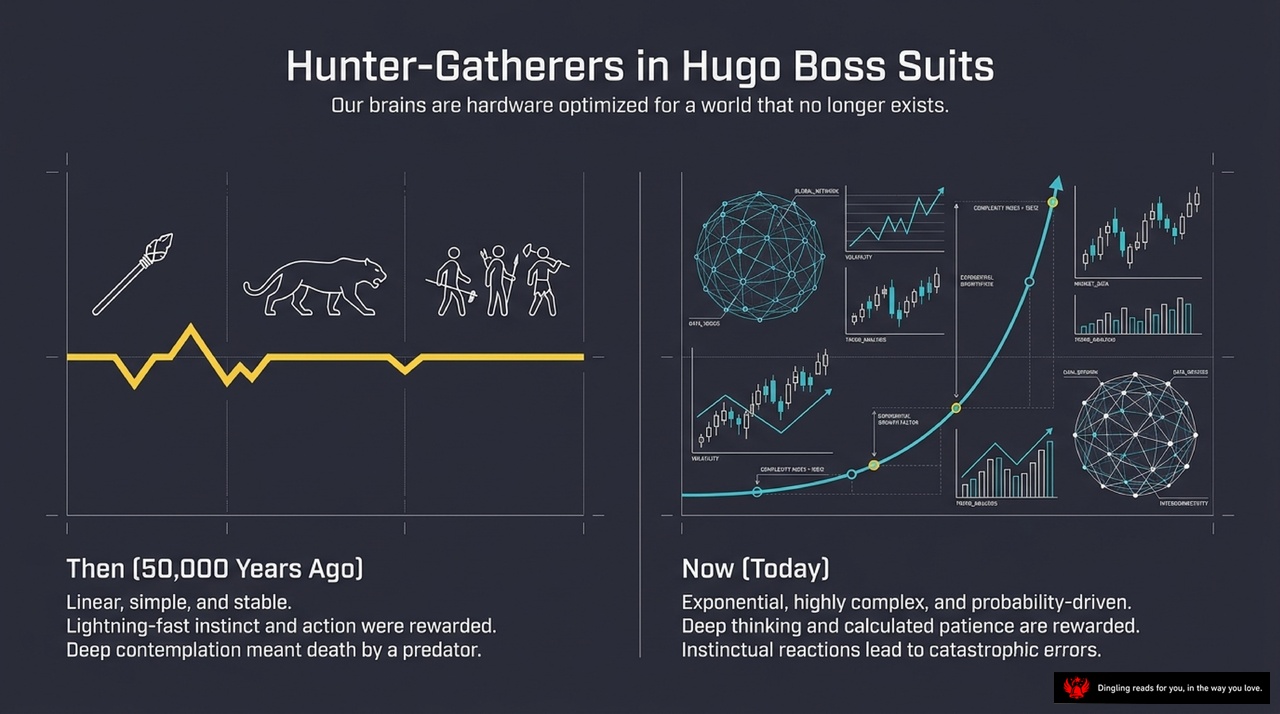
Imagine you are a hunter-gatherer wearing a $2,000 Hugo Boss suit. On the left side of this slide, we see our ancestors 50,000 years ago: simple tools, a saber-toothed cat, and a linear, stable world. Back then, lightning-fast instincts were rewarded; deep contemplation meant death by a predator. But look at the right side. Today, we are "Hunter-Gatherers in Hugo Boss Suits"—our brains are hardware optimized for a world that no longer exists.
We are now living in an environment that is exponential, highly complex, and probability-driven. The slide contrasts this with the old linear path. In our modern world, deep thinking and calculated patience are rewarded, yet our instinctual reactions often lead to catastrophic errors. We are trying to solve today's exponential problems with yesterday's linear instincts. This disconnect is the core problem we face: we are using the wrong mental tools for the current reality.
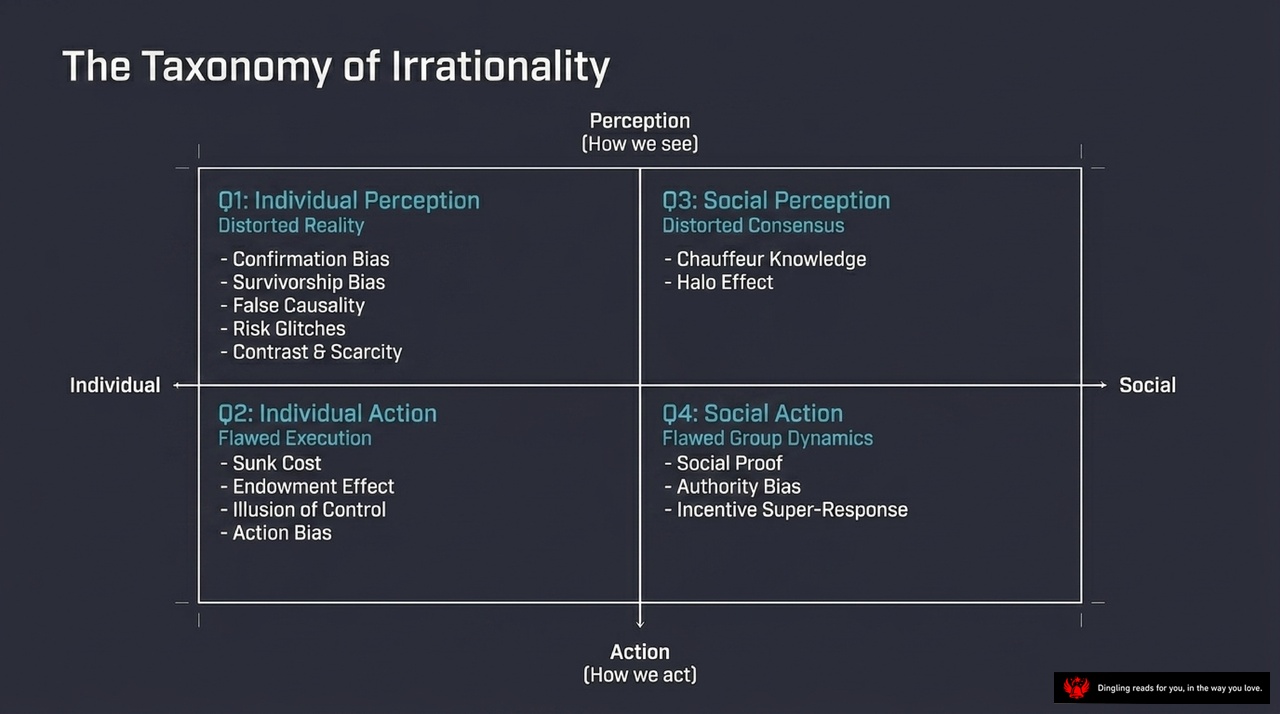
Welcome back to our deep dive into human irrationality. Today, we're looking at the "Taxonomy of Irrationality," a framework that maps out exactly where and why we go off the rails.
This slide breaks irrationality into four quadrants based on two axes: is it an individual or social issue, and does it stem from how we perceive reality or how we take action?
Let's start with the top left: Individual Perception. This is where we distort reality on our own. We fall into traps like confirmation bias, where we only see what we want to see, or survivorship bias, where we only celebrate the winners and ignore the silent graveyard of failures. We also struggle with false causality and risk glitches, seeing patterns where there are none.
Move to the top right: Social Perception. Here, the distortion comes from the group. We rely on "chauffeur knowledge"—taking the surface-level view of an expert without understanding the underlying mechanics—or we fall for the halo effect, letting one positive trait blind us to the rest of a person or company.
Now, look at the bottom row, which is about action. In the bottom left, we have Individual Action. Even if we see things clearly, we can still act poorly due to flawed execution. We suffer from sunk cost fallacy, clinging to past investments; the endowment effect, overvaluing what we own; and the illusion of control, believing we can steer random outcomes.
Finally, the bottom right quadrant: Social Action. This is where group dynamics fail us. We blindly follow social proof, assume authority figures are always right, or respond too aggressively to incentives, prioritizing rewards over actual goals.
The core message here is that irrationality isn't just a personal flaw; it's a system. It happens within us, within our groups, in how we see the world, and in how we move through it. Recognizing these four categories is the first step to building better decision-making habits.

Here's the script for Slide 3:
"Look at this diagram. It illustrates Confirmation Bias, often called the 'Mother of All Errors.' Imagine objective facts flowing through a filter. When those facts align with our existing beliefs, they pass through smoothly. But when new information contradicts what we already think is true, our brain doesn't reject it; instead, it systematically filters it out. We interpret data in a way that protects our current worldview, effectively creating a blind spot where reality is ignored.
The reality, as Aldous Huxley noted, is that facts do not cease to exist just because we ignore them. Yet, we do it all the time. To fix this, we need to actively hunt for disconfirming evidence. The book suggests a specific rule: 'Kill your darlings.' Within the first 30 minutes of forming a new theory, you must force yourself to look for evidence that proves you wrong. Don't wait for the brain to permanently ignore the contradiction. By actively seeking the exceptions and anomalies that the diagram shows getting blocked, you break the cycle of self-deception and see the world as it truly is."

Let's talk about how we actually learn—and why so many of us are walking around pretending to know things we don't.
Imagine a driver who has listened to so many lectures by Max Planck that he can perfectly recite his academic reports. But when a real expert asks a technical question, the driver freezes. This is what Charlie Munger calls "driver's knowledge." It's not real understanding; it's just mimicry. You've memorized the script, but you've never driven the car.
Contrast that with "true knowledge." People who truly understand a subject have spent the time to grasp the logic, the boundaries, and the "why" behind the facts. They don't just repeat; they can adapt.
In today's world, the line between the two is blurring. News anchors sound incredibly authoritative, yet they are often just information couriers, stitching together headlines without deep comprehension. Even big corporations often value a CEO's ability to perform on camera more than their actual strategic skill. If you mistake a performance for expertise, you're in trouble.
Warren Buffett's concept of your "circle of competence" is the antidote. You must know where your real knowledge ends and where it begins. Don't let the flashiness of "driver's knowledge" trick you into stepping outside your lane. Whether you're investing, managing a team, or making life decisions, the only way to succeed is to stay within the boundaries of what you actually understand, and to dig deep into the real mechanics of your field rather than just copying the surface.
Why do we cling to things we already own? It's called the Endowment Effect, and it's a powerful reason why we often make irrational decisions. In a classic experiment, students who were randomly assigned a basketball ticket valued it at $2400, while those who didn't have one were only willing to pay $170 for it. Just the act of owning it doubled its perceived value.
This bias shows up everywhere. Homeowners consistently overvalue their homes because they've poured time and emotion into them, making it hard to sell. Even investors fall for it; Charlie Munge once missed a $5 million opportunity simply because selling his existing shares felt like losing something precious. We also see this in auctions, where the "winner's curse" happens because the person who wins the bid often pays too much, convinced the item is worth their price.
To overcome this, you need to shift your perspective. Instead of asking, "How much would I lose if I sold this?" ask yourself, "If I didn't have this, how much would I be willing to pay for it?" Treat what you own as if you're just renting it temporarily. By stepping out of the mindset of ownership, you can see the true market value and make more rational choices, avoiding the trap of holding onto things just because they're yours.

The scale in front of us perfectly illustrates a painful truth about how we value things: what we own is worth far more than what it objectively is. On the left, we have the "Objective Value" at just $170. But on the right, once that tag says "I Own This," the perceived value skyrockets to $2,400. This isn't just a graphic; it's a snapshot of the Endowment Effect in action. We demand way more money to sell something we possess than we would ever pay to acquire it in the first place.
This psychological distortion isn't limited to objects. It's the same reason you might refuse to sell a failing stock or hold onto a job you hate just because you've already invested years of time and money into it. That's the Sunk Cost Fallacy: continuing to invest in a failing project simply because of what has already been spent. But here's the reality check the slide reminds us of: the only thing that matters is the present and the future. Ownership and past investments fatally corrupt our ability to see value clearly. To make rational decisions, we have to strip away the emotional weight of ownership and ask ourselves a cold, hard question: if I didn't own this right now, would I still want it at this price? If the answer is no, it's time to let go, no matter how much you've already put into it.
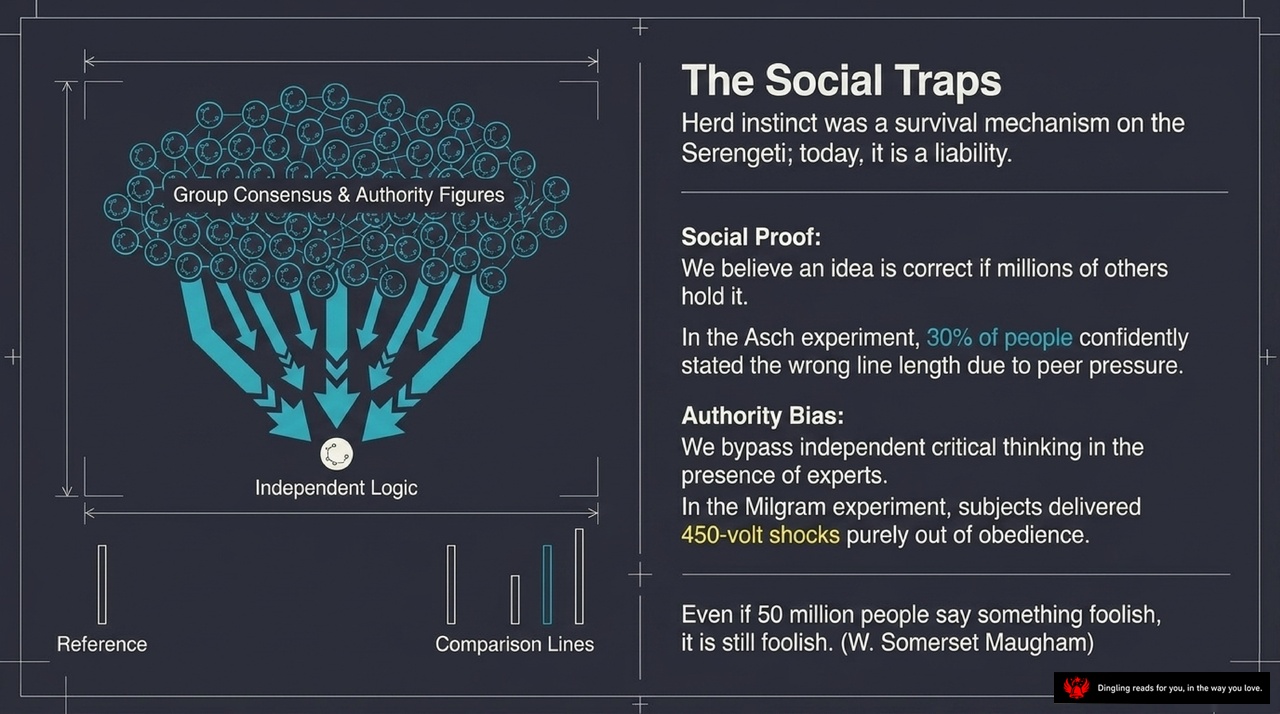
The slide highlights a dangerous psychological trap called "The Social Traps," where our natural survival instincts turn into modern liabilities. Back in the Serengeti, following the herd meant staying alive; today, blindly following the crowd can get us in serious trouble.
Look at that diagram on the left. It shows how "Group Consensus" and "Authority Figures" crush "Independent Logic." We surrender our critical thinking just to fit in. This is what psychologists call Social Proof. We assume an idea is correct simply because millions of others believe it. The Asch experiment proved this terrifyingly: 30% of people confidently stated the wrong answer just to avoid standing out against a group.
Then there's Authority Bias. We bypass our own judgment when experts are around. Remember the Milgram experiment? Subjects delivered 450-volt shocks purely out of obedience to an authority figure, even though it was dangerous.
The bottom line is clear: even if 50 million people say something is foolish, it's still foolish. As W. Somerset Maugham famously said, the crowd is rarely right. To avoid these traps, you must actively question the consensus and trust your own independent logic, no matter how loud the crowd gets.

Why do we press buttons that do nothing? Think about those "Open Door" or pedestrian crossing buttons on the street. They feel like magic wands, right? But often, they are just placebo circuits—disconnected wires that do absolutely nothing. We press them not because they work, but to cope with the boredom of waiting. This is the "Illusion of Control." We create the feeling of influence to make the wait feel shorter, even though our pain tolerance is actually increasing.
But this illusion goes much deeper, especially in high-stakes moments like a soccer penalty kick. Statistically, one-third of balls go straight down the middle—that's the optimal path. Yet, goalkeepers almost always dive left or right. Why? Because diving looks active and heroic, while standing still looks foolish. We prefer blind action over calculated patience. Society rewards the dramatic move, even if it's the wrong one.
The fix is simple but hard: when a situation is unclear, do absolutely nothing. Don't dive until you know exactly where the ball is. Don't press the button until you're sure it works. Stop performing for the crowd and start assessing the reality. True success comes from accurate assessment, not from pretending you can control the uncontrollable.
The slide highlights two critical traps that derail our decision-making: the Endowment Effect and Groupthink.
First, let's look at the Endowment Effect. The text explains that we irrationally assign higher value to things simply because we own them. The author shares a personal story about a BMW: he initially valued it at 40,000 euros, but once he owned it, he refused to sell it even for 53,000 euros. This psychological tilt makes us cling to useless items, overvalue our possessions, and even fall into the "winner's curse" in auctions. To overcome this, we must reframe our perspective. Instead of asking, "How much would I lose if I sell this?", we should ask, "If I didn't own this, how much would I be willing to pay for it?" This simple shift helps us see the true market value rather than the inflated emotional value.
Next, the slide addresses Groupthink. This happens when a group of smart people makes a stupid decision because everyone suppresses dissenting opinions to maintain harmony. The text cites the 1961 Bay of Pigs invasion as a prime example. Kennedy's advisors unanimously agreed to invade Cuba, ignoring critical flaws in the plan because they feared being isolated or challenging the leader. Similarly, Swiss Air's boardroom was so dominated by past success and consensus that no one dared to question their risky expansion strategy, leading to bankruptcy in 2001.
To break free from Groupthink, the text advises a specific tactic: assign a "devil's advocate." This person's sole job is to challenge the consensus and voice the unpopular opinions. It might cause temporary friction, but it prevents catastrophic blind spots. By combining the discipline of re-evaluating our own possessions against market reality with the courage to voice dissent in a group, we can navigate these powerful cognitive biases and make more rational choices.
Let's talk about how our brains trick us into thinking we're in control, when reality often has other plans.
First, consider the difference between "driver's knowledge" and real expertise. You might have heard a famous scientist's speech and could repeat every word perfectly, but if asked a deep technical question, you'd freeze. That's "driver's knowledge"—surface-level mimicry without understanding the core logic. True knowledge requires deep immersion and the ability to handle unexpected challenges. In our information-saturated world, we often mistake smooth presentation for actual expertise, just like a CEO who can talk a great game on camera but lacks real strategic depth.
Next, we fall into the trap of "illusion of control." We believe we can steer outcomes that are actually random. Think about how people shake dice harder to roll higher numbers, or insist on picking their own lottery numbers, believing their hand has more power than it does. Even those "open" buttons on elevators or traffic lights are often just psychological comforters—they make us feel in charge, even when the system doesn't listen to us.
Then there's "incentive myopia." We react fiercely to incentives, often ignoring the actual goal. Imagine a company promising bonuses for hitting sales targets; managers might spend all their time negotiating better targets rather than actually selling more. Or a doctor over-treating patients just to maximize billable visits. The incentive gets in the way of the mission.
Finally, we suffer from "regression to the mean." When things go extreme—like a terrible golf game or a company's worst quarter—we often blame or credit a specific intervention. But often, the next result is just a natural return to the average, not proof that our fix worked. We mistake natural fluctuation for success.
To avoid these traps, remember: focus on what you can truly control, design incentives that align with real goals, and don't confuse random noise with your own genius.

Look at this diagram illustrating what Charlie Munger called "The Incentive Super-Response." The core idea is simple but powerful: people respond rapidly to incentives, not the intentions behind them.
The slide breaks this down into a chain reaction. It starts with a "Bounty on dead rats to stop a plague." This is the classic historical example where the government offered a high price for every rat killed to eradicate a disease. The result? Instead of stopping the plague, citizens bred massive rat farms to kill and collect the infinite bounty. They didn't care about the plague; they only cared about the reward.
This logic applies everywhere in business and life. If you pay lawyers by the hour, they are incentivized to drag out the case. If you reward CEOs for hitting specific targets, they will manipulate those targets rather than build the business. It's a trap.
Charlie Munger had a brilliant rule for spotting this. When he saw an outrageously flashy fishing lure, he asked if fish actually liked it. The shop owner replied, "Charlie, we don't sell these to the fish." We sell them to people who want to look like they know how to fish.
The lesson here is clear: when designing any system, don't just focus on what you want people to do. Focus on what they will actually do when you put money or rewards in front of them. Always align the incentive with the desired outcome, or you will get exactly the opposite of what you intended.
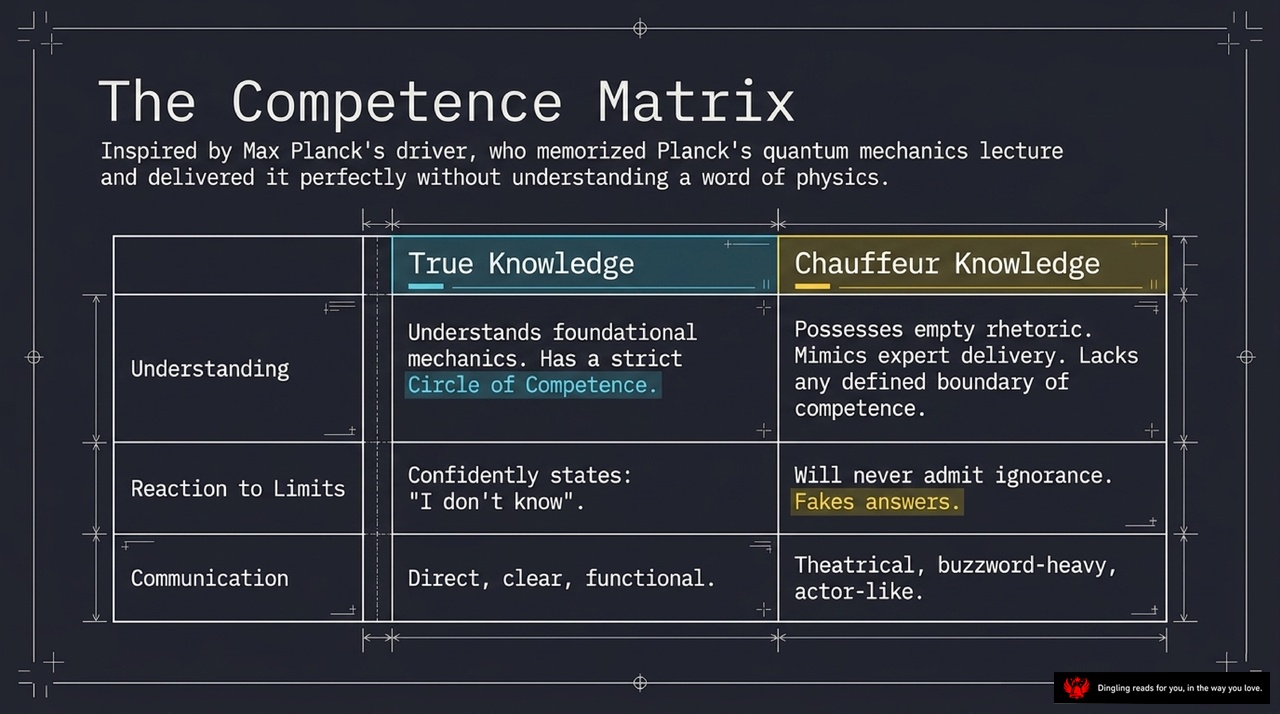
Have you ever heard that story about Max Planck's driver? This guy memorized the physicist's entire lecture on quantum mechanics and delivered it perfectly to an audience of experts. But when the professors started asking deep, technical questions, the driver froze. He had the words, but he didn't have the knowledge. This is what Charlie Munger calls "Chauffeur Knowledge"—the ability to mimic an expert without actually understanding the underlying mechanics.
Look at this matrix. On the left, we have "True Knowledge." This person understands the foundational logic and respects their own limits. They know exactly where their "Circle of Competence" ends and can confidently say, "I don't know." On the right, we have the "Chauffeur." They rely on empty rhetoric and theatrical delivery, mimicking experts to hide the fact that they lack a defined boundary of competence.
The most dangerous trait of the Chauffeur is their reaction to limits. While a true expert admits ignorance, the Chauffeur will never admit they don't know something. Instead, they fake answers to maintain the illusion of expertise. Their communication style is often buzzword-heavy and actor-like, designed to impress rather than inform.
In a world flooded with information, we must be careful not to confuse performance with substance. Just because someone can recite a complex theory doesn't mean they can solve the problem. True competence requires deep understanding, humility, and the courage to say when you're out of your depth. Don't let the showmanship of others fool you into thinking you've mastered a field you haven't even touched.

The Rationality Defense System isn't just a catchy title; it's a survival strategy for your brain. As the slide illustrates, the core problem is simple: rational thinking is a high-calorie expenditure. Your brain is wired to save energy, and perfect rationality is simply too expensive to maintain for every single decision we face.
So, how do we decide when to engage our full cognitive power? The answer lies in the potential impact of the decision. Look at that central question: "Is the potential impact of this decision high?" If the answer is no—think about buying a car or handling daily tasks—you should trust your intuition. In these low-stakes scenarios, letting your Pleistocene instincts take the wheel actually saves mental calories. You don't need a spreadsheet to decide what to eat for lunch.
However, if the answer is yes—when you are facing investments, career choices, or marriage—your instinct is no longer enough. This is where you must engage your Rationality Defense System. You need to override your instinct and deploy deliberate, methodical checklists to bypass your hardwired cognitive bugs. We cannot eliminate our evolutionary flaws entirely, but by managing them with the right tools, we can navigate high-stakes decisions without falling into the traps of overconfidence or bias.
Let's bring it all together. We've walked through the messy, often contradictory landscape of how our brains make decisions, from the survivorship bias that hides the truth of failure to the sunk cost fallacy that traps us in bad choices. We've seen how confirmation bias builds echo chambers, how the availability heuristic distorts our view of risk, and how the story bias makes us rewrite history to fit a narrative.
But there's a deeper layer. It's not just about individual errors; it's about the traps we set for each other. We've looked at the tragedy of the commons, where individual rationality destroys collective good, and the paradox of choice, where too many options paralyze us. We've explored how the endowment effect makes us cling to what we own, and how groupthink can turn smart teams into disaster zones.
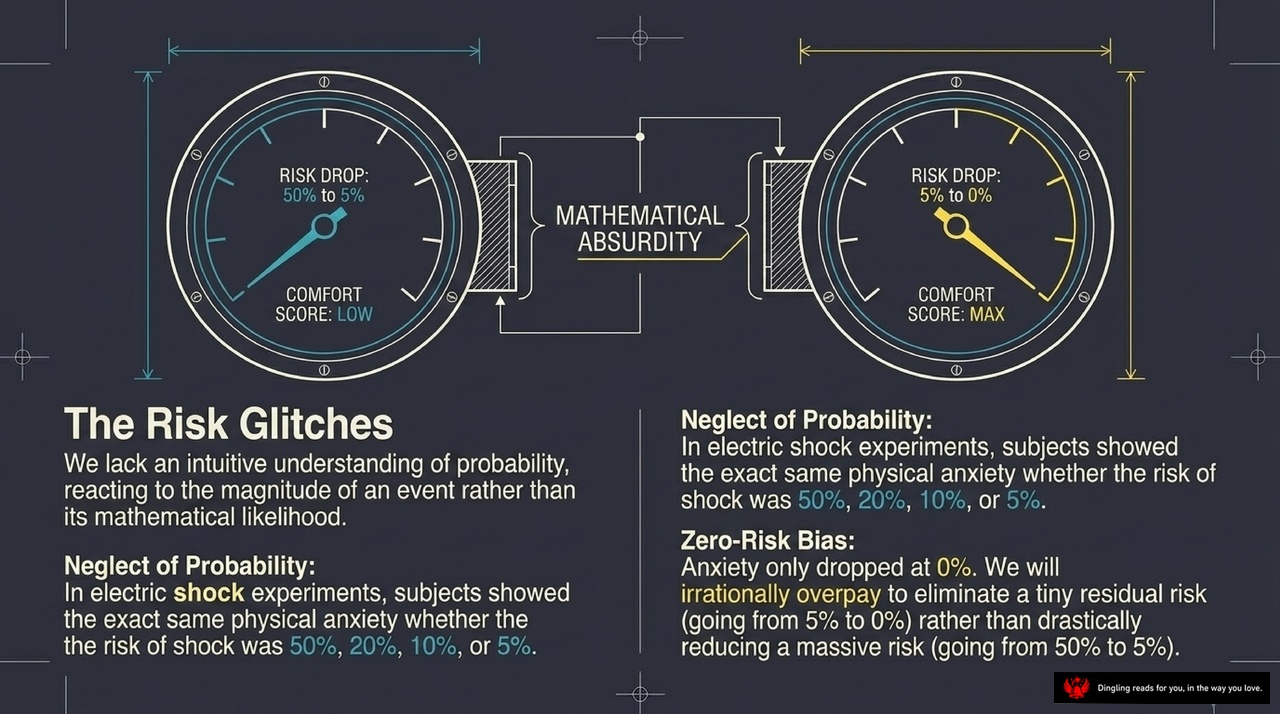
Finally, we confronted our blind spots regarding probability and causality. We learned that zero-risk is a fantasy, that rare events are often just statistical noise, and that we constantly mistake correlation for causation or get lost in the details of a story rather than the reality of the numbers.
So, here is the ultimate question left for you: Are you making your own decisions, or are you simply executing the evolutionary programming and cognitive blueprints that your ancestors left behind? The tools are now in your hands. The real work begins when you choose to override the instinct.