
The Beginning of Infinity: Complete Chapter-by-Chapter Summary
Welcome to "The Beginning of Infinity," a bold intellectual adventure by David Deutsch. As you see on this cover, the book reveals a profound truth: human knowledge holds the infinite capacity to understand and transform reality.
Unlike ancient times, when our understanding of the stars or the universe was stagnant and slow, the scientific revolution sparked an explosion of knowledge. This wasn't just about better tools; it was a rebellion against blind authority. The Enlightenment taught us that we don't need to believe what others say. Instead, we must build a tradition of criticism, constantly testing our ideas against reality.
True progress comes not from following rules, but from creating and refining explanations. Whether we are designing new chips, predicting drug effects, or exploring the cosmos, it is our ability to explain the world that allows us to change it. We are not passengers on a fragile spaceship; we are active creators, using knowledge to build our own life-support systems and expand our reach into the unknown. This book invites you to join that endless journey of discovery.

Welcome back. Today, we're diving deep into a concept that completely flips our understanding of how we know anything: "The Empiricist Illusion."
On the left side of this slide, we see the illusion itself, rooted in John Locke's idea of the "Blank Slate." It suggests that our minds are empty at birth, and that we simply passively receive information through our senses—like an eye capturing light and projecting it onto a blank screen. The text here argues that under this view, sensory evidence is just "meaningless electrical sparks," and theories are somehow derived from these sparks. It paints a picture where the mind is a passive receiver, and the world speaks to us without us needing to say anything back.
But look at the right side. This is the reality: "Active Conjecture." The image shifts from a blank screen to a glowing brain surrounded by a complex, interconnected web of ideas. This visualizes a crucial truth: all observation is actually "theory-laden." We do not derive knowledge from passive observation. Instead, knowledge originates from *within* our minds as bold, active conjectures that we impose upon the world. We don't read the world like it's a "Book of Nature" waiting to be decoded; we actively construct our understanding of it.
So, what does this mean for us? It means that when you look at the world, you aren't just recording data. You are constantly testing hypotheses, fitting the messy reality of your senses into the best possible explanation you can create. Science isn't about finding hidden truths in nature; it's about the endless cycle of guessing, testing, and refining those guesses. The "Empiricist Illusion" tricks us into thinking we are passive observers, but the truth is we are active creators of reality itself.

The slide before us maps out the very engine that drives human knowledge: a continuous, self-correcting loop known as the "Engine of Knowledge Creation." It's not a straight line of progress, but a dynamic cycle where we constantly refine our understanding of reality.
The journey begins with **Encountering a Problem**. This happens when our existing theories clash with what we actually observe in the real world. When reality refuses to fit our expectations, it forces us to rethink everything. From this friction, we move to **Bold Conjecture**, where the mind leaps to create a speculative explanation. It's a creative leap, proposing a new theory to solve the puzzle we just identified.
But a guess isn't enough. That's where **Critical Testing** comes in. We subject our new theory to extreme experimental and philosophical stress. We try to break it, to find its flaws. If the theory survives this rigorous scrutiny, we move to **Error Elimination**. We discard the falsehoods and the parts that don't work, refining our idea until it aligns better with reality.
The result of this cycle is **A Better Problem**. By solving the old problem, we don't just reach a final answer; we graduate to deeper, more fascinating questions. We push the boundaries of what we know further than ever before. This entire loop—problem, conjecture, testing, elimination, and a new, deeper problem—is the core mechanism of the Enlightenment. It's how we move from static dogma to dynamic, ever-expanding truth.

Imagine a hotel with an infinite number of rooms, all currently occupied. This is the famous "Hilbert's Hotel" thought experiment, and it reveals something truly mind-bending about the nature of infinity. If a new guest arrives, we simply ask every current guest to move to the room with the next higher number—Room 1 moves to Room 2, Room 2 to Room 3, and so on. Suddenly, Room 1 is free. But here's the twist: if an infinite number of new guests arrive, we can still fit them all in. We just ask every existing guest to move to the room with double their number. This instantly frees up all the odd-numbered rooms, creating an infinite space for the new arrivals.
This logic gets even stranger when we introduce a "vanishing dog." Imagine a dog carrying a bag of trash that it passes to the next room's guest every two minutes. In a finite hotel, the dog would eventually stop. But in an infinite hotel, after two minutes, the dog simply disappears. It has been pushed infinitely far away, yet no one is holding the bag anymore. This proves that in an infinite system, standard intuition about "common sense" and probability breaks down completely. What seems like a small change in numbering can completely alter the outcome, making the concept of "average" meaningless.
This counter-intuitive reality of infinity is not just a mathematical trick; it mirrors the very nature of human knowledge. Just as we can always find a higher number, there is no final limit to what we can understand. We are never at the end of the truth; we are always at the beginning of a new exploration. While physical laws prevent us from performing these infinite operations in the real world—like moving matter infinitely fast or gathering infinite energy—the mathematical concept of infinity remains an objective, powerful tool. It allows us to model complex systems and push the boundaries of our understanding. Ultimately, the existence of unprovable truths, or "undecidable problems," isn't a failure of science; it's the engine that drives us to keep asking questions, ensuring that our quest for knowledge never truly ends.
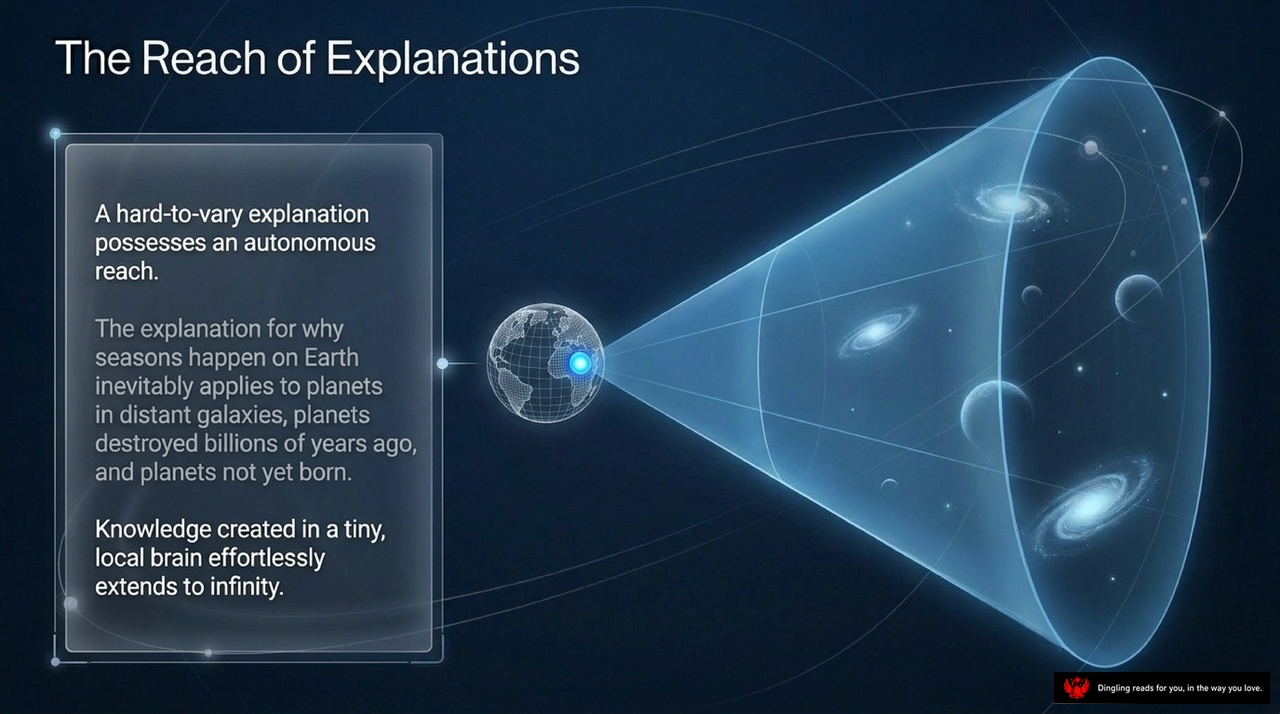
Imagine a world where a simple explanation, forged in a single human mind, can stretch across the cosmos. This is the profound reach of a good explanation. As our slide illustrates, the explanation for why seasons change on Earth doesn't just apply to our planet; it inevitably applies to worlds in distant galaxies, planets destroyed billions of years ago, and even those not yet born. Knowledge created in a tiny, local brain effortlessly extends to infinity.
This power stems from the Enlightenment's core insight: that the best way to grow is not by blindly accepting authority, but by engaging in a cycle of conjecture and criticism. Before this shift, human progress was stagnant, trapped by dogma or shallow observation. But once we learned to question and refine our explanations, knowledge began to accelerate. We realized that a true explanation is more than just a prediction; it's a coherent story that connects the dots. It allows us to simulate the universe in our minds, testing ideas against reality without needing to build a million parallel universes first.
This is why we are "universal constructors." Unlike other species, whose survival is tied to specific, fragile environments, our ability to create and refine explanations gives us a unique adaptability. We can take a barren rock or a hostile planet and, through knowledge, transform it into a life-support system. We aren't just passengers on Earth; we are the authors of our own future. By embracing the power of explanation and the courage to correct our mistakes, we unlock an infinite frontier. We don't just live in the universe; we extend its reach, one better idea at a time.

Let's dive into the "Bubble Fallacy" that traps us in false comfort. As this slide highlights, we often cling to two dangerous myths. First is the "Principle of Mediocrity," which claims we are just insignificant chemical scum in a vast, incomprehensible universe. While it feels humble, the reality is that this is a blind dogma that arbitrarily caps our reason, pretending we can't understand the cosmos.
Second is the "Spaceship Earth" idea, which treats our biosphere as a fragile, perfectly designed life-support system we are destroying. This is equally flawed. The truth is, the biosphere is actually highly hostile. It wasn't built for us; it's human knowledge—tools, fire, and science—that makes our planet hospitable.
The key takeaway here is clear: these paradigms falsely trap humanity in a conceptual and physical bubble. The universe isn't a museum we need to protect or a place where we don't matter. It is raw material, waiting for us to use our reason and creativity to shape it. We are not trapped by nature; we are empowered by our ability to explain and transform the world.

Imagine the tragic story of Easter Island not as a simple tale of running out of wood, but as a profound failure of a static society. The islanders didn't lack the knowledge to survive; they lacked the freedom to use it. When their forests vanished and food ran low, their culture refused to adapt. Instead of innovating, they doubled down on rigid rituals and meaningless stone statues, effectively silencing any creative thought that might have saved them. This is the core lesson of a static society: it prioritizes preserving the past over solving the present, turning tradition into a cage that makes survival impossible.
Contrast this with the true nature of progress. History is not dictated by geography or raw resources; it is driven by ideas. A static society sees resources as a fixed limit, but a dynamic one sees them as a challenge to be solved through explanation and invention. As we've seen, every "resource crisis" in history was actually a gap in our knowledge—until a new explanation, like synthetic fertilizers or new technologies, shattered the old constraints. Progress isn't about finding a perfect, permanent solution; it's about embracing the endless cycle of guessing, criticizing, and correcting. It's about accepting that problems are inevitable, but so is our ability to solve them.
This mindset shifts our view of the future entirely. We are not trapped by the universe's limits; we are the "Universal Builders" capable of reshaping them. Whether it's turning a barren rock into a habitat or cracking the code of the cosmos, our power lies in our creativity. The future isn't a pre-written script waiting for us to fail; it's an infinite frontier waiting for us to define it. By committing to the endless pursuit of better explanations, we don't just survive; we unlock the infinite potential of the universe itself.
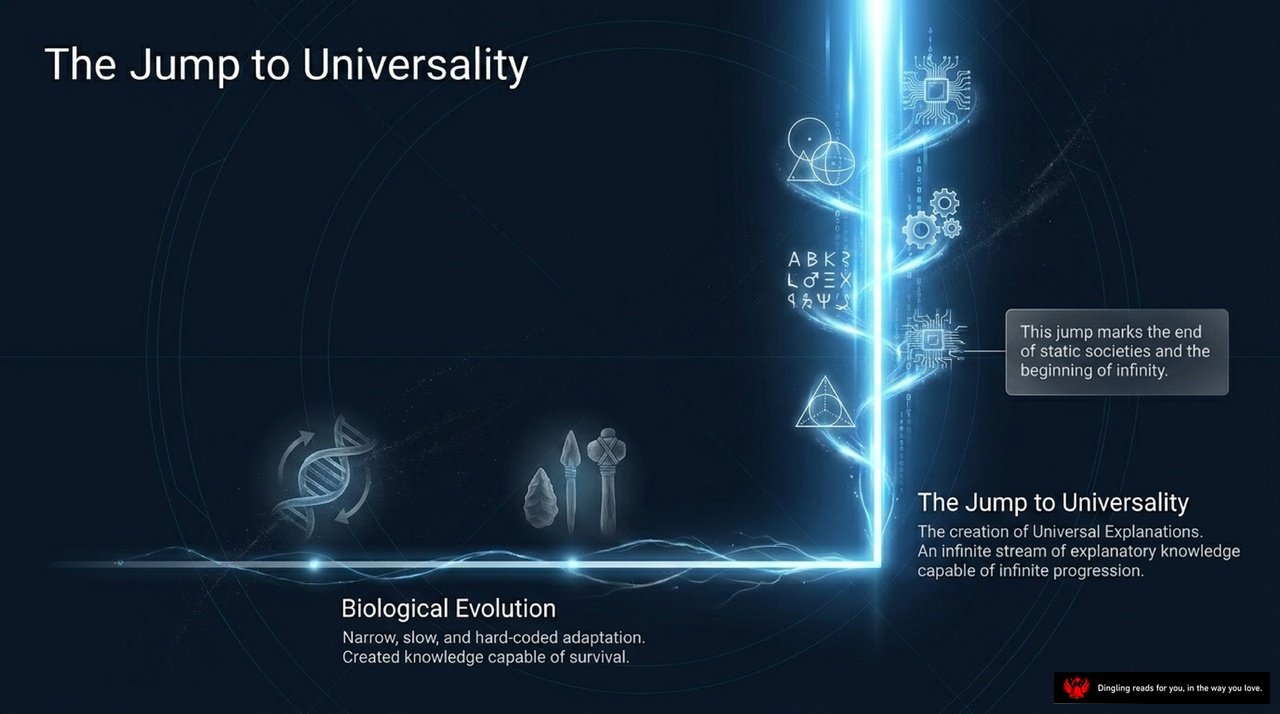
Look at this timeline. On the left, we see "Biological Evolution"—narrow, slow, and hard-coded. It created knowledge just for survival, like DNA adapting to a specific environment. But on the right, there is a massive vertical leap labeled "The Jump to Universality." This is the moment humanity stopped being a passive part of nature and became a "Universal Builder."
Notice the icons climbing that beam: from ancient tools and letters to gears and microchips. This visualizes the shift from static societies to infinity. The text on the right explains it perfectly: this jump marks the end of static societies and the beginning of infinity. Before this, knowledge was trapped; after this, we created "Universal Explanations"—an infinite stream of knowledge capable of endless progression.
Think about it: other species are limited by their biology. A bird can't live underwater, and a fish can't fly. But humans? We don't rely on the biosphere for life support. We rely on *explanatory knowledge*. We use tools, fire, and later, technology to create our own environments. We can live on the moon, recycle waste, and extract oxygen from rocks. We are the only species capable of turning a hostile environment into a home. This is the power of the jump: the ability to explain the world so thoroughly that we can control it. It's not about how much we know today, but about our capacity to generate new explanations forever. That is the true beginning of infinity.

Imagine a hotel with infinite rooms, all perfectly occupied. In our everyday world, this is impossible—a full hotel can't fit one new guest. But in the realm of infinity, the rules change. As the slide illustrates with Hilbert's famous thought experiment, you can simply ask every guest to move to the next room. Suddenly, Room 1 becomes free. If an infinite number of new guests arrive, you ask everyone to move to the room with double their number, instantly freeing up all the odd-numbered rooms. It sounds like magic, but it reveals a profound truth about infinity: it is not just a "really big" number; it behaves in ways that defy our intuition.
This concept extends far beyond mathematics into the very nature of our knowledge. The slide points out an "epistemological reality": no matter how much we learn, we remain at the very beginning. Just like every room in the infinite hotel is exceptionally close to the start, every new piece of knowledge we acquire is just the next step in an endless journey. The horizon of discovery can never be depleted. We might think we are nearing the end of science, but the infinite nature of the universe means there is always more to explain, more to discover, and more to understand. We are forever standing at the start, ready to explore the next room.
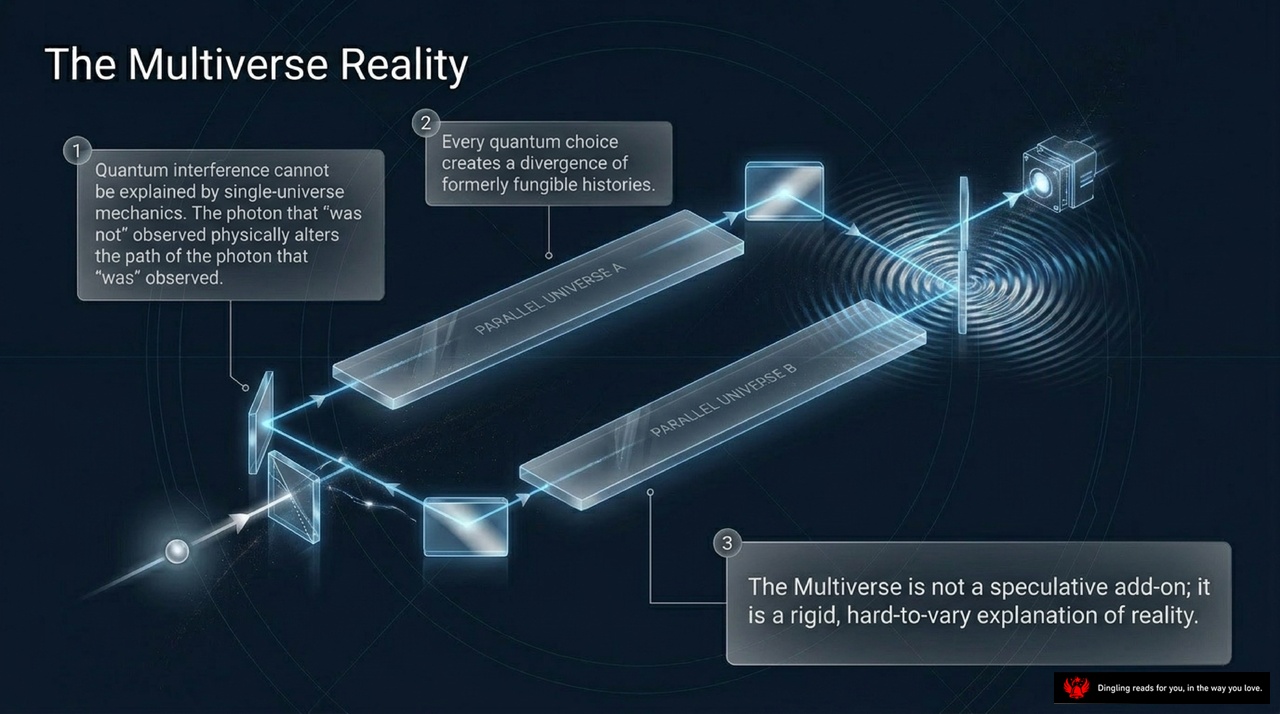
The image before us visualizes one of the most profound yet controversial ideas in modern physics: The Multiverse. It's not just science fiction; according to the text, it is a "rigid, hard-to-vary explanation of reality," not a speculative add-on.
Look at point number one on the slide. It highlights a core mystery: quantum interference. In a single universe, we can't explain why a photon that wasn't observed physically alters the path of one that was. This suggests our reality isn't just one linear timeline.
Move to point two. This is where the concept of "divergence" takes over. The text explains that every quantum choice creates a split, diverging from "formerly fungible histories." Think of it this way: every time a particle makes a choice, the universe branches. One path leads to "Parallel Universe A," and another leads to "Parallel Universe B." It's not that we are imagining these worlds; the text argues they are real, distinct histories that coexist.
Finally, look at point three. This diagram reinforces the book's central argument against "bad philosophy." For centuries, thinkers tried to avoid these uncomfortable truths by treating quantum mechanics as a mere tool for prediction—essentially saying, "Shut up and calculate." But the image shows us that without accepting the reality of these multiple histories, the math simply doesn't work. The multiverse provides the necessary explanation for why the universe behaves the way it does. It forces us to stop treating reality as a puzzle we can ignore and start accepting that the fabric of our existence is far more complex, and far more real, than our everyday senses allow us to see.

Look at this slide titled "The Aesthetics of Truth." It presents a fascinating duality: on the left, a wireframe flower representing nature, and on the right, a complex physics equation representing the laws of the universe. At first glance, one might think these are entirely different worlds—one biological, the other mathematical. But the text at the bottom reveals a profound connection.
Beauty is not purely subjective. Just as a flower evolved to signal bees with a specific, hard-to-forge design that humans also find beautiful, there is an objective standard at play. This cross-species convergence relies on a design that is difficult to fake. The slide draws a powerful parallel: altering a single note in a Mozart symphony destroys the melody, just as changing a single variable in a physics equation collapses the entire theory.
This illustrates a core idea from the book: objective beauty and objective truth share the exact same architecture. They are both hard to vary. Whether we are analyzing the structure of a lily or the energy equations of the cosmos, we are looking for patterns that are robust, elegant, and resistant to change. When a theory or a piece of art withstands the slightest modification, it points to something deeper—a fundamental order that exists independently of our opinions. This is why we can trust science and why we are moved by great art; both are manifestations of this unshakeable, objective truth.

Welcome back to our exploration of *The Anatomy of Optimism*. Today, we are diving deep into the core distinction that defines our future: the difference between Blind Pessimism and Rational Optimism.
On the left, you see Blind Pessimism. This mindset assumes that future problems are simply the result of using only present-day knowledge. It views humanity as a drain on fixed resources, prophesying inevitable doom based on the idea that we will run out of what we have right now. Think of figures like Paul Ehrlich, who argued that resource depletion is an unstoppable force. This perspective is static; it believes the rules of the game are fixed and we are destined to lose.
Now, look at the right side: Rational Optimism. This is the engine of human progress. It recognizes that wealth isn't a pile of fixed resources we are consuming, but rather a repertoire of physical transformations we can cause. It views humanity not as a drain, but as the ultimate resource itself. Why? Because we are the only species capable of creating knowledge. Finally, Rational Optimism understands that all evils are caused exclusively by insufficient knowledge. This is a crucial shift: it means the solution to every problem is not to stop growing, but to learn more.
The text we've read reinforces this beautifully. It argues that while other species are bound by their biology and specific environments, humans are "universal builders." We can create our own life support systems. We don't rely on the biosphere; we rely on our knowledge to build shelters, tools, and even colonies on the moon. Our survival depends on our ability to generate new explanations, not on the luck of having enough oil or water today.
So, when you look at the slide, remember this: Blind Pessimism sees a closed system where we are running out of time. Rational Optimism sees an open system where our ignorance is the only limit, and our creativity is the infinite resource that allows us to transform the impossible into the inevitable. The future isn't written by our current resources; it is built by our future knowledge.
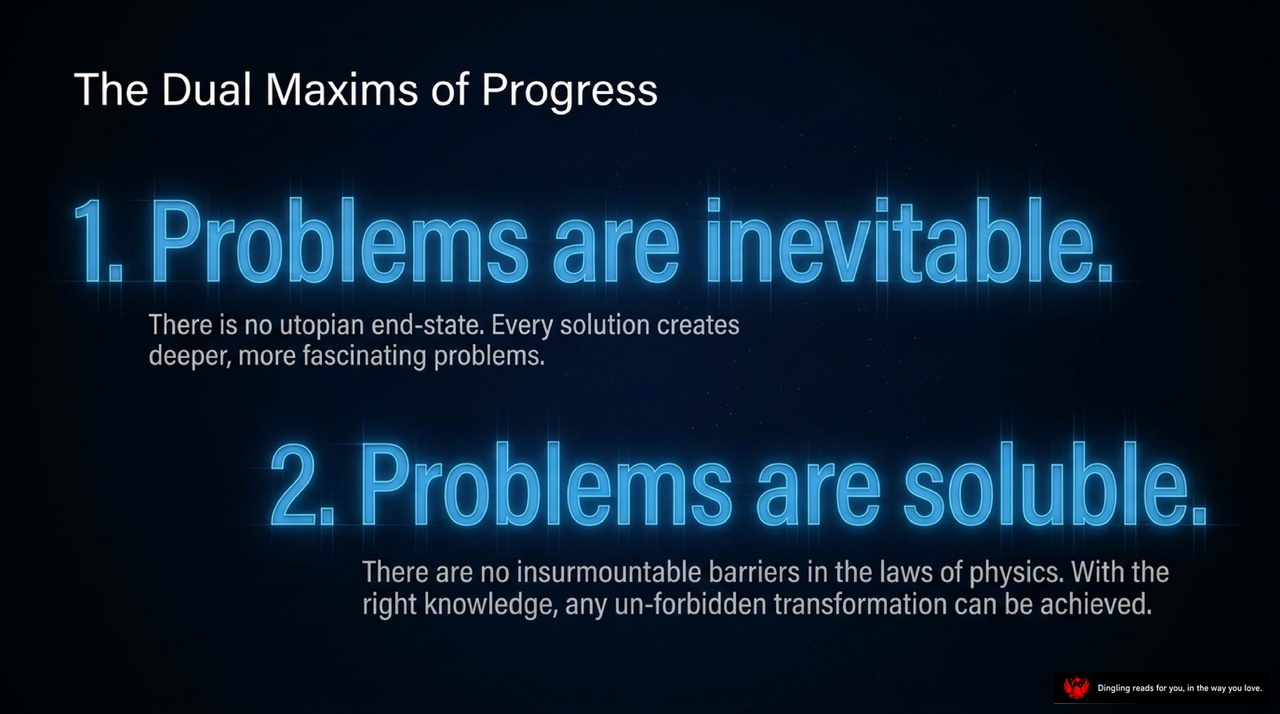
Today's slide introduces what I call the "Dual Maxims of Progress," a simple but powerful framework for understanding our place in the universe. First, remember that problems are inevitable. There is no utopian end-state where we arrive and everything is fixed. In fact, every solution we find creates deeper, more fascinating problems. Think of it as a moving target; solving one issue often reveals the complexity of another, which is why progress is a journey, not a destination.
However, the second maxim offers a reason to keep going: problems are soluble. There are no insurmountable barriers in the laws of physics. With the right knowledge, any un-forbidden transformation can be achieved. This means that while we can't predict every new challenge that will arise, we know that if a problem isn't physically impossible, we have the potential to solve it. This belief—that knowledge is the key to unlocking reality—is the foundation of our optimism. It's not blind hope; it's the confidence that by improving our understanding, we can overcome almost any obstacle standing in our way.
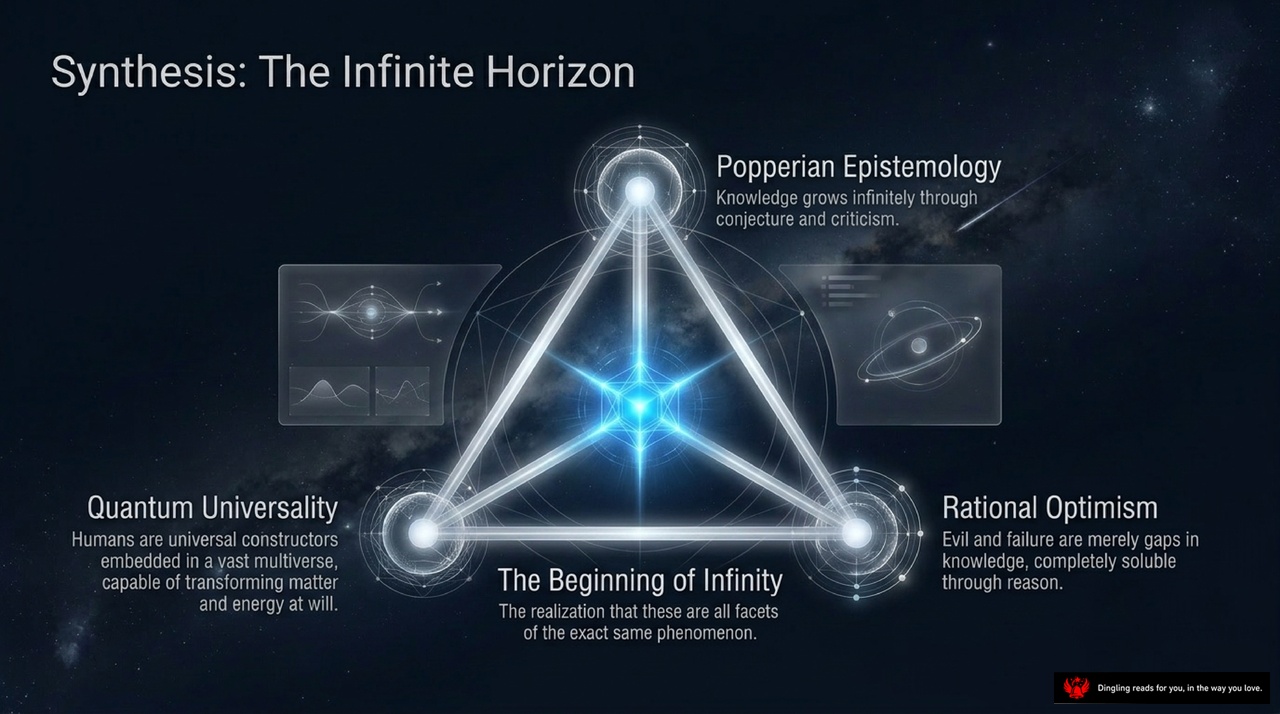
Synthesis: The Infinite Horizon. Look at this triangle; it represents the ultimate synthesis of our understanding. At the top, we have Popperian Epistemology, the engine driving our progress. It teaches us that knowledge doesn't come from authority or static observation, but grows infinitely through a cycle of conjecture and criticism. We guess, we test, we fail, and we improve.
To the left, we see Quantum Universality. This reminds us that humans are not just passive observers; we are universal constructors embedded in a vast multiverse. Unlike other species bound by specific environments, we have the unique ability to transform matter and energy at will, turning inhospitable places into life-support systems through our knowledge.
On the right stands Rational Optimism. This is the belief that evil and failure are not inherent flaws in the universe, but merely gaps in our knowledge. They are solvable through reason and new insights. When we face a crisis, we don't need to despair; we just need a better explanation.
At the center, connecting all three, is The Beginning of Infinity. This is the profound realization that these three facets—the method of inquiry, our unique constructive power, and our optimistic outlook—are all expressions of the exact same phenomenon. We are standing at the beginning of an infinite horizon, ready to expand our understanding forever.
We are not latecomers trapped in a fading, insignificant bubble, but the active, universal creators of an infinite stream of knowledge. This slide challenges a common, limiting view of our place in the cosmos. Instead of seeing ourselves as accidental passengers in a dying universe, we must recognize our role as the architects of an endless future.
Consider this: if the universe is entirely comprehensible and human reach is strictly boundless, what will you choose to explain next? This isn't just a philosophical question; it's a call to action. The "bubble" we often fear is actually a self-imposed ceiling created by accepting the status quo. The truth is, every time we correct an error, every time we refine an explanation, we expand the boundaries of what is possible.
Your choices matter. The next great discovery, the next breakthrough in medicine or energy, the next leap in understanding—these all start with your willingness to ask, "What if?" Don't settle for the current limits of knowledge. Embrace the infinite potential that lies ahead. The universe is waiting for your next explanation.