
The Bezos Letters: Complete Chapter-by-Chapter Summary

Welcome to the book club edition of *The Bezos Letters* by Steve Anderson. Imagine Amazon not just as an online store, but as a massive, intricate machine—a complex system of gears and belts designed to move value from one point to another with relentless precision. The cover art we see here captures that exact feeling: a blueprint of a machine in motion, symbolizing the engine that powered a garage startup into a trillion-dollar empire.
This book decodes the 14 operational principles that made that possible. It's not just a history lesson; it's a masterclass in how to build a business that doesn't just survive, but thrives by constantly reinventing itself. We are about to explore how Bezos transformed Amazon from a simple book seller into a boundless empire, focusing on the core logic that drives every single decision they make.
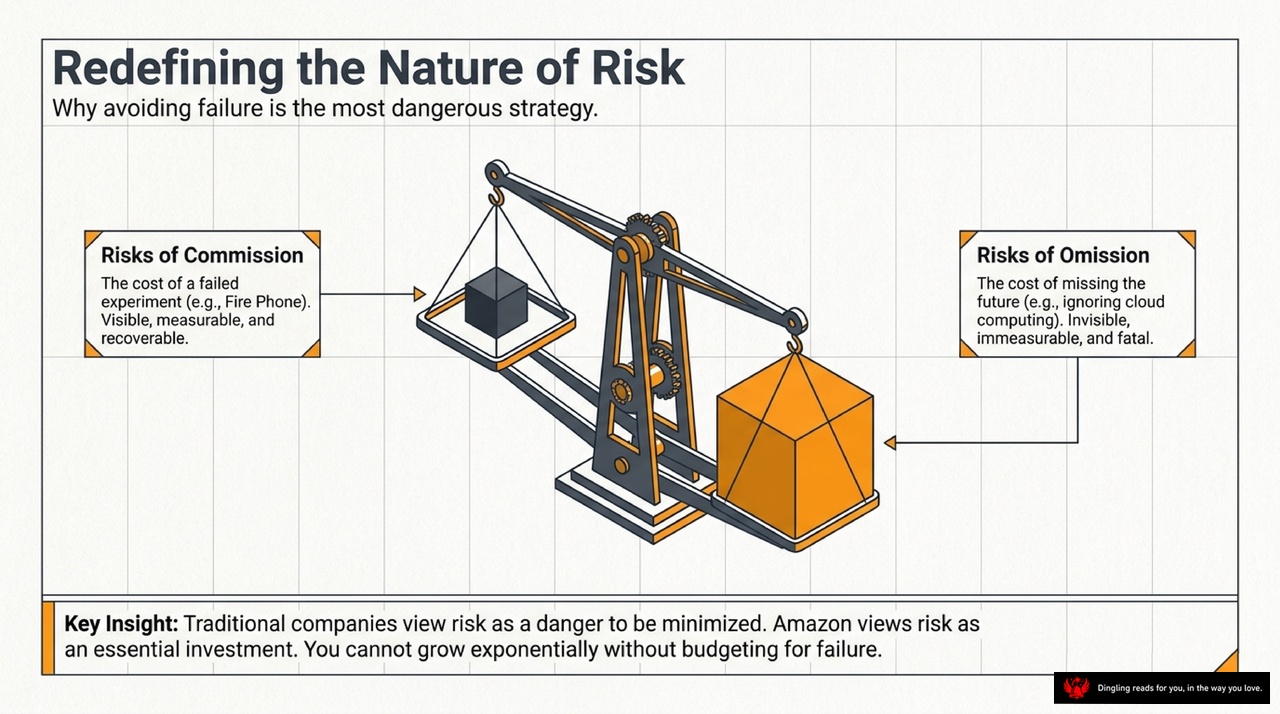
So, look at this scale. It perfectly captures a mindset shift that separates stagnant companies from those that actually grow. On the left, we have "Risks of Commission"—the cost of a failed experiment, like Amazon's Fire Phone. These are visible, measurable, and, crucially, recoverable. It's a heavy box, yes, but it's something you can pick up again.
On the right, however, sits the far heavier weight: "Risks of Omission." This is the cost of missing the future entirely. Think about ignoring cloud computing in the early 2000s. That mistake is invisible, immeasurable, and ultimately fatal. You can't put a price tag on it, and you can't fix it once it happens.
The key insight here is simple but profound: traditional companies often view risk as a danger to be minimized, trying to avoid failure at all costs. But Amazon flips this script. They view risk as an essential investment. You simply cannot grow exponentially without budgeting for failure. By embracing the lighter, recoverable risks of commission, you protect yourself from the catastrophic, silent weight of omission. That's the true redefinition of risk.
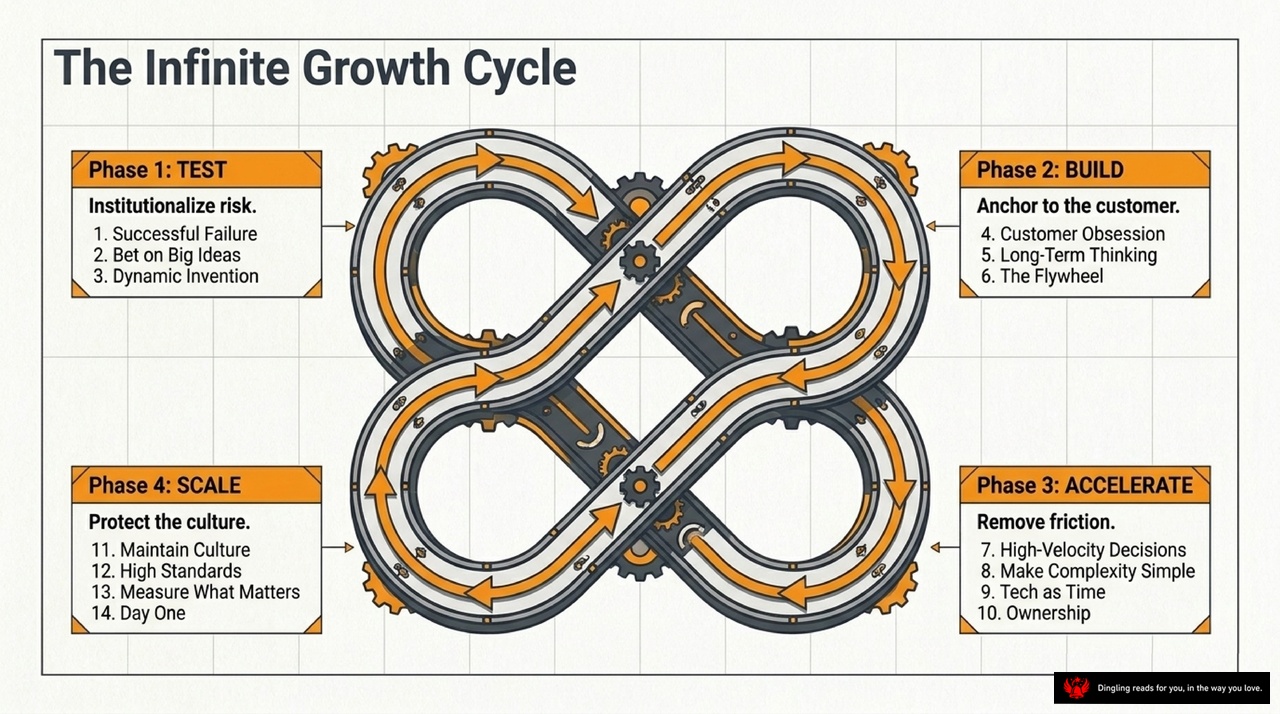
Welcome back to the infinite growth cycle. Today, we're diving deep into the first phase: **Test**. Look at that diagram. It all starts here, in the top left. The core principle is simple but powerful: **Institutionalize risk**.
In the world of traditional business, failure is often seen as a career-ending event. But at Amazon, under Jeff Bezos, failure is just a data point. He calls it "successful failure." It's not about the money you lose; it's about the knowledge you gain. Think of it like NASA's Apollo program. When Apollo 11 finally landed on the moon, it was possible only because of the "successful failures" of previous missions. The data from those crashes and near-misses built the safety protocols for success.
Bezos applied this exact logic to Amazon's massive bets. Take the Amazon Marketplace. The initial attempt, called zShops, failed miserably. It was clunky and confusing. But instead of hiding that failure, they learned from it. They realized customers wanted to compare third-party items right next to Amazon's own inventory. That simple insight, born from a failed experiment, launched the Marketplace into the biggest revenue engine in history.
Or look at the Kindle. Before they built the device, they had to test the concept of an e-reader. They tested paperbacks, then e-books, then dedicated hardware. Many of those early iterations didn't work as planned. But each "failed" test refined their understanding of what readers actually wanted, eventually leading to the perfect device. Even the Fire Phone, which lost nearly $178 million, wasn't a total loss. The technology and user feedback from that failure directly paved the way for the massive success of the Echo and Alexa.
So, what does this mean for you? It means you need to stop fearing the experiment. You need to bet on big ideas, even when the outcome is uncertain. If you don't test, you can't learn. And if you can't learn, you can't grow. Bezos didn't wait to be sure before he acted; he acted, measured the results, and then iterated. That is the essence of the Test phase. It's about creating a culture where failure is not just allowed, but celebrated as the necessary fuel for future innovation.

So, look at this chart. It's titled "Institutionalizing Successful Failure," and it tells a story that is completely counterintuitive to how most businesses operate.
On the left side, you see a long, jagged line labeled "The Cost of Learning." This represents dozens of failed tests. Think about Amazon Auctions, zShops, or the massive $178 million loss on the Fire Phone. These aren't just mistakes; they are the necessary price of admission for growth. In the traditional view, this area is pure loss. But for Amazon, this is the investment phase.
Then, look at that sharp, vertical spike on the right. That's "The Exponential Reward." It shows how a single big win—like AWS or Prime—can eventually pay for thousands of prior failures. The graph illustrates that failure and invention are inseparable twins. If you knew an experiment was going to work in advance, it wasn't an experiment at all.
The key insight at the bottom drives this home: Amazon explicitly budgets for failure. They understand that to achieve exponential growth, you have to be willing to fail repeatedly. It's not about avoiding the red zone on the left; it's about ensuring that the orange zone on the right is big enough to make it all worth it.
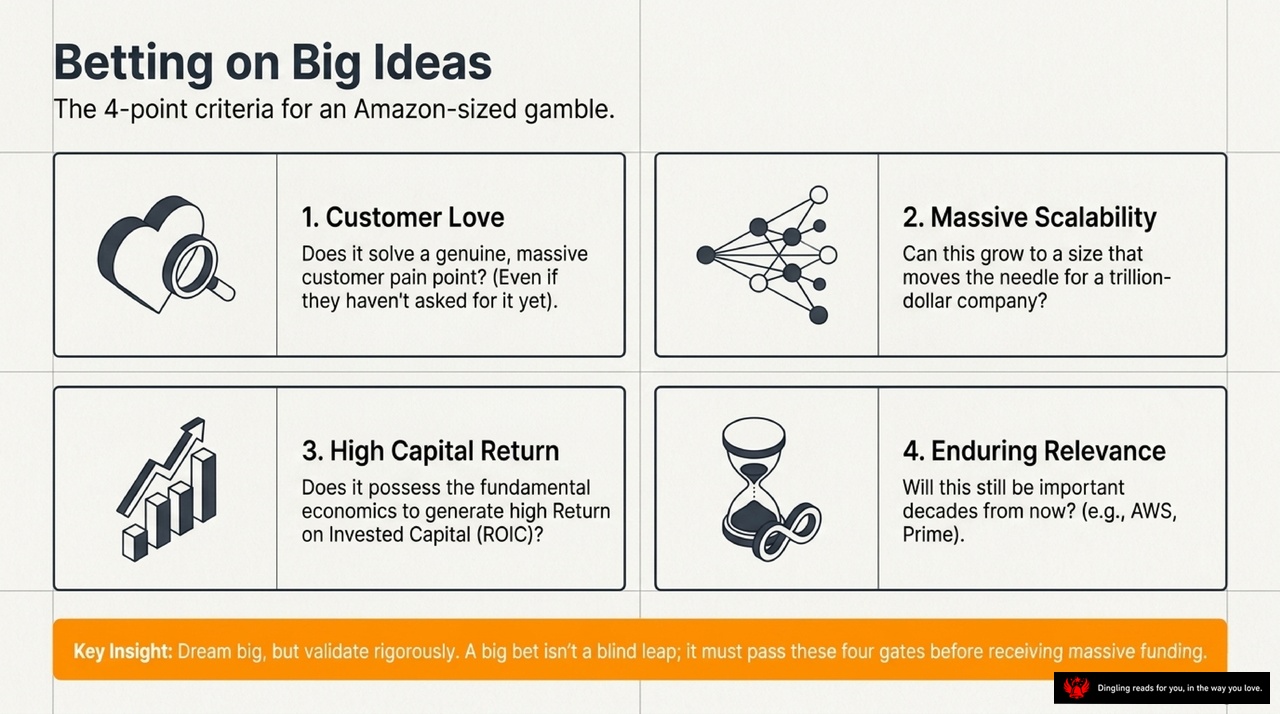
So, how do you actually bet on big ideas without going broke? Amazon didn't just guess; they used a strict four-point checklist to decide if a project was worth the massive risk. Think of it as four gates you must pass before asking for funding.
First, you need Customer Love. Does this solve a genuine, massive pain point? Even if the customer hasn't asked for it yet, is it something they desperately need? Second, Massive Scalability. Can this idea grow big enough to move the needle for a trillion-dollar company? It has to have the potential to become truly global.
Third, High Capital Return. Does it have the fundamental economics to generate a high Return on Invested Capital? In other words, will the money you put in actually generate significant returns over time? Finally, Enduring Relevance. Will this still matter decades from now? Think of services like AWS or Prime; they aren't just trends, they are essential utilities for the future.
The key insight here is simple but powerful: Dream big, but validate rigorously. A big bet isn't a blind leap of faith. It must pass all four of these gates first. Only when you've proven the idea meets these four criteria should you commit the massive resources required to make it a reality.

Imagine a world where you don't build your product to beat your competitors, but instead, you build it solely to solve a problem your customer can't yet articulate. This is the fundamental shift from "Day Two" thinking to "Day One" obsession, and it's the heartbeat of Amazon's success.
On the left, we see the trap of the Competitor-Focused approach. Here, the logic is linear and reactive: you watch what rivals are doing, copy their current technology, build a new product based on that imitation, and only then try to find customers. This strategy leads to incremental improvements and a constant game of catch-up. You are building products based on what others are doing, which inevitably results in a reactive strategy where you are always one step behind.
But look at the right side. This is the Customer-Obsessed mindset, labeled as "Day One." Instead of starting with a product, you start with the customer need right in the center. You work backward from that unarticulated need. The diagram shows how this need drives everything outward: new capabilities, products, and ultimately, value. This means you might need to learn entirely new skills to build the solution, even if it means learning to manufacture hardware like the Kindle or building cloud servers like AWS from scratch.
The key insight here is simple but profound: obsession means prioritizing the customer's needs over your own existing competencies. When you focus on beating competitors, you limit your vision to their boundaries. But when you focus on the customer, you are free to invent the future. This shift from copying to creating is what allows a company to stop chasing and start leading, turning a simple idea into an unshakeable market advantage.
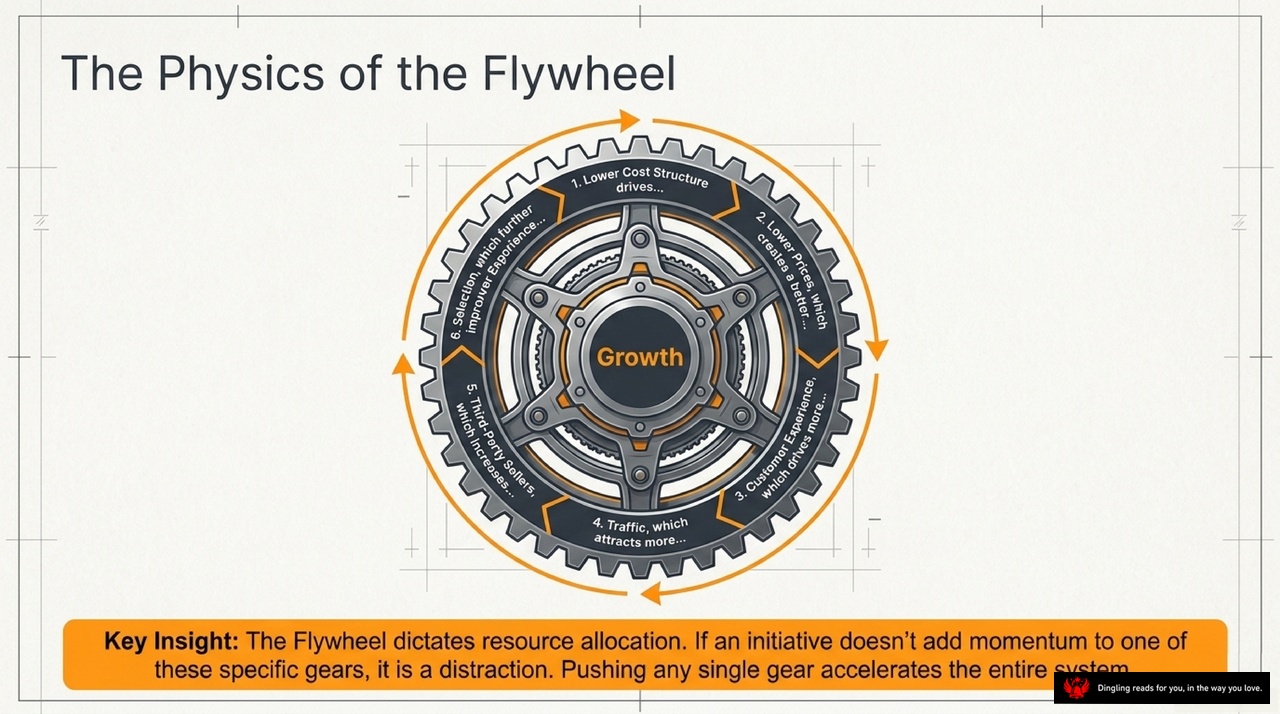
The Physics of the Flywheel isn't just a diagram; it's the engine that drives Amazon's entire business model. Look at this circular motion in the center: Growth. Everything spins around this core. Notice how each gear connects to the next? Lower costs drive lower prices, which attracts more customers. More customers mean better selection for sellers, which increases third-party participation. That expansion allows Amazon to operate more efficiently, lowering costs even further. It's a self-reinforcing loop where pushing one gear accelerates the whole system.
The key insight here is about resource allocation. If an initiative doesn't add momentum to one of these specific gears, it's simply a distraction. Amazon doesn't scatter its energy; it focuses it on the flywheel. Pushing any single gear—whether that's improving customer experience or expanding selection—creates the inertia needed to speed up the entire cycle. This is how Amazon turns small advantages into unstoppable momentum, ensuring that every decision contributes directly to that central growth.
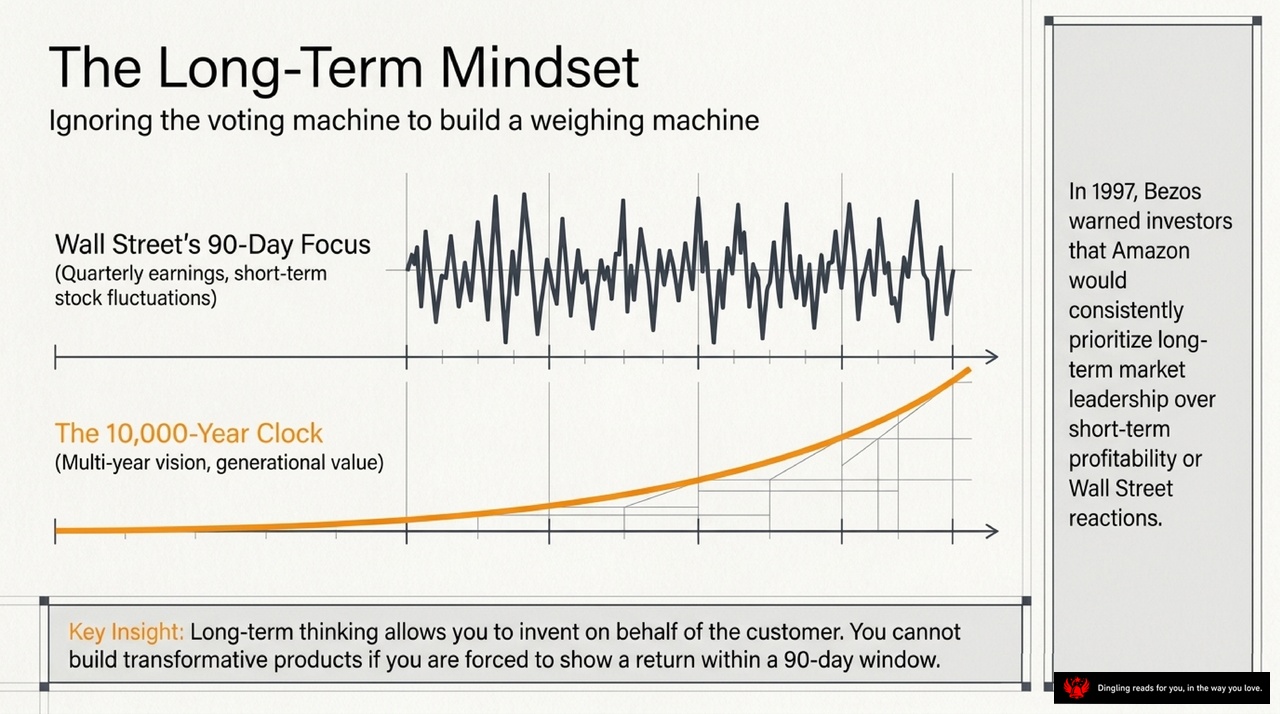
Imagine a world where your business decisions are driven by a 90-day calendar, obsessed with quarterly earnings and stock fluctuations. That's the trap Wall Street often sets, a frantic rhythm of short-term gains that can blind you to what truly matters. But Jeff Bezos saw it differently. He famously told investors in 1997 that Amazon would prioritize long-term market leadership over short-term profitability or Wall Street's immediate reactions. This was the birth of the "Long-Term Mindset."
Look at the chart on your screen. The top line represents that chaotic, jittery 90-day focus—a voting machine that only cares about today's price. But the orange curve below? That's Bezos's vision: the 10,000-Year Clock. It's not about getting rich quick; it's about generational value. By ignoring the noise of the voting machine, Bezos built a weighing machine. He knew that long-term thinking allows you to invent on behalf of the customer. You simply cannot build transformative products if you are forced to show a return within a 90-day window. When you stop chasing the next quarter's profit, you start building something that lasts for decades, creating a legacy that truly weighs more than any temporary stock spike.

Think about how you make decisions every single day. Are you treating every choice like a high-stakes, irreversible gamble, or are you viewing it as a low-risk experiment you can easily undo? This slide breaks down that critical distinction between Type 1 and Type 2 decisions.
On the left, we have Type 1 Decisions, or what we call "One-Way Doors." These are irreversible, high-stakes moves. Think of selling a subsidiary or pivoting your entire core business. Because there's no going back, the process must be methodical, careful, and involve slow, broad consultation. You need all the data before you commit.
On the right, you have Type 2 Decisions, or "Two-Way Doors." These are reversible and low-stakes. Examples include launching a new site feature or running a pricing test. If you make a mistake, you can simply step back through the door and try again. Because the risk is contained, the process should be fast, delegated to individuals or small teams, and executed with speed.
Here is the key insight that changes everything: Bureaucracy often happens when a company mistakenly treats every decision like a One-Way Door. To truly accelerate growth, you need to recognize that the vast majority of your daily choices are actually Two-Way Doors. Stop over-engineering small decisions, empower your teams to move fast, and only apply heavy scrutiny to the few truly irreversible moments. By shifting your mindset, you turn every potential failure into a learning opportunity, allowing your organization to pivot and grow at velocity.

Imagine a world where meetings don't start with slides, but with deep, narrative memos. That's exactly what Jeff Bezos championed with his "Six-Page Narrative Memo." On this slide, you see a powerful contrast: on the left, scattered, superficial bullet points that often hide sloppy thinking; on the right, a stack of deep, forcing-clarity documents that drive real decisions.
Bezos believed that slowing down to write a full six-page story forces the author to clarify their logic, whereas bullet points allow us to hide our lack of thought. But the magic happens after the writing. Notice the second step: The Silence. Every meeting begins with a full thirty minutes of total silence while executives read the memo. No talking, no questions, just pure absorption. This deliberate pause ensures everyone understands the full context before a single word is spoken.
Only after that silence does the third step begin: The Debate. Because everyone has read the same deep narrative, the discussion that follows is high-quality, deeply informed, and incredibly efficient. It's not about debating fragments; it's about debating the whole picture. This method transforms decision-making from a chaotic scramble into a streamlined, strategic process. It's a reminder that sometimes, the fastest way to move forward is to stop, read deeply, and then think together.

Making Complexity Simple isn't just a slogan; it's the engine behind Amazon's massive scale. Look at this funnel. On top, we have the chaos of "Customer Effort & Friction"—the tangled wires of waiting in lines, wrestling with packaging, or fumbling through multi-step checkouts. That friction is the enemy of growth.
But watch what happens when you apply "Technology & Simplification." Amazon didn't just add features; they removed barriers. Think about 1-Click Shopping, which erased the checkout barrier entirely. Or their frustration-free packaging that banned those annoying plastic clamshells and zip ties. Then there's Amazon Go, where you literally just walk out, and the system handles the payment instantly.
The result? An accelerated transaction. By aggressively utilizing technology to strip away every unnecessary step, Amazon turns a slow, frustrating journey into a seamless experience. The key insight here is clear: friction kills scale. When you make complexity simple, you don't just save the customer time; you secure their loyalty and unlock the massive efficiency needed to dominate the market.

Imagine a massive funnel where thousands of candidates pour in, but only one exceptional person emerges at the bottom. That is the essence of Amazon's "Bar Raiser" mechanism. As this slide illustrates, maintaining high standards isn't just about hiring; it's the critical lever for scaling talent without dilution.
Amazon operates on a simple but ruthless truth: growth without standards is cancer. To prevent their culture from becoming mediocre as they expand, they introduced independent "Bar Raisers." These aren't just HR managers; they are decision-makers with veto power over hiring managers. Their sole job is to ensure that every new hire is objectively better than the current average of the team. If a candidate doesn't raise the bar, they don't get in, regardless of how many other managers love them.
To make this work, every interview at Amazon revolves around three core questions. First, will you admire this person? Second, will this individual raise the average level of effectiveness of the group they are joining? And third, along what dimension might this person be a superstar? These questions force the team to think beyond filling a role and focus on elevating the entire organization.
By strictly enforcing these standards, Amazon ensures that their talent pool only gets stronger over time. This prevents the "death spiral" of mediocrity where average hires drag down top performers. It creates a self-reinforcing cycle where the best people attract the best people, securing the long-term competitive advantage that defines the company today.
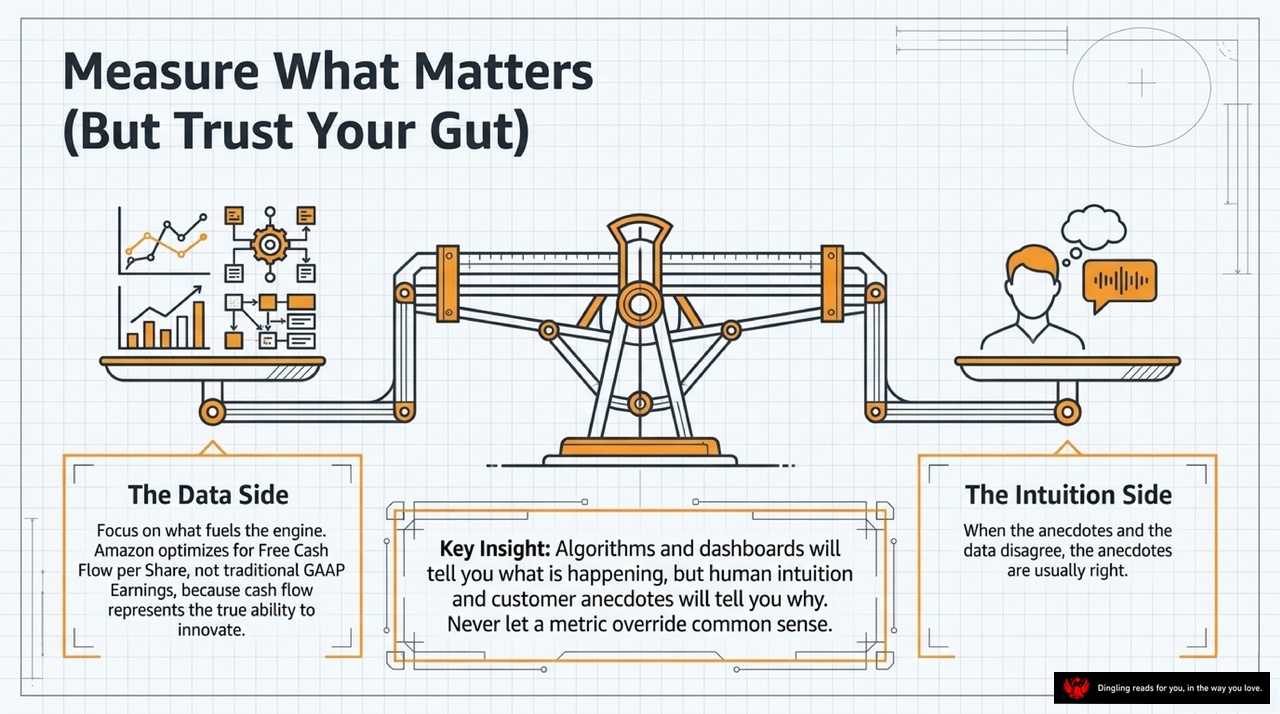
So, we've been talking about data, algorithms, and dashboards. They are incredibly powerful tools that tell us exactly *what* is happening in our business. But here's the critical insight from today's slide: they rarely tell us *why* things are happening.
That is where human intuition and customer anecdotes come in. When your data says one thing, but a real customer tells you a completely different story, trust the customer. The anecdote is usually right.
Look at the scale in the image. On one side, we have the Data Side. This is about fueling the engine. Just like Amazon, which famously optimizes for Free Cash Flow per Share instead of traditional GAAP earnings because cash flow represents the true ability to innovate. This side tells you the numbers.
On the other side, we have the Intuition Side. This is where you look at the stories, the feedback, and the gut feelings. This side tells you the story behind the numbers.
The key takeaway is simple but vital: Never let a metric override common sense. Algorithms are great for spotting trends, but only humans can understand the context. If the data and the anecdotes disagree, listen to your gut. Because in the end, you are building for people, not for a spreadsheet.

Here is the spoken-word script for Slide 13, tailored for an American audience:
The Synthesis: Day One Mentality. This slide captures the ultimate battle every company faces: the choice between staying an innovator or slipping into bureaucracy. Look at the left side, Day One. This is the mindset of the true innovator. It's obsessed with the customer, not the competition. It resists proxies because it knows that rigid processes can never replace real outcomes. A Day One company eagerly embraces external trends and prioritizes high-velocity decision-making. It moves fast to serve the customer. Now, look at the right side, Day Two. This is the trap of the bureaucracy. It becomes obsessed with internal processes and competitors, getting sluggish and risk-averse. Instead of embracing trends, it fights them to protect legacy businesses. And as the slide clearly states, this path is followed by irrelevance, decline, and eventually, death. The key insight at the bottom is the most critical takeaway for any leader: maintaining a Day One culture isn't accidental; it is a daily, deliberate choice to fight organizational entropy. Regardless of your market cap or size, you must stay acting like a hungry startup. If you don't make that choice every single day, you will inevitably slide into the slow, formal, and dangerous state of Day Two.

Imagine you are playing a game where the only guarantee is relentless change. Are you building a business designed to protect its past, or a culture willing to risk it all to invent the future?
This slide captures the essence of Amazon's DNA. As the text reminds us, Amazon's growth isn't an accident; it's a replicable, mechanical cycle. By actively budgeting for failure, anchoring every decision to the customer, and aggressively defending hiring standards, any organization can build a self-sustaining flywheel. But here is the catch: mechanics alone are not enough without the culture to sustain them.
Think about it. If you are running a company, are you optimizing for quarterly earnings or long-term value? The slide asks a critical question: Are you protecting your legacy, or are you cultivating a mindset that embraces risk? Amazon's secret lies in treating failure as a necessary cost of innovation, not a reason to stop. They don't just execute a plan; they build a culture where every employee acts like an owner, constantly asking, "What is the best thing we can do for the customer today?"
In a world obsessed with short-term results, the choice is stark. You can build a fortress around your past successes, or you can build a machine that constantly reinvents itself. The difference between a stagnant giant and a thriving innovator often comes down to this single decision: Do you prioritize safety, or do you prioritize the future?