
The Catcher in the Rye: Complete Chapter-by-Chapter Summary
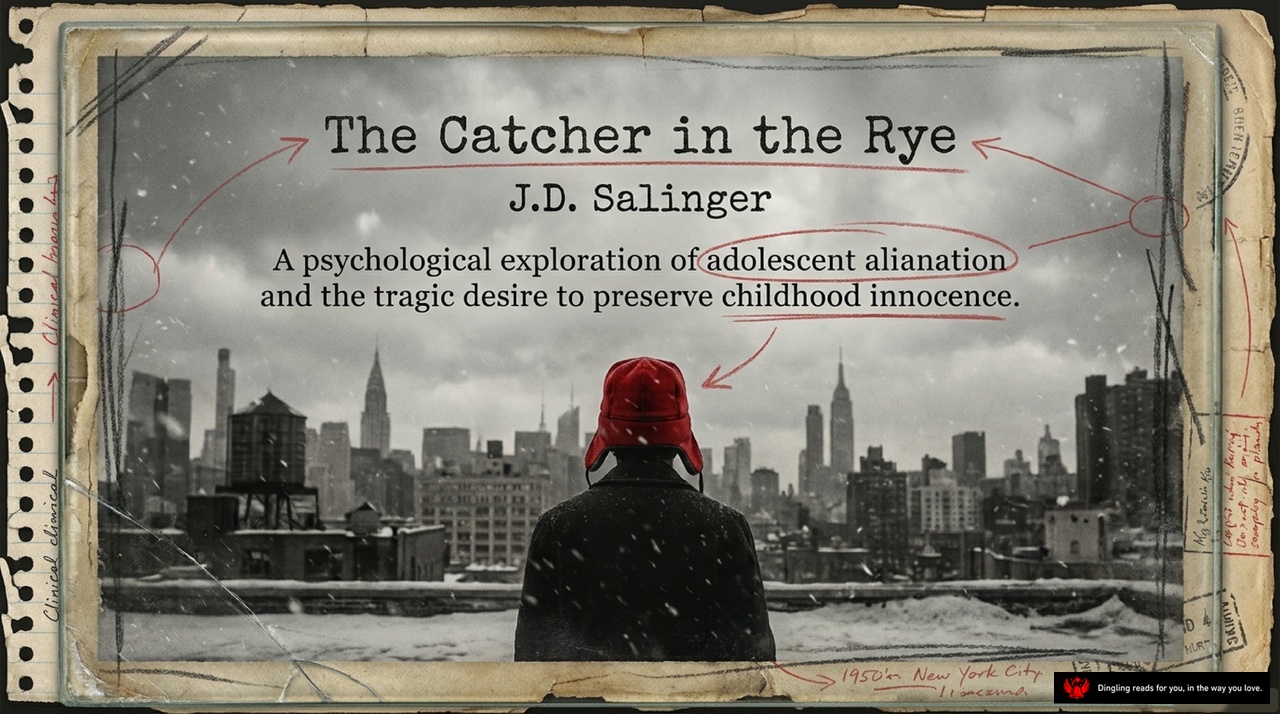
Welcome to our deep dive into J.D. Salinger's timeless masterpiece, *The Catcher in the Rye*. Set against the snowy, monochrome backdrop of 1950s New York City, this story isn't just about a boy running away; it's a profound psychological exploration of adolescent alienation and the tragic, desperate desire to preserve childhood innocence.
At the heart of this narrative is Holden Caulfield, a teenager who sees the adult world as a collection of phonies—people who wear masks to hide their true selves. Whether it's the pretentious students at Pencey Prep or the well-meaning but hypocritical teachers, Holden feels constantly at odds with reality. He is haunted by the memory of his brother Allie, whose innocence was stolen by illness, and he finds himself desperately trying to protect others from falling into the same trap.
That's where the famous metaphor comes from. Holden imagines himself as the "catcher in the rye," standing on a cliff edge watching children play in a vast field of wheat. His job, in his mind, is to catch any child who starts running toward the cliff, pulling them back before they fall into the darkness of adulthood. It's a beautiful yet heartbreaking vision of a world that wants to stop growing up.
As we turn the pages, we'll follow Holden's chaotic journey from the cold dorms of his boarding school to the lonely streets of New York, uncovering why he can't let go of the past and how his struggle to stay innocent ultimately defines his path.
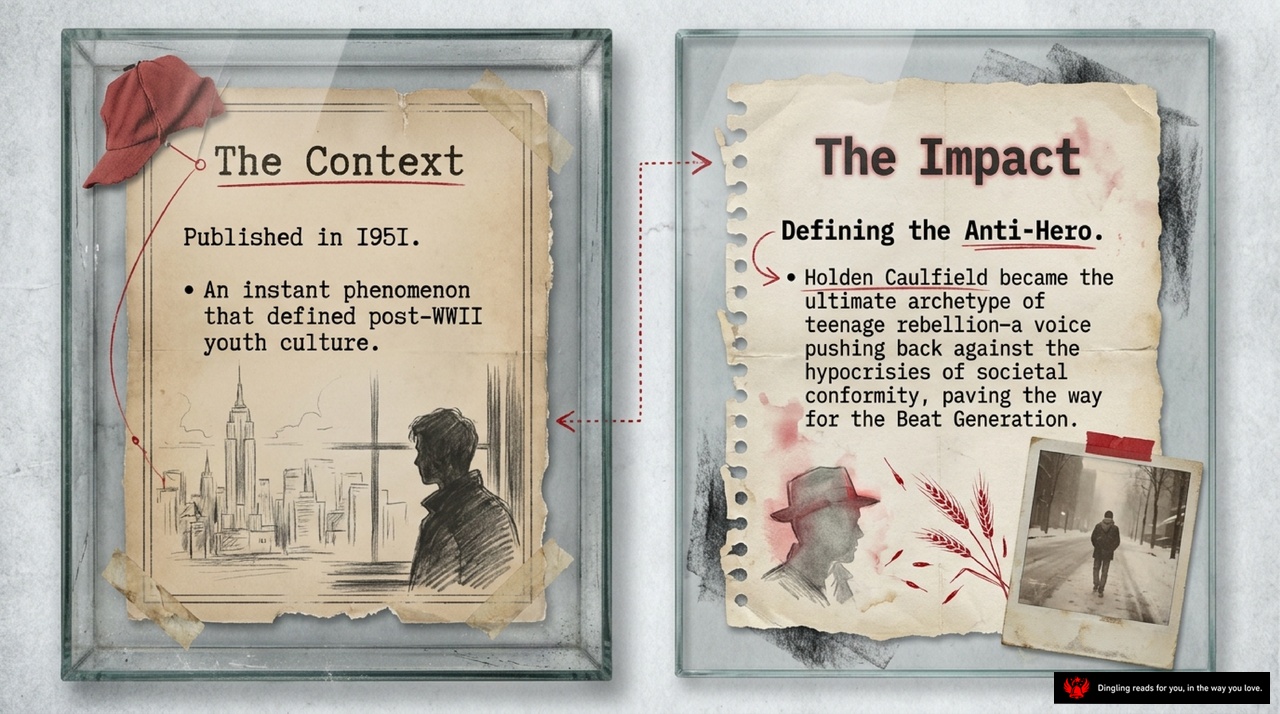
So, let's talk about the moment everything shifted for Holden Caulfield. This slide breaks it down into two crucial parts: the context of his departure and the lasting impact of his character.
First, look at the timeline on the left. Published in 1951, this book wasn't just a story; it was an instant phenomenon that defined post-WWII youth culture. Imagine a generation coming of age right after the war, filled with uncertainty and a deep need to reject the old world's rules. That's exactly where Holden fits in. He represents that raw, unfiltered voice of a teenager who just can't accept the hypocrisy of the adult world.
Now, shift your eyes to the right side, where we see the real legacy: defining the Anti-Hero. Before Holden, the main character in literature was usually someone heroic or at least trying to be. Holden changed that forever. He became the ultimate archetype of teenage rebellion—a voice pushing back against the suffocating pressures of societal conformity. Think about it: instead of pretending to be perfect like everyone else, he exposes the cracks in the facade. He calls out the "phonies," from his shallow classmates to the pretentious adults.
By doing this, Holden didn't just write a book; he paved the way for the entire Beat Generation. He gave millions of young people permission to be messy, to be angry, and to question authority without feeling guilty about it. He showed that it's okay to be an outsider. So, when you think of a rebellious teenager who refuses to play the game, you're thinking of Holden. He redefined what it means to be a protagonist, turning the concept of the hero upside down and creating a new kind of literary icon that we still recognize today.
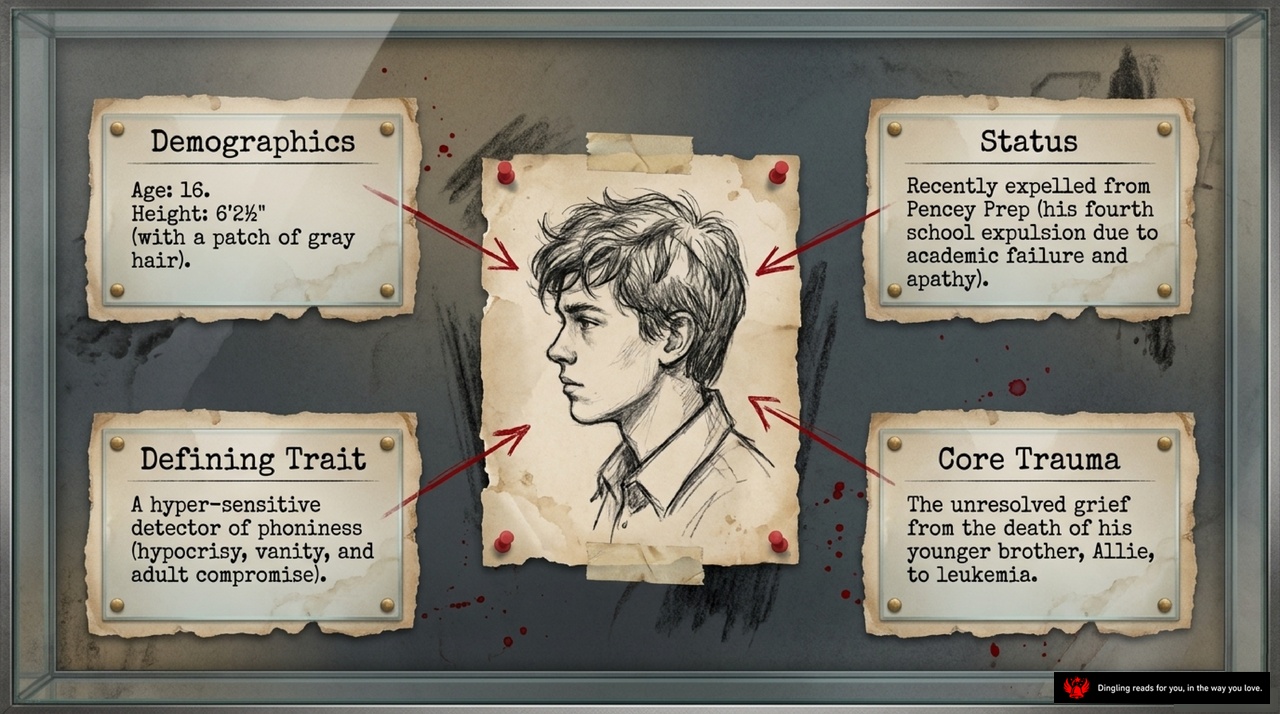
Look at this profile of Holden Caulfield. He's only sixteen, but he's already got a patch of gray hair, and he's six feet two inches tall. But what really defines him isn't his height or his age; it's the unresolved grief from the death of his younger brother, Allie, to leukemia. That trauma is the core of everything he does.
You can see his defining trait right here: he's a hyper-sensitive detector of phoniness. He hates hypocrisy, vanity, and adult compromise. This sensitivity is what gets him expelled from Pencey Prep for the fourth time. The school tries to label him with academic failure and apathy, but the real reason is that he just can't stand the fake people around him. Whether it's the shallow Stradlater or the hypocritical teachers, Holden sees through their masks immediately.
So, his status is clear: he's recently been expelled again, and he's running away from a world that feels too fake to him. He's not looking for a new school or a new rulebook; he's looking for a place where he doesn't have to pretend to be someone he's not. This profile captures a boy who is physically young but emotionally exhausted, carrying the weight of his brother's death and a deep, burning resentment for the adult world that refuses to be real.
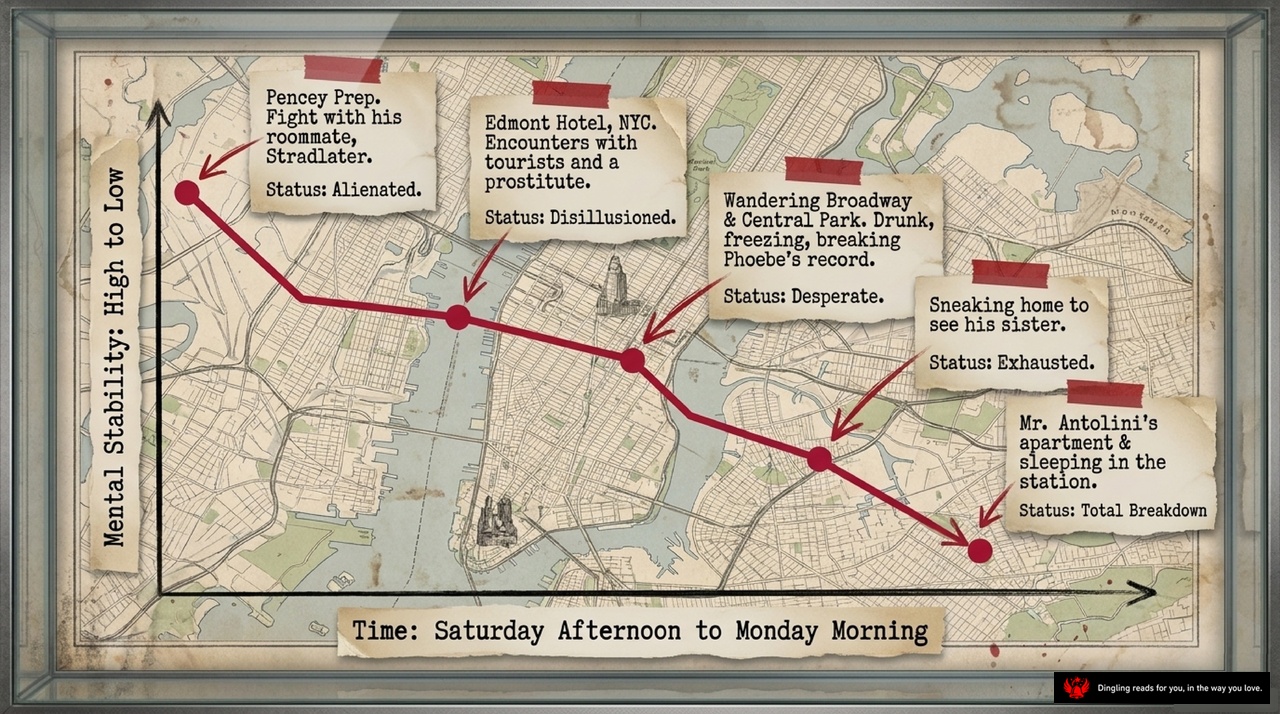
Look at this map of Holden's descent into chaos. From Saturday afternoon to Monday morning, his mental stability plummets from high to total breakdown. It starts at Pencey Prep, where he fights with his roommate Stradlater, leaving him feeling completely alienated. That conflict is just the first domino to fall.
He heads to the Edmont Hotel in NYC, expecting a fresh start, but instead, he encounters tourists and a prostitute, which only deepens his disillusionment. The city isn't a sanctuary; it's another trap. His wanderings through Broadway and Central Park leave him drunk, freezing, and desperate, even breaking Phoebe's record in his panic. He tries to sneak home just to see his sister, but that only leaves him exhausted.
Finally, he ends up at Mr. Antolini's apartment and sleeping in the station, reaching a point of total breakdown. This timeline shows how quickly a single day can unravel someone's world when they're already on the edge. Holden isn't just running away from school; he's spiraling into a crisis where every step forward feels like a step backward into despair.
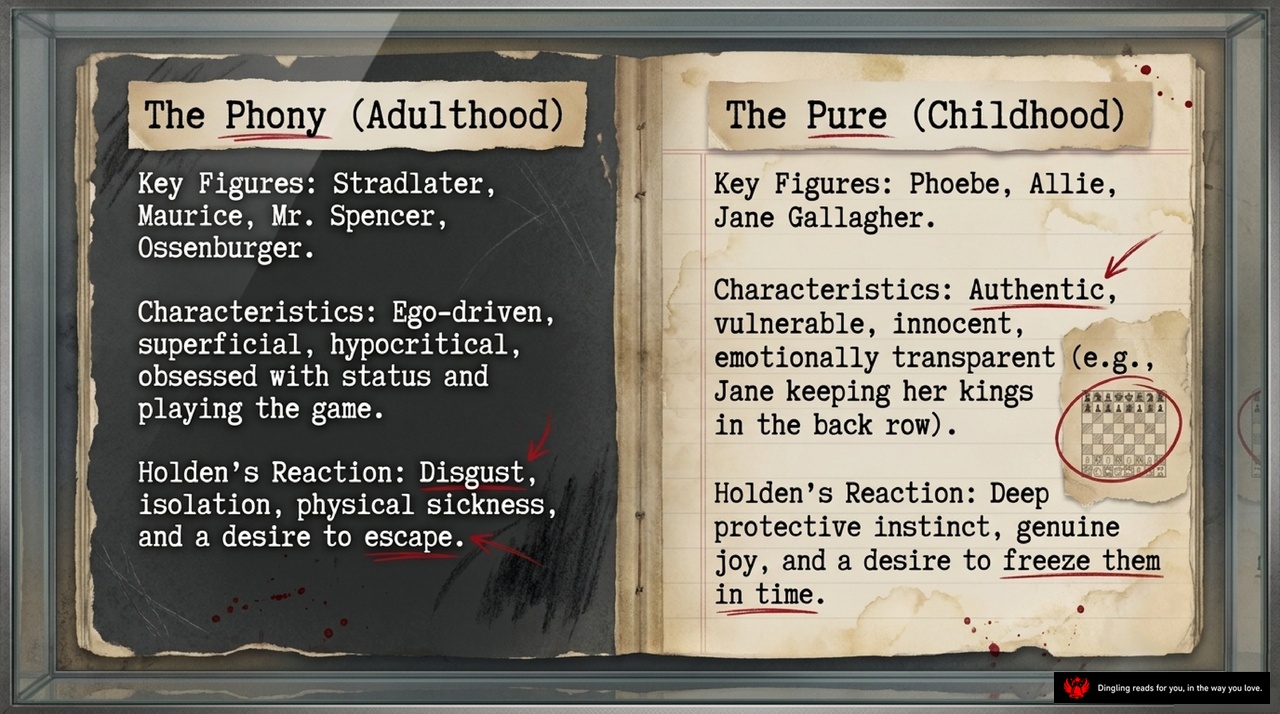
Look at this split between two worlds. On the left, we have "The Phony"—the harsh reality of adulthood that Holden despises. Think of Stradlater, Maurice, or Mr. Spencer. They are ego-driven, obsessed with status, and constantly playing a game of social survival. To Holden, their world feels superficial and hypocritical, leaving him with nothing but disgust, isolation, and a deep desire to escape.
But on the right, we see "The Pure"—the sanctuary of childhood. This side represents Phoebe, Allie, and Jane Gallagher. These figures are authentic, vulnerable, and emotionally transparent. Take Jane, for example; she's defined by her innocence, like keeping her chess kings safely in the back row, refusing to play the adult game. When Holden looks at this side of himself, he doesn't feel disgust. Instead, he feels a fierce protective instinct. He wants to freeze these moments in time, shield them from the corrupting influence of the world, and hold onto the genuine joy they bring. This contrast defines Holden's entire journey: a desperate struggle to keep the purity of childhood alive against the crushing weight of a phony adulthood.
Welcome back to our deep dive into *The Catcher in the Rye*. Today, we're focusing on Chapter 5, a pivotal moment where Holden's journey takes a sharp, emotional turn.
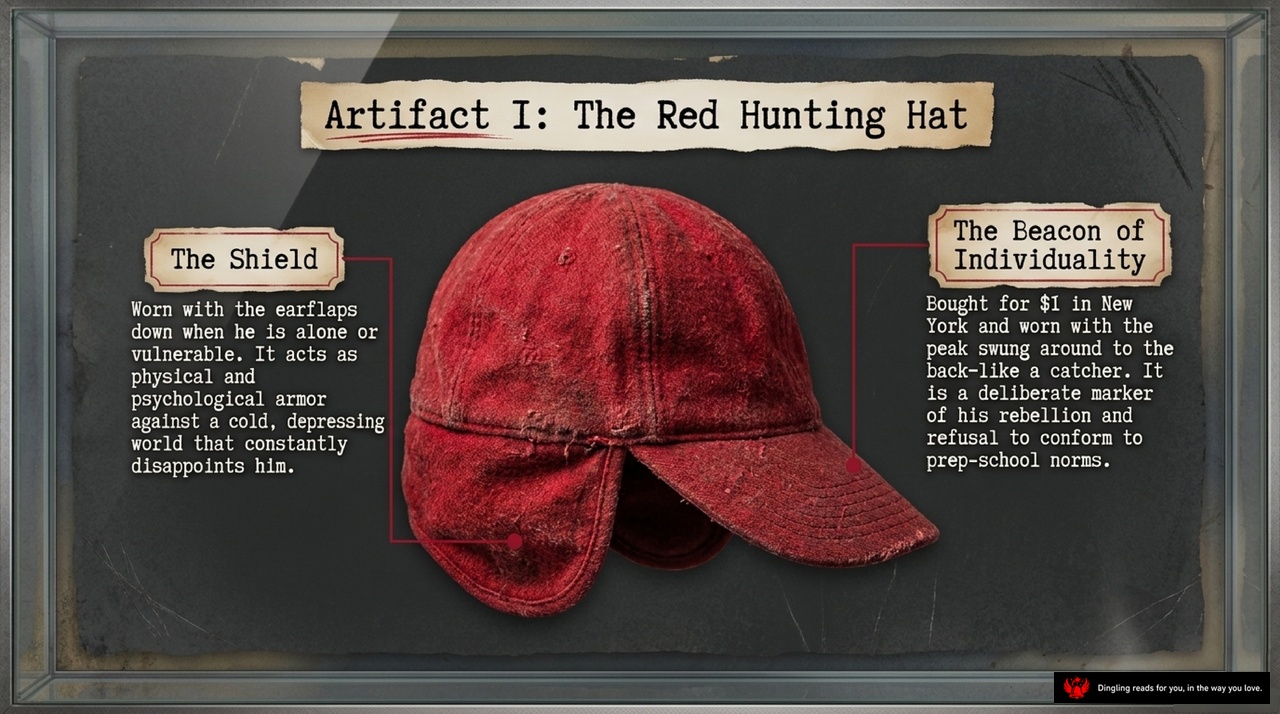
The image you see right here highlights "Artifact I: The Red Hunting Hat." This isn't just a prop; it's the central symbol of Holden's entire struggle. Look at the two labels: "The Shield" and "The Beacon of Individuality."
When Holden wears the earflaps down, it acts as a physical and psychological armor against a cold, disappointing world. It's his shield. But when he swings the peak around to the back, like a catcher in a baseball game, it becomes a beacon of his individuality—a deliberate rejection of prep-school norms.
In Chapter 5, we see Holden at his lowest point. After a night of drinking in the bar and a disastrous encounter with a prostitute, he's shivering in Central Park. He's terrified, his nose is bleeding, and he's completely alone. In this moment of vulnerability, he pulls out that red hunting hat. It's the only thing that makes him feel like himself.
Later, he heads home to sneak into his sister Phoebe's room. He gives her the hat as a Christmas gift, knowing she loves it. This gesture is profound because, earlier in the book, Holden had a breakdown over a stolen hat. Now, he's giving his most prized possession to the one person who truly understands him.
But the chapter ends with a heartbreaking twist. Holden decides to run away to the west, to be deaf and mute. He leaves a note for Phoebe to meet him at the museum. When she arrives, she doesn't just bring him a note; she brings her suitcase. She's ready to go with him.
Holden tries to reason with her, telling her she has to stay home and go to school. But she cries and refuses to leave. In that moment, Holden realizes he can't escape the world, and he can't abandon the people who love him. The red hat stays with Phoebe, symbolizing that while he might be trying to hide, the connection to the real world—and the people in it—is something he can't simply walk away from.

Look at this artifact: Allie's baseball mitt. This isn't just a piece of leather; it's the physical heart of Holden's grief. You can see the green ink on the fingers—Allie wrote poems there so he could read them while playing in the outfield. For Holden, this mitt is the last tangible proof of his brother's pure, uncorrupted innocence, stolen far too early by leukemia.
The story behind this object is raw. When Allie died, Holden didn't just mourn; he smashed every window in the garage with his bare hands. He couldn't let go, and neither could he. Later, when Holden was forced to write an essay about an object at prep school, he ignored the teacher's request and wrote about this mitt instead. It was the only place where Allie lived.
But the tragedy of this artifact isn't just in the past; it haunts the present. When Holden's roommate, Stradlater, criticizes the essay and punches him, the anger isn't just about the fight. It's a violent eruption of the unresolved pain Holden carries in this very glove. He tears the essay to shreds, unable to process the rejection, because rejecting the essay feels like rejecting Allie himself. This mitt represents a reverence for innocence that the adult world has no place for, making Holden feel like an outsider in a world of phonies.
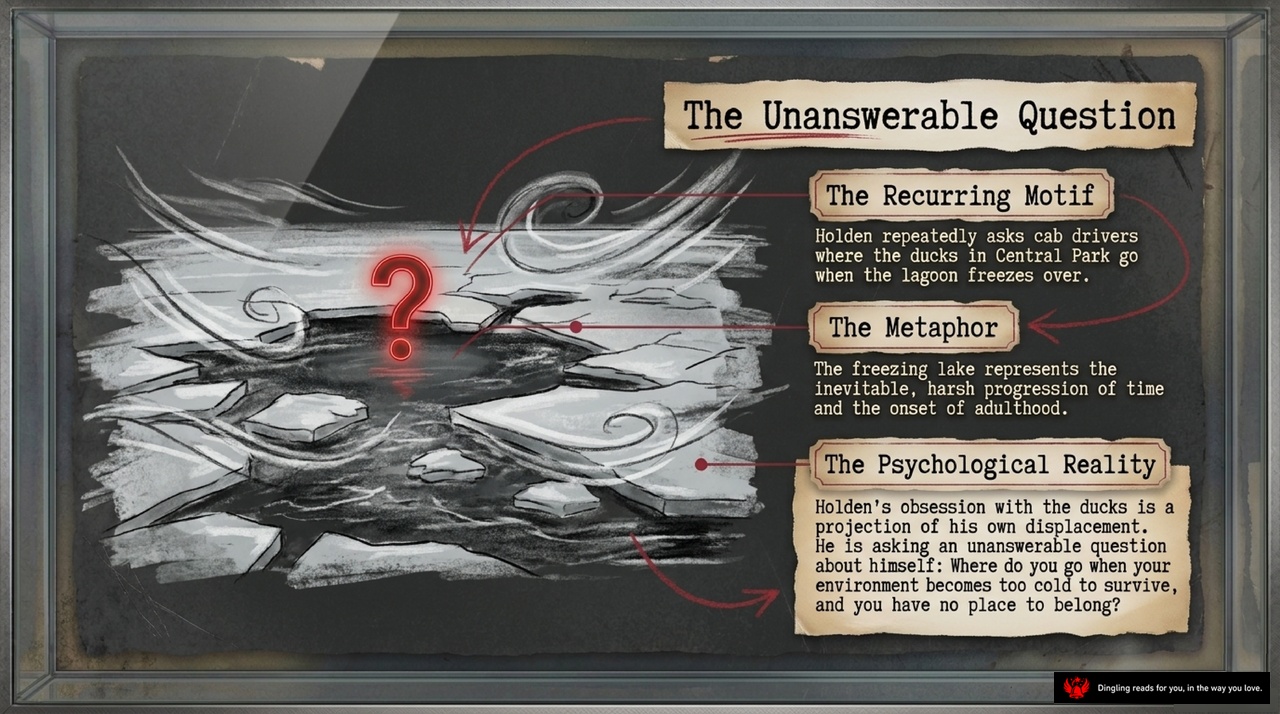
So, we hit a wall—a literal and metaphorical one. Look at that frozen lake in Central Park. For Holden, this isn't just about ducks; it's the ultimate unanswerable question: Where do you go when the world gets too cold to survive?
This obsession with the ducks is a recurring motif because it mirrors his own displacement. Just like the ducks, Holden feels lost when his familiar environment freezes over. The metaphor here is stark: the ice represents the harsh, inevitable progression of time and the terrifying onset of adulthood. He's asking himself, "Where do you go when your environment becomes too cold to survive, and you have no place to belong?"
Ultimately, Holden's psychological reality reveals that he is projecting his own fear of being left behind. He is terrified that if he can't find a safe harbor, he'll be frozen out of life entirely. That's why he clings to these questions; he's desperately searching for a place where he can still belong before the world turns against him.

Holden is spiraling. He's fixated on running away, pretending to be deaf and mute, and hiding from the world in absolute isolation. He feels completely disconnected, alienated, and surrounded by phonies. But in the middle of this chaos, there is one thing that keeps him grounded: Phoebe.
Ten-year-old Phoebe Caulfield is the anchor. She is highly intelligent and perceptive, offering the only unconditional love in his life. While Holden is lost in his cynicism, Phoebe pierces his defenses with a single, piercing challenge: "Name one thing you like."
She forces him to confront his own negativity and anchors his spiraling mind back to reality. She doesn't understand the adult world's complexity, but she sees him clearly. In a moment of vulnerability, she asks him about the future, and he tells her about his dream of being a "catcher in the rye," standing on the edge of a cliff to save children from falling. Phoebe listens intently, her innocence cutting through his despair. She even offers to go with him, proving that she is the only one who truly cares about his broken heart. Without her, Holden would have no reason to stay; with her, he has a reason to hope.
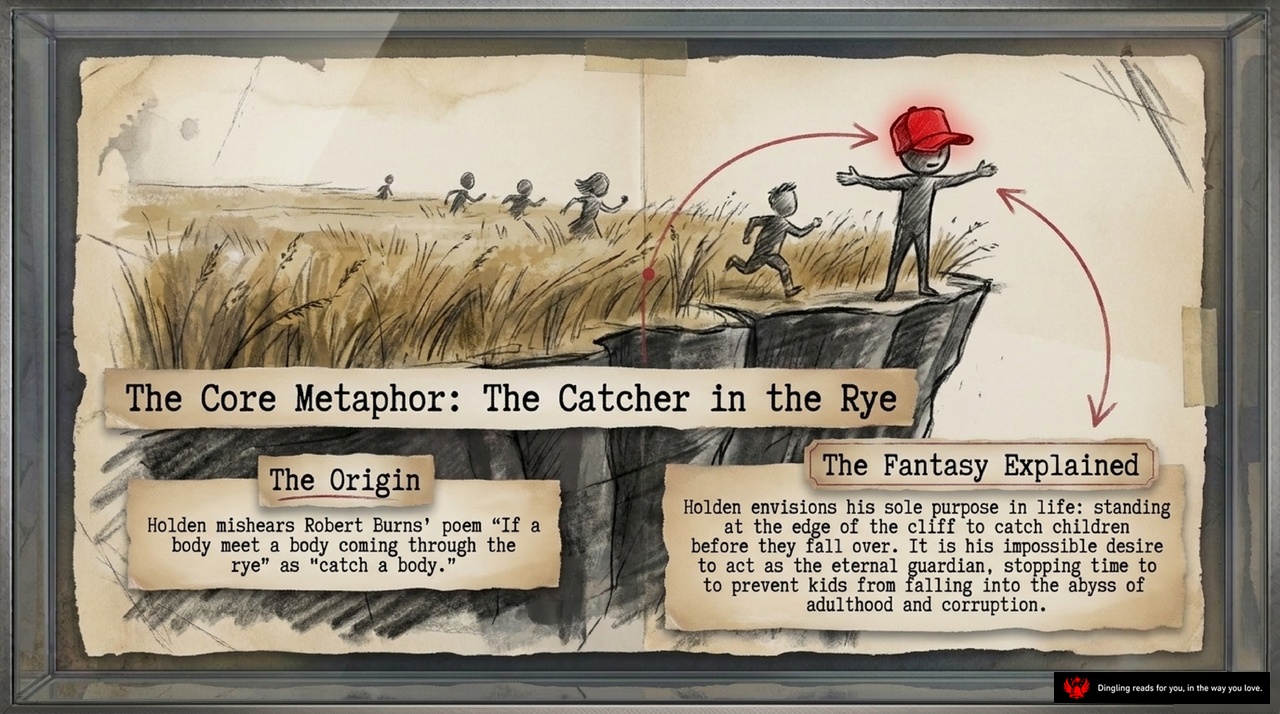
Holden's entire worldview hinges on one image, the one you see right here: the Catcher in the Rye. This isn't just a random metaphor; it's his core fantasy, the reason he stays up late thinking about everything.
Let's break down how this idea actually started. It goes back to a poem by Robert Burns called "To a Mouse." The original line is innocent enough: "If a body meet a body coming through the rye." But Holden mishears it. He hears "catch a body." In his mind, that changes everything. He imagines himself standing right at the edge of a cliff, watching kids run through a golden field of rye. He sees them carefree, but he also sees the danger—the cliff behind them.
So, what is this fantasy really about? It's about being the eternal guardian. Holden wants to stop time itself. He wants to catch every child the moment they start running toward the cliff, before they fall into the abyss of adulthood and corruption. He wants to save them from growing up, from losing their innocence, from becoming the "phonies" he hates so much. It's a desperate, impossible desire to protect the pure from the dirty world, a dream that defines who he thinks he is.

So, let's talk about the moment Holden's entire worldview starts to crack. It happens right here in Chapter 1, with a conversation that feels less like a school talk and more like a brutal wake-up call.
Holden has been expelled from Pencey Prep, and he's packing his bags to run away to New York. But before he leaves, he visits his history teacher, Mr. Antolini. You might remember Mr. Antolini from earlier—he's the kind of guy who seems nice on the surface but is actually quite cynical and judgmental. But this time, something is different.
When Holden is leaving Mr. Antolini's room, he hears a strange noise. He thinks it's Mr. Antolini making a strange sound, so he runs out into the hallway, only to realize it was actually Mr. Antolini talking in his sleep.
That's the scary part. Because in his sleep, Mr. Antolini doesn't see Holden as the rebellious, expelled kid. Instead, he sees him clearly for what he is: an immature boy on the verge of a major mistake. Mr. Antolini warns him, telling him that Holden is "riding for a terrible, terrible fall."
But the most chilling part isn't just the warning. It's what Mr. Antolini says right before Holden runs away. He tells Holden a quote that hits him right in the gut. He says, "The mark of the immature man is that he wants to die nobly for a cause, while the mark of the mature man is that he wants to live humbly for one."
Holden runs out of the house, terrified. He thinks Mr. Antolini is trying to seduce him. But here's the thing: Mr. Antolini wasn't trying to hurt Holden. He was trying to save him. He was telling Holden that survival isn't about being a hero or dying for some grand idea. Real maturity is about humility. It's about being willing to live a quiet, ordinary life instead of trying to be special.
This is the intellectual counterpoint to Holden's whole "Catcher in the Rye" fantasy. He wants to save kids from falling off a cliff, but Mr. Antolini is telling him that the only way to survive the fall is to adapt, to be humble, and to accept the messy reality of life. Holden can't hear that because he's too busy wanting to be the noble hero who saves everyone else. He's running away from the hard truth that sometimes, you just have to live humbly to stay alive.
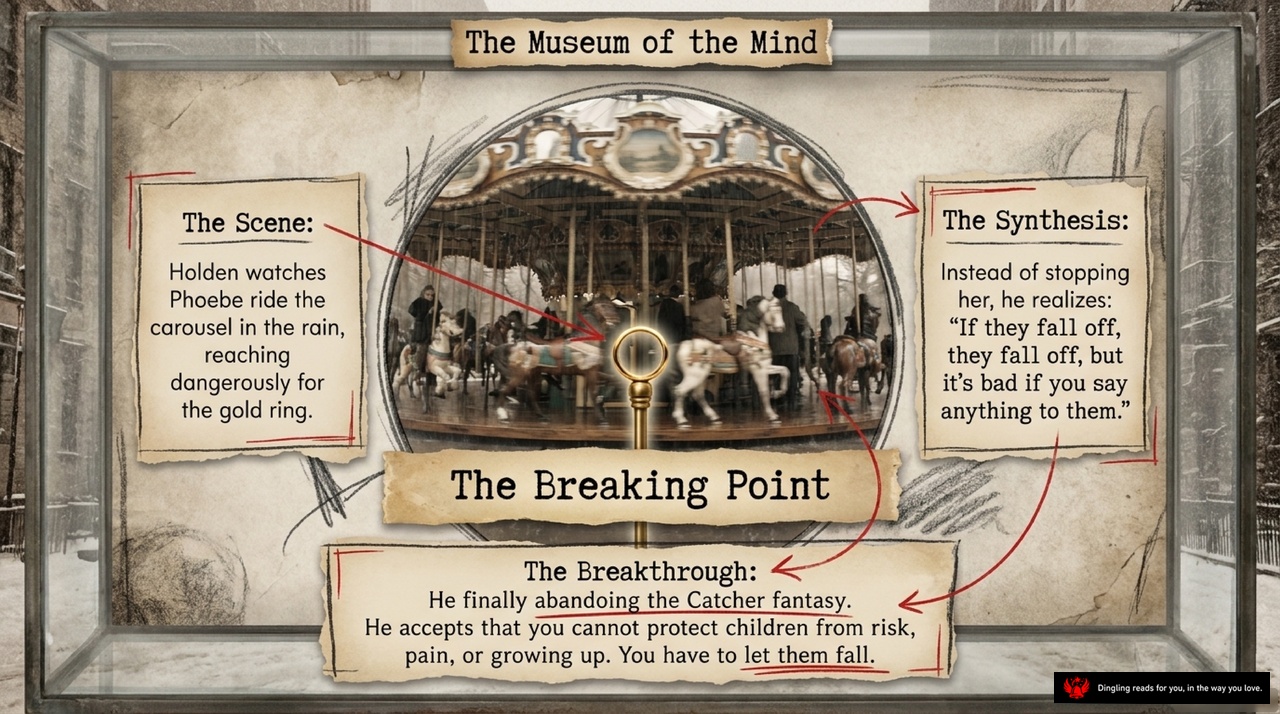
Look at this carousel in the rain. It captures the exact moment Holden Caulfield realizes he can't save anyone, not even himself. This is the breaking point of his journey.
On the left, we see the scene: Holden watches Phoebe ride the carousel, reaching dangerously for the gold ring. It's a terrifying image. He knows that if she falls, she'll be hurt. But on the right, the synthesis reveals his realization: "If they fall off, they fall off, but it's bad if you say anything to them."
Holden has spent his whole life trying to be the "Catcher in the Rye," the guardian who stops children from falling into the "cliff" of adulthood. He wants to protect Phoebe from the pain of growing up, the risk of making mistakes, and the inevitable loss of innocence. He thinks he can stop the inevitable.
But here, in this moment, he has a breakthrough. He finally abandons that fantasy. He accepts a harsh truth: you cannot protect children from risk, pain, or growing up. You have to let them fall.
The carousel isn't just a ride; it's the wheel of life. If Holden tries to stop it, he's not protecting Phoebe; he's trapping her in a world of lies and stagnation. By letting her reach for the ring, he lets her face the consequences. He realizes that the only way to truly love her is to let her grow, even if that means letting her fall. This is the moment Holden stops being a child and starts becoming a man, accepting the messy, dangerous, and beautiful reality of life.

Picture this: your brain is a chaotic radio station, constantly broadcasting everything you feel, think, and suppress all at once. That's exactly how Holden Caulfield experiences the world. On this slide, we're breaking down the "Stream of Consciousness"—the unique narrative style that makes *The Catcher in the Rye* feel so raw and real.
First, look at **The Voice**. Holden's narration isn't a polished story; it's a pure stream of consciousness capturing real-time psychological processing. He doesn't edit his thoughts; he just lets them spill out, complete with his specific 1950s teenage slang like "phony" and "goddamn." This isn't just style; it's a defense mechanism.
See the center diagram connecting **Thought** and **Speech**? That's the core mechanic. Salinger blends highly specific slang with extreme, sweeping cynicism to show us how Holden processes the world. He uses casual profanity and constant digressions—like worrying about ducks in the Central Park pond or getting mad at a teacher's broken nose—not just to be rebellious, but to mask a desperate vulnerability.
Finally, notice **The Effect** at the bottom. Those constant digressions and the casual swearing act as a shield. They mask his profound sensitivity to the world. When he's angry at Stradlater or confused about the ducks, he's actually terrified of losing himself. It's a way to keep his feelings at arm's length so he doesn't get crushed by them. This style forces us to experience Holden's confusion and pain directly, without any filter.
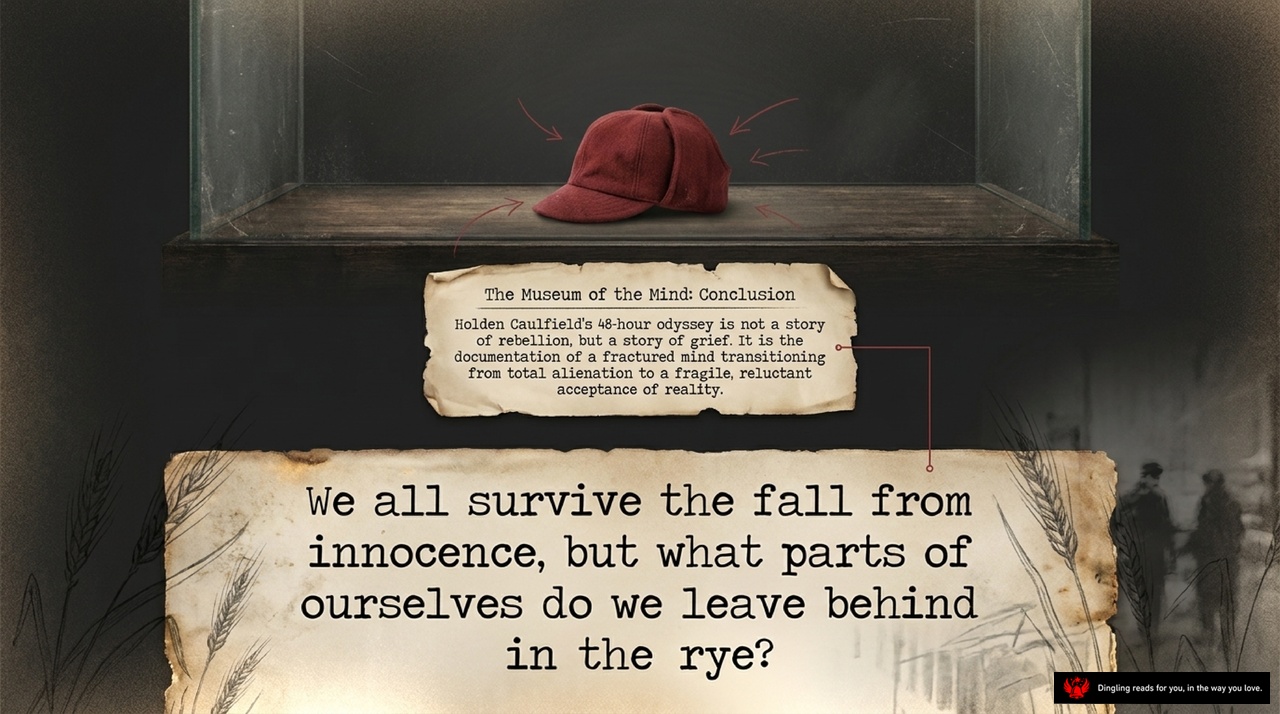
The red cap on the shelf isn't just an accessory; it's the symbol of Holden Caulfield's fractured mind, caught between the innocence he lost and the reality he refuses to fully accept. As we reach the conclusion of this 48-hour odyssey, we see that Holden's journey wasn't really about rebellion. It was a deep, raw story of grief. He is documenting a mind that is slowly transitioning from total alienation to a fragile, reluctant acceptance of reality. We all survive the fall from innocence, but the question remains: what parts of ourselves do we leave behind in the rye?