
The City of God (Books 1-10): Complete Chapter-by-Chapter Summary

Hey folks, welcome to today’s book share. We’re starting with a true classic: Saint Augustine’s *The City of God*. This isn’t just a religious text—it’s a definitive defense of Christian faith against pagan despair, and it dives deep into the eternal clash between two worlds: the earthly city of man, built on worldly wants, and the heavenly city of God, rooted in divine purpose. Let’s explore how these two cities shape our understanding of life, faith, and what lasts beyond the here and now. Let’s get into it!

Let’s turn to this slide. First, the left panel: "The Fall of the Eternal City (410 AD)". In that year, Alaric and his Visigothic army breached Rome’s walls and sacked the city. For 800 years, Rome had stood as the unassailable heart of the empire—so this wasn’t just a military loss; it was a psychological earthquake. The "impenetrable" Rome was broken, and the shock rippled through the entire Mediterranean world.
Now the right panel: "The Pagan Indictment". Pagans didn’t waste time assigning blame. They said Rome had turned its back on the ancient gods, abandoning the old sacrifices and rituals. The pantheon, they claimed, was furious—so it withdrew its protection, leaving Rome defenseless.
But Augustine, in his response, pointed out a crucial irony. The Visigoths who sacked Rome were Arian Christians. And here’s what’s striking: they treated Christian churches as sacred sanctuaries. Anyone who took refuge inside was spared from harm—something that had no parallel in pagan times. Think about it: pagan temples never served as safe havens for refugees. In fact, history is full of examples where those temples became sites of violence, not protection.
Take Troy, Rome’s mythic mother city. It worshipped the same gods as Rome, but those gods couldn’t stop the Greeks from sacking it. The Juno temple there? It was used to hold captives and store loot, not to shield the innocent.
So the pagan accusation fell flat. Rome’s fall wasn’t because it embraced Christianity—it was because the old gods were powerless to protect even their own sacred spaces. Augustine’s argument was clear: the true source of protection, the one that actually saved lives in 410 AD, was Christ, not the false deities of the past.
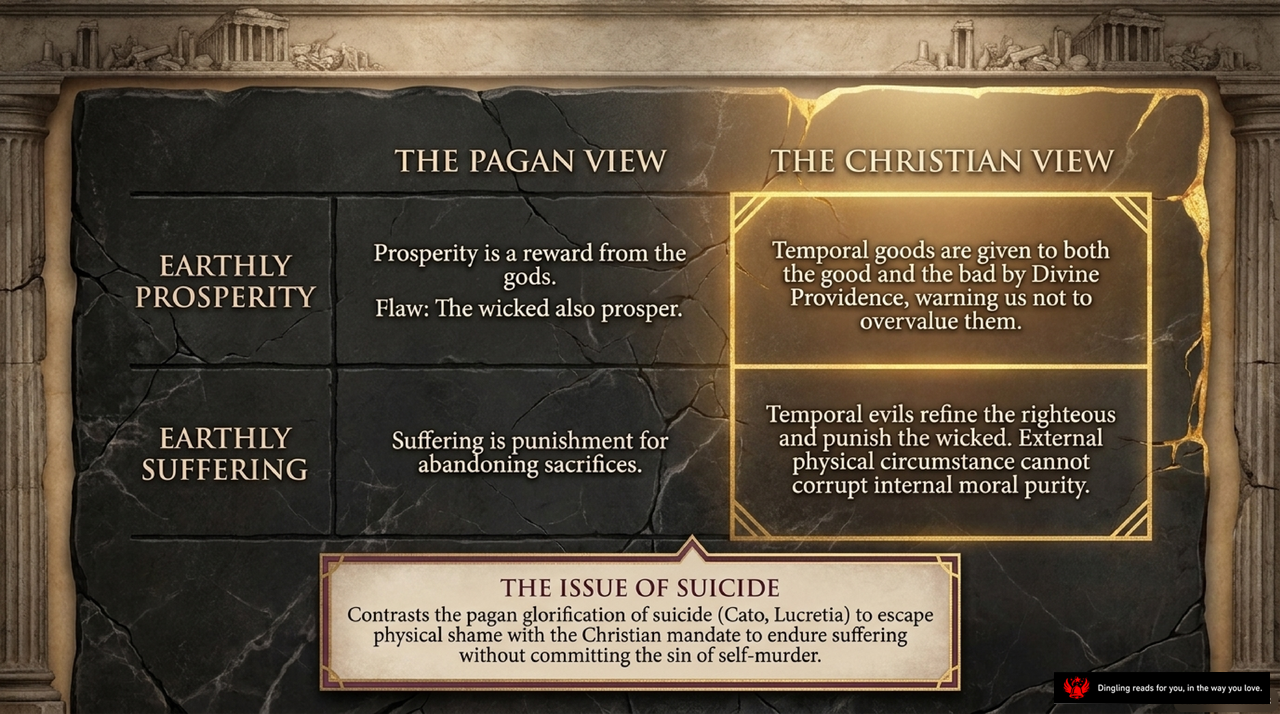
Let’s dive into how pagans and Christians view life’s highs and lows—including a critical take on suicide.
When it comes to earthly prosperity, pagans saw it as a straight-up reward from the gods. But here’s the catch: even the wicked often flourished. That was a gaping hole in their belief system. Christians, by contrast, believe both good and bad people get temporary blessings. Why? Divine Providence uses these gifts to remind us not to cling too tight to things that fade—because real value isn’t in what we own.
Suffering tells a similar story of contrast. Pagans blamed pain on skipping sacrifices or angering the gods. But Christians see suffering as dual-purpose: it sharpens the righteous, making their faith deeper, and it serves as punishment for the wicked. The big truth here? Your inner moral purity isn’t tied to your external circumstances. No matter what happens to your body or your life, your soul’s integrity can stay unbroken.
Then there’s suicide. Pagans sometimes held it up as honorable—like Cato or Lucretia, who took their lives to escape shame. But Christians draw a hard line: suicide is self-murder, a violation of the commandment against killing. Enduring suffering is part of following Christ, and even if your body is harmed, your soul’s virtue remains if you refuse to give in to despair.
These differences aren’t just theoretical—they shape how you show up in the world. Pagans chased rewards from gods, while Christians focus on what lasts: their connection to God and the strength of their character.
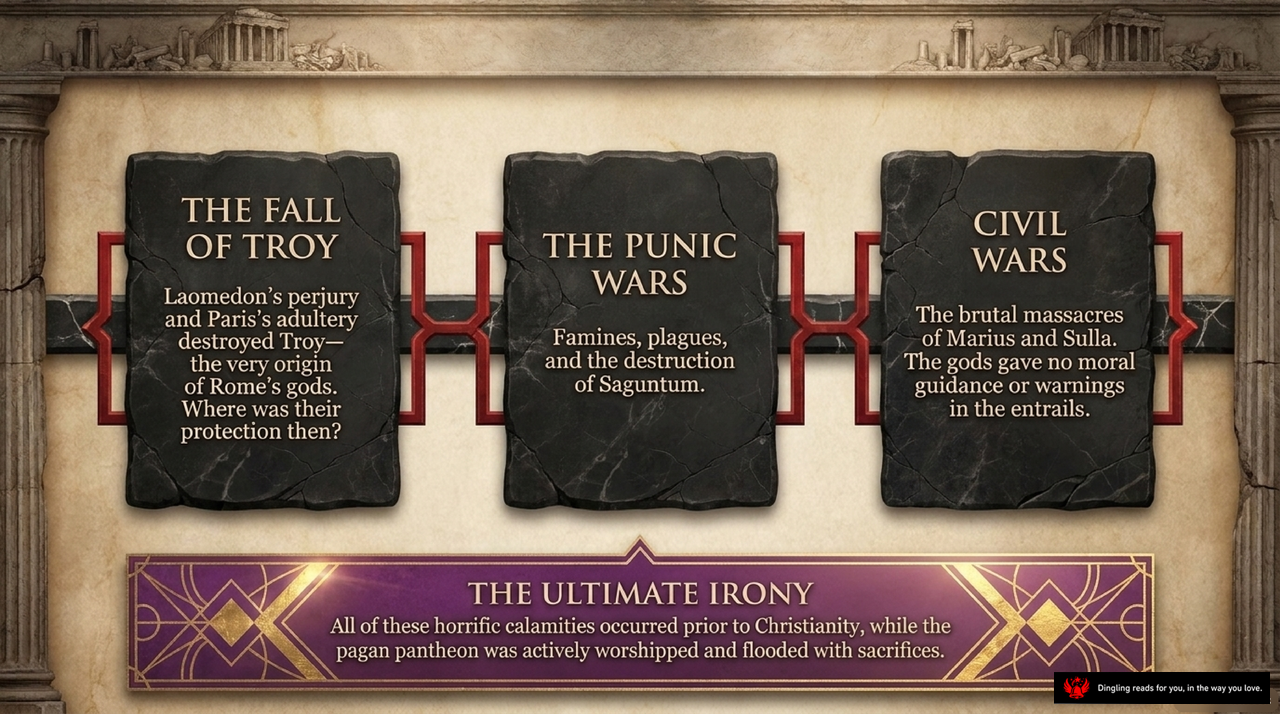
Let’s cut to the chase with the big reveal at the bottom here—The Ultimate Irony. Every single one of these catastrophic events? They unfolded long before Christianity ever took root. Back when Rome was drowning their pagan temples in sacrifices, bowing to every god they thought could shield them from harm. But did those gods step up? Let’s break it down.
First up: The Fall of Troy. Troy wasn’t just some random city—it was the supposed cradle of Rome’s very own gods. But Laomedon’s broken oaths and Paris’s reckless affair brought the whole place crashing down. Where were those gods then? The ones Rome would later pray to for protection—they couldn’t even save their own origin story.
Next, the Punic Wars. Famine that starved whole populations, plagues that wiped out villages, the total destruction of Saguntum. These weren’t minor setbacks; they shook the foundations of the ancient world. But the gods? Silence. No help, no intervention.
And then the Civil Wars—Marius and Sulla’s brutal massacres that turned Rome against itself. Back then, pagans relied on reading animal entrails to get divine guidance. But during these blood-soaked times? No moral direction, no warnings. Nothin’.
So here’s the kicker: All this suffering happened when Rome was fully, unapologetically committed to their pagan pantheon. They gave sacrifices, performed rituals, did everything they thought would keep the gods smiling. But the gods didn’t protect them. That’s the ultimate irony—worshipping beings that couldn’t even prevent the worst from happening. It makes you ask: If those gods couldn’t save Troy, stop plagues, or end civil war… what good were they really?
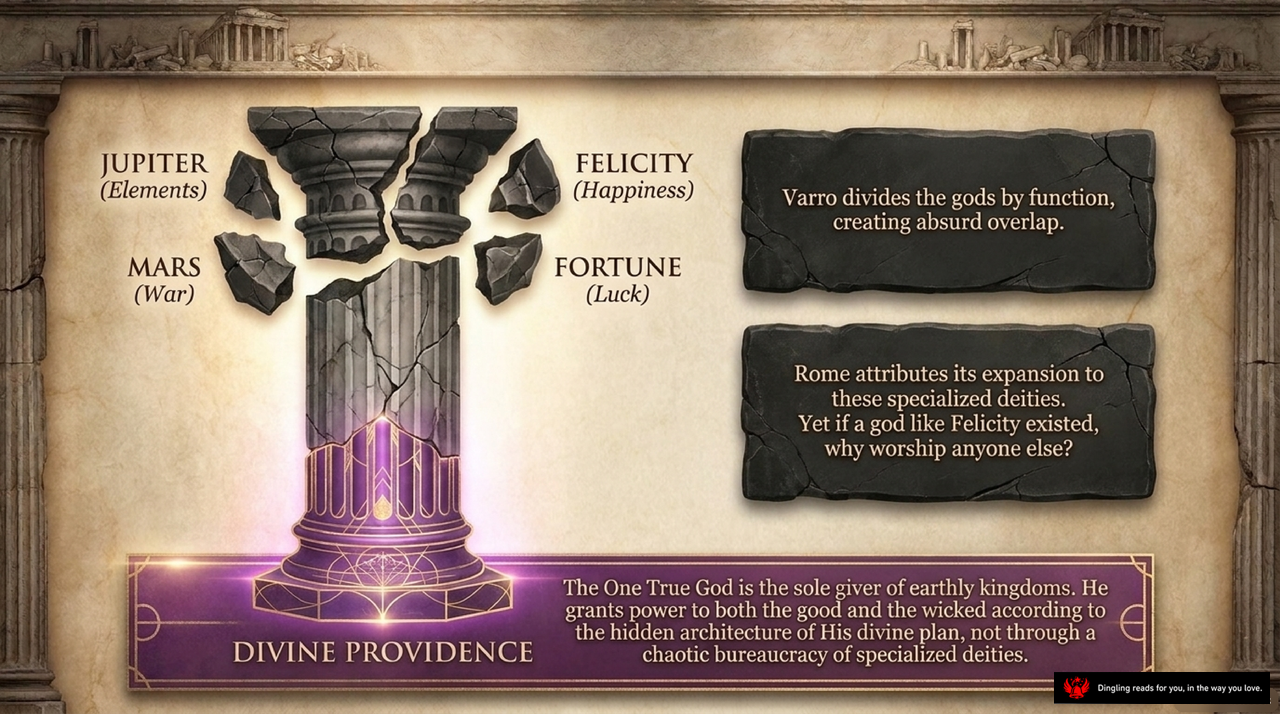
Take a look at this slide—there’s a broken column surrounded by names like Jupiter (Elements), Mars (War), Felicity (Happiness), and Fortune (Luck). These are the specialized deities Roman scholar Varro wrote about. He split gods up by their functions, but as the slide points out, that created absurd overlaps.
Rome used to attribute its expansion to these specialized gods. But here’s the question: if a god like Felicity exists—one that’s supposed to give happiness—why would anyone worship any other deity? It’s a contradiction, right?
The real story is this: The One True God is the sole giver of earthly kingdoms. He grants power to both good and wicked people according to His hidden divine plan, not through some chaotic bureaucracy of specialized deities.
Rome’s growth wasn’t because of Mars or Jupiter. Early Romans were driven by a desire for glory and put the public good above their own. But even that was part of God’s bigger plan. Those specialized gods? They’re just a distraction. They can’t offer real happiness or lasting power. Only the One True God is in control of nations, working everything out for His purpose.
So when you see a bunch of gods with tiny, specific jobs, remember—there’s only one all-powerful Creator who holds every part of the world in His hands. No need for a messy team when you have the One who made it all.
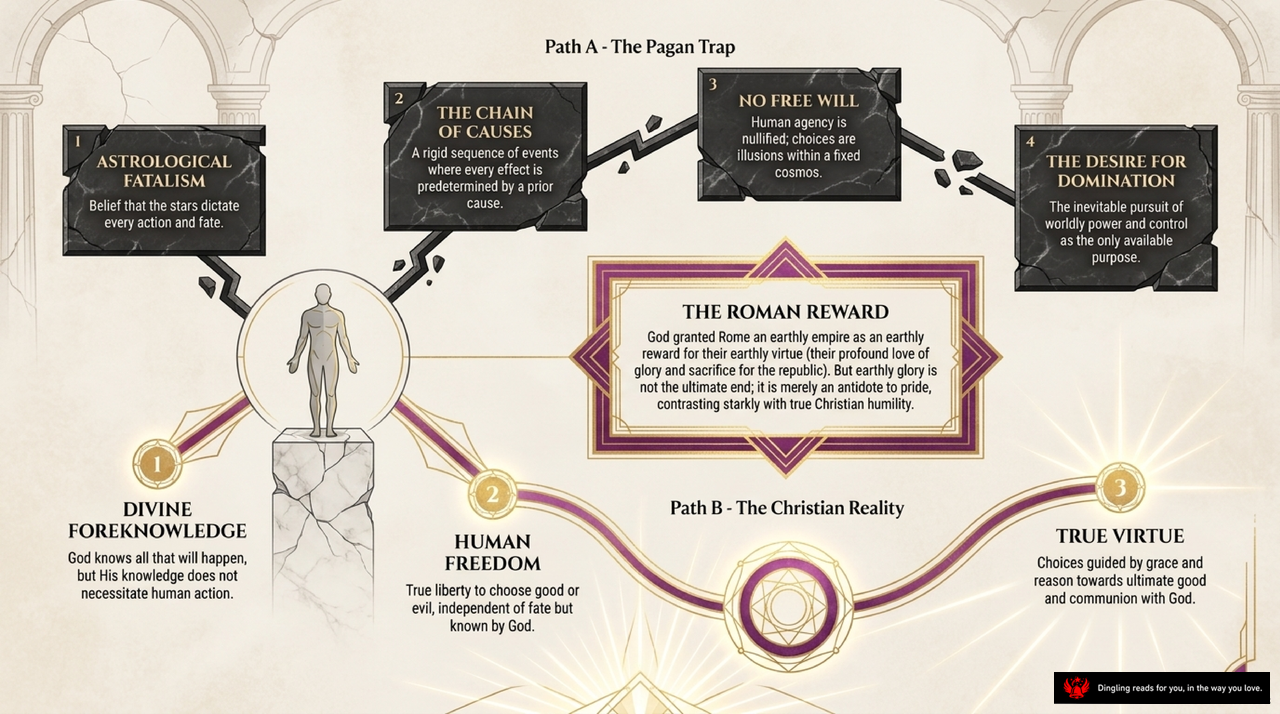
Let’s break down these two paths we see here—Path A is the pagan trap, and Path B is the Christian reality, and they couldn’t be more different.
Starting with Path A: It begins with astrological fatalism—this idea that the stars hold all the cards, dictating every action and our ultimate fate. From there, you get the chain of causes: a rigid, unbreakable sequence where every event is predetermined by something that came before it. No free will here—our choices are just illusions, fixed by the cosmos. And what’s the end result? The desire for domination—chasing worldly power and control like it’s the only thing that matters, because if you can’t control your own fate, at least you can control others.
Now Path B: Let’s contrast that with divine foreknowledge—God knows everything that will happen, but here’s the key: His knowledge doesn’t force our actions. We still have human freedom—true liberty to choose good or evil, independent of fate, even though God sees every choice we’ll make. This leads to true virtue: choices guided by grace and reason, aimed at the ultimate good and deep communion with God.
And what about Rome? The Roman reward box tells us God granted Rome its empire as an earthly prize for their love of glory and sacrifice for the republic. But that earthly glory isn’t the final goal—it’s just an antidote to pride, a stark contrast to the humility that defines true Christianity.
So the pagan path traps you in a cycle of helplessness and power hunger, while the Christian path offers real freedom and a purpose that goes beyond the temporary things of this world. It’s a choice between being a pawn in a fixed system or a free agent called to something greater.
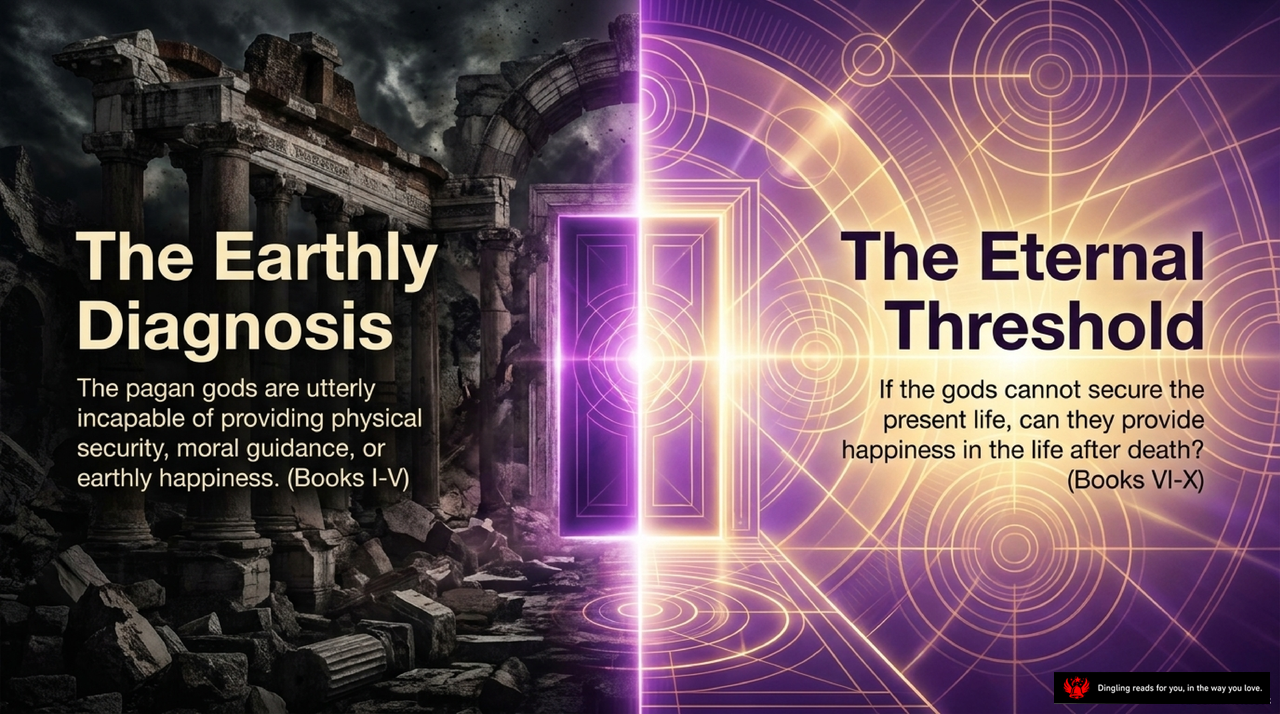
Let’s split this into two parts—first, the Earthly Diagnosis from Books I to V. The big takeaway here? Those pagan gods you’ve heard about? They can’t even handle the basics of life here on earth. Think about the 410 sack of Rome: when Goths stormed the city, where did people find safety? In Christian churches, where no one was harmed or taken captive. Pagan temples? They never had that kind of refuge tradition—if anything, they were often sites of violence: Greeks looted Troy’s temples, Romans ransacked their own during the Catiline conspiracy, and even the gods couldn’t protect their own home base (Troy fell, same deities and all). So if they can’t keep you safe, guide you to do the right thing, or make you happy here and now… what makes anyone think they can help with the afterlife?
That’s exactly the question we dive into in Books VI to X—the Eternal Threshold. If these gods fail at the present, how can they deliver happiness beyond death? Let’s be real: their rituals are a mess. Take the Great Mother’s worship—people cutting themselves, even castrating themselves to please her. Or the festivals with vulgar songs and symbols that would make any decent person cringe. And Varro, that famous Roman scholar, listed all these gods for every tiny life event—from conception to old age—but not one of them can give you immortality. That’s the kicker, right? The thing we all really crave—eternal life—isn’t something they can offer. So why waste time on gods that can’t cover the here and now, let alone the forever?
This split helps us see the core issue: if the gods can’t secure your present life, there’s no way they can promise you happiness in the life after death. It’s time to ask: what’s the alternative to these failing deities? That’s where the rest of our journey goes—toward finding the one who can actually deliver on both earth and eternity.
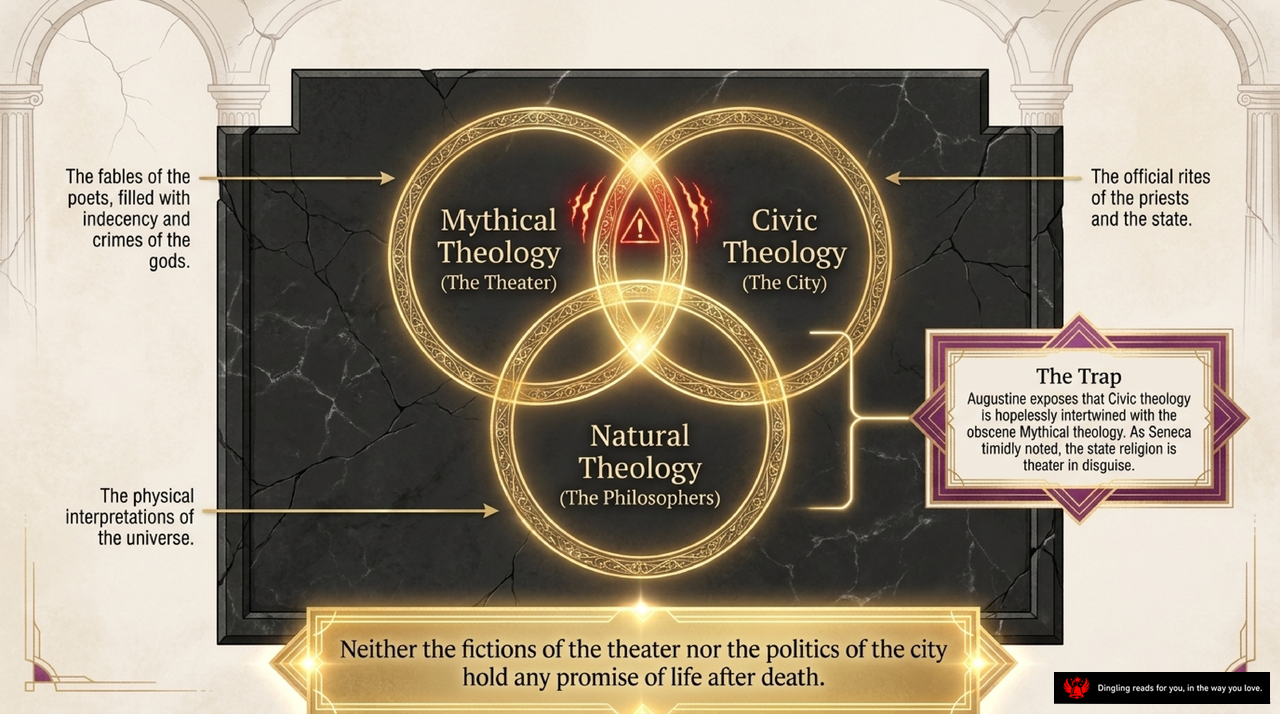
Let’s take a look at this slide—three overlapping circles, each showing a different way ancient Romans approached the divine. First up: Mythical Theology, the stuff from poets, full of gods doing all kinds of messed-up things—adultery, theft, even worse. Then there’s Civic Theology: the official state rituals, the ones priests ran to keep the city in line. And Natural Theology? That’s the philosophers’ angle, trying to explain the universe through physical rules.
But here’s the trap Augustine calls out: Civic Theology is hopelessly tangled with Mythical. Seneca even said the state religion was just theater in disguise. Think about it—those same gods they worshipped in formal ceremonies were the ones poets mocked for their chaotic lives. How could you take that seriously?
The book dives into how absurd this all was. The Romans had gods for every tiny thing—planting seeds, feeding babies—but none of them could give you eternal life. They tried to make it sound deep with naturalistic explanations, like saying Saturn eating his kids was a metaphor for seeds going back to the earth. But let’s be real—that’s a stretch. And the rituals? They were wild: Liber’s ceremonies had people parading with crude symbols, and the Great Mother’s priests would even castrate themselves. These weren’t about holiness; they were about satisfying some dark, primal urges.
And the slide’s bottom line hits it right: neither the theater’s made-up stories nor the city’s politics can promise you life after death. All those rituals and myths were just chasing temporary wins—war victories, good harvests. But when it came to the big question, “What happens when I die?” the Roman gods had nothing to offer. That’s why Augustine was so critical—they were missing the whole point of faith: finding something that lasts forever.
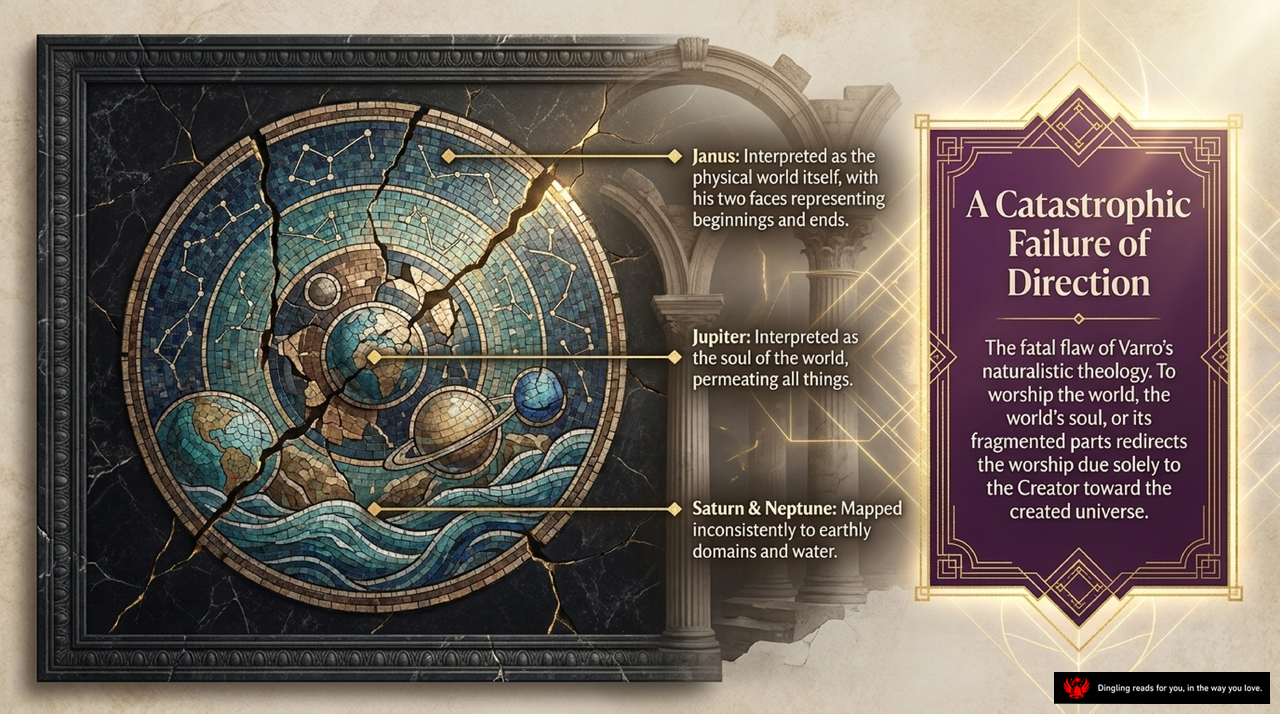
Let’s dive into the catastrophic failure of direction at the heart of Varro’s naturalistic theology.
Varro tried to tie Roman gods to the natural world: Janus wasn’t just a two-faced deity—he represented the physical world itself, his dual faces symbolizing every beginning and end we see around us. Jupiter? Not just a sky god—Varro claimed he was the world’s soul, the force that permeates every living thing, every rock, every breath. Then there were Saturn and Neptune, mapped to earthly domains and water—but Varro’s mapping was messy, inconsistent, like trying to force pieces of a puzzle that don’t fit.
But here’s the fatal mistake: Varro’s approach redirected worship from the Creator to the created. Instead of looking to the one who made the world, he told people to worship the world itself, its soul, or its fragmented parts. That’s like staring at a painting so intently you forget the artist who painted it.
Think about it: if Jupiter is the world’s soul, he’s just part of the creation—not the one who brought it into existence. Janus as the physical world? That’s the thing God made, not God himself. Saturn and Neptune’s inconsistent roles reveal how Varro stretched to make his framework work, but it crumbled under its own contradictions.
Varro mixed up the creator and the created. The world is a masterpiece, but it’s not the master. The soul animating it is a gift, not the giver. By leading people to worship these parts of creation, Varro steered them away from the true source of all good—God. That’s the catastrophic failure: he pointed people to the creation instead of the Creator, a direction no one should follow.
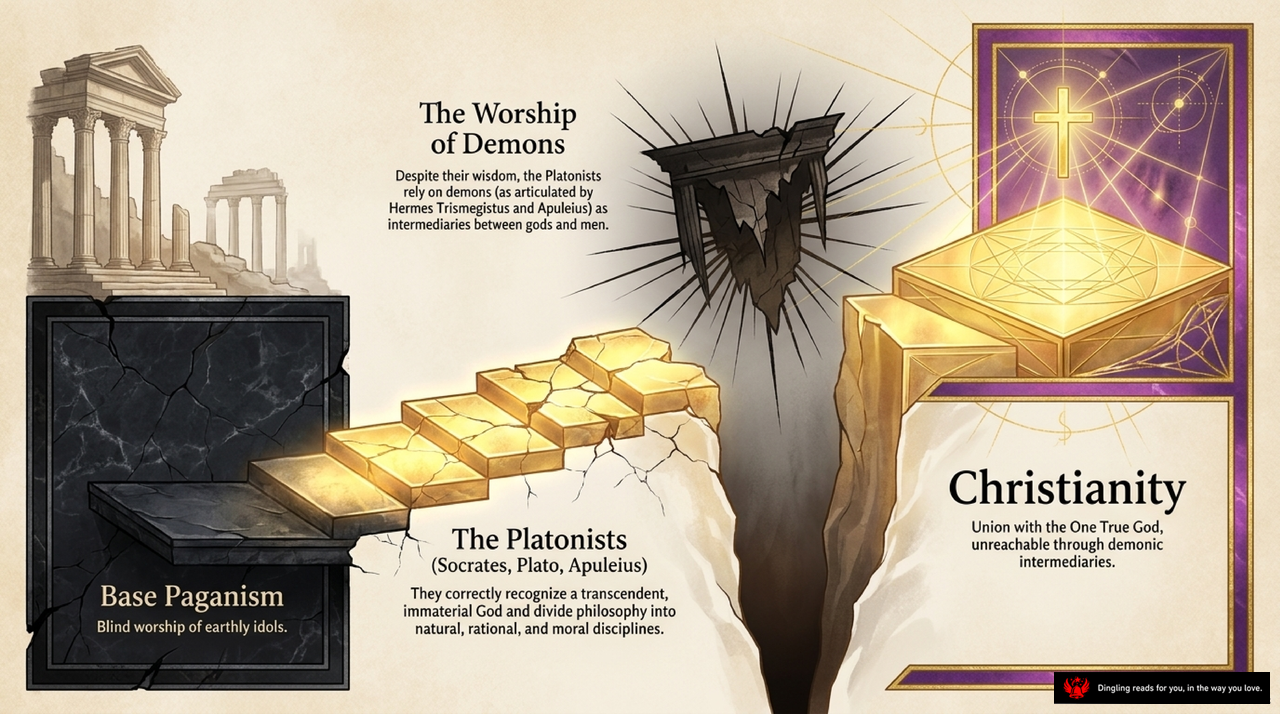
Let’s dive into a big question from Book IX: Is there any such thing as a “good demon” that can act as a middleman between God and us? The old Platonists thought so—they saw demons as this bridge between the divine and human worlds. But Augustine’s here to set the record straight: all demons are evil, and here’s why.
Apuleius, a philosopher Augustine references, defined demons as having immortal, airy bodies but souls full of human-like passions—pity, joy, anger, all the messy stuff. The catch? These demons can’t control those emotions. Imagine being stuck forever with feelings you can’t rein in—total, endless misery. How’s someone that chaotic supposed to guide you to God? They’re too busy being ruled by their own wild desires.
Angels are the opposite. They don’t have those unruly passions. Their actions are pure, driven by reason and God’s will. They don’t crave worship—they just point us straight to the Father.
But the real hero here is Christ. He’s the only true mediator. He’s fully God (so he’s connected to the Father) and fully human (so he gets our struggles). He humbled himself, even dying on the cross, to break the devil’s hold on us. No demon could ever do that—they’re too proud, too trapped in their own darkness.
So forget the idea of demons as middlemen. Christ is the only bridge between us and God. He’s the one who made salvation possible, not some chaotic, passion-fueled demon. That’s the core truth Augustine wants us to grasp in Book IX. It’s not about finding some magical middleman—it’s about leaning into the one who already came down to meet us.
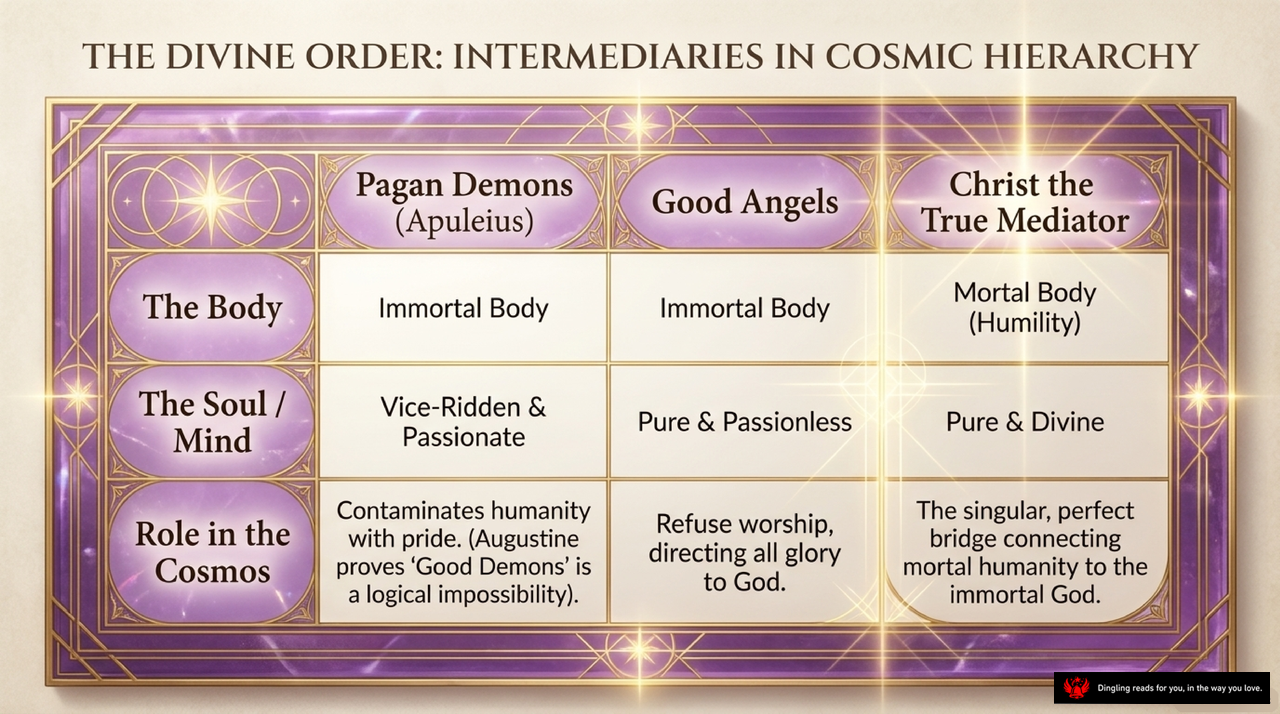
Ever wondered how we, as regular people, can connect to something as big and eternal as God? Today’s slide—The Divine Order: Intermediaries in Cosmic Hierarchy—breaks down three key players in that cosmic connection.
First, let’s talk about pagan demons, as Apuleius described them. They’ve got immortal bodies, but their souls are all tangled up in vices and passions. What do they do? They mess with us, filling us with pride. And Augustine? He called out the idea of a “good demon” as total nonsense—like saying a fire can be cold. If something’s driven by self-serving passions, it can’t help us get closer to the divine.
Next up: good angels. They also have immortal bodies, but their souls are pure—no messy emotions clouding their judgment. Here’s the thing about them: they don’t want our worship. They point every bit of glory straight back to God. Think of them as humble messengers, never trying to steal the show.
But the real star here is Christ, the true mediator. He’s nothing like the others. He chose a mortal body—humbling Himself to walk among us. His soul is pure and divine, so He’s the only one who can truly bridge the gap between us mortal humans and the immortal God. He’s not just some middleman; He’s the singular, perfect bridge. No one else can do what He does—connect heaven and earth because He’s part of both.
So when we think about reaching the divine, it’s not about chasing flawed demons or even putting angels on a pedestal. It’s all about Christ, the one who came down to us to make that connection possible.
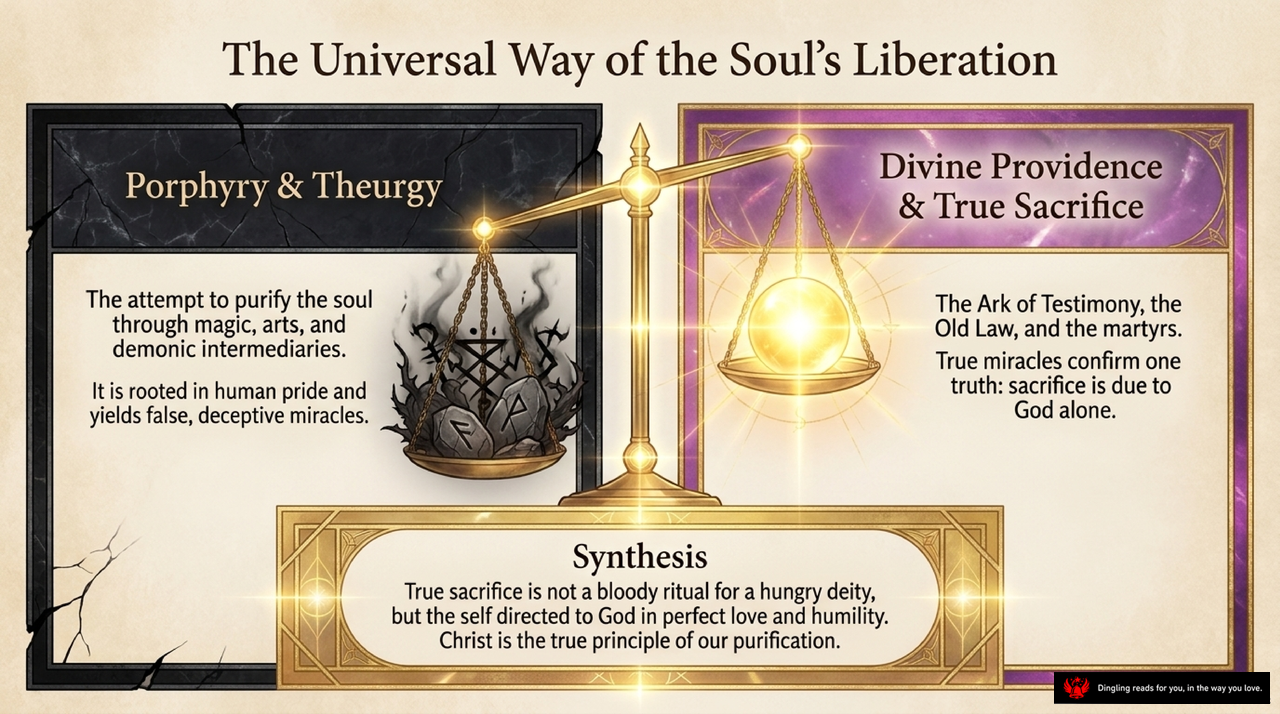
Let’s take a look at the two paths to soul liberation laid out here. On the left, we have Porphyry & Theurgy—this approach claims we can purify our souls through magic, arts, and demonic middlemen. But as the text says, it’s rooted in human pride and leads to fake, deceptive miracles. Think about it: relying on demons to get closer to the divine? That’s like asking a thief to guard your most precious treasure—you’re setting yourself up for betrayal.
On the right side, Divine Providence & True Sacrifice points to the Ark of Testimony, the Old Law, and martyrs. Real miracles confirm one truth: sacrifice belongs only to God. This isn’t about performing rituals to appease a hungry deity—it’s about aligning our hearts with something greater than ourselves.
The scale in the middle shows the weight of these two paths: one side is heavy with empty tricks and pride, the other glows with divine light and truth.
And the synthesis at the bottom sums it all up perfectly: True sacrifice isn’t a bloody ritual for a greedy god. It’s turning our selves toward God with perfect love and humility. And Christ? He’s the true principle of our purification. He’s the only mediator who can bridge the gap between us and the divine—breaking the devil’s hold, washing away our sins with His sacrifice, and leading us to real liberation. No magic, no demons—just a humble, loving turn toward the one who created us. That’s the universal way of the soul’s liberation.
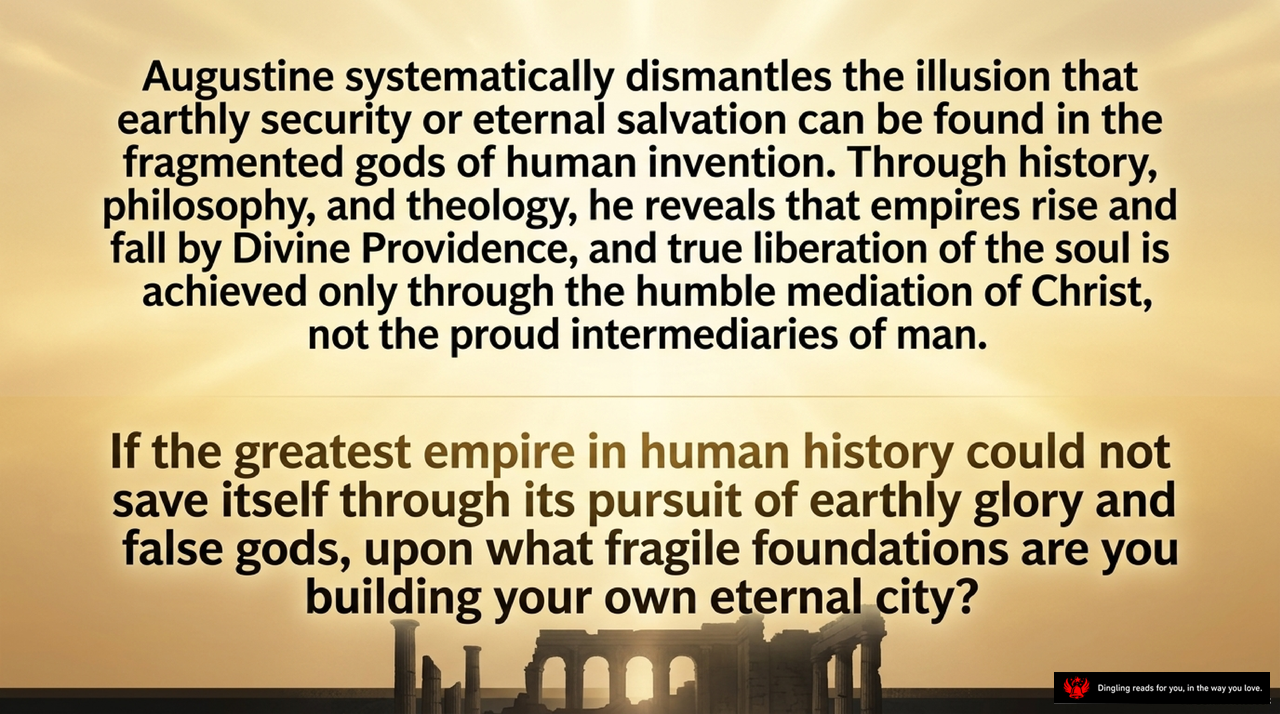
Let’s be real—we all crave security, right? We chase jobs that promise stability, status that makes us feel seen, or even beliefs that we think will guarantee us a spot in something bigger. But Augustine’s got a sharp wake-up call for us here. He systematically dismantles that illusion that any of these human-made, fragmented things—whether it’s Rome’s old pantheon of gods or our modern-day “idols” like money or fame—can give us true earthly security or eternal salvation.
Think about Rome, the greatest empire of its time. They built grand temples, worshipped countless gods, and chased earthly glory like it was the key to forever. But Augustine points out through history, philosophy, and theology that empires rise and fall not because of their own might, but by Divine Providence. Those false gods? They were just human inventions—proud, self-serving, and totally unable to save anyone from the inevitable.
And here’s the gut-punch question from the slide: If Rome, with all its power and glory, couldn’t save itself using those false gods and earthly pursuits, what fragile foundations are we building our own “eternal city” on? Are we relying on things that can crumble tomorrow—our bank accounts, our social media following, even our own good deeds?
Augustine doesn’t leave us in despair, though. He tells us true liberation of the soul isn’t found in those proud human intermediaries (like the false gods or even people who claim to have all the answers). It’s found in the humble mediation of Christ. Unlike those fragmented, self-serving gods, Christ is the real deal—He’s the bridge between us and God, not because He’s proud, but because He humbled Himself to the point of death to save us.
So let’s pause and ask ourselves today: What foundations are we laying for our eternal future? Are they as fragile as Rome’s, or are we building on the solid rock of Christ? Because at the end of the day, only what’s rooted in Him will stand the test of time. We don’t need to chase fragmented illusions—we just need to trust the one who offers true, lasting security. That’s the hope Augustine wants us to hold onto.