
The Coaching Habit: Complete Chapter-by-Chapter Summary
Welcome to a journey that will fundamentally change how you lead. In a world overflowing with leadership books and coaches, finding something that actually works is rare. Most managers are trained to give advice, but true leadership is about asking better questions.
This slide introduces our core theme: The Coaching Habit by Michael Bungay Stanier. The mission is simple yet powerful: Say less, ask more, and change the way you lead forever.
Think about your typical day. You're likely stuck in one of three traps. First, over-dependence, where your team waits for your every decision. Second, burnout, as you get buried in trivial tasks. Third, losing sight of what truly matters. The solution isn't more advice or longer meetings. It's a shift in habit. By mastering just seven essential questions, you can unlock your team's potential and free yourself from the chaos.
This isn't about a special training session; it's about making coaching your daily instinct. When you stop rushing to fix things and start asking the right questions, you transform from a bottleneck into a catalyst for growth. Let's dive into how to turn this simple shift into your new superpower.
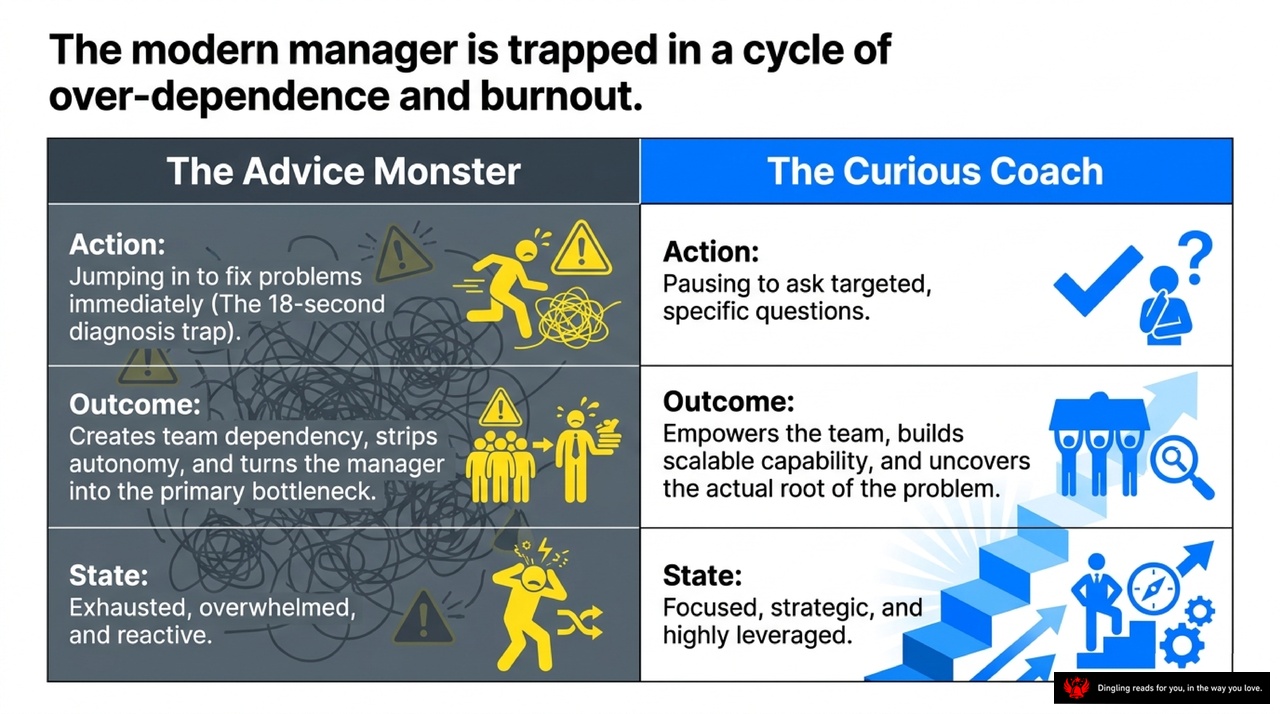
The modern manager is often trapped in a vicious cycle of over-dependence and burnout. Look at this slide: on the left, we have "The Advice Monster." This is the classic trap where you jump in immediately to fix problems, creating a tangled mess of dependency. The outcome? You become the team's primary bottleneck, stripped of autonomy, while your state is exhausted and reactive.
But on the right, we see the alternative: "The Curious Coach." Instead of rushing to fix things, the real power move is pausing to ask targeted, specific questions. This simple shift transforms the outcome. You empower the team to build scalable capability and uncover the actual root of the problem. Your state changes from overwhelmed to focused, strategic, and highly leveraged.
This isn't just about being nicer; it's about efficiency. By switching from giving advice to asking questions, you break the cycle where you are the only one who knows the answers. You stop being the bottleneck and start building a team that can solve problems on its own. The goal is to move from being a "fixer" who burns out, to a "coach" who multiplies your impact.
Imagine your team member walks in, eyes wide, listing a dozen problems like a broken record. Project delays, office politics, budget cuts, traffic jams. It feels like an avalanche, doesn't it? You're ready to grab the biggest rock and smash it, but here's the trap: you're likely solving the wrong problem.
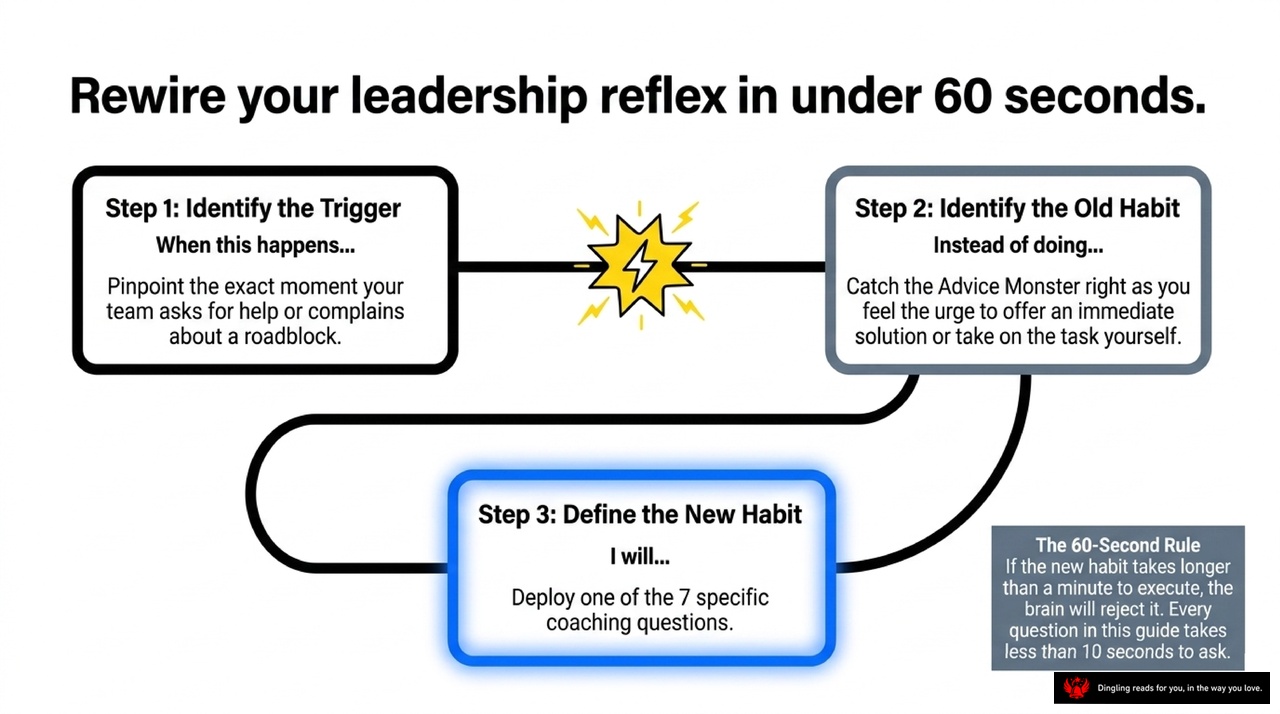
This slide outlines a powerful three-step loop to rewire your leadership reflex in under 60 seconds. First, you must identify the trigger. That exact moment when your team dumps their chaos on you. Instead of diving straight into a solution, catch yourself before the "Advice Monster" takes over. Stop the urge to fix it immediately.
Now, step into the third box. Define your new habit. Instead of acting as the hero who saves the day, ask one simple, game-changing question: "What is the real challenge you are facing?" This shifts the dynamic instantly. You stop being the firefighter and start being the coach. You help them distinguish between the noise and the signal, guiding them to find the core issue themselves.
By practicing this loop, you break the cycle of over-dependence and burnout. You give your team the space to think, and you reclaim your time for what truly matters. It's not about having all the answers; it's about asking the right questions that unlock real growth.

What's on your mind? This isn't just a greeting; it's the single most powerful tool for unlocking real conversations. When you ask this, you instantly cut through the noise of small talk and bypass the trap of assuming you know what the other person needs. Instead, you hand them the microphone, inviting them to share what truly matters to them right now.
But once they start talking, how do you keep the conversation from spinning in circles? That's where our 3P framework comes in. As you see on the screen, every meaningful interaction sits at the intersection of three circles: Project, People, and Pattern. The Project circle covers the technical execution and surface-level tasks. The People circle digs into the underlying relationship dynamics and friction between you. And the Pattern circle targets the behavioral habits and systemic loops that are causing that friction.
Most managers get stuck in the Project circle, fixing tasks without developing people. But true leadership happens when you use this question to pivot the conversation. If they mention a project delay, you can gently ask, "Do you want to talk about the project, the people involved, or the pattern of behavior causing this?" This simple pivot moves you from being a firefighter putting out fires to a coach developing capabilities. It shifts the focus from "what is wrong with this task" to "what is wrong with how we are working together." By anchoring the conversation in these three dimensions, you ensure that every interaction drives both immediate results and long-term growth.

Have you ever found yourself making a decision based on the very first option that came to mind? We often do this without realizing it, settling for the first answer as if it were the only one, or certainly the best one. But the data tells a different story. Research shows that business decisions made with a simple Yes or No binary approach fail half the time. However, the moment you introduce just one more viable option, that failure rate drops significantly to 30%.
This is exactly what the slide illustrates. The first answer someone gives is rarely the complete picture, and it is seldom the optimal solution. By asking "And what else?", you force the conversation to expand beyond that initial, often limited, thought. This simple question acts as a powerful lever for better decision-making, helping you uncover hidden risks, alternative strategies, or insights that the first instinct missed.
The rule of thumb is clear: ask this question three to five times. It is the ultimate tool for taming your inner "Advice Monster," preventing you from rushing to a conclusion before all the data is in. It forces you to remain quiet, listen deeply, and explore the full landscape of possibilities before committing to a path. Don't settle for the first answer; dig deeper. Ask, "And what else?" until you've truly exhausted the options.

What's the real challenge here for you?
Look at this iceberg. On the surface, we see a pile of complaints: too many priorities, missed deadlines, overwhelmed teams, broken processes. It feels like everything is wrong at once. But here's the hard truth: those are just symptoms. They are the tip of the iceberg.
The real problem, the deep level, is hidden underneath. It's not about the specific tasks failing; it's about the core challenge that is driving all of them. If you try to fix every surface complaint without finding that core, you'll just be putting out fires forever.
That is why Question 3 is so critical. We need to ask, "What's the real challenge here for you?" Notice the words: "for you." This is the anchor. It stops us from talking in abstracts about company culture or blaming other departments. Instead, it forces personal accountability. It shifts the focus from "what's wrong with the world" to "what is your specific hurdle right now?"
When a team member dumps a dozen interconnected complaints on you, your job isn't to solve them all immediately. Your job is to ask this one question to help them find the single most important thing to tackle. By focusing on their personal core challenge, we break the cycle of overwhelm and start moving toward real solutions.
Have you ever felt like you're drowning in a sea of questions? Imagine driving through a chaotic roundabout in Paris with twelve roads converging, your heart racing, and every car from every direction asking you a question at once. You have no time to think, no space to respond, and by the time you stop, you've been completely overwhelmed. That's exactly how many of us feel when we lead: we fire off one question after another, desperate for answers, only to leave our team confused, stressed, and unable to think.
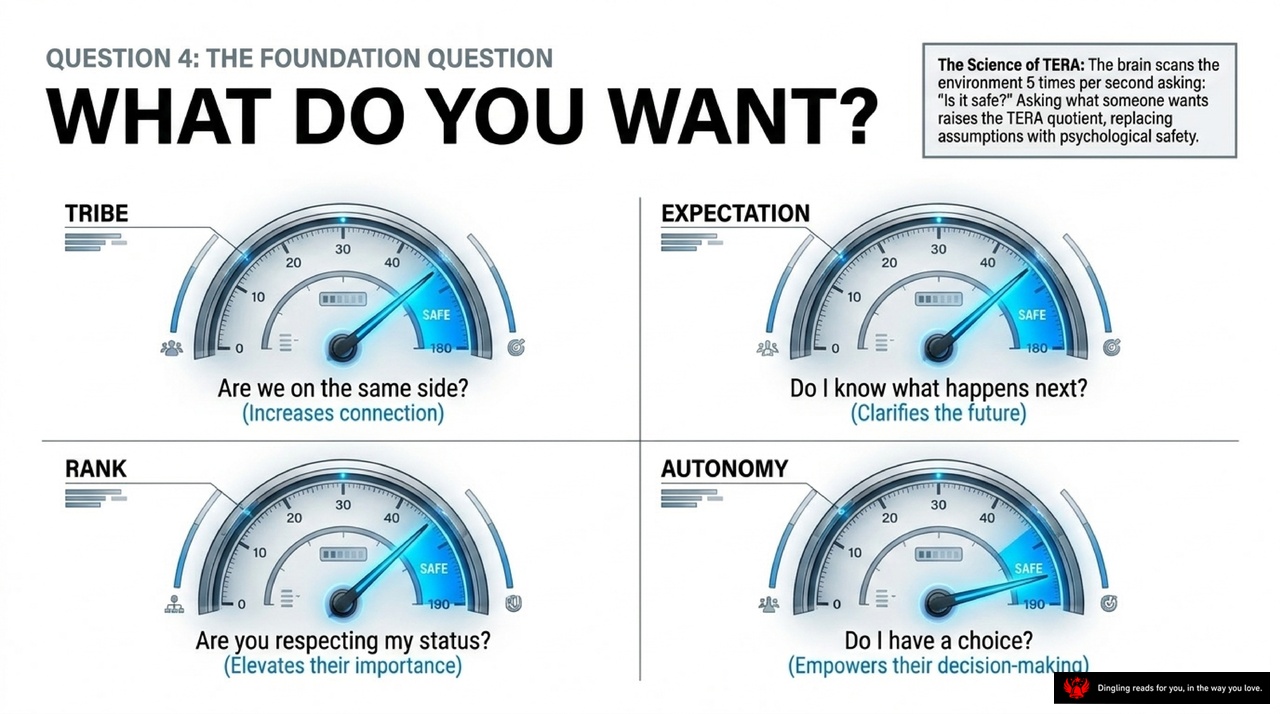
To break free from this chaos, we need to master a simple but powerful habit: ask only one question at a time. When you ask, "What do you want?", and then simply stop talking, something magical happens. You aren't just gathering data; you are creating psychological safety. Think about how your brain works—it's constantly scanning the environment, asking, "Is this safe?" When you ask someone what they want, you are signaling that their perspective matters. You are elevating their status and giving them autonomy. This boosts what we call the TERA quotient, replacing assumptions with trust and allowing your team to actually think and engage.
So, the next time you're in a meeting or a one-on-one, resist the urge to jump in with your own advice or the next question. Instead, ask, "What do you want?", wait three seconds, and then listen. Let the silence do the work. This small shift transforms you from a problem-solver into a thought-partner, empowering your team to find their own answers and helping you lead with clarity and confidence.

Imagine a workplace where everyone is trapped in a three-act play of suffering, blaming, and saving. This is the Karpman Drama Triangle, and it's likely where your team gets stuck every single day. Today, we're going to diagnose exactly which role you are playing right now.
Look at the first column: The Victim. This mindset screams, "My life is so hard, poor me." The behavior? Rejecting accountability and complaining just to attract a savior. The hidden cost? Absolute powerlessness and stagnation. You feel stuck, and everyone else feels stuck too.
Now, look at the second column: The Persecutor. Here, the mindset is, "Everyone around me is incompetent." The behavior involves micromanaging and tearing others down to build a false sense of superiority. The hidden cost? Paranoia, isolation, and deep resentment from your team. You might feel powerful, but you're actually creating a toxic environment.
Finally, look at the third column, highlighted in black: The Rescuer. This is the most dangerous trap for leaders. The mindset is, "Let me take over and fix this mess for you." The behavior? Jumping in to solve problems unprompted. But the hidden cost is crippling burnout for you, and the continuous creation of more Victims. Every time you rescue someone, you actually create a new dependency.
Most of us swing between these three roles without realizing it. The good news is that awareness is the first step to breaking free. Instead of playing these roles, your goal is to step out of the triangle entirely and become a coach who empowers others to find their own solutions.

Let's talk about the "Lazy Advantage." It sounds counterintuitive, right? But being lazy—specifically, resisting the urge to jump in and fix everything—is actually your superpower. As shown on this slide, asking "How can I help?" acts as your "escape hatch" out of the Rescuer role.
When you ask this, you force your counterpart to formulate a direct, concrete request instead of just complaining or dumping vague problems on you. This simple question stops you from blindly executing work you think they want, protecting your own bandwidth. More importantly, it forces them to take ownership of the solution. By being "lazy" enough to ask, you give them the space to think, which is exactly where real growth happens. Don't be the one who saves the day; be the one who asks the question that makes them the hero.

If you're saying YES to this, what are you saying NO to? This isn't just a rhetorical question; it's the core of strategic thinking. Look at the scale in the image: on one side, we have a single block labeled "GREAT WORK"—high-impact, meaningful execution. On the other side, a pile of "GOOD WORK"—routine, comfortable tasks that ultimately lead to stagnation. The insight here is profound: strategy is fundamentally about subtraction. A 'Yes' is meaningless without the boundary of a 'No'.
To protect that one block of Great Work, you must aggressively say no to the pile of Good Work. It's a hard trade-off, but necessary. Every time you commit your energy to a routine task, you are automatically saying no to a breakthrough opportunity. Use this question to force your team to acknowledge the space, energy, and resources a new commitment will consume. Are we really saying yes to the right things? Because if you're filling your plate with good work, you simply won't have the capacity to do the great work that actually moves the needle.
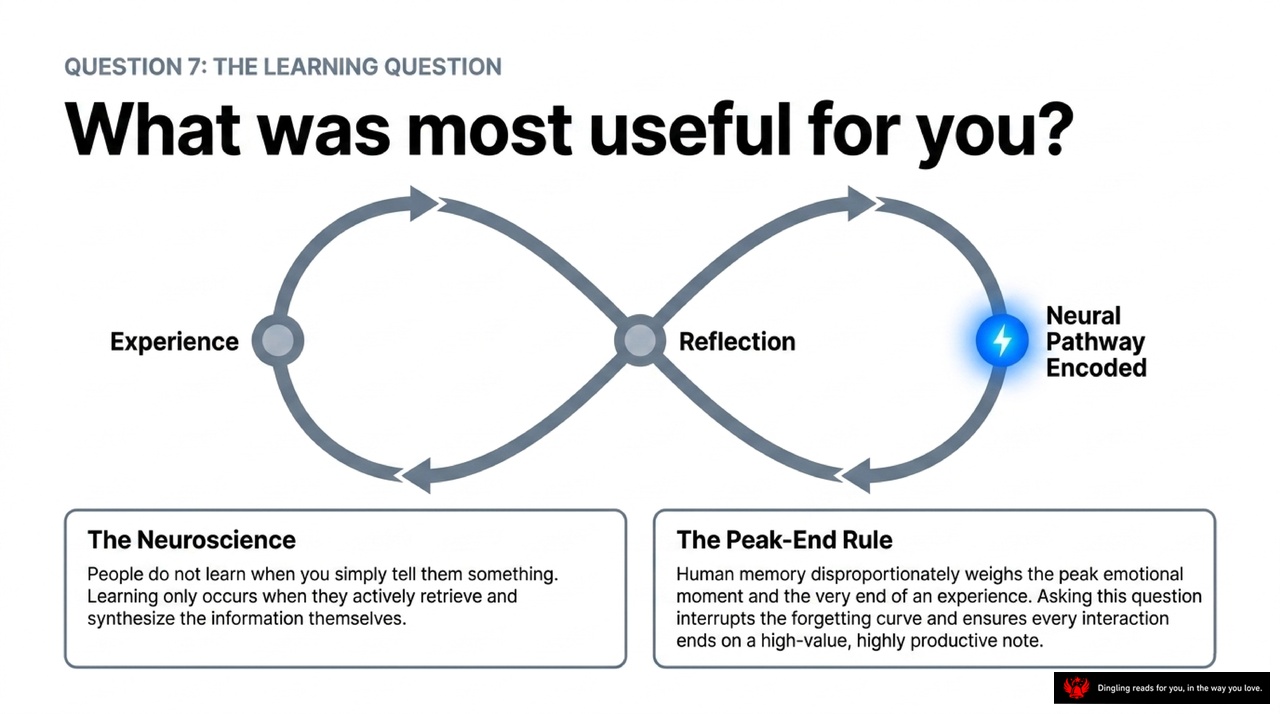
So, here is the big takeaway from our session: learning isn't something that happens when you simply tell someone something. Neuroscience tells us that real learning only occurs when people actively retrieve and synthesize the information themselves. That's why we've spent time on these specific questions—to force that active retrieval.
But there's another powerful psychological principle at play here, known as the Peak-End Rule. Our brains don't remember an entire experience evenly; we disproportionately weigh the most intense emotional moment and the very end of the interaction. If you leave a conversation without a strong, positive closing note, the whole experience gets discounted, and the learning fades.
That is exactly why we end every single interaction with the learning question: "What was most useful for you?" By asking this, you interrupt the forgetting curve. You ensure that the conversation ends on a high-value, highly productive note, locking that new neural pathway in place. So, remember: don't just solve the problem; make sure the other person learns from the process.

Look at this "10-Minute Master Flow." This isn't just a chart; it's your new operating system for leadership. It breaks down coaching into four distinct phases: Open, Deepen, Align, and Execute.
Let's walk through the journey. It starts with **Phase 1: Open**. We kick things off by pressurizing the room with a simple question: "What's on your mind?" Then, we deepen that connection by multiplying options with "And what else?" to uncover the real root of the challenge.
Next, we move to **Phase 3: Align**. Here, we stabilize the situation by asking, "What do you want?" and then help them escape the drama triangle by asking, "How can I help?" This shifts the focus from their problems to a strategic partnership. Finally, in **Phase 4: Execute**, we force the trade-off with a strategic question about what they are saying "no" to, and we close the loop by embedding the memory with a learning question: "What was most useful?"
The bottom line is clear: Coaching isn't a formal HR event. It is a fast, daily habit. By mastering these seven questions across these four phases, you stop being a bottleneck and start becoming a catalyst for your team's growth.
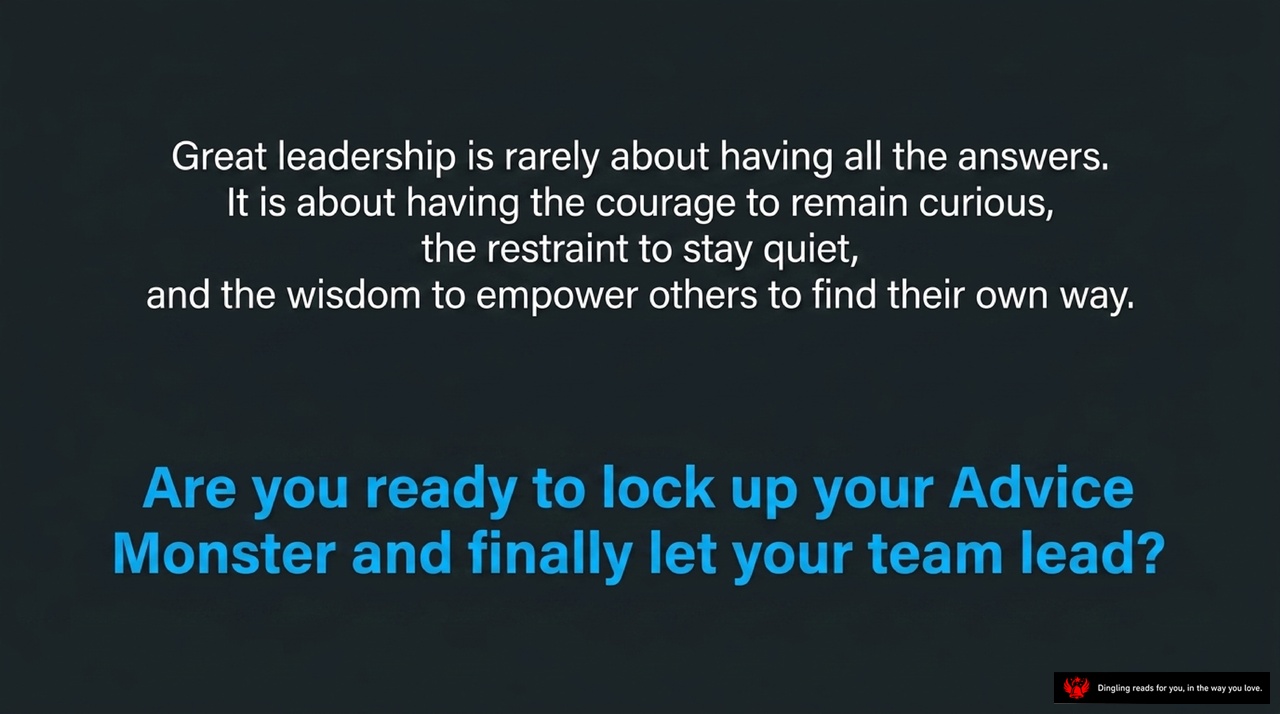
Great leadership isn't about having all the answers. It's about having the courage to stay curious, the restraint to stay quiet, and the wisdom to empower others to find their own way.
Think about it: when you constantly jump in with advice, you're actually training your team to be dependent. You become the bottleneck, drowning in their problems while they lose the chance to grow. But when you step back and ask the right questions, something powerful happens. You unlock their potential. You break the cycle of over-reliance and burnout.
So, are you ready to lock up your Advice Monster and finally let your team lead? The tools are right there in front of you. It's time to stop giving the answers and start asking the questions that matter.