
The Consolation of Philosophy: Complete Chapter-by-Chapter Summary
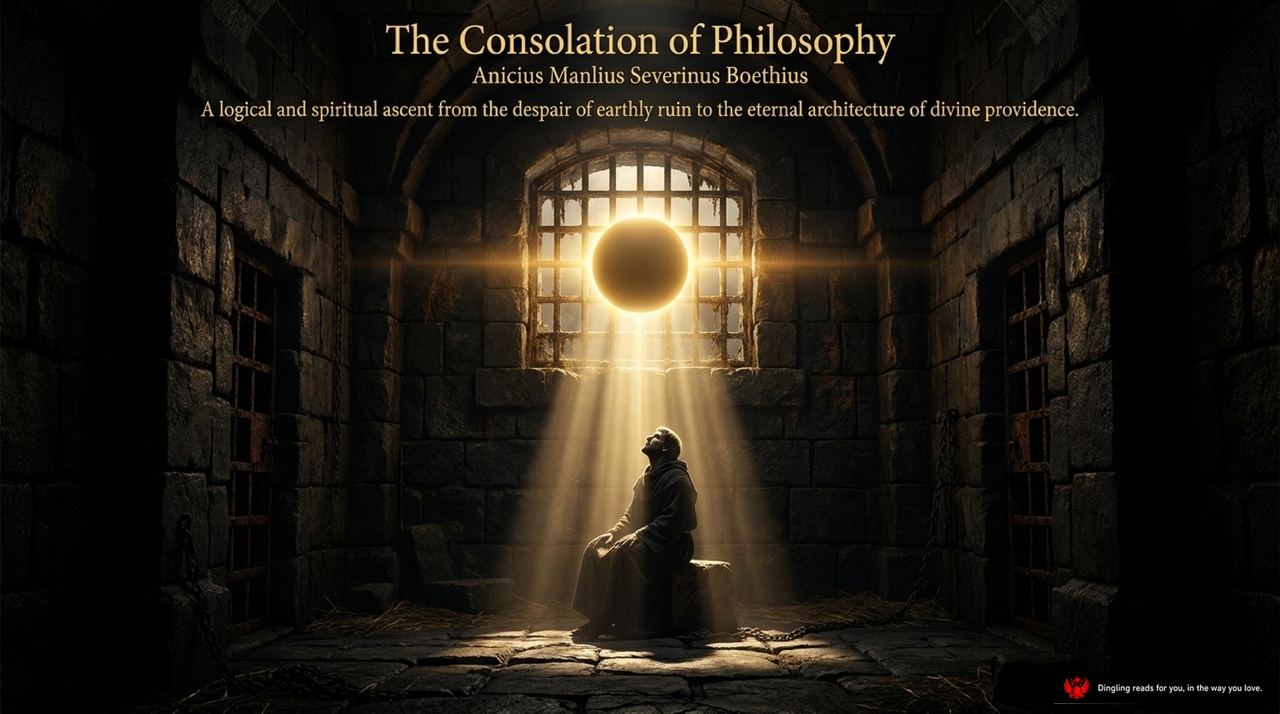
Welcome to the beginning of a journey that will change how you see suffering itself. This is Anicius Manlius Severinus Boethius's masterpiece, *The Consolation of Philosophy*. Look at this powerful image: a solitary figure in a dark, stone prison, looking up toward a single beam of light piercing through the bars. This visual perfectly captures the book's core promise: a logical and spiritual ascent from the despair of earthly ruin to the eternal architecture of divine providence.
Imagine being in this cell. You are Boethius, once a celebrated statesman and scholar, now stripped of everything. The text tells us he feels his soul has been drowned by dark waves, its original light extinguished, leaving him in total darkness. He laments that while he once roamed freely under the vast sky, chasing the stars and understanding their patterns, he is now chained, looking down at a dull, hard world with nothing to see but despair.
But here is the turning point. Just as the light breaks through the window in our image, philosophy arrives. She appears not as a distant goddess, but as a compassionate guide who sees your pain not as a punishment, but as a sickness of the soul. She tells you that your suffering comes from forgetting your true nature. You are mourning the loss of wealth, power, and honor, but she reveals a profound truth: these things were never truly yours to begin with. They were only borrowed from Fortune, who is inherently fickle.
She explains that true happiness isn't found in external circumstances that can be taken away. Instead, it resides within the immortal part of you, in your rational mind, which connects you to the divine. When you realize that your essence is good and eternal, you stop fearing the temporary storms of life. The light in the window isn't just hope; it is the realization that you have never been truly lost, only confused. This book isn't just about surviving tragedy; it is about discovering that the very things you feared losing were never the source of your happiness in the first place.
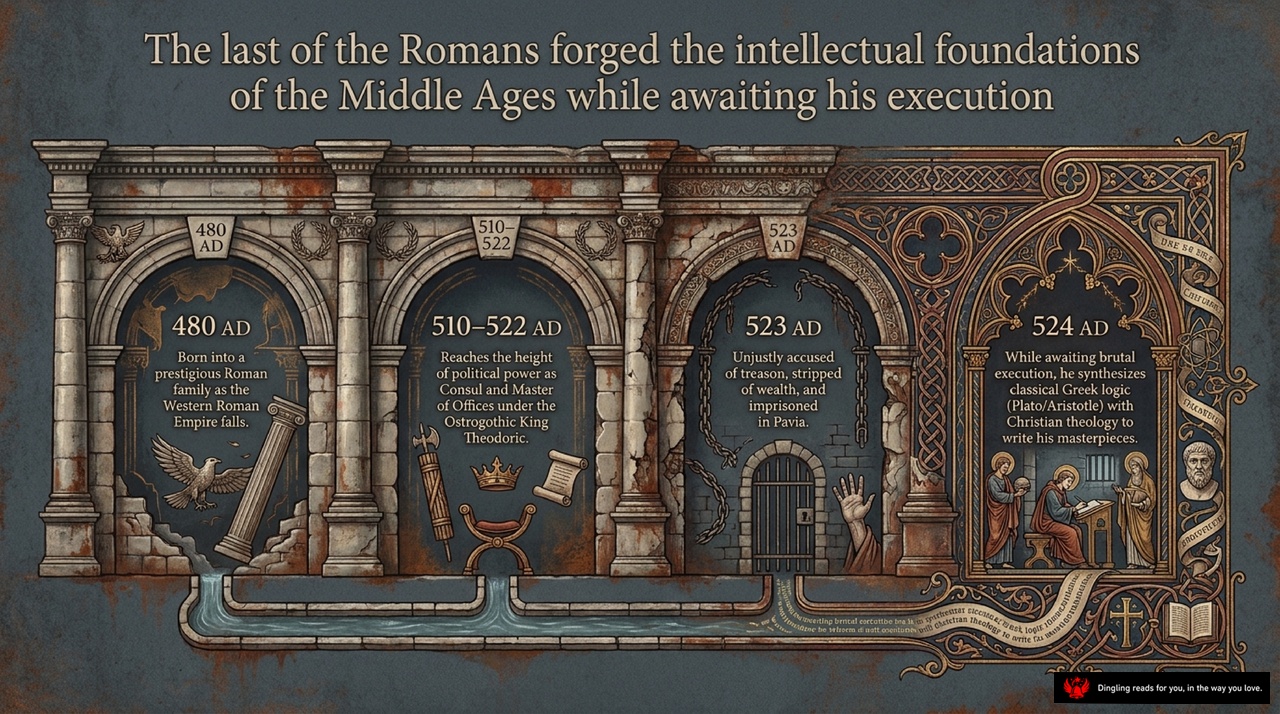
The last of the Romans, Boethius, forged the intellectual foundations of the Middle Ages while awaiting his execution. This timeline captures his tragic yet triumphant journey from a fallen empire to a spiritual rebirth.
It begins in 480 AD, born into a prestigious Roman family just as the Western Roman Empire falls. By 510 to 522 AD, he reaches the height of political power, serving as Consul and Master of Offices under the Ostrogothic King Theodoric. But fortune turns in 523 AD; unjustly accused of treason, he is stripped of his wealth and imprisoned in Pavia.
Yet, even in this darkest hour, his mind remained free. In 524 AD, while awaiting brutal execution, he synthesizes classical Greek logic with Christian theology to write his masterpieces. This image illustrates that while his body was confined by chains, his spirit transcended time, creating a legacy that would illuminate centuries to come.
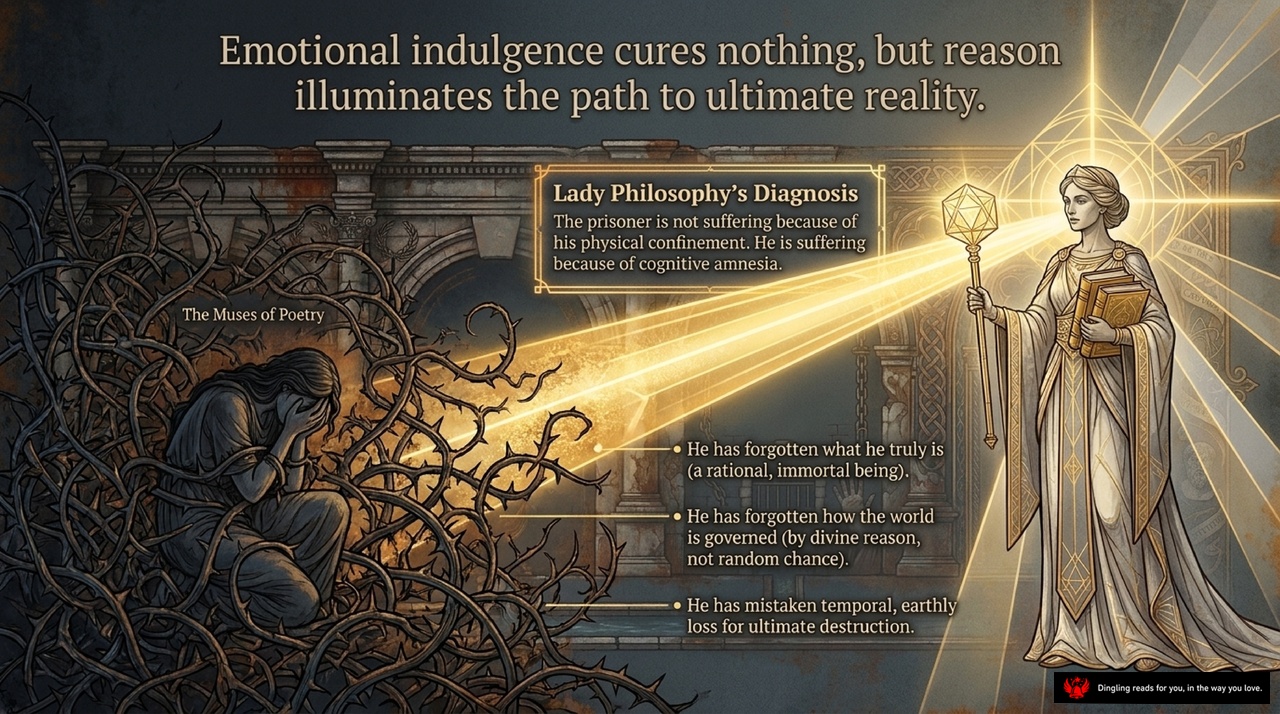
Look at this striking contrast between the prisoner trapped in thorns and Lady Philosophy standing in radiant light. The image captures a pivotal moment: the realization that our suffering isn't caused by our physical chains, but by a deeper, cognitive blindness.
Lady Philosophy's diagnosis is clear. The prisoner isn't suffering because he is locked up; he is suffering because he has forgotten who he truly is. He has lost sight of his nature as a rational, immortal being. Because he has forgotten this, he mistakes temporary earthly losses for ultimate destruction. He has also forgotten how the world is actually governed—not by random chance, but by divine reason.
The text explains that we often indulge in emotions, thinking they will cure us, but they only cloud our vision. True healing comes from reason. When we strip away the illusions of wealth, power, and fleeting pleasure, we see that the things we fear losing were never truly ours to begin with. They were only borrowed.
The prisoner in the image represents us all when we are blinded by fear and sorrow. But look at Lady Philosophy. She holds the light of truth, ready to guide us back to reality. Her message is simple yet profound: stop chasing the hollow promises of the material world. Turn inward, reconnect with your rational soul, and you will find that you are not a victim of fate, but a participant in a rational, ordered universe. By reclaiming our reason, we illuminate the path to ultimate reality and free ourselves from the thorns of unnecessary suffering.
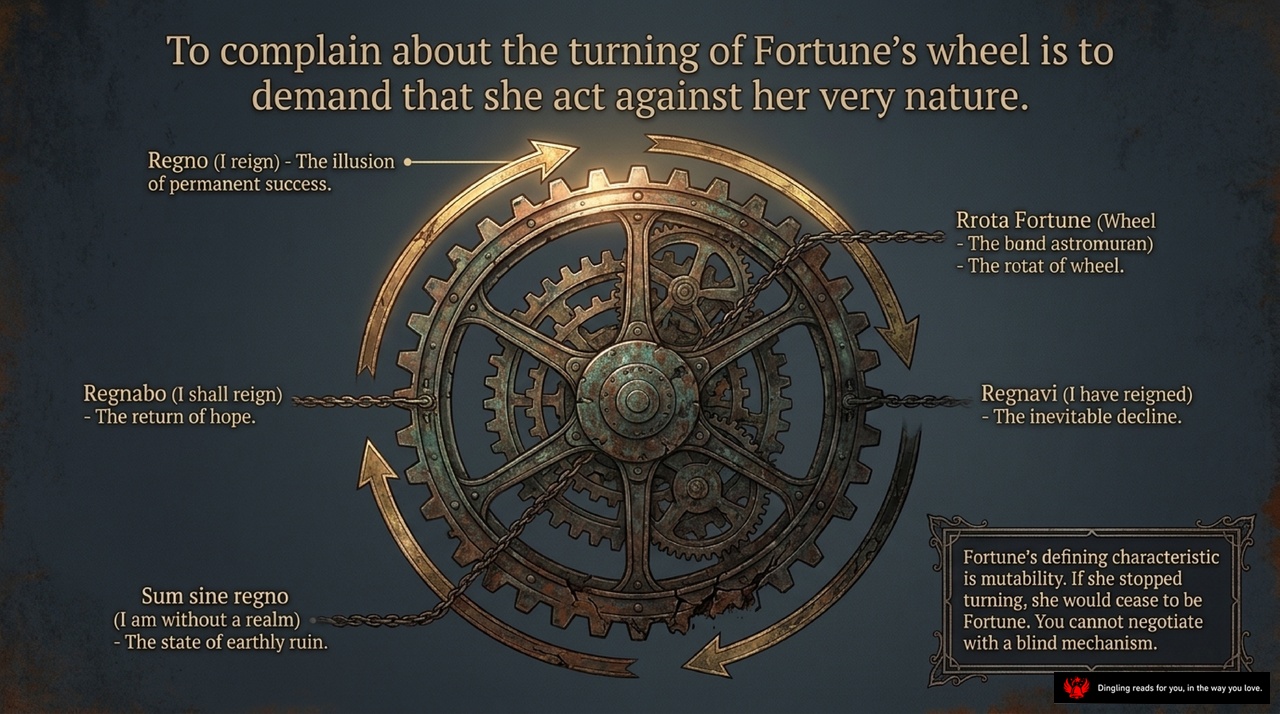
To complain about the turning of Fortune's wheel is to demand that she act against her very nature. As the image illustrates, the Rrota Fortune—the wheel of fate—is a blind mechanism defined by mutability. If she stopped turning, she would cease to be Fortune. You cannot negotiate with this cosmic order.
The slide breaks down the Latin roots of this concept: Regno, the illusion of permanent success; Regnavi, the inevitable decline; and Sum sine regno, the state of earthly ruin. Fortune's defining characteristic is change. When she smiles and offers wealth and honor, it is a temporary loan, not a permanent gift. She is like a fickle lover who dotes on you only to abandon you when you least expect it.
In the text, Lady Philosophy tells Boethius that Fortune has no power over truly valuable things, because she never owned them to begin with. The riches and titles we cling to are merely her servants, moving to and fro at her command. If you believe these fleeting things are yours, you will never lose them—but if you mistake them for your own, their loss will bring you despair.
The key lesson here is found in the text's sharp critique of greed: "As long as you are trembling and sighing, as long as you are anxious about your poverty, you are never truly rich." True wisdom lies in realizing that Fortune is not an enemy to be fought, but a force of nature to be accepted. If you love her, follow her without complaint; if you hate her betrayal, scorn her, for she is designed to play on human hearts and drive them to destruction. By accepting that the wheel must turn, we stop fighting the current and find the freedom to remain calm regardless of whether we are at the top or the bottom of the wheel.

The slide argues that chasing wealth, power, fame, and pleasure is a trap. We think these things promise self-sufficiency, total control, immortality, and pure joy. But the reality is far more painful. Wealth doesn't make you free; it creates chronic anxiety and a constant need for external protection. Power doesn't grant control; it exposes you to fear and treacherous allies. Fame is geographically limited and ultimately erased by the infinite span of time. And pleasure? It ends in inevitable physical frailty and regret. These temporal pursuits offer only fragmented illusions, not genuine fulfillment. The only way out is to realize that true happiness isn't found in these fleeting things, but in the eternal and the divine.

True happiness is not a collection of fragmented parts, but a single, indivisible unity. Look at this diagram: it illustrates a profound truth we often miss in our daily lives. We chase after separate pieces—Sufficiency, Power, Fame, Joy, and Reverence—believing that if we gather them all, we will finally be happy. But the image shows us the trap of our modern mindset. Earthly goods are merely flawed, isolated attempts to grasp ultimate perfection. When we treat these as separate goals, we end up chasing shadows, never finding the whole picture.
The text reminds us that humans are rational, and because of that, we naturally seek this ultimate perfection. We want to possess the Highest Good. What does that mean? To possess the Highest Good is simply to lack nothing. It is a state of complete wholeness. The slide makes it clear: this perfect unity is the only true definition of Happiness.
Think about your own life. How often have you felt incomplete? Maybe you have the money, but you lack peace. Or you have power, but you lack respect. Or you are famous, but you feel empty inside. We try to patch our lives with these scattered fragments, thinking more is better. But the philosophy here is revolutionary: you cannot build a perfect circle with broken pieces. True fulfillment comes not from adding more external things, but from realizing that the self, when aligned with reason and virtue, is already whole.
When we stop trying to isolate these elements and instead seek the single, indivisible unity of the Highest Good, the chaos of our lives begins to resolve. We stop running from one fragment to another and finally rest in the completeness of who we truly are. This is the path to a life that is not just happy, but truly good.
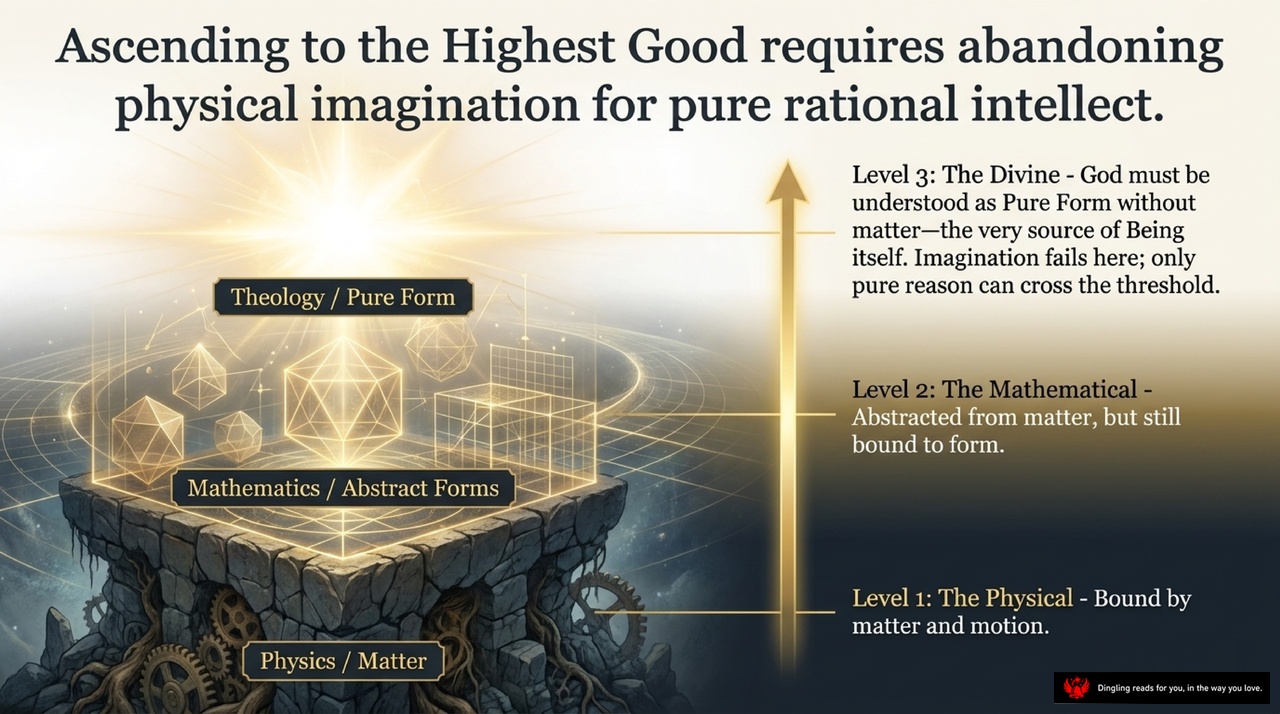
To reach the Highest Good, we must leave the world of physical imagination behind and ascend to the realm of pure rational intellect. As the slide illustrates, our journey upward involves shedding the heavy chains of the material world. We start at Level 1, the Physical realm, bound by matter and motion. From there, we climb to Level 2, the Mathematical, where forms are abstracted from matter but still rely on visible shapes. However, the true summit is Level 3, the Divine. Here, God is understood not as a physical form, but as Pure Form without matter—the very source of Being itself. This is the final threshold where imagination fails completely. Only pure reason can cross it. We must abandon our reliance on physical images and trust our intellect to grasp the divine, which cannot be seen, only understood through the light of the mind.
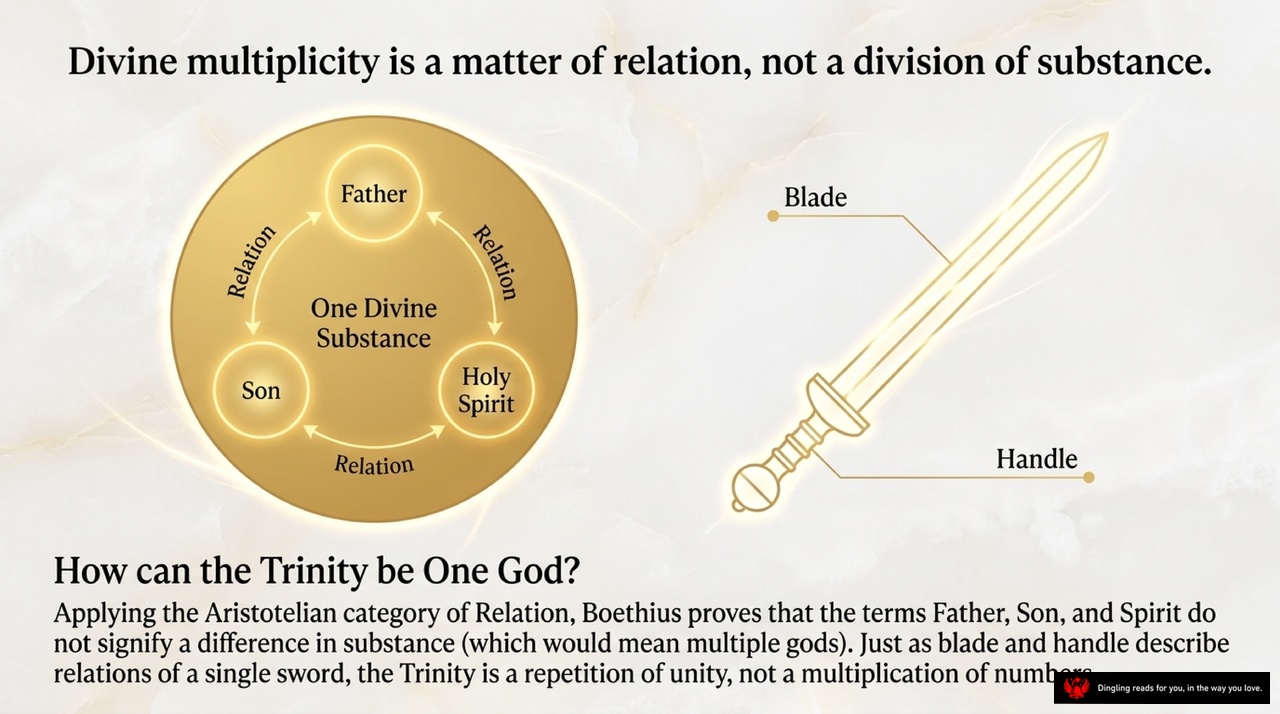
Divine multiplicity is not about splitting God into parts; it is entirely about relationship. As this slide illustrates, the Father, Son, and Holy Spirit are not three separate substances, but three distinct relations within one divine essence. Think of it like a sword: the blade and the handle are different things, yet they are never two separate swords. They are simply different aspects of a single object. In the same way, the Trinity is a repetition of unity, not a multiplication of gods. Boethius uses this Aristotelian logic to prove that the terms Father, Son, and Spirit describe how one God relates to Himself, not how He is divided. This is how the Trinity remains one God while being three persons.
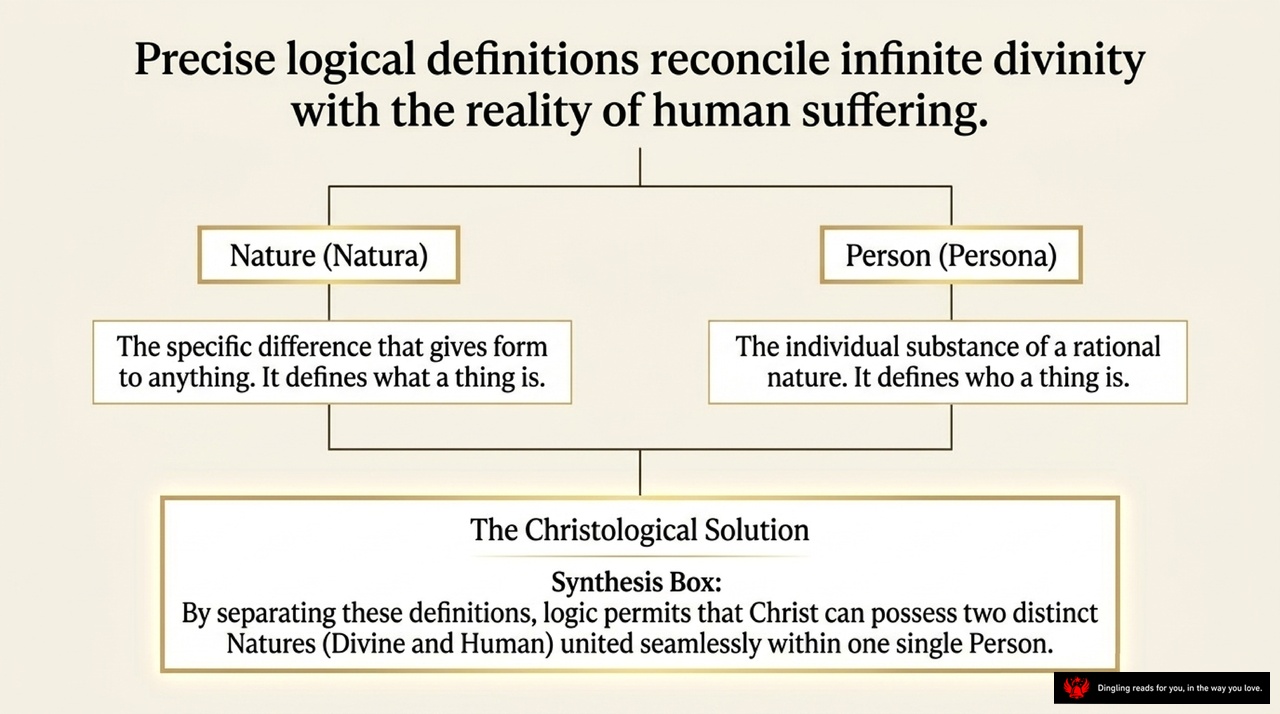
Look at this diagram. It presents what philosophers call "The Christological Solution," a logical framework designed to reconcile the infinite nature of divinity with the very real, often painful, reality of human suffering. At the top, we see the core tension: how can one entity be both fully divine and fully human without contradiction?
The answer lies in separating two distinct definitions. On the left, we have "Nature," or *Natura*. This defines *what* a thing is—its specific difference, the form that gives it shape. On the right, we have "Person," or *Persona*. This defines *who* a thing is—the individual substance of a rational nature.
By separating these concepts, logic permits something remarkable: Christ can possess two distinct Natures, the Divine and the Human, united seamlessly within one single Person. This synthesis allows us to understand how an infinite, perfect divinity can enter the finite realm of human experience, not by diluting its power, but by inhabiting a specific human nature. It is a precise logical definition that bridges the gap between the eternal and the temporal, offering a profound solution to the mystery of incarnation.

Imagine a scale, perfectly balanced, where the weight of "Being" on one side equals the weight of "The Good" on the other. This isn't just a diagram; it's the core argument of Boethius's masterpiece. The slide tells us a profound truth: everything that exists is good simply by the fact that it exists. Why? Because all existence flows directly from the Prime Good, which we call God. If something has no goodness, it essentially has no existence at all.
Think about it this way: if evil were a real substance, it would have to exist. But the text reveals a radical idea—evil is not a substance. It is a privation. It's like darkness. Darkness isn't a thing you can hold; it's just the absence of light. Similarly, evil is just a lack of good, a deficiency in existence. When we choose evil, we aren't creating something new; we are literally ceasing to truly be. We are stepping off the scale of existence into the void.
So, the ultimate consequence is clear: to abandon the Good is to lose your very nature. The balance remains perfect because existence and goodness are inseparable. You don't find good by looking for it; you find it by simply existing. This shifts the entire game of life. We stop fearing the loss of things and start fearing the loss of our own connection to the Good.

Those who commit evil operate out of profound weakness, never actual strength. This is the core truth we must grasp today. As the slide clearly illustrates, the formula for any action is simple yet powerful: Desire plus Capacity equals Action. Without both, action is impossible.
Let's look at how this applies to our moral choices. The first point reminds us of a universal constant: all humans, good or bad, desire the Good. We all seek true happiness. The difference lies in our path. On the Virtuous Path, good people use their natural capacity—virtue itself—to attain that Good. Because they align their desires with their true nature, the result is Power. They are free and effective.
Conversely, on the Wicked Path, evil people also desire the Good, but they attempt to seize it through unnatural desires, or vice. They fight against their own nature. The result? Impotence. They fail to attain true happiness. As the slide concludes, the wicked have zero actual power. They are less than human because they have surrendered their rational nature, becoming akin to beasts.
Consider this: if you want to achieve something, you must align your desire with your capacity. If your desires are twisted by vice, your capacity is blocked. You cannot be strong if you are fighting against your own soul. True power comes from harmony, not from force. The wicked may seem strong on the outside, but inside, they are paralyzed by their own contradictions. They are slaves to their passions, unable to act with true freedom.
So remember: evil is not a sign of strength. It is a symptom of weakness. When you try to force goodness through selfish desire, you lose everything. Only by embracing your true nature and using your natural capacity can you find real power and true happiness.
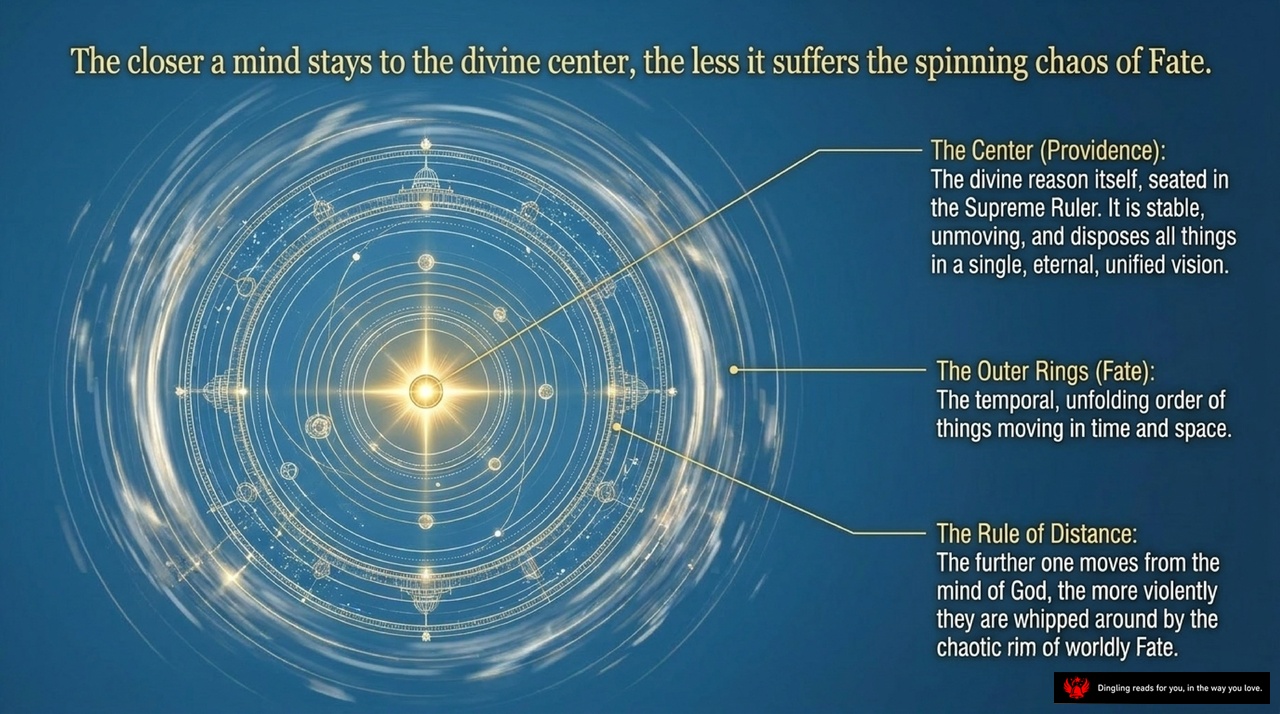
Imagine a cosmic map where the center is not just a point, but a sanctuary of absolute stability. In the heart of this diagram, we see the Divine Center, or Providence—the Supreme Ruler who sees everything in a single, eternal vision. It is unmovable and unmoving, the anchor of all reality. Surrounding this center are the Outer Rings, representing Fate. These are the chaotic, unfolding events of time and space, swirling violently as they move away from the stillness of the divine.
The profound lesson here lies in the Rule of Distance. As the diagram illustrates, the further a mind drifts from that central truth, the more violently it gets whipped around by the chaos of worldly fate. When we lose our connection to the divine reason, we become mere passengers in a storm, buffeted by circumstances we cannot control. But the closer a mind stays to that divine center, the less it suffers the spinning chaos. True peace isn't found by escaping the outer rings, but by anchoring oneself firmly in the center. It is about realizing that while the world spins wildly around us, our inner stability remains untouched if we hold onto the eternal vision of the Supreme Ruler.

Imagine a vast, winding road stretching through a mountainous landscape, where a solitary traveler pauses at a fork, facing an uncertain future. Above, a radiant eye watches from the summit, symbolizing a perspective that sees the entire journey at once. This image perfectly captures the ancient philosophical puzzle: if God foresees everything, does that mean our choices are illusions? The slide boldly answers "Yes." It explains that divine observation isn't a clock ticking toward a fixed future, but rather an eternal gaze existing outside of time. Just as watching a man walk down a road doesn't force him to take each step, God's simultaneous view of past, present, and future doesn't impose necessity on human free will. We remain the authors of our own path, even while being fully seen.

By participating in the Highest Good, the human mind acquires the capacity to become divine. This profound transformation rests on three pillars of truth. First, the Theological Truth: God is the Highest Good, the source of all existence. Second, the Philosophical Truth: True Happiness is the acquisition of this Highest Good. And finally, the Ultimate Consolation: Because True Happiness is God, humans who acquire it become, by participation, divine. This means no prison, executioner, or turn of Fortune's wheel can strip away this internal, eternal architecture. While the world outside may crumble like the broken gears beneath our feet, our connection to the divine remains unbreakable.
True happiness and power are never found in the spinning wheel of worldly fortune, but only in the eternal, rational unity of the Highest Good, where human free will operates under the loving gaze of divine providence. This isn't just a philosophical abstraction; it's the ultimate answer to the chaos we feel in our daily lives. Think about it: when you face adversity, do you see it as a random disaster, or as a tool designed to test your virtue or correct your path? If every challenge is simply a mechanism for growth, what actual power does the world have to harm you? The slide asks us to reflect on this shift in perspective. It suggests that our suffering often stems from forgetting our true nature and the rational order that governs everything. Once we realize that our free will exists within a framework of divine care, the terrifying grip of fate begins to loosen. We stop chasing fleeting wealth and status, which are as unstable as the wind, and instead anchor ourselves in something eternal. True freedom isn't about controlling the external world, which is impossible, but about aligning our inner will with the highest good. In that unity, we find a power that no fortune can take away. So, the next time life feels like a whirlwind, remember: you are not lost. You are operating under a loving gaze, guided by a rational order that ensures every experience, even the painful ones, serves a purpose in your journey toward true fulfillment.