
The Count of Monte Cristo: Complete Chapter-by-Chapter Summary

Welcome to our book club session. Today, we're diving into one of the most gripping tales in literature: *The Count of Monte Cristo* by Alexandre Dumas.
Picture this: a stormy sea, dark clouds breaking to reveal a sliver of light, crashing against ancient stone walls. This isn't just a backdrop; it's the very soul of our story. As the title card suggests, we are about to explore a timeless epic of betrayal, rebirth, and the devastating cost of absolute vengeance.
Imagine a young sailor, Edmond Dantès, who has finally achieved his dream of becoming a captain, only to have his world shattered in an instant by the cruel machinations of jealous rivals. He goes from being the happiest man in Marseille to a prisoner in the unforgiving darkness of an island fortress.
But this isn't just a story about suffering. It is a profound journey about how one man, stripped of everything, rises from the ashes to become a force of nature. Dumas masterfully weaves a narrative where every act of cruelty is met with calculated precision, turning a tale of revenge into a complex meditation on justice, hope, and the human capacity for both destruction and redemption.
Whether you've read it before or are discovering it for the first time, this story offers lessons that resonate long after the final page is turned. So, grab a drink, settle in, and let's begin our journey into the heart of the Mediterranean and the mind of a man who refused to stay broken.

At nineteen, Edmond Dantès possessed everything a man could desire, making him the perfect, oblivious target for those who possess nothing but ambition. Look at his life: his career was poised to take him as the captain of the Pharaon; his love was joyfully betrothed to the beautiful Mercédès; he held deep patronage with the wealthy Monsieur Morrel; and he was devoted entirely to his aging, beloved father. He stood at the perfect horizon, unaware that his greatest enemy was already watching.
But beneath this idyllic surface lay a dark conspiracy. Fernand, consumed by jealousy over Mercédès, and Danglars, envious of Dantès's promotion, joined forces with the ambitious prosecutor Villefort. They orchestrated a deadly trap, framing the innocent young captain as a spy for Napoleon. Just as the wedding was about to begin, soldiers burst in with an arrest warrant, shattering the joyous celebration. In an instant, the perfect life of a nineteen-year-old dreamer collapsed into the darkness of the Château d'If, where Edmond would spend fourteen years in solitary confinement, waiting for a fate that would soon turn him into a man of vengeance.

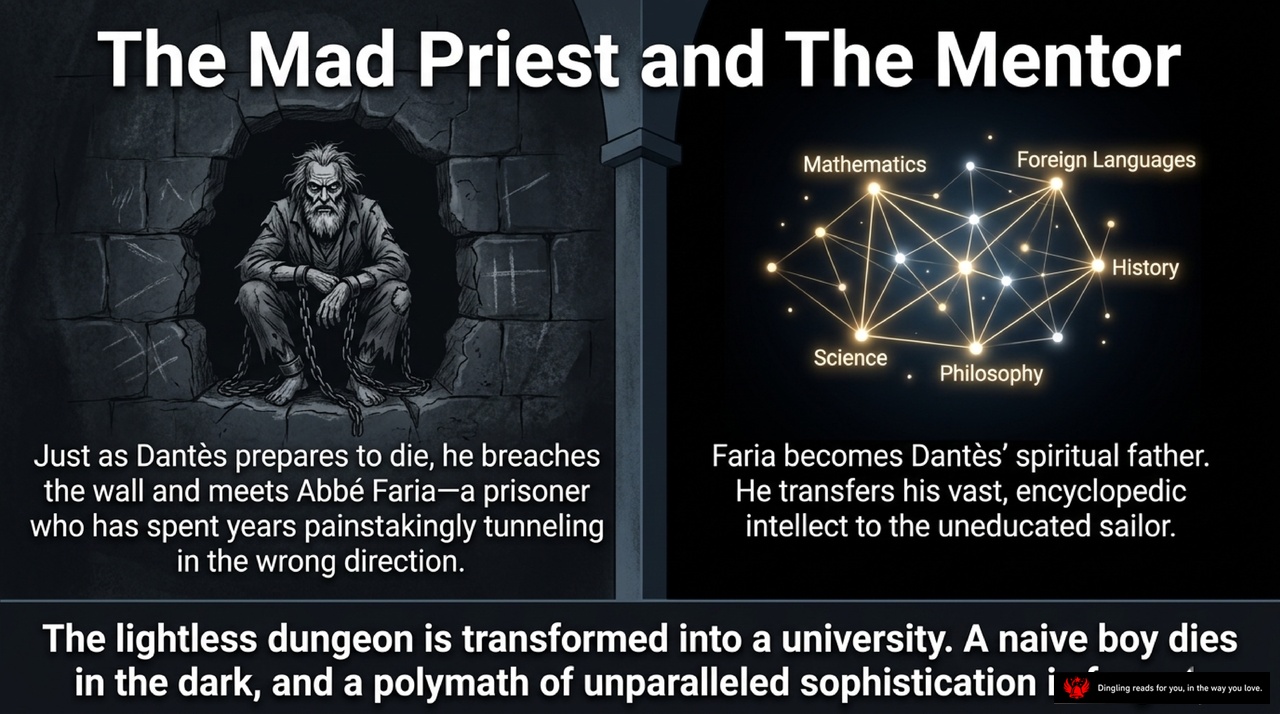
In the heart of a dark prison, hope begins to crack the walls. For Edmond Dantès, fourteen years of silence and despair end the moment he hears a faint, rhythmic sound echoing from the stone around him. It's the sound of hope: Father Abbé Faria, a brilliant scholar imprisoned just a few cells away, has accidentally dug a tunnel that leads directly to Dantès' cell.
This meeting changes everything. Father Abbé isn't just a fellow prisoner; he is a genius who has spent years studying law, languages, and science within the walls of the Château d'If. He becomes Dantès' mentor, teaching him everything he needs to know to survive and eventually escape. But their bond goes deeper than just education. Father Abbé reveals the shocking truth behind Dantès' imprisonment: it was a conspiracy born of envy. Danglars, driven by professional jealousy over the promotion to Captain, and Fernand Mondego, consumed by a romantic obsession with Dantès' fiancée Mercédès, forged a fatal anonymous letter. They framed Dantès as a Bonapartist traitor carrying a treasonous letter from the Isle of Elba, while the cowardly neighbor Cadarousse, who witnessed the plot, stayed silent out of self-interest.
Father Abbé also uncovers a second layer of betrayal: the prosecutor Villefort, Dantès' father's enemy, knowingly threw Dantès into the dungeon to protect his own political career. But amidst the tragedy, there is a gift. Father Abbé reveals the location of a legendary treasure hidden on the Island of Christ, worth millions, left by a murdered cardinal. With this wealth and the knowledge of his enemies, Dantès' fate shifts from victim to avenger. When Father Abbé dies, Dantès executes a daring plan, disguising himself as the priest and escaping into the sea. He eventually reaches the Island of Christ, finds the treasure, and emerges not as the water sailor Edmond Dantès, but as the mysterious Count of Monte Cristo, ready to rewrite the lives of those who destroyed him.

Fourteen years of darkness. For Edmond Dantès, time didn't pass; it simply ceased to exist. He was a ghost in a stone cell, counting his life by the scratches he carved into the damp walls. But even in the deepest abyss, hope can find a crack.
One night, a faint sound of chiseling pierced the silence. It was Father Abbé Faria, a brilliant prisoner who had accidentally dug his way into Dantès's cell. Their meeting changed everything. Faria wasn't just a madman; he was a genius. He taught Dantès mathematics, history, and languages, transforming a naive sailor into a man of profound intellect. Together, they plotted their escape, digging a tunnel toward the sea, fueled by the dream of freedom.
But the true turning point came when Faria revealed the full truth. He exposed the conspiracy of Danglars and Fernand, and the shocking betrayal by Judge Villefort, who sacrificed an innocent man to protect his own father's secrets. And then, Faria handed Dantès a piece of parchment containing the location of a legendary treasure on Monte Cristo Island—enough gold to rewrite the fate of Europe.
When Faria died, Dantès seized the moment. Disguising himself as the dead priest, he escaped the fortress and swam into the unknown. Reaching the island, he found the cave and the chest overflowing with jewels and gold. The treasure wasn't just wealth; it was the weapon he needed. The innocent sailor was dead. In his place rose a new figure, ready to bring justice to those who destroyed his life.

Welcome to the island of Christov. For Franz d'Épinay, this isn't a vacation; it's a trap disguised as paradise. As he steps onto the rocky shore, the air is thick with salt and something far more sinister. Suddenly, a figure emerges from the shadows, dressed in exotic Eastern garb, claiming to be "Sinbad the Sailor." He invites Franz into a hidden grotto, promising a feast fit for a king. Inside, Franz finds himself in a palace of dreams—jewels, art, and endless wine. But this isn't real. Sinbad has drugged him, leaving Franz to sleep in a field of dry grass, his pocket now holding a diamond ring that doesn't belong to him.
When Franz wakes, the illusion is gone. He's confused, but the mystery deepens when he sees a yacht sailing away, crewed by men who claim they never saw him the night before. It's a game of cat and mouse, and Franz is the prey. He eventually tracks Sinbad to Rome, where the stakes get even higher. During the Carnival, Franz overhears a chilling conversation near the Colosseum. Sinbad, now revealing himself as the mysterious Count of Monte Cristo, is plotting something dark involving a condemned man named Pipino and a gang of bandits led by Luigi Vampa.
The tension peaks when Albert de Morcerf is kidnapped by the bandits, demanding a ransom. Franz, terrified and helpless, turns to the Count for help. What follows is a masterclass in manipulation. The Count rescues Albert not just with money, but with a twist of fate—saving Pipino from execution. But the real shock comes when Albert confronts the Count, only to realize that the man who saved him is the very person he's been searching for: Edmond Dantès. The diamond ring, the island, the revenge—all pieces of a grand, deadly puzzle. Franz is no longer just an observer; he's a pawn in a game where the Count holds all the cards.
The Roman Carnival is in full swing, a chaotic explosion of masks, music, and madness. But amidst the revelry, Franz and Albert are chasing shadows. Franz, haunted by his eerie encounter with the mysterious "Maritime Sinbad" on the island of Christ, is on edge. He spots a figure in a brown cloak near the Colosseum, listening in on a plot to execute innocent men. It's the same man from the island. The realization hits him: the charming guide was never just a guide; he was a player in a deadly game.
When Albert is kidnapped by the bandit Luigi Vampa, Franz panics. He races to find the man he suspects is his savior. He finds the "Sinbad" at the tomb of St. Sebastian, and the outcome is nothing short of miraculous. The bandits release Albert, bowing to the mysterious stranger. This man has power, influence, and a code of his own.
But the mystery deepens. Albert and Franz meet this enigmatic figure again, and he asks for an introduction to the Parisian elite. He wants to open doors, to weave a web. He reveals a secret that chills Franz: he was the one who created the hallucinations on the island. The "Sinbad" is a master of disguise and chemistry.
As they leave Rome, a question lingers in Franz's mind: Who is this man who controls the sea, the island, and now the streets of Rome? He is not just a stranger; he is a force of nature, and he is heading toward Paris. The game has just begun, and the pieces are moving toward their final, tragic positions.

"Reconstructing the Crime" isn't just about piecing together clues; it's about understanding the human machinery behind the conspiracy. Look at the three critical nodes we've identified. Node A, the method, points directly to Danglars. He knew about the unscheduled stop at Elba and the secret letter. That was his leverage. But why did Danglars do it? That leads us to Node B, the motive. It wasn't just about greed; it was about jealousy. Fernand stood to gain everything from Dantès losing Mercedes. He wanted her, and he wanted the captain's position. Fernand was the emotional engine of this destruction. Yet, even Fernand wasn't the mastermind. The true catalyst, Node C, was Villefort. Why did he suddenly panic and imprison an innocent man? Because the letter Dantès carried was addressed to Noirtier—Villefort's own Bonapartist father. Villefort's ambition blinded him to his own family's secret, turning him into the executioner of his own son-in-law. Through pure, cold deduction, Faria reconstructs this entire web of betrayal. By revealing the truth, the priest inadvertently injects the venom of absolute vengeance into Edmond's heart. He realizes that revenge isn't just about punishing the guilty; it's about exposing the rot at the very top of society.

Welcome back to our journey through *The Count of Monte Cristo*. Today, we step into the very heart of the story: the final, devastating act of revenge.
The slide before you is titled "The Inheritance of Fate," and it perfectly captures the tragic arc of the villain, Fernand. Look at the first point, "The Bequest." It reminds us of the original betrayal: paralyzed by a fatal stroke, Faria leaves Dante the decoded map to the legendary, lost Spada fortune hidden on a deserted isle. But this isn't just about gold; it's about setting a trap.
Then we see "The Shroud." Dante moves Faria's corpse to his own cell, taking the dead man's place inside the heavy canvas burial sack. This is the moment of transformation. Dante enters the water as a helpless victim, a man about to die, only to emerge later as a god.
Finally, look at "The Drop." Thrown by the guards into the freezing, storm-tossed sea with a cannonball tied to his feet. This is the fate of Fernand. He thought he could kill the innocent and take what wasn't his. But the ocean, that great equalizer, has a different plan. As the slide poignantly states at the bottom: "He enters the water as a helpless victim; he washes ashore as a god."
This is the ultimate irony of the story. The man who tried to drown hope, is now forced to swim through the depths of his own guilt. The inheritance of fate is clear: evil does not go unpunished, and sometimes, the greatest treasure a man can lose is his own soul.

Look at this shattered glass effect—it perfectly captures the moment Edmond Dantès transforms. On the left, we see the innocent, emotional young man who trusted too easily. On the right, stands the Count of Monte Cristo: omniscient, calculating, and infinitely wealthy. He has traded his warm, impulsive passion for cold, divine orchestration of fate.
To exact his grand design, Edmond first had to systematically kill his own capacity for ordinary human joy. He buried his love for his father and his fiancée, sacrificing his soul to become an instrument of Providence. This isn't just revenge; it is the total erasure of the man he once was, leaving behind only the perfect, ruthless machine of vengeance we now know as the Count.

Welcome to the final chapter of our journey with Edmond Dantès. Today, we stand at the climax of the *Count of Monte Cristo*, where vengeance transforms into a grand, tragic opera.
Look at this "Identity Matrix." This isn't just a chart; it's the very weapon the Count uses to dismantle his enemies. He doesn't fight with fists; he fights with mirrors. He creates an arsenal of alter egos to expose the hypocrisy of Parisian society.
First, we see the **Abbé Busoni**. This stern Italian priest was a tool of judgment, used to extract confessions and test souls. The Count resurrects this persona to lure Carducci into a trap, forcing the old man to confront his own greed. It's a psychological mirror showing how easily goodness can be corrupted by money.
Then, there is **Lord Wilmore**, the eccentric English philanthropist. This persona performs anonymous acts of mercy, acting as the constructed opposite of the Count. It's a brilliant strategy to confuse the public and soften the hearts of those who need saving, all while hiding the true mastermind behind the curtain.
On the right, we have **Sinbad the Sailor**, the mythical smuggler. This romantic persona is used to reward the loyal Morel family. By appearing as a generous stranger, the Count restores the family's honor and saves them from financial ruin, proving that kindness is the most powerful form of revenge.
Finally, the central figure is **The Count of Monte Cristo** himself. This charismatic, eccentric billionaire uses immense wealth to dazzle and infiltrate the highest echelons of society. He is the ultimate puppeteer, pulling the strings of Fernand, Danglars, and Villefort, turning their own sins against them.
The story concludes with a profound realization. After years of suffering, the Count realizes that true victory isn't just in destroying his enemies, but in offering a second chance to the innocent. He leaves Paris, taking his treasure and his freedom, leaving behind a legacy of hope. As the final line reminds us, happiness and pain are only relative; the true human spirit lies in the power of waiting and hope.

Before dismantling his enemies, the Count's first move is one of pure salvation. He must save his former employer, Morrel, who stands on the brink of bankruptcy and suicidal despair. The image shows the iconic red silk purse, an exact replica of the one Morrel once used to save Dantès' starving father. The Count uses this symbol of gratitude to anonymously pay off Morrel's massive debts and gifts him an identical, newly built Pharaon ship. His immense, terrifying power is first dedicated entirely to gratitude, proving that even a god of revenge begins with a heart full of thanks.
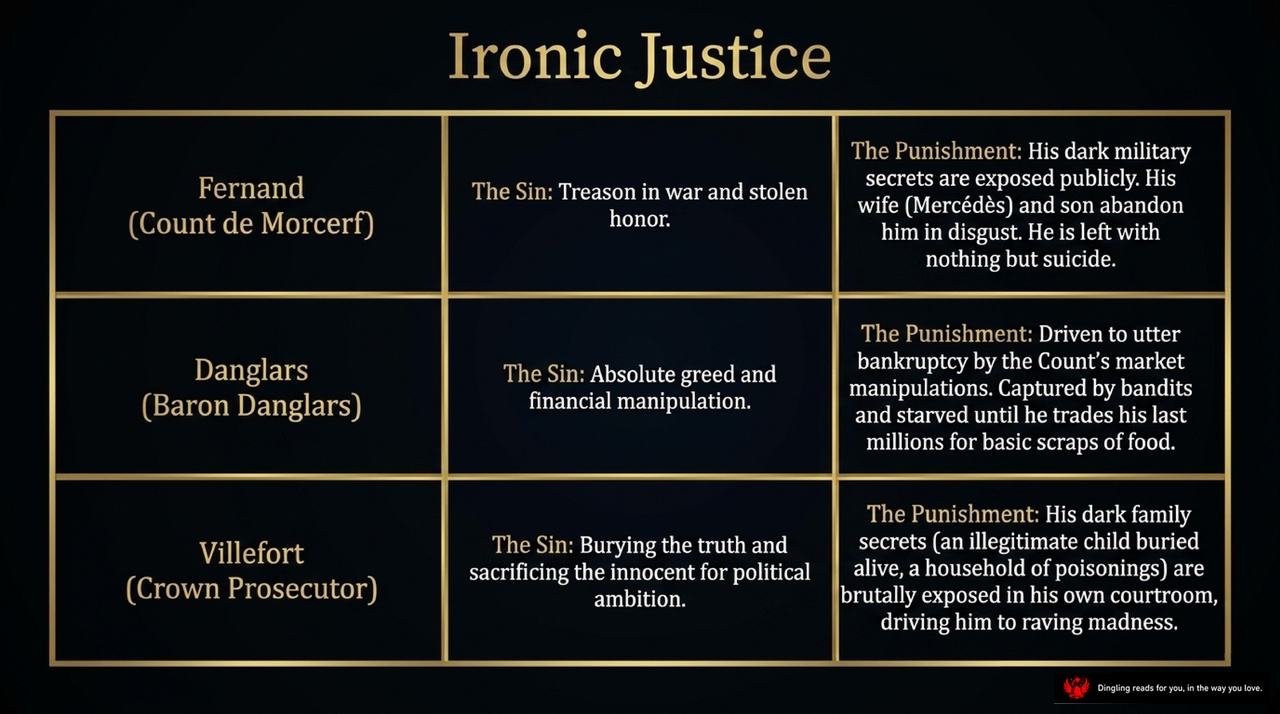
Irony is the ultimate form of justice, where the architects of destruction are inevitably consumed by their own creations. Look at the three villains we've been tracking: Fernand, Danglars, and Villefort. Their fates are a perfect mirror of their sins. Fernand, who betrayed honor for ambition, finds his military secrets exposed, leaving him with nothing but suicide. Danglars, driven by absolute greed, is stripped of his wealth until he trades his last millions for scraps of food. And Villefort, who buried the truth to protect his political career, sees his dark family secrets brutally revealed in his own courtroom, driving him to madness. The universe has a way of balancing the scales, ensuring that every sin finds its precise and devastating punishment.
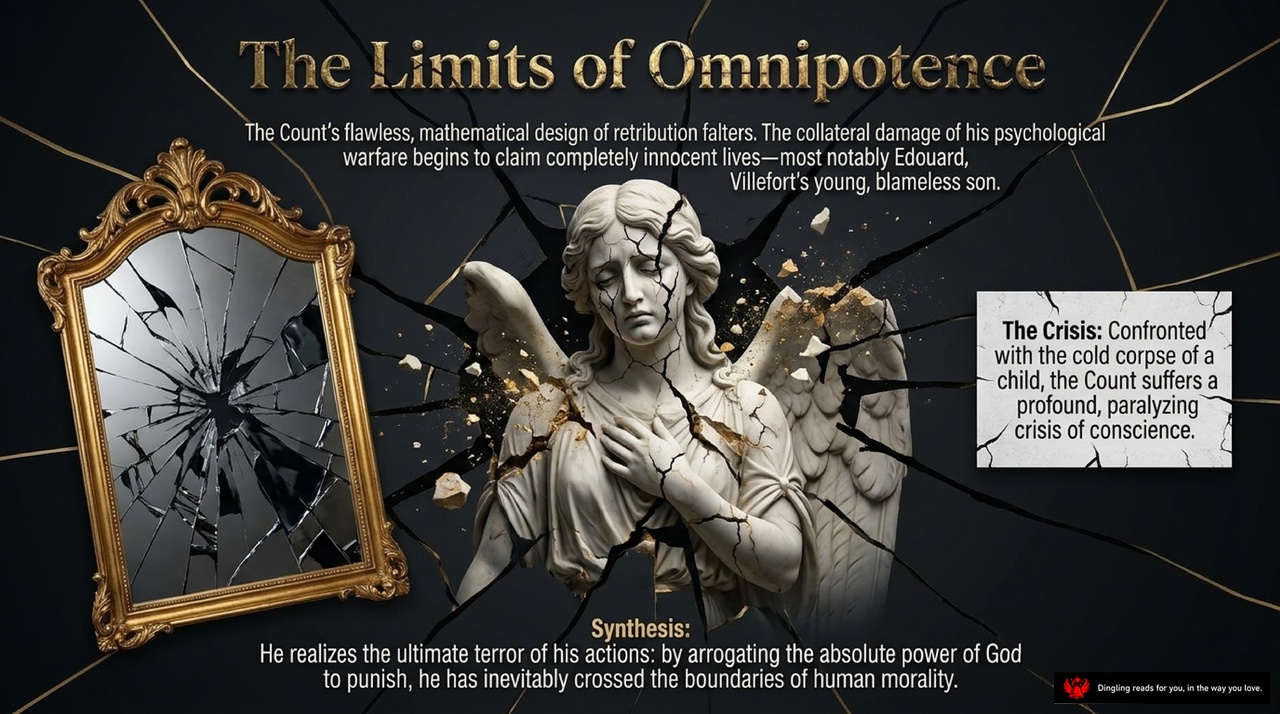
The Count's grand, mathematical design for revenge begins to crack under the weight of its own cruelty. As he executes his psychological warfare, the collateral damage becomes undeniable: innocent lives are claimed, most tragically Edouard, Villefort's young and blameless son. The perfect villain is forced to confront a terrifying reality—his pursuit of justice has spiraled into a nightmare of destruction.
Confronted with the cold, lifeless body of a child, the Count suffers a profound, paralyzing crisis of conscience. The shattered mirror and the broken angel statue in our image perfectly capture this moment of disintegration. He realizes the ultimate terror of his actions: by arrogating the absolute power of God to punish, he has inevitably crossed the boundaries of human morality. The line between avenger and monster has blurred, and in that reflection, the Count sees not a hero, but a man who has lost his soul.

This is the final act of a story that began with a ship docking in Marseille, but it ends not with a bang, but with a whisper against the stars. Look at the image before us: an archway framing a vast, calm ocean under a starry sky. It's a perfect metaphor for the Count's final philosophy. He has walked through fire, through betrayal, and through fourteen years of darkness in the Château d'If, only to stand here at the threshold of a new world.
The text on the left reminds us of "The Final Act." Broken by his own hubris, the Count abandons his absolute vengeance. He realizes that true power isn't about destroying everyone, but about letting the guilty live with the consequences of their choices. He allows his final target, the starving Danglars, to live, choosing mercy over murder. This is the moment where the Count transcends his role as a mere avenger and becomes a philosopher.
On the right, we see "The Legacy." He leaves his vast remaining fortune to Maximilian Morrel and Valentine Villefort, sailing away into the unknown horizon. He saves the innocent and gives the guilty a second chance, letting the ocean wash away the sins of the past. But the true weight of this journey lies in the center. The quote tells us: "There is neither happiness nor misery in the world; there is only the comparison of one state with another." The Count realizes that suffering is often just a matter of perspective. And he concludes that all human wisdom is contained in these two words: Wait and Hope.
In a world obsessed with immediate results, the Count teaches us the most difficult lesson of all: that life is not about the destination, but about the faithfulness of our journey. He leaves us with this ultimate wisdom, not to be consumed by despair or blinded by joy, but to find balance in the quiet moments of waiting and the courage of hope.
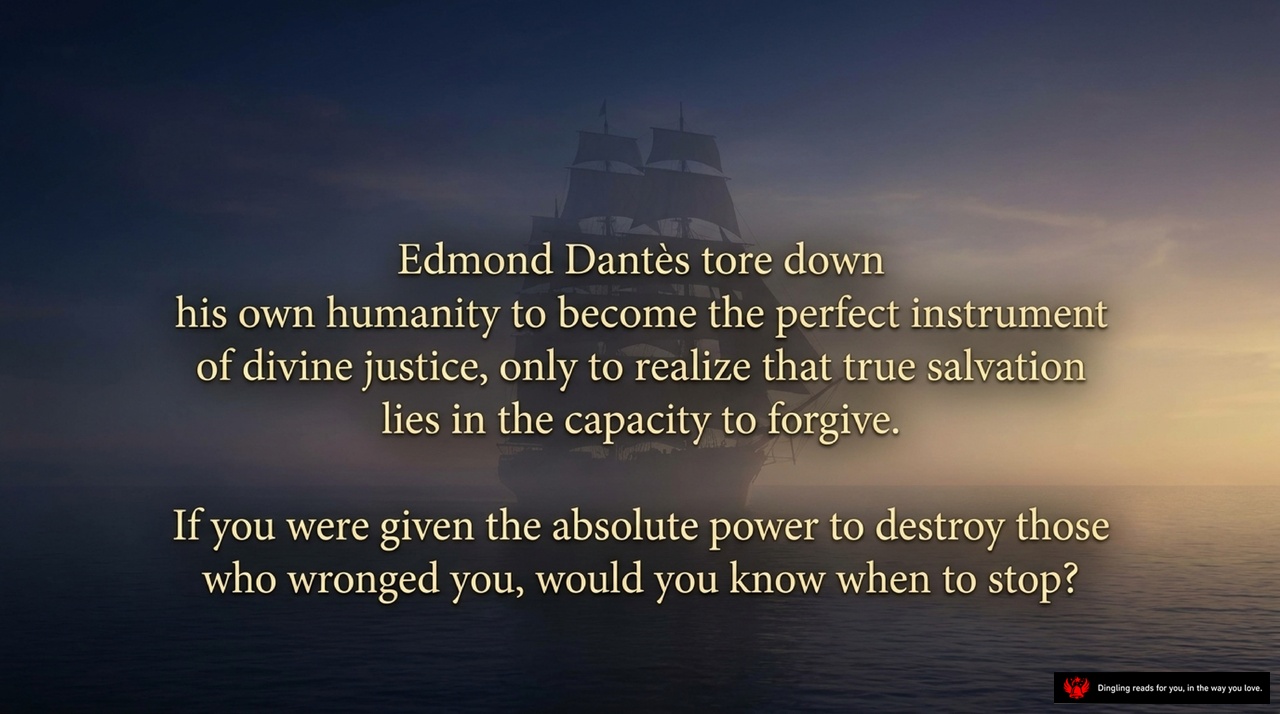
Edmond Dantès tore down his own humanity to become the perfect instrument of divine justice, only to realize that true salvation lies in the capacity to forgive. Imagine being given the absolute power to destroy those who wronged you. Would you know when to stop? That is the eternal question haunting the story of The Count of Monte Cristo. From a betrayed sailor to a god of vengeance, he spared no one—until the final moment. He learned that revenge, no matter how sweet, is a poison that destroys the avenger just as surely as the victim. The real victory wasn't in the fall of Fernand or Danglars or Villefort, but in the choice to let go. True freedom isn't found in the destruction of others, but in the forgiveness of oneself.