
The Definitive Book of Body Language: Complete Chapter-by-Chapter Summary

Welcome to today's session on "The Definitive Book of Body Language" by Allan and Barbara Pease. This isn't just about reading people; it's about mastering the silent signals that drive human behavior.
Think about this: the same gesture can mean "okay" in the US, but insult you in Brazil or Turkey. Yet, across all cultures, a genuine smile, a furrowed brow, or a crossed arm tells a universal story. While words carry only 7% of a message's impact, your body speaks 55%. That's why your handshake, your stance, and even your pupil dilation can reveal more than your words ever could.
Today, we'll decode these hidden cues to build trust, project confidence, and see the truth behind the mask.
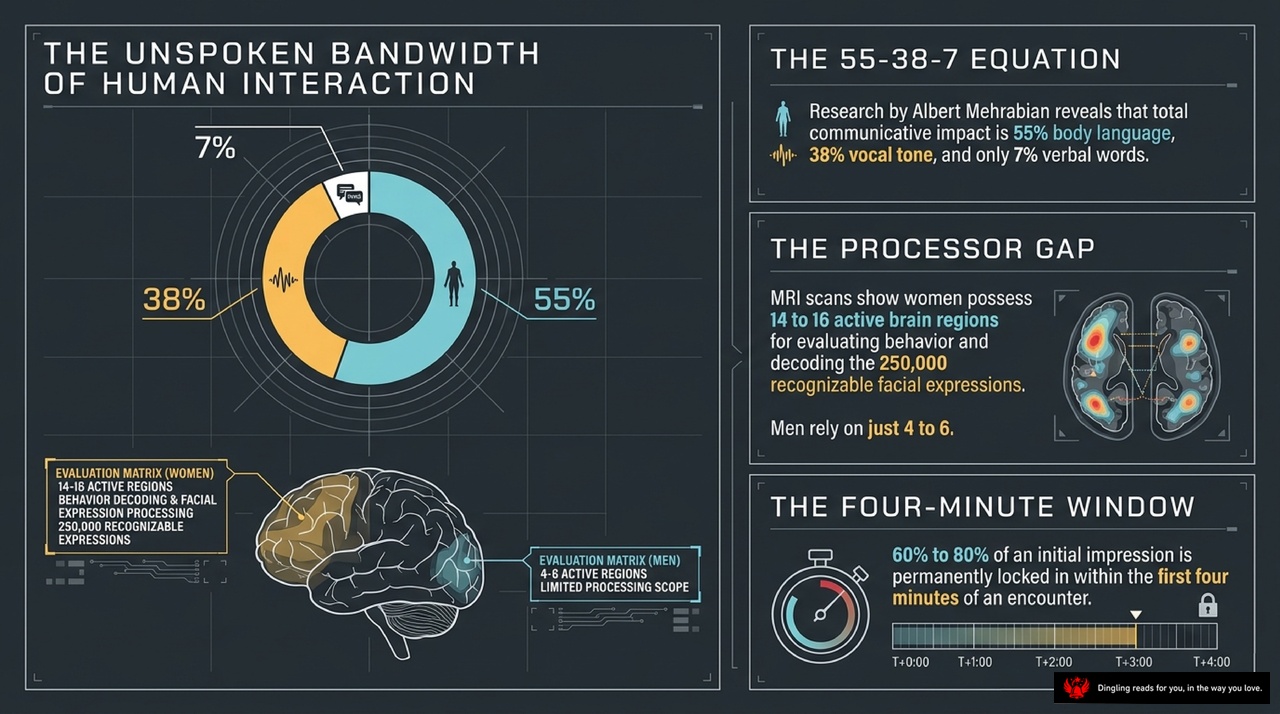
Have you ever wondered why a simple handshake can make or break a career? Let's look at the data. According to Albert Mehrabian's famous 55-38-7 equation, the total impact of communication isn't about what you say. In fact, only 7% comes from your actual words. The real power lies in your body language, which accounts for 55%, and your vocal tone, which makes up the remaining 38%.
This infographic highlights a critical "processor gap" between men and women. MRI scans reveal that women have 14 to 16 active brain regions dedicated to decoding behavior and facial expressions, capable of recognizing over 250,000 different expressions. Men, on the other hand, rely on just 4 to 6 regions. This biological difference explains why women often possess a stronger "gut feeling" about people's true intentions.
But here is the most important rule for any interaction: the four-minute window. Research shows that 60% to 80% of an initial impression is permanently locked in within the first four minutes of meeting someone. During this brief window, your body language speaks louder than your resume or your pitch. If your words say "I am confident" but your posture says "I am defensive," the image of a confident leader will never form. So, remember: before you even speak, ensure your body is telling the right story.

Welcome back. Today, we're diving into the "Three Directives of Accurate Decoding." Think of this as your cheat sheet for cracking the code of human behavior without saying a single word.
First up: Read in Clusters. Don't treat gestures like isolated words; treat them like a sentence. Just because someone scratches their head doesn't mean they are lying—it could just be dandruff. You need to look for at least three congruent signals to get the real story.
Second, look for Congruence. When spoken words and physical gestures contradict, trust the body. Non-verbal signals carry five times the impact of spoken words. If a woman ignores verbal info because her posture says otherwise, you're seeing the truth.
Finally, analyze the Context. The environment dictates meaning. Crossed arms at a freezing bus stop mean someone is cold, but crossed arms during a sales pitch indicate defensive resistance.
Master these three rules, and you'll stop guessing and start understanding.

So, let's talk about the handshake, because it's often the very first thing we do when meeting someone, yet it says a lot more than just "hello."
Look at this diagram. It breaks down the handshake into three distinct power dynamics. First, the palm-up. When you shake hands with your palm facing up, you are being submissive. You are yielding control and giving the other person a sense of dominance. It feels like you are putting them in charge.
On the opposite end, we have the palm-down handshake. This is dominant. By pressing your hand down on theirs, you are asserting authority. While this can be powerful, it often feels aggressive or forced, especially if you are shaking hands with someone of equal status.
The ideal business baseline, however, is the vertical handshake. When your palms are parallel and facing each other, it signals equality and mutual respect. It's the neutral ground where neither party feels threatened or superior.
But what if you meet someone who is aggressively shaking your hand with a palm-down grip? How do you counter that? The slide calls this "The Neutralizer," and it involves a simple footwork trick. To counter a dominant shaker, you step forward with your left foot, then step across with your right foot into their personal space. By squaring your body and stepping into their zone, you physically force their palm into that vertical, equal position. It's a subtle but powerful way to take back control and establish a fair dynamic right from the start.

Look at this breakdown of "Palmar Visibility and the Compliance Touch." We are diving deep into the science of why a simple touch can change the outcome of an interaction.
First, let's look at the "Open Palm." Evolutionarily, showing your palms signals "no weapons." It's a primal way of saying you aren't a threat. Psychologically, exposing your palms makes it neurologically difficult to tell a convincing lie. This is often called the Cause and Effect Law—when you show your hands, your brain aligns with your words, making deception much harder.
Next, we have the "3-Second Elbow Touch." This is a brief, under three-second, touch to the elbow. Why the elbow? Because it bypasses our defensive barriers. We guard our chest and face, but the elbow is often left exposed. A quick touch here instantly lowers someone's guard and builds trust.
Finally, let's look at "The Metrics of Touch." This isn't just theory; it's backed by hard data from the famous "Minnesota Coin Experiment." When researchers simply asked for a coin back, the return rate was only 23%. But when they added a light touch to the elbow, the return rate skyrocketed to 60%. That is a 161% increase in compliance. In real-world scenarios, waitresses who utilized this specific elbow touch saw a 36% increase in their tips.
So, the takeaway is clear: visibility of the palm builds honesty, and a quick, targeted touch to the elbow can unlock compliance and trust in ways words simply cannot.

Today's slide breaks down three distinct arm positions that act as invisible barriers between us and the world. First, we have the "Standard Cross." As the graphic shows with the red box, this is arms tightly folded across the chest. It signals a high threat level and a defensive attitude. If you see this, know that the listener is likely rejecting your message until those arms uncross.
Next is the "Disguised Cross." Here, the barrier is concealed. Instead of crossing arms, someone might be fiddling with a watch, adjusting a cufflink, or holding a handbag across their body. This creates a subtle, socially acceptable physical barrier that masks anxiety without looking aggressive.
Finally, we have the "Single-Arm Hug." This is often an unconscious response where one arm crosses the body to grip the opposite bicep. While it looks like a self-soothing gesture, it's actually a recreation of being comforted by a parent in childhood. It's a way of finding safety within oneself when the outside world feels uncertain.

Have you ever noticed how your feet betray your true intentions long before your lips do? While we spend all our time controlling our facial expressions and managing our hand gestures, our legs and feet are the ultimate truth-tellers. They are the least guarded part of our bodies, often moving subconsciously to reveal exactly where our heart is.
Consider this scenario: a man sits with his legs wide apart, a classic masculine power stance signaling that he has no intention of leaving. But look closer at his feet. If his toes are pointed directly toward the exit, he is mentally checking out, even if he's nodding along to your pitch. Conversely, if someone is sitting with their legs crossed in a "four-point" position, they are likely in a competitive mindset, ready to argue. If they tighten their grip on that top leg, they aren't just being stubborn; they are digging in their heels, refusing to budge on their decision.
Here is a pro tip for closing deals: never ask someone to make a major commitment while they are in a "four-point" stance. They are psychologically locked in against you. Instead, wait until they relax that posture and plant both feet flat on the floor. That is the moment they are ready to listen and decide.
Women have their own subtle signals, too. If a woman frequently crosses and uncrosses her legs, she might be trying to attract attention. But if her feet are turned inward, away from you, she is signaling disinterest. In a business setting, especially with women in skirts, it is best to keep knees together to maintain professionalism and ensure your message isn't lost to distraction.
The direction of your feet is the most honest indicator of your interest. If you are truly engaged, your feet will naturally point toward the person you are talking to. If you are bored or looking for an escape, your feet will subtly pivot toward the door. So next time you are in a meeting, don't just watch the face; watch the feet. They will tell you the real story.

Imagine you are sitting across from a client, and suddenly they cross their arms. Instantly, your brain flags it as a red zone: "They are closed off, skeptical, and maybe even hostile." But before you panic and change your pitch, you need to understand exactly what that posture is really saying, because the context changes everything.
As the flowchart on your screen clearly outlines, this moment of defense usually falls into one of three stages. First, we have Stage 1: Boredom. Here, the head is fully supported by the palm. The listener isn't necessarily evaluating your argument; they are fighting sleep. If they are tapping their feet or playing with a pen, that indicates impatience, not deep thought. You need to wake them up immediately.
Move to Stage 2: Evaluation. This is where things get interesting. The listener is now engaged. You'll notice their index finger pointing vertically up their cheek, often with the thumb supporting the chin. This is the thinking pose. However, watch out for the details. If the listener disagrees with you, that index finger might suddenly rub their eye. That is a subtle sign of rejection.
Finally, we reach Stage 3: Decision Making. The hand moves to stroke the chin, signaling that they are weighing the final verdict. This is your critical action point. You need to watch their body language closely. If they cross their arms after stroking their chin, the answer is a hard no. They are building a defense wall. But if they lean forward or open their arms, the answer is a resounding yes. They are ready to buy in.
So, the next time you see someone crossing their arms, don't just assume they hate your idea. Look at the preceding stage. Are they bored, evaluating, or deciding? And look at the follow-up actions. Are they closing the door or opening it? By decoding these specific signals, you can tell if you need to re-engage their interest, clarify your point, or simply wrap up the deal while they are still open. Mastering this flowchart turns a confusing moment of silence into a clear path toward a successful outcome.

Look at this infographic. It breaks down exactly where to look and how eyes react to tell the truth. First, we have the "Power Gaze." This is the triangle formed by the eyes and the center of the forehead. When you lock eyes here, you aren't just looking; you are maintaining control and asserting authority. It's the look of a leader or someone in charge.
Next to that is the "Social Gaze." This triangle connects the eyes to the mouth. This is the sweet spot for conversation. It creates a non-threatening, open environment where people feel comfortable sharing ideas. If you want to build rapport, aim your eyes here.
Then there is the "Intimate Gaze." This extends from the eyes all the way down to the chest or crotch. It is used unconsciously to gauge sexual interest. In a professional setting, you definitely want to avoid this zone, as it can make others feel uncomfortable or unsafe.
Finally, look at the "Pupil Dilation" section. It states that pupils can expand up to three times their normal size when a person is interested or aroused. The text even cites a Revlon catalog test where models with artificially dilated pupils increased sales by 45%. This proves that our eyes give away our true feelings before we even speak. So, remember: where you look and how wide your pupils go can reveal more than your words ever could.

Have you ever wondered why a simple handshake can make or break a business deal? It all comes down to reading the internal channel through ocular access cues. When someone looks up and to the left, they are accessing visual memory, like seeing a picture or recalling a specific scene. If they look up and to the right, their brain is accessing sound, perhaps recalling a conversation or a specific noise. When they look down and to the left, they are engaging in internal dialogue, talking to themselves or processing information before speaking. Finally, if they look down and to the right, they are accessing kinesthetic feelings, emotions, or tactile sensations. By observing these eye movements, you can decode what is truly happening in their mind, whether they are remembering facts, feeling emotions, or planning their next words. Mastering these subtle signals allows you to understand the unspoken narrative behind every interaction.

Check out these three powerful lower body signals that reveal what people are really thinking without saying a word. First, look at the Seated Ankle Lock. When someone crosses their ankles and locks them tightly, they are often holding back negative emotions or anxiety, similar to biting their lip. If you spot this, don't push harder; instead, ask open-ended questions to help break that tension. Next, notice the Figure-4 Seated Cross. This aggressive posture, where one foot rests on the opposite knee, is a clear territorial claim. It signals competitiveness and dominance, telling everyone in the room, "I am in charge of this space." Finally, check out the Cowboy Stance. With thumbs hooked in the belt or pockets and feet planted wide, this is a classic male-dominated pose designed to assert fearlessness and control. It highlights the crotch area specifically to claim dominance. While these stances might seem natural, they often hide hidden agendas. Whether someone is feeling defensive, trying to dominate, or projecting an image of toughness, their legs are broadcasting the truth. Pay attention to these architectural clues to understand the real story behind the seat.

Proxemics is often called the "invisible territorial radar" because it governs the invisible bubble of space we all carry with us. As the slide illustrates, this isn't just about physical distance; it's a psychological boundary that shifts based on who you are and where you are.
First, look at the concentric rings on the left. The innermost red zone is the Intimate Zone, ranging from 15 to 45 centimeters. This is strictly reserved for lovers, family, and close friends. If a stranger steps into this space, your body immediately triggers a physiological fight-or-flight response. Moving outward, we hit the Personal Zone, spanning from 46 centimeters to 1.22 meters. This is the standard distance for friendly social gatherings and parties, like a casual chat at a coffee shop. Beyond that lies the Social and Public zones, extending up to 6 meters and beyond, which we use for formal interactions or public speaking.
But here's the critical part: these boundaries aren't fixed; they are conditioned by your environment. As the slide notes under "Environmental Conditioning," spatial needs are dictated by your upbringing. A city dweller, used to crowded subways and busy streets, might feel comfortable with a handshake at just 46 centimeters. In contrast, someone from a rural or remote background might require a full meter, or even up to 6 meters of clearance, to feel safe. If you try to close the gap with someone from a different cultural or environmental background, you risk crossing their invisible line and making them feel threatened.
So, whether you are negotiating a deal or just making small talk, always pay attention to how much space the other person is giving you. If they lean back or step aside, they are telling you to respect their territory. Mastering this invisible radar is the key to reading the room and avoiding accidental social friction.
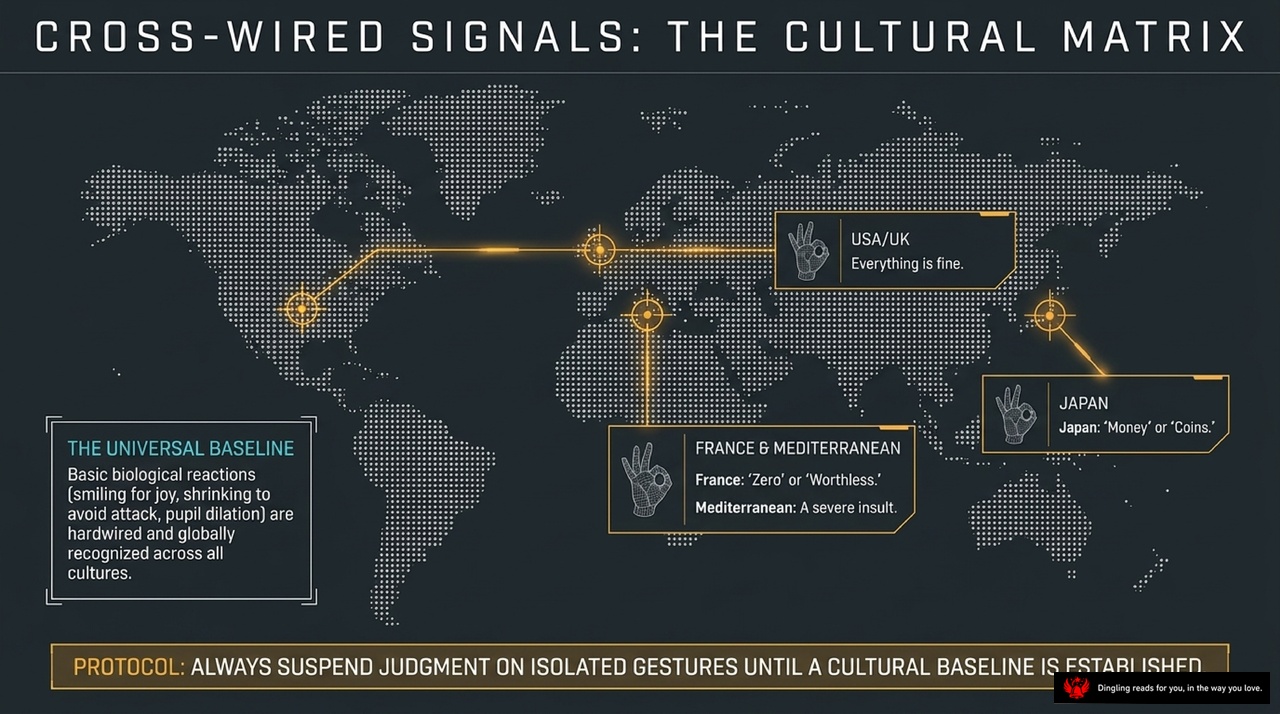
When we look at the world map, we often assume our gestures are universal, but as this slide reveals, they are actually a complex cultural matrix filled with cross-wired signals. While our basic biological reactions—like smiling for joy or shrinking to avoid attack—are hardwired globally, the specific meaning of a simple hand gesture can completely flip depending on where you stand.
Take the "OK" sign, for instance. In the USA and UK, it simply means everything is fine. But travel to Japan, and that same circle represents money or coins. Move to France and the Mediterranean, and it suddenly means "zero" or "worthless." In the Mediterranean region specifically, it can even be a severe insult. These aren't just misunderstandings; they are cultural protocols that can make or break a negotiation.
The lesson here is clear and stated right at the bottom of our protocol: always suspend judgment on isolated gestures until a cultural baseline is established. You cannot interpret a single action in a vacuum. You must understand the context, the location, and the person before you. By recognizing these cross-wired signals, we stop reacting to our own cultural biases and start truly connecting with people from different backgrounds, turning potential conflicts into successful cross-cultural communication.

Look at this "Mirroring Protocol" dashboard. It visualizes something fascinating: biometric synchronization. When two people are in sync, their frequency matches at 98.5%, their postures mirror each other, and the rapport index hits high. This isn't just sci-fi; it's a real psychological tool called the "Mirroring Protocol."
The core concept here is subconscious synchronization. In cooperative environments, we naturally mimic each other's posture, gestures, and even blink rates. It's an evolutionary survival tool that signals, "I am like you." The data in the middle shows "Phase Alignment: Optimal," which is the sweet spot for building trust.
However, there's a significant gender gap to consider. The chart shows that women naturally mirror other women four times more often than men mirror other men. This makes female groups highly cohesive and explains why women often excel at building rapport instantly.
But here is the strategic application: you can artificially engineer goodwill by subtly adopting a counterpart's posture and vocal tone. Just remember the warning at the bottom: never mirror defensive or negative gestures, like crossed arms. If you mimic someone's open stance, you create an invisible bond. If you copy their closed-off body language, you only reinforce the barrier. Master this protocol, and you turn simple conversation into a powerful connection.

So, you've just unlocked the ultimate cheat code for human interaction. By bypassing the noise of spoken words, you've accessed the biological source code of how we actually connect. When you master this biometric framework—reading the micro-frictions of deception on a face or spotting the spatial radars of territorial defense—you stop being a passive listener and become a conscious observer of reality.
But here is the million-dollar question: What will you do with the secrets people are already telling you without saying a single word?
Think about it. We spend so much time decoding sentences, but the real story is happening in the silence. It's in the way someone crosses their arms to build a wall, the subtle shift of a foot pointing toward the exit, or the micro-expression that betrays a lie before the words even leave the mouth.
This isn't about mind-reading magic; it's about seeing what everyone else is blind to. Whether you're in a high-stakes negotiation, navigating a complex office dynamic, or just trying to understand a friend better, these silent signals are the difference between guessing and knowing.
The power to read these secrets is now in your hands. The stage is set. Now, it's up to you to decide how you're going to use this advantage to change your interactions forever.