
The Ecology Of Chinese Culture: Complete Chapter-by-Chapter Summary

Welcome to our exploration of "The Ecology of Chinese Culture," a journey deeply rooted in the groundbreaking work of Feng Tianyu, He Xiaoming, and Zhou Jiming. Today, we are stepping onto the map of East Asia to understand the invisible forces that shaped one of the world's most enduring civilizations.
We aren't just looking at a static history; we are examining the dynamic interplay between geography, economy, and society. Think of it as a complex ecosystem where the vast, diverse landscape of China—from its fertile plains to its rugged mountains and long coastline—provided the stage for a unique cultural performance. Unlike ancient Egypt or Mesopotamia, which were confined to narrow river valleys, China's expansive geography offered immense flexibility, allowing culture to flourish in multiple directions and shift its center over millennia.
But here is the crucial insight: geography sets the possibilities, but human choice writes the story. While the land provided the material foundation, it was the ingenuity of the Chinese people, adapting to this vast environment, that forged a civilization capable of surviving and evolving for thousands of years. From the early agricultural roots to the complex social structures that followed, every element of this culture is a response to this unique ecological stage. We are about to unpack how these forces combined to create a civilization that is both deeply rooted in its land and remarkably adaptable to change.

Let's talk about the invisible foundation of our civilization. Look at this diagram: it breaks down cultural ecology into three essential pillars that hold everything together.
First, we have the Geographic Environment, labeled here as "The Stage." Think of this as the physical container of our lives. It's not the only factor, but it sets the rules of the game—defining what is possible and what is a survival constraint for us.
Second, there's the Economic Soil, or "The Nutrients." This is how we produce and sustain ourselves materially. It's the direct result of how we interact with that environment, shaping our tools, technologies, and daily rhythms.
Third, we have the Social Structure, acting as "The Framework." This is the architecture of our human relationships and power dynamics—the invisible glue that organizes our society.
Notice how the central sphere, Culture, isn't sitting on top of these elements as if designed by some distant sage. Instead, it is organically grown right out of the soil. It emerges from the specific limits and possibilities of this unique combination of stage, nutrients, and framework. This is why our culture looks the way it does—it's a natural response to the world we were born into.

Look at this 3D model of China. It illustrates a crucial concept: Continental-Coastal Confinement. Imagine our geography as a giant, semi-closed incubator. On one side, we have "The Walls"—the Pacific Ocean, the Himalayan Plateau, and the arid steppes. These natural barriers acted like protective shields, keeping us safe from fatal external disruptions for thousands of years.
Inside this protected basin lies "The Interior," a vast area of immense geographic diversity. From the fertile river plains to the towering mountains and expansive grasslands, this variety allowed our culture to rotate and evolve without collapsing. Because we were isolated yet rich in resources, we developed a unique psychological complex: the belief that we were the center of the world. This geography didn't just protect us; it bred an enduring "World Center" mindset, shaping a culture that was resilient, unified, and confident in its own destiny.
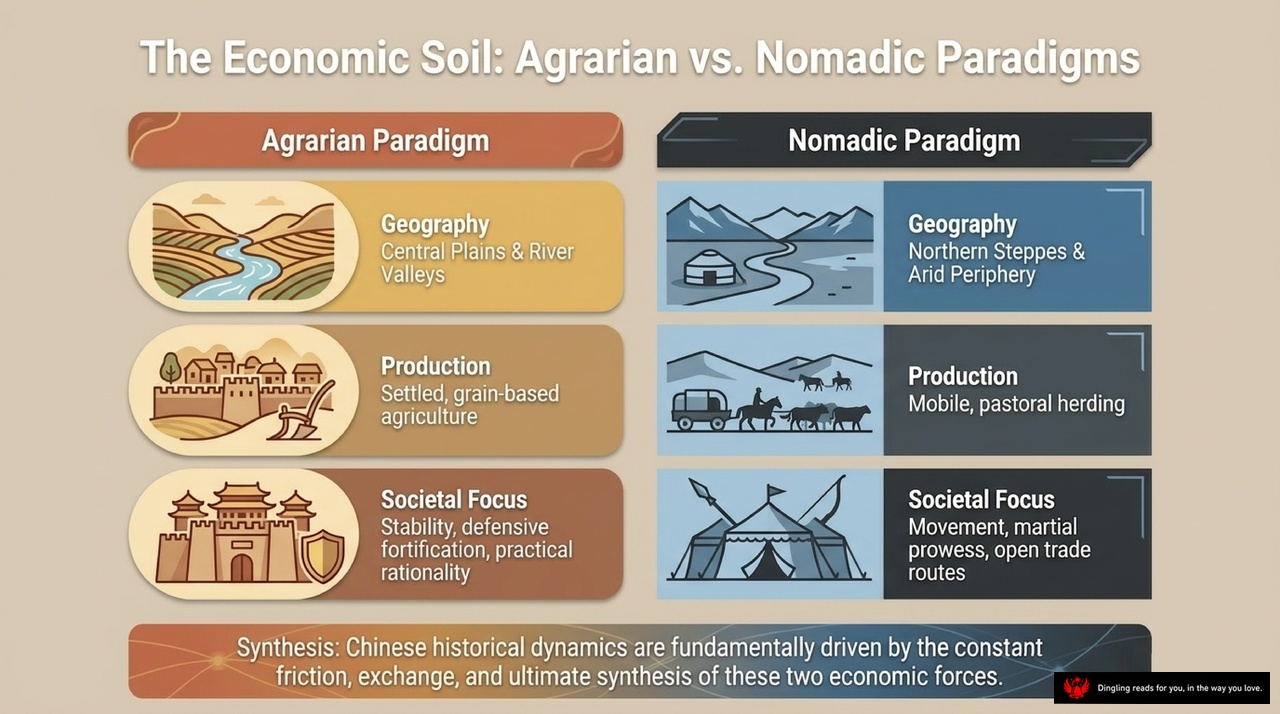
Let's dive into the deep roots of Chinese civilization. Think of culture not as a static museum exhibit, but as a living ecosystem shaped by the land, the economy, and the society we built together. Today, we're looking at how these forces collided to create something unique.
First, consider the soil. Unlike the Nile or Tigris-Euphrates, which confined ancient civilizations to narrow river valleys, China's cradle was vast and diverse. From the fertile plains of the Yellow River to the arid steppes of the north, this geography offered multiple possibilities rather than a single destiny. It allowed for a diversity of cultures and even the shifting of political centers from north to south over millennia.
But the land alone isn't enough; it's the economic soil that truly defined us. A sharp divide runs through East Asia, separating the wet, settled agrarian zones from the dry, mobile nomadic steppes. This contrast created a dynamic tension. On one side, farmers built stable, defensive societies focused on grain and stability. On the other, nomads thrived on mobility, martial prowess, and open trade routes. For thousands of years, these two worlds pushed against each other—building the Great Wall, engaging in fierce conflicts, yet also exchanging goods, technologies, and ideas.
This friction wasn't just destructive; it was creative. The constant exchange between the agrarian and nomadic paradigms forced innovation and adaptation. It shaped a culture that valued pragmatism, stability, yet remained open to change. It forged a society where the internal structure of the family mirrored the state, blending ethical living with political order.
Ultimately, Chinese history is a story of synthesis. It's the result of this constant friction and exchange between these two powerful economic forces. By navigating the tension between the settled and the mobile, the defensive and the open, our ancestors built a resilient, adaptable, and uniquely rich civilization that continues to evolve today.

Let's dive into the roots of Chinese civilization. Unlike the narrow river valleys of Egypt or Mesopotamia, China's cultural cradle was vast and diverse, stretching from the Yellow River to the Yangtze and beyond. This expansive geography fostered a "polycentric" origin, where distinct regional cultures like the romantic, artistic spirit of Chu and the ritualistic, pragmatic ethos of Qi merged to form a unified whole. The dragon totem itself is a symbol of this unity, crafted from the fusion of various tribal spirits.
As we moved from the matriarchal clans of the Neolithic era into the patriarchal Bronze Age, the social structure shifted dramatically. The Shang Dynasty saw the rise of a powerful priestly class who controlled both the spiritual and political realms, while the Zhou Dynasty introduced a revolutionary concept: "The Mandate of Heaven." This shifted the focus from blind worship of ghosts to the importance of human virtue and the welfare of the people. This human-centric turn laid the foundation for everything that followed.
The true explosion of Chinese thought happened during the Spring and Autumn and Warring States periods, often called the "Axial Age" of our civilization. It was a time of unprecedented chaos but also brilliant intellectual freedom. The collapse of the old aristocratic system gave rise to the "Shi" class—a new group of scholars, strategists, and thinkers who weren't tied to land or birthright. This led to the legendary "Hundred Schools of Thought." Confucius emphasized ritual and benevolence; Mozi advocated universal love; Laozi championed non-action; and Legalists pushed for strict laws. This vibrant debate established the core values and philosophical framework that still defines Chinese culture today.
Following this, the Qin Dynasty unified the fragmented states, standardizing everything from writing and currency to laws. However, their harsh rule and cultural suppression, like the burning of books, ultimately led to their quick collapse. The Han Dynasty that followed learned from this mistake. By adopting "Rule by Confucianism," they stabilized the empire and made the scholar-official system the backbone of society. This era also saw incredible achievements in history, literature, and technology, including the invention of paper and the opening of the Silk Road, connecting China to the wider world.

Welcome back to our exploration of China's cultural evolution. Today, we are diving into the Ming and Qing dynasties—a period defined by a striking duality. On one hand, the early Ming saw strict cultural suppression, with the "Eight-Legged Essay" stifling creativity and harsh purges silencing dissent. Yet, as the dynasty progressed, a vibrant transformation emerged. The rise of powerful merchant groups like the Hu and Jin clans broke traditional social hierarchies, fueling a boom in popular literature that celebrated human desire and true love, challenging centuries of rigid orthodoxy.
Simultaneously, a fascinating cross-cultural exchange began. Jesuit missionaries like Matteo Ricci arrived, bringing Western science and technology to China. While some scholars resisted, others like Xu Guangqi embraced this "Western learning," collaborating on groundbreaking works that blended Chinese wisdom with global knowledge. This era also saw a golden age in science, with monumental achievements in botany, agriculture, and acoustics that still stand today.
As we moved into the Qing dynasty, the narrative shifted from confrontation to profound integration. Despite initial conflicts over dress and customs, the Manchu rulers eventually embraced Han culture, while Han society absorbed Manchu elements, creating a unified multi-ethnic identity. This fusion culminated in the massive compilation of the *Siku Quanshu*, a true encyclopedia of Chinese civilization. However, the closing of China's borders during the late Qing years created a dangerous isolation, leaving the nation unaware of the global storm approaching.
It was the Opium War that shattered this complacency. The failure of the "Self-Strengthening Movement" to modernize China's institutions proved that learning Western technology without reforming the underlying system was insufficient. This painful realization paved the way for the Hundred Days' Reform and eventually the Revolution of 1911, which ended two millennia of imperial rule. But the true intellectual awakening came with the New Culture Movement. Led by figures like Chen Duxiu and Lu Xun, this movement boldly critiqued feudal traditions, championing democracy and science, and replacing classical Chinese with vernacular language to make ideas accessible to all.
Ultimately, this era was not just about rejecting the past, but about forging a new path. From the rise of Marxist thought to the creation of a modern national culture, China learned to balance its unique heritage with the necessities of the modern world. This journey of self-renewal laid the essential groundwork for the cultural confidence and global engagement we see today.
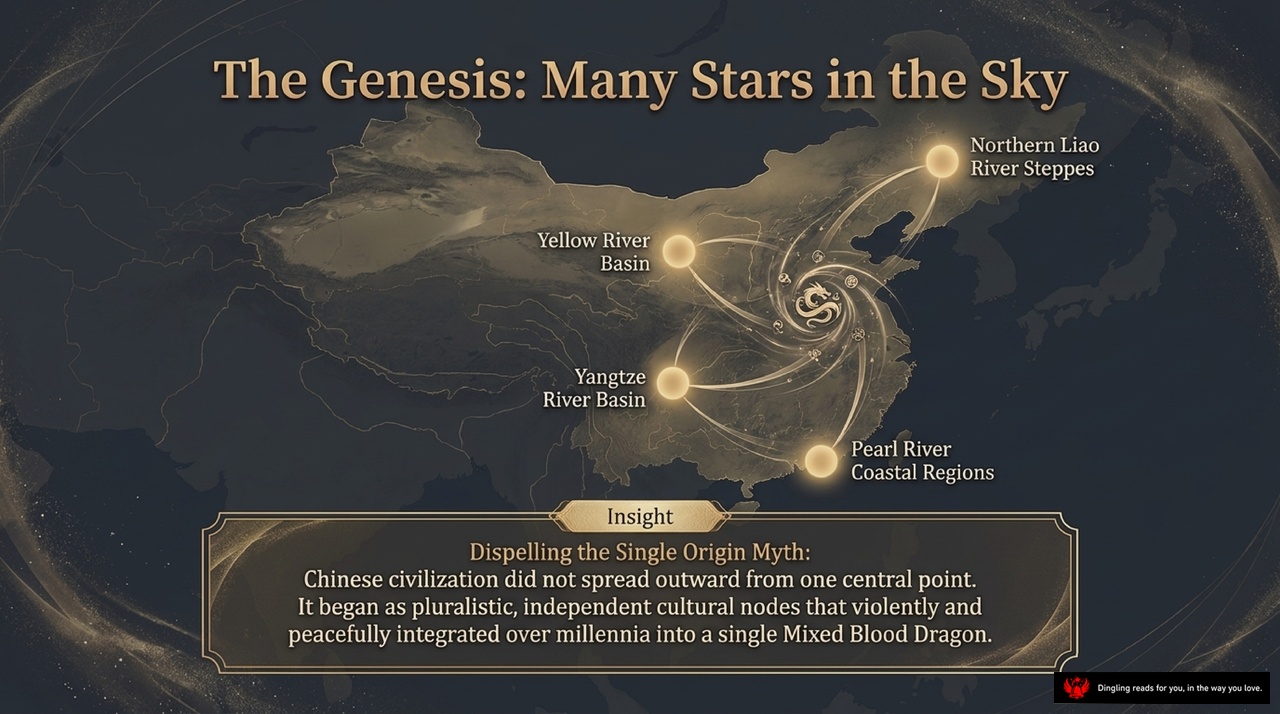
The Genesis: Many Stars in the Sky. Look at this map. For centuries, the story went that Chinese civilization sprang from a single point, radiating outward like a ripple in a pond. But the evidence tells a different story. It didn't start from one center. It began as many stars in the sky. From the Northern Liao River Steppes to the Yellow River Basin, the Yangtze River Basin, and the Pearl River Coastal Regions, independent cultural nodes rose up across the vast land. These weren't just isolated tribes; they were vibrant, distinct civilizations that eventually integrated—sometimes through conflict, often through peace—into what we now call the Mixed Blood Dragon. This is the reality of our origins: not a single spark, but a constellation of stars that came together to light up the world.
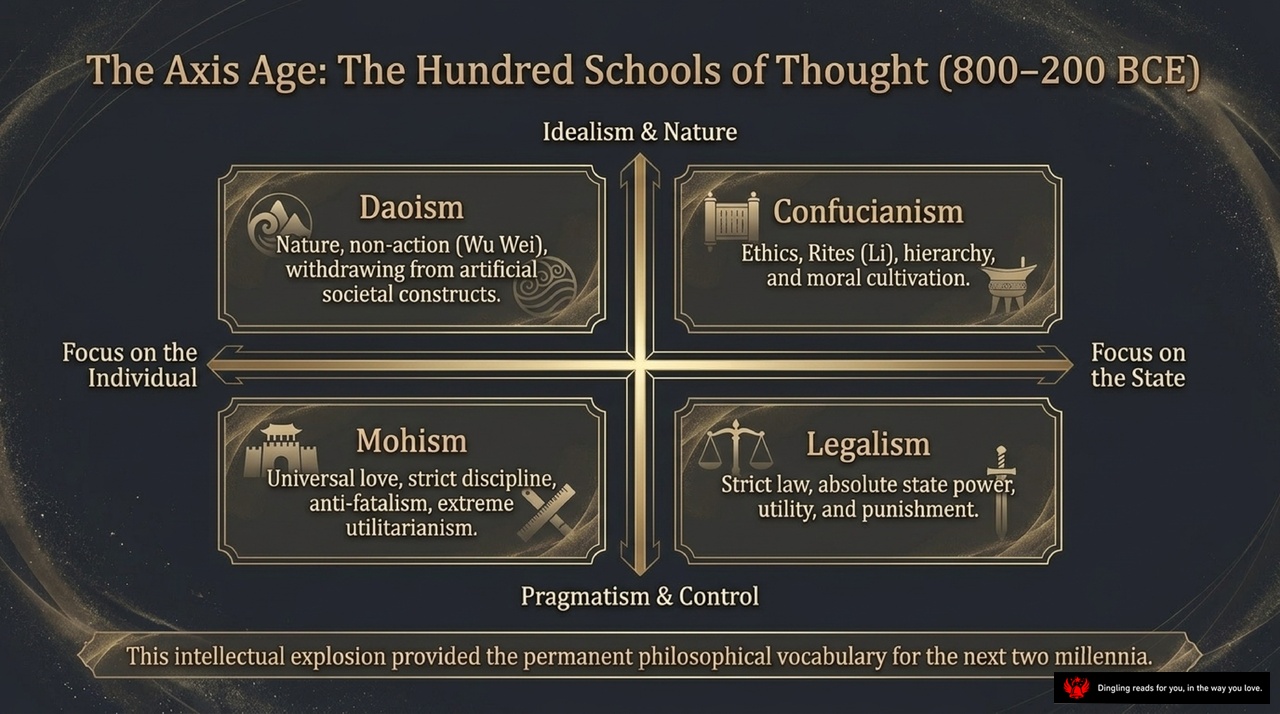
The Axis Age: The Hundred Schools of Thought (800–200 BCE) marked a pivotal moment in human history, a true intellectual explosion that shaped the next two millennia. This era wasn't just about ancient China; it was a global crucible where the fundamental vocabulary of philosophy was forged.
As the slide illustrates, we can map these diverse schools of thought using two powerful axes: the focus on the individual versus the state, and idealism versus pragmatism.
In the top-left quadrant, we find Daoism. Focusing on the individual and embracing idealism, Daoism champions nature and the concept of *Wu Wei*—non-action. It teaches us to withdraw from artificial societal constructs and flow with the natural order.
Directly across in the top-right is Confucianism. While still individual-centric in its pursuit of moral cultivation, it leans heavily on ethics, rites, and hierarchy. It believes that through rigorous self-improvement and social responsibility, we can create a harmonious society.
Moving down to the pragmatic side, we see Mohism in the bottom-left. This school focuses on the individual but with a sharp, utilitarian eye. It advocates for universal love and strict discipline, rejecting fatalism in favor of active, practical solutions for the greater good.
Finally, in the bottom-right, we have Legalism. This is the ultimate focus on the state. It prioritizes pragmatism and control through strict laws, absolute state power, and the use of utility and punishment to maintain order.
Together, these four schools—Daoism, Confucianism, Mohism, and Legalism—created a dynamic tension that defined Chinese culture. They provided a permanent philosophical framework, allowing future generations to debate governance, ethics, and the nature of reality with a rich, enduring vocabulary. This was the birth of a civilization's conscience.
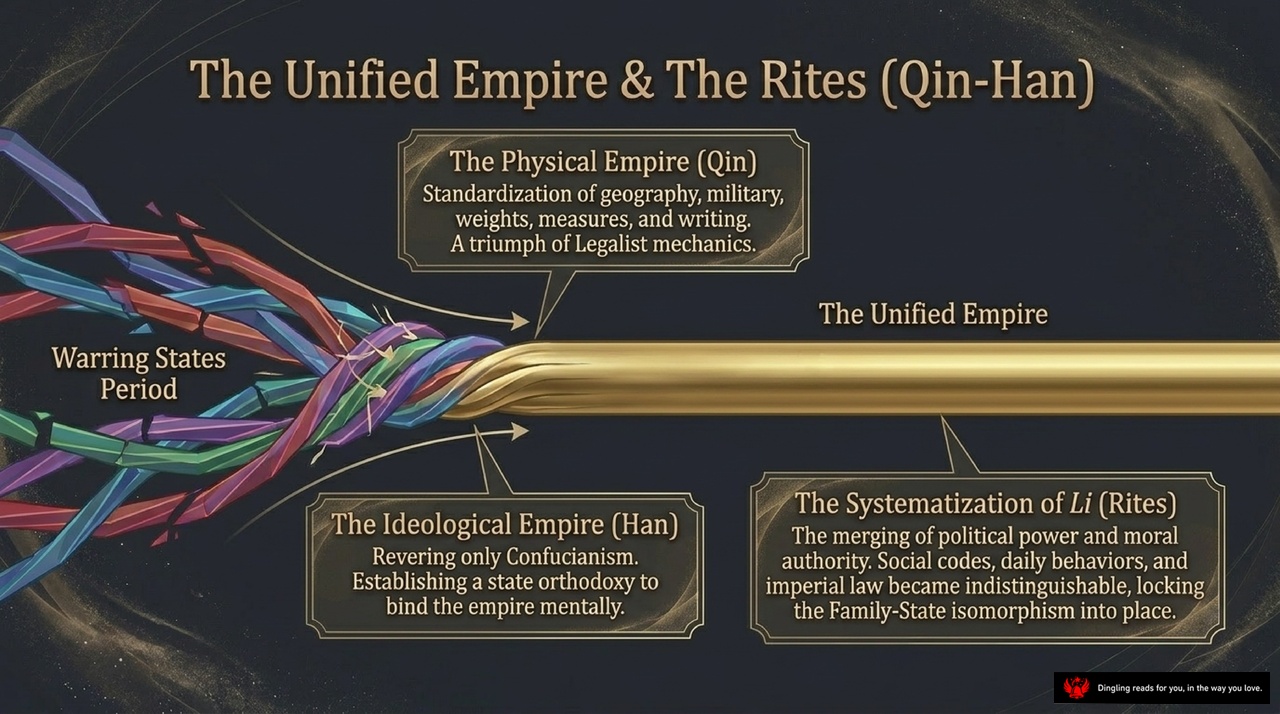
Imagine the chaotic tapestry of the Warring States Period as a bundle of colorful, tangled threads—representing the diverse and fragmented cultures of ancient China. Now, watch how history weaves these strands into a single, golden cord: The Unified Empire. This transformation wasn't just about conquering land; it was about forging a shared identity through two powerful forces.
First, look at the Qin Dynasty. They built the "Physical Empire" by standardizing geography, military, weights, measures, and writing. It was a triumph of Legalist mechanics, creating a unified infrastructure that made governance possible across vast distances. But a physical empire isn't enough to hold a nation together mentally. That's where the Han Dynasty stepped in to create the "Ideological Empire." By revering only Confucianism, they established a state orthodoxy that bound the people's hearts, turning a collection of subjects into a cohesive people.
Finally, notice how the "Systematization of Li," or Rites, completed this unification. This was the merging of political power with moral authority. Social codes, daily behaviors, and imperial law became indistinguishable, locking the concept of the Family-State isomorphism into place. In essence, the Han Dynasty took the rigid structures of the Qin and softened them with Confucian ethics, creating a stable, enduring civilization where the family and the state mirrored each other perfectly. This fusion of law, ritual, and ideology is what allowed Chinese culture to survive and thrive for millennia.

Imagine culture not as a static museum exhibit, but as a living, breathing machine—a sophisticated digestive engine that processes raw materials into something entirely new. This is the mechanism of cultural fusion.
Look at the input on the left. For China, this meant absorbing foreign elements like Indian Buddhist philosophy and nomadic martial traditions. These weren't just foreign imports; they were raw ingredients pouring into the system. But simply adding them wouldn't work. The magic happened in the middle: the process. This was the "digestive engine," where Sinicization took place. Foreign concepts were modified to fit the unshakeable, agrarian-patriarchal framework that defined Chinese society. It was about making the new feel like the old, integrating the unfamiliar into the familiar.
The result? A powerful output of new Chinese syntheses. You see the creation of Chinese Zen Buddhism, where Indian mysticism merged with local Daoist and Confucian sensibilities. You see the intellectual restructuring into Neo-Confucianism, blending Buddhist logic with traditional ethics. And finally, you see the export of this mature, refined culture back to Japan and Korea, influencing their own national identities.
This diagram illustrates a profound truth: cultural strength comes not from isolation, but from the ability to digest the world around you, transform it, and spit out something stronger and more unique.
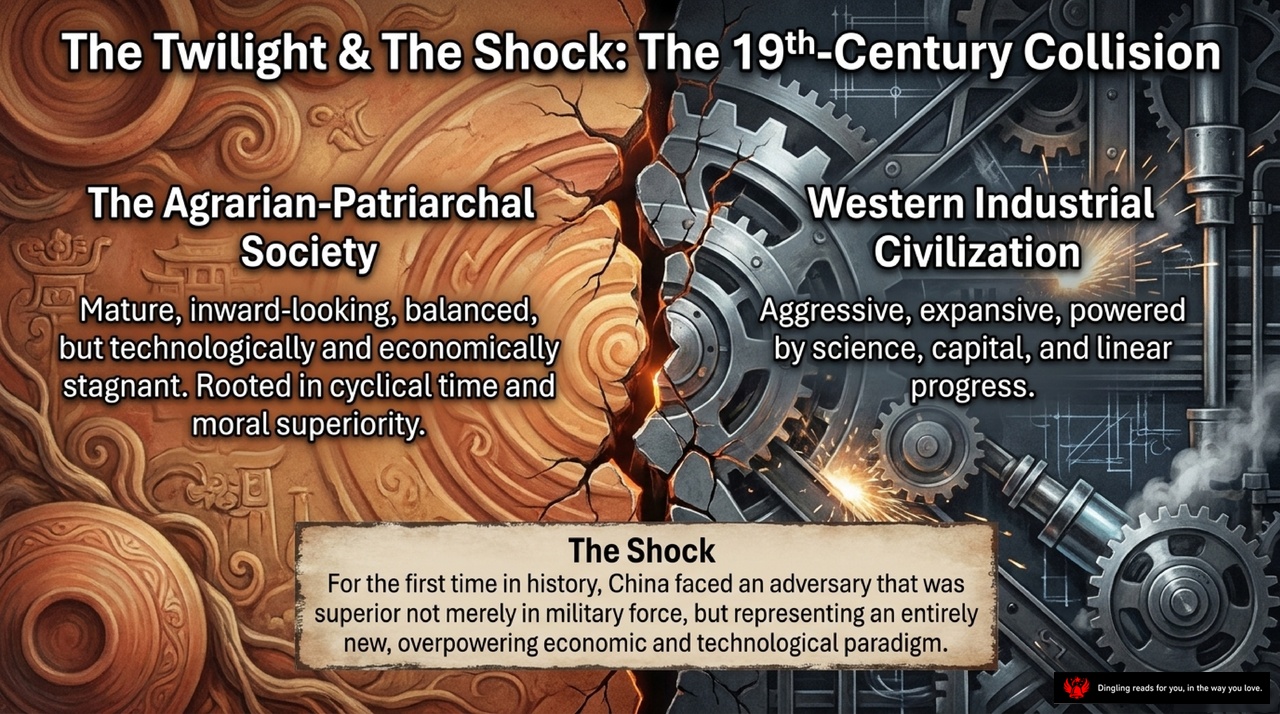
The image vividly captures the defining moment of the 19th century: a violent collision between two vastly different worlds. On the left, we see the "Agrarian-Patriarchal Society"—mature, inward-looking, and balanced, yet technologically stagnant, rooted in cyclical time and a deep sense of moral superiority. This represents the traditional Chinese order for millennia. On the right stands the "Western Industrial Civilization"—aggressive, expansive, and powered by science, capital, and the relentless belief in linear progress. The crack running down the center symbolizes the inevitable shock of this encounter.
For the first time in history, China faced an adversary that was superior not merely in military force, but in representing an entirely new, overpowering economic and technological paradigm. This wasn't just a battle of armies; it was a clash of civilizations where the old ways of cyclical time and agrarian stability were challenged by the new logic of industrial expansion. This moment of "The Shock" marked the end of China's long twilight and forced a painful, transformative awakening, setting the stage for the modern era we know today.

Today's slide, "The Awakening Staircase," visualizes a profound journey of China's modernization—a path from simply buying foreign tools to fundamentally reshaping the nation's soul. It breaks this transformation into three critical steps.
First, we see **Step 1: Objects**, labeled "Self-Strengthening." This represents the initial, often desperate, attempt to adopt Western guns, ships, and industry while stubbornly keeping the traditional Confucian system completely intact. It was a strategy of trying to modernize the hardware without touching the software, a realization that soon proved insufficient.
Moving up the stairs, we arrive at **Step 2: Institutions**, defined here as "Reform & Revolution." This is the agonizing shift where leaders finally recognized that advanced technology requires modern software. It was a painful but necessary step to abolish the monarchy and adopt Western political systems, understanding that you cannot run a modern industrial engine on an ancient feudal operating system.
Finally, at the summit, stands **Step 3: Culture**, representing the May Fourth Movement. This is the ultimate realization that changing governments is useless without changing the mind. It calls for the radical adoption of Science and Democracy to forge a new National Character. This step acknowledges that true awakening happens not just in the streets or the factories, but in the minds of the people, completing the ascent from mere objects to a fully awakened civilization.
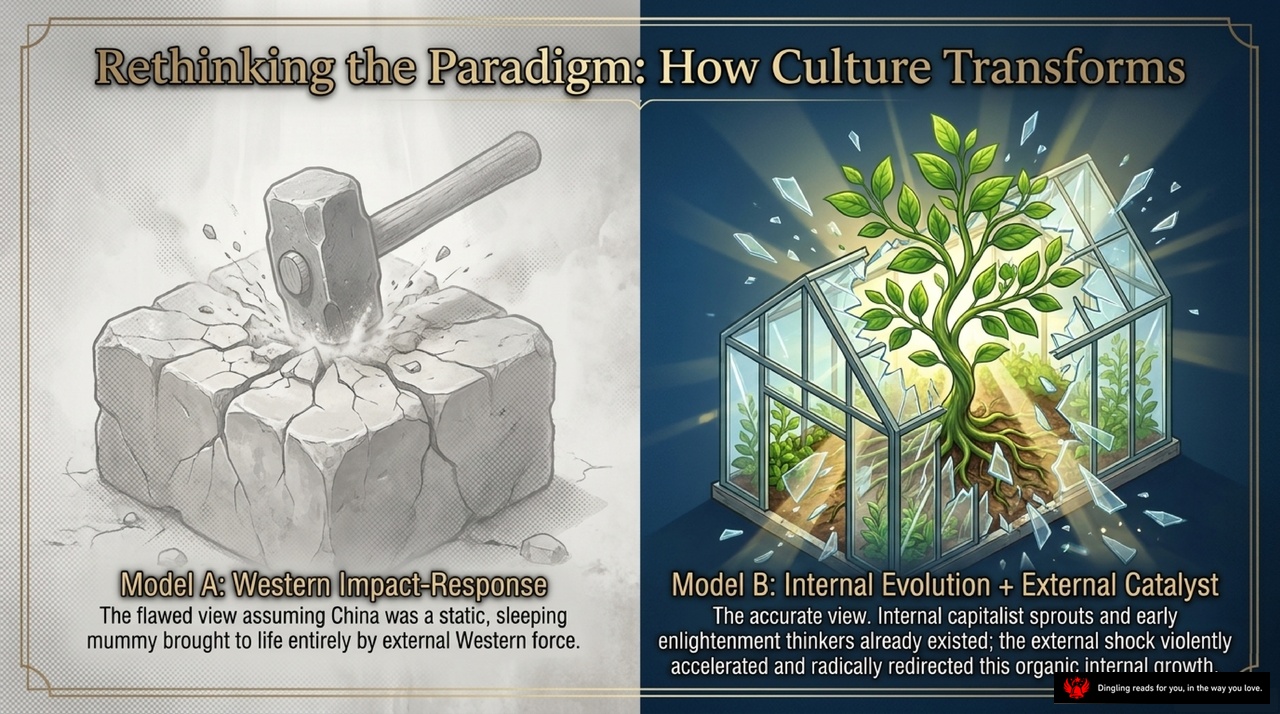
Today, we need to completely rethink how we view cultural transformation. For too long, the dominant narrative has been what we call "Model A: Western Impact-Response." This flawed perspective treats China as a static, sleeping mummy—completely inert and lifeless—until an external Western force violently smashed the stone and brought it to life. It assumes China had no internal momentum, no sprouts of its own, and that everything changed solely because of an outside shock.
But history tells a different story. The accurate view, which we call "Model B," is one of "Internal Evolution plus External Catalyst." Long before the West arrived, internal capitalist sprouts and early enlightenment thinkers were already growing quietly within Chinese society. The external shock didn't create the culture from scratch; instead, it violently accelerated and radically redirected this organic, internal growth. Think of it like a greenhouse: the plant was already rooted and growing inside, but the sudden breakage of the glass walls allowed sunlight and new air to flood in, causing an explosion of growth that the plant would never have achieved on its own in the dark.
We must stop seeing our history as a story of being passive victims of foreign impact. Instead, we must recognize the powerful, inherent vitality that was always present within our civilization, waiting for the right moment to burst forth and transform the world.
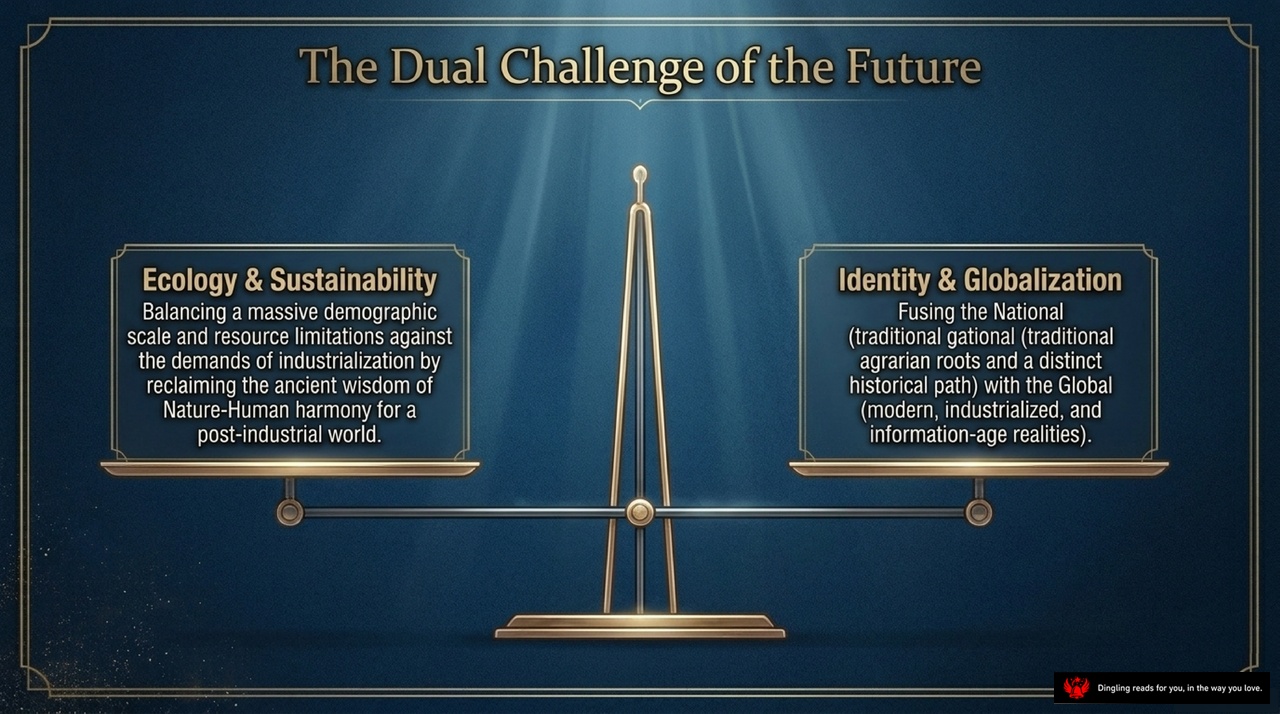
Today's slide presents "The Dual Challenge of the Future," a powerful metaphor for the two heavy weights we must balance to build a post-industrial world. On one side, we have Ecology and Sustainability. This isn't just about saving trees; it's about the hard reality of balancing our massive population against limited resources while moving away from industrialization. We need to reclaim the ancient wisdom of Nature-Human harmony, finding a way to thrive without destroying the planet that sustains us.
On the other side sits Identity and Globalization. This is the struggle to fuse our deep national roots—our traditional agrarian history and distinct cultural path—with the fast-paced, industrialized realities of the modern global age. We are asked to honor who we are while fully engaging with a connected world.
As we move forward, remember that true progress lies not in choosing one side over the other, but in finding the delicate equilibrium between preserving our ecological future and forging a global identity that respects our unique heritage.

Chinese culture didn't survive the last few thousand years by locking itself away in isolation. Instead, it thrived through a continuous cycle of self-preservation and self-renewal. Think of it as a resilient organism that takes its deep agrarian and philosophical roots and uses them to absorb foreign shocks and internal revolutions, adapting to change rather than resisting it.
Now, look at the world we live in today. We are entering a fractured post-industrial age, where old structures are crumbling and uncertainty is everywhere. In this context, a powerful question arises: Can the ancient Chinese wisdom of harmony and integration provide the blueprint the world actually needs to survive itself?
While the West often focuses on competition and expansion, Chinese philosophy has long championed the balance of opposites and the unity of all things. This isn't just about history; it's about offering a different operating system for human civilization. As we face global crises, that ancient emphasis on integration might just be the key to our collective future.