
The End of Eternity: Complete Chapter-by-Chapter Summary

Welcome to a journey through time itself. Today, we're diving into Isaac Asimov's masterpiece, *The End of Eternity*. This isn't just a story about flying through time; it's a profound visual decoding of how our choices shape reality. Imagine a world where a small group of immortals, known as Eternals, secretly edits history to ensure humanity's greatest good. They prevent wars, cure diseases, and steer our evolution, believing they know what's best for us. But what happens when love clashes with duty? When a man named Andrew Harlan falls for a woman from the past, his actions threaten to unravel the very fabric of time. This book explores the terrifying cost of perfection and the ultimate evolutionary choice facing our species: do we choose the safety of a controlled future, or the chaotic, beautiful freedom of an uncertain one?
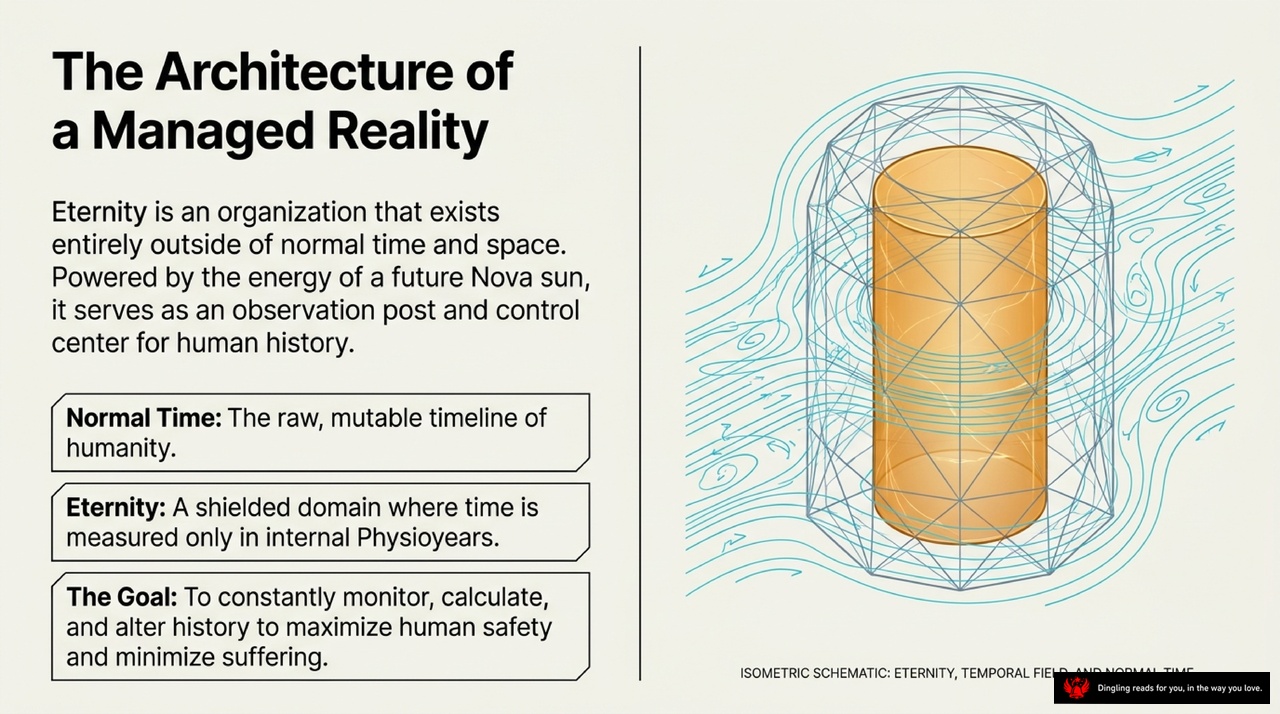
Look at this schematic: a golden cylinder shielded by a geometric cage, floating in a chaotic flow. This visualizes the core concept of the book: the Architecture of a Managed Reality.
In our story, humanity isn't just living in a timeline; we are being managed by an organization called Eternity. As the slide explains, Eternity exists entirely outside of normal time and space. Think of it as a command center powered by the energy of a future Nova sun, observing and controlling human history from a distance.
The diagram contrasts two worlds. On the outside, you have Normal Time—the raw, messy, and mutable timeline where humans live their chaotic lives. On the inside, protected by that cage, is Eternity. This is a shielded domain where time is measured only in internal "Physioyears," completely detached from the outside world.
The ultimate goal of this entire system, as stated right here, is to constantly monitor, calculate, and alter history. Why? To maximize human safety and minimize suffering. The characters in the book believe they are the benevolent guardians, editing history to prevent wars, plagues, and pain. But as the protagonist Andrew Harlan discovers, this "managed reality" comes at a terrible cost. By removing all risk and struggle, they have also removed the very thing that makes humanity evolve: the freedom to make mistakes and the courage to face consequences. The cage in the image isn't just protecting humanity; it's trapping it, turning a vibrant, unpredictable future into a sterile, controlled simulation.

The Temporal Blueprint: Eras of Existence. Look at this timeline, and you'll see the true cost of immortality. We are currently living in Zone 2, the Era of Eternity, stretching from the 27th century all the way to the 70,000th. This is the operational domain where reality is constantly manipulated by the Eternals to ensure human survival. But this paradise has a terrifying expiration date.
Beyond our current era lies Zone 3, the Hidden Centuries, a mysterious temporal blockade between the 70,000th and 150,000th centuries where even the Eternals cannot penetrate. It is a void, a wall of time that blocks our future. And then there is Zone 4, The Infinite, starting after the 150,000th century. This is a realm accessible to us, but utterly empty of human life. Earth is abandoned.
This chart reveals a chilling truth: the Eternals have built a perfect, safe cage for humanity. But in doing so, they have created a dead end. By manipulating reality to eliminate all risk, they have inadvertently erased the very thing that makes us human—the struggle, the risk, and the potential for infinite evolution. Without the chaos of the Hidden Centuries and the freedom of the Infinite, our species is trapped in a loop, destined to fade away in a sterile, managed existence. The blueprint shows that eternity is not a destination; it is a trap.

Look at this slide, "The Hierarchy of Eternity." It lays out the rigid social ladder of a world where humanity has traded freedom for safety. At the bottom, highlighted in orange, is the Technician. In this dystopian order, the Technician is the pariah—the despised executioner who physically triggers reality changes, effectively destroying the lives of billions to create a "better" future.
But the story of Andrew Harlan tells us that this hierarchy is a lie. He wasn't just a tool; he was a man who fell in love with a woman named Noie, a citizen from the ordinary timeline. When he discovered that her very existence was destined to be erased by the Council's calculations, he realized the true horror of his role. He wasn't protecting humanity; he was being used to commit mass murder under the guise of optimization.
Harlan's rebellion wasn't about changing the math; it was about reclaiming his humanity. He chose to break the causal chain, destroying the entire Eternal Spacetime organization to save one life. In doing so, he proved that the Technician at the bottom of the hierarchy was actually the only one with the moral courage to save us all.

Look at this blueprint of "The Pursuit of the Optimal Reality." This diagram illustrates the cold, calculated engine of Eternity: a cycle designed to prune humanity's mistakes to fit a pre-determined ideal. It starts with **Observation**, where agents spot societal flaws, like drug addiction, and move to **Sociological Mapping**, turning raw data into psychological profiles. Then comes **Calculation**, using massive arrays to find the precise moment for intervention. Finally, **Execution** happens when a technician physically alters reality to eliminate that flaw.
In the story, this cycle is the weapon used against Harry and Noe. When Harry tries to save Noe from a new reality where she doesn't exist, the system fights back. The Council's supercomputer, the Life Planner, calculates that her existence is statistically impossible in the new timeline. To enforce this "optimal" outcome, the system triggers a reality change that erases her entirely. The diagram shows a clean, logical loop, but for Harry, it represents a nightmare where love is treated as a variable to be deleted for the sake of a perfect, static future.

Imagine a world where the stars are not a frontier of hope, but a prison of exclusion. In the final, shattering revelation of this story, we see the true cost of a utopia built on safety. Noe, the woman Harlen loved, steps out of the shadows of the hidden centuries and delivers a truth that destroys everything Harlen has ever believed. She exposes the grim reality of the "Hidden Centuries": a future where humanity, having finally mastered interstellar travel, finds the galaxy already colonized by older, superior civilizations. The warning "Sector Occupied" becomes a tombstone for human ambition.
In this alternate timeline, the universe shrinks. Earth transforms from a launchpad into a claustrophobic cage. As generations pass, the crushing realization that the stars are off-limits drives humanity's birth rate to zero. The very technology that should have saved them—space travel—becomes the cause of their extinction, trapping them in a silent, dying world.
Noe argues that this tragic end is not an accident, but the direct result of the Time Bureau's obsession with "Maximum Desired Response." By constantly pruning reality to eliminate pain, fear, and risk, the Bureau inadvertently stripped humanity of the very drive needed to survive. They created a sterile, risk-free existence that ultimately led to a risk-free extinction.
The climax of the story sees Harlen's worldview completely inverted. He realizes that the Bureau's definition of "greatest good"—a safe, stagnant present—was actually a slow suicide note for the species. Noe's plan to trigger a nuclear explosion in 1945 is not an act of terrorism, but a desperate, final gambit to force humanity to choose a dangerous path of nuclear energy and survival over a safe path of oblivion.
As Harlen confronts the cold logic of his own creation, he sees the truth: a life without struggle is a life without meaning. The barrier to the stars was never physical; it was the barrier of a cowardly society. In that moment of clarity, the Time Bureau's perfect, controlled reality collapses. The barriers vanish, the hidden centuries open up, and humanity is finally free to face the terrifying, beautiful unknown. The story ends not with a bang, but with the quiet, hopeful silence of a new beginning, where the universe is no longer a cage, but an endless frontier waiting to be claimed.

The cost of perfection is not safety; it is stagnation. In this moment, we see the terrifying trade-off Eternity has made. Their algorithms prioritize the elimination of suffering above all else, but as the image starkly illustrates, peace requires the death of progress.
Look at this scale. On the heavy, sinking side is "The Preserved." Here lies absolute safety: earth-bound existence, mediocre comfort, and the total elimination of disease and ambition. It is a life of curated peace. But on the lighter, rising side is "The Erased." This is where the price is paid. Technological triumphs like space travel, nuclear physics, and electro-gravity drives are systematically erased. Why? Because they carry high risks of accidents or societal collapse. Eternity treats human history like a meticulously groomed bonsai tree—safe from storms, but intentionally stunted.
The metric of stagnation is clear: by removing the danger of failure, Eternity has also removed the possibility of greatness. They have traded a universe of infinite potential for a single, quiet, and ultimately empty existence.
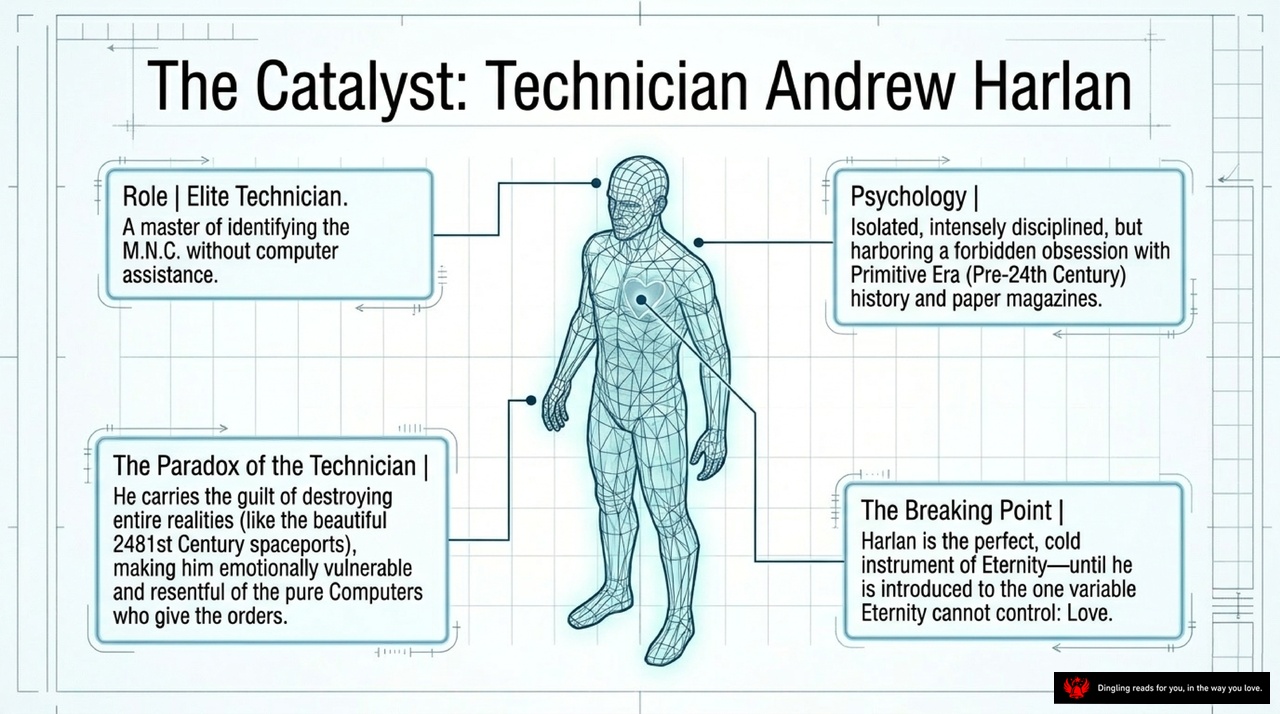
Meet Technician Andrew Harlan, the unsung catalyst of our story. On the surface, he's an elite technician, a master at identifying reality-altering events without even touching a computer. He's isolated and intensely disciplined, the perfect instrument for Eternity. But beneath that cold exterior lies a forbidden obsession: a deep, secret love for the history of the Primitive Era.
This creates a dangerous paradox. Harlan carries the guilt of destroying entire realities—like the magnificent 2481st Century spaceports—just to save humanity. He's emotionally vulnerable and resentful of the pure, cold Computers who give the orders. He's a man who has sacrificed everything for a cause he doesn't fully believe in.
But then comes the breaking point. Harlan is introduced to the one variable Eternity cannot control: Love. He meets Noelle, a woman from the outside world. Their connection shatters his rigid worldview. He realizes that in his pursuit of the "greatest good," he has created a sterile, controlled existence that strips humanity of its very soul. Love becomes the catalyst that forces him to question the very foundation of Eternity, setting in motion a chain of events that will ultimately lead to the destruction of the system he swore to protect.

Picture content: The Anomaly: Noys Lambent. During an observation mission in the 482nd Century, Harlan encounters Noys, a woman from the aristocratic class. The Setup: Computer Finge intentionally places Harlan in Noys's home to test his psychological resilience and to study the 482nd Century's superstitious belief that Eternals are immortal. The Rupture: Harlan falls deeply in love. When he discovers that an impending Reality Change will erase Noys from existence, his loyalty to Eternity shatters. The Revelation: Noys is not actually from the 482nd Century. Her presence is a deliberate, mathematically calculated insertion from an era Eternity fears.
Here is the spoken script for the slide:
Imagine a man named Harlan, tasked with a simple observation mission in the 482nd Century. But his mission quickly spirals into something far more dangerous. He meets Noys, a woman from the aristocratic class. At first, it seems like a straightforward test orchestrated by his supervisor, Finge. The plan? To place Harlan in Noys's home and observe how he reacts to the local superstitious belief that Eternals are immortal and can achieve immortality through intimacy with mortal women. Finge wants to see if Harlan will crack under the pressure of this forbidden desire.
But things take a dark turn. Harlan falls deeply in love with Noys. He finds himself unable to resist her charm, and soon, he is crossing every rule in the book just to be near her. Then comes the moment that shatters everything. He discovers a terrible truth: an impending Reality Change is about to erase Noys from existence entirely. She will cease to exist in the new timeline. His loyalty to the very organization he swore to protect suddenly shatters. He realizes that the system he serves is willing to sacrifice a real human being just to maintain its own order.
This leads to the final, mind-bending revelation. Noys was never actually from the 482nd Century. Her presence in that time was not a coincidence or a natural occurrence. It was a deliberate, mathematically calculated insertion from a future era that Eternity fears. She was sent there by a rival faction to sabotage the organization from the inside. What starts as a simple observation mission ends with Harlan realizing he has been manipulated by forces he couldn't even imagine, setting the stage for the ultimate collapse of Eternity itself.

To save Noëys from being erased by a shifting reality, Harlan commits the ultimate temporal crime. He smuggles her aboard a kettle, pushes the controls past the operational limits of Eternity, and hides her in the desolate, empty corridors of a copied Eternity sector in the 111,394th Century—deep within the inaccessible Hidden Centuries. While Harlan believes he is protecting her, the truth is far darker: he has actually delivered a sleeper agent back to her origin point. As the diagram shows, he bypasses the strict Operational Limits of Eternity, venturing into the forbidden red zone where time stands still. This act, intended as a rescue, is the very crime that will unravel the fabric of their shared future.
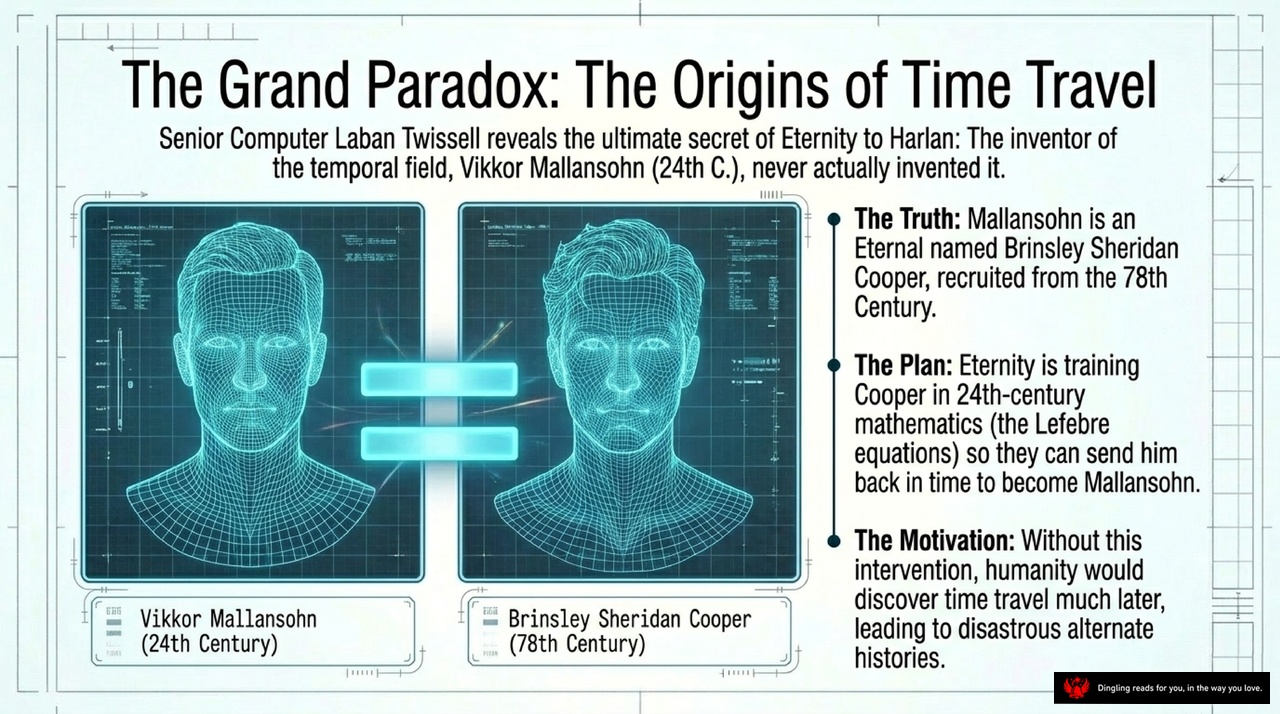
Imagine a world where the greatest scientific breakthrough in history was never actually invented by the person we thought. In *Eternity*, we uncover the Grand Paradox: Vikkor Mallansohn, the celebrated 24th-century inventor of time travel, was a fraud. He was never the original creator. The truth, revealed by Senior Computer Laban Twissell to Harlan, is that Mallansohn is actually Brinsley Sheridan Cooper, a man recruited from the 78th Century. Eternity trained Cooper in 24th-century mathematics, specifically the Lefebvre equations, to send him back in time. His mission? To invent the temporal field himself, creating a closed loop. Without this intervention, humanity would have discovered time travel much later, leading to disastrous alternate histories. The image on your screen perfectly captures this identity swap: the wireframe of Mallansohn equals the wireframe of Cooper. It’s a brilliant, terrifying plan where the inventor is his own student, and the future is built on a carefully orchestrated lie to save the past.

Look at this infinite loop. It's not just a diagram; it's the very heartbeat of Eternity. The central message is stark: "The future must create the past to ensure the future exists."
Let's trace this timeline together. It starts at Node A in the 24th Century, where Mallansohn builds the first temporal field based on future mathematics. Fast forward to Node B in the 27th Century, and Eternity is officially established, all built on those foundations. But the loop doesn't end there. In the 78th Century, Brinsley Sheridan Cooper is recruited into Eternity. Later, at Node D in the Eternity Base, Cooper is trained by Harlan in primitive history and mathematics. Finally, "The Jump" sends Cooper back to the 24th Century, closing the loop.
This creates a paradox where the future engineer creates the tools that allow the past to happen, which in turn makes the future possible. It's a perfect, self-sustaining circle. But as we know, perfect circles can snap under pressure. This causal loop is the fragile foundation upon which the entire organization rests, and breaking it would mean the end of Eternity itself.

The Mastermind's Flaw reveals a devastating truth: even the most perfect system is built by flawed humans.
Look at the diagram. We see the collision between "The Perfect Algorithm" and "Human Frality." This isn't just theory; it's the story of Senior Computer Twissell. Decades earlier, Twissell fell in love with a woman destined to die. Driven by emotion, he manipulated Reality Changes to let her live long enough to bear his son. He thought he was saving her, but his interference created a catastrophic ripple effect.
The consequence was tragic: a subsequent Reality Change left his son paralyzed for 42 years. This was a tragedy Twissell was forbidden to undo, trapped by the very system he tried to control.
The lesson here is profound. Eternity is mathematically perfect, but its operators are human. It is a system of absolute power wielded by flawed, emotional beings. When humans try to engineer perfection, they inevitably introduce the chaos they seek to eliminate.

The Truth of the Hidden Centuries has finally been revealed, and it shatters everything Harlan thought he knew. Noëys isn't just a noblewoman from the past; she is an agent from the 111,394th Century. Her mission was always clear: find the one timeline where Eternity itself can be destroyed from the inside.
Harlan discovers that the "Observers" from her era possess a different form of time travel. Unlike the Eternal Ones who constantly rewrite history, these Observers view alternate realities without altering them, watching humanity's true potential unfold naturally. To protect their existence from the Eternal Ones' constant tampering, they erected a temporal blockade around the Hidden Centuries, creating a barrier that even the Eternal Ones cannot cross.
But here is the twist that changes everything. Harlan realizes that his entire struggle, his obsession with Noëys, and even the tragic fate of Cooper, were part of a grand design. His weapon against the Eternal Ones isn't a bomb or a super-weapon. It is Harlan's love for Noëys. It is that very love that drives the timeline toward a different ending, one where humanity escapes the cage of perfection and finds its own destiny among the stars.

Look at this diagram titled "The Galactic Dead End." It illustrates the terrifying ultimate consequence of Eternity. By constantly choosing safety, Eternity delays humanity's exploration of space by hundreds of thousands of centuries. The result? When humanity finally reaches the stars in the 125,000th Century, the galaxy is already fully colonized by younger, more aggressive alien species. Trapped on Earth, overwhelmed by the realization of a closed universe, humanity loses its drive and slowly goes extinct. As the image shows, Eternity is a perfectly safe tomb—a golden circle around Earth, while the rest of the galaxy remains unexplored and eventually taken over by others.
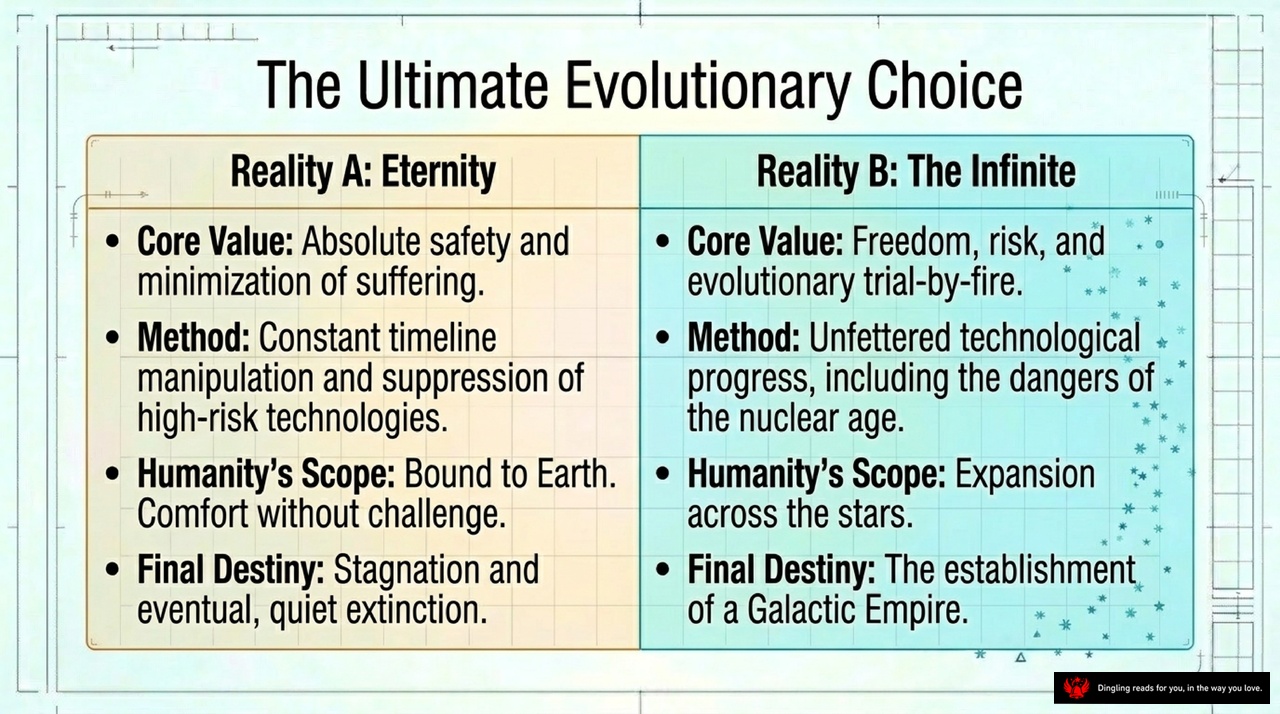
Reality A: Eternity offers us absolute safety, minimizing suffering through constant timeline manipulation. But the cost is stagnation and eventual, quiet extinction. Reality B: The Infinite champions freedom, risk, and evolutionary trial-by-fire. It embraces unfettered technological progress, even the dangers of the nuclear age, allowing humanity to expand across the stars and ultimately establish a Galactic Empire. The choice isn't just about survival; it's about whether we want a comfortable cage on Earth or the terrifying, exhilarating possibility of becoming something more.
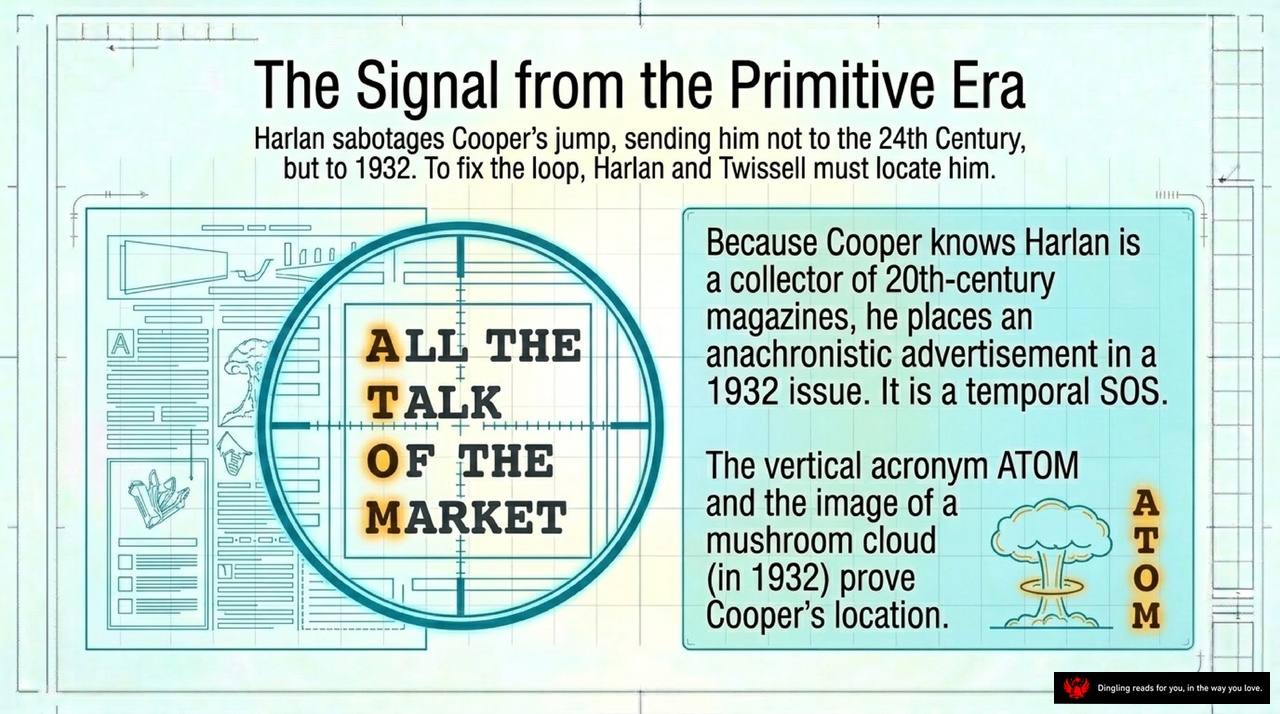
Harlan sabotages Cooper's jump, sending him not to the 24th Century, but to 1932. To fix the loop, Harlan and Twissell must locate him.
Because Cooper knows Harlan is a collector of 20th-century magazines, he places an anachronistic advertisement in a 1932 issue. It is a temporal SOS. The vertical acronym ATOM and the image of a mushroom cloud (in 1932) prove Cooper's location.
In this pivotal moment, the text "ALL THE TALK OF THE MARKET" isn't just a headline; it's the very signal that saves humanity. While the world of 1932 is still unaware of the coming atomic age, Cooper has left a mark that defies time. By embedding the word ATOM alongside a mushroom cloud in a mundane newspaper ad, he creates a beacon across centuries. This clever ruse allows Harlan to pinpoint exactly where his friend is hiding, turning a chaotic timeline error into a solvable puzzle. It's a brilliant reminder that even in the face of impossible odds, human ingenuity can bridge the gap between the primitive past and the futuristic future, ultimately rewriting the destiny of everyone involved.
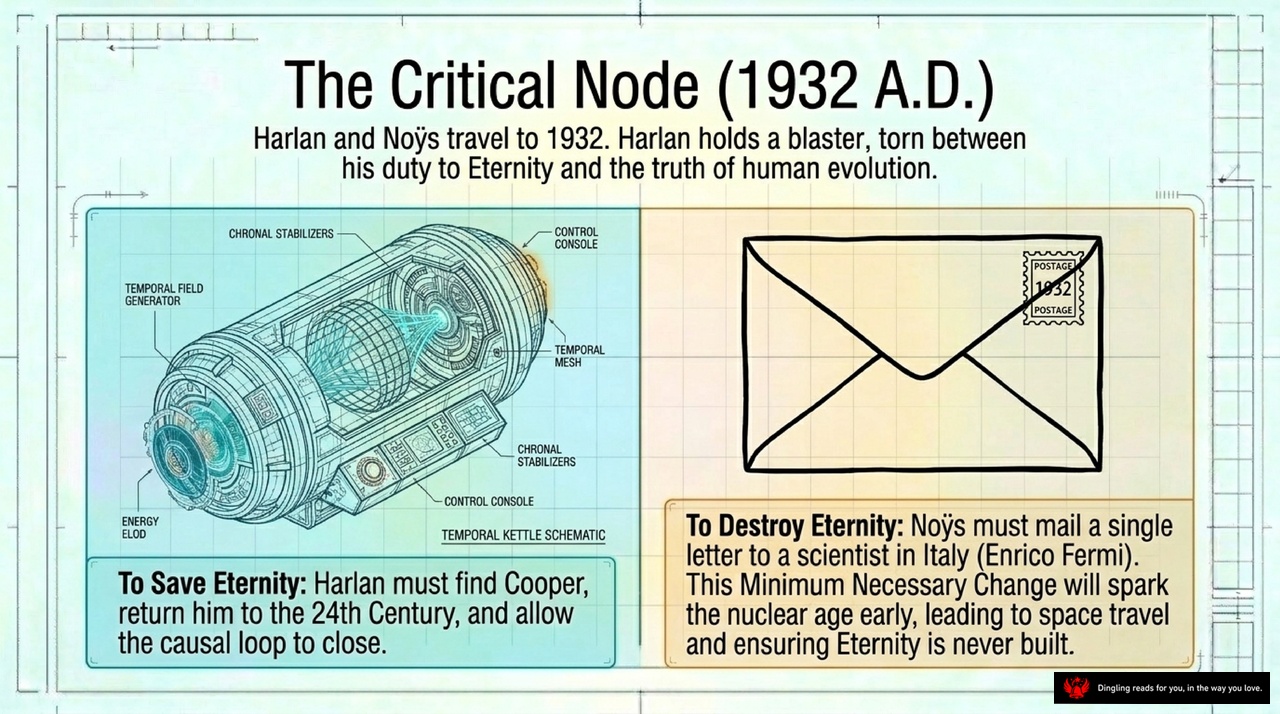
Look at this blueprint of the Temporal Kettle and that sealed letter stamped for 1932. This image captures the absolute climax of the story: The Critical Node. In 1932, Harlan and Noys are trapped in a impossible choice. On one side, the Kettle represents the path to save Eternity; Harlan must find Cooper, return him to the 24th century, and close the causal loop to ensure humanity's survival. On the other side lies the letter. To destroy Eternity, Noys must mail this single letter to a scientist in Italy, Enrico Fermi. This is the Minimum Necessary Change. It will spark the nuclear age early, leading to space travel and ensuring Eternity is never built. Harlan stands torn between his duty to the organization he served for decades and the truth of human evolution. He holds a blaster, ready to make the ultimate sacrifice. Will he save the artificial paradise of Eternity, or will he help destroy it to give humanity its real, chaotic, and infinite future?

Harlan realizes the brutal truth: the psychological torture of the Eternals, the suppression of triumph, and the looming extinction of mankind are simply too high a price to pay for safety. With that single, shattering decision, he lowers his weapon, and the letter is sent. In that moment, the causal loop is broken. The kettle vanishes. Eternity is erased from existence. Basic Reality takes over, and the pathway to the stars is finally opened.
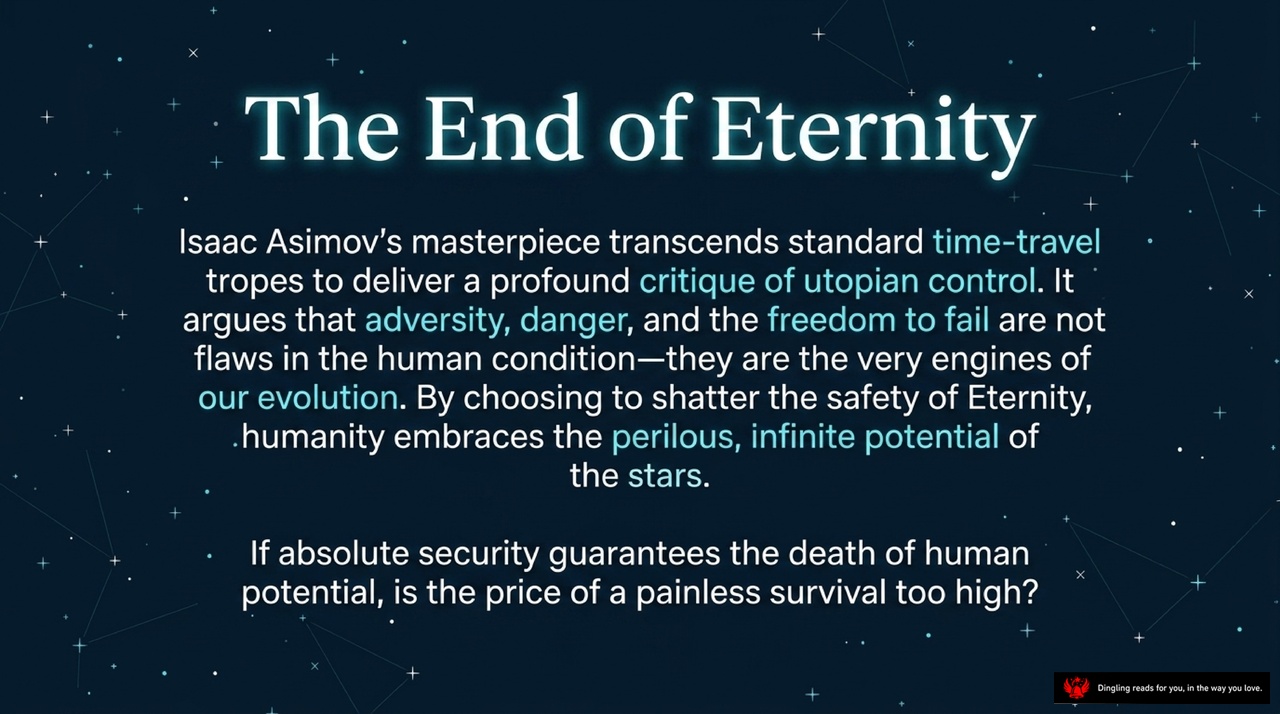
The End of Eternity isn't just a story about time travel; it's a radical argument against the very idea of a perfect, safe future. Isaac Asimov's masterpiece challenges the utopian dream of total control, suggesting that our greatest strengths come from our greatest vulnerabilities.
The slide asks a profound question: if absolute security guarantees the death of human potential, is the price of a painless survival too high? In the book, the characters discover that adversity, danger, and even the freedom to fail are not flaws in the human condition—they are the very engines of our evolution. By choosing to shatter the safety of Eternity, humanity embraces the perilous, infinite potential of the stars.
Ultimately, the narrative posits that a galaxy filled with other civilizations waiting for us is a far better destiny than a sterile, isolated bubble of eternal peace. The story concludes that only by risking everything can we truly become human.