
The Ethics of Leisure and Boredom: Complete Chapter-by-Chapter Summary

Welcome to our deep dive into Koichiro Kokubun's groundbreaking work, *Ethics of Leisure and Boredom*. Today, we're tackling a paradox that defines our modern existence: why, despite having more free time than ever before, we feel more alienated, distracted, and profoundly bored than any generation in history.
This book isn't just a philosophical inquiry; it's a mirror held up to our daily lives. It challenges the very idea that leisure equals happiness. Instead, Kokubun argues that our inability to sit with our own thoughts has become the root of our unhappiness. We've turned into creatures who cannot bear the silence of our own rooms, constantly filling every moment with noise, distraction, and the desperate need to escape the stillness that lies beneath.
As we explore the text, we'll uncover how this modern crisis of boredom connects to ancient philosophical insights, the nature of our work, and the hidden traps of consumer culture. We'll ask ourselves: Is boredom a disease we must cure, or is it a signal calling us to a deeper understanding of what it means to be truly alive? Join me as we navigate the ethics of doing nothing, and discover how embracing boredom might just be the key to finding real freedom.

The architecture of the void isn't just a metaphor; it's a structural reality we live in today. Look at the image on the left: "The Illusion of the Busy Youth." It highlights a disturbing trend—studies show that boredom is negatively correlated with age. College students and busy young professionals report the highest levels of profound boredom, while retirees report the lowest. Why? Because we have confused activity with fulfillment.
On the right, we see the "Meaning-Attentional Components Model" by Westgate & Wilson. This framework explains why we are bored. It's not because we lack an environment or external stimuli; in fact, we are drowning in them. The real culprit is a dual failure. First, we suffer from a [Lack of Meaning]. Second, we experience an [Attention Mismatch]. When you combine these two, you get [Profound Boredom].
Here is the crucial insight: We do not lack stimuli. We lack an internal target worthy of our attention. We are constantly scrolling, working, and consuming, yet we aren't engaging with anything that truly matters to us. We are busy, but we are not alive. We are trapped in the void, mistaking the noise of a busy life for a meaningful one. The solution isn't to do more; it's to find a worthy target for our attention that gives our life actual meaning.

The Sedentary Revolution and the Birth of Boredom
Imagine two distinct worlds: one where survival is a constant, high-stakes game, and another where safety comes with a strange, heavy price. This slide contrasts The Nomadic Era with The Sedentary Era, highlighting the pivotal shift that created the very feeling of boredom.
On the left, we see The Nomadic Era. Here, the environment was ever-changing, filled with high stimuli and constant threats. There was no room to breathe or pause. Human capacity was 100% utilized for pure survival. You were either hunting, migrating, or defending. The state was exhausted, yes, but fulfilled. You were never alone with your thoughts because the world was always demanding your attention.
Fast forward to the right side: The Sedentary Era. The environment shifted to fixed, repetitive routines with predictable resources. Suddenly, human capacity created a Capacity Surplus. Skills developed for the wild were no longer needed. We were safe, but restless. For the first time in history, we had a gap between what we could do and what we needed to do. That gap is where boredom is born. It is the direct result of this surplus capacity.
This isn't just about history; it's about the human condition. When we stopped running from predators and started running from the silence of our own minds, we invented boredom. We traded the fulfillment of survival for the restlessness of existence.

Have you ever sat in a room, completely still, and felt an overwhelming urge to do something, anything, just to escape that silence? You aren't alone. In the 17th century, the philosopher Blaise Pascal identified this exact feeling as the root of all human misery. He argued that our inability to sit quietly in a room forces us to seek distractions, leading us into a cycle he called "Pascal's Rabbit."
The graphic on this slide breaks down this psychological trap into four distinct stages. It all begins with **The Void**. When we stop moving and face the emptiness of existence, anxiety sets in. To escape this void, we move to **The Distraction**. We actively seek out burdens, risks, or pain—like hunting, gambling, or overworking—simply because these activities give us a reason to act.
Here lies the core deception: **The Self-Deception**. We convince ourselves that we are chasing the rabbit, the prize, or the reward. But the slide reveals a harsh truth: we don't actually want the rabbit. We want the hunt. We crave the suffering and the struggle just to avoid the silence of being alone with our thoughts.
This brings us to the final point, **The Reality**: we are not looking for happiness; we are looking for a motive to avoid boredom. As the slide's insight states, boredom creates a desire for suffering, just to find a reason to move. We are trapped in an illusion of the hunt, running in circles because we are terrified of stopping.

Have you ever sat in a crowded room with friends, enjoying great food and wine, yet felt a strange, hollow emptiness the moment you walked out? You were fully present, laughing and engaging, but deep down, you sensed the night was meaningless. This isn't just a bad mood; it is what the philosopher Martin Heidegger calls the second form of boredom.
Unlike the first kind of boredom, where you are actively waiting for something to happen—like staring at a clock at a train station—the second form is far more insidious. It happens when you are actually doing something, but you have silently surrendered your inner needs to the environment. You aren't looking for a way to escape the boredom; instead, you actively blend into the emptiness around you. You take a drag of a cigarette or sip a drink not to savor them, but simply to fit in. In doing so, you become part of the void.
Heidegger argues that this specific type of boredom is actually a form of freedom in disguise. It strips away all external distractions and possibilities, leaving you face-to-face with your own existence. While it feels like a trap, this stagnation is actually a crucial opportunity for self-reflection. It forces you to stop running and ask yourself: What do I truly want?
However, most of us avoid this moment. We flee from this deep, silent boredom into the first kind—becoming slaves to our schedules—or the third kind—making rash decisions just to feel something. We fill our lives with endless entertainment and concepts, consuming the *idea* of being busy rather than living it. This is the trap of modern leisure. We think we are free, but we are just endlessly chasing the next distraction to silence that quiet, inner voice asking, "Why am I here?" True freedom begins only when we dare to sit with that silence and stop trying to fill it.

So, we've walked through the history of boredom—from Pascal's fear of solitude to Heidegger's deep existential void. But now, let's zoom out and ask a fundamental question: Why do we feel bored at all? Is it just a modern problem?
The answer lies in a shift that happened about 10,000 years ago: the "Settling Revolution." For millions of years, our ancestors were nomads. They moved constantly, always hunting for fresh food and water. Their brains were constantly stimulated by new environments. There was no time to get bored because there was no time to stand still.
But when humans finally settled down, everything changed. We stopped moving. We built houses, farms, and communities. Suddenly, the world looked the same every day. The landscape didn't change. The routine became predictable. That stillness created a gap in our minds—a gap we call boredom.
This shift also brought something else: leisure. As economist Thorstein Veblen pointed out, having free time used to be a sign of high status. But today, that dynamic has flipped. We have free time, but we don't know how to use it. Instead of enjoying the silence, we fill every second with distractions. We turn our leisure into a product to be consumed, buying things or chasing trends just to feel something.
This leads us to a darker realization. In our modern consumer society, we've created a trap. We think happiness comes from the next purchase or the next trend. But as the book suggests, this endless cycle of consumption actually deepens our boredom. We are constantly trying to fill that ancient gap left by the Settling Revolution, but we're just trading one empty feeling for another.
So, the real question isn't how to kill time. It's how to learn to sit with that quiet space without running away. It's about finding a way to be present in our stillness, rather than being enslaved by the fear of it. That is the true challenge of living in a settled world.

Imagine a clock melting under the weight of time, stretching into a droplet that seems to defy logic. This isn't just an artistic choice; it's a visual representation of a profound philosophical truth we often ignore: the very act of waiting can reveal the deepest layers of our existence.
Today, we are diving into Heidegger's concept of boredom, specifically the second form: the kind that isn't triggered by a specific event, but permeates everything around you. Think about a perfect evening party—great food, interesting friends, lively conversation. You're engaged, smiling, even enjoying the moment. Yet, when you finally get home, a sudden, quiet realization hits you: "That was actually boring."
This is the insidious nature of this type of boredom. Unlike the frustration of waiting for a train, where you can distract yourself by counting trees or checking emails, this boredom has no external target. You aren't avoiding it by doing something else; you are actively participating in it. In fact, you are willingly surrendering to the emptiness, letting the environment shape your inner state until you become part of that void yourself.
Heidegger describes this as a state where time doesn't feel slow, as it does when we are impatient. Instead, time feels like it has frozen. You are locked in a stagnant moment, unable to escape, not because you are trapped, but because your own inner emptiness has expanded to fill the entire universe. It is a terrifying yet liberating realization: the boredom isn't coming from the world; it's coming from within you.
This form of boredom is often the most dangerous because it hides behind the mask of busyness. In our modern consumer society, we are constantly filled with work, social obligations, and endless entertainment. We mistake this constant activity for a full life, unaware that we are simply drowning in a second form of boredom—a hollow existence where we have no time to stop, no space to breathe, and no chance to hear that quiet, internal whisper saying, "It's so boring."
Recognizing this hidden boredom is the first step toward reclaiming our freedom. It forces us to ask: Are we truly living, or are we just going through the motions, numbing ourselves to the silence inside? The answer lies not in escaping into more distractions, but in learning to sit with this emptiness, to find meaning in the pause, and to understand that sometimes, doing nothing is the most profound thing we can do.

Imagine yourself sitting at a dinner party, surrounded by people laughing and eating. On the surface, everything seems fine, but deep down, you feel a profound sense of boredom. This is what we call "Form 2: Bored WITH a Situation." Unlike being frantic or lost, you are actually partaking in a stable, everyday compromise. You aren't fighting the world; you've blended into it. The image on the screen shows that single red figure among the gray crowd, perfectly illustrating this state.
According to our text, this is where distraction and boredom become intertwined. You are engaging in a pastime, yet an emptiness lingers beneath the surface. Think about it: unlike the intense anxiety of the first form of boredom, this is the baseline of modern human existence. We have designed our culture, art, and conversations specifically to peacefully coexist with this background hum of boredom. It represents a kind of human resilience. Instead of panicking, we accept this stable compromise. We fill the gaps with small distractions, creating a buffer against the void. This isn't necessarily a failure; it's a strategy we've all adopted to navigate the mundane reality of daily life.

When the void strips away all meaning, how do we react? This is the core question of what we call "Profound Boredom"—the feeling that life itself has become dull. In this moment, the philosopher Heidegger suggests a radical solution: Make a Resolution. He argues that to prove your freedom, you must commit to a cause, latch onto an ideology, or dedicate yourself to an extreme project. We do this to silence the terrifying voice inside us that whispers, "I am bored."
But here lies the trap. This path leads us to what I call "The False Hero." We often envy fanatics because they never seem bored; they are always burning with purpose. However, their resolution is actually just a blindfold against reality. By forcing themselves into a rigid narrative, they deny the very emptiness that calls them to grow. This forced commitment often spirals into fanaticism. People become slaves to a rigid ideology, a certification, or extreme workaholism, simply to escape the discomfort of facing their own existence.
The danger is clear: when we try to outrun boredom by becoming a hero, we lose our freedom. As the critic Kokubun points out, this forced resolution doesn't solve the problem; it just creates a new form of slavery. We end up serving a cause we didn't truly choose, just to avoid the silence. True freedom isn't found in the noise of a grand mission, but in having the courage to sit with the boredom, to let the void speak, and to find meaning not by escaping it, but by facing it directly.

Have we ever stopped to ask if we are just bored animals? Today, we're diving into a fascinating concept from the philosopher Jakob von Uexküll: the "Umwelt," or the environment-world. Think of it this way: animals live in a closed world of specific signals. A tick, for instance, only reacts to light, smell, and heat. It is a prisoner to these signals. It cannot be bored because it simply doesn't have the capacity to perceive the rest of reality. Its world is narrow, focused, and complete within its own boundaries.
Now, look at the human Umwelt. Unlike the tick, humans possess something called "Cross-Umwelt Capacity." We don't just live in one fixed world; we build habit-worlds, and crucially, we can shift between them. We can move from the world of a commuter to the world of an art critic, or from the world of a scientist to the world of a poet. This ability to jump between different ways of seeing and being is what makes us human, but it also makes us uniquely prone to boredom.
Here is the conclusion that ties it all together: We are bored precisely because we are free to jump between worlds, but unable to stay in one. That freedom to constantly shift our perspective is what creates the gap between our potential and our reality, and that gap is where boredom lives.

The Anatomy of Thought reveals a startling truth: thinking isn't our natural state; it's an emergency response. We are wired to seek habit, to build what philosopher Gilles Deleuze calls an "Umwelt"—a personal world of automated signals that simplifies the chaos around us. Our goal is comfort and efficiency. But true thinking only happens when that comfortable world gets violently disrupted by an "illegal invasion." Imagine a foreign element crashing into your routine, forcing you to wake up and engage. This friction creates boredom, and here lies the paradox: boredom isn't a flaw to be fixed; it's the friction between our desire for mindless habits and our inability to stay satisfied with them. It's the signal that your current environment has become too predictable, too closed off. As we've seen from the history of thought, from Pascal's restless hunters to Heidegger's deep existential dread, this feeling of being stuck in a loop is actually the spark that ignites real understanding. When we stop trying to escape the boredom and instead lean into it, we break the cycle of habit and finally open the door to a new way of seeing the world.
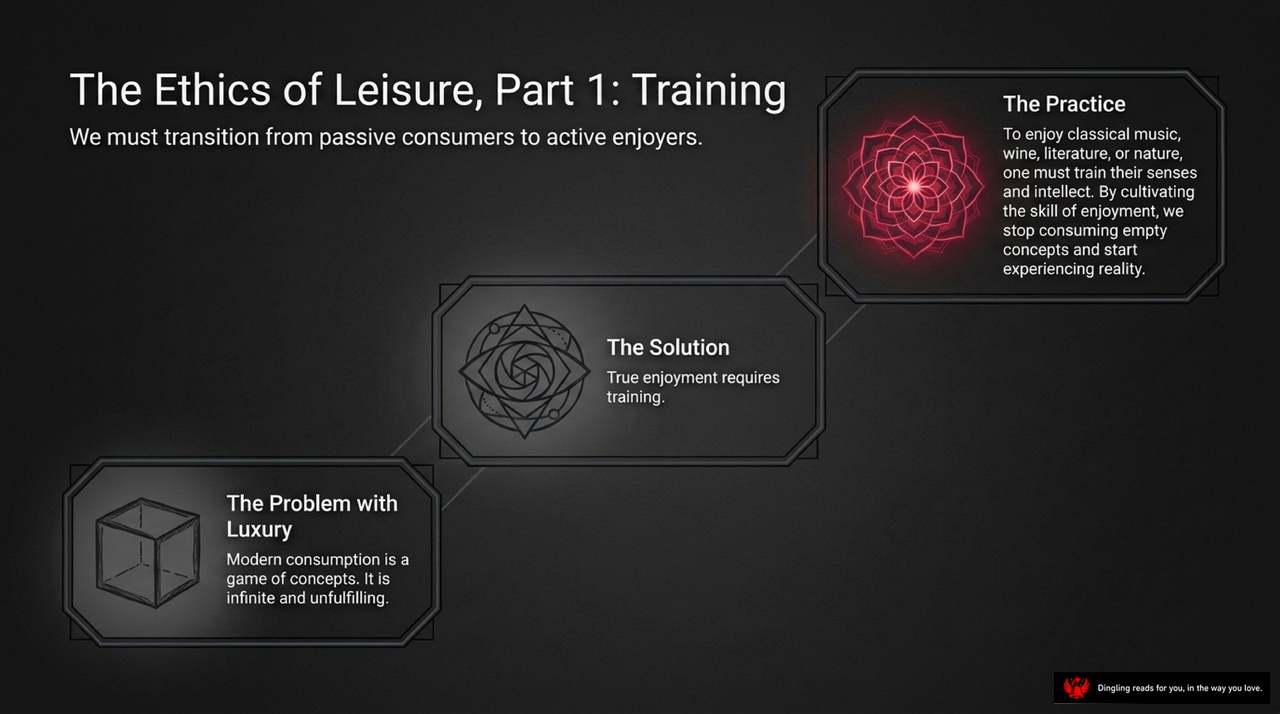
So, let's talk about the real problem with how we spend our time today. We've been told that true happiness comes from having more stuff or doing more, but the slide right here is actually calling that out. It points to "The Problem with Luxury," arguing that modern consumption is just a game of concepts. We buy things to feel something, but it's infinite and ultimately unfulfilling. We are passive consumers, chasing empty ideas instead of real experiences.
But there is a way out, and the slide calls it "The Solution": true enjoyment requires training. Think about it. To truly enjoy something—whether it's a complex piece of classical music, a fine wine, or just a walk in nature—you can't just walk in the door and expect to get it. You have to train your senses and your intellect. It's a skill. By cultivating this skill of enjoyment, we stop consuming these empty concepts and start experiencing reality itself.
Finally, look at "The Practice." This is where the actual work happens. We must transition from being passive consumers to active enjoyers. It means committing to the effort of learning how to be present. It's about moving away from the endless cycle of buying and doing, and instead, focusing on the quality of your experience. It's a shift from quantity to depth. As the slide suggests, this training is the key to unlocking a richer, more authentic life where we aren't just filling time, but actually living it.
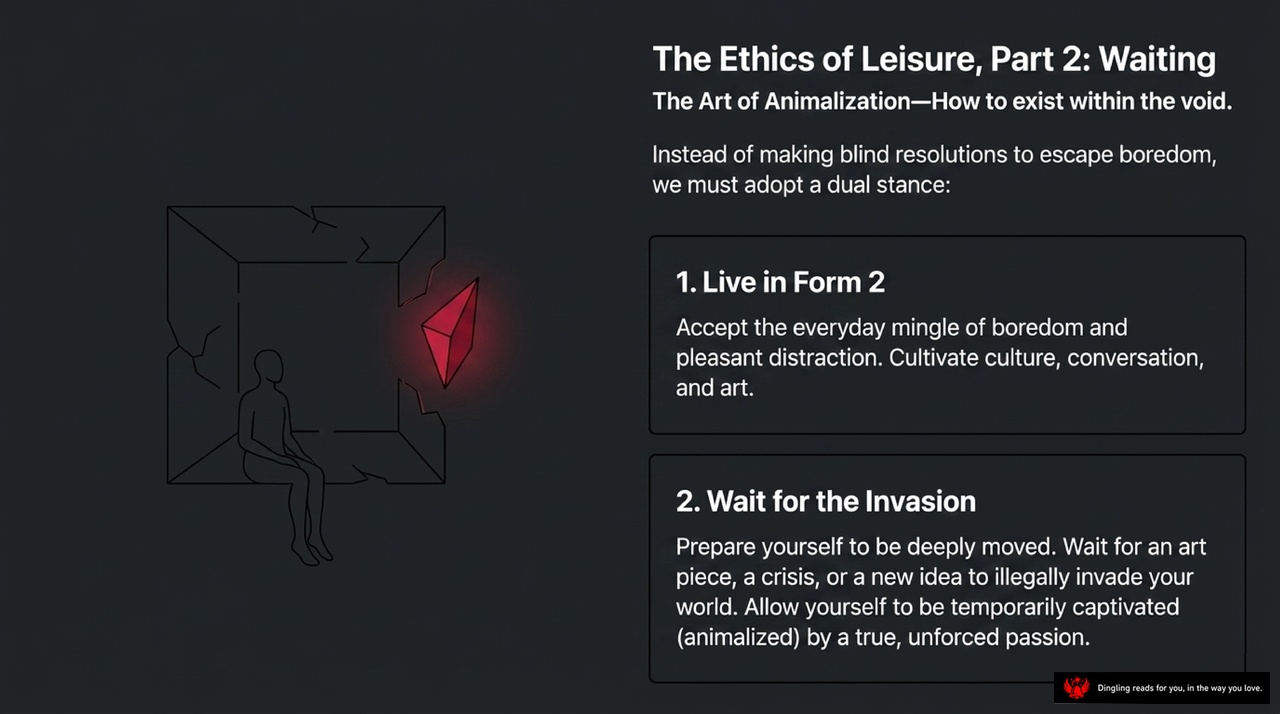
We often think boredom is a problem to be solved, something we must escape at all costs. But what if we stopped running? The slide suggests a different path: instead of blindly trying to flee boredom, we need to adopt a dual stance. First, we must learn to live in Form 2. This means accepting the everyday mix of boredom and pleasant distraction as part of life. Rather than fighting the quiet moments, we should cultivate culture, conversation, and art within them. Second, we must wait for the invasion. This is about preparing ourselves to be deeply moved. We should stay open for an art piece, a crisis, or a new idea to unexpectedly break into our world. When this happens, allow yourself to be temporarily captivated by a true, unforced passion. It is in these moments of being "animalized" by something real that we find the deepest connection to life.

Look at this diagram. It maps out a journey from the individual all the way to a transformed society. We start at the center with the **Self**. Moving outward, we encounter **The Privilege of Boredom**. As the slide explains, worrying about how to live within boredom is a luxury. Many people are still trapped by war, poverty, and the constant struggle for survival. They don't have the freedom to simply sit and think.
The outermost ring represents **Society: The Ultimate Goal**. Here, our ethical duty shifts. We need to restructure society—perhaps by shortening work hours or altering production methods—so that all of humanity has the luxury of facing their own boredom. True freedom, as the final step suggests, begins only when the entire world has the space to ask the profound question: "What do I actually want?" This isn't just about being idle; it's about creating a world where everyone can stop running and finally discover what truly matters.

So, let's bring it all home. We've journeyed through the minds of giants—from Pascal's warning that boredom is the root of all unhappiness, to Nietzsche's observation that we sometimes crave pain just to escape the void, and even Heidegger's deep dive into how boredom can be a form of freedom. We've seen how modern society, from the "settling revolution" to the relentless pace of consumer culture, has tried to fill every second with distraction, turning leisure into a commodity and silence into an enemy.
But here is the ultimate takeaway: Boredom is not a defect to be cured by frantic consumption or blind fanaticism. It is the ultimate proof of our human freedom and our capacity to transcend our immediate world. We must stop fleeing the void, train ourselves to truly enjoy our leisure, and wait for the thoughts that genuinely move us.
If our ultimate freedom is born from our capacity to be bored, what profound truths are you distracting yourself from right now?