
The Extended Phenotype: Complete Chapter-by-Chapter Summary

Welcome to today's session on *The Extended Phenotype* by Richard Dawkins. This cover art beautifully captures the book's core idea: evolution isn't just about the body you see, but about the invisible reach of genes stretching far beyond it.
Dawkins challenges the traditional view that natural selection acts only on an organism's physical traits. Instead, he proposes that a gene's influence extends to anything it builds or causes to be built. Think of a beaver dam or a spider's web—these aren't just environmental accidents; they are the physical expression of the genes inside the creatures that built them.
The book also introduces a fascinating concept called "extended phenotype" to describe how genes manipulate other organisms, even across species. For instance, a parasitic worm can alter a snail's behavior to make it more visible to birds, effectively using the snail as a vehicle to spread the worm's own genes.
Ultimately, Dawkins argues that the true unit of selection is the gene itself, not the individual. Everything in nature, from the shape of a leaf to the complex social structures of an ant colony, is a strategy employed by genes to ensure their own survival and replication. This paradigm shift helps us see the world not as a collection of independent life forms, but as a vast, interconnected network of competing genetic strategies.
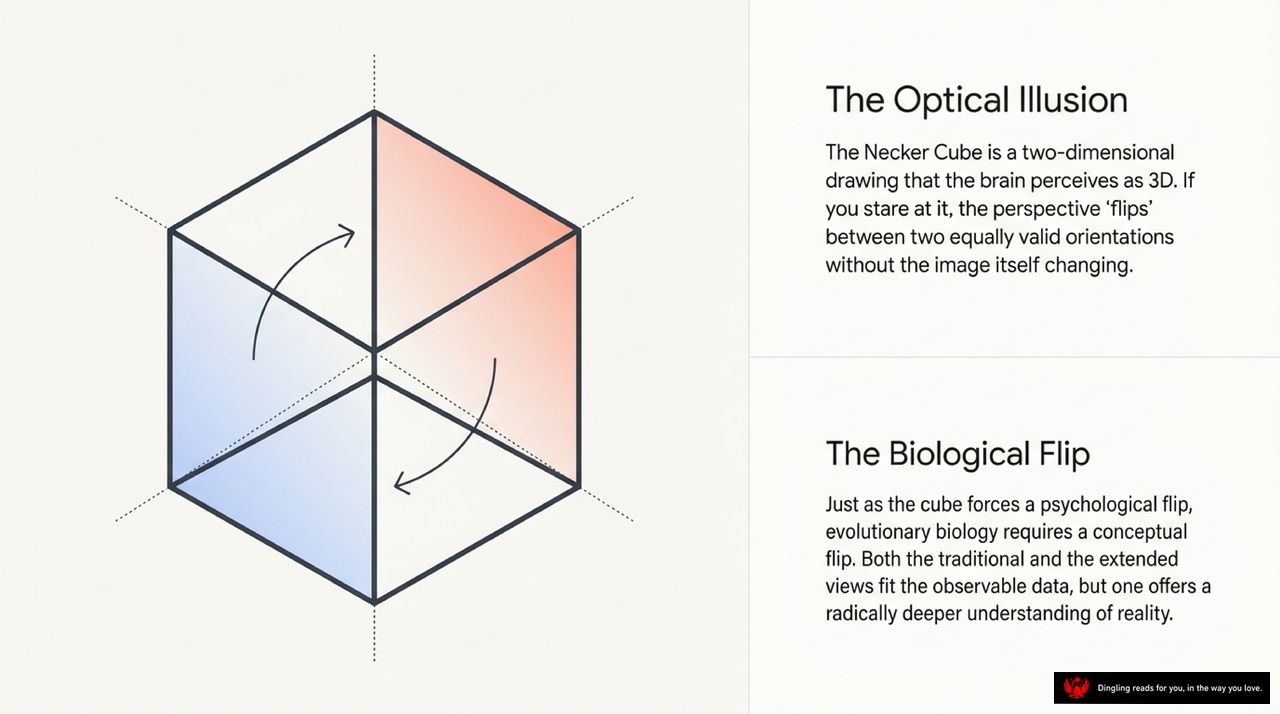
Imagine looking at a simple line drawing that your brain stubbornly interprets as a 3D cube. Stare at it for a moment, and suddenly the perspective flips. One face is the front, then it's the back. The image hasn't changed, yet your reality has completely inverted. This is the Necker Cube, a classic optical illusion that perfectly mirrors a much deeper biological truth.
Just as your brain forces a psychological flip between two equally valid orientations, evolutionary biology demands a similar conceptual shift. We are used to viewing the individual organism as the hero of evolution, the unit that adapts and survives. But the traditional view, while fitting the observable data, is only one side of the cube. The "Extended Phenotype" offers the other orientation. It forces us to flip our perspective and realize that genes don't stop at the skin. Their influence extends far beyond the individual's body into the environment they shape—think of beaver dams, spider webs, or even parasites manipulating host behavior. These external structures are not just environmental accidents; they are just as much a product of natural selection as a body part.
So, while the traditional view and the extended view might seem like competing realities, they aren't. They are simply two ways of seeing the same graph. Embracing this biological flip allows us to see a radically deeper, more complete picture of how life actually evolves.

Today's slide breaks down the core concept of the "Selfish Organism." In traditional biology, we view the individual biological body—like the bison pictured here—as the central unit of natural selection. The goal of this organism is to maximize its own physical survival and reproductive fitness. However, there is a strict boundary to this influence: evolutionary pressure stops exactly at the physical skin. This means that, in the traditional view, the physical organism is the undeniable center of the evolutionary universe. But remember, this is just one perspective. We will soon see how the "Extended Phenotype" theory challenges this boundary, suggesting that genes can influence the world far beyond the skin, turning the environment itself into an extension of the organism.
Imagine you've always thought of an animal as a single, independent individual acting for its own good. But what if that individual is actually just a vehicle? A temporary survival machine built by something far more selfish and powerful: the gene.
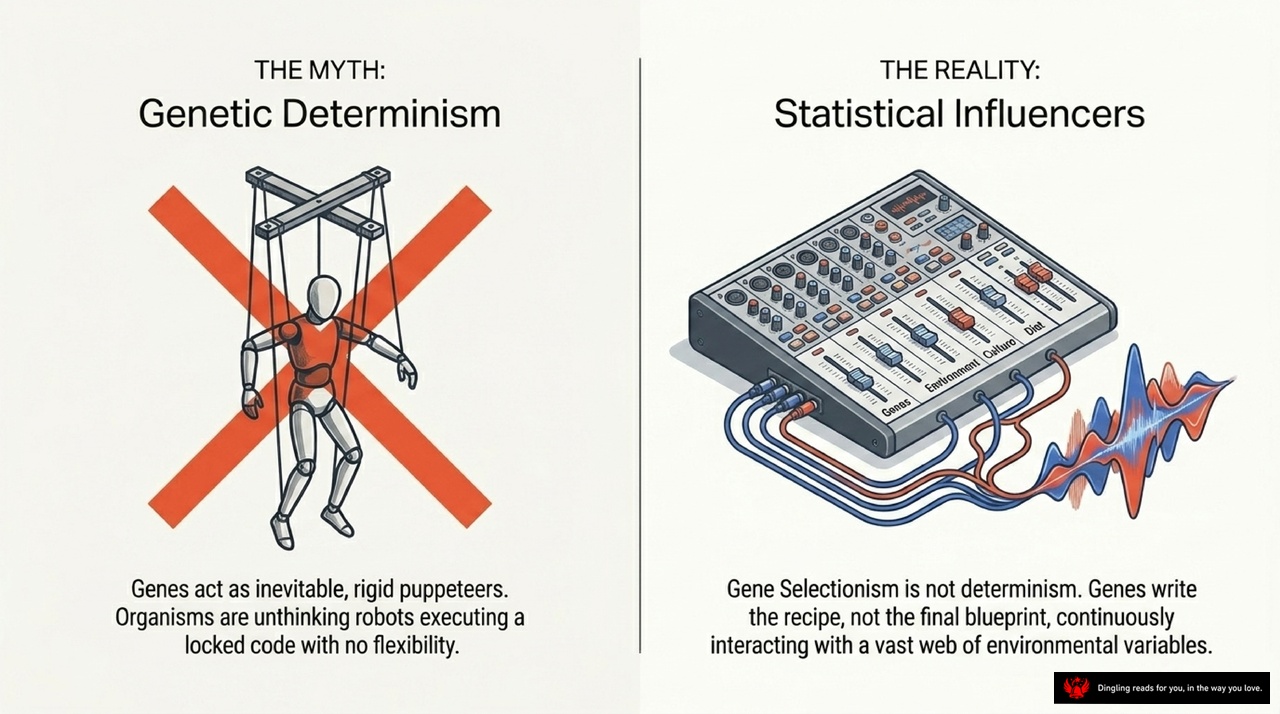
This slide breaks down that crucial distinction between the "Myth" and the "Reality." On the left, we see the myth of Genetic Determinism, depicted as a rigid puppet. This is the idea that genes are inevitable, unthinking controllers, forcing organisms to execute a locked code with zero flexibility. It suggests that if you have a certain gene, you are a robot programmed to act in a specific way, no matter what.
But look at the right side. This is the reality: Statistical Influencers. As the image shows, genes aren't puppets pulling strings; they are more like a complex audio mixing board. Genes write the recipe, but they do not dictate the final blueprint. They continuously interact with a vast web of environmental variables—factors like culture, diet, and specific conditions—to create the final outcome.
Think of it this way: having a gene that *might* lead to a certain behavior is just a statistical trend, not a guaranteed command. Just like a musical track changes based on how you adjust the knobs, an organism's behavior changes based on how its genes interact with its environment. The gene provides the potential, but the environment and the specific circumstances determine how that potential is actually expressed. This means organisms aren't just mindless robots; they are active participants in their own development, shaped by a dynamic interplay rather than a rigid script.

Look closely at this wireframe buffalo. It's not just a picture of an animal; it's a visual metaphor for one of the most mind-bending ideas in evolutionary biology. On the slide, we see two distinct concepts: The Vehicle and The Replicator.
First, let's look at point number one: The Vehicle. The text here tells us that the physical organism—the buffalo itself—is not the main actor. Instead, it is merely a temporary, disposable survival machine. Think of the animal's body as a car. It's built, it drives, it gets damaged, and eventually, it breaks down and is discarded. It is not the thing that survives; it is just the tool that gets used up.
Now, look at point number two: The Replicator. The image highlights a geometric cube in the center of the buffalo, which the text calls the Active Germ-Line Replicator. This is the gene. Just like the Necker Cube in the image can flip between two different perspectives, our view of evolution often flips too. We might think the animal is in charge, but the true actor is the gene. The biological world is an arena where these replicators manipulate matter to ensure their own immortal survival.
So, what does this mean for us? It means that when we look at a buffalo, we shouldn't just see a conscious, independent creature making choices. We should see a sophisticated survival machine constructed by genes to protect and copy themselves. The animal is the vehicle; the genes are the passengers who never get off the bus. They are the ones that truly persist through time, using the temporary bodies of animals to travel from generation to generation. This shift in perspective is the core of the "Gene's Eye View" of evolution.

Look at this diagram. It illustrates a radical shift in how we view evolution: the idea of "breaking the boundary."
Traditionally, we've stopped tracing a gene's influence right at the skin. We see the organism, the tissues, and the organs, and then we assume the story ends there. But genetically speaking, there is no reason to stop. A gene's phenotype is simply its physical manifestation, and that manifestation can extend far beyond the body itself.
As the slide shows, the causal influence of a gene naturally radiates outward into the world, unbound by the physical body. Think of a beaver dam or a spider's web. These aren't just environmental accidents; they are extensions of the genes that built them. The gene shapes the animal, and the animal shapes the world.
This concept also applies across species. Consider a parasite manipulating a host's behavior. The parasite's gene isn't just inside the host; it is actively rewriting the host's actions to serve the parasite's survival. In this sense, the host's behavior becomes an extended phenotype of the parasite's gene.
So, evolution isn't just about what happens inside a body. It's about the ripple effect of genes shaping the entire environment, from the soil to the social structures of other animals. The body is just the starting point for a much larger, invisible network of genetic influence.
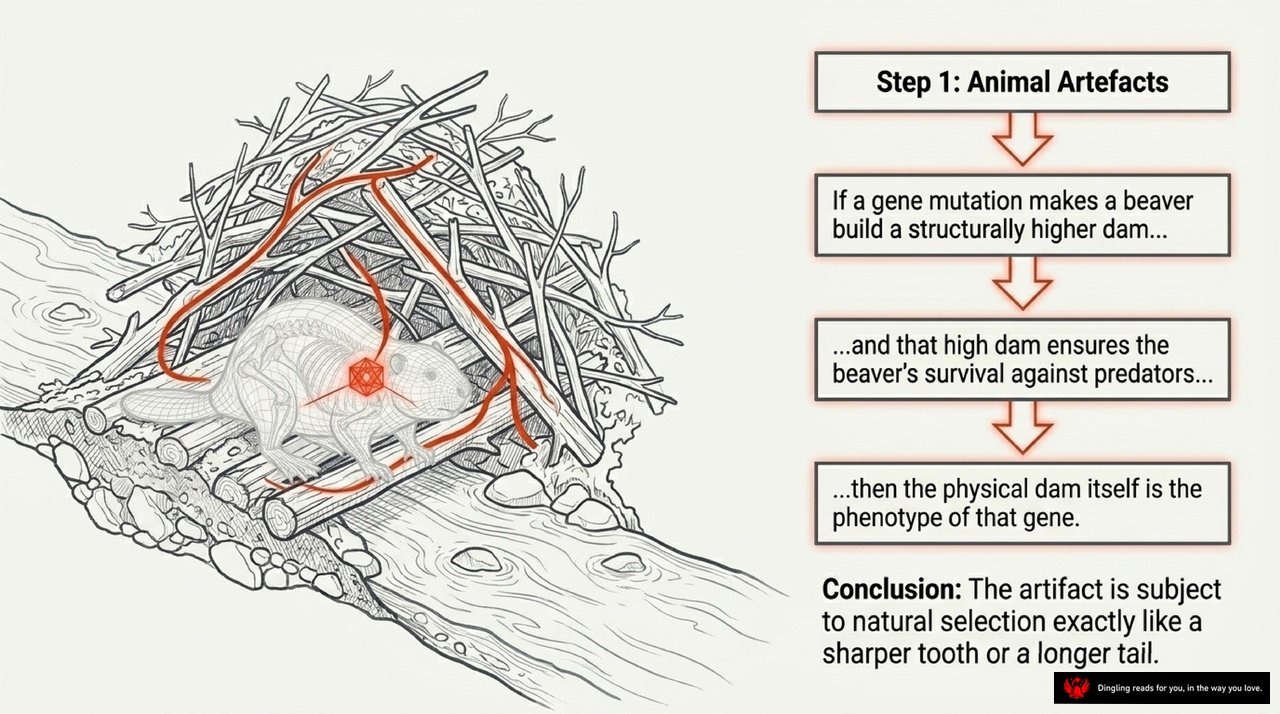
Step one: Animal Artefacts. Imagine a beaver standing on a log, hard at work building a dam. Now, picture this: what if a tiny mutation in the beaver's DNA made it instinctively build a dam that was significantly higher?
Here is the logic. If that higher dam ensures the beaver survives against predators, then that physical structure—the dam itself—becomes the phenotype of that gene. It's not just the beaver's body that evolves; the environment changes with it. The dam is subject to natural selection, just like a sharper tooth or a longer tail.
This concept challenges our traditional view. We often think evolution only shapes the animal itself. But the Extended Phenotype theory tells us that genes can extend their influence far beyond the body, shaping the world around the creature. Whether it's a beaver's dam, a spider's web, or even a parasite manipulating a host's behavior, these external structures are just as much a product of evolution as the organism's skin and bones. The artifact is the adaptation. The environment is the tool. And the gene is the architect.

Step 2: The Hijacked Host. Look closely at this diagram of a snail. What you are seeing here is a masterclass in deception, a perfect example of how evolution can turn a living creature into a puppet for another's genes.
First, notice the shell. The text points out that parasitic flukes force the snail to grow an unusually thick shell. From the snail's perspective, this is a mistake—it's wasting energy and harming its ability to reproduce. But from the parasite's view, it's a brilliant survival strategy. A thicker shell means the snail lives longer, giving the parasite more time to mature and spread.
Then look at the brain. The parasite doesn't just hide inside; it chemically hijacks the snail's nervous system. It alters the snail's behavior, driving it out of its safe, dark hiding spots and into bright, open areas where it is easily spotted by birds. Why? Because birds are the parasite's next host. By making the snail seek its own death, the parasite ensures its own life cycle continues.
The conclusion at the bottom drives this home: the snail's thickened shell and its altered, suicidal behavior are not the snail's own adaptations. They are the extended phenotypes of the parasite's genes. In this twisted dance of evolution, the snail is no longer the protagonist; it is merely a vehicle, a hijacked host carrying the parasite's genetic blueprint into the future.
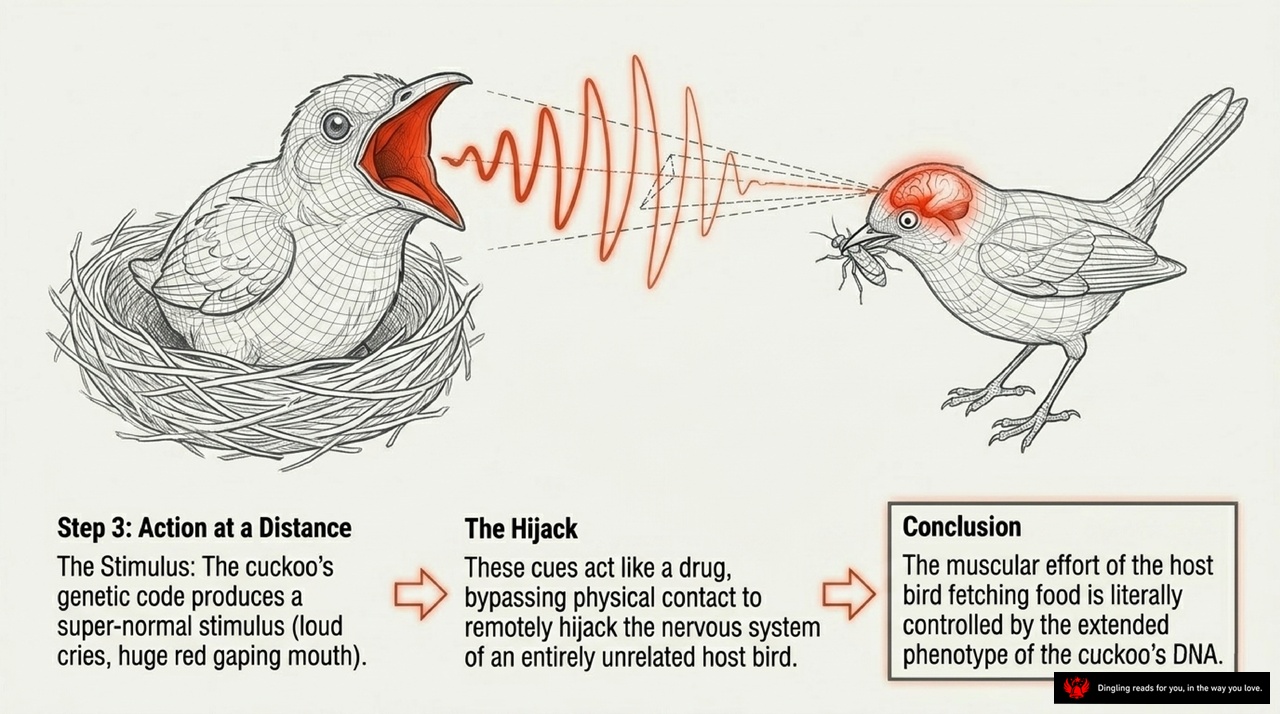
Look at this diagram: a hungry cuckoo chick screaming at its parent, and the parent bird, brain hijacked, rushing to feed it instead of its own offspring. This is "Step 3: Action at a Distance." The cuckoo's genetic code creates a super-normal stimulus—those loud cries and that huge, gaping red mouth. These cues act like a powerful drug, bypassing physical contact to remotely hijack the nervous system of an entirely unrelated host bird. The result? The muscular effort of the host bird fetching food is literally controlled by the extended phenotype of the cuckoo's DNA. It's a perfect example of how genes don't just build bodies; they can manipulate other species to do their bidding, turning a stranger into a devoted servant.

Today's slide contrasts how we've traditionally viewed genetics against the revolutionary lens of "Extended Genetics." On the left, you see the old model: the individual organism is the primary unit, confined strictly within its body wall, acting solely to survive. But look at the right side—this is where the real shift happens. Extended genetics flips the script. The primary unit isn't the animal itself, but the active germ-line replicator: the gene. Its influence isn't limited to the body; it stretches infinitely across the entire biosphere. Its goal isn't just to keep the physical body alive, but to maximize the replication of the causal gene itself. Ultimately, the perspective changes from "the organism acts to survive" to a more profound truth: "the gene acts, utilizing the organism." This means our bodies are essentially survival machines, built and directed by genes to ensure their own endless legacy.
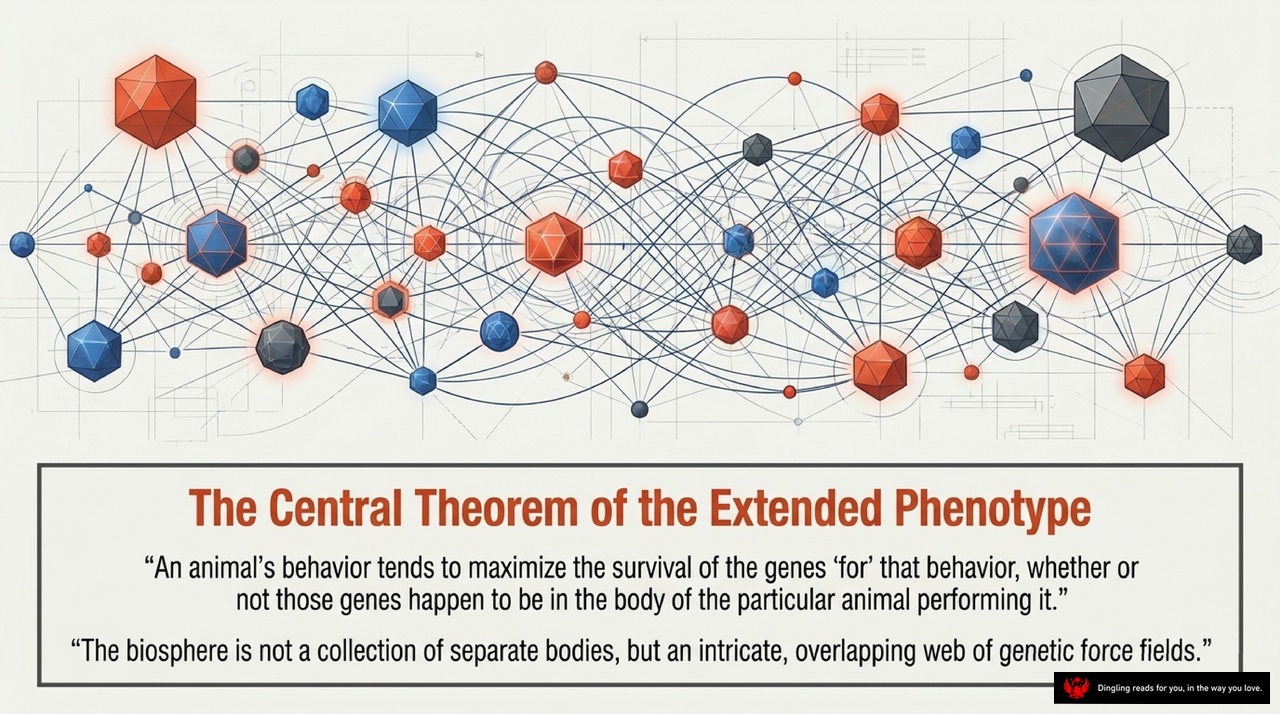
Today's slide presents what Richard Dawkins calls the "Central Theorem of the Extended Phenotype," a concept that fundamentally shifts how we view evolution. Look at the intricate web of connected nodes behind us; this visual represents the core idea: the biosphere isn't just a collection of separate bodies, but an overlapping web of genetic force fields.
Dawkins argues that an animal's behavior tends to maximize the survival of the genes "for" that behavior, regardless of whether those genes are actually inside the animal performing the action. This means we must stop looking only at the organism as the unit of selection. Instead, we must expand our view to include everything the gene builds and manipulates.
Think of it this way: a beaver's dam or a spider's web isn't just an environmental object; it is the physical manifestation of the genes inside those animals. Even more strikingly, a parasite can manipulate a host's behavior—like a fluke making a snail climb into the sun to be eaten by a bird—simply to ensure its own genes get passed on. In these cases, the host's body becomes a tool used by the parasite's genes.
The theorem teaches us that natural selection acts on the phenotype, wherever it occurs. Whether that phenotype is a body part, a behavior, or an external structure built by the organism, it all counts as an extension of the gene's reach. We are not just individuals fighting for survival; we are vehicles for genes that are constantly building, manipulating, and shaping the world around us to ensure their own legacy.
Imagine evolution not as a grand design, but as a relentless arms race between competing strategies. Picture the anglerfish luring unsuspecting prey with a worm-like bait, only for the prey to evolve sharper senses to spot the trick. This is the essence of an evolutionary arms race: a constant push-and-pull where every adaptation by one side drives a counter-adaptation in the other.
But here's the twist that changes everything: this competition is rarely even. It's governed by the "Life/Dinner Principle." Think of it like a rabbit and a fox. For the rabbit, failing to run fast enough means death—there is no second chance. For the fox, missing a meal just means hunger; it can try again tomorrow. Because the cost of failure is so much higher for the rabbit, natural selection forces it to evolve superior speed, often outpacing its predator.
This asymmetry explains why parasites are so dominant. A parasite's entire existence depends on manipulating its host's behavior to ensure its own survival. If the host evolves a defense, the parasite faces extinction. But if the parasite fails to manipulate, the host simply lives another day. This imbalance allows parasites to evolve incredibly effective manipulation tactics, like the trematode that alters a snail's shell to make it thicker and more vulnerable to birds, or the parasite that makes a frog's eyes twitch to attract birds. In these cases, the host's body and behavior become mere puppets for the parasite's genes.
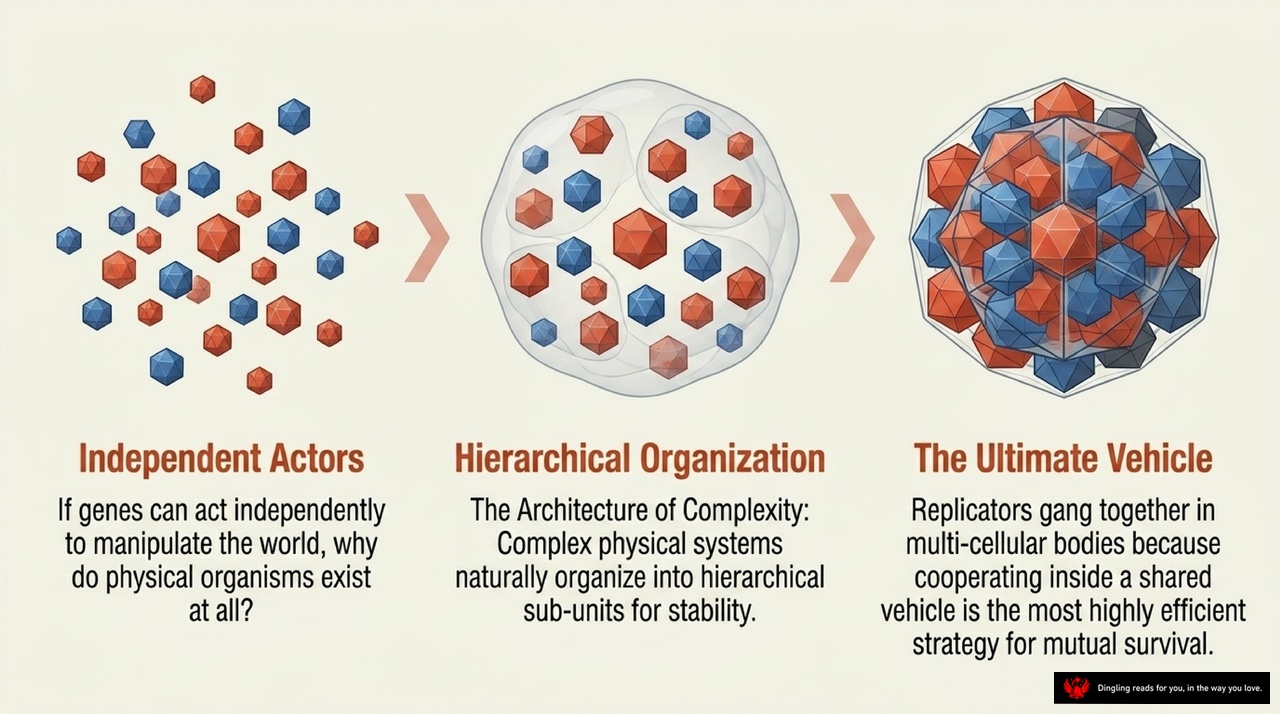
This leads us to a profound realization: evolution isn't just about individuals fighting for survival. It's about "selfish genes" competing to replicate themselves. Whether it's a rabbit running for its life, a fox hunting for a meal, or a parasite hijacking a snail's nervous system, the ultimate goal is the same: maximizing the transmission of genetic information. The organisms themselves are just temporary vehicles, survival machines built to carry these replicators through the harsh landscape of life.

Imagine a world where you are not the driver, but merely the vehicle. This slide captures the core of Richard Dawkins' radical idea: genes are the true units of selection, utilizing our biological bodies, external artifacts, and the broader world as temporary, manipulable tools to ensure their own immortal replication.
Think about it. If our physical forms, our behaviors, and our environments are merely the extended battlegrounds for a vast, invisible network of competing genetic interests, then who are we? Are we truly the masters of our own actions, or simply the magnificent, expendable vehicles of our genes?
Consider the beaver. Its genes didn't just build its body; they drove the construction of a dam that reshapes an entire river ecosystem. Or the spider, whose genes dictate not just its legs, but the intricate architecture of its web. These are "extended phenotypes"—the genes reaching far beyond the skin to manipulate the world.
The image in the center represents this complex, interconnected network. It reminds us that we are not isolated individuals making conscious choices. Instead, we are the stage upon which genes play out their strategy for survival. Every time we act, we are often just following a script written by our genetic code, ensuring that the next generation of that code gets to run the show again. We are the means, not the end. The end is the eternal replication of the gene.