
The Fifth Discipline: Complete Chapter-by-Chapter Summary

Welcome to the world of *The Fifth Discipline* by Peter M. Senge. Imagine an organization not as a rigid machine, but as a living, breathing ecosystem where growth is natural and continuous. This book introduces the five core disciplines that transform any group into a true learning organization.
At the heart of this transformation is the art and practice of building a learning organization to thrive in an interconnected world. It's about shifting from passive reaction to active evolution. The journey begins with individual self-transcendence, where people constantly push their limits, followed by improving their mental models to see the world more clearly. When individuals align around a shared vision, the collective power becomes unstoppable. Team learning then amplifies this wisdom, while systems thinking ties it all together, ensuring no one is left behind.
This isn't just about better performance; it's about unlocking human potential and creating a resilient culture where everyone thrives. In a complex world, the choice is clear: evolve or be left behind. Let's explore how these disciplines can reshape your future.

Today's slide contrasts two very different ways organizations operate. On the left, we see the prevailing system—often called the "rigid machine." It relies on management by measurement, where short-term metrics drive every decision. It fosters a compliance-based culture where people advance by pleasing bosses rather than solving real problems. It focuses on controlling outcomes and hitting arbitrary quotas, often by forcing fragmented parts to work in isolation. Finally, it suffers from the illusion of right answers, rewarding quick technical fixes while ignoring the complex reality of the system. This approach leads to premature failure because it treats the organization like a clockwork mechanism rather than a living entity.
In stark contrast, the right side shows the Learning Organization. Here, management shifts from measurement to intrinsic motivation, nurturing curiosity, dignity, and the joy of learning. Instead of compliance, we build a commitment-based culture that unlocks shared aspirations and a collective vision. We move from controlling outcomes to understanding the whole—managing those invisible, interconnected networks that actually drive success. Most importantly, we embrace generative learning, which expands our capacity to continuously create the future rather than just adapting to it. This isn't just about better performance; it's about transforming the organization from a passive machine into an active, evolving life system capable of thriving in uncertainty.
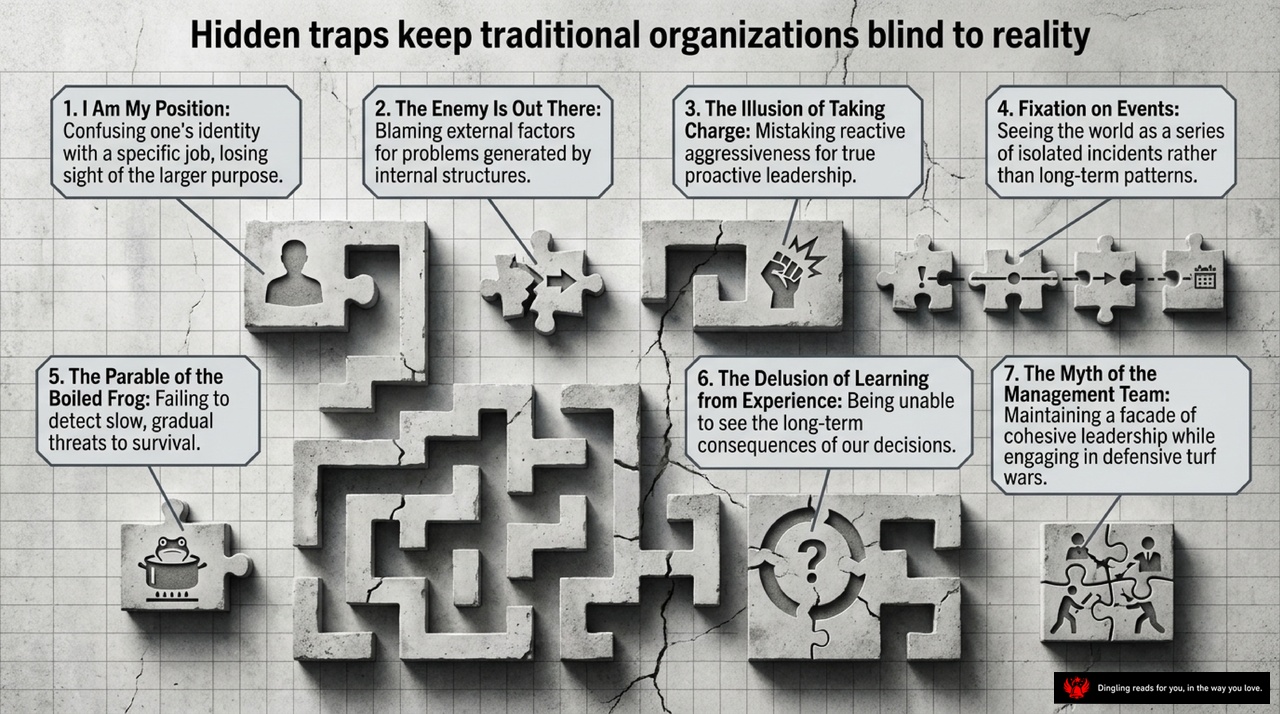
Traditional organizations often get stuck because they fall into seven hidden traps that blind them to reality. Think of these traps as invisible walls built right into your daily thinking.
First, the "I am my position" trap. When you confuse your identity with your job title, you lose sight of the bigger picture and stop collaborating. Second, the "enemy is out there" trap. Instead of looking inward at our own processes, we blame the market or competitors, creating a cycle of finger-pointing that solves nothing. Third, the illusion of taking charge. We mistake busy work and reactive aggression for real leadership, but true leadership is about proactive system design. Fourth, fixation on events. We get obsessed with isolated incidents, like a single drop in sales, while ignoring the long-term patterns driving the problem.
Then there's the "boiled frog" parable. We fail to notice slow, gradual threats until it's too late, just like a frog that doesn't realize it's boiling because the water heats up slowly. Sixth, the delusion of learning from experience. We rely too heavily on past successes, which often become rigid habits that fail when the environment changes. Finally, the myth of the management team. We pretend to have a cohesive leadership group, but underneath, we're just engaging in defensive turf wars, afraid to have the hard conversations needed for real growth.
Recognizing these traps is the first step. If your team is constantly blaming external factors or only reacting to fires, these barriers are likely holding you back. Overcoming them requires a shift from linear thinking to system thinking—seeing the whole picture instead of just your piece of the puzzle.
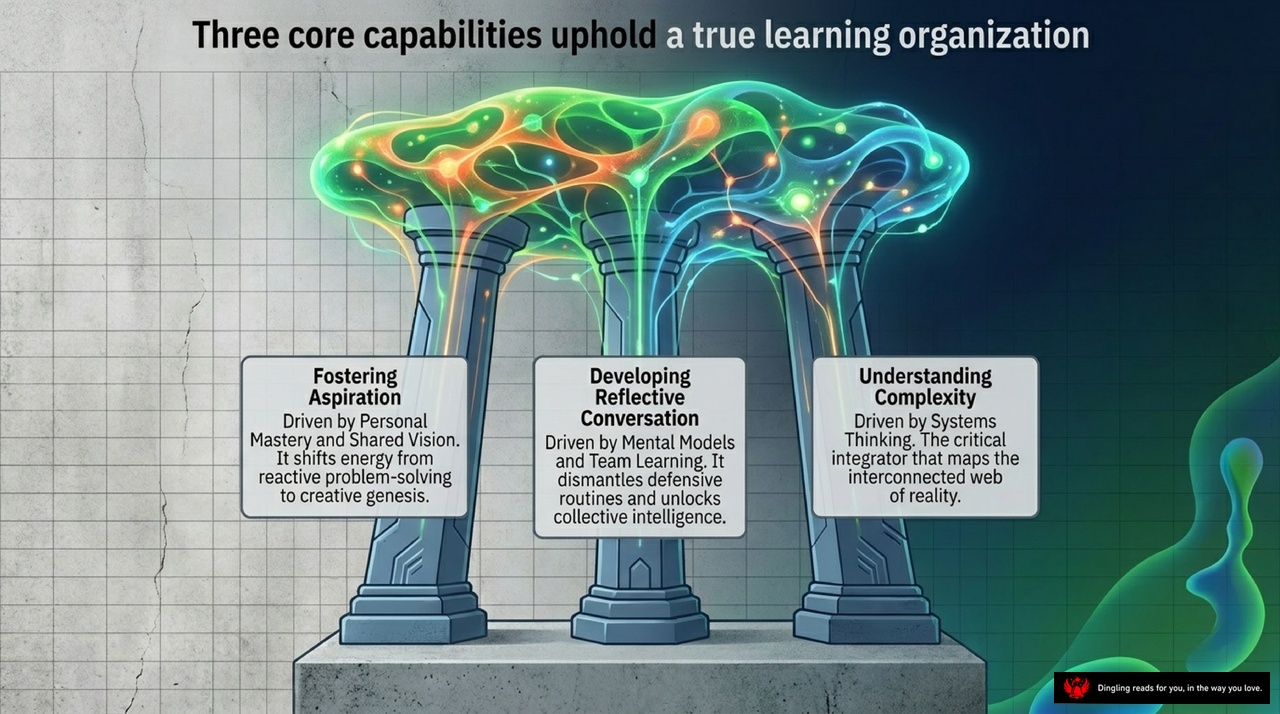
Look at these three pillars holding up a true learning organization: Fostering Aspiration, Developing Reflective Conversation, and Understanding Complexity. These aren't just buzzwords; they are the essential capabilities that transform a static company into a living, evolving organism.
First, let's talk about **Fostering Aspiration**. This is driven by personal mastery and a shared vision. Think of it as shifting the entire organization's energy from simply reacting to problems to actively creating new possibilities. When individuals are constantly pushing their own boundaries and aligned with a collective future, the organization stops being a machine that just follows orders and starts becoming a force that generates its own momentum.
Next, we have **Developing Reflective Conversation**. This capability is fueled by mental models and team learning. In many workplaces, we get stuck in defensive routines where everyone protects their own turf. But true learning happens when we dismantle those barriers. By engaging in deep, honest dialogue—what we call "reflective conversation"—we unlock collective intelligence. It's about moving past surface-level arguments to understand the underlying assumptions driving our decisions, turning our team into a single, smarter brain rather than a collection of individuals.
Finally, the third pillar is **Understanding Complexity**, driven by systems thinking. This acts as the critical integrator, mapping out the interconnected web of reality. It helps us see that problems are rarely isolated; a change in one part of the system ripples through the whole. Without this ability to see the big picture, we end up fixing symptoms while ignoring the root causes. When we combine these three capabilities—aspiration for direction, reflective conversation for connection, and systems thinking for context—we build an organization that is resilient, adaptable, and ready for whatever the future throws at it.

Personal mastery isn't about escaping reality; it's about holding the tension between where we are and where we want to be. Think of it as a powerful bow: on one end, you have the heavy anchor of current reality—a ruthless, unvarnished commitment to the truth of where you stand right now. On the other, you have the star of personal vision, a clear and deeply held picture of the results you truly care about creating.
The magic happens in the middle, in what we call the rubber band of creative tension. Many people make the mistake of trying to snap the band shut immediately, lowering their vision to match their current limitations. But that's a trap. The gap between your vision and your reality isn't a failure; it's actually the source of your generative energy. That tension seeks resolution, constantly pulling your reality toward your vision.
So, how do you stay in this powerful zone? You must resist the urge to shrink your dreams when things get tough. Instead, you lean into the discomfort. You acknowledge the anchor's weight, but you trust that the pull of the star is stronger. This dynamic balance is what drives true growth, turning the struggle between who you are and who you could be into the very engine of your personal evolution.
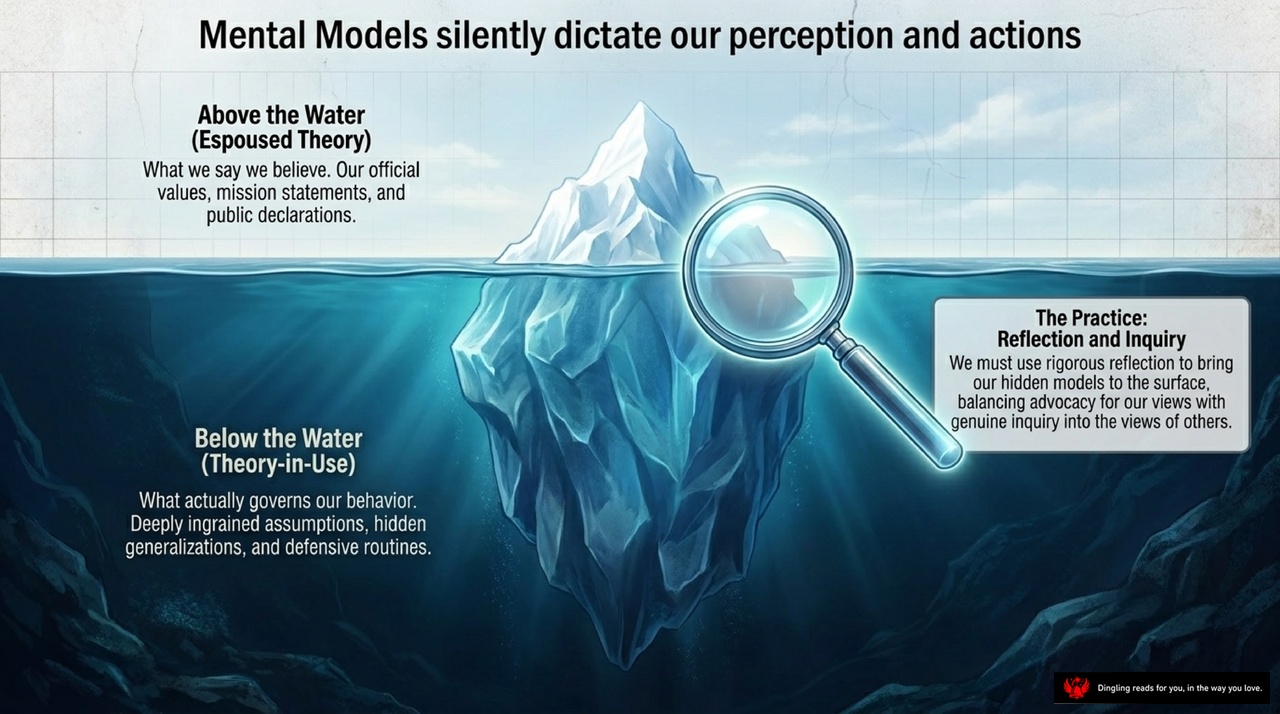
Mental models are the invisible architecture of our reality. They silently dictate how we see the world and, more importantly, how we act within it. But here's the catch: what we say we believe and what we actually do are often two completely different things.
Look at this iceberg. Above the water, we have our "Espoused Theory"—the mission statements, the values we proudly display, the public declarations of who we are. It's the polished facade. But below the water lies the much larger, hidden mass: our "Theory-in-Use." This is what truly governs our behavior. It's filled with deeply ingrained assumptions, hidden generalizations, and those automatic, defensive routines we never admit to having.
The gap between these two layers is where our biggest blind spots live. We often fail not because we lack good intentions, but because our hidden mental models are steering us in the wrong direction. To bridge this gap, we need a practice of rigorous reflection and inquiry. We must use a magnifying glass on our own thinking, bringing those submerged models to the surface. It's about balancing our advocacy for our own views with a genuine curiosity about the perspectives of others. Only when we stop blindly trusting our own mental maps and start examining them critically can we truly change our perception and, ultimately, our actions.

Look at this slide. It perfectly captures the shift from a "compliant workforce" to "committed builders." On the top, we see "Fragmented Vision." Here, goals are dictated from the top down. People follow rules out of fear or obligation, and their energy is scattered in every direction. It's a chaotic mess where everyone is pulling in different places.
But look at the bottom. This is "Shared Vision," or what we call "Enrollment." Instead of being forced, people opt-in voluntarily because they truly care about this collective picture of the future. When energy aligns like this, it creates an overwhelming force for forward momentum.
This transformation is the heart of a learning organization. It's not just about better management; it's about unlocking human potential. When we move from compliance to commitment, we stop asking people to do things just because they have to, and start inspiring them to do things because they want to. That is where real innovation and resilience come from.

Team Learning unlocks collective intelligence that exceeds individual limits. Look at this split screen: on the left, we have "The Trap of Discussion," and on the right, "The Art of Dialogue." This isn't just semantics; it's the difference between a stagnant meeting and a breakthrough moment.
Think about your last team meeting. Did ideas get ping-ponged back and forth, with everyone trying to defend their view and protect their turf? That's the trap of discussion. It comes from the root word "percussion"—it's about impact and winning the argument. In that mode, we're just shouting over each other, unable to see the bigger picture.
But look at the right side. This is the Art of Dialogue. The word comes from "dia-logos," meaning flowing through. Here, individuals suspend their assumptions and enter a shared pool of meaning. Instead of fighting to prove who is right, we think together to discover insights no single person could realize alone.
The visual contrast is stark. On the left, arrows collide in sparks of conflict, trapping us in our own silos. On the right, those same connections swirl into a unified, glowing vortex. This is where true collective intelligence lives. When we stop discussing and start dialoguing, we stop competing for territory and start co-creating solutions. This shift is the heartbeat of a learning organization, turning a group of individuals into a single, smarter entity.

Systems Thinking acts as the glue that binds all the disciplines of a learning organization into one indivisible whole. As you can see in the center of our diagram, Systems Thinking sits at the core, connecting Vision, Team Learning, Mastery, and Mental Models into a dynamic, living system. Without this integrator, the other disciplines risk becoming isolated tricks—just a collection of separate skills that don't actually work together.
Think of it this way: Vision gives us the destination, but Systems Thinking provides the map of the terrain, helping us understand the feedback loops and delays that might derail us. Team Learning allows us to collaborate effectively, while Mastery ensures we have the skills to execute. But it is Systems Thinking that prevents the organization from simply treating symptoms. It reveals a profound truth: the whole is fundamentally greater than the sum of its parts. By shifting our perspective from linear cause-and-effect to seeing the underlying structures and interconnections, we stop reacting to events and start shaping the system itself. This holistic view is what transforms a group of individuals into a truly adaptive, self-renewing organization capable of thriving in a complex world.

The laws of systems thinking defy linear logic, and today we're diving into four powerful principles that will change how you see problems and solve them.
First, look at the cycle icon: "Today's problems come from yesterday's solutions." This is a hard truth. Often, our quick fixes just shift the pain to another part of the system, creating a cycle where the cure becomes the disease. We treat symptoms instead of the root cause, and eventually, the problem just comes back stronger.
Next, consider the speedometer hitting the red zone: "Faster is slower." Pushing a system past its natural rate of growth triggers violent backlash. Whether it's a company rushing to scale or an individual burning out, ignoring the system's rhythm leads to collapse. The most effective leverage points are often the least obvious, hidden in the invisible architecture of the system, rather than the flashy, fast actions we see on the surface.
Then, look at the crutch and the warning sign: "The cure can be worse than the disease." Easy, familiar solutions often create dangerous long-term dependencies. Just because something feels comfortable or works in the short term doesn't mean it's the right move. In fact, relying on these crutches can cripple the system's ability to evolve.
Finally, notice the seesaw with the heavy rock: "Small changes can produce big results." This is about leverage. By understanding the feedback loops and delays in a system, you can find that one small adjustment that creates massive, lasting impact. It's not about doing more; it's about doing the right thing at the right structural point.
These four laws remind us that systems are dynamic, interconnected, and often counterintuitive. To navigate complexity, we must stop thinking in straight lines and start seeing the circular, feedback-driven reality of how things actually work.

Today's slide breaks down the three invisible building blocks that make or break any complex system: Reinforcing Feedback, Balancing Feedback, and Delays.
Think of Reinforcing Feedback as the engine of growth or collapse. It's that snowball effect where small changes compound upon themselves, creating exponential momentum. Whether you're building a business or facing a crisis, this loop pushes you further in the same direction.
On the other hand, Balancing Feedback is your system's natural tendency to self-correct and maintain stability. It's the force that resists change, acting as a thermostat to keep things from spiraling out of control. It's the source of resistance, but also the key to stability.
Finally, we have Delays. This is often the hidden trap. Delays represent the gap between the actions we take and the consequences we see. When we fail to account for these time lags, we often overcorrect, leading to extreme volatility and chaos. Understanding these three structural blocks is the first step to mastering systemic reality.

The U-Process isn't just a chart; it's the heartbeat of deep collective learning. Imagine a journey that moves from seeing things as they truly are, to connecting with our highest aspirations, and finally, into rapid action.
It starts with **Sensing**. This is about suspending our ingrained mental models. We stop filtering reality through our biases and judgments, choosing instead to observe the world purely. It's the courage to see the situation without our own ego getting in the way.
Once we have that clear view, we move to **Presencing**. This is the deep, quiet connection to our ultimate source of aspiration and vision. It's not about planning the future from where we are now; it's about allowing the future to begin manifesting right here, by tapping into that deep knowing.
Finally, we leap into **Realizing**. This is where the vision becomes tangible. We rapidly prototype the new vision, moving swiftly into action to gather feedback and refine our systemic model. It's the transition from the inner world of possibility to the outer world of reality.
Together, these three stages map the path from deep insight to transformative action, guiding us through the complex journey of learning as a collective.

Leadership is no longer about the lone hero saving the day; it's about becoming the architect of an entire ecosystem. Today, we're looking at the evolution of the modern leader through three distinct, overlapping roles: the Designer, the Teacher, and the Steward.
First, think of the leader as a **Designer**. Just like an architect doesn't build every brick but creates the blueprint and the foundation, a leader builds the invisible infrastructure. This means crafting the environment, policies, and practices that allow learning to emerge naturally. You aren't telling people what to do; you are designing the soil where their ideas can grow.
Next, consider the leader as a **Teacher**. This isn't just about training skills; it's about fostering systemic understanding. Your job is to help everyone in the organization uncover their deep mental models and restructure how they view reality. You are guiding them to see the connections between things, breaking down silos, and helping them learn from each other rather than just from you.
Finally, the leader acts as a **Steward**. This role is about serving a larger purpose. It requires a profound commitment to the overarching vision and the long-term health of your people. You are protecting the organization's future, ensuring that decisions today don't compromise the well-being of the team tomorrow.
When these three roles merge, you get **The New Leader**. This is a leader who designs the system, teaches the culture, and stewards the people. It's a shift from controlling outcomes to cultivating potential. By balancing these three dimensions, leaders stop being the bottleneck and start becoming the catalyst for sustainable, organic growth.

An organization's only sustainable competitive advantage is its ability to learn faster than its competitors. This isn't just a catchy slogan; it's the fundamental truth of survival in today's volatile world. By mastering Personal Mastery, Mental Models, Shared Vision, Team Learning, and Systems Thinking, we transform organizations from rigid machines into vibrant, living ecologies capable of creating their own reality.
Think about it: when you stop viewing your team as a collection of individual roles and start seeing them as a connected, evolving system, magic happens. You move from simply surviving the complexities of our world to actively learning together to create the future we truly desire.
The journey begins with the individual. Personal Mastery is the foundation—it's about constantly pushing your own boundaries and aligning your actions with your deepest values. But an individual's growth means little without a shared direction. That's where Shared Vision comes in. It's not a top-down mandate; it's a collective dream that ignites passion and turns diverse personal goals into a unified force.
However, even the best vision can falter if our underlying assumptions are flawed. This is where Mental Models matter. We all have invisible lenses through which we see the world, often filtering out critical information. By surfacing and challenging these hidden beliefs, we unlock true Team Learning. When we practice deep dialogue, we stop defending our positions and start exploring new possibilities together, creating a collective intelligence that far exceeds the sum of individual parts.
And finally, it all ties together with Systems Thinking. This is the lens that connects everything. It helps us see the interconnections and delays that cause problems, moving us away from quick fixes and toward structural solutions. It allows us to anticipate consequences before they happen and navigate complexity with confidence.
So, the question isn't whether we can adapt to the chaos around us. The question is: are we willing to evolve? Are we ready to embrace these five disciplines, not as separate tasks, but as a unified way of being? Because when we do, we don't just react to change; we lead it. We build an organization that is resilient, innovative, and alive, ready to shape the future rather than just waiting for it to happen.