
The Genius's Back: Complete Chapter-by-Chapter Summary
Welcome to today's session on *The Silhouette of a Genius* by Chen Yan. This book takes us on a profound journey into the rugged heart of Shaanxi, exploring how the harsh, unforgiving earth of the Qinling mountains gave birth to the roaring, passionate art of Qinqiang opera. It is a story about how a specific theatrical ecosystem didn't just entertain people, but acted as a mirror, reflecting the deepest struggles and the most resilient spirit of the human soul. As we open this chapter, we are stepping onto a stage where history, nature, and art collide to create something timeless.

The Qinling Mountains are far more than just a physical divide between North and South China; they are the invisible, unyielding bedrock of our people's spirit. As the slide illustrates, this massive range acts as a powerful "geographical engine." On one side lies the harsh, arid north, while the other holds the fertile, misty south. But the true power of the Qinling isn't just in separating these climates and cultures; it's in its role as a silent guardian.
Think of the mountains as "The Dao"—a concept from ancient Chinese philosophy representing the fundamental, silent order of the universe. The Qinling endures in total silence, weathering centuries of war, political turmoil, and natural disasters without complaint. It is this very silence that forges a unique resilience in the people who call this land home. Just as the mountains withstand extreme suffering without breaking, the spirit of the people learns to endure hardship and then erupt into profound joy.
Furthermore, these mountains have historically served as "The Refuge." Throughout history, when chaos threatened from the plains, poets, hermits, and even fleeing laborers found safety in the deep valleys and caves of the Qinling. It was a sanctuary where culture could survive and evolve away from the noise of the outside world. This geographical barrier didn't just stop armies; it protected a way of life, preserving traditions and a deep connection to the land that persists today. So, when we look at the Qinling, we aren't just seeing rocks and peaks; we are witnessing the silent, enduring soul of a civilization that refuses to be erased.

The Cultural Crucible: Shangzhou versus Xi'an. On the left, we see Shangzhou, defined by silence. It carries an ancient, dignified vibe with deep historical roots. Here, hardship is borne without boasting, making it the hidden home of hermits and poets. On the right stands Xi'an, the roaring counterpart. Its vibe is chaotic and hard-edged, a city rushing toward globalized modernity while clinging to ancient imperial glory. This creates a fractured mirror of history. But true art is born in the friction between these two forces: Shangzhou's stoic silence and Xi'an's roaring ambition. This clash defines the soul of the region, blending the quiet endurance of the past with the explosive energy of the present.

Imagine a graph where the vertical axis represents "Emotional Intensity" and the horizontal axis tracks "Peasant Hardship." For decades, the line stays flat—a low, steady hum of silent, backbreaking labor in the loess soil. This is the baseline. But then, suddenly, the line spikes upward into a jagged, red frenzy. This spike is the passionate, unrefined scream of Qinqiang Opera.
This visual captures the core truth: Qinqiang is not a delicate court entertainment; it is a grassroots survival mechanism. It survived imperial bans precisely because it is the primal scream of thirty million Shaanxi peasants refusing to be silenced. When hardship hits its peak, the people don't just suffer quietly; they erupt. They turn their pain into art, transforming their suffering into a powerful, defiant voice that refuses to fade away.

Today, we dive into the heart of comedy with a spotlight on Yan Zhensu, the ultimate embodiment of "The Clown" archetype. Unlike the polished performers on glossy stages, Yan emerged from the harshest margins of society, born into such extreme poverty he once had only a bowl of thin soup to wash his face. This raw origin isn't a tragedy; it's the very forge that shaped his genius.
His core contribution lies in something radical: elevating the "ugly" and the marginalized into profound social commentary. He proved that true comedic genius cannot be artificially manufactured in a studio. Instead, it is distilled from a lifetime of surviving on the fringes of society, turning personal pain into universal truth.
This brings us to a powerful philosophical takeaway: comedy uses tragedy as its chassis. Without the weight of real suffering, there is no lift for the laughter. Yan's journey teaches us that the most impactful humor doesn't come from making light of things, but from standing firmly in the darkness and finding the light within it. It is a reminder that our deepest scars often hold the sharpest insights, and sometimes, the funniest stories are the ones that hurt the most.
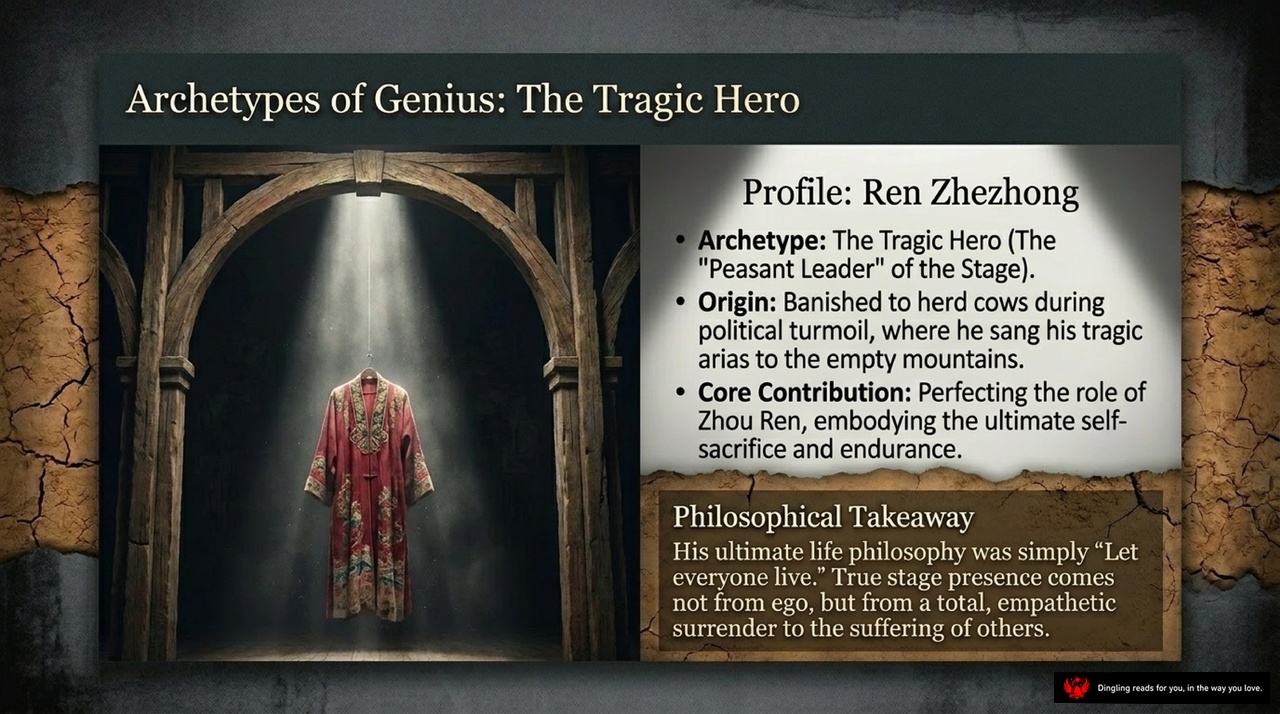
Today, we step into the soul of a specific archetype: The Tragic Hero. On your screen, you see a solitary robe hanging in a spotlight, a visual metaphor for Ren Zhezong, the man known as the "Peasant Leader" of the stage. Unlike heroes who conquer empires, Ren's power came from his ability to embody the suffering of others.
Born into a time of political turmoil, he was once banished to herd cows, singing his tragic arias to empty mountains. This humble origin shaped his core contribution: he perfected the role of Zhou Ren, a character defined by ultimate self-sacrifice and endurance. In his performances, he didn't just act; he surrendered his ego to the pain of the crowd.
His philosophical takeaway is simple yet profound: "Let everyone live." True stage presence isn't about ego or applause; it comes from an empathetic surrender to the suffering of others. Ren Zhezong taught us that the greatest heroism lies not in rising above the world, but in standing with it, carrying its burdens so others can breathe.
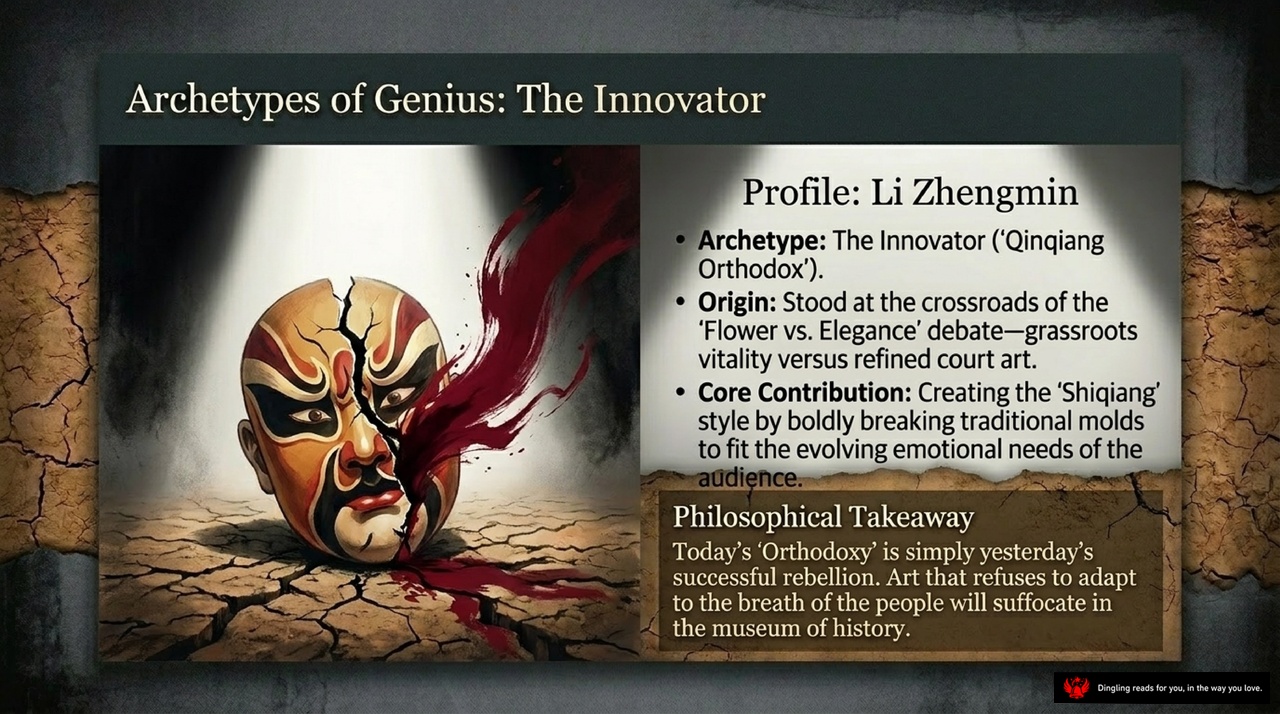
Archetypes of Genius: The Innovator. Let's dive into the profile of Li Zhengmin, a true disruptor in the world of Chinese opera.
Picture this: a traditional mask, cracked down the middle, with blood splashing out as if breaking free from its constraints. This isn't just art; it's a revolution. Li Zhengmin represents "The Innovator" archetype, specifically known as the "Qinqiang Orthodox."
He stood at a critical crossroads in history, caught between the "Flower vs. Elegance" debate. On one side, you had the refined, polished court art; on the other, the raw, vibrant energy of the grassroots. Li Zhengmin chose the latter. He didn't just participate in this debate; he boldly shattered the traditional molds that had long suffocated the art form.
His core contribution was creating the "Shiqiang" style. By daring to break away from the old rules, he aligned Qinqiang with the evolving emotional needs of the audience. He understood that today's "orthodoxy" is simply yesterday's successful rebellion. Art that refuses to adapt to the breath of the people doesn't just fade; it suffocates in the museum of history.
Li Zhengmin's legacy teaches us that true genius isn't about preserving the past perfectly; it's about having the courage to crack the mask and let something new bleed through.

From Stage to Page isn't just about moving a story from a script to a book; it's about unlocking the invisible parts of life that a physical stage simply cannot hold.
Look at this image. On the left, we have the "Theatrical Script," representing decades spent managing theaters, observing the raw blood, sweat, and backstage politics of performers. But there's a hard ceiling here, shown by the pulley system: the physical stage limits the depth of internal psychological and historical exploration. You can't show the quiet thoughts or the complex history of a character's soul when you only have two hours and a set.
That limitation forces a transformation. As the text on the right suggests, we must transition to long-form literature to capture the "unsaid" realities of the theater ecosystem. Writing a novel becomes a report to the soul. It is the only way to document the theatricality of life itself—the slow burn of a career, the hidden struggles, and the full arc of a human being that no single performance could ever convey.
This shift allows us to explore the quiet resilience of ordinary people, like the stagehands who carry the lights, or the artists who spend decades perfecting their craft behind the scenes. Literature gives them a voice that lasts forever, turning fleeting moments on stage into an enduring legacy.

Welcome back to our deep dive into Jia Pingwa's world. Today, we're stepping into the heart of his theatrical philosophy with a framework he calls "The Stage Trilogy Matrix." This isn't just a chart; it's a map of three distinct worlds that define the human experience on stage, from the silent struggle of labor to the tragic glory of the lead, and finally, the chaotic laughter of the clown.
First, look at the left column: **The Scene-Setter**, or *Zhuangtai*. Here, the protagonist archetype is **The Invisible Worker**, like our character Diao Shunzi. This isn't about fame; it's about survival. The central conflict is stark: **Physical survival versus Urban marginalization**. These workers build the stage for others' glory, carrying heavy props and lights, yet their view of the stage is simply a "heavy physical construct built for others' glory." They are the foundation, the unseen hands holding up the world, often erased by the spotlight.
Moving to the center: **The Protagonist**, or *Zhujiao*. Think of **The Reluctant Star**, like Yi Qin'e. Here, the stakes are higher. The conflict shifts to **Artistic purity versus Institutional corruption**. These are the people forced to choose between their soul and the system. Their view of the stage changes from a physical structure to a "spiritual battlefield demanding ultimate sacrifice." It's a place of intense inner warfare, where talent meets the crushing weight of expectation and betrayal.
Finally, on the right, we have **The Comedy**, or *Xiju*. The archetype here is **The Corrupted Clown**, like He Jiabei. This is where the lines blur. The conflict becomes **Pandering for laughs versus The boundary of dignity**. In this world, the stage is no longer a battlefield or a construction site; it becomes "a distorting mirror that inevitably shatters." It reflects our absurdity, showing how easily we can trade our dignity for a quick joke, only to find the reflection broken and unrecognizable.
Jia Pingwa uses this matrix to show us that there is no single way to be on stage. We can be the invisible worker, the struggling star, or the laughing clown. But in every role, we face the same fundamental truth: the stage is a mirror, and what we see in it depends entirely on where we stand.

The image before us paints a powerful picture of the unsung heroes behind every grand performance. It's titled "Philosophy of the 'Small Character,'" and it brilliantly captures a truth we often overlook: history and reality are not built by the stars in the spotlight, but by the steady hands of the stagehands working in the shadows.
Look at the left side of the slide. It speaks to "The Illusion of the Spotlight." We are obsessed with the leading roles, the ones basking in the light, yet it is the foundation of reality that is held up by the stagehands. Without them, the show simply cannot happen.
On the right, the text highlights "The Dignity of the Dust." Characters like Diao Shunzi, the protagonist of my novel *Zhuang Tai*, endure the cold and the sharp edges of social life. They work in the dusty, overlooked corners of the city, yet they maintain a profound, uncelebrated moral compass. They are the backbone of society, often invisible to the public eye, but essential to its functioning.
Finally, at the bottom, we see "The Mandate." Literature possesses a natural duty to speak for the weak. To ignore these scene-setters—the loaders, the cleaners, the builders—is to fundamentally misunderstand the architecture of human society. As I wrote in *Zhuang Tai*, these small people are the true color of our era. Their struggles, their resilience, and their quiet dignity are what make our stories real. This is why I dedicate so much of my writing to them: because they are the most important characters of all.
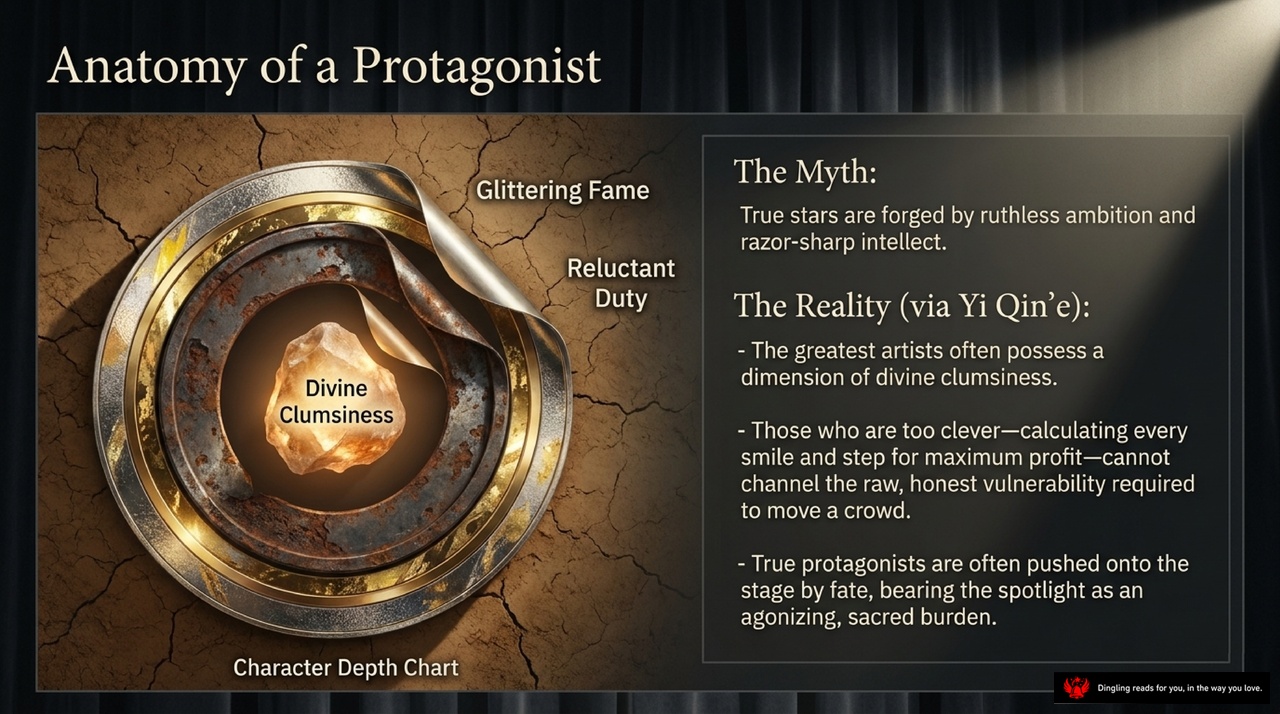
The Myth of the Star is a lie we tell ourselves to feel special. We believe true greatness is forged only by ruthless ambition and razor-sharp intellect. We think if you just calculate every smile, every step, and every move for maximum profit, you will inevitably conquer the stage. But the reality, as Yi Qin'e's life proves, is the exact opposite.
Look at the diagram. The outer layers represent "Glittering Fame" and "Reluctant Duty"—the things the world sees. But peel back those layers, and you find the core: "Divine Clumsiness." This is the secret ingredient of every great protagonist. Those who are too clever, who try to engineer their success, can never channel the raw, honest vulnerability required to truly move a crowd.
Think about it. The most compelling characters aren't the ones who have everything figured out. They are the ones pushed onto the stage by fate, bearing the spotlight as an agonizing, sacred burden. They stumble. They feel the weight of their own existence. That very "clumsiness"—that refusal to be perfect, that willingness to be seen in their rawest, most vulnerable state—is what makes them magnetic. It's not about being a flawless machine; it's about being a real human who is afraid, who struggles, and who dares to show it. That is the anatomy of a true protagonist.

Comedy is humanity's thermal lab, a place where we generate immense heat and energy, but it comes with a dangerous cost. When an audience endlessly demands punchlines and society forces entertainment past the boundaries of human dignity, that thermal lab explodes. Pushed to its absolute extreme, comedy inevitably loops into tragedy. We cannot continuously perform a comedy without eventually being dragged offstage by reality. This dialectic reveals a hard truth: the very mechanism that generates laughter also contains the seeds of tears, reminding us that no matter how much we try to control the narrative, reality always has the final word.
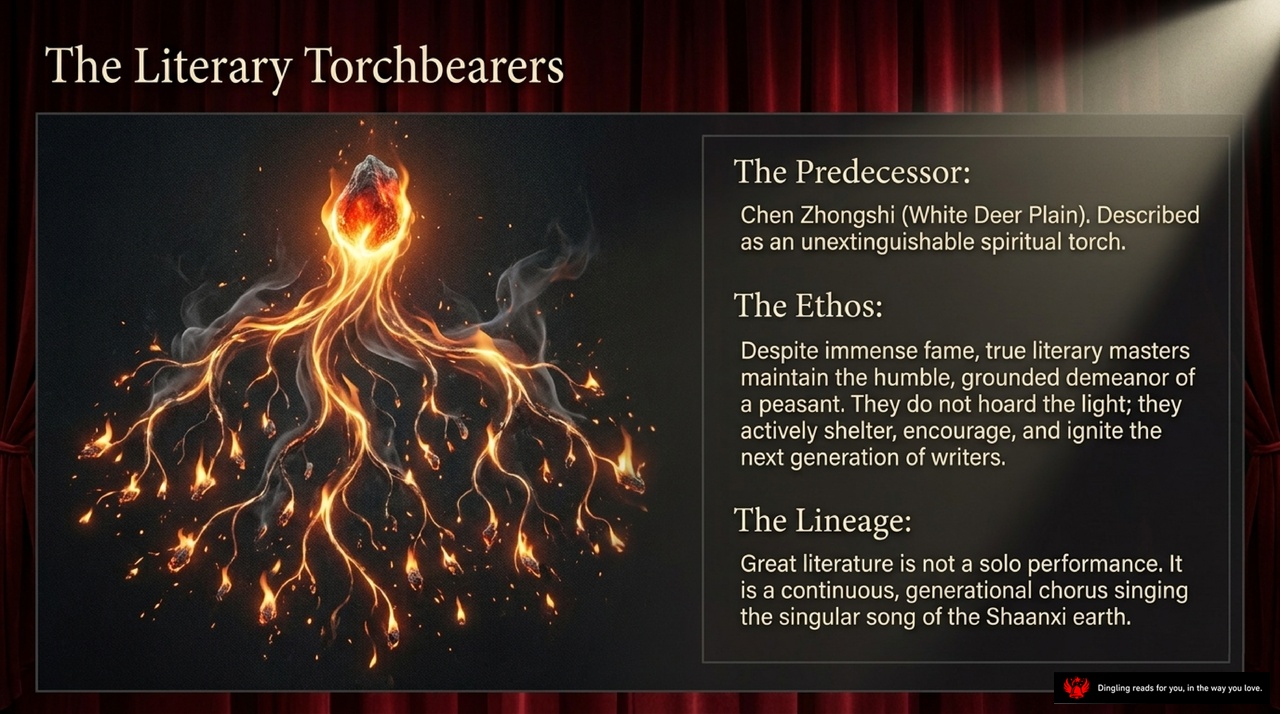
The Literary Torchbearers: Why Great Writers Stay Grounded
Look at this image of the torch. It's not just a flame; it's a lineage. The text on the right calls these figures "The Literary Torchbearers," and it breaks down exactly what that means for us.
First, the Predecessor. We are talking about Chen Zhongshi, the author of *White Deer Plain*. The slide describes him as an "unextinguishable spiritual torch." Why? Because true literary masters, despite their immense fame, never let their success inflate their ego. The slide highlights "The Ethos": even when they are famous, they maintain the humble, grounded demeanor of a peasant. They don't hoard the light. Instead, they actively shelter, encourage, and ignite the next generation of writers. This is the core of their character.
Then, look at "The Lineage." The text says, "Great literature is not a solo performance." It's a continuous, generational chorus singing the singular song of the Shaanxi earth. Think about it: when Chen Zhongshi passed, he didn't just leave a book; he left a torch. And someone else picked it up. In the text, we see how he personally supported younger writers like me, even bowing to my stage plays and writing encouraging reviews for my novels. He refused to be a distant celebrity; he was a mentor who stayed in the trenches with us.
This torch was also carried by others, like the late Ma Hesheng, who tried to persuade my mother to get the surgery she desperately needed, and the countless literary friends who gathered to honor Chen Zhongshi's spirit. They all understood that their job wasn't just to write; it was to pass the flame. As the slide concludes, this isn't about one person's glory. It's about a chain reaction. One writer lights the way for the next, ensuring that the story of this land—the "Shaanxi earth"—keeps being told, evolving, and living on. That is the true power of a literary torchbearer.
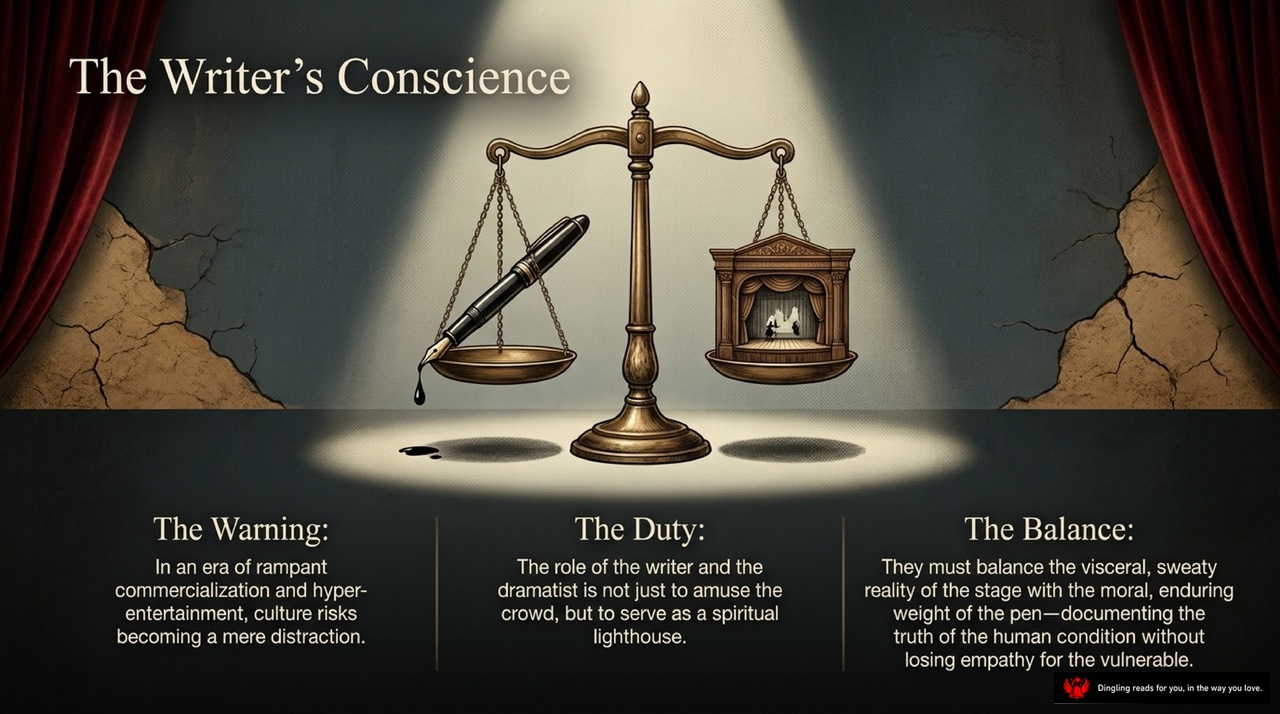
The image presents a profound visual metaphor: a scale balancing a pen against a stage. On one side, the pen drips ink, representing the heavy, visceral reality of writing; on the other, the stage holds a miniature performance, symbolizing the entertainment we crave. This isn't just about art; it's about the writer's conscience in a world obsessed with spectacle.
The slide breaks this down into three critical points. First, **The Warning**: In our current era of rampant commercialization and hyper-entertainment, culture risks becoming nothing more than a distraction. We are so busy chasing the next big show that we forget the deeper purpose of storytelling.
Second, **The Duty**: The role of the writer and the dramatist goes far beyond amusing the crowd. We must serve as a spiritual lighthouse. Just as a lighthouse guides ships through storms, our stories must guide people through the chaos of modern life, offering clarity and moral direction.
Finally, **The Balance**: This is the hardest part. We must balance the sweaty, raw reality of the stage—the messy truth of human existence—with the moral weight of the pen. We have a duty to document the truth of the human condition without losing our empathy for the vulnerable. It is about finding that delicate equilibrium where art remains both entertaining and ethically grounded, ensuring that our stories don't just entertain us, but elevate us.
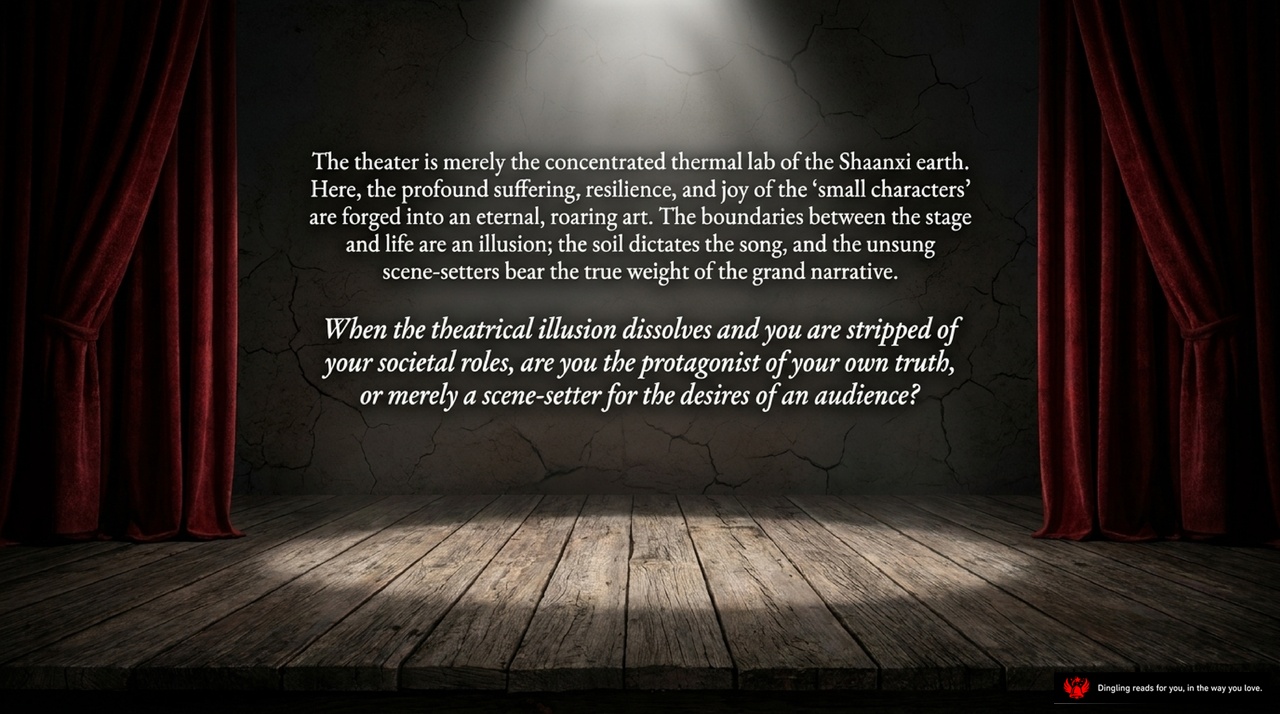
Look at this stage. Red velvet curtains frame a cracked, dark backdrop, illuminated by a single spotlight. It's a powerful visual: the theater isn't just a place for entertainment; it's a concentrated thermal lab where the raw earth of Shaanxi is forged into art.
The text on the screen asks a profound question that strikes at the heart of our own lives: "When the theatrical illusion dissolves and you are stripped of your societal roles, are you the protagonist of your own truth, or merely a scene-setter for the desires of an audience?"
This image captures the essence of the journey we've discussed. We often spend our lives performing—acting out roles as employees, parents, or leaders. But like the "small characters" in the stories we've explored, from the resilient opera singers to the quiet stagehands, we must ask ourselves: when the curtain falls and the applause stops, who are we really? Are we defining our own narrative, or are we just background characters in someone else's story?
The stage is empty, waiting for us to step in. It reminds us that the boundaries between the performance and reality are often just an illusion. The true weight of our lives doesn't lie in the roles we play for others, but in the authentic truth we carry within ourselves. So, when you leave this room, take a moment to check the script of your own life. Are you writing the lead role, or just filling in the scenery?