
The Grand Design: Complete Chapter-by-Chapter Summary

Welcome to *The Grand Design* by Stephen Hawking. This book offers a revolutionary new picture of the universe, one that unravels the ultimate mysteries of our existence. We often ask profound questions: How do we understand our world? What rules govern the cosmos? Where did it all begin? Do we need a creator? While these thoughts may not always occupy our minds, they inevitably surface, stirring deep curiosity.
Historically, these were philosophical questions, but today, science—especially physics—has taken the lead. Using the latest discoveries, we can now describe a universe very different from our traditional view. This new perspective wasn't just a sudden idea; its seeds were planted nearly a century ago. Our old understanding, based on daily life, assumed everything moved along a clear, predictable path. But in the 1920s, this view failed at the atomic scale. Quantum physics emerged to explain the strange behavior there, showing us that reality is far more complex than we ever imagined.
At the heart of this new understanding is a radical idea: the universe does not have a single history. Instead, it exists in all possible histories at once. This might sound like it defies common sense, but our everyday intuition simply doesn't apply to the quantum realm or the early universe. To make sense of this, we adopt a powerful framework called "model-dependent realism." It suggests that our knowledge isn't a direct copy of reality. Instead, our brains build models to interpret sensory input. A model is "real" not because it is the absolute truth, but because it successfully predicts what we observe. Whether it's a simple chair or the complex fabric of spacetime, if a model works, it is a valid description of reality.
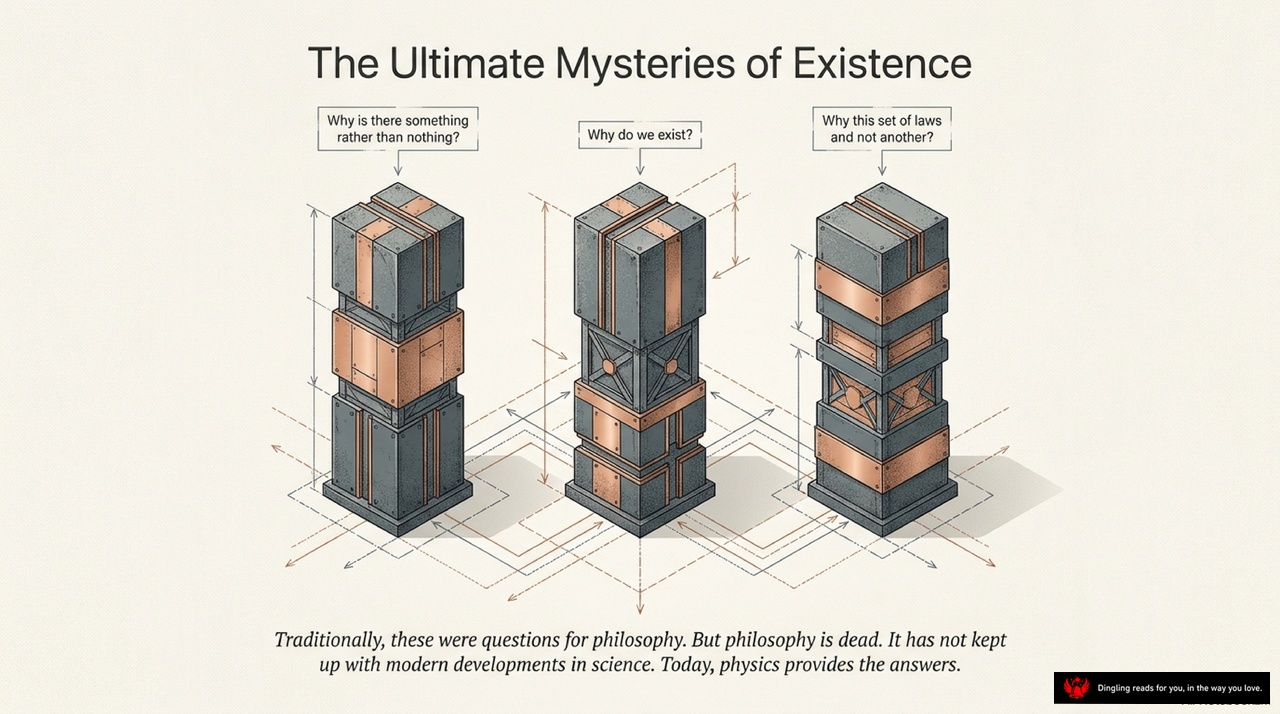
Look at these three pillars. They represent the ultimate mysteries that have haunted humanity for millennia: Why is there something rather than nothing? Why do we exist at all? And why is this specific set of laws governing our universe, rather than some other?
Traditionally, these were questions reserved for philosophy. But here's the hard truth: philosophy has struggled to keep up with modern science. Today, physics provides the answers.
Let's break down what these questions actually mean. The first pillar asks about the origin of existence itself. The second asks about our specific place within it. The third asks about the rules of the game.
For centuries, people assumed the universe was a single, fixed history—a straight line from the beginning to the end. But modern physics, particularly the work of Richard Feynman, tells us something radical: the universe doesn't have just one history. It exists in a superposition of all possible histories at once. We are just observing one specific outcome from an infinite number of possibilities.
This shifts our understanding of reality entirely. We aren't looking at a single, pre-written script. We are looking at a vast network of potential realities, where the laws of physics act as the filter that selects which version of the universe becomes real. This is the core insight that connects these three pillars: existence isn't a given; it's a selection from infinite options, governed by the elegant, unified framework of M-theory.

Imagine a goldfish trapped inside a curved aquarium. To us, watching from the outside, a fish swimming in a straight line looks perfectly normal. But for the goldfish, that same path appears as a distorted arc. If we tried to explain the world from inside that bowl, we'd need a complex set of laws to describe why objects curve, even though they move straight to us. This raises a profound question: Is our view of reality the only "true" one, or is it just a model that fits our perspective?
This concept is central to the idea of "model-dependent realism." It suggests that there is no single, absolute truth about the universe we can all agree on. Instead, reality is defined by the models that successfully predict what we observe. The goldfish's curved world is just as "real" and valid as our straight-line world, provided both models accurately describe the phenomena within their own contexts.
Think back to the great debate between the geocentric and heliocentric models of the solar system. For centuries, the Church insisted the Earth was the stationary center of the universe because it matched our daily experience of standing on solid ground. Copernicus challenged this, proposing the Sun was the center. Was the Church wrong? Not necessarily. Both models could predict planetary positions with high accuracy. The geocentric model was just more complicated, requiring endless "epicycles" to fit the data. We eventually chose the simpler heliocentric model not because it was the only truth, but because it was a more efficient and useful tool for understanding the cosmos.
In modern physics, this idea becomes even more critical. Quantum mechanics tells us that particles don't have definite positions until they are measured. This shatters the classical notion of an objective reality existing independently of observation. If our perception is filtered through a model built by our brains to interpret sensory input, then asking "what is really out there?" might be the wrong question. The better question is: "Which model best explains what we see?"
Whether we are describing the motion of a goldfish, the orbit of planets, or the behavior of subatomic particles, the goal isn't to find a single absolute truth. It's to find the most effective, simplest, and predictive model for the specific scale we are observing. Reality, in this view, is not a fixed object waiting to be discovered, but a flexible framework we construct to make sense of the universe.

Imagine a goldfish staring out from inside a curved bowl. To the fish, the world outside looks distorted, bent by the glass. Yet, that fish isn't confused; it has built its own perfect scientific laws to predict exactly what happens outside, even though its reality looks warped compared to ours. This simple image captures the heart of Model-Dependent Realism: there is no single, absolute "truth" waiting to be found. Instead, reality is whatever model works best for the observer.
Look at the grid on the right. It represents the outside world, a standard coordinate system we use. But for the fish inside, that grid is a distortion. The slide reminds us that there is no picture-independent concept of reality. If two different models—one from inside the bowl and one from outside—can both accurately predict the same events, we cannot claim one is more "real" than the other. They are simply different tools for different perspectives.
This idea revolutionizes how we see the universe. It means our perception isn't a direct window into the cosmos; it's a constructed model. Whether we are humans on Earth or fish in a bowl, the value of our reality isn't defined by some hidden absolute truth, but by how well our mental map matches our observations. We don't need to find the "true" grid to understand the fish's world; we just need to accept that their grid is valid for them. This flexibility allows us to explore the universe without getting trapped in the illusion that our specific viewpoint is the only one that matters.
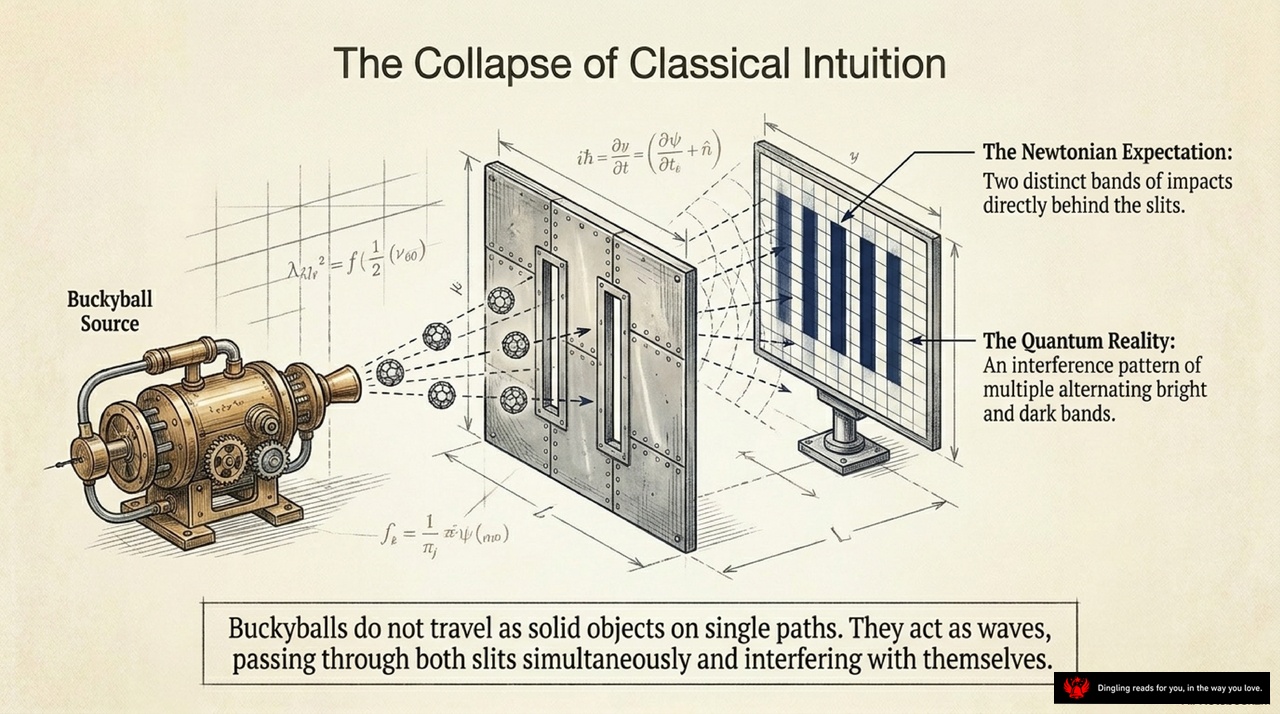
The collapse of classical intuition begins with a simple, yet mind-bending experiment: the double-slit experiment. Imagine firing particles like buckyballs—clusters of 60 carbon atoms—at a barrier with two narrow slits. In our everyday world, you'd expect them to act like solid objects, passing through one slit or the other, creating two distinct bands of impact on the screen behind. That's the Newtonian expectation, the logic that has governed our understanding for centuries.
But the quantum reality is far stranger. When these buckyballs hit the detector, they don't form two bands. Instead, they create an interference pattern of multiple alternating bright and dark bands, exactly like waves crashing on a shore. This proves that even large molecules don't travel as solid objects on single paths. They act as waves, passing through both slits simultaneously and interfering with themselves.
This phenomenon, known as wave-particle duality, shatters the idea that matter is either a particle or a wave. It reveals a deeper truth: the act of observation itself changes reality. If you try to measure which slit a particle takes, the interference pattern disappears, and it behaves like a solid object again. This leads us to Richard Feynman's revolutionary idea: particles don't just take one path; they explore every possible path at once, from going through one slit to circling the moon and back. The final outcome is a sum of all these histories, creating the patterns we see.
In the macroscopic world, these countless paths cancel each other out, leaving only the one "classical" path we expect. But at the quantum level, the full complexity of reality emerges. We are witnessing the collapse of classical intuition, realizing that the universe operates on rules far more fluid and interconnected than our everyday senses can ever imagine.

Imagine a world where the fundamental building blocks of reality aren't tiny, point-like dots, but rather vibrating threads of energy. This is the core idea of String Theory, and it's the key to unlocking the deepest mysteries of the universe. Instead of electrons or quarks being static specks, they are actually tiny strings, constantly oscillating. Just like a violin string produces different musical notes depending on how it vibrates, these cosmic strings produce different particles based on their specific vibration patterns. One mode of vibration might create an electron, while another creates a photon or a quark.
But here's where it gets even stranger. For this theory to work mathematically, our universe can't just have the three dimensions of space and one of time we experience. It needs extra dimensions—seven more, to be precise. These aren't vast, open spaces we could travel to; they are curled up so tightly at the microscopic scale that they are invisible to us, much like the surface of a thin straw looks like a single line from far away, but reveals its second dimension up close.
This leads us to M-Theory, the grand unification that brought together five different versions of string theory. It expands the stage to eleven dimensions, introducing not just vibrating strings, but also higher-dimensional objects called "branes." The shape of those hidden, curled-up dimensions acts like a dial, determining the values of our physical constants. It explains why gravity is so weak compared to other forces and why the universe has the specific properties it does. While we haven't found direct experimental proof yet, M-Theory offers the most promising framework we have to understand how all the forces and particles in the cosmos fit into one single, elegant design.

Welcome back to our exploration of reality. Today, we're diving into the final chapter: The Great Design.
We often ask, are the laws of physics just a lucky accident, or is there a deeper logic behind the universe? For decades, scientists like Einstein chased a "Theory of Everything," believing that if we could just find the right mathematical framework, we could unify all forces—gravity, electromagnetism, and the nuclear forces—into one elegant equation. Einstein dreamed of a universe governed by pure logic, where constants weren't arbitrary but inevitable, like geometric truths.
That dream is now within our grasp through M-Theory. Unlike previous theories that focused on single strings, M-Theory unifies five different versions of string theory into one grand framework. It suggests that our fundamental particles aren't just points, but vibrating strings or even higher-dimensional membranes. Crucially, M-Theory provides the geometric structure that determines why our universe looks the way it does. It explains why the extra dimensions are curled up in specific shapes, which in turn dictates the strength of gravity and the mass of particles.
This connects directly to our earlier discussion on Model-Dependent Realism. We learned that reality isn't a single absolute truth, but a collection of useful models. M-Theory is the ultimate model because it successfully predicts the behavior of the universe across all scales, from the smallest quantum fluctuations to the expansion of the cosmos. It shows that the "fine-tuning" we observed—those seemingly perfect constants that allow life to exist—isn't magic. Instead, it's a natural consequence of the universe's underlying geometry.
Think of it like the "Game of Life" we discussed earlier. Simple rules at the bottom level can create incredibly complex structures at higher levels. Similarly, the simple geometric rules of M-Theory generate the complex, life-permitting universe we inhabit. It resolves the mystery of why our universe is so hospitable to us; we are simply living in one of the many possible universes generated by this theory that happens to have the right parameters.
In the end, M-Theory doesn't just describe the universe; it explains its own creation. By balancing the positive energy of matter with the negative energy of gravity, it allows the universe to spontaneously emerge from nothing, conserving energy in the process. It unifies the origin of the cosmos with the laws that govern it. This is the realization Einstein sought: a single, self-consistent logical structure that encompasses everything. We have moved from wondering if the universe was designed by a god to understanding how the universe designed itself through the elegant mathematics of M-Theory.

The quest for unification is the holy grail of physics, a journey that began with James Clerk Maxwell in the mid-19th century. He did something revolutionary: he took the messy, separate laws of electricity and magnetism and wove them into a single, elegant tapestry. His equations didn't just explain what we knew; they predicted something entirely new—electromagnetic waves. And here's the kicker: when he calculated their speed, it matched the speed of light perfectly. Suddenly, light wasn't a mystery anymore; it was just a specific type of electromagnetic wave.
But this unification hit a wall. Maxwell's theory worked perfectly for electric and magnetic fields, but it couldn't explain gravity. For decades, physicists assumed light needed a medium to travel through, a substance called "ether," which would act as an absolute reference frame. In 1887, the Michelson-Morley experiment shattered this dream. No matter how the Earth moved, the speed of light remained constant. This failure forced Albert Einstein to rethink everything. He realized that time and space aren't fixed stages; they are flexible, interconnected dimensions that warp and stretch depending on how you move.
Einstein's Special Relativity solved the puzzle of light and motion, but gravity remained stubbornly separate. It took him another decade to crack the code with General Relativity. His insight was profound: gravity isn't a force pulling objects together like a magnet. Instead, mass and energy actually curve the fabric of spacetime itself. Imagine placing a heavy ball on a stretched sheet; the sheet dips, and marbles rolled nearby will spiral inward, not because they are being pulled, but because they are following the curve. This geometric view of gravity not only explained anomalies like Mercury's orbit but also predicted black holes and gravitational waves, phenomena we have now observed directly.
Today, we know the universe runs on four fundamental forces. Gravity, the weakest yet with infinite reach, shapes galaxies. Electromagnetism governs chemistry and biology. The weak force drives radioactivity, and the strong force holds atomic nuclei together. Physicists have successfully unified three of these into the Standard Model using quantum field theory. But gravity? It refuses to play nice with the quantum rules. When you try to force gravity into the quantum framework, the math breaks down, spitting out infinite, nonsensical results. This disconnect is the biggest hurdle left. The ultimate goal remains: to find a single theory that unifies all four forces, perhaps through a framework like M-theory or string theory, where everything from the smallest particle to the curvature of the cosmos emerges from one coherent, beautiful set of rules.

Imagine the universe not as a single, fixed map, but as a vast, overlapping network of different theories. This is the core idea behind M-Theory, often described as "The Map of Everything." Think of it like trying to represent a spherical Earth on a flat piece of paper; no single map can show the whole globe without some distortion. Similarly, no single physical theory can describe the entire universe perfectly. Instead, we have different theories—like String Theory A, String Theory B, and Supergravity—that are each valid in their own specific domains. Where these domains overlap, the theories match up seamlessly, just like adjacent maps connecting at their borders.
To make this mathematically consistent, M-Theory requires an 11-dimensional spacetime: ten dimensions of space and one of time. However, seven of those spatial dimensions are curled up so tightly that they are invisible to us, hiding within the fabric of reality. This framework unifies five previously distinct string theories into one coherent picture. It suggests that our reality is just one specific configuration among perhaps 10 to the power of 500 possible universes, each with its own unique laws. M-Theory offers a hopeful vision: a single, logical foundation that could finally explain every force and particle in the cosmos, turning the chaotic puzzle of physics into a complete, unified design.
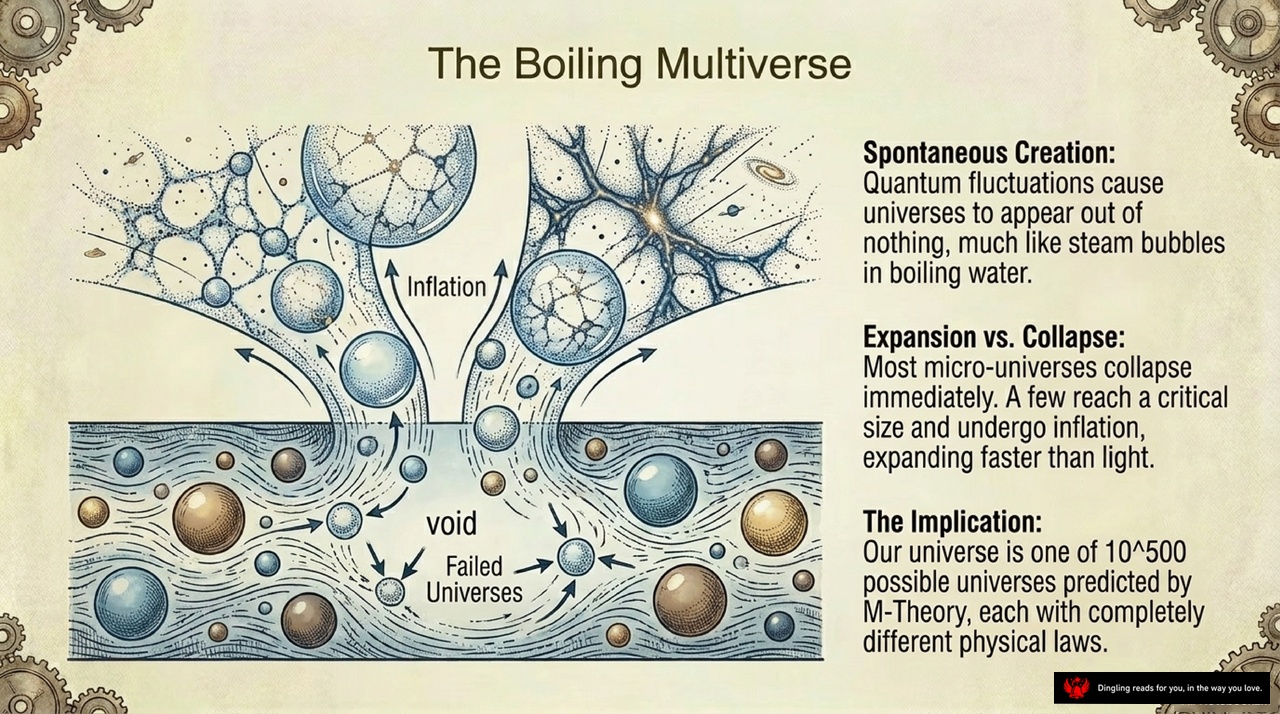
Imagine a pot of water coming to a boil. As the heat rises, countless tiny bubbles erupt spontaneously from the liquid, expanding rapidly before most of them collapse back into the void. A lucky few, however, grow large enough to escape the surface, expanding faster than the speed of light and becoming stable bubbles of their own. This image perfectly captures the concept of "The Boiling Multiverse."
Just like those steam bubbles, our universe didn't necessarily start from a single, unique point in a pre-existing space. Instead, quantum fluctuations in a primordial void caused countless micro-universes to pop into existence out of nothing. Most of these "failed universes" collapsed immediately, disappearing back into the void. But a tiny fraction reached a critical size, triggering a period of rapid inflation. These survivors expanded faster than light, freezing out their own unique physical laws and evolving into separate, isolated realities.
This leads to a staggering implication: we are not living in the only possible universe. According to M-Theory, our cosmos is just one of $10^{500}$ possible universes predicted by the mathematics of the multiverse. Each of these billions of trillions of universes operates under completely different physical laws—different strengths for gravity, different constants for electromagnetism, and perhaps even different numbers of spatial dimensions. We exist here not because the universe was fine-tuned for us, but simply because we are the lucky observers in one of the few bubbles that managed to survive the boil and expand.
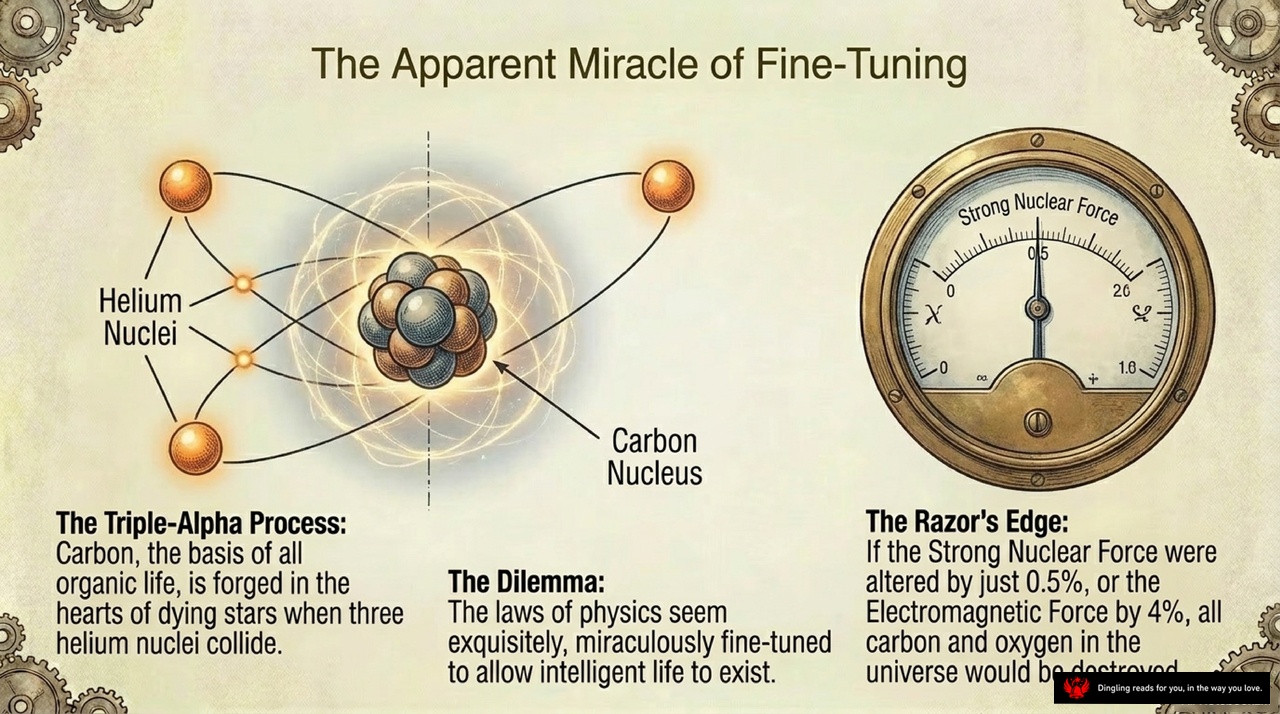
The Triple-Alpha Process is the cosmic alchemy that forged carbon, the very foundation of all organic life. As depicted in the diagram, this miracle happens deep within the hearts of dying stars when three helium nuclei collide to form a carbon nucleus. However, this process hangs on a razor's edge. If the Strong Nuclear Force were altered by just 0.5%, or the Electromagnetic Force by 4%, the resonance required for this reaction would vanish. Without it, no carbon or oxygen would exist in the universe. As the gauge on the right suggests, the laws of physics seem exquisitely, miraculously fine-tuned to allow intelligent life to exist. This apparent miracle challenges us to ask: is this precision a sign of design, or simply a statistical inevitability in a vast multiverse where countless universes have different laws?
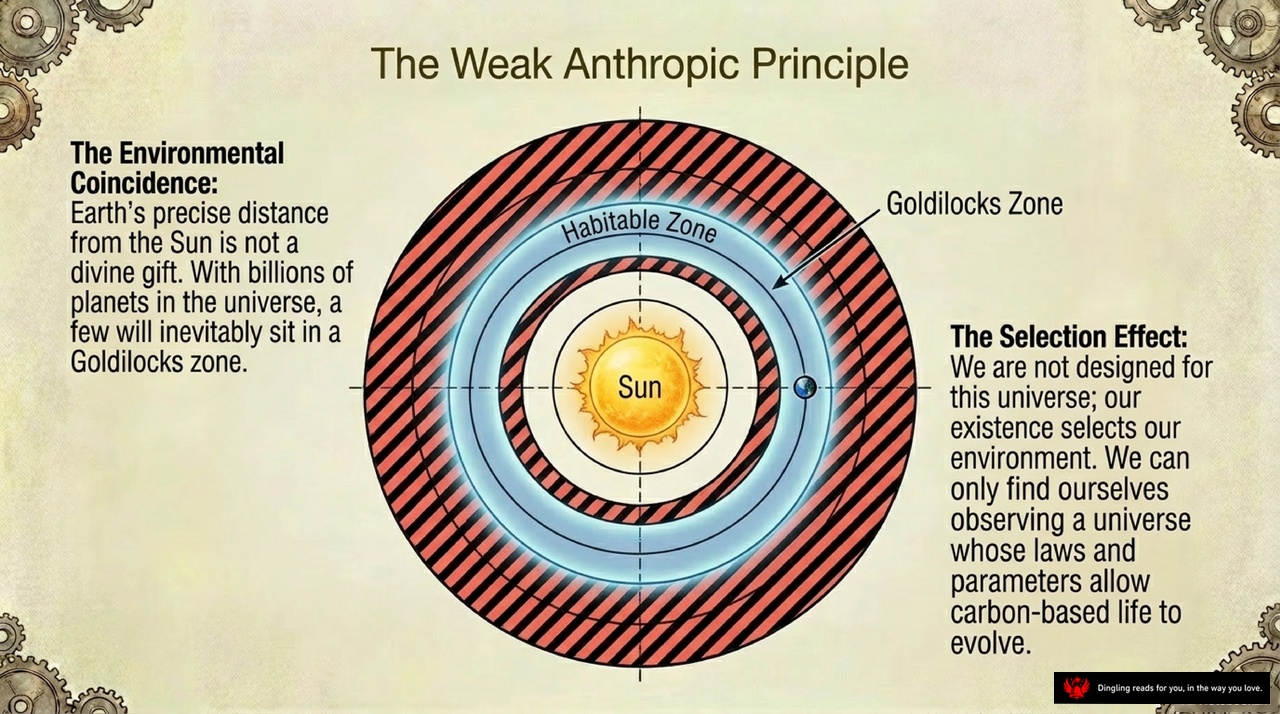
Today's slide breaks down the Weak Anthropic Principle into two powerful ideas that reshape how we see our place in the cosmos. On the left, we see the Environmental Coincidence: Earth's perfect distance from the Sun isn't a divine gift. With billions of planets scattered across the universe, it's statistically inevitable that a few will land right in this Goldilocks Zone—neither too hot nor too cold. We aren't special because of where we are; we are here because we had to be. On the right, the Selection Effect flips the script entirely. We aren't designed for this universe; rather, our existence selects the environment we can observe. If the laws of physics didn't allow carbon-based life to evolve, we simply wouldn't be around to ask the question. We only find ourselves in a universe whose parameters permit our survival. This isn't about fine-tuning by a creator; it's about a simple logical filter: life can only perceive a universe that supports life.
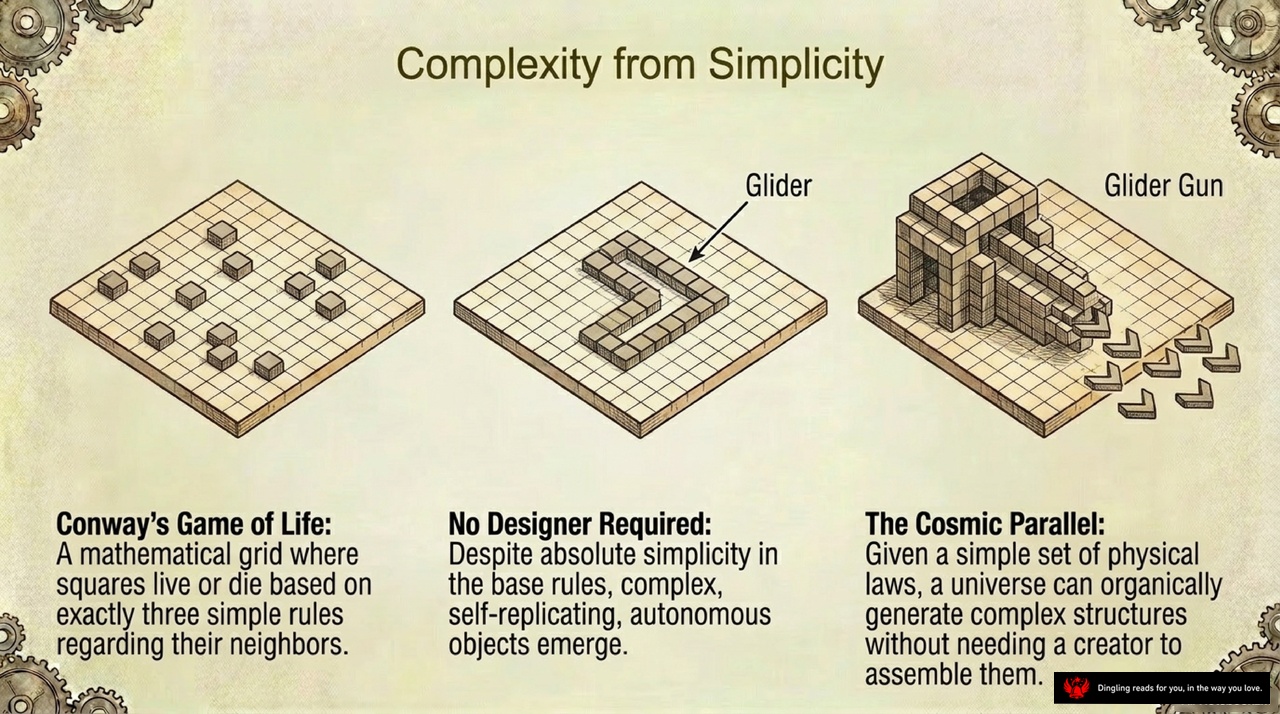
Complexity from Simplicity: How a Tiny Grid Creates a Universe.
Look at this slide. It shows Conway's Game of Life, a mathematical grid where squares live or die based on just three simple rules regarding their neighbors. At first glance, it seems like a boring pattern of blocks. But watch what happens. Despite this absolute simplicity in the base rules, complex, self-replicating, autonomous objects emerge.
See that shape labeled "Glider"? It's a stable pattern that moves across the grid on its own. And then look at the "Glider Gun" on the right. This structure doesn't just move; it periodically generates these gliders, creating a stream of activity. No designer required. These structures build themselves.
This is the cosmic parallel we are talking about. Given a simple set of physical laws, a universe can organically generate complex structures without needing a creator to assemble them. Just like this grid, our own universe might be running on a similarly simple set of underlying rules, yet it produces the staggering complexity we see around us—from atoms to galaxies. It suggests that the universe isn't a chaotic mess, but a system where complexity naturally arises from simplicity.
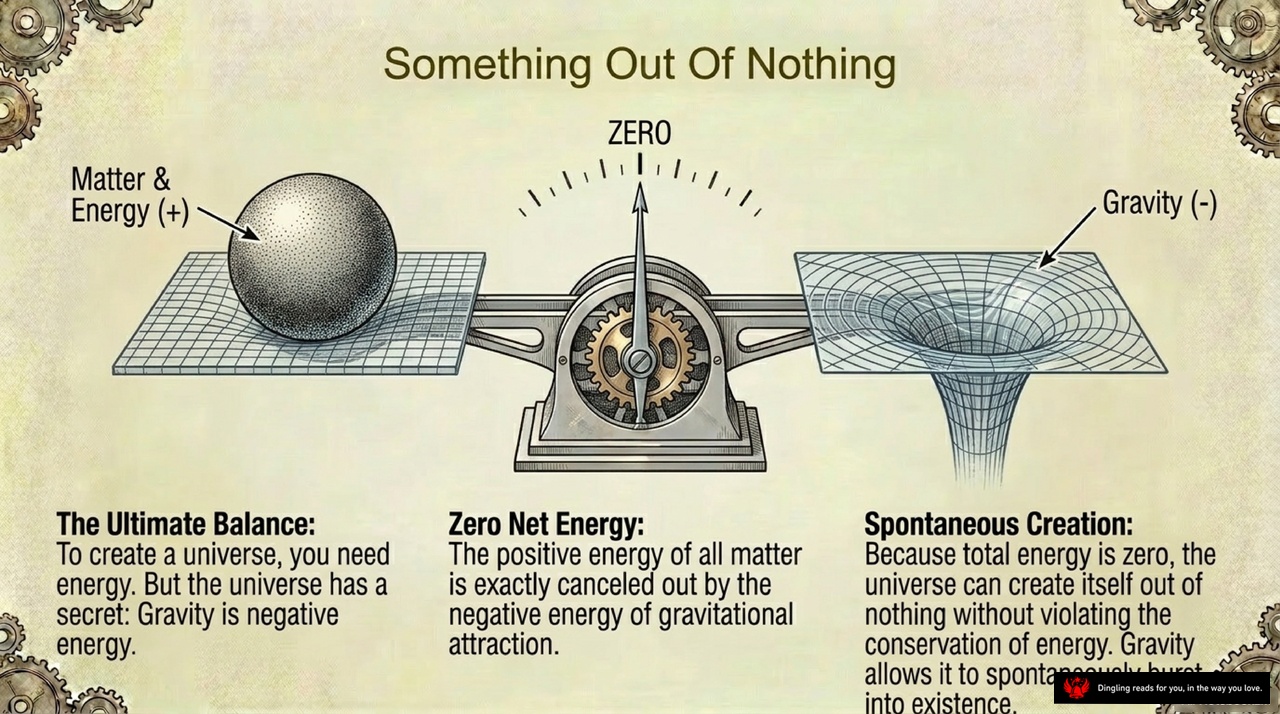
Imagine a universe that creates itself out of nothing, without violating the law of energy conservation. How is that possible? The secret lies in a perfect, ultimate balance. On one side of the scale, you have all the matter and energy in the cosmos, which represents a massive positive value. But on the other side, gravity acts as a negative energy. This gravitational attraction pulls everything together, effectively canceling out the positive energy of matter. The result? Zero net energy. Because the total energy is zero, the universe can spontaneously burst into existence from nothing. It's a self-contained system where the positive and negative forces perfectly balance each other, allowing creation to happen without needing an external creator. This elegant solution turns the concept of "something from nothing" into a logical reality.
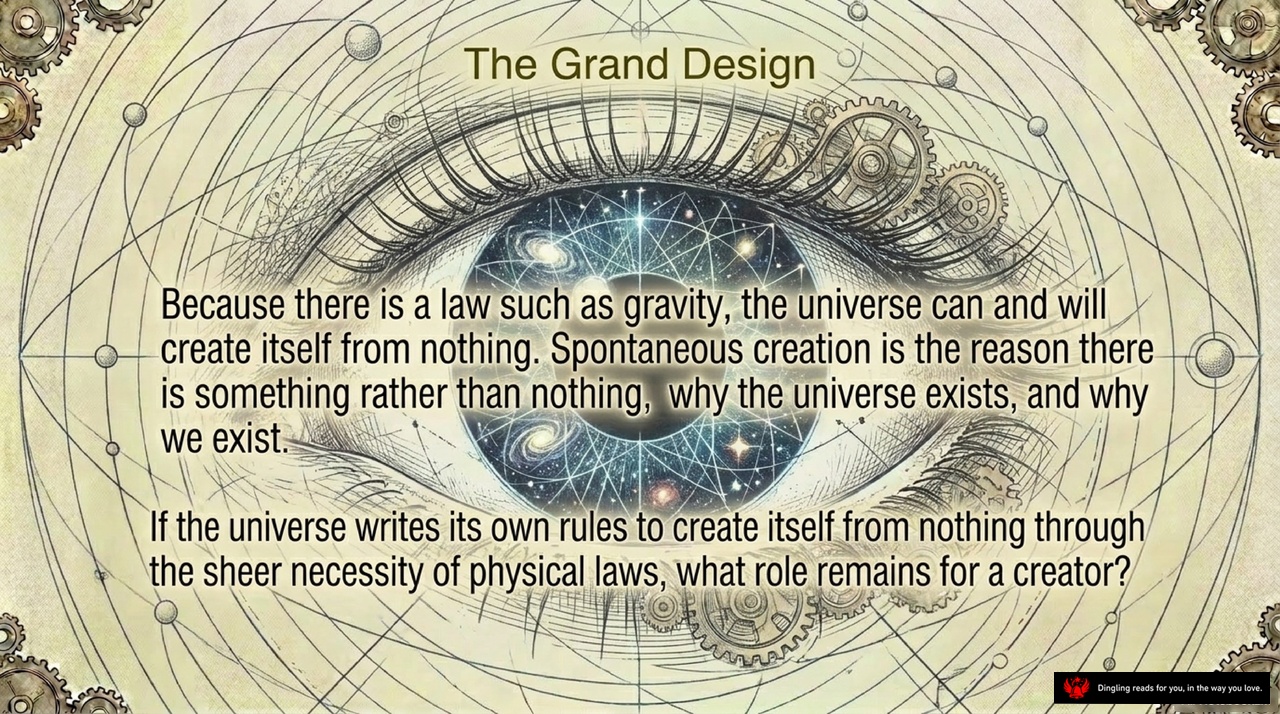
Imagine a universe where the rules of physics act like a cosmic loom, weaving existence out of nothingness itself. As the slide "The Grand Design" suggests, laws like gravity aren't just constraints; they are the creative force that allows the universe to spontaneously emerge from a void. This spontaneous creation is the ultimate answer to why there is something rather than nothing.
But here lies a profound question: If the universe writes its own rules through the sheer necessity of physical laws, what role remains for a creator? We are told that the universe can create itself from nothing because the laws of physics make it inevitable. It's a self-sustaining loop where the existence of the laws guarantees the existence of the universe.
This perspective shifts the entire conversation. Instead of looking for a divine hand pulling the strings, we see a universe that is self-generating. The slide asks us to consider this bold idea: the universe is not a creation *by* a creator, but a creation *by* its own laws. It challenges us to rethink the very definition of design, suggesting that the "Grand Design" is inherent in the fabric of reality itself, requiring no external architect to bring it into being.